
Summer 2025 / Volume IX, Number 2
A Difficult Decoupling
China’s Past, America’s Present: Revisiting Wang Hui
Wang critiqued liberalism as a tool of global capitalism, arguing that China’s post-1978 reforms had led to inequality, depoliticization, and elite dominance. He advocated for a return to socialist ideals, with greater political participation, state intervention, and resistance to Western ideological hegemony. In his 2008 tract, “Depoliticized Politics,” he argued that liberal intellectuals had aligned with market elites, promoting a vision of democracy that ultimately served capital rather than the people. In 2009’s “The End of the Revolution,” Wang argued that China’s problem wasn’t an oppressive government, but its integration into globalist capitalism…
The Lessons of Liberation Day
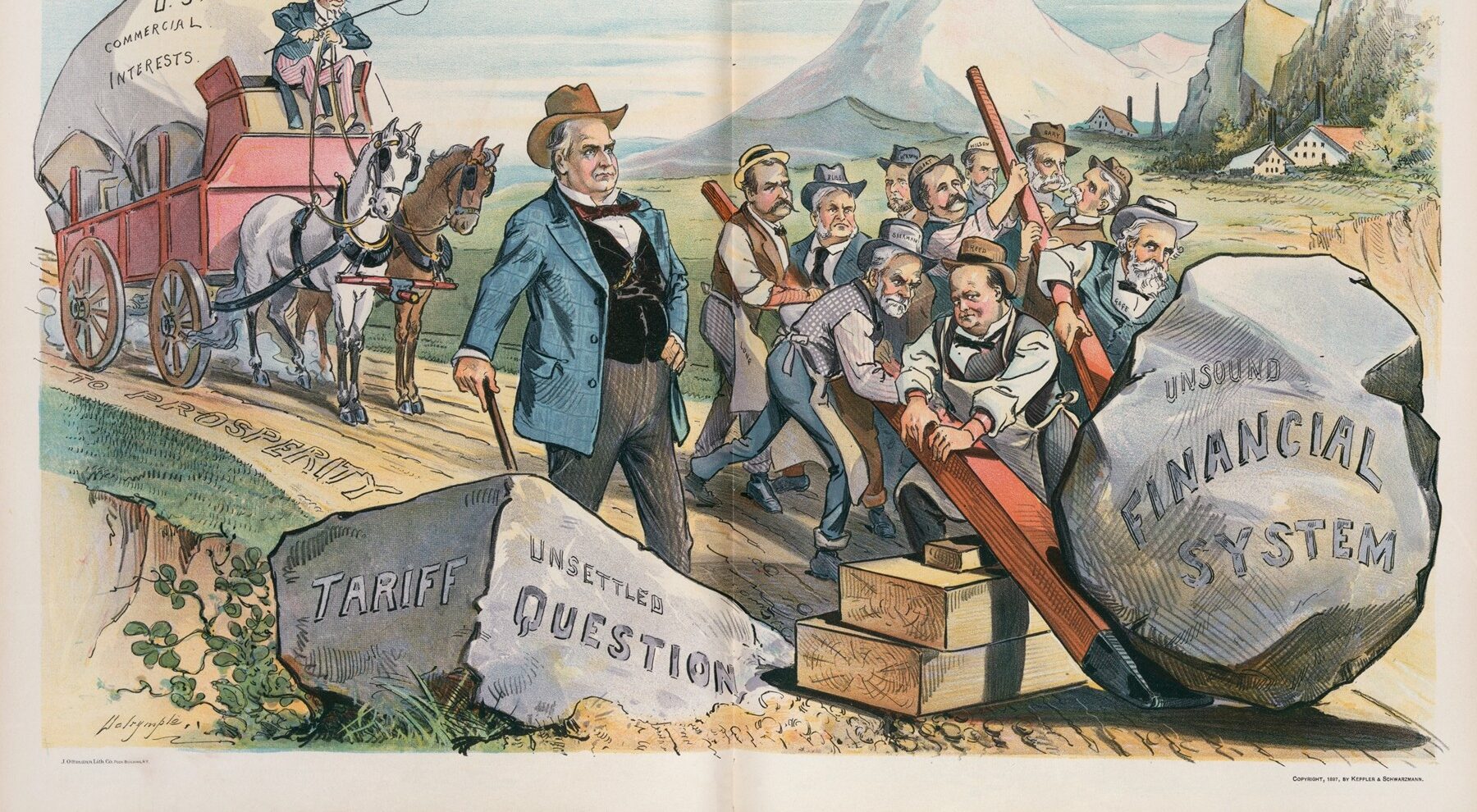
When American politicians start talking about “liberation,” it is usually not a good sign, at least in recent decades. Prior to President Trump’s “liberation day” tariff announcements on April 2, many of my generation associated the term with the George W. Bush administration’s insistence that Americans would be “greeted as liberators” after the invasion of Iraq. The latter proved to be a catastrophic blunder. And while it is still too early to gauge the full effects of Trump’s tariffs, some of which have already been suspended, it is clear that the administration’s liberation day moves suffered from serious miscalculations…
Building toward Economic Security
Solving America’s Chip Manufacturing Crisis
Because the federal government refused to engage in a subsidy competition to finance the massive costs of new semiconductor fabs, no new leading-edge logic fabs had been built in the United States for over a decade, and no new leading-edge memory fabs for roughly two decades, before the chips Act. Congress passed the chips Act in recognition of this major security vulnerability. But the chips Act is only authorized for five years, expiring in 2027, and it is not at all clear that it will be renewed. Intel’s major capital program to renew the company’s technology position is also facing challenges, including the departure of the CEO who created the program and the arrival of a new one. Maintaining leadership in semiconductors is a long game, and a renewal of financing support for both R&D and future new fab construction will be needed. Additional support for Intel Foundry in both the short- and medium-term horizons has also become a national security issue: there are no real-world alternatives on the table…
Economic Security Is National Security: The Future of the Defense Production Act
Congress should not retreat from the DPA’s historic role as a flexible tool to secure the general economic stability of the United States. The economic origins and application of the Defense Production Act may strike some as counterintuitive and unusual. That’s because the DPA is a modern outlier—a vestige of the pre-neoliberal era, when policymakers pursued national and economic security needs in concert. We forget the lessons of this history at our own risk. The threats the United States faces this century will be all the more difficult to vanquish if we narrowly circumscribe our capabilities for strengthening economic resilience. Any effort to “rein in” the DPA would needlessly weaken both the law and our national security…
A Shining City on the Sea: Rebuilding America’s Maritime Industry
China’s rise as a strategic adversary and maritime power has finally triggered much-needed introspection and shaken America out of a multigenerational hibernation. The U.S. maritime industrial base (MIB) faces a Chinese counterpart hundreds of times larger in both shipbuilding capacity and commercial orders. Revitalizing America’s maritime industry to compete and win in a global economy saturated with nonmarket actors requires dramatic and rapid changes. Rather than chasing politically expedient solutions wrapped in nostalgia, we must look deeper into our past and further into our future to find the path to victory. A successful U.S. maritime strategy must amplify America’s technology and geography advantages…
Building the Builders: A Workforce Development Strategy for the AI Economy
Zeal for reinvigorating manufacturing, coupled with fears that AI can leave workers behind, are generating a rare moment of political and policy unity where such a new workforce development strategy and an American apprenticeship renaissance could finally gain traction. Silicon Valley’s history offers important lessons for the industrial future U.S. policymakers are looking to realize. The innovators working on advanced technologies and the workers with good secure jobs in manufacturing were once neighbors. It may not be an obvious or well-known fact nowadays, but Silicon Valley has always had firm industrial roots. From Palo Alto to Mountain View, a thriving middle class emerged as young returning GIs formed the manufacturing workforce at leading local firms…
Democracy Means Agreeing with Me: Electrification Past and Present
The American grid is in trouble. For years, our country has been retiring reliable power plants and building unreliable wind and solar resources. Moreover, most of the country’s power gets allocated in complex power markets where decisions are made beyond the public eye. And areas without markets still fall beneath the aegis of utilities, leviathans who toss their weight around in state politics and often get caught up in corruption schemes. These were problems when America’s power demand stayed flat for decades. Even then, potential solutions felt more like a dizzying labyrinth of rules, regulations, interest groups, and technical minutiae. A new reality of increasing power demand has only intensified both the need for grid reform and the difficulties of even understanding what needs reformation…
Misaligned Metrics
Accounting for State Capacity
The debates over the Department of Government Efficiency have revealed, if nothing else, that the federal budget is obscure even to the political combatants ostensibly responsible for developing and overseeing it. In the executive branch, Elon Musk highlights that billions of dollars of payments are processed by the Treasury without even a memo line. Meanwhile, in Congress, Republican politicians highlight the incompleteness of the bureaucracy’s spending records, while Democrats bemoan the Trump administration’s dissimulation in ceasing to share budgetary guidance documents. The camp followers of these obscure programs are thousands of federal contractors, pursuing vague goals with indefinite timelines. As soon as the ink on a bill is dry, it seems, Congress loses sight of its initiatives. Contrast this with the 1930s, when the Roosevelt administration provided Congress with hundreds of pages of spending reports every ten days, outlining how tax dollars were being put to use in minute detail. The speed and thoroughness with which these reports were produced is hard to fathom, and yet the administration was actually holding its best information back. FDR’s Treasury had itemized information on hundreds of thousands of projects, down to the individual checks that were written. Incredibly, politicians had better dashboards in the era of punch cards than we have in the era of AI. The decline in government competence runs deeper than our inability to match the speed and economy of New Deal construction: even their accounting was better…
Data-Broke: U.S. Tech Firms’ Counterintelligence Dilemma
Can consumer data be treated as a “strategic resource,” as the most recent National Counterintelligence Strategy asserts, from both the commercial and security perspectives simultaneously? Or will one necessarily come at the expense of the other? As the age of “Big Data” and advances in computing have birthed the Artificial Intelligence era, these questions require urgent attention from policymakers. From OPM to Equifax to Salt Typhoon, the issue is now less that a single sensitive puzzle piece might be collected by U.S. adversaries but that a holistic mosaic has already been aggregated: that a vivid and detailed picture of U.S. military, intelligence, and national security rank-and-file personnel is coming into view for any sophisticated adversaries who care to look…
The Limits of Consumption Deepening: Why Consuming More Makes Us Poorer
Today’s consumer capitalist societies present us with a paradox: We are told year in and year out that living standards are rising, but many people—especially younger people—can feel their quality of life decline as time goes on. This feeling is palpable and can be seen in the hardest of the quality of life indices, such as the suicide rate and the rates of drug addiction and overdose. Noneconomic measures show a large decline in quality of life in recent years, but economic metrics show it is increasing. The old Marx Brothers phrase comes to mind: “Who are you going to believe, me or your lying eyes?” It is time for economists to admit that their metrics are broken…
Doomer Optimism
Renewing the Democratic Party
The Democratic Party has lost its way. A party whose very purpose has been to fight for working families has forfeited their trust and confidence. The losses are most obvious among white working-class voters. The self-flattering story Democrats have told themselves is that rising white racism explains the defection of white working-class voters. But that simple story was always undercut by data showing white racism has declined, not increased, in recent decades. And the fable was further undermined in the 2024 election by the defection of many Hispanic, Asian, and black working-class voters as well. What went wrong for the Democrats, and what can be done about it? At a time when the life prospects of Americans are increasingly shaped by economic class, not skin color or gender, Democrats have moved in the opposite direction and time and time again prioritized racial and gender identity…
Democracy’s Demons
Following her defeat in the 2016 general election, Hillary Clinton published a book titled What Happened. While that tome is not considered a classic work of political analysis, its implied titular question animates a good deal of writing about politics these days, including two books released over the past year: Zack Beauchamp’s The Reactionary Spirit and Quinn Slobodian’s Hayek’s Bastards. Both books are attempts to grapple with the significance of the political energies of which Trump’s initial victory was both cause and effect. And each is in different ways trying to articulate a conceptual vocabulary to describe the associated movements for which terms like “conservative” and “right-wing” seem inexact or insufficient. Nonetheless, neither is entirely successful in their attempts, for the same political changes they seek to understand have a way of resisting the categories imposed on them…
Rewriting the Californian Ideology
In this sense, tech today is less Jeffersonian than the first Californian Ideology suggested, celebrating the hacker, the dropout, and the lone builder, with the profound skepticism of centralized power entailed by these archetypes. It is arguably more Hamiltonian, focused on building state capacity at the national level. Whereas the old Californian Ideology captured the liberating power of technology, the new one affirms its constructive power. Tech’s social capital may be uneven, but its intellectual capital is growing. It is generating new ideas faster than most institutions can absorb them. Its ideological adolescence may still be bumpy, but the outlines of maturity are clearly visible, and only getting sharper as they are battle-tested in the political arena. Tech is well-positioned to usher in a new era of thinking and working. In tech’s model of the world, change is assumed to be a constant, and individuals are prized for their ability to invent and build us out of any crisis…
It’s So Over, We’re So Back: Doomer Techno-Optimism
Prophets and their warnings arise in times of peril, and the arrival of the doomer techno-optimist discourse is fortunate. Simply put, we needed the wake-up call. Yet, if the first step to fixing a problem is admitting you have one, then the second step is actually doing something about it. To that end, what is needed from the next phase of contributions to this discussion are proposals to reboot science and generate breakthroughs, policies to create an environment in which transformative growth is possible, and new economic analyses that more accurately account for the role of technology in growth. In fact, doomer techno-optimists have an opportunity to take their unique blend of harsh reflection on the present and bold vision for a sci-fi future and fuse it with creative and actionable proposals to realize such ambitious dreams. What strategies could the doomer techno-optimists propose? Perhaps the most important approach would be to involve government as a “market maker”…