Nothing was ready for the war that everyone expected.
—Leo Tolstoy, War and Peace
This January, I pushed a stroller up and down the street under a murky grey sky. The pollution had been gone for many years, but this year it had returned with a vengeance, like some sort of karma. Some say that Westerners, heirs to the Enlightenment, see history as a line or, as American progressives would have it, an arc bending toward justice. In contrast, Chinese see history as cyclical, an endless return of the same, with slightly different individuals engaging with the timeless variables of human nature. Or at least they once saw it that way: the China founded in 1949, colloquially known as “New China,” is supposed to break with all of that.
Technology implicitly promises to change the way that we live, but that promise is only ever implicit; maybe it is just in our imagination. It explicitly promises to change the environment in which we live, and in China, it has done that. But many of the thoughts that people think are the same ones, in some cases traumas that keep cycling round and round with no resolution in sight. Contemporary Chinese life begs the question: can we ever escape ourselves, and the eternal recurrence of the same?
In the year 2024, at the end of an unprecedented bender of historical transformation, China’s economy and population are in a hungover condition, digesting everything that has changed—and everything that hasn’t. The built environment and biological condition of the population have changed: mass urbanization, near universal use of computers and 5G mobile phones, and the doubling of Chinese life expectancy since 19401 have transformed China forever. On the other hand, the political structure is falling into historical patterns. Maybe it never really left those patterns. As influencer Ma Dugong recently said,
Now that we’re living in cities, we are all aware that modern life is far from perfect. The cities are packed with people who have just left the rural areas, people like us. At the founding of the People’s Republic of China, Shanghai stood as the only industrial and commercial city in the country, where we are now. Other places, like former Japanese colonies, had some dilapidated factories but very few people. Over the decades, the vast majority of families in modern Chinese society can trace their roots back to farming within one or two generations. Thus, the perfect life that rural children look up to, along with the cultural narratives that depicted such existence, were crafted by people just like them. This is the logic behind how a bunch of clowns can rise to achieve remarkable feats.2
The image of a perfect faraway place is, indeed, an embellishment. The mythical age of heroes, as often depicted, never truly existed. But as long as we believe[d] in it, the society of clowns can also move forward, guided by the starlight. China’s path to modernization was often propelled by external forces.
It has come as a shock to everyone that the perfect faraway place, the United States, turns out to be both a vengeful enemy and also a clearly confused society. It is difficult for Chinese to idealize the United States anymore, perhaps particularly for those Chinese who spend time there or are fluent in English. And yet, China is not anywhere close to “finished,” and so the map is being redrawn in the middle of a voyage.
Today, China’s society is like Frankenstein’s monster, with different parts grafted into a single organism. Rich cities with the superficial trappings of globalization, like Shanghai; first-tier China. Socialist cities with heavy industry and limited middle classes, like Shenyang; second-tier China. An eternal countryside, the 39 percent of the population which remains rural and traditional, in provinces like Gansu or Guizhou; the third China. These parts struggle among themselves, in a conflicted condition, wondering why they were brought together in the first place, and how they can become a “national unified market,” in which China’s component parts fuse into the unity that Chinese planners foresee as unlocking greater economies of scale. As recently as 2022, traveling from one province to another was difficult, with digitally enforced police barriers. This contradictory tapestry of persons and places is trying to find an internal connective thread. In lieu of anything else, resentment at outsiders will suffice.
Frankenstein’s monster, of course, killed his maker, Dr. Frankenstein. In this parable, the Americans are Dr. Frankenstein; they brought the technological and economic changes, in the vain hope of remaking the entire social organism in their own image. The only result was to create an intelligent and articulate society alienated from those who brought it to where it is today, trapped between a future that seems forestalled and a past which is gone forever. This society seeks, mimicking the Americans of a previous era, to solve these profound spiritual problems with technology, a project known as “Made in China 2025”; 2025 is next year. These efforts include IT (Huawei), robotics (China installs more industrial robots than anyplace else), green energy and green vehicles (BYD, CATL, solar, and wind), aerospace (comac, the Chinese space program), ocean engineering and shipbuilding (which China is doing at speed, for both military and commercial purposes), railway equipment (Chinese railways have begun to be used in Indonesia, Laos, and elsewhere), power equipment, new materials—like the rare earths that China threatens to stop exporting, medicine and medical devices, i.e., China’s burgeoning biotech industry, and agricultural machinery, of which several billion dollars worth is exported to Africa every year. One would have to say that the Chinese have done a pretty decent job. Maybe by next year they’ll be further along on semiconductors as well.
The Future Is Now
As Joseph and I headed home, we saw a man with a cage of chickens on a bicycle loitering near our compound’s entrance; he wrung their necks, one by one, scalding them with hot water. They were for sale, along with frozen blocks of pork, river fish squirming around in Styrofoam boxes, and the vegetables from Chongming Island. In the center of the largest Chinese city that the world has ever known, life felt not far removed from the peasant life that characterized China for so long; the feeling would dissipate by mid-morning, but at dawn, China was the eternal China. Over the past few years, I’ve become increasingly fatalistic about the processes that the United States and China are caught up in; sometimes I wonder if this is part of my cultural assimilation into Chineseness, after so many years here. But then, in the equation we’d known, China was the past and America was the future, specifically the future of China, which was to become ever more American. Fundamentally, China’s attitude to America is an attitude toward itself and to modernity more generally. If many Chinese find Trump’s descriptions of reality intuitively appealing, it is because they share the sense that modernity, democracy, and capitalism are all some kind of gigantic hoax, for the same reason that Chimericans living in the United States do. Trumpism is emotionally satisfying for many Chinese, even if cooler heads—including the leadership—can count all sorts of reasons why he might be bad for China. In a way, the Chinese dilemma is not dissimilar to the American voter’s choice between Biden and Trump: the status quo, as stupid and disappointing as it is, or a gamble that might go horribly wrong, but haunts one’s imagination, particularly the parts of it given over to resentment and hypotheticals.
China told itself and the world that it was the future, something sparkling and modern, for decades. It may still be; but from my street in downtown Shanghai, it looks like China as a globalized and capitalist society has, if not peaked, then perhaps plateaued. Two generations ago, Russia chose political modernization without economic modernization; China, the inverse. China seemed to have made a canny choice for a while, but by now, the economic modernization has engendered a highly educated, middle-class urban population that is miserable in a system created for their fathers (who remain in charge). A remnant of the former foreign population lingers on, mourning peak globalization, unsure where to go next.
The president of China is a conservative in the William F. Buckley sense, in that he stands athwart what had seemed like an inevitable history, yelling stop; and he has stopped some changes, or at least held them back. Consider the Wenzhou train crash in 2011; in the early days of China’s high-speed rail, train carriages derailed, killing hundreds. A national conversation began about whether China itself was hurtling along too fast. The railways minister of that time, Liu Zhijun, was incredibly corrupt; I recall reading about how he had thirteen mistresses. It seemed excessive even to me as an oversexed twenty-one-year-old. Even if you only dated your mistress two times a month, you wouldn’t have a single evening in February off. Since then, China’s high speed rail system has inexorably expanded, slowly sucking southeast and central Asia into its orbit. But Liu Zhijun, and many of those who went to the same whorehouses as he did, are in prison for life with no possibility of parole.
For me, living on Shanghai’s Yongfu Road near the German consulate, I watched revelers in the street late every night walking past the eighteen-year-old soldiers stationed at the embassy gates. The streets of China were wild then; what must those soldiers have been thinking, as they stood perfectly straight for hours on end, watching women their age going to the homes of foreigners? Hindsight is always 20/20, but as I look back and read my journal from that time, a reactionary backlash seems like it was practically inevitable. China is the geographical heart of a global reaction against the progressive ideology of human improvement; but the tools which it uses to fight back, paradoxically, are the most cutting-edge technologies that exist, implemented at a scale of more than one billion individuals, individuals whose boundaries are not as clear as those in Western societies. People, places, and memories bleed into each other, in an endless sameness which is called social unity.
Late this January, I had dinner with a Chinese philosopher, a man notionally of the Right—the Burkean Right, he was careful to say—this man finds the current situation disastrous to the point that he indulged in fantasies that if only Bo Xilai had taken over at that critical juncture, China would look different today. The fact that, in Bo’s Chongqing, visitors to the city received quotations from Chairman Mao as text messages didn’t deter my friend from improbably claiming that Bo would’ve set China on a course to market liberalization.
China has just this chance, once in a millennium, some have said, to return to its rightful place. If it doesn’t succeed in the next generation, demographics and other factors will mean that it probably never will, until the world order has completely changed once more. For China as number one, it’s now or never, and many disloyal courtiers have begun telling me that they think China is going to blow it. But those Fudan professors, aware of their former colleague Wang Huning’s success, can’t help but be envious; our subjectivity suggests to us that what’s good for us is what’s good for the country, but in China, nearly half of the country are still peasants who might as well not exist from the perspective of the global economy—they are alive in a biological, but not really an economic, sense, and ultimately China’s project must be to bring these individuals to full consciousness of themselves as economic actors—even if that consciousness is a torment.
In any case, the fact remains that the course for China’s next decade has been set, and despairing liberals or liberal-adjacent conservatives (the Burkean ones, not the Maoists) seem to think that the future will just be more of the past. There’s only one trick variable in this equation: the policies of the U.S. government. When I asked the professor about the election, he told me that the United States couldn’t change China’s government, it could only make China suffer; he hoped that Robert Lighthizer wouldn’t gang up with the current Chinese government to make lives like his unbearable.
Conservatives of my acquaintance—the real kind, the kind that wishes to conserve the China they have known, which they call “socialism”—fear that it might already be too late for China. Of course, the anti-corruption campaign is good, but an uphill struggle. Of course, returning to strong authority is good, but the kids already seem lost. These men fear that to continue in the direction that things had been going would mean the end of China as they—the older, “red” generation—knew it. No matter whether it’s Trump or Biden, China’s course won’t change, they say; that’s the official line. But the reality is that China surrendered a lot of its cultural agency in order to import technology and capital. What is today clear to the Chinese state and economists like Justin Yifu Lin, the Taiwanese soldier who swam to China in 1979 to join the side he perceived to be the future and later became a key strategist, is that the competition between China and the United States is about technology. China’s comparative advantage is in manufacturing and the sorts of knowledge that come out of factories. China is playing catch-up in in R&D, and Xi’s idea of “new productive forces” is about throttling things into a higher gear. If the energy transition to EVs, solar panels, and batteries is one site of Chinese industrial success, that reflects the ability to circumvent Western monopolies on intellectual property—for example, with internal combustion engine automobiles—as well as Chinese comparative advantages of scale. The West’s energy transition is about expiating the consequences of our past actions; China’s is about outrunning time. In the time that remains, China must fully “wake up,” with access to technology being the agent of awakening.
People speculate that with the passage of time, certain changes begun long ago—urbanization, the rise of the middle class, family sizes shrinking, mass education—will force the system to change, or at least to shed its skin and develop a new way of interacting with the world. Imagine a paper cup partially filled with cold water. Empty it out. Now fill it with boiling water, and watch it collapse. If it is relatively flimsy, form cannot contain a content that has changed completely. Chinese government officials want to reinforce their governmental structure, but many fear that won’t be enough to cope with the radically different sorts of people who make up China today, compared with what the Chinese were a generation or two ago. Nowadays in China, every ten years brings a new generation, with children of the ’90s professing not to understand those born after the millennium.
A retired government official from the far north approvingly quoted to me Putin’s comment that if the world didn’t need Russia, then Russia could end the world. “We can see that people want to erase our revolution, our party, from history. We won’t let them do it,” he told me. But the chance for China to remain as pristine as North Korea—a country, he added, where the birth rate is two children per family—is gone. The powerful and rich half of the country has already molted into something unrecognizable to the fathers. “We built this country for them. And now they don’t even want to live here,” he grumbled. For these sorts of people, the idea that the United States would be a hostile force seeking to hurt China is obvious and unsurprising; there’s nothing to be done about it. The policies of the United States are just the expression of fate itself. Alexander III once said that Russia had two allies: the Russian army, and the Russian navy. In that sense, China (or rather, Beijing’s CCP) has two allies: Zhejiang and Guangdong. Faced with American hostility, Chinese leaders see manufacturing as their only way out.
In cafés and universities, conversation is relatively free about China’s relationship with the United States and the activities of the U.S. government; those in the 10 percent but not quite the 1 percent tend to be more negative on China’s future, and more inclined to see a hidden logic in the actions of the U.S. government. In contrast, entrepreneurs in China’s engineering and manufacturing economy told me of their steely confidence that China would get through it—stock market debacles, demographic decay, technological blockades—it would just take time. In this context, batteries, EVs, or even climate diplomacy with America are just weapons in a war that is not so much between China and America as it is between competing visions of what China is or could potentially be. Both those who, on some level, once felt that American society represented some sort of higher value and those who defended the Chinese system through thick and thin had a fatalistic sense that this was their country, right or wrong, and no matter what happened with the United States.
One prominent Chinese economist, shortly before the Twentieth Communist Party Conference (in 2022) told me in a Beijing hotel lobby that he expected a war to break out. Well, they won’t bomb Beijing, I told him. He revealed to me that he had a specific sense of what the targets in China would be: where the military industrial complex was located, where the population centers were . . . they absolutely would bomb Beijing, he told me; but if Beijing is bombed, what would I do in some hideout someplace else? This is my home, and my son’s home. . . . This man holds a PhD from an American university, and I asked him why he didn’t just leave. Twisted in a bitter smile, he told me: that’s not how it works. For years, I told anxious Chinese like him that there would be no war and no second Trump term until I started to wonder why I believed it so fervently.
Throughout it all, most of the Chinese—the chicken man and his counterparts—remained disengaged from the tides of power and capital that transfixed the elites. Our lives are simply what we do every day. And China is what the Chinese people do every day. Ever since I arrived in 2008, China has been changing very quickly. But now? China’s rise has been a wave crashing on the beach of anglophone commercial civilization. Like the wave, it has seemed powerful and violent, full of froth. And like the wave, it crashes, and retreats, and comes back, and erases the traces of its own movement. Now that the frenzy of construction is over, one looks around Chinese cities wondering what—or whom—it is for. That’s all over now. The immediate future for China seems to be one of struggle and yet more hard work, with little punctuation; the opportunity to watch the blunderings of the Biden administration, and to listen to the exceptionally negative perspective on the U.S. government not only of Trump but also of Robert Kennedy Jr., offers Chinese office workers some form of consolation. At least it was worse in America. The former U.S. president said so. To most Chinese, it seemed almost inevitable that he would return; few, if any, felt confused about why Americans would choose Trump as a leader. For most of 2024, he seemed to have a veto on American legislation and foreign policies; Biden, a senile prince regent surrounded by scheming courtiers, against a figure who the Chinese have contextualized in the history of patriarchal monarchs. If you dislike patriarchal monarchy, Trump is easy to dislike; but many Chinese take it for granted as the way that human societies are structured, and therefore find Trump much easier to understand than many Americans do. King Lear is still a king.
Down the Old Tunnels
The streets of Huangpu district in Shanghai, with the windows of apartment buildings revealing accumulated clutter, have the ambience of a vast nest. Disorganized, at times lively, ramshackle, here is where people who aren’t young anymore cling to the wreckage of their past. For many years, critics brandished American architect Ben Woods’s redevelopment of the Xintiandi compound, a sanitized version of Shanghai’s past life, as a proof that the glitzy was swallowing the humanity. Xintiandi metro station is now called the CPC Foundation Site. It seems that those rickety old men chain smoking in the alley have had the last laugh, if laughter it is. Buildings are boarded up, painted over; in this economy, it’s hard to tell if the government is engaging in slum clearance (拆) or if business is just so bad that nobody bothers to work. And yet, every action leads to an equal and opposite reaction. During the low tide of Shanghai’s closed decades, nothing much happened for decades on end; but something was fructifying, fermenting like the contents of the chamber pots and the drains. Xintiandi and Shanghai’s boom emerged from this society with a speed that baffled those who were present at the time. Is Shanghai hibernating again, yet to return in new form? Or is this less the hibernation of animal spirits waiting for warmth to return than the dozing of the elderly as they approach the ultimate rest?
China’s governing elite are a well-trained machine that can do anything they are asked to, from GDP growth to zero Covid. What are they asked to do now? The execution is often great. But the machine cannot operate itself; like AI, it is fundamentally reiterative, not iterative. And so much of the data that went into this machine is American data, with the outcome that China today is at war with itself; the part that’s painful is called America.
Chinese New Year
The American flag fluttered out of the window of my childhood home, a fortress protecting a certain way of life. Inside, the Penguin paperbacks, old furniture, and clothes that stand in for our traditions. America’s tradition is modernity and cosmopolitanism, and if you don’t believe me, check the bookshelves next time you’re at dinner in coastal Maine, nice towns in California, or the Upper East Side. At family gatherings—while everyone seemed to be so angry and willing to argue over global affairs that, in a way, seemed utterly irrelevant to their everyday life—I wondered whether Americans’ anger was justified. Through the Covid years in China, I worried that America was somehow nearing a breaking point, a spiraling decline; the decline, if it is that, isn’t really visible to me; the place looks much the same, although the grocery stores have more variety and higher prices now. And yet the psychological mania that comes from the American middle class centering itself as a global ruling class has peaked; or else why do old friends argue bitterly over wars in the Middle East and eastern Europe, the temperature of the globe, and shipping lanes in the Pacific? These topics are interesting and perhaps concerning, but what felt remarkable was the degree to which ordinary individuals felt personally offended by their trajectory; the election that was looming seemed to give Americans a choice, not only about the way that they lived, but about the way that so many others lived as well. The fact is, English speakers are heirs to centuries of global empire; our ancestors have been a global ruling class (perhaps not the ancestors of people living in Kansas, but certainly those living in the better parts of Boston, New York, and D.C.). The Chinese are descended from working-class people, and most of them are working-class today; indeed, their economy is oriented to factories and production, where ours revolves around consumption. In the blue state settings I patronized, few discussed China that much, certainly not in comparison with Israel or Putin. And yet, the tectonic plate that the 2024 election might interrupt—America’s pretension to global hegemony, and the sense that ordinary Americans were guilty, somehow implicated, in our various foreign adventures—hinges on our relations with China. Will America be a nation, or an empire? We could ask the same question about China.
Many American economists feel that China’s economy no longer poses a threat to the United States, with a cocksure and flimsy confidence that’s interlinked with pleading for Bidenomics.3 It’s true that GDP has been replaced as the defining metric for Chinese economic performance by a cocktail of more qualitative and therefore vague objectives, the Chinese equivalents to DEI and SDGs: common prosperity, “patriotism,” national security, and so on. But there’s one new metric which is empirically measurable, which is driving China’s transition away from a Manhattan economy of finance and real estate. Carbon neutrality may not be as clear a metric as GDP, but it serves the numerous goals of the leader: fending off the American social model of citizen-consumers, even as it builds a centralized economy capable of generating a positive trade balance, at the same time vanquishing any domestic rivals. There’s evidence that these industries now drive China’s economy,4 but it’s also clear that China has decades of hard work ahead if it is to decarbonize. That’s decades of SOE control of everything and Chinese exports driven by artificially low labor costs, and Chinese industrial policy of the kind that former Chongqing mayor Huang Qifan calls for—value-added manufacturing. China’s new economic model, in short, is to rebuild the entire world for carbon neutrality; to build the solar panels that prevent power outages in South Africa, the wind farms buzzing through the night in the Pacific, the batteries and EVs coming to Europe and Latin America. China will rebuild bridges washed away in Pakistani floods, build settlements around nickel mines in Indonesia, and fuel it all with the nearly bottomless pit of renewable energy, deflating the petrodollar in the process. Even Saudi Arabia is investing in this process. In short, the energy transition both serves Xi’s purposes more profoundly than the conspiracy theory that China is planning to invade Taiwan does, with fewer risks, at the same time as it threatens American hegemony more comprehensively. Our way of life is built around oil, and that life has a default setting of American dominance. That’s why China is trying to build an alternative structure.
Economies of Scale and Scientific Research
Since the reform and opening, regional experimentation has benefited China’s economy. Guangdong pursued marketization even as the Northeast continued a socialist model, and the results spoke for themselves. More recently, the science and technology innovation model has been pioneered by the provincial capital of Anhui, Hefei, whose GDP growth has outpaced the rest of the country and offers a case study for the leadership on how a science institution (CAS university) can fuel “high quality growth.” Today, we see many economists such as Huang Qifan advocating a “national unified market,”5 which seeks to leverage Chinese economies of scale by flattening interprovincial regulatory differences.
For MIT’s Huang Yasheng, these economies of scale are also key to realizing China’s technological agenda. For example, China’s AI industry fattens on an unprecedented quantity of data that the Chinese legal and cultural setup allows to be collected. Another obvious example is the success of Chinese “green tech” companies, from solar panels to batteries to EVs, which are based very much on Chinese economies of scale, both in terms of technological development and in scaling to market (and thus, achieving low price via competition)—which the U.S. government increasingly prohibits on questionable “national security” pretexts, internalizing Xi Jinping’s policies in the name of combating his agenda.6 Huawei CEO Ren Zhengfei commented that “the direct contribution of artificial intelligence software platforms to human society may be less than 2 percent, with the remaining 98 percent promoting industrial and agricultural society.” For all of the ado about China’s semiconductor issues, the industrial functions such as robotic mining, smart logistics, and robotized production lines don’t require very sophisticated chips; if China’s semiconductor quality will hold back consumer applications, so does China’s entire economic structure, which is above all oriented to working, rather than consuming. That economic structure engenders a political structure, which is called communism.
As time goes on, American companies such as OpenAI will innovate, but may be unable to scale to market in useful ways (and maybe won’t need to: the point might be about harvesting venture capital). China didn’t invent digital payments, or EVs, or solar panels; but it has used its huge market scale to innovate in all of these areas, using regulatory policies to push universal adoption of new technologies in such a way that, while Chinese frontier research remains years behind the United States, the applications people use in the streets are years ahead. Chinese companies will bring AI to scale, not with the sophistication of OpenAI, but with the total factor productivity gains Xi wants. This won’t necessarily make investors in Shanghai rich: it will just further elaborate China’s industrial system, providing even more scale advantages. In this sense, it’s not hard to imagine China “scaling” those Ren Zhengfei–style unsexy AI applications, running with simple chips, even as Silicon Valley makes increasingly marvelous products whose primary application is consumer-facing little games. (The use of AI in biotech research is one obvious utility; the company InSilico, with a Shanghai research base, is an excellent case study.)
Today, the three areas of scientific inquiry which most urgently need work and which offer the most obvious economic opportunities are the energy transition, AI, and biotech. In all three, it’s easy to imagine China allowing the West to innovate and then using scale conditions to make “applied science” results, like BYD cars, CATL batteries, Huawei-driven industrial AI applications, mass-produced SMIC chips that aren’t as good as TSMC’s, but are good enough for most things, or (in the future) Chinese pharmaceutical companies that copy or adapt Western innovations at a lower price, driven by the scale of China’s population (450 million people over age sixty by 2035). In that scenario, no matter how stupid China is, it can still “win” these markets.
China and the United States in Science Competition
Imperial consolidation tends to repress innovation. Consider Harry Lime’s argument in Orson Welles’s The Third Man:
You know what the fellow said—in Italy, for thirty years under the Borgias, they had warfare, terror, murder, and bloodshed, but they produced Michelangelo, Leonardo da Vinci, and the Renaissance. In Switzerland, they had brotherly love, and they had five hundred years of democracy and peace. And what did that produce? The cuckoo clock.
Today, China may be internally unified, but its science system cannot stagnate or rest, because America is sanctioning it. In that sense, Chimerica is a warring state of which CCP-land is only half. If China versus the West is the story of land and sea, then there are clearly numerous amphibious zones. The mutant creation of American technology and capital grafted onto a collective peasant state now uses its Westernized equipment to push back against the West, even as those technologies can’t help but change China itself in the most profound ways—transforming the collective of peasants into a group of atomized individuals. Still, whatever doesn’t kill you, makes you stronger. Will American tech controls kill China? If not, what’s the other option?
And what can Trump do? Achieving in America what Putin has in Russia—a renewed popularity of political leadership, a redrawing of the line dividing us from them in boldface, an ejection of foreign corporate interests without any loss of the quality of life, an economy “run too hot”—this desire is the love that dare not speak its name on the American right. It is no childish aesthetic fantasy, nor a canny geopolitical gambit d’apres Dr. Kissinger. No, the American Right’s interest in Russia is the reflection of a submerged belief that our country has suffered something similar to what befell Russia in the 1990s, at the hands of the same people. Russia, Chadayev once said, exists as a great lesson. And for certain American thinkers today, it is so. And yet, this yearning for a homeland is in a way as ridiculous for Americans as it is for natives of St. Petersburg: places like the United States and St. Petersburg are artificial modern arks, the logic of rootedness in soil and tradition doesn’t bear inspection in these places. The myths are too clearly mythical; if Weber spoke of disenchantment, our homeland was founded by the Enlightenment that cast away the spell. Moreover, it is owned by the American middle class, for whom the logic of property rights will always be more significant than the abstractions of homeland. What would America even look like without Chinese imports (no cheating with Vietnamese, Mexican, or other third-world-country imports)? Is an America that made what it used even imaginable today?
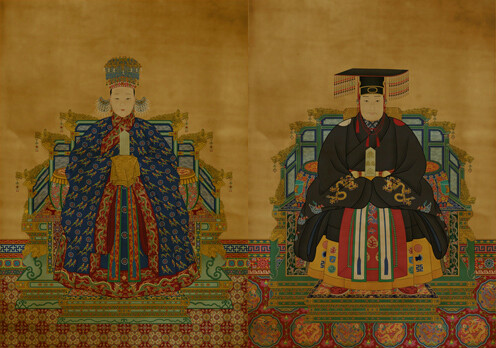
During the Ming dynasty, the emperor Wanli went on strike. The bureaucrats of his court kept cutting him off at the pass; the dragon emperor, born to power, couldn’t achieve even the most basic victories, such as picking which son would be his heir. In response, as Shelia Melvin summarizes:
For nearly three decades of his forty-eight-year reign (1572–1620), Wan Li refused to read petitions and memorandums sent to him, replace officials who retired or died or even attend his own morning audiences. His officials held these audiences anyway, rising before dawn every third day, assembling outside the Gate of Brightening Administration—only to enter the throne room and kowtow to an empty chair.7
Like Wanli, a second Trump term would be historic. But like Wanli, the chances that Trump will get away with the grand schemes that his supporters hope for and detractors fear, such as decoupling from China, will inevitably be cut off at the bend. A 2011 museum exhibition of the relics of Wanli’s reign noted, “Although politics was corrupt in the Wan Li period, society, economy, technology and culture had great achievements. . . . This is a very important issue—you can’t say Wan Li promoted all this, but he didn’t prevent it.” After Wanli’s death, the Ming had one more emperor to go before the empire collapsed, under the weight of invading barbarian hordes.
This article originally appeared in American Affairs Volume VIII, Number 2 (Summer 2024): 208–221.
Notes
1 “
Life Expectancy in China 1850–2020,” Statista, June 2019.
2 Haobo Deng, Jiawen Zhang, and Yuxuan Jia, “Ma Dugong: Glad That We Are All Clowns in Different Makeup,” East Is Read (Substack), March 26, 2024.
3 See, for example, Paul Krugman.
4 Lauri Myllyvirta, “Analysis: China’s Emissions Set to Fall in 2024 after Record Growth in Clean Energy,” CarbonBrief, November 13, 2023.
5 “China’s Unified Market a Vital Boost for Economic Circulation,” State Council (China), May 17, 2022.
6 Philip Pilkington, “China Dominates the West in Electric Cars Market,” UnHerd, March 4, 2024.
7 Shelia Melvin, “China’s Reluctant Empire,” New York Times, September 7, 2011.