Revelations of plagiarism, dishonesty, and ideological bias in academia are becoming more commonplace. Harvard alone has faced a series of high-profile scandals along these lines: Its former president, Claudine Gay, resigned after accusations of plagiarism against her were proven true.1 Another Harvard scholar, a “dishonesty researcher,” was accused of fraud in the misrepresentation of her data.2 Roland Fryer, one of the school’s top economists, revealed that when his findings did not comport with the preferred media narrative about race and police shootings, he was targeted and ostracized.3 These misrepresentations and ideological pressures raise troubling questions about the reliability of scientific inquiry, as well as the policies that result from flawed empirical findings.
Unfortunately, these are not isolated occurrences. The “fight” against domestic violent extremism is a case in point. After the Capitol riot of January 6, 2021, the Department of Homeland Security (DHS) under the Biden administration claimed that domestic violent extremism was our gravest threat.4 As if on cue, academia began to amplify the existence of this threat and generate research to substantiate the claim. One group singled out for being more prone to extremism was the veteran community and active-duty service members. Veterans and active-duty service members faced such accusations based on the questionable definitions and dubious empirical findings of ideologically motivated academics.
The goal of the research presented here is to provide an analysis of the existing work of other researchers and to present the findings of a recent thousand-person survey we conducted of veterans who found themselves the target of academia, the media, and the Biden administration because of their supposed propensity toward extremism. The findings are striking. A number of prominent researchers claimed that veterans and active-duty military are more prone to extremism, but these claims were based on highly questionable empirical evidence and these studies were conducted without any systematic approach to the definition of extremism itself. At the same time, left-wing groups such as Black Lives Matter (BLM) were largely left out of the inquiry because researchers did not categorize the movement as extreme even though the property damage, violence, and arrests resulting from these protests fit their definitional requirements. Because there is no legal or even coherent definition upon which to base the assessment of extremism, the researchers engaged in a great deal of ideological sleight-of-hand to organize data and advance claims that extremism among active-duty service members and veterans was a significant problem—when, in fact, it was not.
Academia and Extremism
Although extremism is an imprecise and complex category and must be defined relative to other groups, institutions, and ideologies present in society, academic research has tended to treat it as a straightforwardly demonstrable category. Researchers then labeled veterans and active-duty service members as prone to extremism without concern for the effects. This omission is not without consequences in a pluralistic society. According to Seymour Martin Lipset and Earl Raab’s The Politics of Unreason (1970), for example, extremism represents a position against pluralism because the charge is used to suppress political difference and deviation, impose limits on the marketplace of ideas, and maintain the view that ideological conflict is illegitimate.5 Despite these concerns, however, the focus on extremism has recently intensified and is now used by academia, media, and government with increasing frequency to designate groups and ideologies as especially problematic. The consequence of the label of extremism is to demonize ideas or groups as dangerous and to deprive them of legitimacy in the political process, but this is a highly personal and devastating attack as well.
Part of this research entailed one-on-one conversations with a variety of veterans from across the political spectrum. Among them, the label of extremism was often taken as an insult, demeaning, and highly politicized. Many expressed that they would never again serve in the military and that they had advised their children to avoid service because of the targeting of “extremists” in the armed services. Because “extremism” generally was used to stigmatize patriotism, traditional values, and white men with Republican leanings, many of the veterans felt that they were under unwarranted attack after offering up their lives to military service. They also expressed the sense that the government and society to which they had dedicated their lives had denigrated all that they had done. The flippant use of the accusation of “extremism” and its consequences are particularly damaging when it comes to veterans who face a panoply of challenges after their service has ended.
In addition to these effects on individuals, the claim that extremism was rampant among active-duty military and veterans substantiated many flawed policy approaches as well. After January 6, accusations of “extremism” in the ranks led the Department of Defense (DOD) to issue a “stand-down” order in February 2021 to address “extremism,”6 despite a lack of substantial evidence. Later, the claim of extremism among active-duty military was largely debunked by a study conducted by the Institute for Defense Analyses (IDA). Nearly two years after the stand-down order issued by the DOD and the uproar surrounding it, the IDA found no evidence that the number of violent extremists in the military is “disproportionate” to U.S. society. In fact, a review of Pentagon data suggested “fewer than 100 substantiated cases per year of extremist activity by members of the military in recent years.”7 On the question of military participation in January 6, the report says “of the more than 700 federal cases in which charges were publicly available a year after these events, fewer than ten” were in the military at the time. Further, there was “no evidence that service members were charged at a different rate than the members of the general population.”8
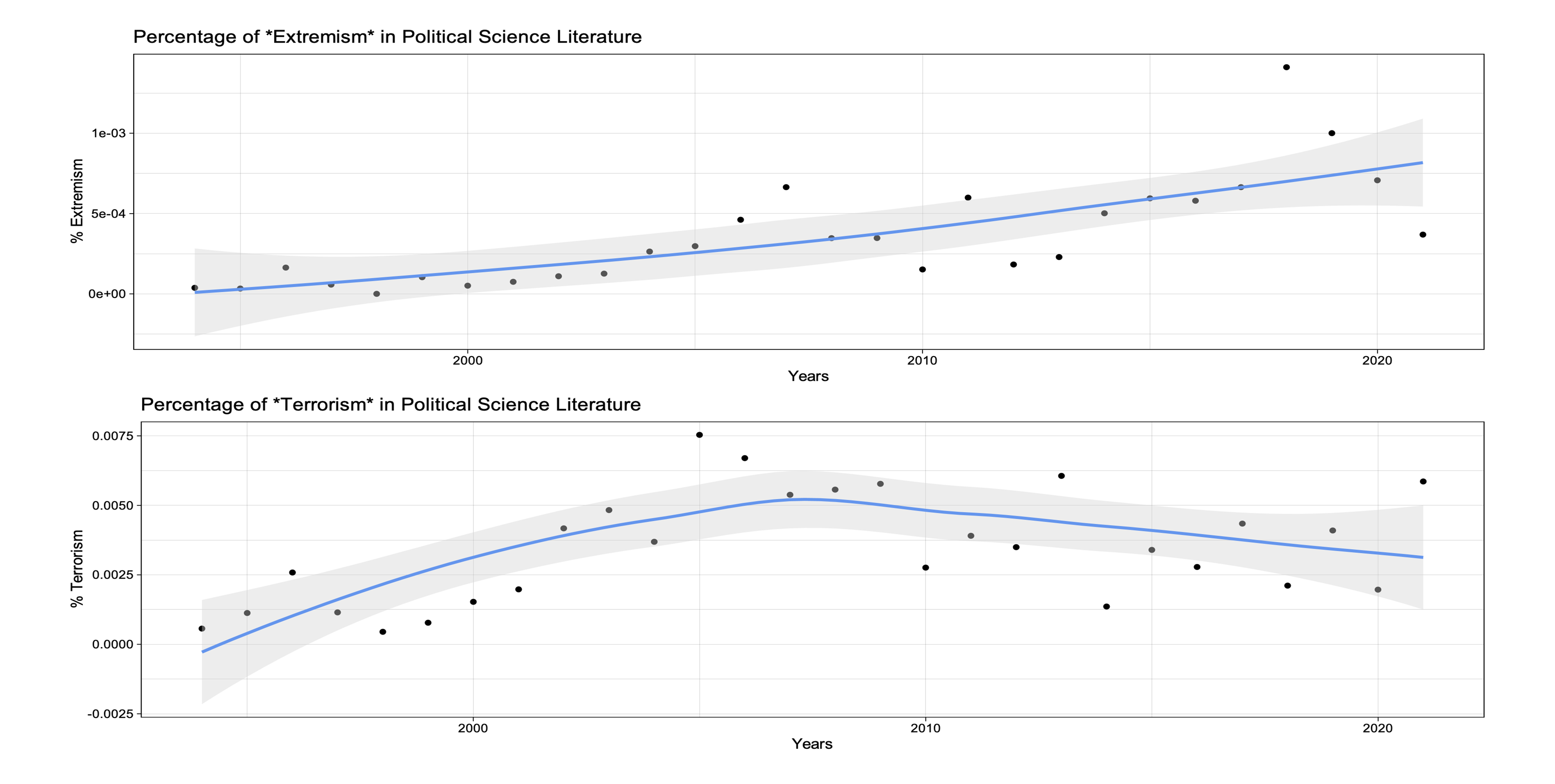
Although the narrative of extremism among active-duty military personnel was largely dispelled, it unfortunately remains a favorite accusation among certain segments of politicians, media, and academia. It is still used against veterans but is also directed against an expanded range of ideas, groups, and ideologies, which are largely right-leaning. Yet these claims are based on definitions and evidence that are riddled with inconsistencies when compared to one another and even on their own terms. Despite the ambiguity of the label, or perhaps because of it, the concept of extremism is increasing in frequency in academic literature, but without the corresponding clarity one would hope. Unlike terrorism, the definition of extremism possesses no precise legal definition, allowing researchers to use the moniker of extremism to describe a variety of actors, ideologies, and actions. Not surprisingly, the term “extremism,” which is usually depicted as entirely right-wing, reached its highest usage between 2016 and 2020, when Donald Trump was elected president. This trend is a troubling one, because the empirical evidence is not at all clear on the question of which groups are responsible for “extremism.”
Defining Extremism in a Democratic Society
Much of the academic literature on the topic of extremism leaves the meaning of the concept unaddressed. There is disagreement on the weighting given to such aspects as political and social context, the presence of violent action, or the perceived morality of the ideologies in question. Often, the definition of extremism is based upon circular logic and is used to characterize a variety of attitudes and behaviors within society in relation to what is perceived as mainstream. It goes without saying that mainstream ideology is in the eye of the beholder, though it generally includes the most powerful, and so those on the margins are forced into categories like extremism by default. One of the most important factors in defining extremism is the perspective of the researchers engaging in the assessment, because they tend to view extremism through their own ideological lenses. Failure to consider the exact criteria by which extremism is defined, however, allows this bias to go unchecked and the findings to be presented as unproblematic in the development of policy.
For example, the RAND Corporation defines extremism in the following terms: extremists are those who (1) identify with beliefs and organizations that are on the far end of political, religious, or ideological spectra within a society; and (2) advocate for activities that are outside societal norms and laws. These individuals often draw meaning from the identity that they apply to themselves and others based on their group affiliations (e.g., race, gender, religion, nationality, political beliefs).9 The obvious problem with this definition is that it expands the scope of extremism to include behavior and attitudes of groups. Using such a broad definition to collect data on the number of extremist cases significantly increases the number of cases found, which has the potential to distort our understanding of the prevalence of extremism and which groups are supposedly responsible for it. There is also the troubling fact that stigmatizing attitudes and including behavior protected under the First Amendment is an undemocratic approach.
Even more problematic is the definition used by the Anti-Defamation League (ADL). The ADL simply designates religious, social, or political belief systems that exist substantially outside of belief systems more broadly accepted in society (i.e., “mainstream” beliefs) as extreme. Determining the mainstream is an inherently political exercise, except that the ADL presents the process of definition as objective and scientific. A similar problem occurs in the Center for Strategic and International Studies (CSIS) database and report, “The Military, Police, and the Rise of Terrorism in the United States.” This analysis focuses on domestic terrorism, which is a misnomer, because it does not track with the existing legal definition of that term. Instead, CSIS defines terrorism as “the deliberate use—or threat—of violence by non-state actors in order to achieve political goals and create a broad psychological impact.”10 Including the threat of violence (or intimidation) in the definition and coding criteria greatly expands the scope of the definition and distorts our understanding of the prevalence of extremism and who is responsible for it; and, once more, it includes First Amendment–protected rights.
A report by the start—National Consortium for the Study of Terrorism and Responses to Terrorism—entitled “Radicalization in the Ranks: An Assessment of the Scope and Nature of Criminal Extremism in the United States Military,” attempts to overcome the problem of breadth by classifying arrests associated with extremism according to their ideological affiliations.11 These affiliations are determined by reviewing the perpetrators’ public statements, their extremist group memberships, and their stated motivations for committing criminal acts. The attempt to connect arrests with ideological disposition, however, falls short because the motivation for crimes is assumed to be ideological in all cases because of membership in “extreme” groups. Yet the arrests (the outcome of the prosecutions is not accurately noted) are not always for crimes with an ideological motivation as the mens rea. There is also no requirement of violence, as is the case with the legal definition of domestic terrorism. This definitional caveat allows for nonviolent crimes of trespassing, obstruction, and parading (prominent charges in the response to January 6) to be counted as equal to assault or worse.
Another obvious problem in the databases is that extremism is more often depicted as a far-right problem and violence is more often associated with this ideology. This conclusion, however, is based on an underrepresentation of the BLM riots across all datasets. If included, according to the definition used by CSIS and start, the BLM riots would add more than ten thousand arrests, more than $2 billion of property damage, as well as nineteen deaths.12 Moreover, if an arrestee had affiliations with a BLM organization, it was not included as one of the “extremist” groups, as was the case with right-leaning organizations. If BLM violence were integrated into the database of CSIS, for example, it would disrupt the findings that far-right violence is the most prevalent and would instead show that far-left extremism is really a larger problem. This exercise shows how dependent the findings are on the biases of the definitions used by the researcher.
The Importance of Definitions
The differences in these “extremism” definitions, which lead to the inclusion or exclusion of different data, are highly consequential. If the actual legal definition of terrorism was used to measure incidents of ideologically motivated violence, then the number of cases would be quite low. This is because domestic terrorism cases represent a very small number of crimes, while including “extremism,” given the breadth of the definition, can result in a 300 percent increase in the number of cases.
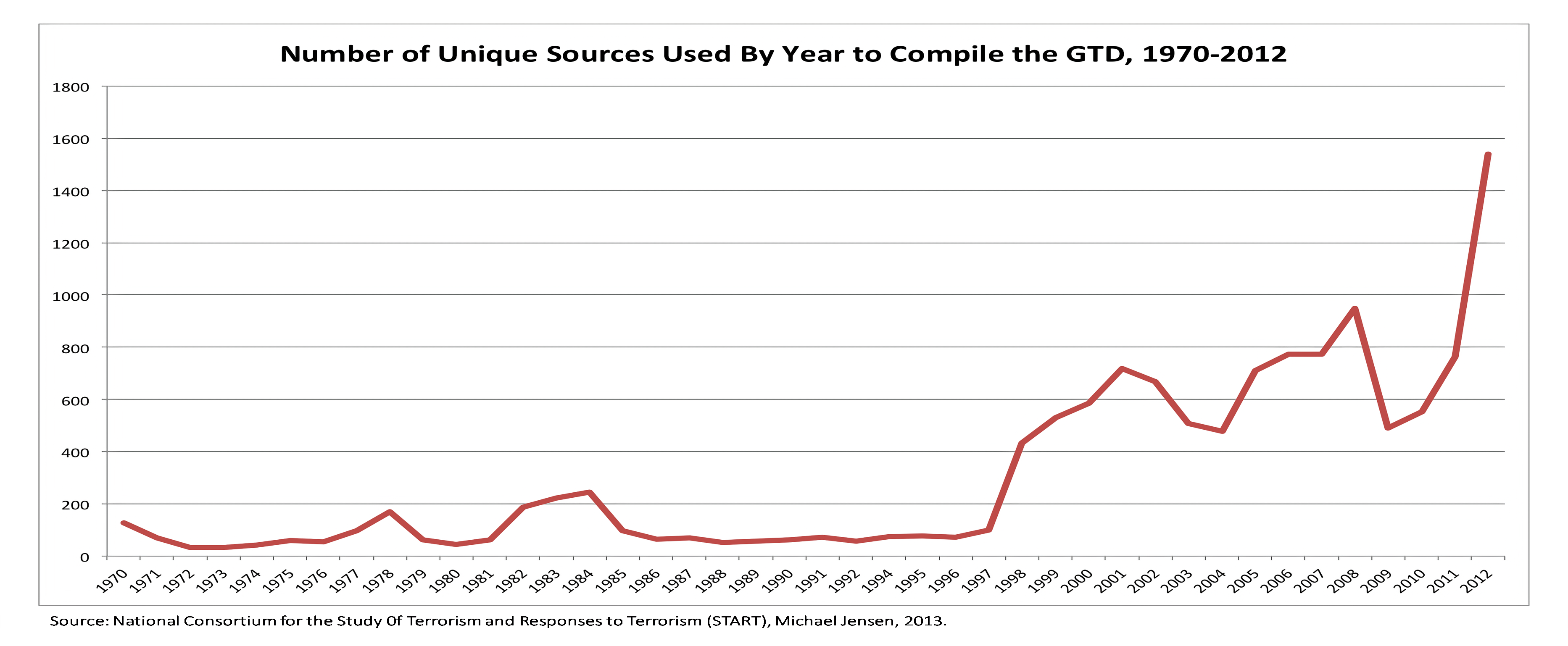
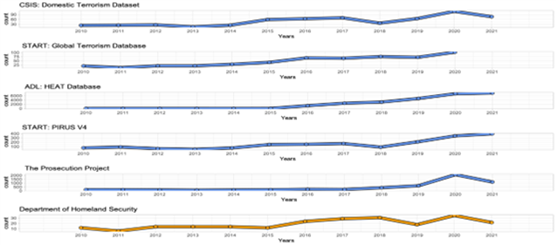
Another issue that undermines the reliability of the findings is the reliance on internet reporting, which is inevitably biased, and can lead to potential distortions resulting from inflating the number of cases due to multiple sources reporting on the same incidents. The graph below shows the number of unique sources used by start per year, to compile the Global Terrorism Database and other start products, such as pirus and Military pirus. Start’s products are also used to build other datasets such as CSIS’s domestic terrorism dataset, ADL’s HEAT, and the Prosecution Project’s dataset. As the incidents are increasingly reported online, there is the appearance that the occurrence of them is increasing, when, in actuality, the inflation of numbers is due to the increase in reporting. Also troubling is the fact that the increased number of sources being used to gather this information influences the trend found within the data itself: this may contribute to the difference between the numbers in the global terrorism database and CSIS’s domestic terrorism dataset when compared to the DHS’s domestic terrorism data. This reliance on reporting also magnifies the bias in the media. Interest in right-wing extremism is then regarded as a fact that is highlighted in reporting while an association with BLM, for instance, is not reported as an extremist ideology. The ideological bias that is present in reporting is thus magnified by the reliance on internet sourcing.
A further omission in the research is that the number of incidents of extremism among veterans and active-duty service members is never compared to the general population. In a comparative framework, the trend for politically motivated violence in the military community is a shared trend with the general population. There is a demonstrable rise in political violence across all segments of the population, not only for veterans and active-duty service members. Simply parsing out veterans and active-duty service members as groups prone to political violence without a comparative measure to the general population does not sustain the argument often made about either group. In fact, this sleight-of-hand could be done with any chosen ideology or group. Perhaps a more important question is why political violence is rising more generally in society and what is driving its occurrence. This question holds little interest, however, for researchers because it would point to governmental and societal failures that may not be as politically useful to partisan actors.
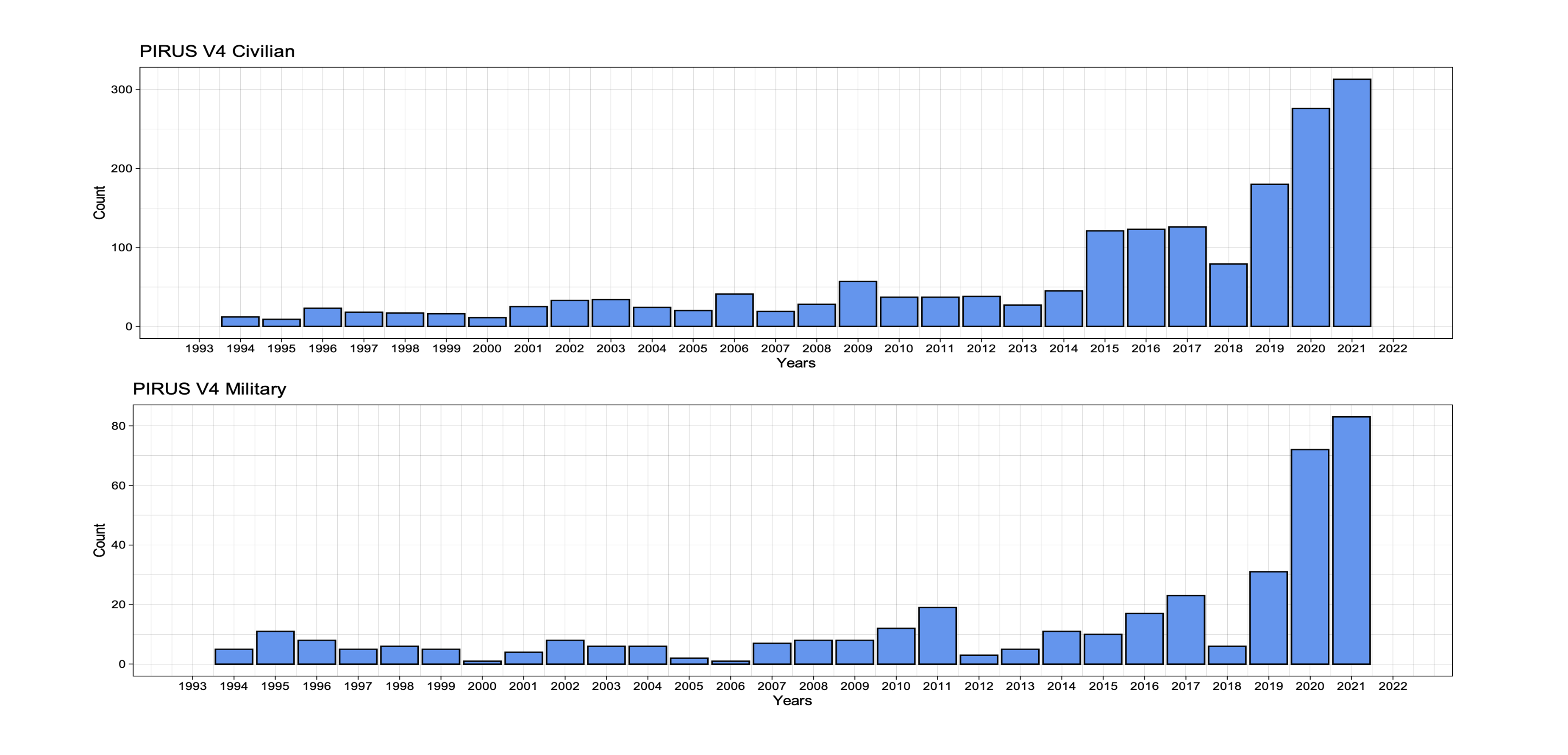
Another factor that skews the claim that veterans and active-duty service members are more prone to engage in politically motivated crime is the inclusion of the events of January 6 in the datasets. First, the majority of arrests of the veteran community were for nonviolent offenses related to “parading” or “obstruction of official proceedings.”13 In fact, only nine veterans were charged with assault, and three active marines were arrested and charged with participating in the riot. Second, the final tally for any of these arrests also will depend on how these crimes survive the prosecution and appellate phase, which may take years to conclude. Again, if the BLM arrests were similarly framed, they would far exceed those of January 6. Significantly, if violence is our main concern associated with extremism, then the BLM riots involved far more violent offences, including assault, arson, and other forms of violent crime, than January 6.
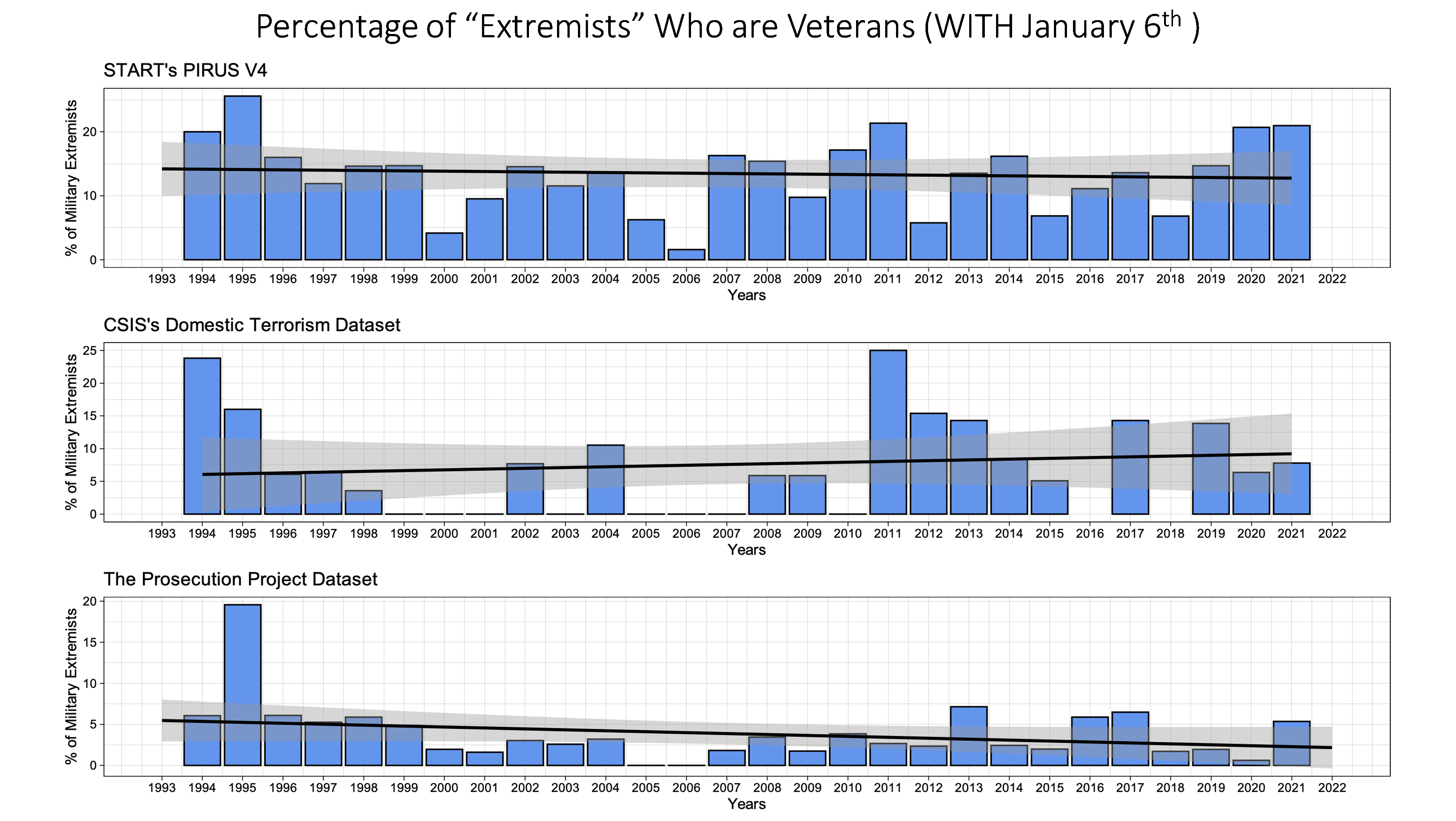
There are some important conclusions to be drawn from these findings. First, extremism as a concept is very indeterminate and politically charged, and this is not without consequences for the groups and ideas identified under its auspices. It has been used to the advantage of researchers who seek to advance a narrative for political rather than scientific purposes. Second, extremism is an ideological categorization, and its meaning is relational to other ideas in the ideological spectrum instead of an absolute value. This means that other viewpoints and ideologies that are present in culture, politics, public, and private institutions, and society more generally, can also be viewed as extreme. In other words, extremism lacks any precise definition. Moreover, in a democratic society, the contestation of ideas through the political process, rather than their exclusion, is the key to the preservation of democratic values. Because extremism is not a precise category and is relative, it follows that the label should be used carefully and with attention to its ambiguous parameters and the bias of those embracing the terminology.
To illustrate this point, we conducted a thousand-person survey of veterans to demonstrate that the most important factor in defining extremism is the political perspective of the one making the determination. The survey was conducted from June to July 2023 through NORC/Amerispeak, which maintains a database of veterans: we surveyed one thousand veterans, and held interviews with twenty-five veterans from varying ideological perspectives. These findings, however, are not particular to veterans, who are demographically very similar to the general population.
The upshot is that researchers tend to be more sympathetic to those with whom they agree: this is not startling until institutions begin attaching the label of “extremist” to perceived political rivals, in order to operationalize the authority of the state to attack them. One of the most shocking comments I heard came from a left-leaning veteran who suggested that all January 6 protesters should be executed. This kind of ideological fervor is the dangerous result of demonizing ideas and groups in a democratic society and, worse, we are all potentially subject to it. Ideological dominance in institutions, groups, and ideas is subject to change. And this introduces the possibility of “extremism” simply being used against groups which find themselves outside of political power centers. If the language of extremism is relied upon as a criterion of political acceptability, the tables can quickly turn in line with institutional power.
The language of extremism is not new, unfortunately. Throughout our history, claims of extremism have been used, and not only by the Left against the Right. In the McCarthy era, accusations of extremism were used to attack communist ideology and, about a decade later, to characterize civil rights groups and ideas as dangerous. September 11 ushered in an era of fears about Islamic ideology and terrorism.
Institutions Can Be Extremist Too
Another unexpected finding is that the veterans surveyed associated extremism with most institutions in our society, including academia, both conservative and liberal media, and both the Trump and Biden administrations. Academia, financial corporations, social media companies, partisan media of either stripe, and corporations ranked the highest in extremism across both sides of the political spectrum. When this trend was explored in interviews, the moniker of extremism was used because the institutions prioritized ideology over their institutional role in society: academics that distort their findings; a media outlet that hid certain facts to alter the story; a financial institution that turned over data to the government without a legal warrant; a social media company that censored political ideas.
The question, then, is: why use the label of extremism if it has no determinate meaning and can politically isolate those who are labeled as such? The use of the label “extremism” is often a more politically expedient way of asserting authority and control over political opponents than achieving legitimacy among the members and groups of the population who disagree with the dominant ideology.
Ideology, as it is used here, is not intended to invoke disparaging connotations. Instead, ideology here refers to ideas, concepts, and beliefs that tend to be unifying, action-oriented, rationalizing, legitimating, universalizing, and naturalizing. As Terry Eagleton describes it, ideology connects the values and ideas that we take as legitimate, and which authorize the use of power and serve to enforce the rules, knowledge, and authority in society:
A dominant power may legitimate itself by promoting beliefs and values congenial to it; naturalizing and universalizing such beliefs as to render them self-evident and apparently inevitable; denigrating ideas which might challenge it; excluding rival forms of thought, perhaps some unspoken by systematic logic; and obscuring social reality in such ways convenient to itself.14
If the exercise of political authority is consistent with the ideology that authorizes it, then there is a general acceptance of the institutions. On the other hand, when the political authority does not abide by its ideological justifications, then there is often a refusal to accept it. To overcome the loss of legitimacy and the emergence of political opponents, the dominant group may denigrate and exclude those who challenge them. The responses in the survey and in one-on-one interviews on the question of extremism relate to this point. Institutions considered “extreme” were often the ones perceived as employing the accusation of extremism itself as a weapon against their opponents rather than dealing directly with the ideological challenges raised.
When the label of extremism was used by those in institutional positions of power—whether government, media, or academia—it was seen as a means of demonizing groups among whom the exercise of achieving legitimacy was not considered necessary, feasible, or even desirable. This finding goes hand in hand with the perception that extremism is attributable to institutions driven by ideological motivations rather than by the institutional role they served in a democratic polity: a media organization that only promoted one viewpoint; academics that grounded their work in a partisan point of view; or an administration that discounted the relevance of an entire swath of the country. All were seen as serving only a certain segment of society while excluding the worth of the rest and, more importantly, rejecting the need to win legitimacy from them. While the political leanings of the respondents affected which institutions were seen as the greatest abusers of extremism accusations, social media and internet companies and academia in general were seen as offenders by those on both sides of the political spectrum.

Achieving political legitimacy is often much more difficult than using “extremist” labels to exclude ideological challengers, but the latter is not without political costs. A dominant ideology must continually negotiate with the other ideologies vying for power unless it reverts to authoritarian tactics to maintain its dominance. But the more an institution is seen as using the extremism accusation as a tool of retribution against rivals, the more extreme the institution is perceived to be. Legitimate political authority that we regard as just and valid may have to fight hard to win credibility from society as a whole. But employing accusations of extremism to suppress opposition also comes at a cost—namely, the loss of credibility on the part of the dominant institutions and leadership classes.
Here it is important to point out that the use of “extremism” is often used to rationalize stepping outside typical constraints on the use of power, and this may be the most troubling consequence of the usage of this terminology. Constitutional restraint and governmental accountability can be set aside more easily when “extremism” is the enemy. Likewise, social media, the financial industry, and the media routinely engage in the “fight” against extremism without any consideration of the costs of censorship, demonetization, or outright banning, and all without the accountability and transparency a democratic society requires. The loss of privacy, civil rights and liberties, and the overt denigration of democratic principles are not worth the war against “extremism” if we cannot even be sure who and what we are fighting against. Unfortunately, powerful actors justify extra-institutional actions with flawed findings and empirical sleights-of-hand. But it is precisely such actions that erode the foundations of a free society as well as trust and accountability in institutions.
This article is an American Affairs online exclusive, published May 20, 2024.
The author thanks Noah Fair for research support and the Collaboratory Against Hate for financial support in preparing this article.
1 Andrew Lawrence, “Harvard’s Claudine Gay Was Ousted For ‘Plagiarism’. How Serious Was It Really?,” Guardian, January 6, 2024.
2 Kelsey Piper, “A Harvard Dishonesty Researcher Was Accused of Fraud. Her Defense Is Troubling,” Vox, March 22, 2024.
3 Barry Weiss, “Economist Roland Fryer on Adversity, Race, and Refusing to Conform,” Free Press, February 13, 2024.
4 Office of the Director of National Intelligence, “Domestic Violent Extremism Poses Heightened Threat in 2021,” Department of Homeland Security, March 1, 2021.
5 Seymour Martin Lipset and Earl Raab, The Politics of Unreason: Right Wing Extremism in America, 1790–1970 (New York: Harper and Row, 1970), 6.
6 Ellen Mitchell, “Pentagon Releases Training Materials to Address Extremism,” Hill, February 26, 2021.
7 Wall Street Journal Editorial Board, “The Military’s Phantom ‘Extremists,’” Wall Street Journal, January 1, 2024.
8 Wall Street Journal Editorial Board, “The Military’s Phantom ‘Extremists.’”
9 Marek N. Posard, Leslie Adrienne Payne, Laura L. Miller, “Reducing the Risk of Extremist Activity in the U.S. Military,” Rand Corporation, September 16, 2021.
10 Seth G. Jones et al., “The Military, Police, and the Rise of Terrorism in the United States,” Center for Strategic and International Studies, April 12, 2021.
11 Michael A. Jensen, Elizabeth Yates, and Sheehan Kane, “Radicalization in the Ranks: An Assessment of the Scope and Nature of Criminal Extremism in the United States Military,” Start—National Consortium for the Study of Terrorism and Responses to Terrorism,” January 17, 2022.
12 Anita Snow, “AP Tally: Arrests at Widespread US Protests Hit 10,000,” AP News, June 4, 2020.
13 NPR Staff, “The Jan. 6 Attack: The Cases Behind the Biggest Criminal Investigation in U.S. History,” NPR, April 5, 2024.
14 Terry Eagleton, Ideology: An Introduction (New York: Verso, 2007), 5.