
The Heart of the Country
We need to operate as if America did not exist.
–Rem Koolhaas
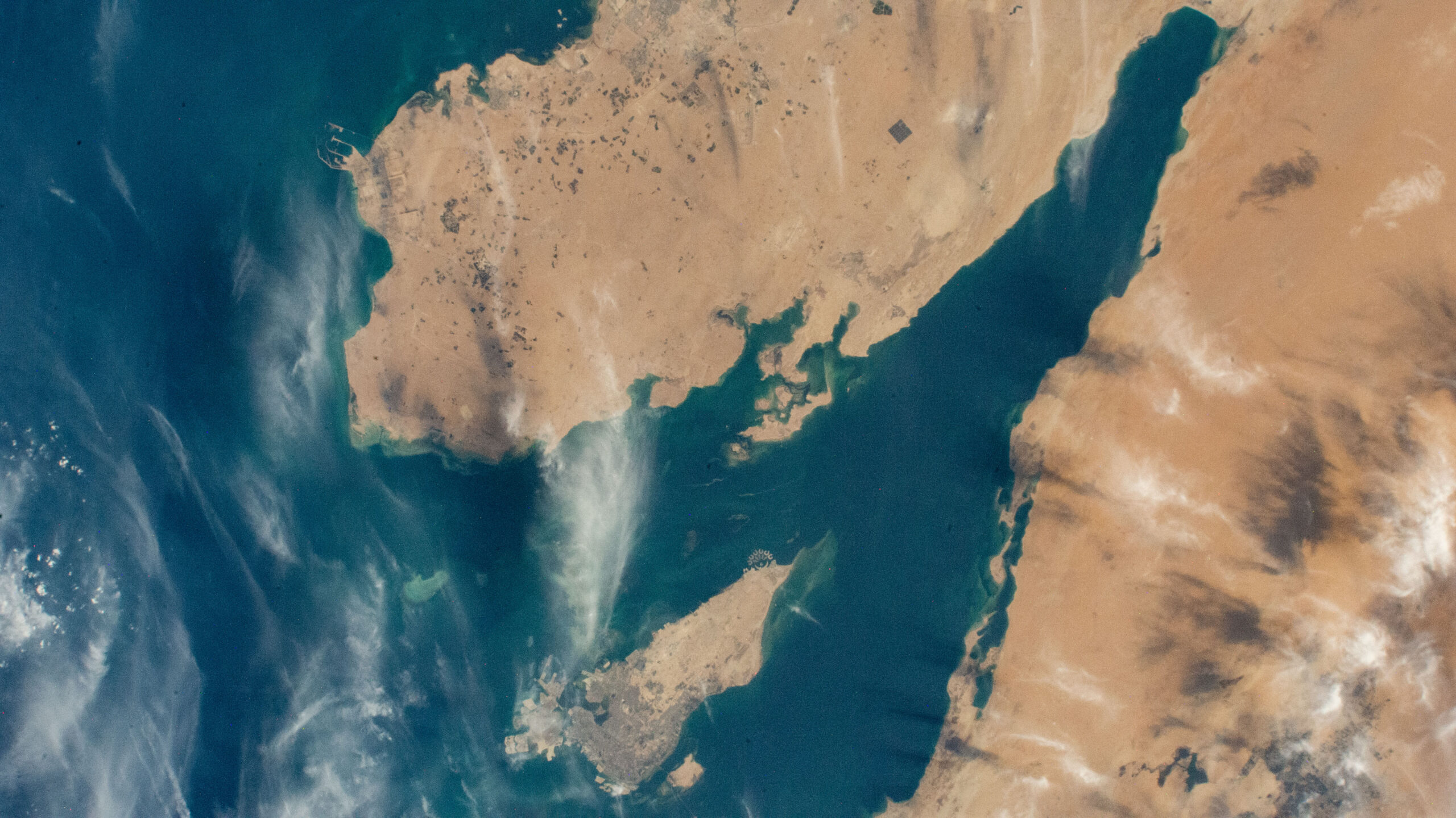
What happens when the countryside— the global periphery —becomes the center of human progress, and America, once the heartland of modernity, turns into an exceptional, possibly obsolete island? Maybe America pivots, leaving twentieth-century allies behind and reorienting toward the places that will play a central role in the automated AI future, where the social order is closer to feudalism than to democracy. One such country is Qatar, where I went in October of 2025 to see an ambitious set of ideas about the future, curated by maverick Dutch architect Rem Koolhaas.
Qatar has the atmosphere of a particularly rich Chinese third-tier city: impressive skyscrapers glittering by night, but empty by day; shopping malls where one can eat at IHOP or get a coffee at the Chinese chain Cotti. It is also the place where Koolhaas and his colleague Samir Bantal chose to display his research on the global countryside, five years after a Guggenheim show that was prematurely closed because of Covid. Perhaps by happenstance, his updated show sees Qatar at the median point of an arc stretching between China and eastern Africa; this arc is the place where the world’s future will emerge. Roughly, the arc corresponds to Halford Mackinder’s idea of the heartland. Unlike the Soviet Union, this heartland is not united by ideology, unless engineering itself is an ideology; the area basically serves as the core of China’s Belt and Road.
For my American ears, the word “country” means my country. If cities feel increasingly generic, the country feels personal, secret, special, filled with memories of childhood. But in the expansive imagination of Koolhaas, the countryside is a greenfield site where the future is under construction. In his analysis, the divide between cities and the countryside seems as significant as the one between the West and the East. And it is the countryside that captivates him.
Back to the Land
The countryside is the warehouse of traditions, of the remaining humans who live in a rooted condition. Even since the original show in Manhattan, in 2020, the global center and periphery have been noticeably shifting. Maybe the fact that the Manhattan show was a bit of a damp squib and needed a reboot in Qatar spoke to a deep truth: the old centers feel more provincial, the old peripheries newly powerful. It’s as if the exhibition itself had migrated with capital: Manhattan was the showroom of the past; Doha, the testing ground of the future.
Koolhaas’s career is sui generis. Although he is peer of other great architects, it would be more accurate to say that he is a writer and visionary who managed to realize his ideas in the form of buildings, an ethnologist mapping capitalism’s outer frontiers. Koolhaas built the CCTV Tower in Beijing (notably, passing up the competition to design NYC’s Freedom Tower to do so), the national library of Qatar, and the public library in Seattle, to name only a few of his works. He taught at Harvard, where he charted the emergent urbanisms of Shenzhen and Lagos. He coined the term “junkspace”: the landscape of global sameness. He and OMA partner Reinier de Graaf were the presiding spirits at Moscow’s Strelka Institute, reimagining the Soviet legacy as a network of infrastructures stretching from the Arctic to Central Asia.
The word “globalist” has become an insult, implying that curiosity about the world masks greed or disloyalty. Yet OMA’s globalism was a form of philosophy: a belief that to understand the built environment is to understand humanity itself. This impulse is criticized today, just as much by the Left as by any nationalists of the Right. But perhaps those critiques stem from a sense that our lifeworld, as heirs of the European civilization (and in the United States, we certainly are that), is shrinking. Koolhaas looked outward, to the world as a jumbled set of facts and arguments; Americans today look inward, spiraling in a toxic self-regard.
Rem’s arc traces new built environments and technologies, as well as memories of grand projects and forgotten utopias, through the places where most humans live today: Kenya, Kazakhstan, Mongolia. America has not much to do with these places, Europe even less, although Koolhaas speculates Europe and Africa can have a more fruitful interchange in the future. For demographic reasons, as well as the immense fertility of African soil, he told me that Africa could have a plausible modern countryside.
The world of the future, as depicted in the maps and discussion points that Koolhaas collected in the show, looks very similar to the world that Chinese institutions like the National Development and Reform Commission envision. It’s a world where instead of people going to the city, the city goes to people (in other words, instead of everybody trying to move to New York, Huawei wireless towers and Chinese solar panels go everywhere else). It’s a world where Asian technologies underpin a burgeoning Africa. Consider that the last ambitious European ideas about continental engineering emerged in 1937, when German engineer Herman Sörgel proposed to link Europe with North Africa and the Middle East by damming the Mediterranean, which would have created a unified space quite similar to the Roman Empire at its height. And today?
One diagram in the show points out that Europe and Russia, which today constitutes 9.5 percent of the world’s population, will have 3 percent by 2100 (neither North nor South America is on the map; apparently, they will be in an exceptional condition of their own). Koolhaas’s gaze migrated from the metropolis to the periphery at the same pace as capital itself.
A World of Villages
The start of Russia’s war with the West caused the Strelka Institute to close down. It was often said that Russia was just a gas station. Anybody who’s lived in the countryside knows that gas stations are among the most important places; the dismissive way that “gas station” landed like an insult demonstrated the lifestyles of the sort of people who said it. As Louis-Vincent Gave observes, Russian oil and gas is locked into low-cost contracts with China, making China the place with the lowest cost of energy in the world. Europe’s energy costs have increased, with Chinese solar, American LNG, and fossil fuels from the Arab states helping to fill in the gap.
In the global village, the question is what is your comparative advantage? Gas stations are dingy and out-of-the-way places, but it’s clear enough what value they add. China is the world’s factory and a center of consumption, technology, and culture in its own right. Attempts to ice China out of trade seem practically impossible, such is the Chinese grip on rare earths (another of those things, like gas stations, that we’d rather not think about).
America is experiencing a turbulent moment, but it’s hard to call it decline. Judged by certain factors, we might be failing upwards, chasing on the heels of Artificial General Intelligence (AGI), a technology that we know is American because it wraps itself in patriotism and a search for God. America is the world’s Manhattan: globalist almost by definition, with 46 percent of revenues of the S&P 500 generated outside of the United States. But if the future of the world is in the countryside, in authentic communities created by shared need, how will Manhattan fare?
China’s new centrality to the arc, from Kazakhstan to Ethiopia, comes from the fact that the Chinese are trying to reconcile their own cultural traditions, from patriarchy to love of the native land, with technological modernity. The scale of the Chinese population and the competence of the CCP makes this process faster for them than for anybody else. China’s rise across the Global South recalls the Maoist idea of the countryside surrounding the cities. The outcome is a set of technologies that are designed for villages, not for cities; in a world of villages, that’s powerful. What is Europe’s comparative advantage? Last autumn in Doha’s Ned Hotel, asking Koolhaas the question was enough to make him grimace.
When OMA got the commission for the CCTV tower, he said that it “could never be conceived by Chinese or built by Europeans.” Speaking with a living European visionary with a complete mental map of the world, driven by the empirical experience of a successful entrepreneur and builder, was quite a revelation. What’s a vision for Europe, and how can we build it, I wanted to ask him. Harnessing the might of Chinese engineering to realize European aims is an admirable task. We aren’t used to Europeans like that anymore. It seems so obvious from the outside that the sort of solutions he proposes aren’t about design or aesthetics, but about the life of the city, e.g., politics (indeed, OMA is an acronym for “Office of Metropolitan Architecture”).
Koolhaas studies infrastructure because it the last political project left in a depoliticized world. Bantal, head of OMA’s research wing and coauthor of the show, brought up Dan Wang’s thesis in Breakneck that China is an engineering state, whereas America is a legalistic state. Leaving aside the originality of this thesis, Bantal confirmed that OMA is more an engineering firm than a legal firm: we could say that engineers change reality and wait for customs to adapt, whereas lawyers change customs and wait for reality to adapt.
Reality is changing pretty quickly all by itself; both laws and, to a lesser extent, engineers struggle to keep up. But the success of China’s worldwide model in facing challenges like a changing climate, surging demand for electricity, increasing protein consumption, and the general extension of an American quality of life to the global population, demonstrates that engineering solutions are more effective, at least in the short term. We live in an era of grand projects, wonders of the world like China’s Yarlung Tsangpo dam in Tibet, the UAE’s reinvention as an AI hub, Elon Musk’s Starlink, and the creation of AI models such as ChatGPT. OMA has done consulting work for the European Union, but it’s hard not to see Europe as a force to conserve an old world order that is melting, rather than a disruptive power.
If the world is changing, then trying to keep things the way they are is swimming upstream; the Qatar exhibition paints a picture in which the dissemination of Chinese engineering throughout the arc is the stream. Northwestern Eurasian provinces such as Holland may return to nature, or to their own niche pursuits. But in the end, the built environment of Europe––even postwar reconstructions like Rem’s home base in Rotterdam––testify to a civilizational wealth that is hard to measure and even harder to trade within a capitalist system. Does the life of the streets of Paris have a comparative advantage? No, because it cannot be exchanged. But many prefer it to Dallas.
Politics, of course, is the life of the polis or city. Many of us, including Koolhaas and Bantal, associate cities with alienation, individuation, solitude, and submission to capitalist norms. One powerful valence point of the countryside, whether la France profonde, the American heartland, or the Chinese villages, is the sense that community and collective ways of life are stronger there. If many of the nationalist movements that have swept the world––including, of course, MAGA––reflect a yearning for community, for shared values beyond economic structures, then it’s no surprise that the countryside is where we look for the community, as the antidote to the gray blandness of the city. The first room of the countryside exhibition is a Mongolian-style yurt, with carpets hung on the walls; these nomads stand before history, in the way that globalizing capitalism was called “the end of history.” What happened between the yurt and the Washington Consensus was the creation of a world of disparate communities and nations, a world of endless variations, ones that led to conflict but also to creative sparks.
If the political economy of globalized capitalism, with China as a core component, is a genericizing structure which generates sameness and equality of outcomes––the reason why Doha looks like downtown Houston and Nursultan looks like Shenyang––then how can we preserve singularity, culture, community? If not those of indigenous peoples, can we at least preserve our own?
Oceania and Eastasia
Since “Liberation Day,” and the subsequent cold truce between the United States and China, negotiated in terms of bartering access to components of the tech stack––rare earths, H200 chips––it has become clear that President Trump has a new world order in mind. Adopting an Obama phrase, he tweeted about the G2. If we accept that the pursuit of AI and automation is a core focus for both the United States and China, and that no third country rivals this duopoly, then what might we conclude about the international order that is emerging? In this new world, minerals and resources that previously weren’t that important (lithium, copper, etc.) become more so. Access to sea lanes and territories not seriously considered since the nineteenth century, such as through Greenland and the Arctic, turn into core strategic questions; alliances meant to fight the Soviet Union, principally NATO, appear less relevant.
And if scholars such as Graham Allison have warned of the Thucydides Trap or a breakdown on the scale of 1914, what is shaping up ahead of the April visit by Trump to China looks more like the Berlin Conference of 1885, where the great powers divided up the African continent amongst themselves in a quest for natural resources. Yet while this vision may appeal to Trump, it is a caricature to suggest that China has any such desire, much less Russia and Europe.
Some atavistic personalities suggest that Trump’s plan is to divide the world into three zones, as in Orwell’s Nineteen Eighty-Four: Eurasia, Oceania, and Eastasia. The problem with this idea is that, if Europe is flailing, Russia is too. Koolhaas spoke fondly of Russian culture; Russia is part of Europe, though one that was treated with savagery in the 1990s. The Eurasia which looks like a reconstituted Soviet Union would be a distant third in geopolitical and economic might compared to Oceania and Eastasia.
It’s fair enough to observe that if in the 1950s, America contended with a stable and hostile Soviet Russia and a demented but impoverished Maoist China, today it contends with a stable, hostile China and its demented and decaying business partner, Russia. But it’s also fair enough to observe that geographically, the difference between Russia and Europe can be hard to distinguish. Historically, Russia has been part of Europe as well, although ambiguously so. There’s no future for Europe that doesn’t include a settlement of some kind with Russia; it’s not just going to vanish. For Koolhaas, education and shared projects are the most promising ways to rebuild mutual understanding.
Historical metaphors help us to see, but they fail to encapsulate the current landscape perfectly. The possibility that AI, automation, and the combination of a Chinese-led energy transition with the effects of climate change (caused largely by Chinese coal emissions during its great boom) might bring us to a sort of world with no serviceable metaphors from the last two hundred years. As the industrial revolution and the nineteenth century were a great break with what came before, so the endless flux of renewable energy to data centers, digital governance to breakthroughs in biotech, terraforming to quantum computing, and so forth, might really bring a new sort of world into being.
If the last war was a land war over territories in Europe, the coming conflict is over technology and its manifestations in physical space. “We want to ensure that U.S. technology and U.S. standards, particularly in AI, biotech, and quantum computing drive the world forward,” the 2025 National Security Strategy states. Chinese scholars whose work I have published, such as Edmund Sheng of Shandong, have been discussing post-ice-cap trade routes for a long time now. In a sense, one could say that the Trump administration has simply been adopting some of its rival’s best practices and has a parallel focus on AI and the technologies (including quantum and biotech) which it is revolutionizing.
If the United States and China collectively––whether as opponents in a duel, or partners in a G2 duopoly––remake the world in the pursuit of AGI, their strengths will nonetheless remain asymmetrical. Consider the paperclip problem, which imagines somebody asking an AI to assemble as many paperclips as possible: the single-minded AI kills humans to harvest their organs and bones in order to produce paperclips. Neither China nor America wants paperclips. China wants regime stability, and perhaps, as Xi joked to Putin, for Xi Jinping to live forever (turns out he’s just another tech bro).
The U.S. algorithm wants returns on capital. With AI as a national security imperative, there can be no AI bubble; the U.S. government will prop it up. In 2026, the streets of San Francisco pulse with a vibrancy that is hard to find in China: here, many young people believe they’re getting rich, and they’re right. In Chinese AI labs that I’ve visited, government-funded scholars talk about bringing low-cost healthcare diagnoses to the villages, or AI tutors to rural schools. If AI is a tool, America comes to it with capital, and it is going to a place with even more capital. China comes to it with a long list of errands, which it seeks to tick off one by one, as it works to bring an acceptable standard of living to all of its citizens.
The American scene, whether in technology or foreign policy, is capable of surprises, with quick flashes of lightning and ideas that seem too stupid to work until they do. The Chinese make practical, rational plans and slowly, bit by bit, make incremental progress. There’s no obvious reason why the American algorithm can’t make money while the Chinese algorithm keeps the regime in power. And Europe? It will continue to honor its traditions, and to maintain its brilliant and delicious civilization, one hopes.
Between Hope and Hubris
For an American, the exhibition presented by Koolhaas in Qatar offered a compelling vision of the world without us. Peter Thiel has written that the world from the 1970s seemed to be an enchanted forest, but in reality, it had been a desert. What is a forest and what is a desert? Will shucking the empire off of our shoulders allow Americans to encounter our fate, as people living in our country, testing its limits and our own? Since 1945, the size of the U.S. government has ballooned, taking on a life of its own, becoming monstrous in the process. We’ve become addicted to this sort of imperial state, but addicts are resourceful.
Ours is a society that is, at its best, not defined by the actions of a centralized, planning state: our civilization is decentralized, democratic, and grows in uneven spurts. In all of his chaotic, unregulated behavior, Trump personifies an American capitalism which acts, while others—including China—react. The same could be said of the financial flows or technological developments that are happening in our country. Many associated with America’s twentieth-century empire cannot accept that it might end. That’s their problem. For us, quitting these unrealistic goals of changing the world can’t come soon enough; if we change ourselves, it will be good enough.
In the world of the twenty-first century, Americans are still driving change: technological, political, and cultural. For better or worse, our country remains a protagonist of world history: the Chinese would be the first to say that they don’t wish for this role. Where will we go next?