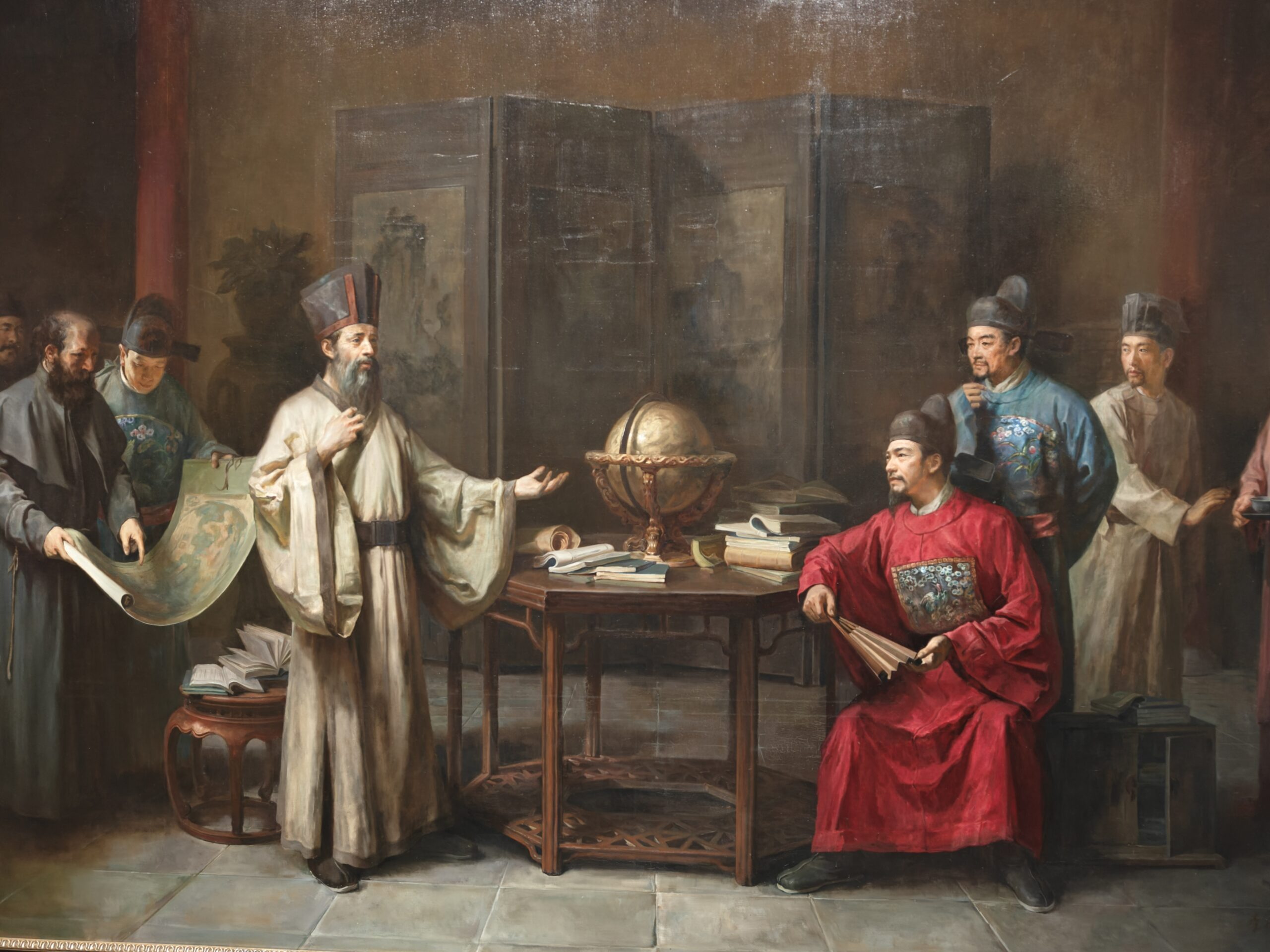
With harmony, slight things grow to greatness. With discord, great things shrivel and fail.
—Matteo Ricci, 15961
In 1989, Francis Fukuyama caused a stir by publishing an article in the National Interest titled “The End of History?”. A State Department and Rand Corporation analyst at the time, Fukuyama confessed that he was feeling something out of the ordinary. “We may be witnessing,” he said, “not just the end of the Cold War, or the passing of a particular period of postwar history, but the end of history as such.” Did this fill him with dread? Not really. Post-history was not brought on by catastrophe but, fortunately, by the apotheosis of what he called “the Western idea.” And apparently, liberal democracy is the Western idea. The “end point of mankind’s ideological evolution” had not, therefore, come like a thief in the night, but rather, like a liberal technocrat.2
Not everyone was convinced. In fact, Fukuyama’s 1992 book in the same vein, The End of History and the Last Man, was negatively reviewed; Perry Anderson, a historian of the Left, was struck by “the virtual universality of the rejection” of Fukuyama’s thesis: “For once,” he observed, “most of the Right, Centre, and Left were united in their reaction.”3
It is telling, though, that Fukuyama made his move by channeling a feeling. For whatever his critics said, his idea matched the Western mood circa 1990, which could accurately be called euphoria. What Fukuyama hailed as the preordained triumph of liberal democracy quickly became an axiom. His sense that liberal ideology had not just outlasted Soviet communism but had transcended the whole realm of “ideological struggle” took root in Washington, and then in London and Berlin. His notion that “we have already emerged on the other side of history” spread rapidly in Western policy circles.4 Many liberals, especially in the up-and-coming Boomer generation, felt that they had truly won the great game of history.
But Fukuyama’s legacy is not finally reducible to a mood. He had a theory. According to that theory, it is not by chance that “the state that emerges at the end of history is liberal.”5 History culminates in liberal states because Fukuyama shares a widely and deeply held conviction that liberalism is not just one ideology among many, nor for that reason do liberal states merely realize one historically contingent form of governance. On the contrary, liberalism is held to be a historically necessary expression of the human essence, namely a desire for freedom and dignity.6 This is a desire which not only Soviet-style communism but illiberalism tout court could never hope to satisfy.
If only liberal states can satisfy the desire that drives history, then what more concretely is that desire? Recognition.7 It is an archaic individual thirst for recognition which finally matures into the modern political “struggle for the universal recognition of rights.” The social contradictions which make history are nothing but the shifting objective formations of this primitive desire to be recognized. Fukuyama’s hope is that late liberal states realize a political culture which is so “universal” and so “homogeneous” that “all prior contradictions are resolved” within it.8 Once the desire that makes history is satisfied, post-history can finally begin.
Of course, post-history is no paradise. Fukuyama never denies that war has a future. What he concludes is that there is no real possibility of future ideological conflicts between great powers. Post-history promises the world a pacified liberal core of democratic states. The social contradictions and ideological conflicts of history are all relegated, in this view, to liberalism’s ever-diminishing periphery.
Since the collapse of the Soviet Union, Fukuyama’s name has functioned as a cipher of liberal hegemony. It symbolizes the force or hubris of liberal ideology, depending on your politics. As such, critics have been calling time on him for decades. The “end of the end of history” has been a recognizable genre since 2002 at the latest.9 Not all his critics actually break with his ideological framing, however. In a 2003 column published by National Review, for instance, the “end of the end of history” just means that Fukuyama’s liberal core must defend itself more vigorously against one of its illiberal peripheries. Since “Iraq is the central front of the war against terrorism,” we read, the Iraq War is a necessity.10 The idea here is obviously not that a return of history will draw liberal hegemony to a close. Rather, history is summoning Fukuyama’s liberal core to deploy its power more aggressively. One more push to reach the true end of history!
Today, the situation looks very different. China has risen to the status of a great power. After its invasion of Ukraine, Russia’s standing has arguably been enhanced. Iran and several of its proxies, especially the Houthis, have proved extremely tough to crack. Those who once snickered at North Korea’s dynastic communism now fret about South Korea’s political stability. The September 11 attacks and utterly failed occupations of Afghanistan and Iraq shook the end-of-history thesis, but they never really shattered it. In recent years, however, Fukuyama himself has become distraught and increasingly disoriented by global developments.
In a March 2022 post entitled “Preparing for Defeat,” Fukuyama predicted that Russia was heading for “outright defeat” in the Ukraine war. Putin would “not survive,” he said. What is more, he felt sure that “populist” figures in Europe and the Americas (all the usual suspects) had suffered “huge damage” in the first month of the conflict and would lose the rest of their influence and credibility in the course of the war. Finally, he believed that Ukraine had presented a “good lesson” to China. The military power of NATO should not be underrated in the Black Sea region or in the Taiwan Strait.11
The following year, Fukuyama went so far as to meet with representatives of Ukraine’s highly controversial Azov Brigade during their visit to Stanford University.12 As recently as 2021, Harper’s had identified Azov as one of Ukraine’s “armies of the right.” A seasoned war correspondent, Aris Roussinos, numbers Azov among the country’s “extremist militias.”13 But this did not faze late liberalism’s most iconic thinker.
Of course, events in Ukraine have refuted Fukuyama’s predictions. He has seemed detached from reality and has tried to blame his misjudgments on others. In a recent essay for Yascha Mounk’s Persuasion, Fukuyama complained that the United States had “switched sides” in the war and that he had taken this “personally” due to his decade-long support of liberal initiatives in Ukraine. There is little in the way of reflection on why his 2022 predictions missed the mark so badly.
But one thing is clear. When Fukuyama states that we are embroiled in a “global fight” between liberal and illiberal alliance structures, he is renouncing his own end of history.14 For that is the one thing that post-history, or permanent liberal hegemony, was supposed to save us from.
World History on the March
Let us step back from contemporary geopolitics and ask: what lies behind Fukuyama’s original thesis, which so effectively captured the Western zeitgeist for a whole generation?
The sources of the liberal “end of history” are twofold and linked: G. W. F. Hegel’s 1807 masterwork The Phenomenology of Spirit, and a hugely influential set of lectures on Hegel’s Phenomenology delivered in Paris in the 1930s by Alexandre Kojève (or at birth, in Moscow, Aleksandr Kozhevnikov).15 Fukuyama makes frank and extensive use of both Hegel and Kojève, though it is worth pointing out that, in both cases, he basically limits himself to the works just cited.
Hegel is more than The Phenomenology of Spirit, and Kojève is more than his Introduction to the Reading of Hegel.16 But Fukuyama’s notion of the end of history is drawn from a certain reading of both those works in near-total isolation. As a result, his concept of history owes much to what Hegel calls “world-historical individuals.”17 This is an idea that takes us back to the year 1806, the year in which, crucially, the Holy Roman Empire ceased to exist.
Hegel had a transformative experience in 1806. In the Prussian university town of Jena, where he held the unremunerated post of “extraordinary professor,” Hegel caught sight of Napoleon on horseback within the surge of his Grande Armée.18 At a time when many Europeans viewed Napoleon as the Antichrist, one who had imposed mass conscription to levy an army capable of inflicting casualties on a scale never been seen before, liberal-minded intellectuals saw the charismatic emperor as a vehicle chosen to purvey the ideals of the French Revolution across the continent and, ultimately, into Russia.19 Hegel agreed, but he saw something even deeper: world history on the march.
Shortly after Napoleon’s recruits smashed through the Prussian forces, and then torched and looted much of Jena, Hegel famously wrote to a friend of his singular encounter:
I saw the Emperor—this world-soul—riding out of the city on reconnaissance. It is indeed a wonderful sensation to see such an individual, who, concentrated here at a single point, astride a horse, reaches over the world and masters it.
It is not entirely clear that Hegel saw the French Emperor, spreading Enlightenment ideals at the barrel of a cannon, as the beginning of history’s end. He liked to say, rather, that Napoleon’s task was to “finish the novel” that the Jacobins had begun.20 In any case, Fukuyama’s other authority, Kojève, identified the figure of Napoleon with the end of history. What is more, Kojève saw Joseph Stalin as Napoleon’s esoteric heir. He hoped the Georgian autocrat could finish the job in Moscow that the Corsican had started in Paris. And like Hegel, who admired Napoleon for bringing enlightened politics to Europe, Kojève revered Stalin for consolidating an egalitarian, Marxist-inspired union of republics in Eurasia.21
Even when he was ardently defending Stalin, Kojève held that history had ended at Jena in 1806. For him, Stalin was merely engaged in perfecting the Enlightenment ideals that Napoleon had first realized and Hegel had then theorized. Marxist revolution was not so much a matter of destroying the institutions of the liberal Enlightenment but rather of completing them. Controversially, he saw the Stalin regime as a “Marxist avatar” of Hegelian philosophy.22 Marx was to Hegel what Stalin was to Lenin, and this whole revolutionary sequence had started with Napoleon.
Kojève speculated that the “total integration of history,” in other words, the end of history, had been realized in the Napoleonic liberal order. It then fell to Hegel, after his revelatory sighting in 1806, to state that history must end and had ended in the new form of “self-consciousness” that Napoleon forged in his politics of universal recognition, which was also, logically, a universal politics of recognition.23 Liberté, égalité, fraternité, or else.
There has been much debate about whether Kojève remained a loyal Stalinist, or even a KGB informant, until the end of his life. It is likely that he did.24 This generates a number of institutional questions, given Kojève’s hand in devising the European Common Market. He worked devotedly “on the creation of the European Union” and died on the job in Brussels, in 1968, as Boris Groys reminds us, a “Romantic bureaucrat” to the end.25 It generates theoretical ironies, too, given Kojève’s role in the mythologization of post–Cold War liberalism. Indeed, we might ask: is the end of history Stalinism’s last laugh?
Most interesting, though, may just be that Kojève looked to Napoleon and Stalin as immensely hard characters, tyrants, if you like, who were committed to “an extension in space of the universal revolutionary” state. For him, the end of history was nothing but the total victory of “the avant-garde of humanity,” which he consistently traced back to the Jacobins and Bonapartists.26
Triumphal Illusionism
What Kojève understood, and what most doctrinaire liberals have misunderstood, is that liberalism is not just the gentle, negative ideology portrayed by a certain number of nineteenth- and twentieth-century thinkers. It is a set of hard-edged abstract ideals that drive relentlessly toward a “universal and homogenous” mode of government and culture. To Fukuyama’s great credit, he recognized this. “The end of history,” he wrote in 1989, is “the universalization of Western liberal democracy as the final form of human government.”
Fukuyama starkly opposed his vision of the end of history to “an ‘end of ideology’ or a convergence between capitalism and socialism.” In his telling, liberalism does not converge; it conquers. Post-history is made possible by the “total exhaustion” of illiberalism and by liberalism’s “ultimate triumph.”27 Though rarely acknowledged by his partisans, Fukuyama’s end of history hypothesis highlighted the fact that Western liberalism is a totalizing ideology that seeks to dominate all. And in 1989, he was a true believer in permanent liberal hegemony.
In the mid-2020s, Fukuyama’s liberal core is beginning to feel like an undemocratic periphery; indeed, a new term has been coined, “undemocratic liberalism,” which serves as a very apt description.28 All that remains of the end of history’s liberal triumphalism is what Jean Baudrillard once called “triumphal illusionism.” The cool Etats-Unis in which Baudrillard encountered “the only surviving primitive society,” as he put it in a 1986 text, America, feels more and more unironically primitive. The “mindless luxury of a rich civilization” is harder and harder to find in New York, Milan, and Paris. The “great world powers” of the collective West are less and less seen, by citizens or rivals, as great, or as world powers.29
Perhaps the decisive error that Fukuyama made was in linking liberalism and democracy. They are not even in the same ideational category. Democracy is a form of regime while liberalism is a political ideology. What is more, democracy vastly antedates liberalism. Liberalism as a political ideology can be traced back to the English Civil War and John Locke’s Two Treatises on Government.30 Democracy, on the other hand, can be traced right back to the 6th century BC and the Athenian reforms initiated by Cleisthenes.31
Nor is there anything particularly democratic about liberalism. The term “illiberal democracy” was introduced in the 1990s to counter Fukuyama’s narrative, but it is hardly a recent phenomenon.32 Historically, liberalism has been an elitist ideology. Napoleon was no democrat; he was a soi-disant emperor. If Napoleon were alive today and ruling France, Fukuyama’s followers would call him a dictator. Hegel was skeptical that democracy was a sustainable way to organize the enlightened liberal society that he thought constituted the goal of world history. In his Philosophy of Right, he even argues that democracy would undermine the very foundations of the rational state:
To hold that every single person should share in deliberating and deciding on political matters of general concern on the ground that all individuals are members of the state, that its concerns are their concerns, and that it is their right that what is done should be done with their knowledge and volition, is tantamount to a proposal to put the democratic element without any rational form into the organism of the state, although it is only in virtue of the possession of such a form that the state is an organism at all.33
Liberalism is an ideology obsessed with bringing certain forms or appearances of equality to a society and then driving that society toward “rationalization” along liberal lines. It is only very recently—after the United States ascended to the status of world power after the Second World War—that liberals have come to link their project with representative democracy. This seems like a highly contingent fusion. The actual ideological conflict between Western liberals today and the government of China has very little to do with democracy; it has everything, however, to do with liberalism.
As the months since February 2022 roll on and the cannons fire daily across eastern Ukraine, Westerners are becoming increasingly aware that a new core of non-Western states is starting to form. Whatever shape this system might take (new energy zones, trading blocs, strategic relationships, and so on), it signals a reawakening of the consciousness or Geist of the non-Western world. To put it in Hegelian terms, while the non-Western world has always existed in itself, it is again starting to exist for itself. Or in Kojèvian terms, it is both seeking and obtaining recognition. But however we choose to think of this moment, the non-Western world is evidently renewing its claim to a status that it held until the zenith of Western power in the nineteenth and twentieth centuries.34 And the undisputed center of this emerging, or reemerging, system of states is China.
In the 1990s, of course, many Western liberals thought that Deng Xiaoping’s opening of the Chinese economy would lead to liberalism. They should have known that China has its own laissez-faire traditions which, in fact, influenced the West.
For more than a century now, economic historians have noted the French Physiocrats’ interest in Chinese policy (or what they took to be Chinese policy).35 Confucius formulated the idea that a virtuous ruler could “rule by doing nothing,” and Confucian scholar-bureaucrats knew that “lessening the control over the people” could function as a positive rule of governance. It is the Chinese principle of wu wei or “no action” that seems to be echoed in a memorable conversation between the Dauphin of France and the economist François Quesnay, who went on to write a highly influential treatise titled Despotism in China. “What would you do,” the Dauphin asked, “if you were king?” Quesnay’s reply was, “Nothing.” The Western debt to Asia is largely forgotten, but the whole program of laissez faire, laissez passer seems to have been inspired by China’s ancient notion of “ruling by doing nothing” (無為而治).36 This is presumably why one of Quesnay’s contemporaries dubbed him the “European Confucius” (le Confucius d’Europe).37
It is worth remembering, too, what Adam Smith wrote in Wealth of Nations: “China is a much richer country than any part of Europe.” Was this an aberration or a chance phenomenon? Not at all. “China has been long one of the richest, that is, one of the most fertile, best cultivated, most industrious, and most populous countries in the world.”38 Could the nation’s enduring wealth have something to do with its political economy? Not necessarily. Skeptical of Quesnay’s effusions, Smith credits China’s wealth to “the wisdom of nature” more than the sagacity of Peking’s commercial policy.39 But even if Smith is a relative China skeptic, he took the country far more seriously in the late eighteenth century than did free trade ideologues at the close of the twentieth.40
Fukuyama’s views on China strike us today as both provincial and familiar, although the level of confidence is astounding. The historically shallow liberal supposition is by now so common that it barely needs to be summarized: economic liberalization would lead to consumerism, and consumerism would lead to Western-style democratization. This was the hope. In 1989, Fukuyama seems almost to have been under the impression that China was already there:
The power of the liberal idea would seem much less impressive if it had not infected the largest and oldest culture in Asia, China. The simple existence of communist China created an alternative pole of ideological attraction, and as such constituted a threat to liberalism. But the past fifteen years have seen an almost total discrediting of Marxism-Leninism as an economic system. . . . The various slowdowns in the pace of reform, the campaigns against “spiritual pollution” and crackdowns on political dissent are more properly seen as tactical adjustments made in the process of managing what is an extraordinarily difficult political transition. . . . Yet the pull of the liberal idea continues to be very strong.41
We are hardly the first to note that Fukuyama seems to be a hardcore economic determinist, or dare we say, a dialectical materialist.42 He states that because the planned economy that existed in the Maoist period had collapsed, liberal political developments were a fait accompli. Any attempts by the Communist Party of China to intelligently balance market development and the continued existence of the party-state, he assumes, must soon be thwarted by young people under the sway of Western cultural ideals.
Fukuyama underscores how many “children of the Chinese elite” are studying in Western universities. “It is hard to believe that when they return home to run the country,” he writes, “they will be content for China to be the only country in Asia unaffected by the larger democratizing trend.”43 But more than thirty years on, even critics are noting the sharply rising prestige of China’s universities.44 The Chinese people, including Chinese young people, seem largely content with the current political system. It has delivered safety and stability, rising living standards, and so on.45 China, to be sure, is not without its own problems, but by many metrics it is outperforming the liberal West. This was not the case when Fukuyama declared that history had ended.
On the other hand, it scarcely needs to be said that the current Western system is failing to deliver on its promises, especially for the young. Within recent memory, most Western citizens sincerely believed, with Fukuyama, that “liberal capitalism is the ne plus ultra of political and economic life on earth.”46 Today, it is hard to deny that China and certain other illiberal states appear to have gone, in certain important respects, plus ultra. Whether we like it or not, liberal thought and culture no longer dominate the horizon.
The Oldest and the Newest
In China, Hegel and Kojève still have philosophical cachet, but Fukuyama is seen as a crude, imperialist thinker. His views are regarded as objectively discredited. Rather than concern themselves with the now collapsing ideology of liberalism, Chinese intellectuals and Party officials prefer to ask civilizational questions. The Maoist period has been absorbed into the historical canon, not without a little bit of handwringing, and the eyes of China’s intellectual class are set on the future. What will China be a half-century from now?
There is no doubt it will be rich: in many ways, it already is. There is no doubt that it will be mighty, for even now, its might can be debated but not denied.47 But what will be the end goal of this great state and economy that the Chinese have built?
It seems that the conscious goal of the Chinese state is to fuse the cutting edge of future technological development with the singularly rooted past of its civilization. There is enormous interest in Confucian and other classical texts and a stated conviction that “fine traditional Chinese culture” (中华优秀传统文化) can offer a deeper rationale to the still advancing Chinese way of life.48 In many ways, Confucian philosophy is admirably suited to the modern Chinese state. It endorses the sort of rule by intellectuals that is effectively the system under the current Communist Party bureaucracy.
However shocking it might seem to liberal Westerners, Hegel is echoing a centuries-old European cliché when he writes this:
China has therefore succeeded in getting the greatest and best governors, to whom the expression “Solomonic wisdom” might be applied. . . . All the ideals of princes and of princely education which have been so numerous and varied since the appearance of [François] Fénelon’s Télémaque [in 1699] are realized here.
When Hegel then adds, “in Europe there can be no Solomons,” it would be hard for a twenty-first-century European to object.49
Confucian tradition also provides a set of principles on which Chinese people can measure themselves ethically and morally. Now, Hegel was himself a rather severe critic of Confucian culture. He concedes that China’s civil machinery is “perfect” and notes that its state administration has consistently “astonished Europeans.” He nevertheless feels that Confucian culture is lacking something that he calls “the element of subjectivity.” To be sure, the Confucian canon features many “correct moral sayings,” but their lack of speculative daring leaves him cold. He ultimately concludes that in China’s premodern political culture “all claims of the subjective heart are absent.”50 Perhaps we could say that, for Hegel, Confucianism is neither personal nor deep.
But what matters here is just that Hegel knew, and can remind us, that his own negativity toward the Eastern sage was not the Western norm. On the contrary, as Hegel notes in the early nineteenth century:
Chinese morality—since Europeans have become acquainted with it and with the writings of Confucius—has obtained the greatest praise and proportionate attention from those who are familiar with the Christian morality.51
It was not only Western Christians who saw similarities in Confucian morality.52 We read in firsthand reports that some of Hegel’s Chinese contemporaries “thought that Jesus and Confucius were alike—the one intended for Europe, and the other for China.”53 It is today the Brussels mandarin class, far more than Party members in Beijing, who would be upset to hear that Jesus is intended for Europe.
Meanwhile, as the Chinese look West, they see instability and chaos. With that in view, some more of Hegel’s words echo through. In his Lecture on the Philosophy of History, Hegel writes:
History must begin with the empire of China, for it is the oldest of which history gives us any report. Indeed, China’s principle is of such substantiality that it is at once the oldest and the newest for this empire.
The oldest and the newest. Could there possibly be a better description of what China is currently trying to create?54
The Question of Re-Civilization
Scarcely anyone today would argue that the future for China is a liberal one. Rather, its future is civilizational. China is not seeking to abolish or suppress its ancient civilization. It aims to revive its traditions and integrate its past with a society of the future. This is a total repudiation of the West’s failed “end of history” mentality. It is a conscious reassertion of history and a strategic embrace of cultural memory. Furthermore, it is a recognition that, outside of a truly eschatological realm, there is no end to history.
For atheists, history ends when the last human being dies, or ceases to be human.55 For theists, it ends when God wills it. But searching for any permanent “post-historical” settlement is a delusion: a dream of the Enlightenment that was taken up, in due course, by Marxists and highly ideological liberals.
China is taking a different path. “Revival of civilization” in the official Chinese (文明复兴), or “recivilisation” in Thomas Carlyle’s English, is a conscious task that will shape its politics and culture in the coming decades. Xi Jinping’s Party is formally committed to “the revitalization, not disruption, of Chinese civilization.” And when the state’s paramount leader says that “the distinctive features of the Chinese civilization” must be honored and handed on, he is not only referring to modern China. He has in mind the “rich foundations” of his country’s “more than 5,000-year-old civilization.”56
The question now is for the West: will it, too, re-civilize? Will its political and intellectual classes honor again the rich foundations of their more than three-thousand-year-old civilization?57 The reality that we are slowly waking up to in the West is that, much like Marxism-Leninism, liberalism is a critical ideology, not a constructive one. The late liberal creed is reducible to a certain number of abstract rules which are now responsible for a cascading sequence of de-civilizational effects in the West.58
The West is in chaos precisely because it listened to clichés put into circulation by the likes of Fukuyama in the early 1990s. Western intellectuals are starting to wake up to our need to re-civilize. They are doing so completely independently, and for very different reasons, than their counterparts in China, but they are waking up all the same. While the main roots of Chinese civilization lie in the traditions of Confucius and his acolytes, the source of our “eccentric culture” is a complex legacy of Greek philosophy, Roman law, and Christian religion.59
Westerners who hope for re-civilization often have a nostalgic view of what it might look like. They often seem to assume that modern developments, both technological and governmental, will simply vanish as society re-civilizes and that we will then return to the insularity of old‑school village life. But this seems extremely unlikely. The process of re-civilization is undertaken by integrating aspects of one’s ancestral civilization with ultramodern innovations in both government and technology. While libertarian conservatives in the West decry state bureaucracies, the Chinese intelligentsia has realized that these bureaucracies are themselves the tools by which we can inculcate civilization. The law is a teacher—and the bureaucracies bring the law.
Take the example of social media. In liberal capitalist societies, the sole purpose of social media is to generate profit. It is, therefore, no surprise that social media C-suites have discovered what every knave in human history has always known: the best way to rob a man is to appeal to his vices. For this reason, social media has become a vortex-like force of de-civilization. The more efficiently predatory technologies turn people into addicts, the more lucrative they become. In a society focused on re-civilization, vice-inculcating apps would be highly regulated or simply replaced by socially valuable systems.
Or, to be even more ambitious, consider the political economy. Liberal capitalism erodes itself as it forces people to work and consume so much that they do not make time to bear and raise children at sufficient rates to replace the labor force.60 The logical response to this would be to restructure our economies in such a way that creating stable families is given a higher priority than maximizing short-term GDP growth. In practice, this would mean ordering immediate production and consumption in line with what is optimal to achieve above-replacement fertility rates. For this to work, the state would have to take an active role in redistributing income and therefore resources to families and away from more sterile forms of consumption. The state would also have to play an active role in promoting family life as the basic aspirational goal because liberal capitalism, as we can now see, promotes sterile consumption among young people, simply because this maximizes short-term revenues and profits.
“The problem of overly high birth rates,” as historian Bernd Roeck remarks, “had been discussed in China as far back as the third century BC.”61 But of course, the People’s Republic now has different issues with fertility. Its birthrate is reported to be marginally higher than that of several European countries, including Germany, but lower than the European Union as a whole, or indeed the United States. Its low fertility is due to a variety of factors, many of which it doubtless shares with rapidly aging populations throughout Asia and the West. Yet it is surely, too, a legacy of the Party’s inexpressibly grim one-child policy, which was in force until the end of 2015.
Western complacency is nevertheless out of place. The demographic realities in fact favor China in the medium- to long-term. Consider agricultural employment in China versus its competitors. In Europe, roughly 3.8 percent of the labor force are employed in agriculture; and in the United States, roughly 1.6 percent of the population work in the sector. In China, however, over 22 percent of the population remain employed in agriculture. If we assume that the Chinese cities need around 1 percent annual labor force growth on top of the current rate of population growth, China has at least seventeen years of potential labor force growth locked up in the countryside. Yet when the Chinese build enormous residential projects to prepare for these massive population flows, skeptics in the West call them “ghost cities” and argue that a property collapse is set to destroy the economy.
Then there is the question of natalist policy which we have mentioned as part of a re-civilization program. It is becoming increasingly clear that every advanced country will be forced to deploy natalist policy or face long-term economic collapse. The fact that matters most for Western observers is therefore not, as they might hope, that China’s fertility is at a historic low. Rather, the salient fact is that China’s centrally promulgated antinatalist policy has been reversed after decades of strict enforcement. Xi Jinping now speaks openly about the nation’s birthrate as a strategic concern.62 Fertility is now treated coolly and deliberately as a matter of national (not immigrational) and civilizational significance. Beijing frames its program of national rejuvenation as a core element of its “revival of civilization.” These are systematically linked objectives. In other words, China is transforming itself into a pronatalist civilization-state.
Nothing like this could presently be said of Washington or Paris, London or Berlin. It is harder than ever to deny that historically high immigration and de-civilizational effects are linked throughout the West. Fortunately, however, liberalism is not, as Fukuyama claimed, the Western idea.
In the wake of the Jacobins’ terror and Napoleon’s wars, European politicians and intellectuals reacted in astute and hardheaded ways. The West then saw a century of high growth and the “effulgence of recivilisation” (in Carlyle’s phrase).63 After the illusions of the post–Cold War period, we too should hope for an era of re-civilization.
This idea opens up a new set of possibilities: perhaps the West and China could re-civilize together. Perhaps these two civilizations, “the oldest and the newest” (to vary Hegel’s meaning), could cease to view each other as rivals, a view which is more popular in Washington than in Beijing, and could begin to recognize that they are both committed to the same positive historical process. A process that is world historical, but not “universal and homogenous.” A consciously historical process in which civilization-states can be recognized as such, and in which historically committed cultures can live together in harmony. Maybe this vision is just what we need to draw the West back into history.
This article originally appeared in American Affairs Volume IX, Number 4 (Winter 2025): 179–96.
Notes
1 Matteo Ricci, On Friendship: One Hundred Maxims for a Chinese Prince, trans. Timothy Billings (New York: Columbia University Press, 2009), 93.
2 Francis Fukuyama, “The End of History?,” The National Interest, no. 16 (1989), 3–18, here 3–4. That the end of history will come like a “thief in the night” is a primitive Christian intuition. We find this motif in the Gospels (Matthew 24:36–44), the Pauline letters (1 Thessalonians 5:2), and the final pages of the New Testament (Revelation 16:15).
3 Francis Fukuyama, The End of History and the Last Man (New York: The Free Press, 1992); Perry Anderson, A Zone of Engagement (London and New York: Verso, 1992), 281–84.
4 Fukuyama, “The End of History?,” 18.
5 Fukuyama, “The End of History?,” 5.
6 Of course, non-liberal postulations of human freedom and dignity are central to early Christian anthropology, and to Christian political culture in the longue durée: David Lloyd Dusenbury, Nemesius of Emesa on Human Nature: A Cosmopolitan Anthropology from Roman Syria (Oxford: Oxford University Press, 2021).
7 For more on the history of this concept: Axel Honneth, Recognition: A Chapter in the History of European Ideas, trans. Joseph Ganahl (Cambridge: Cambridge University Press, 2021), 94–133.
8 Fukuyama, “The End of History?,” 5.
9 John Gray, “The End of the End of History,” Project Syndicate, August 19, 2002.
10 Mackubin Thomas Owens, “The End of the ‘End of History’,” National Review, September 11, 2003.
11 Francis Fukuyama, “Preparing for Defeat,” Persuasion, March 10, 2022.
12 Alec Regimbal, “Author Francis Fukuyama, a Stanford Fellow, Backs Far-Right Azov Group after School Visit,” SFGATE, July 12, 2023.
13 Aris Roussinos, “The Armies of the Right: Inside Ukraine’s Extremist Militias,” Harper’s Magazine, January 2021.
14 Francis Fukuyama, “The Ultimate Betrayal: America Just Switched Sides in the Ukraine War,” Persuasion, February 20, 2025.
15 Georg Wilhelm Friedrich Hegel, The Phenomenology of Spirit, trans. and ed. Terry Pinkard (Cambridge: Cambridge University Press, 2018); Alexandre Kojève, Introduction to the Reading of Hegel: Lectures on the Phenomenology of Spirit, comp. Raymond Queneau, ed. Allan Bloom, trans. James H. Nichols Jr. (Ithaca and London: Cornell University Press, 1980).
16 An important new book is: Trevor Wilson, Alexander Kojève and the Specters of Russian Philosophy (Evanston: Northwestern University Press, 2025). Of special interest among Kojève’s papers is: Alexandre Kojève, “Outline of a Doctrine of French Policy: The First English Translation of the Philosopher’s 1945 Memo,” Policy Review (August–September 2004).
17 G. W. F. Hegel, Lectures on the Philosophy of World History: Introduction, trans. H. B. Nisbet, intro. Duncan Forbes (Cambridge: Cambridge University Press, 1975), 83.
18 Peter Paret, The Cognitive Challenge of War: Prussia 1806 (Princeton: Princeton University Press, 2009), 21–22.
19 Michael A. Pesenson, “Napoleon Bonaparte and Apocalyptic Discourse in Early Nineteenth-Century Russia,” Russian Review 65 (2006), 373–92, here 373: “The identification of Napoleon with the Antichrist, as well as a general sense of apocalyptic foreboding associated with the Napoleonic Wars was evident throughout Europe (as well as the newly independent United States) during the emperor’s meteoric rise to power and during the height of his military conquests, with Russia being no exception.”
20 Among the Prussian forces routed by Napoleon was a young adjutant named Clausewitz, who later wrote the book On War: Paret, The Cognitive Challenge of War: Prussia 1806, 16–27, 73–79; Terry Pinkard, Hegel: A Biography (Cambridge: Cambridge University Press, 2000), 227–29.
21 Trevor Wilson, “Kojève Out of Eurasia,” Radical Philosophy 2, no. 11 (2021), 27–30.
22 Alexandre Kojève, “Philosophy and the Communist Party,” Radical Philosophy 2.11 (2021), 31–33, here 32.
23 Hager Weslati, “Kojève’s Letter to Stalin,” Radical Philosophy 184 (2014), 7–18, here 9.
24 “Alexandre Kojève, KGB Spy,” The New Criterion 18, no. 3 (1999): 2; Hager Weslati, “Kojève’s Letter to Stalin,” Radical Philosophy 184 (2014), 7–18.
25 Boris Groys, “Romantic Bureaucracy: Alexander Kojève’s Post-Historical Wisdom,” Radical Philosophy 196 (2016), 29–38, here 37.
26 Kojève, Introduction to the Reading of Hegel, 159–62; Wilson, Alexander Kojève and the Specters of Russian Philosophy, 102–5.
27 Fukuyama, “The End of History,?” 3–4.
28 Michael Behrent, “The Undemocratic Liberalism of Emmanuel Macron,” Compact, September 25, 2025.
29 Jean Baudrillard, America (London and New York: Verso, 2010), 7, 53, 118.
30 Philip Pilkington, The Collapse of Global Liberalism (Cambridge: Polity, 2025), 12–15.
31 Pierre Lévêque and Pierre Vidal-Naquet, Cleisthenes the Athenian: An Essay on the Representation of Space and Time in Greek Political Thought from the End of the Sixth Century to the Death of Plato, ed. and trans. David Ames Curtis (Atlantic Highlands, N.J.: Humanities, 1997).
32 Daniel A. Bell et al., Towards Illiberal Democracy in Pacific Asia (Oxford: St Martin’s 1995).
33 Georg Wilhelm Friedrich Hegel, Philosophy of Right (Clarendon Press 1952), § 308.
34 Donald F. Lach, Asia in the Making of Europe, Volume I: The Century of Discovery. Book 2 (Chicago: University of Chicago Press, 1994), 730–835.
35 Virgile Pinot, “Les Physiocrates et La Chine Au XVIIIe Siècle,” Revue d’histoire Moderne et Contemporaine 8, no. 3 (1906), 200–14; L. A. Maverick, “Chinese Influences upon the Physiocrats,” Economic History 4, no. 13 (1938), 54–67; L. A. Maverick, “The Chinese and the Physiocrats: A Supplement,” Economic History 4, no. 15 (1940), 312–18.
36 Tan Min, The Chinese Origin of Physiocracy (Singapore: Springer, 2025), 175–207, here 178–95.
37 Pinot, “Les Physiocrates et La Chine Au XVIIIe Siècle,” 200.
38 Adam Smith, An Inquiry into the Nature and Causes of the Wealth of Nations, ed. R. H. Campbell, A. S. Skinner, and W. B. Todd (Oxford: Clarendon Press, 1979; repr. Carmel, Ind.: Liberty Fund, 1981), vol. 1, 89, 208.
39 Ryan Patrick Hanley, “The ‘Wisdom of the State’: Adam Smith on China and Tartary,” American Political Science Review 108, no. 2 (2014): 371–82, here 371, 375; Gabriel Sabbagh, “Quesnay’s Thought and Influence through Two Related Texts, Droit naturel and Despotisme de la Chine, and Their Editions,” History of European Ideas 46, no. 2 (2019): 131–56.
40 David Porter, “A Peculiar but Uninteresting Nation: China and the Discourse of Commerce in Eighteenth-Century England,” Eighteenth-Century Studies 33, no. 2 (2000): 181–99, here 184–92; Giovanni Arrighi, Adam Smith in Beijing: Lineages of the Twenty-First Century (London: Verso, 2009).
41 Francis Fukuyama, “The End of History?,” 11.
42 Joseph McCarney, “Endgame,” Radical Philosophy 62 (1992), 35–38, here 35. “As Fukuyama acknowledges, [his is] essentially an economic interpretation of history, indeed a kind of Marxist interpretation that leads, he insists, to ‘a completely non-Marxist conclusion’.”
43 Francis Fukuyama, “The End of History?,” 11.
44 “Are China’s Universities Really the Best in the World?” Economist, June 18, 2025.
45 John Gray, “Global Utopias and Clashing Civilizations: Misunderstanding the Present,” International Affairs 74, no. 1 (1998): 149–64, here 158. “Different kinds of capitalism reflect different cultures. . . . The capitalisms of East Asia are not the products of individualist cultures, and there is no reason to think that they will ever engender such cultures.”
46 Anderson, A Zone of Engagement, 336.
47 Dan Wang and Arthur Kroeber, “The Real China Model: Beijing’s Enduring Formula for Wealth and Power,” Foreign Affairs (September/October 2025): 44–57. “China’s industrial and technological strength is now a permanent feature of the world economy.”
48 For a notable recent study, see: Qin Pang, State-Society Relations and Confucian Revivalism in Contemporary China (Singapore: Palgrave Macmillan, 2019).
49 Hegel, Lectures on the Philosophy of History, 112.
50 Hegel, Lectures on the Philosophy of History, 102–24. For more on this see: Jon Stewart, Hegel’s Interpretation of the Religions of the World: The Logic of the Gods (Oxford: Oxford University Press, 2018).
51 Hegel, Lectures on the Philosophy of History, 65.
52 D. E. Mungello, Curious Land: Jesuit Accommodation and the Origins of Sinology (Honolulu: University of Hawaii Press, 1989); Franklin Perkins, Leibniz and China: A Commerce of Light (Cambridge: Cambridge University Press, 2004).
53 Peter J. Kitson, Forging Romantic China: Sino-British Cultural Exchange 1760–1840 (Cambridge: Cambridge University Press, 2013), 93.
54 Hegel, Lectures on the Philosophy of History, 105. Obviously, our question here is not what Hegel meant by “the oldest and the newest” in his lectures on late-imperial China.
55 A posthuman future is one that Kojève contemplates: Kojève, Introduction to the Reading of Hegel, 158–59.
56 Qiushi Commentary, “A New Cultural Mission: Developing a Modern Chinese Civilization,” Qiushi Journal, September 13, 2023.
57 A 3,000-year-old civilization? Well, Percy Bysshe Shelley’s iconic poem “Ozymandias” takes us right back to the reign of Rameses II in the thirteenth century bc, an Egyptian ruler whose nemesis, according to many traditions, is Moses. See: Johnstone Parr, “Shelley’s ‘Ozymandias,’” Keats-Shelley Journal 6 (1957), 31–35; Jan Assmann, Moses the Egyptian: The Memory of Egypt in Western Monotheism (Cambridge: Harvard University Press, 1998).
58 The term “de-civilization” is credited to Renaud Camus, but Emmanuel Macron popularized the concept: Renaud Camus, Décivilisation (Paris: Fayard, 2011); Marc-Olivier Bherer, “En parlant de ‘décivilisation’, Emmanuel Macron utilise un concept malléable à souhait”, Le Monde, May 31, 2023.
59 Rémi Brague, Eccentric Culture: A Theory of Western Civilization (South Bend: St. Augustine’s, 2002). Judaic, Byzantine, and Islamic contributions are highlighted in Brague’s theory of Western civilization. It is also necessary to highlight Asian contributions, beginning in antiquity.
60 Philip Pilkington, “Capitalism’s Overlooked Contradiction: Wealth and Demographic Decline,” American Affairs 6, no. 4 (Winter 2022): 173–89.
61 Bernd Roeck, The World at First Light: A New History of the Renaissance, trans. Patrick Baker (Princeton and Oxford: Princeton University Press, 2025), 898.
62 “More Steps Needed to Maintain Fertility Level in China, Xi Says,” Reuters, November 15, 2024.
63 Carlyle’s full phrase is, “the Thermidor effulgence of recivilisation.” See: Thomas Carlyle, The French Revolution: A History, in The Works of Thomas Carlyle, vol. 4 (New York: Charles Scribner’s Sons, 1896), 302.