In Ancient Greek, the term phármăkon (φάρμακον) has a variety of meanings, some of them contradictory. In its most basic definition, the phármăkon is a drug that can either be curative or poisonous. Another definition, which folds these two meanings into one, is the phármăkon as a charm or spell, an object that captures the attention and produces indeterminate effects.1 Nuclear weapons are probably the greatest phármăkon of the modern age. Their existence risks the destruction of mankind—or, at the very least, of advanced human civilization—but it has also kept the world from seeing a truly global conflict since World War II.
There is good reason to think that if nuclear weapons had not been invented in the middle of the twentieth century, the world would have slipped back into total war. In fact, without the invention of nuclear weapons, total war may well have become the norm for humanity in an age of advanced industrial warfighting capabilities, as was foreseen in, for example, George Orwell’s Nineteen Eighty-Four.
Nuclear Mitosis
The proliferation phase of nuclear weapons development started with a bang. By any measure, the development of nuclear weaponry that took place in the United States in the first half of the 1950s has never been matched since, and it will probably never be matched in the future. As the chart below shows, between 1948 and 1956, the amount of explosive power deliverable on behalf of the United States by nuclear payload increased 2,371 times. Meanwhile, the Soviets built their power up much more gradually, probably due to the recognition that much as the world’s largest ball of twine, which also began construction in America in the same time period, there was no real point to having access to this much explosive power.

After this initial phase of “wild” proliferation in the Cold War, by the 1970s, it appeared that the major powers were moving to tame the nuclear phármăkon. This started with the 1972 Strategic Arms Limitation Treaty (SALT I) which froze the number of strategic ballistic missiles at then current levels. The Vladivostok Accord in 1974 set a framework for SALT II which sought to establish a hard ceiling on the overall number of strategic nuclear delivery vehicles to twenty-four hundred on either side. SALT II was eventually signed in 1979. These arms control treaties did not aim directly at bringing down nuclear explosive capacity—the goal was to limit delivery systems—but the indirect effects on the American stockpile can be seen in the data. The Soviet Union continued to accumulate weapons in the hopes of reaching parity with the United States. This was a feat they achieved, rather ironically, in the mid-1980s, just before their political system collapsed. Since then, both Washington and Moscow have been drawing down the size of these costly weapons systems.

The enormous amount of proliferation between the United States and the Soviet Union in the mid-twentieth century makes it looks like, if one is to glance at the chart above, that arms control has largely been achieved. But it has not. We can see this if we look at the next chart which shows the number and status of nuclear weapons possessed by the nuclear powers. The first thing that stands out is just how large the stockpiles of the United States and Russia are. Russia’s stockpile of nuclear weapons (both deployed and non-deployed) is 7.2 times larger than China’s. America’s is 6.2 times larger than China’s. The discrepancy becomes even larger if we look at deployed nuclear weapons. China only has twenty-four nuclear weapons deployed at any given moment in time, compared to 1,710 for Russia, 1,670 for the United States, 280 for France, and 120 for the United Kingdom. China is the major outlier on both metrics. This is not surprising because, having developed largely outside of the influence of either the United States or the Soviet Union, it has beaten its own path. The question is whether China is doing something really smart or something really stupid.
Wrestling the Paper Tiger
In 1946, during the Chinese civil war, Mao Zedong sat down for an interview with the American journalist Anna Louise Strong. During the interview, Strong asked Mao what he thought of America’s possession of the atomic bomb. In a now famous answer, Mao responded: “The atom bomb is a paper tiger which the U.S. reactionaries use to scare people. It looks terrible, but in fact it isn’t. Of course, the atom bomb is a weapon of mass slaughter, but the outcome of a war is decided by the people, not by one or two new types of weapon.”2
This position set the tone for China’s attitude toward nuclear weapons all the way up to the present time. On October 16, 1964, the Peoples’ Republic of China tested its first nuclear weapon as part of what they called the “Two Bombs, One Satellite” strategy. In a statement released by the government and printed in the New York Times, the Chinese Communist Party reiterated their view that the atomic bomb is a “paper tiger” and stated: “In developing nuclear weapons, China’s aim is to break the nuclear monopoly of the nuclear powers and to eliminate nuclear weapons.” Crucially, the statement outlines a very clear no-first-use (NFU) policy on nuclear weapons: “The Chinese Government hereby solemnly declares that China will never at any time and under any circumstances be the first to use nuclear weapons.”3
As time went on, this sentiment crystalized into the official nuclear doctrine of China. This rested on two pillars. One is a continued commitment to NFU and the other is a concept of “minimal deterrence.” The idea of minimal deterrence is that China keeps a small but survivable nuclear force that is capable of delivering a serious second strike in the event of a nuclear war.4 This survivable nuclear force consists of road-mobile ICBMs like the DF-41 missile5 which are constantly moved around and submarine-launched JL-3 missiles.6 Both missiles are equipped with multiple independent reentry vehicles (MIRVs), meaning that a single missile breaks into multiple missiles as it reenters the earth’s atmosphere, giving it the ability to hit multiple targets. The DF-41 is equipped with up to ten separate reentry vehicles, while the JL-3 can likely carry up to three. The Chinese government believes that, combined with the NFU doctrine, this ensures that no country will try to launch a nuclear attack on China.
Let us briefly consider the approximate damage that China’s second-strike capabilities could do to the United States in the case of a nuclear conflict. It is estimated that twelve to eighteen of the twenty-four deployed warheads are on road-mobile ICBMs with the remainder on submarines. It is unclear whether the estimate of twenty-four deployed warheads means that China could immediately fire twenty-four single-payload warheads or whether they could fire twenty-four warheads that are MIRV-capable and therefore have more actual payloads.7 Let us be conservative and assume that some of the warheads are MIRV-capable and that China can immediately fire fifty nuclear payloads in the case of a second strike.
Studies show that the probability of intercepting advanced ICBMs even with advanced American air defense is very low.8 We will assume, generously, that 20 percent of a Chinese second-strike volley is knocked out, meaning that forty warheads will reach their destinations. Assume that each warhead has a yield of three hundred kilotons and are targeted at major U.S. cities to maximize casualties, economic damage, and general disruption. Using the NUKEMAP model,9 we estimate that each city would suffer around 200,000 immediate deaths and 400,000 serious injuries. This means that, in a single second strike, the United States would see eight million people dead and sixteen million people in need of urgent medical care.
With casualties like this, the United States would suffer severe economic disruption to the point that major shortages of goods and hyperinflation would be almost certain. Massive internal refugee flows would completely overwhelm what is left of American infrastructure after the strike. The debris thrown up by the detonations would almost certainly cause a severe “nuclear autumn.” Such a catastrophic outcome would see temperatures would drop for several years after the detonations and lead to a cratering of agricultural productivity, meaning huge numbers of Americans would starve.10 Complete social breakdown would follow.
Is Anyone Really Surprised?
These estimates show that if the United States launched a surprise first strike on China, the response from China would be enough to destroy the United States as a functioning country. This means that even China’s limited number of deployed missiles is sufficient to incentivize the United States, or any other country, against daring to engage in a first strike. But even this raises the question: why would any country actually engage in such a reckless move? The threshold for using nuclear weapons is very high and the idea that one country would decide to launch a surprise nuclear attack seems farfetched. To get a sense of this, consider the recent launch of the Oreshnik missile by the Russian Federation.
On November 21, 2024, Russia launched a hypersonic intermediate range ballistic missile (IRBM) that they subsequently identified as the “Oreshnik,” which in Russian means “hazelnut tree,” likely a reference to the weapon’s MIRV capabilities. The missile would go on to deliver six inert warheads to the PA Pivdenmash facility in Dnipro, Ukraine, a key aerospace manufacturer which historically served as a center of Soviet missile production.
The Oreshnik was launched from the Kapustin Yar test range in Russia’s Astrakhan region, meaning that it had to travel approximately 550 miles to hit its target. Travelling at a speed of Mach 10–11 (or 5,592–6,710 miles per hour), the missile reached its targets in only around fifteen minutes.11 News reports at the time suggest that Moscow warned the United States of the attack thirty minutes before the launch of the missile.12 For those forty-five minutes, however, the United States and its allies could not have been sure what was happening. All they could reliably say was that Russia had warned them that a non-nuclear IRBM had been launched at Ukraine and that their radar and satellite warning systems registered a hypersonic ballistic missile flying from Russia toward Europe. There was no way for decision makers to be certain that it was not a nuclear weapon equipped with a MIRV system that could hit multiple European cities. Yet this did not trigger a first strike on the part of the United States or other nuclear-capable NATO countries like France or the United Kingdom. If the Oreshnik event did not trigger a surprise first strike, it is hard to imagine what would.
This thought raises the possibility that the idea of a surprise first strike is, in all likelihood, a phantom. If a nuclear war were to break out, it would almost certainly be due to a conflict that escalated gradually. Here again it is instructive to consider Chinese nuclear capabilities and doctrine. Consider once more that China has a stockpile of roughly six hundred warheads, yet it only deploys around twenty-four at any given time. We now know that these twenty-four warheads are sufficient for deterrence. So, what is the role of the other 576 warheads? These warheads can be deployed in a situation where the Chinese became genuinely concerned about a conflict that they were involved in escalating to a nuclear level.
China’s non-deployed warheads are in storage and are held apart from their launchers.13 This storage method is undertaken both to save on costs and to minimize the probability of an accident occurring. The question is how long these warheads would take to deploy and whether this deployment time would be reasonable in the event of an escalatory situation. We have very limited information on how the Chinese would transport the warheads to the launchers, but we can take as an example the British Ministry of Defence (MoD), which has published extensive details on how they transport nuclear material.14
Britain undertakes road transportation of nuclear materials under police guard which travel at highway speeds of thirty to eighty miles per hour, but transports also must undertake checks at various points in the process. This suggests that non-deployed missiles transported by road could probably be deployed in one or two days. If China utilized rail transport in this process, it might be even quicker. For rapid deployment, air transport might be preferable.15 Air transport is very likely undertaken by helicopter, although in the case of China, large military fixed-wing aircraft like the Xi’an Y-20 Kunpeng could be used if we assume that the launchers are located near airfields. Air transport would likely reduce the deployment time to a matter of hours.
Pulling The Trigger
If we are to assess China’s novel nuclear strategy of NFU married with minimal deterrence, we must ask whether they can deploy their non-deployed nuclear arsenal in a crisis situation. To do so, we will have to imagine what a crisis situation would actually look like. This will be speculative, of course, but there is good reason to think that we have a basic sense of how a nuclear confrontation between China and the United States, for example, would actually develop if a military confrontation escalated out of control. The RAND Corporation contends that there are six provocations that would push China into crossing the nuclear threshold:
The following are six U.S. military actions—or Chinese perceptions that the U.S. military is engaging in such actions—that have the greatest potential to drive Chinese nuclear first use: (1) conventional attacks on the Chinese Communist Party (CCP) leadership (decapitation); (2) conventional attacks on nuclear forces, including dual-capable assets and nuclear-related command and control elements; (3) conventional attacks on critical infrastructure, especially those that generate large-scale civilian casualties; (4) conventional attacks on civilian nuclear infrastructure; (5) medium- or high-intensity conventional attacks on major cities and other political or economic centers; and (6) any conventional attack that turns the overall strategic situation disadvantageous to the regime, specifically making the CCP leadership fear for regime or personal survival.16
The question then becomes: what would lead to any of these situations occurring? Too much of the discussion about nuclear strategy is based on abstractions, usually abstractions based on game theory.17 It seems much more fruitful to take a real-world example and to study the actual dynamics of escalation that would be required for the scenario to reach the nuclear threshold. We can then compare these dynamics with the time needed to deploy the majority of a nuclear arsenal of a country which practices a more subdued nuclear posture, like China.
The most likely point of major conflict between China and another major nuclear power is with the United States over Taiwan. In recent times, it has been fashionable to assume that if China wanted to move on Taiwan, it would launch an invasion of the island. But recent developments, especially the Houthi blockade of the Red Sea, have led many to reassess China’s strategy and conclude that it is far more likely that they would simply blockade the island, which is extremely dependent on maritime imports for necessities like food and fuel.18 Recent military exercises by the Chinese government have confirmed this analysis, as they seem to be geared toward simulating a blockade.19 This would be the starting point of a conflict between the United States and China.
Here we will assume that China does not simply scale up its nuclear deterrence before they undertake the blockade by deploying previously non-deployed weapons. There is little reason to think that they would not do this. Perhaps it would risk detection, and the United States might be able to then anticipate that China was going to undertake a military action against Taiwan. But it seems likely that the Chinese could engage in this deployment stealthily, perhaps over the course of a few weeks. Nevertheless, we want to be very conservative in our assumptions and so we will assume that for some reason China would not deploy more of its nuclear arsenal prior to taking military action. This means that our argument will work in a situation where the country using China’s model of nuclear deterrence might be the one that is confronted with the military action rather than the country undertaking it.
Climbing the Ladder
We can get a hint as to how the People’s Liberation Army (PLA) would undertake a blockade by looking at their own literature which emphasizes “three dominances” (三权): informational, maritime, and air. Science of Campaigns (2006), a book agreed upon to be the best information we have about Chinese military thinking in the West, discusses a “joint blockade campaign” (联合封锁战役) as “an offensive campaign that is implemented by Navy-, Air Force-, Second Artillery- and Army campaign large formations with the assistive concerted efforts of the armed police force and militia . . . to sever enemy economic and military connections with the outside world.”20 The most likely blockade is what American authors have referred to as an “all-out kinetic blockade,” as this type of blockade aligns with the sort described in the Science of Campaigns.
This begins with China citing its 2005 anti-secession law and stating that Taipei has made a move toward establishing independence. In response to this, Beijing states that the PLA will conduct a week of live-fire exercises around Taiwan. Within forty-eight hours of the announcement, the operations will take place in five air and maritime “exclusion zones” which will involve “unprecedented levels of PLA activity, including aircraft and surface vessels encroaching into Taiwan’s claimed territorial waters.” In addition to this visible activity, Chinese submarines will “covertly deploy sea mines at the entrances of Taiwan’s key ports and energy terminals”; these mines will not be activated but will be timed for activation.
On the third day of the exercises, China and Russia “hold a joint strategic air patrol over the East China Sea and the Sea of Japan.” While this will be justified as a regular Chinese-Russian patrol, it will actually be to deter Japan from intervening. On the fifth day, Beijing will announce that in forty-eight hours the PLA will initiate “special law enforcement operations to punish Taiwan independence elements.” This will replace the five “exclusion zones” with a broader perimeter that will encompass the entire island. Any unauthorized vessels entering this zone will be fired upon. Beijing justifies this perimeter as being an internal affair enforcing Chinese law and announces that the mines in the Taiwanese ports have been activated. A limited blockade is then enforced.21
At this point, the Chinese government is faced with two options: enforce and maintain the blockade to squeeze the island or move to eliminate the island’s defenses and core infrastructure. If they go with the latter option, the PLA rocket forces, air force, and navy launch massive barrages against a host of Taiwanese targets including “air and naval bases, coastal and air defence batteries, communication facilities, and military command and control infrastructure.” The Chinese government will also have the option of striking key civilian infrastructure including “civilian ports and airfields” and “energy import terminals, fuel storage facilities, and power grids” to put further pressure on the island. At the same time, the PLA “cuts undersea internet cables, incapacitates Taiwan’s communication satellites, and launches cyberattacks against government and commercial entities.”
A huge naval contingent of up to thirty warships can then be deployed to solidify the total blockade of the island. This naval contingent will include an aircraft carrier strike group deployed to the east of the island to deter Taiwanese or U.S. Navy vessels trying to protect ships that are trying to run the blockade. Soon after this show of force, the Chinese government will wind down PLA deployments and rely more on shore-based anti-ship and cruise missiles. But if the United States does try to break the blockade, the large force can be redeployed.22
All in all, this would take a week. Optimistically, an initial American response that would mobilize a full carrier strike group from Yokosuka or Guam would take five to seven days, while reinforcements from Hawaii and the West Coast would take seven to fourteen days.23 Full-scale deployment with airlift and sealift has been war-gamed as taking an entire month.24
We will not analyze the likelihood of the United States being able to break the blockade. Given the experience with the Houthis in the Red Sea, it seems highly unlikely that they would succeed and the losses that the U.S. Navy would face are difficult to comprehend. But we are only interested here in the timeline. We have seen that the initial timeline to enforce the blockade is around seven days. The initial American response is estimated to take five to fourteen days. And if the United States chose to try to break the blockade, it could possibly deploy the forces needed in a month. The question this raises for China’s nuclear deterrent is: when would it need to be scaled up so that its entire deployable arsenal is deployed?
Certainly, it would need to be fully prepared by the time the United States tried to break the blockade. The ensuing conflict would greatly increase the chances of a nuclear exchange between the two countries and China would be foolish to rely on its standard nuclear stance. But to be cautious, it would probably be advisable to have its nuclear forces fully deployed by the time the blockade was enacted. This would provide a strong signal to China’s adversaries: if they intervened in the blockade, they risked a full-scale nuclear exchange. We have already seen that deployment of nuclear weapons by road and rail would take one to two days and “emergency” deployment by airlift would take a few hours. We can therefore say that China would easily be able to have its nuclear deterrent fully deployed in time for any looming conflict with its rivals over Taiwan. If they started deployment after the announcement of the live-fire exercises around Taiwan, the nuclear deterrent would be fully deployed long before the exclusion zones were even set up.
What about the destructive power of China’s nuclear deterrent when it is fully deployed? A conservative estimate suggests that China could deploy 270–350 warheads on ICBMs,25 seventy-two to one hundred warheads on SLBMs (submarine-launched),26 and ten to twenty warheads on bombers giving us a total of 350–470 warheads.27 In the table below, we estimate the casualties using the same methodology as before and running the numbers through NUKEMAP. We have included our previous estimate for a situation in which China attacked the United States using only the limited nuclear weapons it deploys during normal times. This is the surprise attack scenario.
Figure 3: Estimated Warheads and Casualties in Nuclear Conflict Scenarios
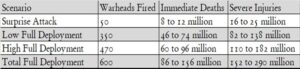
These numbers are barely worth commenting on. With anywhere between 37.6 percent and 100 percent of its population either dead or severely injured, a nuclear attack from a fully deployed Chinese military would completely destroy the United States. Whereas a surprise strike would likely collapse the United States as a country, a full-scale attack would wipe the country off the map. Looking at these numbers, we can be confident that China does not need a larger nuclear stockpile than it has. Taken together with our previous findings that China could easily deploy its nuclear arsenal in adequate time in an emergency situation, it is very difficult to find fault with China’s nuclear strategy.
The Wages of Sin
It is extremely difficult to find fault with China’s nuclear strategy. Unless one believes in the possibility of a surprise outbreak of total war, which, in any case, would likely destroy the world, there is really no justification to have the number of nuclear weapons possessed by either Russia or the United States. Nor is there any rationale for having so many of these weapons constantly deployed. Doing so simply increases the risk of an accidental misfire or some other accident. But even beyond this, it is simply a waste of money. The United States and Russia appear to be wasting enormous amounts of resources in order to maintain such large nuclear stockpiles and to ensure that so many of the warheads are consistently deployed. Yet when one starts to investigate the various nuclear weapons strategies from the perspective of cost, it soon becomes apparent that there are no reliable cost metrics available to compare these strategies. The following table lays out some of the most widely cited estimates of the annual costs of maintaining and building each country’s nuclear deterrent. Note that we have cited the figures in both nominal dollars and in PPP-adjusted dollars.
Figure 4: Estimated Costs of Maintaining and Building Each Country’s Nuclear Deterrent
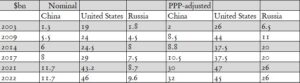
When considering these numbers, consider the following ratios. When it comes to deployed weapons, the ratio of China-Russia-United States looks like this: 1:0.98:0.01. When considering non-deployed weapons, the ratio looks like this: 1:0.75:0.22. Looking at these ratios, we see that the cost estimates make no sense. Russia has slightly more nuclear weapons than the United States, while China has significantly less. Yet Russia’s costs are apparently comparable to China’s rather than to the United States. The same is true even if we PPP-adjust. When we compare numbers and see discrepancies like this, we can only conclude that the numbers are completely unreliable. This is not surprising since the sources that the numbers come from seem to admit that these are often just guesswork. We have taken our 2021 figures for the above table, for example, from the 2022 International Campaign to Abolish Nuclear Weapons (ICAN) report on nuclear weapons spending.28 When discussing Chinese spending, the report notes: “There is no reliable public information about Chinese nuclear spending.”
It seems more fruitful then to build estimates of the various strategies from the ground up. Even if these do not turn out to be accurate, they will give a better sense of how much money a country might save by shifting from a Russian or American nuclear deterrent strategy to a Chinese nuclear deterrent strategy. We know that in 2022 the American nuclear budget was $46 billion. We also know that the CBO has reported that around 60 percent of the budget is allocated to strategic forces (ICBMs, SLBMs, bombers), command, control, communications, and early warning systems, that is, to deployed forces.29 If we divide the budget up using these figures, we find that each deployed nuclear warhead in the United States costs around $16.5 million a year annually, while each non-deployed nuclear weapon costs around $9.5 million annually. We can then apply these ratios to the Chinese and Russian data which we can then PPP-adjust to try to get a reasonable comparison. These are laid out in the table below:
Figure 5: Cost per Missile and Total Deterrent Cost
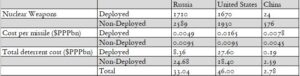
Again, whether these “ground-up” estimates are correct or not does not really matter. What matters is that they show what the different nuclear deterrent strategies cost relative to one another. Here we see that Russian costs and American costs are somewhat similar, with the difference between them being accounted for mostly by the PPP-adjustment we have undertaken for Russia. But these Chinese costs are a fraction of those of the other two economies. This leads us to the ultimate question of the exercise: how much money might the United States save annually if it adopted the more limited Chinese nuclear deterrent model?
To get a ballpark estimate of this, we will take the $2.78 billion PPP-adjusted estimate we have gotten for the Chinese nuclear deterrent, and we will remove the PPP-adjustment. This gives us a figure of around $5.89 billion. This means that, based on our estimates, the United States could save around $46 billion a year if it adopted the Chinese model of nuclear deterrence. For comparison, at the time of writing, total savings from the recent “Department of Government Efficiency” (DOGE) program are claimed to be around $180 billion in total.30 By adopting the Chinese model of nuclear deterrence, the savings would be equal to roughly a quarter of this, meaning that DOGE-equivalent savings would be realized every four years.
Toward a United States Rocket Force
Investigating whether China’s unique nuclear doctrine is coherent has necessitated that we look at some of China’s broader capabilities, especially around their capacities in the Taiwan Strait and the South China Sea. The lessons we have gleaned about nuclear deterrence from studying the Chinese model can be applied by any country, no matter their particular military force structure. But studying China’s broader military capacities carries further lessons that can potentially be learned by other countries. This is especially the case for countries like the United States that share much in common with China geographically, most notably, large land size and extensive access to the ocean.
When looking at the situation around the Taiwan Strait, we may have noted China’s extensive conventional missile capabilities. Some of these are developed directly to maintain control over Taiwan, but even these could be deployed in other conflicts. China’s overall missile force, the People’s Liberation Army Rocket Force (PLARF), is the largest conventional missile force in the world. It is designed for a complete defense of China from the outside world. This feeds into the logic of China’s overall defense strategy. Its nuclear deterrent is limited but can be scaled up quickly in case of escalation. China’s missile forces are developed to provide defense for the country in circumstances where a conflict does not escalate to a nuclear level. This could be in a conflict with a non-nuclear competitor, for example, Taiwan itself if the United States did not intervene, or with a nuclear competitor in a conflict that was managed in such a way that it did not escalate to a nuclear level.
The first layer of the PLARF’s arsenal consists of short-range ballistic missiles (SRBMs) like the Dong-Feng-11 (DF-11), DF-15, and DF-16. China possesses between 750 and fifteen hundred of these and they have a range of up to one thousand kilometers (or 621 miles). In the event of a conflict, these missiles would be used against regional targets like Taiwan, Japan, and America’s Indo-Pacific bases.31 The next layer are the PLARF’s medium-range ballistic missiles (MRBMs). These missiles can strike up to three thousand kilometers (or 1,864 miles) and are a key part of the Chinese arsenal because of their anti-shipping role.
In the event of a naval attack on China, the PLARF’s MRBM stockpile would be deployed against the attacking country’s ships. These missiles include the DF-21D, often referred to as the “carrier killer.” The DF-21D is the world’s first operational anti-ship ballistic missile.32 Other anti-shipping missiles typically use cruise missile technology.33 Given how difficult it is to intercept ballistic missiles, some argue that large naval assets like carriers would be defenseless against a salvo of DF-21Ds. DF-21Ds have also been equipped with maneuverable reentry vehicles (MaRV) which make them almost impossible to target. There is reason to think that a DF-21D equipped with a MaRV may be completely immune to any existing air defense.34 These MRBMs are arguably the most important component of the PLARF’s arsenal and should be studied carefully by defense planners in other countries.
The next layer of China’s missile defenses are its intermediate-range ballistic missiles (IRBMs) like the DF-26. These can hit targets of up to four thousand kilometers (or 2,485 miles) and can be used in either a conventional or a nuclear capacity. They are designed to hit U.S. bases in Guam, among other targets. Some have speculated that they could be used in a long-range anti-shipping role, possibly to hit immobile vessels from long distances.35
Finally, there are the Chinese hypersonic missiles like the DF-17, which is equipped with a hypersonic glide vehicle (HGV).36 Unlike standard ballistic missile reentry vehicles that follow a predictable high-altitude arc, the DF-ZF operates at a lower altitude while flying at up to Mach 10 and utilizing a skip-glide trajectory (sometimes referred to as the “Qian Xuesen” trajectory). The HGV’s maneuverability allows it to evade missile defenses by altering its trajectory midflight, and this makes it much harder to track and intercept compared to conventional ballistic missiles. HGVs are the crown jewel of China’s counterintervention strategy, which aims at complete area denial to foreign military forces because it should, in theory, be able to overcome almost any air defense and hit any target reliably and extremely quickly. China also has an array of ground-launched cruise missiles, but these play a more minor role in its overall missile arsenal.
When we turn to look at the missile forces of the United States, these are much more limited.37 This is because the United States has adopted a military strategy that relies much more on fixed-wing aircraft. The United States has no conventional ballistic missiles whatsoever. The country has exclusively developed ballistic missile technology for its nuclear arsenal.38 All the United States has are cruise missiles like the Anti-Tactical Missile System (ATACMS), the Tomahawk, and the Joint Air-to-Surface Standoff Missile (JASSM). The fastest of these missiles is the ATACMS, which can fly at Mach 3 but only has a range of 193 miles.39 Whichever way one looks at it, America’s conventional missile arsenal is extremely underdeveloped.
Taken together with its nuclear deterrent, the PLARF renders China as impenetrable as is likely possible with contemporary weapons technology. As the United States eschews foreign involvements and starts to focus its attention on the its own hemisphere, there is a strong argument to be made that the country should study carefully the military structure of China and try to learn lessons from it. America’s current military structure is that of an “imperial island nation,” copied from the British and aimed at overseas power projection.
As the United States pulls back from its global commitments, it is perhaps the time as well to fall back on its more natural geographical defensive stance and operate a “defensive island nation” posture. This would greatly increase the security of the United States and reduce the amount of money that needs to be spent on defense. China’s nuclear deterrent cannot be understood in isolation from its broader military strategy. This does not mean that the United States or other countries could not replicate the Chinese nuclear doctrine—doing so would probably be a good in and of itself. But to get the optimal defensive benefit, a country should also develop a serious rocket force like the PLARF. This would generate enormous savings of its own inside the militaries of the Western nations, but a discussion of this topic would take us too far afield for the present essay.
From Offense to Defense
We have not chosen to look to China for clues to reform the defensive capabilities of the United States. The current military structure that the United States has was built for a very different world than the one the country will face in the twenty-first century.
In the last century, the United States effectively took over Britain’s status as a country that needed to project force all over the world. Its military structure reflects this still. Its current nuclear deterrent reflects developments in the Cold War that were often reactive. For this reason, the U.S. defensive posture overall has no actual strategic thinking behind it. China’s, on the other hand, has been thought through carefully and that is what makes it unique among the superpowers.40 China and the United States have very similar defense needs from a geographical perspective: in fact, being surrounded by non-hostile countries and having an ocean of two coasts, the United States is more suited than China itself for the broad Chinese defensive strategy. For this reason, policymakers in the United States should carefully study China’s defensive strategy in general and its nuclear deterrence strategy in particular. Learning lessons from this strategy could massively reduce costs for the U.S. government while significantly increasing the country’s actual defenses.
For the United States to wind down its nuclear arsenal, however, it seems likely that policymakers would need to see Russia do the same. We have shown that having such a large, deployed nuclear stockpile as the Americans and Russians do is a waste of resources. But psychologically, it seems unlikely that the United States could decommission large amounts of nuclear weapons and then put most of what is left into storage unless the Russians did the same.
Extensive nuclear discussions with the Russians and joint work on this project would be political prerequisites for such a goal. This would also allow the two countries to discuss which technologies they should ban to prevent accidents.
While the limited deployment stance reduces the risk of an accidental exchange, we have seen that such an exchange, even with a limited deployed force, could destroy the two countries that engaged in it. For this reason, the United States and Russia should once more consider “speed limits” on the nuclear arsenal that is deployed at any given moment in time. Slower missiles mean longer warning times—and a longer period to communicate any accidental misfire. This is standard practice in arms control and is in the interest of every country.
This article is an American Affairs online exclusive, published November 20, 2025.
Notes
1 The French poststructuralist philosopher Jacques Derrida highlighted this interesting linguistic phenomenon. Although, as with much in his work, he makes too much out of it. See: Jacques Derrida, Dissemination (London: Athlone Press, 1981)
2 Mao Tse-tung, “Talk with the American Correspondent Anna Louise Strong,” Marxists.org, August 1946.
3 Hsinhua, “Statement by Peking on the Nuclear Test,” New York Times, October 17, 1964.
4 Hui Zhang, “China’s No-First-Use Policy Promotes Nuclear Disarmament,” Diplomat, May 22, 2013.
5 Missile Defense Project staff, “DF-41 (Dong Feng-41/CSS-X-20),” Center for Strategic and International Studies – Missile Defense Project, April 23, 2024.
6 Laura Caggiano, “China Deploys New Submarine-Launched Ballistic Missiles,” Arms Control Association, May 2023.
7 Hans M. Kristensen, Matt Korda, Eliana Johns, and Mackenzie Knight, “Chinese Nuclear Weapons,” Bulletin of the Atomic Scientists 81, no. 2 (2025).
8 “The current [Ground-Based Midcourse Defense] capabilities are low and will likely continue to be low for the next 15 years, particularly against a sophisticated threat employing countermeasures such as decoys or MIRVs.” See: William Thomas, “Physicists Argue US ICBM Defenses Are Unreliable,” American Institute of Physics, March 1, 2022.
9 Alex Wellerstein, “NUKEMAP,” Nuclear Secrecy, accessed June 17, 2025.
10 Adam J. Liska, Tyler R. White, Eric R. Holley, and Robert J. Oglesby, “Nuclear Weapons in a Changing Climate: Probability, Increasing Risks, and Perception,” Environment Magazine 59, no. 4 (2017): 15–27.
11 Matthew Powell, “Introducing the Oreshnik Missile: Vladimir Putin’s Not-so-Secret Weapon,” Conversation, December 2, 2024.
12 Gerry Doyle, Tom Balmforth, and Mariano Zafra., “Enter ‘Oreshnik,” Reuters, November 28, 2024.
13 Federation of American Scientists staff “Chinese Nuclear Weapons, 2025: Federation of American Scientists Reveals Latest Facts on Beijing’s Nuclear Buildup,” Federation of American Scientists, March 12, 2025.
14 Ministry of Defence Police, “Out and About with the SNM,” Talk Through, no. 118 (2004): 16–19.
15 Stephen Cameron, Defence Nuclear Materials Transport Contingency Arrangements (London: Local Authority and Emergency Service Information, 2007).
16 Nathan Beauchamp-Mustafaga, Elliot Ji, Alexis Dale-Huang, Cindy Zheng, Gregory Graff, and Dahlia Anne Goldfeld, Denial Without Disaster: Keeping a US-China Conflict over Taiwan under the Nuclear Threshold (Santa Monica, CA: RAND Corporation, 2024).
17 The classic of the genre is, of course: Thomas C. Schelling, The Strategy of Conflict (Cambridge, MA: Harvard University Press, 1981).
18 Michael Jestrab, “A Maritime Blockade of Taiwan by the People’s Republic of China: A Strategy to Defeat Fear and Coercion,” Atlantic Council, December 12, 2023.
19 Gabriel Dominguez, “As Invasion Fears Rise, China Hones Taiwan Blockade Strategy,” Japan Times, October 3, 2023.
20 Bonny Lin, Brian Hart, Matthew P. Funaiole, Samantha Lu, and Truly Tinsley, “How China Could Blockade Taiwan,” Center for Strategic and International Studies – ChinaPower Project, August 22, 2024.
21 Up until now I have followed Lin et al. to the letter. From here I will present various “options” for China which those authors have spun out into different scenarios.
22 Lin et al., “How China Could Blockade Taiwan.”
23 Jasper Campbell and James Martin, “Prepare the Logistics to Break a Chinese Blockade of Taiwan,” Proceedings 148, no. 10 (October 2022): 1436.
24 Lin et al., “How China Could Blockade Taiwan.”
25 Kristensen et al., “Chinese Nuclear Weapons.”
26 Federation of American Scientists staff, “Chinese Nuclear Weapons, 2025.”
27 If we make more generous assumptions—including that many ICBMs are MIRV capable—China could deploy its entire six hundred warheads. This actually seems quite likely because China’s nuclear doctrine seems highly rational and there is good reason to think that they do not maintain any redundant warheads.
28 Alicia Sanders-Zakre and Susi Snyder, Squandered: 2021 Global Nuclear Weapons Spending (Geneva: International Campaign to Abolish Nuclear Weapons, 2022), June 2022.
29 Michael Bennett and David Mosher, Projected Costs of U.S. Nuclear Forces, 2021 to 2030 (Washington, D.C.: Congressional Budget Office, 2021).
30 DOGE staff, “Savings,” Department of Government Efficiency (DOGE), June 3, 2025.
31 Hans M. Kristensen and Matt Korda, “The Pentagon’s 2019 China Report,” Federation of American Scientists, May 6, 2019
32 ChinaPower Project staff, “How Are China’s Land-based Conventional Missile Forces Evolving?,” Center for Strategic and International Studies – ChinaPower Project, May 12, 2021.
33 Briefly, the difference between ballistic missiles and cruise missiles is that the latter operate at low altitudes like aircraft while the former are fired out of the earth’s atmosphere using an arching trajectory. Due to their extreme speed—up to Mach 11 compared to Mach 3 for cruise missiles—they are very hard to shoot down, especially if multiple missiles are fired at once or if they are equipped with MIRV vehicles.
34 Aziz Erdogan, “DF-21D (East Wind) – The World’s First ASBM,” Beyond the Horizon (blog), January 4, 2021.
35 Since China has anti-shipping ballistic missiles like the DF-21D, it is probably only a matter of time before IRBMs can be equipped with MaRV warheads and used in long-range anti-shipping roles. If this technology were to develop large naval vessels like aircraft carriers could become an enormous liability for the countries that deploy them. See: Philip Pilkington, “Redundant Aircraft Carriers, Maneuverable Oreshniks, and Hybrid Ekranoplans,” National Interest, March 2, 2025.
36 Lauren Frias, “China’s Missile Arsenal May Soon Rival the US. Here Are the Leading Missiles It’s Stockpiling for a Big Fight,” Business Insider, September 28, 2024.
37 Drew Wood, “How Do the Most Powerful Missiles in the US Arsenal Compare to Russia’s and China’s?,” 24/7 Wall Street, February 13, 2025
38 I could not find a single article explaining why the United States has not developed a conventional ballistic missile strike capability. This seems like an enormously important question but investigating it would take us far beyond the scope of this essay. A cursory glance at the evidence suggests that this was probably an institutional decision to ensure that the U.S. Air Force maintained its military budget intact.
39 Missile Defense Project staff, “Country: The United States,” Center for Strategic and International Studies – Missile Defense Project, accessed June 2025..
40 Russia’s military structure is also a remnant of the Cold War, including its nuclear deterrent. But since the Russo-Ukraine war started in 2022, this is gradually beginning to change. In fact, Russia was an adopter of new missile technology, a development that goes right back to the Cold War days. But China has been given by far the largest “historical blank slate” to develop its military strategy.