The Defense Production Act of 1950 (DPA) is one of America’s oldest and most important industrial policy laws, reemerging in recent years as a vital tool for addressing urgent national crises. Yet for decades, the DPA was rarely used outside of the Department of Defense, and was hardly the subject of major policy debates or headline news. That changed over the last five years, as both presidents Trump and Biden increasingly came to rely on the law for a number of emergent needs. The DPA expanded and hastened the production of ventilators, personal protective gear, and vaccines during the pandemic.1 It advanced domestic energy security.2 It helped resolve baby formula shortages.3 It helped restore hurricane-damaged IV fluid production sites.4 And under both presidents, it increased our supply of critical minerals.5
This year, Congress will decide whether, and how, to reauthorize the DPA. Despite the law’s Covid-era resurgence, some in Congress have pushed to “refocus” the law on “core” national security needs by restricting its use in the civilian economy.6 In a congressional hearing last year, entitled Mission Critical: Restoring National Security as the Focus of Defense Production Act Reauthorization, Republican members of Congress voiced concern over how the DPA has, in their view, strayed into non-defense realms of the civilian economy. Congressman Andy Barr bemoaned how the “DPA has drifted from its original focus on national defense to address non-defense national emergencies,”7 specifically targeting energy-related appropriations for the DPA under the Inflation Reduction Act. Congressman Blaine Luetkemeyer said he was “concerned about the expansion” of the law, particularly singling out the Biden administration’s baby formula effort.8 Congressman Dan Meuser lamented that using the DPA for green energy projects came “at the expense of our national security,” saying that “we need to put the ‘D’ back in ‘DPA.’”>9
At first blush, it’s an understandable reaction. After all, what do infant formula or solar panels have to do with national security? Shouldn’t the Defense Production Act stay in its lane?
But that reaction misunderstands the origins and purposes of the DPA and dismisses long-held American instincts about how best to protect our national security. In truth, narrowing the DPA won’t create a refocused law so much as a weak, short-sighted one. For good reason, the DPA has never distinguished between the civilian and defense economies, and it has been used to respond to all manner of economic perils, from inflation to energy crises, that threaten both. The Act has long reflected the strategic sensibility, once commonly understood across our policymaking apparatus, that the economic health of the country and its citizens undergirds our national defense. Rather than diminishing the DPA, Congress should reaffirm—or even better, expand—the law’s longstanding authorities to further ensure that important national priorities take precedence over the whims of the market. The supposedly adrift DPA is in reality an adept DPA, a law suited to responding to the wide range of modern threats to our national security with flexibility and effectiveness.
The Economic Past and Present of the DPA
Since its inception, the DPA has been, in part, a set of tools available to stabilize the economy.10 The law’s origins can be traced back to emergency economic policies during World War II. To reinforce the wartime economy, President Franklin Roosevelt’s administration deployed price controls. With supermajority support in public polls, the FDR administration relied in part on thousands of regular American shoppers as the “front-line forces in the fight against inflation” to spot and challenge violations of price controls in local stores.11 Despite enormous inflationary pressure from the military mobilization, after a few iterations of price controls, FDR’s intervention worked: consumer price increases were held to just 2 percent during the war’s final two years.
After the war ended in 1945, President Truman wound down price controls, which were due to expire by law a year later. Pent-up demand and postwar consumer spending quickly triggered a new surge in inflation, however. Truman, with the backing of prominent economists like future Federal Reserve chair Arthur Burns, asked Congress to extend price controls to no avail. Inflation continued to climb from 1946 to 1948, particularly for meat and other food products.
Truman unexpectedly won reelection in 1948 by railing against a “Do Nothing” Congress that refused to tackle high prices. Democrats gained control of Congress in that election, too. In his 1949 State of the Union address, Truman asked Congress to enact an anti-inflation agenda, including price controls, consumer credit controls, authority to direct priorities and allocations for key materials facing shortages, and investments in productive capacity for critically short supplies (particularly steel). Democrats in Congress then introduced legislation—the Economic Stabilization Act—to give Truman these powers.
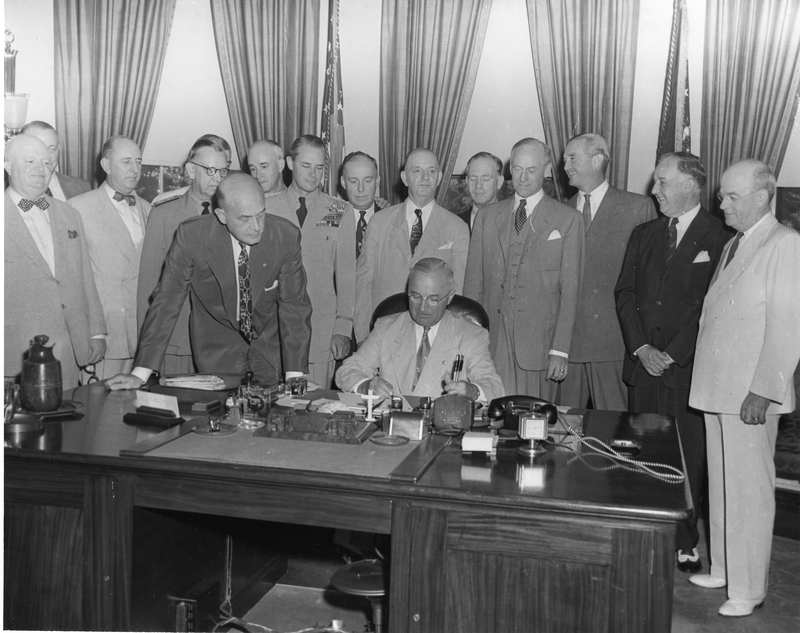
In June 1950, the outbreak of the Korean War (feared at the time as a potential start to World War III) heightened inflationary worries and created political urgency for Congress to enact Truman’s price-stabilization agenda. Weeks after American troops entered the war, Truman issued a special message to Congress reiterating his call for stronger economic authorities. Truman’s aides then worked with Congress to turn the Economic Stabilization Act of 1949 into the Defense Production Act of 1950, which included Truman’s requested anti-inflation tools.
Notably, the impetus for what ultimately became the DPA predated hostilities in the Korean peninsula. The conventional narrative of the DPA’s origins as being tied to the Korean War, therefore, misrepresents that law’s true origins.
In passing the DPA, Congress determined that it needed to give the president “adequate authority to meet these potentially serious inflationary pressures,” and that “a system of controls must be available both as a restraint and as a ready weapon for combating inflation.”12 The Senate Banking Committee saw the DPA’s authority to invest in productive capacity as a tool to overcome bottlenecks and expand the supply of critical goods.
In early 1951, Truman’s Office of Price Stabilization began administering price ceilings for most consumer goods. This intervention worked again: inflation fell from 8 percent to 2 percent, with the largest price increases concentrated among goods and services that Congress had exempted from controls. Nevertheless, because Republicans had gained seats in 1950, Congress began curtailing the DPA’s price controls in the summer of 1951 and allowed them to expire in 1953.
In 1970, as part of legislation extending the DPA, price controls were revived in response to more inflation. Democrats in control of Congress expected this authority would go unused by President Richard Nixon, who had detested price controls since his early experience administering them as an attorney in the Roosevelt administration. But with more than 60 percent of the country favoring price controls as inflation rose in 1971, Nixon acquiesced and announced a temporary price freeze followed by price ceilings administered by a small Cost of Living Council, led by future secretary of defense Donald Rumsfeld. Nixon’s price controls initially succeeded in cutting inflation from 6 percent to 3 percent by the middle of 1972. But after winning a second term, Nixon almost immediately ended price controls, fueling more inflation that persisted for the rest of the decade.
While Congress amended the DPA to remove price controls in 1974, it still gives the president a number of other inflation-fighting powers.13 For instance, it allows the president to direct priorities and allocations to ensure resources facing shortages go to the highest-priority uses—a power President Biden invoked to alleviate a baby formula shortage in 2022. The DPA prohibits certain forms of price-gouging, which both the Trump and Biden administrations used to crack down on retailers who overcharged for masks and other critical products during the pandemic. The DPA also empowers the president to increase the domestic productive capacity and supply of critical goods—an authority President Biden used to, among other things, invest in domestic production of essential medicines.
The president may also use the DPA to obtain information from industry, including through testimony or by inspecting corporate books, records, and properties. This could be used to monitor pricing decisions, gather information on supply chains, or to conduct audits of corporations suspected of price-gouging or profiteering.
Finally, the DPA allows the president to facilitate voluntary agreements among private firms, free from antitrust scrutiny. This could be used to negotiate agreements with industry to limit prices and profits, much like the deal the Mexican government struck that successfully capped prices on a “basics basket” of food and consumer essentials.14
In the congressional debate over whether to retain or cabin these authorities, energy projects have become a particular lightning rod. Yet the DPA has long explicitly defined “national defense” to include energy production. And despite Republican congressional backlash to President Biden’s use of the law for clean energy projects, President Trump’s March 2025 executive order similarly invoked the DPA for critical minerals with the explicit aim of addressing a “National Energy Emergency,” and critical minerals are particularly important for the kind of renewable energy infrastructure that has otherwise been disfavored by this administration.
Moreover, deploying the DPA to secure domestic energy supply is hardly novel. As early as the 1950s, the Department of the Interior relied on the DPA to respond to emergencies that jeopardized oil supply—first after the 1951 assassination of the Iranian prime minister, and again after the Suez Canal crisis of 1956–57, when Egypt’s attempt to nationalize the canal threatened the transportation of oil.15 In 1967, after several Arab countries imposed an oil embargo on the United States, the government used the DPA to refurbish old oil tankers to increase oil shipments from other countries.16
The DPA was particularly useful for enabling energy investments in response to the severe oil shocks in the 1970s that roiled the economy and harmed consumers. In 1974, after the Organization of Petroleum Exporting Countries (OPEC) subjected the United States to another oil embargo, the government invoked the DPA to accelerate the construction of the Trans-Alaska crude oil pipeline. In the late 1970s, to further protect the United States from such oil squeezes, President Jimmy Carter began using the DPA to fund research into then cutting-edge energy sources like natural gas and liquefied coal, launching the U.S. Synthetic Fuels Corporation to finance the development of plants to produce alternative fuels.17 (The Synfuels Corporation was not long for this world, and was unwound by the Reagan administration.) During this era of energy crises, DPA-led industrial policy helped promote domestic stabilization while defusing calls for more dramatic policy measures, like nationalizing oil companies or taking military action against OPEC nations.
The DPA has even been invoked to respond to purely domestic energy shocks. In 2000 and 2001, California suffered from a serious electricity crisis caused in part by the market manipulation of Enron and other energy trading firms, leading to rolling blackouts and surging household energy costs. When California’s largest utility fell into bankruptcy, the outgoing Clinton administration invoked the DPA to compel suppliers to sell natural gas into the state anyway—an action that was continued by the succeeding Bush administration. There is thus a long history of presidents using the DPA to enhance national energy security and relieve attendant the economic hardship on consumers.
Economic Stability for National Security
What the history of the DPA shows is that policymakers have long recognized that economic stability advances national security. There are at least five reasons why:
First, the preservation of stable domestic affairs is, in many ways, precisely what national security aims to protect. A broadly prosperous economy in turn funds the nation’s ability to protect itself. The American diplomat George Kennan defined national security as “the continued ability of this country to pursue the development of its internal life without serious interference.”18 In national security strategies (NSS) issued by presidential administrations since 1986, presidents from both parties have struck similar chords. In the first NSS, in 1987, the Reagan administration included a “healthy and growing US economy” as one of five “key national interests” to protect: the next year, the administration declared that “we rely on the size and strength of the US economy as our ultimate line of defense.”19 In 2010, the Obama administration’s NSS said, “In the long run, the welfare of the American people will determine America’s strength in the world. . . . Our prosperity serves as a wellspring for our power.” In 2017, the Trump administration likewise wrote that “a strong economy protects the American people, supports our way of life, and sustains American power.”20
Second, the absence of economic stability can reverberate beyond domestic politics and impede upon national security. During wartime, economic instability at home has jeopardized national defense operations abroad. World War I brought on economic tumult in the United States that led to “a near revolutionary combustibility,” as historian Meg Jacobs put it in her book Pocketbook Politics, which frequently threatened to undermine the war effort. Consumer prices more than doubled in the five years after the outbreak of war in Europe in 1914.21 Food prices were a particular problem: before the United States entered the war, it supported the allies with an increasing volume of food shipments to compensate for shipping losses from German U-boat attacks.22 These foreign-policy-driven exports, coupled with poor agricultural yields in 1916, led to a severe food shortage and rising prices at home that threatened to subvert national security imperatives.23 Rising consumer prices led to production shutdowns from labor unrest, as workers demanded higher wages and went on strike at record levels, with one million workers walking off the job between April and October 1917.24
After the U.S. entered the war, the rising cost of living was compounded by energy shortages in the winter of 1917–18. Coal supplies were dwindling, and local officials went so far as to commandeer passing coal trains so their constituents could heat their homes. The Wilson administration was forced to briefly order all factories east of the Mississippi closed for four days to prioritize coal shipments for ships idled at eastern seaports. This emergency was seen as a wartime embarrassment signaling national weakness and mismanagement: it led to attempts by Congress to seize control of the war effort.25
The Wilson administration was often slow to respond to wartime economic instability at home, settling instead for rhetorical attacks on corporate profiteering.26 Administration bodies like the War Industries Board and the Price Fixing Committee resisted calls to stabilize the cost of living, limiting price controls largely to raw materials processing.27 (Because these bodies were created by executive action, industry compliance with price controls was “voluntary” under the threat of government seizure.28) Other administration offices like the Herbert Hoover–led Food Administration did regulate the markups retailers could charge for foodstuffs, and relied on conservation-oriented strategies—like “meatless Mondays” and “wheatless Wednesdays”—to counter inflation.29 The administration’s stabilization actions did eventually help ease the country’s inflationary spiral: before the government began intervening against inflation, wholesale prices were rising at an annual rate of 32 percent; after August 1917, they rose at a 7 percent annual rate.30
The World War I experience later informed President Franklin Roosevelt’s determination to secure domestic economic stability during World War II. After declaring in 1940 that the United States would support the allies as an “arsenal of democracy,” President Roosevelt assured the public in a fireside chat, “This emergency demands that the consumers of America be protected so that our general cost of living can be maintained at a reasonable level. We ought to avoid the spiral processes of the [first] World War, the rising spiral of costs of all kinds.”31 Roosevelt thereafter embraced price controls and other economic management policies during World War II.
Third, as Roosevelt recognized, having robust tools to promote economic stability is particularly important during large-scale conflicts. Mobilizing industry and converting the economy to wartime production will often require suspending normal market operations to give priority to military needs, while restraining profiteering and inflation. In 1951, the Industrial College of the Armed Forces (ICAF), a wing of the Department of Defense’s National Defense University, recognized the need for the government to strengthen its management of the economy during national emergencies. “[I]ncreased prices and profits as the sole incentive or principal motive are not relied upon to induce industries to convert to war production,” ICAF wrote, and the country should not tolerate more than a “moderate increase” in most prices and profits. Other incentives were needed, ICAF recognized, such as “patriotism, interests of national security, and long-run industrial well-being. Some form of limitation is needed to keep the price rise within bounds.”32
In his 1960 book The Political Economy of National Security, James Schlesinger, an economist who would go on to serve in three presidential administrations as secretary of defense and secretary of energy, concurred. In a national security conflict, he wrote, “[t]he reorientation of the economy that is required may be so severe that the price system becomes an inadequate instrument to achieve the necessary production shifts.”33 Because war mobilization imposes such a strain on the domestic economy, “[a]t some point . . . it becomes advisable to develop a system of controls to deal with the tensions that arise.”34
Fourth, national security depends on economic stability in a very direct sense in order to preserve military budgets and finance diplomacy. Inflation erodes defense budgets, makes it harder for the military to attract and retain strong servicemembers, and increases the cost of government borrowing to finance any major military conflict. FDR took action against wartime inflation both to protect consumers, but also to protect the military, which had been placing orders for hundreds of millions of articles of increasingly expensive clothing in competition with private demand, accelerating price levels.35 The Obama administration’s 2010 NSS recognized that “[o]ur prosperity . . . pays for our military, underwrites our diplomacy and development efforts, and serves as a leading source of our influence in the world.”36
And fifth, economic stability sustains the manpower needed for defense production. Workers who lack basic economic security—which consists of housing, health care, nutrition, and so on—will be less equipped to mount an effective mobilization campaign. During the Cold War, Congress enacted civil defense legislation on the understanding that defense productive capacity depended on the economic wellbeing of the workforce and citizenry. The Federal Civil Defense Act of 1950 was enacted to protect civilian life and property from a potential enemy attack on the United States, and created a system for the emergency provision of medical, health, sanitation, and welfare services, among other measures. When it passed the FCDA, Congress explicitly recognized the link between defense productive capacity and civilian economic security:
[P]roduction capacity depends utterly upon the community in which it thrives. In the community sense, production capacity also demands houses within reach of the factories, and transportation facilities by which people can get to and from their work. . . . It demands families to be cared for, and places for those families to live in, and enough light and heat and water to make their homes habitable. It demands schools for the children, and medical care for the old and infirm.37
Civil defense was meant to preserve, to the greatest feasible extent, the economic stability of the American people in the event of an attack. As the Senate Committee on the Armed Services recognized, such preservation was “vital to the security of the United States, because it will provide the means of minimizing the effects of such attack and permit this country, if attacked, to retain its ability to fight back.”38 That meant ensuring that people had food, clothing, shelter, fuel, social insurance benefits, and employment. The National Security Resources Board—a onetime federal agency focused on emergency mobilization—understood that these foundations of individual economic security were “required to enable people to return promptly to productive activity.”39
In the face of the omnipresent threat of atomic attack during the Cold War, the United States saw maintaining secure economic conditions for the American people as an essential component of its national security. When enacted in 1950, the text of the DPA reflected Congress’s view that economic stabilization was critical to national security. Title IV granted the president wage and price stabilization authority, declaring it “the intent of Congress . . . to prevent inflation . . . to stabilize the cost of living for workers and other consumers . . . to eliminate and prevent profiteering [and] to protect consumers, wage earners, investors, and persons with relatively fixed or limited incomes from undue impairment of their living standards.”40 Congress deemed such economic intervention “necessary . . . to promote the national defense.”41
The Economic Future of the DPA
The DPA’s economic stabilization authorities are important to retain now more than ever. A new era of economic warfare has dawned: Nations competing for industry, technological advantage, strategic resources, and geopolitical dominance are increasingly weaponizing supply chains and taking aim at adversaries’ economies in a series of moves and countermoves. Economic weapons like tariffs, sanctions, and export controls are proliferating, while targeted nations seek to evade them via smuggling and cryptocurrency to conduct stealth transactions. Countries are leveraging choke points in the global financial and communications systems, while others create new financial blocs and institutions to evade American surveillance and power.42
So far, the United States has been a leader in deploying these tactics. But what goes around tends to come around, and we should expect to reap blowback from other countries turning this economic arsenal against us. Already, countries have responded to the Trump administration’s tariffs in kind, targeting politically sensitive industries and regions in the United States.43 The administration, meanwhile, has warned Americans to prepare for economic pain while waiting for tariffs to reshore industries, with President Trump saying that domestic firms and workers bearing the brunt of foreign retaliation will “have to bear with me again.”44
If the future of warfare aims for economic destabilization, then tools for economic stability will be an essential defense. As with past instances of actual warfare, Americans will better weather economic battles if they are protected by economic shields. Given the potential scale of domestic economic dislocation, we will need strong policy authorities to cushion against shocks and to fortify our capacity to meet any challenge—authorities like the DPA’s.
Simply put, this is no moment to abandon the DPA’s insight that economic stability promotes national security. Instead of circumscribing the DPA’s economic stability authorities, Congress should expand them.45 First, Congress could consider restoring authorities to stabilize the prices of economically critical goods experiencing sharp price changes due to abnormal market conditions. This could include supply disruptions resulting from natural disasters, public health emergencies, military conflict, or similar circumstances. Targeted price stabilization would shield consumers from shocks by applying an “inflation brake” to keep a market disruption from spilling over to affect downstream prices. It would resemble a quarantine to prevent illness from spreading across a wider population, or a forced stock market trading pause following unusual market activity. Or this tool may be needed to set price floors to shield domestic producers from predatory competition by foreign companies, such as heavily subsidized Chinese firms dumping commodities into the country to undercut American competitors. The DPA’s existing price-gouging prohibitions should be strengthened and harmonized with these tools.
Additionally, Congress could reinstate strategic credit controls, another lapsed DPA power. This would be a more precise tool than the Federal Reserve’s monetary policy adjustments: where general interest rate changes affect the cost of borrowing across the entire economy, strategic credit controls can do so for only certain targeted sectors. For instance, in the event of a lumber shortage, credit controls could apply to nonessential construction.
Congress could also strengthen the DPA’s current policy of geographic resilience for the industrial base. Since the 1950s, the DPA has included a policy statement encouraging geographic dispersal of industry for protection against attacks by enemies of the United States (particularly nuclear attacks by the Soviet Union). This policy could be updated and expanded to protect domestic industry against modern threats. Congress could give the president greater authority to initiate loan guarantees and other flexible investment arrangements under Title III of the DPA to promote and preserve critical, geographically resilient industry in the United States. This would both promote national and economic security, by better insulating industry from external threats, as well as geographic equality, by spreading industry to more of the country.
Congress might also reconsider past proposals to invest in secure supply chains. In the course of the legislative process that ultimately yielded the chips and Science Act, Congress considered amending Title III of the DPA to authorize investments to strengthen supply-chain resilience through increased production of critical components, technologies, and raw materials.46 Congress should revisit that legislation to enhance the government’s ability to intervene to protect critical supply chains.
But at a minimum, Congress should not retreat from the DPA’s historic role as a flexible tool to secure the general economic stability of the United States. The economic origins and application of the Defense Production Act may strike some as counterintuitive and unusual. That’s because the DPA is a modern outlier—a vestige of the pre-neoliberal era, when policymakers pursued national and economic security needs in concert. The recent urge to “refocus” the DPA on narrow defense sectors is to rewrite its history of success and eliminate its comprehensive role in defending American economic and national security.
We forget the lessons of this history at our own risk. The threats the United States faces this century will be all the more difficult to vanquish if we narrowly circumscribe our capabilities for strengthening economic resilience. Any effort to “rein in” the DPA would needlessly weaken both the law and our national security.
This article originally appeared in American Affairs Volume IX, Number 2 (Summer 2025): 69–80.
Notes
1 Anshu Siripurapu, “
What Is the Defense Production Act?,” Council on Foreign Relations, December 22, 2021.
2 U.S. Department of Energy, “President Biden Invokes Defense Production Act to Accelerate Domestic Manufacturing of Clean Energy,” June 6, 2022.
3 White House Office of the Press Secretary, “White House Press Release – President Biden Announces First Two Infant Formula Defense Production Act Authorizations,” American Presidency Project, May 22, 2022.
4 HHS Press Office, “Fact Sheet: Biden-Harris Administration Takes Action to Ensure Americans Can Access Medical Supplies Following Hurricanes Helene and Milton,” U.S. Department of Health and Human Services (Web Archive), October 11, 2024.
5 White House Office of the Press Secretary, “Memorandum on Presidential Determination Pursuant to Section 303 of the Defense Production Act of 1950, Amended,” White House, March 31, 2022; White House, “Immediate Measures to Increase American Mineral Production,” March 20, 2025.
6 Andres Picon, “The Next Big Energy Fight: Defense Production Act Renewal,” E&E News by Politico, April 30, 2024.
7 U.S. Congress, House, Committee on Financial Services, Mission Critical: Restoring National Security as the Focus of Defense Production Act Reauthorization, 118th Congress, 2nd sess., 2024, Statement of Representative Andy Barr.
8 U.S. Congress, House, Committee on Financial Services, Mission Critical: Restoring National Security as the Focus of Defense Production Act Reauthorization, 118th Congress, 2nd sess., 2024, Statement of Representative Blaine Luetkemeyer.
9 U.S. Congress, House, Committee on Financial Services, Mission Critical: Restoring National Security as the Focus of Defense Production Act Reauthorization, 118th Congress, 2nd sess., 2024, Statement of Representative Dan Meuser.
10 Portions of this essay are adapted from: Joel Dodge, “The Anti-Inflation Defense Production Act,” Vanderbilt Policy Accelerator, March 2025.
11 Meg Jacobs, Pocketbook Politics: Economic Citizenship in Twentieth-Century America (Princeton: Princeton University Press, 2007), 203–4.
12 The Defense Production Act of 1950, as Amended, U.S. Code 50 (2018), § 4501 et seq.
13 The following DPA authorities are expanded upon in: Dodge, “The Anti-Inflation Defense Production Act.”
14 “Sheinbaum, Business Sector Agree to Lower Basic Food Prices,” Mexico News Daily, November 13, 2024.
15 Douglas I. Bell, “‘A Little-Known Bill of Great National Significance’: The Uses and Evolution of the Defense Production Act, 1950–2020,” U.S. Army Heritage & Education Center, 2020, 22.
16 Bell, “A Little-Known Bill.”
17 Bell, “A Little-Known Bill,” 23.
18 John Lewis Gaddis, Strategies of Containment: A Critical Appraisal of American National Security Policy during the Cold War (Oxford: Oxford University Press, 2005), 26.
19 National Security Strategy of the United States (Washington, D.C.: White House, 1987); National Security Strategy of the United States (Washington, D.C.: White House, 1988), 21.
20 National Security Strategy (Washington, D.C.: White House, 2010).
21 Jacobs, Pocketbook Politics, 53.
22 Jacobs, Pocketbook Politics, 53.
23 Jacobs, Pocketbook Politics, 54.
24 Jacobs, Pocketbook Politics, 64.
25 David M. Kennedy, Over Here: The First World War and American Society (Oxford: Oxford University Press, 2004), 90–91.
26 Jacobs, Pocketbook Politics, 55
27 Hugh Rockoff, Drastic Measures: A History of Wage and Price Controls in the United States (Cambridge: Cambridge University Press, 1984), 50, 64.
28 Rockoff, Drastic Measures, 75-76.
29 Rockoff, Drastic Measures, 51; Jacobs, Pocketbook Politics, 56.
30 Rockoff, Drastic Measures, 83.
31 Franklin D. Roosevelt, “Fireside Chat—May 26, 1940,” American Presidency Project, accessed April 2025.
32 Benjamin H. Williams, Emergency Management of the National Economy (Washington, D.C.: Industrial College of the Armed Forces, 1954); ICAF recognized that economic management is a matter of degree: “In a broad sense the national economy is always being managed in one way or another. Tariffs, antitrust laws, interstate commerce regulations, and fair trade practice requirements are forms of control”; Rockoff, Drastic Measures.
33 James R. Schlesinger, The Political Economy of National Security: A Study of the Economic Aspects of the Contemporary Power Struggle (New York: Praeger, 1960), 74.
34 Schlesinger, The Political Economy of National Security, 75.
35 Jacobs, Pocketbook Politics, 182.
36 National Security Strategy (201o).
37 U.S. Congress, Report on the Amending Section 3804 of the Internal Revenue Code (Washington, D.C.: U.S. Government Printing Office, 1939), 8.
38 U.S. Congress, Report on the Federal Civil Defense Act of 1950 (Washington DC: U.S. Government Printing Office, 1953).
39 United States Civil Defense (Washington, D.C.: U.S. Government Printing Office, 1950).
40 The Defense Production Act of 1950, as Amended.
41 The Defense Production Act of 1950, as Amended.
42 Henry Farrell and Abraham Newman, Underground Empire: How America Weaponized the World Economy (New York City: Henry Holt & Co., 2024).
43 Daniel Desrochers and Grace Yarrow, “Republicans Squirm as Trump’s Tariffs Come for Their States,” Politico, March 4, 2025.
44 Shannon Pettypiece, “Trump and His Allies Hint at Economic Pain Ahead for Americans,” NBC News, March 7, 2025.
45 The following policy recommendations are expanded upon in: Dodge, “The Anti-Inflation Defense Production Act.”
46 U.S. Congress, House, H.R. 4521, America Competes Act of 2022, section 60903.