
2 Schweizerische Kreditanstalt was the bank’s name then.
3 Bruce Caldwell, ed., Mont Pèlerin 1947: Transcripts of the Founding Meeting of the Mont Pèlerin Society (Stanford: Hoover Institution, 2022).
4 Caldwell, Mont Pèlerin 1947, 1.
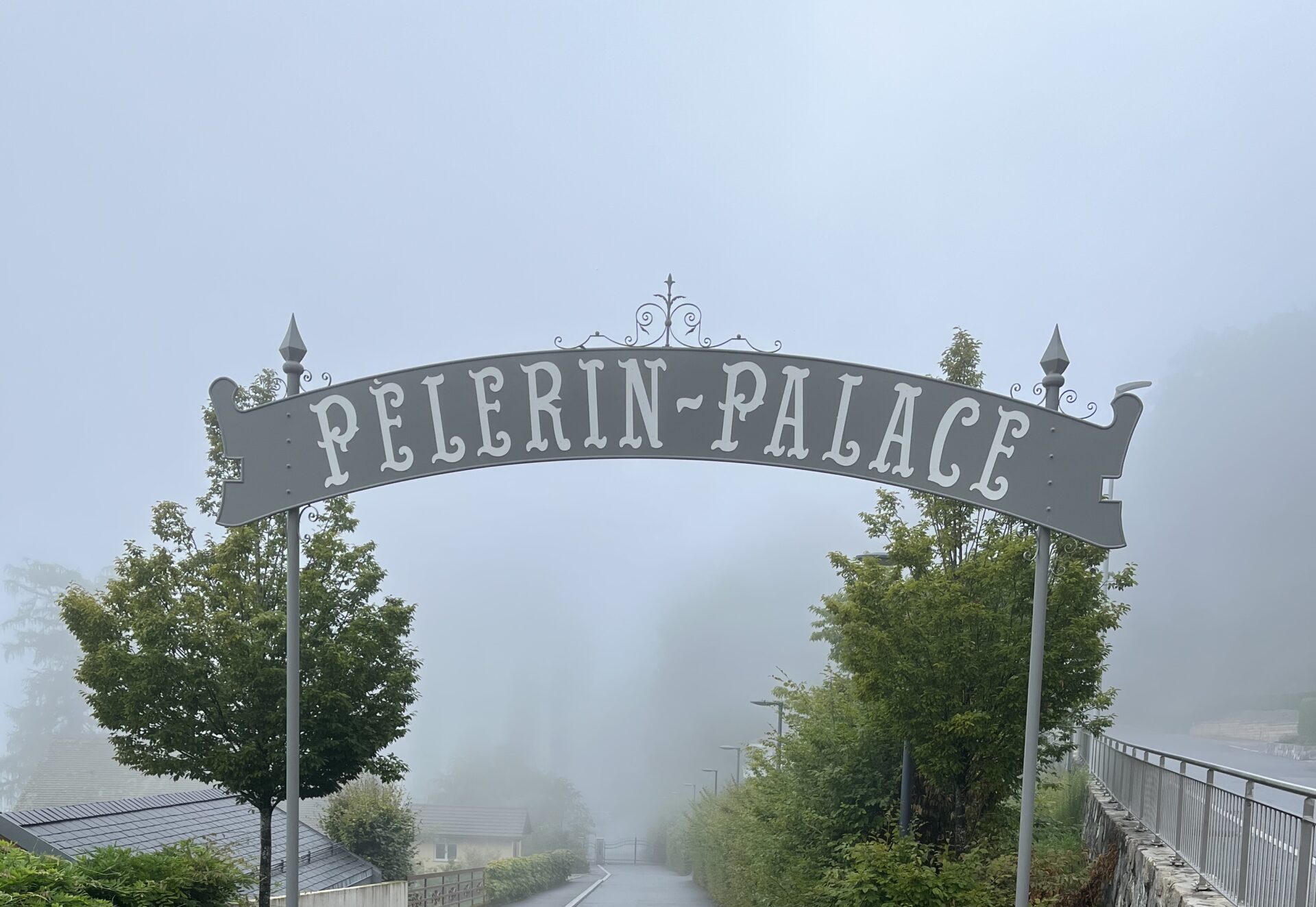
“Pelerin” means pilgrim in French. I made a pilgrimage—an ironic one—to Mont Pelerin in Switzerland. It was here in 1947 that F. A. Hayek organized the foundational meeting that would effectively launch neoliberalism as an intellectual and policy movement (the term was coined at a predecessor meeting1 held in Paris before the war). The ideas discussed at and disseminated from Mont Pelerin were to reshape the global economy. The conference also led to the institutionalization of the neoliberal movement in the form of the Mont Pelerin Society (MPS). I traveled to the holy mountain seventy-five years later to see what relics might remain.
Hayek organized his 1947 conference of neoliberals, or economic liberals, as they mostly called themselves, at the Hôtel du Parc on Mont Pelerin, also known as the Pelerin Palace. There were thirty-nine participants, including Milton Friedman, Ludwig von Mises, and Karl Popper. The hotel offered a remote, private Alpine setting where they could discuss the dual threats to liberal economies posed by, in broadest terms, “collectivism” and monopoly. The conference was principally funded by the Swiss bank2 later to be known as Credit Suisse.
Mont Pelerin rises above the town of Vevey on Lake Geneva, from which it can be reached by a funicular railway. Vevey is part of the hyper-rich “Swiss Riviera.” It is a highly cultured town with many tourist attractions. Charlie Chaplin’s home and also tomb are here, where, in a bizarre crime, his corpse was disinterred and held for ransom. Vevey is also the location of Anita Brookner’s gloomy novel “Hotel du Lac.” I, however, had no time to visit the local sights because I was dead set on my pilgrimage.
I caught an early morning ferry from Evian, just across the lake. The day of my trip happened to coincide with major local (and to some extent global) news, flashing on the video screens of the ferry: Jean-Luc Godard was dead. The Franco-Swiss film director lived nearby in the lakeside village of Rolle, where he had died from assisted suicide. As the passengers on the ferry read the story, I could see them looking up from their newspapers and glancing towards Rolle further down the lake.
Once we docked, I took the short train ride to Vevey. The funicular to Mont Pelerin departs slightly outside Vevey’s town center, very close to Nestlé’s main office, “Palais Nestlé.” Here, executives in blue suits marched in twos and threes in front the company’s Y-shaped, fantastically sleek, modernist headquarters. Nestlé has done very well indeed from neoliberal globalization.
There were a handful of people waiting for the funicular on the day of my trip, most of them smoking. The funicular itself was built at an angle, with seats arranged off the sides of a very steep central staircase. We began our sharp climb to Mont Pelerin, traveling across vineyards and through layers of mist floating above Lake Geneva.
Most passengers got off at intermediate stops, leaving only two others for the final ascent: a teen wearing a New York Yankees hat and carrying an e-scooter, who looked somehow neater that his American equivalent, and a woman with wild hair gnawing her nails down to the quick who was possibly mad or just driven crazy by the no smoking rule on the funicular.
On the funicular, we were approaching our terminal destination, the village of Mont Pelerin. Though it had been mostly clear below, a thick cloud lay overhead, obscuring views of the top of the mountain. We plunged into the cloud, and after a few minutes of traveling with almost no visibility, we pulled into the Mont Pelerin village station.
My two fellow passengers hopped off, immediately lit up cigarettes, and vanished into the cloud. I walked up the platform. Outside of the station, halos formed around the lights because of the fog. I could make out a sign for the Mirador hotel, my first destination, given that the Pelerin Palace hotel was closed. I could see enough to follow the road markings, and then made my way down the long driveway which led to the hotel itself.
When the Mont Pelerin Society (MPS) held a second, special meeting on Mont Pelerin, to mark the fiftieth anniversary of the first, it took place at Le Mirador hotel. The Pelerin Palace, having fallen into decrepitude, was closed by this time. Milton Friedman was the only original participant to attend.
If the attendees at the original 1947 meeting felt embattled and their ideas obscure, things were very different in 1997. Socialism had been vanquished. Economic planning was now held in ill repute. The desirability of limited government, free trade, and a purely market-driven economy—all neoliberal principles—was unquestionable.
But this moment of triumph for neoliberalism would be short-lived. In the twenty-first century, things would turn out very differently for the neoliberal project. The ideas of 1947 would prove to be maladapted to the problems of the new millennium and exposed countries pursuing them to extreme risks.
Le Mirador Resort and Spa is a five-star Swiss hotel. Its changing ownership mirrors the vicissitudes of the global economic order. For years it was owned by an American entrepreneur from Philadelphia, who founded the Franklin Mint. In the 1990s, it passed into Japanese hands, and still has a highly regarded Japanese restaurant. Today, it is owned by a multimillionaire who is based in China.
The driveway ended in a circle in front of the hotel entrance, which on a non-misty day would have offered a view of the lake. To the side was a sculpture by J. Seward Johnson, the Johnson and Johnson heir, known for his realistic, but essentially artless, bronze sculptures. This one, a life-size rendering of two businessmen, one holding his jacket casually over his shoulder, was titled Let’s Just Skip the Meeting.
The hotel itself was low-slung with most floors arranged below the entrance. I walked through the empty lobby, down a staircase, and then past a meeting room where a Swiss wealth management conference appeared to be underway. As I approached the end of an extremely long corridor I was stopped by an elegant Asian woman, who asked, “Are you here for the clinic—for your treatment?”
Le Mirador, like many top Swiss hotels, has a medical, or curative, component. The clinician explained that the hotel offered a medical program, supported by diagnostic testing, with treatments for stress, detox, and other conditions. She directed me to the clinic’s website which read: “good health means maintaining stability on all levels: physiological, mental, emotional and energetic.”
I told her this was not the reason for my visit at all, which was more historical, related to a commemorative conference held here in 1997. I climbed a staircase back up to street level and slipped out a side door into the fog.
I doubled back on my route in order to reach my primary destination, the now closed Hôtel du Parc, also known as the Pelerin Palace. It was near the funicular station but slightly higher on the mountain. Its entrance was demarcated by a Belle Époque sign with the hotel’s name, which arched over a driveway. I walked down the driveway which ended in an electronic gate. It was firmly locked. Behind it, only half visible in the mist, was the actual building where the 1947 meeting was held.
The book Mont Pèlerin 1947: Transcripts of the Founding Meeting of the Mont Pèlerin Society3 was published last year to mark the conference’s seventy-fifth anniversary. The transcripts reveal the participants’ obsessions, namely the dire risks to free markets posed by socialism, including “Nazi-socialism,” central planning, trade protectionism, and state nationalization of industry.
Although neoliberalism today is associated with laissez-faire, Hayek’s other obsession at the time was the need for state and legal interventions to ensure market competition and prevent the rise of monopolies. Bruce Caldwell, the editor of Mont Pèlerin 1947, summarizes the first session of the conference:
After opening introductions, the first formal topic—“free” enterprise [versus] competitive order—aimed at contrasting the laissez-faire free-market system with a system where the government had a role of making markets more competitive. The two terms were meant to describe two different systems, and it was the system described by the term “competitive order” that Hayek himself preferred.4
This distinction, between what Hayek termed a “competitive order,” which he advocated for and which involves government intervention to contain the rise of monopolies, and that of laissez-faire, or in his language, “free enterprise,” which could easily lead to loss of competition through market concentration, was one of the Hayek’s major points. Yet this subtlety has been lost in contemporary American interpretations of neoliberalism, which tend toward libertarianism.
The financial history of Hôtel du Parc itself could serve as a case study of recent developments in neoliberalism. After the hotel closed, the building housed a business school. It was then bought by a developer in 2008 with the intention of turning it into residences. This aimed to be one of the most luxurious real estate conversions in Swiss history. The former hotel/business school was gut renovated (removing all traces of anything that remained from the original meetings), with expensive and rare new finishes installed as well as an indoor pool. A handful of apartments were sold, including one to French American basketball player Tony Parker. But the developer went bankrupt along the way and the work was never completed. It then passed into the hands of a Geneva promoter, but its finances remain murky.
Nevertheless, help is on the way from a Paris-based blockchain company, Blockapital. The blockchain company aims to bring together investors to buy the building, get it out of bankruptcy, finish the work already started, and relaunch the project. They have already raised several hundred million dollars to this end. Central to their strategy, of course, is the use of the blockchain and tokenization.
I spoke to an executive at the company by phone. “We are tokenizing the asset,” he told me. “We are bringing innovation in financing. Though we are raising funds through classical investments, we are also using tokenization. This is very much a continuity of the spirit of the original MPS meeting held there.”
The wind picked up as I stared through the gate, and clouds billowed past, providing some clearing. For several moments I could clearly see the former hotel building, which was indeed a Belle Époque palace. Then the cloud closed over it again.
The tokenized, financially distressed Hôtel du Parc on Mont Pelerin could serve as the perfect metaphor for neoliberalism—except there is no consensus definition of neoliberalism. Liz Truss with her tax cuts is a neoliberal, but so is Rishi Sunak with his hostility to industrial policy. For both, growth derives from tax policy, not innovation policy. The four freedoms of the European Union—free movement of goods, capital, services, and persons—are profoundly neoliberal. Though neoliberalism is strongest on the right, it also has made inroads on the left, such as the call for open U.S. borders.
The reason for these contradictions in neoliberalism today is that it has different strands, policies, interpretations, and histories. Most, but not all, derive from the original Mont Pelerin meeting; Milton Friedman played an important independent role in developing neoliberal theology. One could attempt a “nosology” (a medical term for the study of classifications of diseases) of the variants of neoliberalism but this would just be an academic exercise. The only agreement today is that the word neoliberal is an insult and the movement is in decline.
But this decline is overstated: neoliberalism remains largely the default ideology at the World Bank, the UK Treasury, and the U.S. Treasury, with an exception reserved for climate-change-related industrial policies. Neoliberalism is capable of shape shifting, as can be seen in the way it has resurfaced in heavily disguised form in the ESG (environmental, social, governance) movement dominating contemporary finance. ESG exhibits several neoliberal characteristics: market-based solutions such as the one for carbon offsets, lack of democratic accountability; shadowy supranational institutions including those involved in ratings; and financialization. ESG is one of the last high-fee areas left in asset management, raising suspicions of green profiteering. Who exactly asked fund managers to lead the charge against climate change? Do they have any background in this area? Any expertise? Any competence?
The answer to these questions can be found by looking at results. While ESG managers have been flying around to conferences talking about the coming “energy transition,” China has taken control of the entire clean energy supply chain and dominates electric vehicle production too. (It also leads in greenhouse gas emissions as the world’s largest polluter.)
The effective but brutal party-state capitalism of China has allowed it to dominate steel, aluminum, shipbuilding, commercial shipping, drones, high speed rail, robotics, telecommunications hardware (Huawei), and very soon space technology, bio-pharma manufacturing, and narrow body passenger jets. A rare Chinese stumble has been in semiconductors. Here the United States has used export controls and subsidies—both forbidden by the neoliberal playbook—to effectively compete.
State capitalism turns neoliberalism on its head. Rather than the market setting the long-term economic policy goal and the state staying out of the way except to keep the market functioning, the state sets the goal and uses the market, or at least competition, to implement it. As Xi Jinping stated in his 2020 speech about China’s goals and strategy for technological dominance, “let enterprises play the main role and government play an overall planning role.” This state-market combination was overlooked by Hayek even though it is nothing new; it is how the United States built the railroads, with the government handing out land grants to railroads who competed for traffic.
It is a mystery why neoliberalism retains any influence at all, and not just because of the rise of China. Neoliberalism no longer pays—its growth model has petered out. Secular stagnation now afflicts the financial services industry itself (ESG is an exception along with alternative investments).
One commonly made conspiratorial argument for neoliberalism’s survival is to point to the institutional strength of the neoliberal network, including the Mont Pelerin Society (which still exists) and the think tanks run by MPS members, which have included the Cato Institute at various times. The network of fellow travelers and free market think tanks is larger still, such as the American Enterprise Institute (which self-identifies as non-partisan). More likely is that the West has not yet been able to develop an intellectual framework to replace neoliberalism and so it remains the default. My preferred explanation is that being a neoliberal is an age-related condition. Neoliberal ideas have been the received economic wisdom for so long that people who grew up on them cannot adapt. Yet the persistence of these ideas, and the non-death of neoliberalism, remains uncanny. “Zombie neoliberalism” may be more than just a metaphor.
It was time to leave Mont Pelerin, to come down from the mountain. The cloud was breaking up. I could see Lake Geneva below. I decided to skip lunch at the Japanese restaurant and headed directly to the funicular station.
There, a friendly local was waiting for the funicular. Under her tailored jacket she was wearing a t-shirt of a melting glacier—a warning about global warming. I asked her about the differences between Mont Pelerin and Vevey below which was now visible. “Oh, that’s very simple,” she said. “Vevey is a town. In Mont Pelerin there is nothing.”
This isn’t completely true: Mont Pelerin is a location of the utmost importance in the history of ideas. And in addition to the open hotel and the closed hotel, there is a chocolate shop.
But I knew what she meant. I didn’t see a single other living soul during my trip, (aside from at the clinic or at the funicular) and not just because they were hidden by the fog. Yet even if there were no people, there are plenty of ghosts. The thirty-nine original participants of the MPS meeting are long dead. I wouldn’t say their ideas are alive, exactly, rather that they are “undead,” endlessly circling the world from Mont Pelerin.
2 Schweizerische Kreditanstalt was the bank’s name then.
3 Bruce Caldwell, ed., Mont Pèlerin 1947: Transcripts of the Founding Meeting of the Mont Pèlerin Society (Stanford: Hoover Institution, 2022).
4 Caldwell, Mont Pèlerin 1947, 1.
Already subscribed?
Sign In With Your AAJ Account
| Sign In with Blink