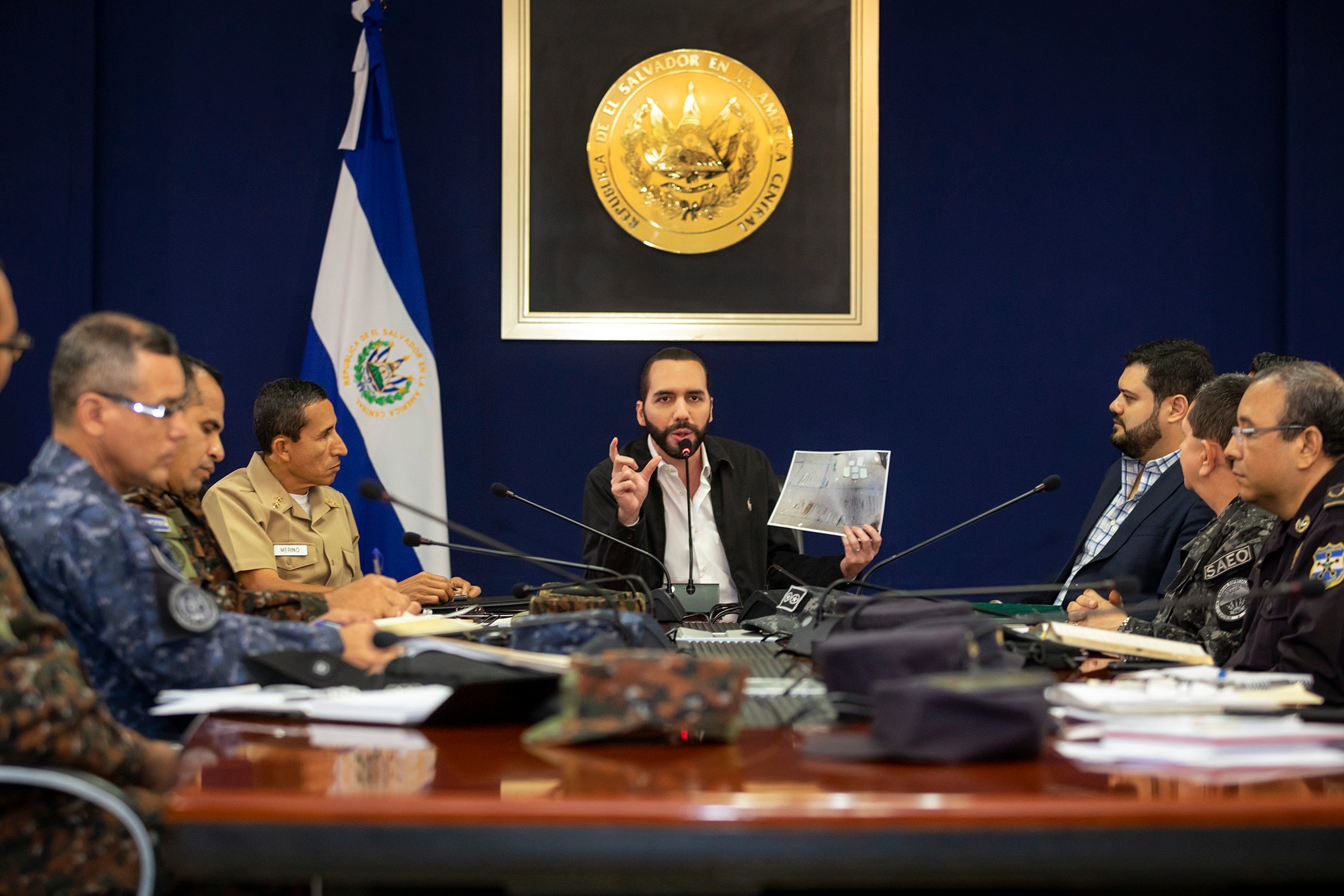
On February 4, 2024, President Nayib Bukele secured a thumping reelection in El Salvador, receiving an astonishing 85 percent of the vote. His victory signals the consolidation of an unprecedented sociopolitical transformation in Latin America. Not long ago, El Salvador was considered to be one of the most dangerous countries on the planet, on par with war-ravaged Syria and Somalia. Today, El Salvador’s homicide rate rivals the likes of Canada following the success of a still ongoing state of exception that has locked up close to seventy-five thousand people, or about 2 percent of the country’s population.1 Unsurprisingly, Bukele has drawn admirers from throughout the Americas, particularly—though not exclusively—on the political right.2
By all accounts, the country is better off today than when Bukele first assumed office in 2019. Salvadorans are more than justified in backing a leader who has delivered a decisive blow to the country’s street gangs. Yet the Bitcoin king’s success has also raised questions about whether this approach is replicable and durable. Those that are currently attempting to replicate his achievements have discovered the hard way that transposing the Bukele model to other countries is no easy feat. It remains an open question as to whether that model—and by extension, Bukele himself—are capable of delivering lasting gains on the security front as well as meaningful development in the long term. Yet another question is whether current policies signal more fundamental shifts in El Salvador’s political institutions.
The Rise of Nayib Bukele
For decades, the infamous Mara Salvatrucha (MS-13) and Barrio 18 gangs waged violent turf wars—largely over extortion and other illicit economic activities—on Salvadoran streets. Ironically, both gangs emerged initially in the United States among incarcerated Central American immigrants in Los Angeles during the late 1980s and early ’90s. The gangs were later exported to the Northern Triangle following the deportation of gang members back to the region. Over time, MS-13 and Barrio 18 consolidated control over the less sophisticated gangs that were previously dominant in Honduras, Guatemala, and El Salvador.3
Consecutive right-wing governments in El Salvador, Honduras, and Guatemala tried and retried mano dura (or “iron fist”) policies in order to combat the gangs: declaring states of exception, deploying military anti-gang squads, and engaging in mass arrests—to no avail.4 In El Salvador, the conservative National Republican Alliance (arena) saw homicides soar over the course of four consecutive presidential administrations between 1989 and 2009. In 2004, president Antonio Saca (2004–9) echoed Honduras’s Ricardo Maduro (2002–6) by introducing a “Super Mano Dura” plan following the failure of ordinary mano dura policies. Gang leaders responded by toughening initiation rituals and curtailing drug use in order to discipline their members. During the first year of “Super Mano Dura,” authorities made almost twenty thousand detentions, but of these, an estimated 95 percent of cases were dismissed, and homicides rose from the year prior. It’s worth noting that polls consistently displayed support for iron fist policies even as they routinely yielded underwhelming or even adverse results.5
By the 2010s, El Salvador was consistently among the five most dangerous countries on the planet. A newly ascendant Salvadoran Left finally captured the presidency under Mauricio Funes in 2009. His party, the leftist FMLN, had transformed from a Marxist guerrilla organization into a legal political party following the peace accords that ended the Salvadoran Civil War (1979–92). Just three years after Funes’s election to the presidency, one Nayib Bukele was elected mayor of Nuevo Cuscatlán as a member of the FMLN in 2012.
Upon taking the presidency, the FMLN tried its hand at controlling gang violence by other means. Outwardly, the administration continued many of the same hardline policies of its arena predecessors. Covertly, however, national and municipal officials of the FMLN began negotiating with leaders of MS-13 and Barrio 18 in prison. Imprisoned gang members would receive special privileges and benefits from the government; in exchange, the gangs would agree to limit violence among themselves and against the state.6
It would take time—and significant setbacks—before this approach yielded results. Between 2011 and 2014, homicides dropped from 70 to 40 per 100,000, before skyrocketing to over 100 per 100,000 inhabitants in 2015. During this time, it was claimed that one of the most effective administrators of gang-state relations was the thirty-three-year-old Bukele, who went on to win the mayorship of the capital San Salvador in 2015. According to InSight Crime—an investigative think tank focused on security in the Americas—Bukele achieved a successful revitalization of San Salvador’s city center as mayor by tailoring and ultimately perfecting his negotiating skills with the gangs.7 Between 2015 and 2020, San Salvador saw homicides fall from over 500 to 106. Under Funes’s successor, Salvador Sanchez Ceren (2014–19), the national homicide rate declined 70 percent, from around 103 to 36 per 100,000 in 2019.
During his years as mayor of San Salvador, the media-savvy and populist Bukele gained a cult following through the use of Facebook livestreams and Twitter to connect with his supporters. Moreover, amid a slew of corruption scandals that tainted both the FMLN and arena, as well as low economic growth—a result of the commodities bust—Bukele gained notoriety for his outspoken criticism of the leadership of the FMLN. In 2017, Bukele was expelled from the FMLN and began testing the waters for a presidential run in 2019.8
Having failed to register his political party—Nuevas Ideas—in time for the election, Bukele chose to run for office as the candidate of the center-right Great Alliance for National Unity (GANA) party. The former mayor quickly emerged as the favorite in the presidential contest—far outpacing his arena and FMLN rivals in the polls. At the time, Bukele ran on a third-way, change platform, promising to put an end to the polarized two-party system that had emerged after the end of the civil war. As an outsider candidate, he took an unusual, and seemingly sincere, stance against authoritarianism in the region. The thirty-seven-year-old Bukele won applause from both regional and international human rights groups for his respective condemnations of autocrats such as Daniel Ortega, in power in Nicaragua since 2007, on the left, and Juan Orlando Hernández, who ruled Honduras from 2014 to 2022, on the right.9
Bukele’s resounding 2019 victory echoed that of the Mexican populist Andrés Manuel López Obrador (AMLO) in December 2018. Like AMLO, the former mayor secured a majority in the first round—winning the election outright with 53 percent of the vote.
Public Failures and Covert Successes:
Iron Fist Policies in Latin America
El Salvador’s pre-Bukele experience is a textbook case of the difficulties of iron fist policies in Latin America. With the notable exceptions of guerrilla conflicts in Colombia and Peru, militarized crackdowns in the post–Cold War era have almost always resulted in further violence.10 In Colombia, the state’s open—and necessary—war against the Medellín Cartel during the narco-terror period (1984–93) led to a wave of bombings, mass killings, and political assassinations. In Mexico, President Felipe Calderón (2006–12) instituted a militarized crackdown on the country’s infamous cartels. Yet, by the end of his term, homicides rose fivefold and have remained more or less stable ever since—the so-called kingpin strategy has almost always resulted in further violence both within and between cartels due to subsequent power vacuums.11
Conversely, strategies that are both covert and non-repressive, such as negotiating with organized criminal groups, have a comparatively better—if also volatile—track record in the region. During the tail end of the same narco-terror period in Colombia, the state experimented with a policy of negotiated appeasement with the leader of the Medellín Cartel, Pablo Escobar. In exchange for an end to the bombings, Escobar was granted a reduced sentence and was allowed to construct his own mansion-style prison: a campus laden with prostitutes, a soccer field, and guards composed of cartel hitmen. And while the policy—known in Colombia as sometimiento or submission—was viewed as a humiliation both at home and abroad, it substantially reduced homicides for a brief period between 1991 and 1992.12 Similarly, before 2000, Mexico’s seventy-year, one-party dictatorship under the Institutional Revolutionary Party (PRI) ran a genuine—if also comparatively pacific—narcostate. Through the Federal Security Directorate (DFS), Mexico’s equivalent of the FBI, the state actively limited criminal violence by directly regulating cartel trafficking operations.13 Still another, more recent example is the current criminal landscape of the city of São Paulo, Brazil. Since the 2000s, allegedly, an informal arrangement between security forces and the country’s most important gang, the First Capital Command (PCC), transformed the city into one of the safest on the continent. In each of these cases moreover, the consolidation of organized crime by one or two criminal actors has been a key factor in facilitating cartel-state negotiations as well as limiting inter-cartel violence.14
Yet this approach is often not sustainable in the long term. In Colombia, violence again resurfaced in 1992 after authorities attempted to transfer Escobar to a proper prison and the kingpin subsequently escaped to his nearby hometown of Envigado. In Mexico, the end of one‑party rule as well as the splintering of the once-dominant Guadalajara Cartel during the 1990s has since limited the ability of the state to successfully negotiate with multiple, competing cartels.15 Finally, in São Paulo, the so-called killing consensus is prone to routine spikes in violence when the purported agreements between the PCC and authorities break down.16
The latter case is particularly salient to the Salvadoran experience under both the FMLN and Bukele. The decline in violence seen during the government of Mauricio Funes between 2011 and 2014 was quickly undone when homicides surged past their previous peak in 2015. This was no accident. According to various independent investigations, the 2015 spike resulted from disagreements between authorities and the gangs regarding specific privileges for imprisoned gang leaders.17 Moreover, as in business or diplomacy, the effectiveness of any negotiation depends both on the parameters of a specific agreement as well as the skill and sincerity of the parties involved. Similarly, whether dialogues are overt and legally sanctioned or covert—and unacceptable to the public—are often key factors for more lasting success.
In Colombia, the parameters under which Pablo Escobar agreed to curtail violence proved unacceptable to various independent institutions such as the attorney general’s office, the press, and, notably, the United States. In turn, covert agreements with cartels in post-2000 Mexico are notoriously difficult to sustain and conceal from the public.18 Accordingly, former Salvadoran president Mauricio Funes fled to Nicaragua in 2019 and has since been tried and convicted by Salvadoran authorities for negotiating with the country’s gangs during his term in office.19
The prosecution of Funes, of course, is politically motivated, considering that the Bukele administration has almost certainly continued the otherwise illegal policy.20 The great irony of the president’s celebrated iron fist is that it is at best responsible for around 10 percent of the reduction in homicides since 2015. By the start of 2022, prior to the state of exception, homicides had already fallen to their lowest point in twenty-five years. A master at branding, the president’s famed displays of inmates, crouched, stripped naked, and organized in single-file lines are very clearly meant to signal to the population that its leader is tough on criminals. Naturally, they also serve to mask the less flattering possibility that the president is routinely cutting deals with the very same convicts. Rather than a simple victory of tough-on-crime paradigms, Bukele’s early success was more likely attributable to a skilled synthesis of both iron fist policies and conditional, negotiated agreements with criminal actors.
The Bukele Model
For the better part of Bukele’s first term, the president seemed to have perfected the security strategy he inherited from his predecessors. As mentioned, homicides had already fallen to historic lows by 2021. But this relative peace broke suddenly following a spike of eighty-seven murders during a single weekend in March 2022.21 As in 2015, it was reported that state-gang relations suffered yet another breakdown, prompting the president to take immediate action. Knowing full well that the latest outbreak of violence stood to tarnish his presidency, Bukele resorted to a time-honored practice in the region and declared a state of exception. Thereafter, Salvadorans would forfeit due process and security forces would be granted broad authority to make arrests at their discretion.
At first, there was little indication that the state of exception would achieve anything more than modest success. Like iron fist policies, states of exception have been used and reused throughout Latin America and have seldom made lasting gains on the security front. But almost two years later, El Salvador’s ongoing state of exception has far exceeded expectations. While the decline in homicides long predates the state of exception, the measure is nonetheless remarkable because it has brought homicides down to a point that none thought possible in both the country and the region. In 2022, homicides fell to 7.8 per 100,000, down from 17 per 100,000 in 2021. And in 2023, homicides fell to an astonishing 2.3 per 100,000, with the rate expected to fall to 1.6 per 100,000 in 2024. For perspective, in 2024, El Salvador is likely to have a lower homicide rate than Chile (6.7 per 100,000), the United States (6.3), Argentina (4.2), and even Canada (2.3).
Additionally, the decline in homicides does not tell the full story. Extortion—the chief means by which the gangs finance themselves—has been drastically curtailed. Prior to the state of exception, street vendors, small, and even large businesses were forced to pay a tax, under threat of retaliation, to the gangs in order to operate. In the past, calling the police to report extortion was likely to result in direct retaliation from the gangs and/or allied police officers. Now, business owners enthusiastically report when they are threatened by gang members who are promptly arrested and sent to prison.22
What explains Bukele’s success, and why is it that El Salvador’s state of exception has succeeded where so many others have failed? Contrary to the platitudes of many progressives and criminal justice advocates, the simple if also superficial answer is that incarceration is a crucial remedy for violent crime. More specifically, the elusive key to the success of tough-on-crime policies—including against white-collar crime and corruption—is whether or not they reduce impunity. The problem with previous iron fist policies in Latin America is that they failed to address the underlying weakness of the justice system in states like El Salvador. Up until 2022, less than three of every hundred arrests throughout the country led to convictions, even as the homicide rate continued to decline. By contrast, under the current state of exception, effectively all those who are arrested go to jail.23
Of course, mitigating and punishing crime is easier when the state deprives its citizens of individual rights. With the notable exception of failed states such as Venezuela, dictatorships typically display lower rates of violent crime compared to democratic peers. This is especially true in Latin America, where the region’s past and present dictatorships have proven to be consistently better at controlling violent crime.24 In the past, states of exception achieved limited victories by endowing authorities with temporary authoritarian capabilities. Such gains rapidly evaporated, however, following the end of the respective emergencies. In El Salvador, Bukele has sustained low rates of violent crime by keeping the state of exception in place. Almost two years and seventy-five thousand arrests later, the state of exception no longer seems exceptional but has instead become the norm.
Bukele himself displayed autocratic tendencies well before 2022. Prior to 2021, Bukele’s GANA party held only ten of the unicameral legislature’s eighty-four seats (congressional terms are staggered). In 2020, when the legislature balked at the president’s preferred budget, Bukele sent armed troops into the parliament building to intimidate lawmakers. And after voters granted the president and his party, Nuevas Ideas, a legislative supermajority following congressional elections in 2021, the president proceeded to pack ten of the fifteen justices currently on the Supreme Court. Subsequently, the nascent regime took a page from the likes of neighboring Daniel Ortega and Juan Orlando Hernández: the Supreme Court declared that Bukele could run for a second term—something strictly forbidden by the country’s constitution.25
It is by no means a coincidence that the state of exception’s success has followed the regime’s co-optation of all relevant—and previously independent—institutions of power in El Salvador. In the past, the Supreme Court objected to various draconian criminal justice measures on the grounds that they violated human rights. Furthermore, the decentralization of municipal criminal courts and the ineffectiveness of prosecutors’ offices meant that most of those arrested eventually went free—particularly following the suspension of emergency powers.26 Thus, the broader erasure of democratic and institutional checks and balances in El Salvador directly contributes to Bukele’s success in combating crime.
At the same time, however, the government’s own statistics show that hundreds, if not thousands, of non-gang members have been incarcerated since 2022. At the start of the state of exception, the administration calculated that there were approximately seventy thousand gang members active throughout the country. Yet, in September 2023, a leaked report from the Salvadoran National Police estimated that around forty thousand gang members remained at large—raising the question as to exactly how many of the seventy-five thousand arrested do not belong to gangs. A common sight in El Salvador are the long lines that amass outside the country’s public defenders’ offices where ordinary Salvadorans seek to inquire about arrested family members.27
The unflattering irony about Bukele’s fawning coverage on the political right is that many of the defining characteristics of his regime resemble a distinctive political system—abhorred by conservatives—that boasts an equally impressive track record on crime: a one-party Marxist state. One need only travel to China’s Xinjiang province—where more than a million Uyghurs have been confined to concentration camps—to experience the marvels of a society where authorities have solved 100 percent of murders since 2016.28 Closer to home, El Salvador under Bukele increasingly resembles Daniel Ortega’s Nicaragua, where, unsurprisingly, homicide rates are also exceptionally low. Indeed, since 2007, PCC Cuba and FSLN Nicaragua are the only countries in Central America and the Caribbean that have consistently maintained homicide rates at or below ten per 100,000.
Perhaps not coincidentally, since 2022, the “freedom-loving” Bukele has refused to condemn the increasingly tyrannical moves of his Nicaraguan neighbor—such as jailing and deporting dissident Catholic priests. And like his recent Honduran counterpart, Juan Orlando Hernández—who was ultimately extradited to the United States and convicted of drug trafficking charges—Bukele is also accused of laundering money for Venezuela’s socialist dictator, Nicolás Maduro. Since 2013, Juan Luis Merino, a Salvadoran businessman and board member of Alba Petroleos, has been a key financial backer of Bukele’s mayoral and presidential campaigns. An unsavory character and former guerrilla leader, Merino is alleged to have trafficked arms for the Revolutionary Armed Forces of Colombia (FARC) during the 2000s.29 In turn, Alba Petroleos is a subsidiary of Venezuela’s state oil firm, pdvsa, and is accused by U.S. authorities of being part of a multimillion-dollar money laundering operation based out of Venezuela, El Salvador, Panama, and the United States.30 Additionally, one of Bukele’s closest advisers, Sara Hanna Georges, is alleged to have acted as an intermediary between the Venezuelan government and its Miami-based lobbyists Raul Gorrín and former Republican congressman, David Rivera—who was arrested in December 2022 for money laundering and failing to register as a foreign agent for the Venezuelan regime.31
Indeed, while Bukele’s numerous dealings with Latin American leftists have gone mostly unnoticed, his close ties with China have alarmed congressional hawks in Washington. Contrary to his February rebuke of “globalism” at CPAC, it is worth noting that El Salvador joined China’s Belt and Road Initiative soon after the millennial president assumed office in 2019. Accordingly, Bukele was enraged when senators Jim Risch (R-ID), Bill Cassidy (R-LA), and Bob Menendez (D-NJ) introduced legislation meant to scrutinize El Salvador’s adoption of Bitcoin as a means for the CCP to circumvent U.S. sanctions.32
Export Challenges
Understandably, Bukele’s success has inspired envy and multiple imitators throughout the Americas. Even in low-homicide Chile, polls show that majorities in some parts of the country would approve of a Bukele-style crackdown.33 Yet the keys to replicating the Bukele model are far more elusive than many of its foreign boosters recognize.
When he became president of Brazil in 2019, Jair Bolsonaro was expected to follow the tactics of Bukele and the Philippines’ Rodrigo Duterte. But these expectations proved unfounded due to the South American country’s entrenched federalism and competitive, clientelist institutions. Unlike the Philippines, Brazil is divided into federal units, with each of the country’s twenty-six states having independent state and municipal security forces as well as broad autonomy on various matters relating to policy.34 Much as Bolsonaro may have liked to emulate his Philippine and Salvadoran peers, the Brazilian president lacked the same authority as his counterparts. This is likewise the case in federal Mexico, where calls for a Bukele-style crackdown are comparably unrealistic. Indeed, it is for this very reason that both AMLO and Bolsonaro failed to implement their preferred approaches toward the Covid‑19 pandemic over the will of both Brazil and Mexico’s federal states.35 Here, the advantage of centralized authoritarianism once again supports the success of dictatorships in combating crime.
As of this writing, neighboring Honduras as well as a crisis-stricken Ecuador have attempted to replicate El Salvador’s success through their own states of exception. Notably, the left-wing administration of Xiomara Castro (in power since 2022) initiated a state of exception in November 2022, which remains in place. Yet while Honduras’s homicide rate declined to a thirty-year low in 2023, the results of the state of exception have been comparatively underwhelming, with the country’s impunity rate remaining virtually unchanged.36
In Ecuador, the January 8 escape of Los Choneros gang leader Alias Fito from prison plunged the Andean nation into a state of narco-terror akin to that of neighboring Colombia during the 1980s. In response, the newly inaugurated Daniel Noboa declared a still-ongoing state of exception that has likewise taken pointers from Bukele’s example in El Salvador. Here, it’s worth recalling that Noboa’s predecessor, Guillermo Lasso (2021–23), decreed multiple sixty-day states of exception that regrettably failed to halt Ecuador’s rapid transformation into the most dangerous country in the Americas.37 Thus far, homicides have declined 30 percent according to government figures. Yet it remains uncertain whether any security gains will evaporate following the abrogation of respective emergencies in all three countries.38
Security and Non-Development
When it comes to economic performance, Bukele’s tenure showcases both promising and troubling developments. As both a businessman and a former member of the FMLN, the president exhibits competing tendencies toward both neoliberal “pro-market” policies and economic populism.
With a formal workforce of just 30 percent and an extremely low level of economic complexity—El Salvador’s economy consists mostly of tourism, low-grade textiles, and a handful of cash crops—the country is also highly dependent on both imports and remittances from its large diaspora in the United States.39 Having little domestic industry to speak of, Bukele has promoted free trade and offered tax breaks to attract tech companies to El Salvador. The campaign has had some success; Google opened an office there in April.
Bukele has also slashed funding for various public services, such as when he cut $5 million worth of funds for thirteen of the country’s thirty-one hospitals in 2023.40 In 2021, he fired twenty-thousand public sector workers—excluding the relatives of pro-Bukele officials—and essentially privatized the servicing of water in the country. In the ensuing strikes by utility workers, the government jailed demonstrators per the ongoing state of exception. In 2023, authorities also arrested striking municipal workers in San Salvador for demanding months of backpay.41
On the other hand, Bukele has followed in the footsteps of his Mexican neighbor, AMLO, and championed major public works projects—most of which are funded by China—including monumental public libraries in San Salvador and a proposed Pacific Train that would connect the country’s western end with the capital.42 In large part due to such spending on public works, the Salvadoran president is by no means a deficit hawk. El Salvador’s debt-to-GDP ratio has remained stubbornly high, at around 73 percent, since Bukele first assumed office.
Despite the close alliances that the president has forged with the international Right, it’s worth noting that Bukele’s Nuevas Ideas is a big‑tent party composed mostly of former FMLN members as well as various opportunists. In 2022, the legislature approved a pension reform boosting pensions by 30 percent. A year earlier, the government raised the minimum wage by 20 percent, citing the impact of global inflation on poor Salvadorans, and augmented food handouts under the administration’s pandemic program.43
Then there’s the millennial president’s enthusiasm for cryptocurrencies. Bukele famously declared Bitcoin legal tender alongside the U.S. dollar on September 7, 2021. Just two months later, the market for cryptocurrencies collapsed, with the price of Bitcoin plummeting almost 70 percent by June 2022. Having invested over $100 million from the country’s public coffers in cryptocurrencies, El Salvador was on the verge of default throughout 2022. Toward the end of that year, El Salvador bought back substantial sums of its own debt to calm markets. Polls show that the adoption of Bitcoin is far and away the government’s least popular measure, with around 67 percent expressing disapproval even as Bukele himself maintains approval ratings close to 90 percent.
By 2024, however, El Salvador managed to recoup much of its crypto losses. As the price of Bitcoin and other cryptocurrencies recovered, gains on the security front have increased investment and restored confidence in the country’s finances. In January 2023, the government managed to pay back $800 million in maturing bonds. By the end of the year, the country’s notes had all but completely recovered from prior losses as crime declined to multidecade lows.44
Still, contrary to the boldest claims of the president’s crypto influencers, there is thus far little indication that El Salvador is currently on the road to broader economic development. Even despite reduced security costs as a result of decreased crime, GDP growth remains virtually unchanged since Bukele took office at around 2 percent; a figure that is catastrophic in a nation as poor as El Salvador and remains the lowest in Central America. (In 2023, GDP growth was 3.4 percent in Guatemala, 4.3 percent in Honduras, 6.3 percent in Panama, 4.2 percent in Costa Rica, 4.0 percent in Nicaragua, and 9.6 percent in Belize). The twin punches of the Covid-19 pandemic as well as Bukele’s Bitcoin debacle have caused the country’s foreign reserves to fall to a fifteen-year low and extreme poverty to double since 2019.45
Meanwhile, during the same period, El Salvador’s emigration rate has halved, in large part as a result of security gains, and repatriation is increasing. But these gains have not altered the reality that Salvadorans are still one of the largest groups migrating to the U.S. southern border—at around 100,000 each year.46
States of Non-Exception
The 75,000-person question for a second-term Bukele administration is obvious: what happens if or when the state of exception expires? To be clear, there are moments when states of exception are not only justified but eminently desirable, as is in Ecuador. But in El Salvador, the justification of an ongoing nationwide emergency is less and less credible. Thus, in June 2023, the president and the legislature moved to reform the justice system to allow for mass trials of up to nine hundred accused at a time.47
There is, moreover, evidence that the country’s gangs have been weakened but not outright defeated by the state. A report from the Salvadoran National Police leaked in 2023 showed that only eighty-three gang rifles were seized by police in 2023, compared to 242 in 2022. Indeed, the number was far higher prior to the state of exception, with 321 seizures in 2020 and 508 in 2019—suggesting that MS-13 and Barrio 18 are actively hiding their arsenals.48 Reporting from El Faro has likewise documented credible evidence that the administration is still negotiating with gang leaders. Non-gang members who have been detained and later released under the state of exception have testified that gang members receive special treatment, such as more varied meals and better carceral conditions than non-gang prisoners.49
Officials from the Bukele administration have also been seen entering maximum-security prisons accompanied by masked men who are presumed to be gang members. A subsequent investigation was ultimately shelved after the attorney general who was investigating the affair was replaced in 2021. Still another curious development was the sudden release of gang leader Elmer Canales, whose extradition was requested by U.S. authorities in a related case on the administration’s dealings with gangs.50 Bukele has dismissed pertinent reporting as fake news from “Soros-funded media.” And while El Faro is indeed funded in part by the Hungarian American billionaire, it’s worth noting that the paper’s allegations against Bukele are similar—and in some cases, identical to—those leveled against past administrations (El Faro also relocated its headquarters to Costa Rica in 2023 due to harassment from Salvadoran authorities).51
For all practical intents and purposes, El Salvador under the current state of exception is a dictatorship. In real terms, the degree to which checks and balances exist in El Salvador are functionally equivalent to those of authoritarian Venezuela and Nicaragua—a reality that Bukele has tacitly acknowledged by proclaiming himself “the world’s coolest dictator.” Whether or not the millennial president’s rule devolves into the sort of mass repression seen in the “troika of terror” will depend on the regime’s ability to deliver continued material improvements in the lives of its citizens.
Unlike Cuba or Nicaragua, Salvadorans have freely elected to sacrifice key democratic liberties in order to control criminal violence. Observers would do well to both respect and understand this decision as well as celebrate the many lives that have been saved thanks to the policies of the current government. At the same time, questioning the relative benefits of this trade-off is by no means illegitimate. As mentioned, homicide rates had already declined to a more-than-two-decade low prior to the current state of exception. Given Bukele’s alleged skill at negotiating with the gangs both prior to and after March 2022, it is not inconceivable that homicides may have stabilized after the initial March spike—though recent gains in reducing extortion likely would not have been as significant, if they occurred at all. The issue now is that an abrupt end to the state of exception could result in the mass release of gang members.
A key gauge of the regime’s adaptability will come from the public’s reaction toward mass trials of alleged gang members given the very real possibility that hundreds or even thousands of innocent Salvadorans stand to go to prison. Just five days after Bukele’s resounding reelection, the regime began its first mass trial via Zoom of 492 suspected MS-13 members.52 The trial is ongoing as of this writing and it may still take years for Salvadoran justice to convict (or exonerate) all seventy-five thousand of those currently detained.
Until then, the most likely path forward for the Bukele regime is a continuation of the status quo: that is, the routine renewal of a euphemistically permanent state of exception. It bears repeating, as both Geoff Shullenburger and the Salvadoran novelist Horácio Castellanos Moya have noted, that Bukele’s popularity and subsequent realignment of the Salvadoran state “enabled the defeat of the gangs, not the other way around.”53 The relative instruments available to democratic as opposed to autocratic regimes in Latin America speak to comparative strengths and costs of each mode of governance. Bukele’s recent victory has offered him an overwhelming mandate—one which has effectively consolidated one-party rule over El Salvador. It remains to be seen exactly how long the Bukele model might last or whether it stands to outlive Bukele himself.
This article originally appeared in American Affairs Volume VIII, Number 2 (Summer 2024): 153–69.
Notes
1 “
El Salvador Says Murders Fell 70% in 2023 as It Cracked Down on Gangs,” Reuters, January 3, 2024.
2 Will Freeman, “Nayib Bukele’s Growing List of Latin American Admirers,” Americas Quarterly, February 16, 2023.
3 Steven C. Boraz and Thomas C. Bruneau, “Origins of the Maras,” Military Review (2006).
4 Thomas Bruneau, Lucía Dammert, and Elizabeth Skinner, Maras: Gang Violence and Security in Central America (Austin: University of Texas Press, 2011).
5 Sonja Wolf, “Street Gangs of El Salvador,” in Maras: Gang Violence and Security in Central America (Austin: University of Texas Press, 2011), 58–59, 63–65.
6 David Gagne, “El Salvador’s FMLN: Talking Peace While Waging War,” InSight Crime, November 21, 2016.
7 Steven Dudley and Alex Papadovassilakis, “How El Salvador President Bukele Deals with Gangs,” InSight Crime, October 1, 2020.
8 Ximena Enriquez, “Will El Salvador’s Nayib Bukele Be the Next Social Media President?,” Americas Quarterly, November 8, 2018.
9 Nelson Renteria, “Honduran, Nicaraguan, Venezuelan Leaders Not Invited to Salvadoran’s Swearing-In,” Reuters, April 9, 2019.
10 Robert Muggah, Juan Carlos Garzón, and Manuela Suárez, “Mano Dura: The Costs and Benefits of Repressive Criminal Justice for Young People in Latin America,” Igarapé Institute, 2018.
11 Benjamin Lessing, Making Peace in Drug Wars: Crackdowns and Cartels in Latin America (Cambridge: Cambridge University Press, 2017); Angélica Durán Martínez, The Politics of Drug Violence: Criminals, Cops and Politicians in Colombia and Mexico (Oxford: Oxford University Press, 2017).
12 Lessing, Making Peace in Drug Wars.
13 Lessing, Making Peace in Drug Wars.
14 Graham Denyer-Willis, The Killing Consensus: Police, Organized Crime, and the Regulation of Life and Death in Urban Brazil (Oakland: University of California Press, 2015).
15 Durán-Martínez, The Politics of Drug Violence.
16 Denyer-Willis, The Killing Consensus.
17 Michael Lohmuller, “Assessing El Salvador’s Gangs in a Post-Truce Context,” InSight Crime, November 30, 2015.
18 David P. Thompson, “Pablo Escobar, Drug Baron: His Surrender, Imprisonment, and Escape,” Studies in Conflict & Terrorism 19, no. 1 (1996): 55–91.
19 Marcos Alemán, “Ex-El Salvador President Mauricio Funes Sentenced to 14 Years for Negotiating with Gangs,” Associated Press, May 29, 2023.
20 Steven Dudley, “The El Salvador President’s Informal Pact with Gangs,” InSight Crime, October 2, 2020.
21 Alex Papadovassilakis, “The Road to El Salvador’s State of Emergency,” InSight Crime, December 6, 2023.
22 Carlos Martínez, Efren Lemus, and Óscar Martínez, “Bukele Government Dismantled Gang Presence in El Salvador,” El Faro, February 3, 2023.
23 Eugenia Velázquez, “Funde y Acción Ciudadana: El Salvador refleja alto índice de impunidad desde 2019,” Elsalvador.com, Nov 19, 2022.
24 Neil L. Whitehead, Jo Ellen Fair, and Leigh A. Payne, Violent Democracies in Latin America (Durham, N.C.: Duke University Press, 2010).
25 “Bukele buscará la reelección en 2024, ¿qué dicen la Constitución y el fallo de la Sala de lo Constitucional?,” CNN Español, September 16, 2022.
26 Wolf, “Street Gangs of El Salvador.”
27 Roberto Valencia, “El Salvador Police Reports Contradict Bukele’s Triumphalism,” InSight Crime, September 22, 2023.
28 “Critics See ‘Scary Reality’ as China Touts Xinjiang Police High Case Clearance Rates,” Radio Free Asia, March 31, 2022.
29 Héctor Silva, “La oscura trama detrás de los $120 millones que El Salvador deberá pagar el año próximo al régimen de Nicolás Maduro,” Elsalvador.com, June 10, 2023.
30 Héctor Silva, “El Salvador’s President Bukele Linked to Venezuelan Money Laundering Scheme: Report,” InSight Crime, September 23, 2020.
31 Héctor Silva, “Quién es la asesora del gobierno de El Salvador vinculada a Raúl Gorrín, el testaferro de Maduro,” Infobae, May 6, 2023; Juan David Rojas, “Miami’s Neoconservative Grift,” American Conservative, January 16, 2023.
32 Ricardo Valencia, “Not All U.S. Conservatives Buy the Bukele Act,” El Faro, March 6, 2024; Sebastián Sinclair, “El Salvador’s President Calls US Senators ‘Boomers’ over Bitcoin Bill,” Blockworks, February 17, 2022.
33 “Encuesta Pulso Ciudadano: un 52,7% está de acuerdo con un Estado de Excepción en la RM,” El Mostrador, April 16, 2023.
34 Leandro Carneiro, “The Organization and Functioning of Police Forces in Brazil,” Global Perspectives in Policing and Law Enforcement (Lanham, Md.: Lexington Books, 2021).
35 Juan David Rojas, “AMLO and Mexico’s Fourth Transformation,” American Affairs 6, no. 4 (Winter 2022): 151–72.
36 Peter Appleby and Steven Dudley, “Honduras and El Salvador: Two States of Emergency with Very Different Results,” InSight Crime, December 6, 2023; Tesla Rodríguez, “Honduras, país con mayor tasa de impunidad en América,” Tiempo, August 18, 2023.
37 “How Ecuador Became Latin America’s Deadliest Country,” Economist, January 10, 2024.
38 Carolina Mella, “Noboa da un nuevo golpe en seguridad tras el referéndum con la detención del líder criminal Colón Pico,” El País, April 23, 2024.
39 “Atlas of Economic Complexity: El Salvador 2021,” Harvard Growth Lab, accessed April 21, 2024.
40 Maryelos Cea, “Recortan fondos a 13 hospitales en presupuesto 2023,” La Prensa Gráfica, October 25, 2022.
41 Claudia Díaz-Combs, “In El Salvador, Workers Fight to Protect Public Services,” Nacla, August 15, 2023.
42 Pablo Balcáceres, “El Salvador’s Bukele Has Mixed Track Record Midway through His Mandate,” Bloomberg Linea, June 3, 2022.
43 “El Salvador to Repurchase More of Its Debt,” Associated Press, November 29, 2022.
44 Zijia Song and Maria Elena Vizcaino, “How El Salvador’s Bitcoin-Loving President Won Over Wall Street,” Bloomberg, February 16, 2023.
45 Sarah Kinosian and Nelson Renteria, “Short on Cash, El Salvador Doubles Down on Bitcoin Dream,” Reuters, February 2, 2024.
46 Adam Isacson, “Migration, Country by Country, at the U.S.-Mexico Border,” WOLA, November 23, 2022.
47 Oswaldo Rojas, “Exigen liberación de ‘inocentes’ detenidos en El Salvador; preocupan juicios masivos,” Excelsior, October 12, 2023.
48 Roberto Valencia, “El Salvador Police Reports Contradict Bukele’s Triumphalism,” InSight Crime, September 22, 2023.
49 “Testimonios: sobrevivientes de las cárceles del régimen,” El Faro, 2023.
50 Carlos Martínez, “US Captures ‘Crook’, MS-13 Fugitive Released by Bukele Administration,” El Faro, November 9, 2023.
51 Óscar Martínez et al., “Gobierno negoció con pandillas reducción de homicidios,” El Faro, March 14, 2012; Luke Taylor, “El Salvador News Outlet Relocates to Costa Rica to Avoid Bukele’s Crackdown,” Guardian, April 19, 2023.
52 “El Salvador inicia sus juicios masivos contra los ‘mareros,’” DW, February 9, 2024.
53 Geoff Shullenburger, “Bukele’s Kingdom of Dreams,” Compact, February 19, 2024.