REVIEW ESSAY
The Land Trap: A New History of the World’s Oldest Asset
by Mike Bird
Princeton University Press, 2026, 296 pages
Land’s unique features have continually proved irresistible to financiers both public and private. The credit that land creates sits at the center of financial bubbles that form at a regular, if not always predictable, cadence. Repeatedly, the permanence of land finds its mirror in our cyclical patterns of financial exuberance and collapse. The centrality of land creates a choke point for political progress, while simultaneously creating an economic trap that inevitably requires government intervention or, put more simply, a bailout.
The Land Trap: A New History of the World’s Oldest Asset, by the Economist’s Wall Street editor Mike Bird, covers this history across time, from the founding of America to the efficiency of modern-day Singapore. Bird’s telling casts land as a tool of politics and finance that has brought both capitalist and communist nations to their breaking point. Today it is clear—as the Trump administration floats policy ideas ranging from fifty-year mortgages to the selling of public lands to restricting institutional investors in the residential housing market—that finance, policy, and land have never been more entangled.
The Land Trap extrapolates its primary argument from the early American experience. Yet even when recounting the land bubbles of communist nations, the narrative is consistent: wealth concentrates, that concentration fractures the political order, and the land’s value is ultimately redistributed through credit creation that inflates an asset bubble until it cannot hold. As John Kenneth Galbraith observed, “Once a boom is well started, it cannot be arrested. It can only be collapsed.” Where the narrative falters is in its insufficiently examined assumption that credit feeds asset bubbles, when, in fact, deliberate policy choices to protect land values cause credit expansion. The arrow of causality runs counter to most textbook understandings of credit bubbles. Bird, through his diverse survey, leads the reader right to the edge of this conclusion but refuses to state it outright. The Land Trap’s commitment to a strictly historical account leaves critical analysis merely hanging around the margins.
The Problem of Land and Credit
Nations need money to feed into their economies, and all money is a form of credit. That credit may be gold ingots, ready military might, or, frequently, land. As Bird explains, “the fixed amount of land available, its immobility, and the fact that it does not naturally decay,”1 make it ideal collateral. Gold can be stolen, grain can rot, but land’s immanence provides unique security. The barter myth, which holds that societies progress from trading utility to commodity money to paper currency through a process of efficiency gains, does not survive contact with the historical record. Historian A. Mitchell Innes showed that credit precedes coinage virtually everywhere it has been studied.2 A longer tradition of thinkers, including Aristotle, John Maynard Keynes, Hyman Minsky, and David Graeber, arrived at similar conclusions through the study of money: the two were never separate questions. Land and credit are, and have always been, two faces of the same political problem.
In the early days of the American colonies, the new nation’s fertile soil was a primary site of domestic production, but complex goods had to be imported. With no official scrip, coins, or currency, trade was difficult, and this fact constrained economic growth in the New World. Long before the study of what we now call “economics,” an English land administrator named William Potter was working on a series of tracts that approximated an economic theory: if money could be backed by gold, why couldn’t it be backed by land?3
Potter’s ideas found a handful of proponents, including Benjamin Franklin, but the colonies had also imported English sensibilities. One such cultural import was the idea that land was more akin to a birthright and the notion of it being repossessed offended lingering aristocratic notions. In fact, many of the Founding Fathers were themselves wealthy land speculators.
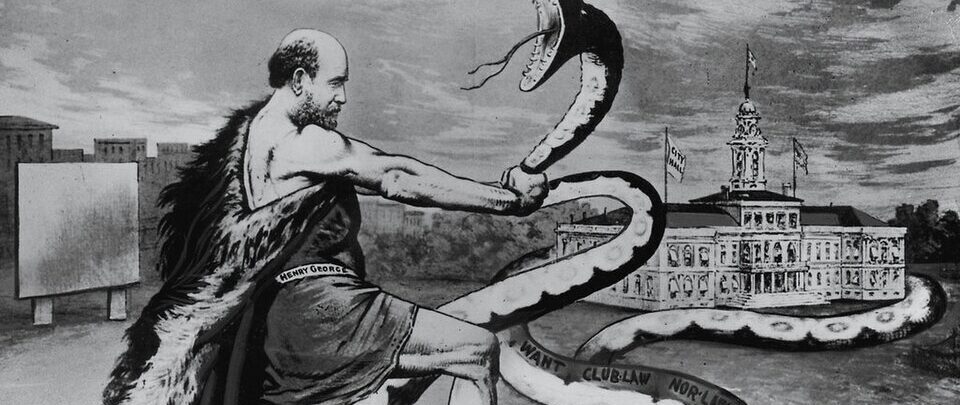
America’s land economy remained deeply hierarchical through much of the nineteenth century. Far from a fairy-tale republic of independent freeholders, this was a system in which access to land, and the credit to work it, determined a person’s place in the social order. It is here that Bird introduces Henry George, the most well-known land thinker of the past two centuries, and the main character for the first third of The Land Trap.
Henry George was a fledgling journalist and failed publisher when his book Progress and Poverty was published in 1879. George’s advocacy for a “single tax” on the rental value of all land, but no tax on any activity on it or improvements to it, was an elegant policy that spoke to multiple social and economic problems at once. George believed landlords were essentially free riders on economic productivity, earning their wealth passively from the innovations and entrepreneurial risk others took. “When new infrastructure was built—the roads, bridges, railways and utilities that were being blanketed over urban America—land prices went up, and landlords vacuumed up the benefits, at the expense of the people who built, used and funded those same developments,”4 Bird writes. By extension, land speculation meant that real estate, the resource from which George believed all economic activity sprung, was misallocated.
George’s aggressive prose and populist message found a large, rapidly growing audience both in America and abroad. Bird states without hyperbole that “Progress and Poverty was not just a popular book, but quite possibly the most influential piece of political writing of an entire century.”5 Some two million copies ultimately sold in its twenty-five years in print, not counting the abridged and anthology versions. George would become a political celebrity all over the world, speaking throughout the United Kingdom and parts of Asia.
This was in part because George’s message transcended conventional political alliances, appealing to radicals at both ends of the political spectrum. George was intensely religious and his tax proposal had a libertarian flavor that attracted conservatives. Bird writes, “George drew direct biblical comparisons through his work: liberty was the promise given to the Israelites by God, and liberation from monopolies in land, the asset that belonged to everyone in equal measure, was equally urgent and just.”6 At the same time, his policy ideas were centered on working and middle-class people in a way that attracted liberal radicals and labor movements.
Karl Marx, surveying much the same economic landscape a decade earlier than George, arrived at the more challenging conclusion that the ownership of capital, not just land, is the primary axis along which wealth concentrates and political power organizes itself. George’s single tax was unique in that it could coexist with capitalism. His framework stops short of naming capital ownership as the deeper structural driver of class hierarchy, treating land as a special case rather than as one expression of a broader logic.
Henry George’s ideas were safe enough for conservatives and libertarians to embrace because they did not challenge the ownership of factories, banks, or accumulated wealth, only the passive extraction of ground rent. The same quality that gave Progress and Poverty its remarkable reach is what ultimately prevented George’s framework from displacing Marx as the dominant language of class politics in the twentieth century. A politics capacious enough for both labor radicals and libertarians may be too capacious to cut.
In the end, George’s ideas didn’t lose the argument so much as lose the audience. The First World War and its aftermath accomplished what no intellectual counterargument had managed. The conflict and the accompanying fear of radicalism collapsed the broad reform coalition that had given Georgism its political viability. The war demanded loyalty to nation over class, and the postwar reaction demanded it again—this time against the specter of Bolshevism.
In such a climate, any politics that questioned the distribution of property was guilty by association. George’s single tax was not socialism, and George himself had been at pains to distinguish the two. But it didn’t matter. The window for fundamental land reform closed with the armistice and never regained the political currency it held during the apex of Georgism.
What replaced reform was capital “predistribution.” In both the United States and the United Kingdom, the postwar decades produced the most rapid democratization of land ownership in either country’s history. The GI Bill, the building societies, the Federal Housing Administration, and the explosive expansion of mortgage credit were not neutral market outcomes, but deliberate policy choices. By the mid-twentieth century, homeownership rates had climbed to levels George’s contemporaries could not have imagined. The land question appeared, at least on the surface, to have been answered.
But the democratization of ownership did not resolve the underlying issue George had identified. Land’s capacity to generate unearned wealth didn’t disappear when it passed from aristocratic landlords to suburban homeowners. It simply acquired a vastly larger constituency of beneficiaries. A tax on land values had once threatened the wealthy few. Now it threatened the balance sheets of the middle class. The political economy of land reform had been permanently altered, not by argument but by the mortgage. The modern land trap was born.
Distribution without Resolution
Postwar housing policy across the anglophone world effectively financialized land, transforming it from a productive resource and social necessity into the primary vehicle for middle-class wealth accumulation. Once that transformation was complete, the interests of landowners, however modest, were structurally aligned with the interests of capital. Any policy serious about disciplining land values would have to answer to pensioners and suburban families, not just to aristocrats.
It was not only the Western world that had to reckon with land policy following the war. “With the world in flux, American policy entrepreneurs with grand ideas had a canvas on which to paint their ideas,”7 Bird writes, introducing Wolf Ladejinsky, another central figure in the land question. Ladejinsky may be lesser-known domestically but was hugely influential in development economics, particularly in the postwar period in Asia.
Shaped by his own family’s experience in Stalinist Russia, Ladejinsky believed “an efficient, equitable and broad distribution of agricultural land would be a bulwark against violent left-wing revolution,”8 Bird recounts. First from his position in the foreign affairs section of the Department of Agriculture and then as an independent consultant, Ladejinsky spread this message across the eastern world, across Japan, Korea, and China. He believed that communists would always pursue nationalized land ownership, but only after first securing political control by manipulating the peasant class: “The peasants, in sheer despair, believe the promises, not knowing that they will eventually be betrayed, their land nationalized, and they themselves herded into collective farms at the point of a bayonet.”9
Ladejinsky’s theory proved correct in its diagnosis but failed to foresee the problems that democratized land ownership would bring. Distribution of land capital in Japan, Taiwan, and South Korea indeed blunted communist organizing among the rural peasantry and created the stable smallholder class Ladejinsky had envisioned. But in doing so, it also set in motion the same dynamic that postwar mortgage policy had created in the United States. Over time, the demands of a mass constituency of landowners whose financial security was tied to land values became politically nonnegotiable.
Unlike the United States, where households could distribute savings across equities, bonds, and real estate, the Japanese financial system offered few comparable alternatives. Companies that had once flourished under international trade found themselves shut out from global markets in the late 1970s as America took a protectionist turn. Corporations and households alike defaulted to land investment as the only reliable vehicle for wealth preservation.
Urban land became the foundation of the entire credit architecture. Japanese banks used property as the primary collateral for commercial lending throughout the postwar growth era, and the practice ran deep into the corporate sector. The cross-shareholding structures of the keiretsu rested on land-backed balance sheets. Rising land values supported bank lending, which supported corporate investment, which supported the economic growth that justified further lending. The system was self-reinforcing at every level, as the Japanese government also installed policies that made land investment particularly tax efficient.
Tokyo land prices at the peak of the 1980s bubble achieved a kind of feverish absurdity. By some estimates, the land beneath the Imperial Palace was worth more than all the real estate in California. The numbers were striking, but the cargo cult mentality of land investors ultimately proved partially right.
The Bank of Japan’s rate increases in 1989 and 1990 punctured the bubble, but what followed was two decades of managed stagnation. The government could not allow land values to find their floor, because the constituency holding land-backed debt was too large and too central to the financial system to absorb genuine price discovery. Banks were kept solvent rather than restructured. The so-called zombie firms of the 1990s survived precisely because acknowledging their true condition would have required acknowledging the true value of their collateral. Bird summarizes, “The policymakers who wanted to squeeze out the financial excesses at the end of the bubble era misunderstood just how embedded land assets were in the financial system.”10
Where Japan represents a kind of speed-run version of America’s potential future, the Chinese experience presents a more uncomfortable conclusion that land traps are not a unique feature of capitalism. It is a feature of credit-based economies, whatever ideological flag flies over them.
The Chinese Communist Party came to power on the promise of land redistribution, and its rural base was the revolution’s political foundation. Early land reform programs after 1949 were genuine in their redistributive intent. Peasants received land, often for the first time in generations. Mao’s initial reforms were, in this narrow sense, the fulfillment of what Ladejinsky feared communism would only simulate.
Land reform in the mid-1950s reversed course. Land moved back under state control, and the peasants who had received it found themselves, as Ladejinsky had predicted, herded into collective arrangements that bore little resemblance to Mao’s initial promise. But the deeper structural question only emerged later, during and after Deng Xiaoping’s reforms that limited central fiscal transfers and tasked local authorities with funding infrastructure and social services internally. Their diminished fiscal position left local governments dependent on land sales as their primary revenue source. The system worked by granting developers use rights to land the state nominally retained, with municipalities capturing the premium between agricultural and urban values.
Urban households, newly permitted to own apartments and with few reliable alternatives, made property the centerpiece of household savings. Bird states, “Chinese households have determined, quite rationally, that saving huge sums for expensive housing assets is their safest alternative form of security. A Chinese family’s financial future is stored in their homes, as much or more than it is anywhere else in the world.”11 The pattern mirrored postwar Japan and America closely and, if anything, was heightened by the belief that the Chinese government, with its long-term perspective, would not allow the accumulation of existential financial risk.
By the 2000s, China had produced precisely the constituency Ladejinsky’s theory predicted. In China, like in the United States and Japan, the financial security of a large mass of households had become inseparable from the value of the property they held. When megadeveloper Evergrande’s debt problems became undeniable in 2021, the government’s instinct was to contain contagion rather than allow restructuring. Xi Jinping’s “common prosperity” campaign gestured at redistributing wealth from asset owners but stopped well short of any mechanism that would allow land values to correct in any meaningful way.
The ideological distance between Beijing and Washington obscures the structural convergence in managing the same political economy, in which a large enough class of asset owners makes normal market functions—depreciation, correction, and price discovery among them—politically impermissible.
Two Ways to Fail
Hong Kong presents the sharpest possible contrast to the land reform model. Hong Kong’s colonial administration never distributed land at all. The Crown retained ultimate ownership; private parties held leases. This produced a city of extraordinary density, persistent unaffordability, and a fiscal model that depended almost entirely on land premium revenues. The government funded itself by keeping land scarce. The result was extremely concentrated ownership in the hands of a small number of property conglomerates, and successive generations found themselves priced out of a market the generation before them had taken for granted.
Hong Kong’s housing costs were not one of the primary grievances underlying the 2019 protests, but as Bird explains, “the gargantuan gaps in wealth generated by the inequalities of the housing market gave Hong Kong’s youngest residents no interest in conserving or defending the existing political arrangement either.”12 The failure to broadly distribute land carries its own political costs, a dynamic that is now in the early stages of playing out in the United States, especially in the gateway cities where left-wing political establishments already hold significant power.
Los Angeles, New York, and San Francisco, the cities Bird identifies as the sharpest contemporary expression of the land trap, reflect decades of deliberate decisions to make land the primary vehicle for middle-class wealth accumulation. The result is cities where the people who build the institutions, staff the hospitals, and run the schools cannot afford to live near them. The policy responses now in circulation—upzoning campaigns, inclusionary requirements, social housing proposals, various experiments in land value capture—are nascent, proximally Georgist approaches that fundamentally try to undermine the attractiveness of land as a financial asset and reclaim its status as a social good.
But Bird does not pursue these policy dynamics in any depth. What any account of contemporary land economics must at some point acknowledge is the role of nonfinancial policy in compounding the dynamics he describes. Zoning is the most significant example. Single-family zoning, height restrictions, parking minimums, setback requirements, and the accumulated weight of local land use regulation have done as much as mortgage policy to constrain supply and inflate values in the cities where the trap is most acute. Bird’s decision to stay within the financial frame is defensible on its own terms, but the legal framework of value protection extends far beyond fiscal and monetary finance.
By treating the land trap as primarily a story about credit and collateral, Bird implies that the solution, if one exists, must be found in the financial architecture. What the supply side of the housing market suggests is that the same constituency his book documents, the mass of suburban homeowners created by postwar mortgage policy, has also used the local regulatory apparatus to defend land values by restricting new supply.
Thus, what yimbyism fails to recognize is that these local policies are merely incremental expressions of a larger political economy aligned behind the protection of asset values. Zoning ordinances that prevent density, historic preservation designations that freeze neighborhoods in amber, and environmental review processes that can delay a housing project for a decade are not separate phenomena from the land trap. Housing is not primarily a consumer good that has been priced out of reach by regulatory friction. It is a financial asset whose appreciation is actively underwritten by public institutions that will not allow values to collapse, regardless of the macroeconomic forces that might otherwise demand it. Clearing the path to add supply does not remedy a market structured around asset appreciation rather than shelter provision.
Additional supply is not simply absorbed at lower price points. Incumbent asset holders shape what gets built, how it gets financed, and who ultimately benefits. The predictable result is a development pattern that produces high-end units at a pace calibrated to avoid genuine price compression. Building a few thousand studio apartments in a metropolitan area where housing functions as a speculative instrument does not disrupt the underlying dynamic. Bird has the framework to explain these outcomes, which follow directly from his argument. The decision not to draw the connection is perhaps the clearest evidence of the book’s self-imposed limits.
Singapore is the case Bird uses as something close to a resolution, and it is the most instructive example in the book. Lee Kuan Yew’s Housing Development Board model houses the majority of Singapore’s population in state-built flats held on long leases rather than freehold title. Lee understood that freehold ownership creates the too-big-to-fail constituency, the mass of homeowners whose retirement plans, collateral positions, and political instincts all depend on appreciation, and that once that constituency exists, land policy ceases to be a tool of governance and becomes a political liability.
Singapore’s housing is expensive by regional standards but accessible and stable in ways that Tokyo, Hong Kong, London, and San Francisco are not. That stability is neither a cultural nor geographic aberration. Singapore’s land policies are the direct consequence of a government that retained the authority to reprice, redevelop, and reallocate land in response to economic conditions rather than political ones.
The honest account of Singapore requires stating plainly what made it possible: Lee governed with a degree of political insulation that is incompatible with liberal democracy in any large, pluralist state. A single party, a managed press, and an institutional apparatus willing to absorb short-term political costs in service of long-term structural design were all critical. No elected government in a large democracy has managed to retain anything like Singapore’s direct authority over land, and the reason is not a failure of will or imagination.
The constituencies created by freehold ownership are, in a functioning democracy, powerful enough to prevent it. The conditions that make Singapore’s success possible, concentrated authority, managed politics, and small scale, are precisely the conditions that liberal democracies cannot replicate. Bird uses Singapore as a conclusion, evidence that the problem is solvable. The more unsettling reading is that Singapore demonstrates why it is unsolvable everywhere else.
The Arrow of Causality
The standard account of land bubbles runs like this: cheap credit floods the market, prices rise beyond what fundamentals support, and the bubble eventually corrects when credit tightens or rates rise. Bird’s history, taken seriously, does not support this story. The same trap reasserts itself across tight and loose credit regimes, across capitalist and communist economies, across countries with sophisticated financial markets and countries with almost none. If credit availability were the primary driver, the variation across these cases should be far greater than it is.
What The Land Trap ultimately shows is that policy protects the asset first, and credit prices that protection in. Governments protect asset values because the ownership base has grown too large and too politically organized to be exposed to normal market corrections, and that political protection is what makes debt against those assets an increasingly rational bet. This is visible in the instruments every government in Bird’s survey eventually reaches for: mortgage guarantees, forbearance programs, preferential tax treatment of housing gains, central bank policy calibrated to prevent asset price deflation. In each case, the impetus for policy intervention was primarily political, not a response to financial conditions.
In the United States, the constituency of landowners now extends far beyond the suburban smallholder to include pensioners, insurance holders, and retirement savers via institutional real estate investment. Commercial real estate, including offices, residential housing, industrial properties, and hotels, has become an increasingly meaningful asset class for investors.
According to J.P.Morgan, total assets under management for private real estate firms amount to nearly $2 trillion, with public real estate firms adding another $1.5 trillion of equity value.13 Supported by a constellation of credit providers that includes banks, private credit firms, and a robust securitization market, the total value of real estate owned for investment purposes represents close to $9 trillion, or 45 percent of the estimated $20 trillion of commercial real estate in the United States.
Private real estate capital has grown threefold since a global financial crisis nominally caused by excessive real estate speculation. The institutional response to regain financial stability by protecting the balance sheets of key debt issuers effectively exempted certain asset classes from normal market corrections, just as it did in Japan two decades earlier.
The political protection of an asset class changes the incentive structure for everyone operating in that economy, not because new owners suddenly have access to more credit, but because credit becomes more attractive when extended against an asset the government has committed to protect. A household taking on a mortgage against politically protected land is making a reasonable bet that the state will prevent significant depreciation, because the state has already demonstrated, repeatedly, that it will. As the ownership base broadens, this bet becomes more reliable, not less.
While land may be the original and most durable instance of politically supported asset-price inflation, the mechanism extends to any asset class that achieves sufficient political mass. The most instructive contemporary example is not land but equities, and the decades-long policy project to make stock market ownership as universal as homeownership. The 401(k) tax advantage, increasing IRA contribution limits, and the shift from defined-benefit to defined-contribution pension plans were deliberate policy choices that moved the primary savings vehicle of the American middle class from guaranteed income, in the form of pensions, into market-exposed asset ownership.14
The political consequences followed the same pattern as the mortgage. Once enough households held retirement savings in equity markets, the political tolerance for sustained corrections shrank accordingly. The Federal Reserve’s increasing sensitivity to equity prices, the speed and scale of its interventions after 2001, 2008, Covid-19, and the so-called regional bank crisis of 2023 reflect the institutional reflex to maintain near-term stability at the expense of true price discovery.
The Trump administration’s proposal to seed children’s investment accounts with public funds at birth is a bald expression of a mandate that has been operating implicitly for decades. The explicit goal is to manufacture more capitalists, defined as asset owners with a financial stake in market appreciation. Whether or not these accounts survive in their proposed form, the impulse behind them is the same one that produced the GI Bill’s homeownership provisions: expand the ownership base, and you expand the political coalition committed to protecting asset values. The question this raises is whether this expansion of equity ownership is simply spreading the land trap into new asset classes, or whether it contains, inadvertently, a partial remedy.
Land’s particular severity as a trap derives partly from its unique features as collateral. It does not depreciate, cannot be replicated, and cannot move. Equity markets, however, even if politically protected, carry different properties. Stocks can go to zero. They dilute. They can be displaced by new entrants in ways that land in a desirable city cannot.
The political protection extended to equity markets has proved durable but not absolute, and corrections of 30 to 50 percent have occurred more regularly without triggering the same permanent policy floor that land reliably attracts. There is at least a theoretical case that a middle class whose primary savings vehicle is a diversified equity portfolio is marginally more compatible with functioning markets than one whose wealth is entirely concentrated in local land value.
The Trump administration’s current gestures follow the same pattern from a different direction: fifty-year mortgages that extend the credit window without touching the underlying price level; restrictions on institutional investors that protect the small owner constituency; the sale of public lands that converts a common asset into a private one, deepening the very dynamic the administration elsewhere claims to want to correct. These contradictions are the behavior of a political system managing the land trap rather than confronting it.
The Structural Logic of Protection
Bird has written a book that is more important than its thesis claims to be. The historical record he assembles—from Potter’s colonial credit experiments to Ladejinsky’s Asian land reforms to Lee Kuan Yew’s managed exception—is genuinely valuable, and the trap framing is an advance on most housing literature, which treats each bubble as a discrete failure rather than as one iteration of a persistent structural pattern. Where the book falls short is in following its own evidence to the conclusion.
The trap Bird documents is not a series of policy mistakes or a recurring human weakness for speculation. It is the predictable consequence of governments making mass asset ownership the primary vehicle for middle-class wealth accumulation and then discovering that the constituency this creates makes normal market functions politically impermissible. The instinct to view the land trap as an ongoing tension between “more market” and “more state” is not a useful starting point.
Hayekians would have us believe that the distortions Bird documents are the products of political interference—that land markets, left to their own devices, would clear efficiently and allocate property to its highest-value use. Socialists and progressives counter that the dysfunction is inherent to private ownership, correctable by redirecting the state’s considerable power toward public ends. But the expansion of markets eventually creates pressures that prevent idealized markets from functioning as those markets eventually depend on the state for their survival. And the state capacity progressives want to harness has spent the better part of a century proving that a government committed to broad-based ownership will be forced to protect asset owners before it protects anyone else.
Henry George’s single tax appealed simultaneously to libertarians and labor radicals precisely because it refused that framing. George targeted neither the market nor the state but the structural condition that made both serve the same rentier interests. Every government that has since made land the foundation of state capacity and middle-class wealth has had powerful reasons to avoid arriving at his conclusion, and the ideological debate between the Left and the Right has given them the perfect excuse to never have to.
The institutional structures that determine whose asset values get guaranteed, and whose do not, are the only terrain on which this issue can be honestly addressed. And thinking in these politically uncomfortable terms asks policymakers to consider bigger questions that go beyond adjusting interest rates, tightening lending standards, or expanding supply.
George saw that the passive extraction of land value was the central problem of industrial capitalism. Bird sees that the mechanism is universal and persistent across political systems and centuries. The argument waiting inside The Land Trap, and the one its evidence most powerfully supports, is that democratic capitalism has a structural tendency to convert the aspiration for broad prosperity into an engine of asset price inflation that it cannot, by its own logic, correct.
This article originally appeared in American Affairs Volume X, Number 2 (Summer 2026): 212–25.
Notes
1 Mike Bird, The Land Trap: A New History of the World’s Oldest Asset (New York: Portfolio, 2025), 11.
2 A. Mitchell Innes, “What Is Money?,” Community Exchange, accessed April 2026.
3 Bird, The Land Trap, 28.
4 Bird, The Land Trap, 55.
5 Bird, The Land Trap, 67.
6 Bird, The Land Trap, 57.
7 Bird, The Land Trap, 104.
8 Bird, The Land Trap, 103.
9 Bird, The Land Trap, 103.
10 Bird, The Land Trap, 174.
11 Bird, The Land Trap, 215.
12 Bird, The Land Trap, 202.
13 “Quarterly Alternatives Update,” J.P.Morgan, March 6, 2026.
14 Hunter Hopcroft, “From Investment to Savings: When Finance Feeds on Itself,” American Affairs 9, no. 1 (Spring 2025): 3–17.