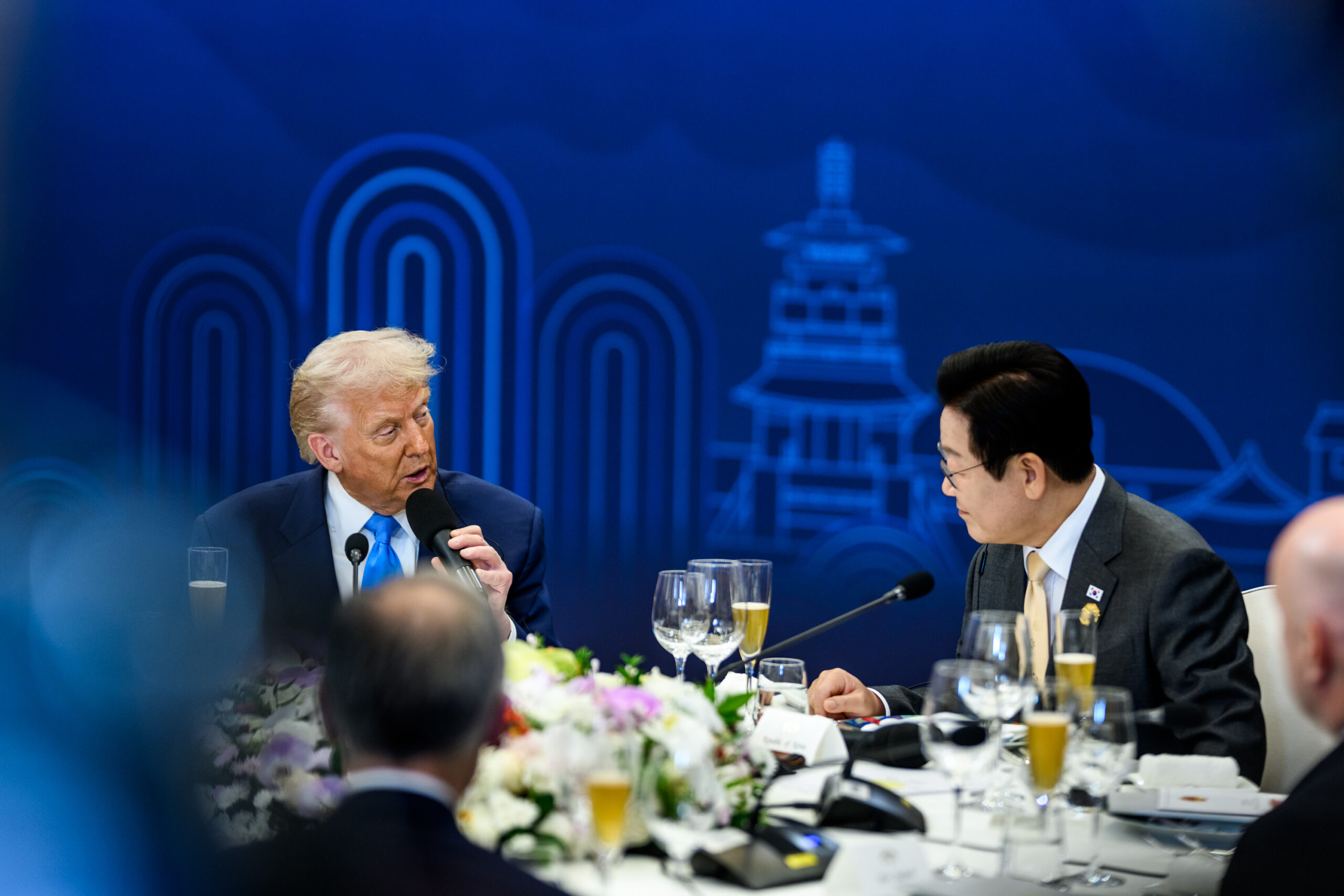
One of the most unexpected outcomes of President Donald Trump’s global trade war last year was that the governments of Japan and South Korea agreed to set up funds to invest hundreds of billions of dollars in new projects in the United States. Where the so-called investment pledges in Trump’s other trade deals, like his deal with the European Union, generally amount to governments taking note of ongoing private sector investments that foreign companies are making in the United States, the Japan and South Korea deals represent something different and much more specific. Both governments have pledged to use state-backed funds to invest vast sums of money—$550 billion in the case of Japan, and $350 billion in the case of South Korea—in U.S. projects selected by the U.S. president.
These deals are unlikely to reach their full headline values, at least during Trump’s remaining years in office. Total foreign investment in the United States from all countries has been running at about $300 billion per year in recent years, with the majority of that coming from foreign companies simply reinvesting profits from their investments already in the United States.1 Japan and South Korea could not make $900 billion in combined new investments over the next three years without crowding out other investors and impacting the value of the dollar, a fact that the final South Korea deal tacitly acknowledged by stipulating that the South Korean government is not obliged to make more than $20 billion in new investments in any given year.
Moreover, as with other elements of America’s pivot to industrial policy starting under the Biden administration, the deals raise important questions about governance and conflicts of interest: for instance, how might those responsible for making such deals ensure that the money is invested in national priorities and not politically favored projects? And what is the right balance to strike between the interests of state-backed investments and those of the U.S. private sector? While beyond the scope of this essay, there are also important legal questions about the deals, such as whether the U.S. government is allowed to direct how a foreign government invests money in the United States and whether the U.S. government can accept ownership interests in the deals without specific authorization from Congress, which, under the Constitution, controls U.S. government expenditures.2
That said, if put on a sound legal basis and executed effectively, the deals have the potential to help address a long-standing gap in the American industrial policy toolkit: the need for “patient capital” that is willing to invest in lower-return but strategically important projects, such as manufacturing and infrastructure. This is vital to the restoration of America’s manufacturing industrial base.
While the U.S. government has never before directed foreign state investment into domestic industry, governments have long deployed capital toward strategic national priorities. For decades, foreign governments, including both the Japanese and South Korean governments, have deployed this type of capital via sovereign wealth funds and/or state-backed “policy banks” that provide low-cost loans to nationally important industries. Governments, including the United States, have also long utilized both equity investments and loans to promote growth in the developing world.
These past precedents—call it the global industrial development toolkit—hold important lessons for the United States, Japan, and South Korea as the three governments move toward implementing the deals. These include the need to focus on projects that don’t have ready access to private capital, the need to deploy different types of capital against different strategic priorities, and the need to get governance and oversight mechanisms right. Getting these funds right has the potential to significantly aid the U.S. government in its reconstruction of America’s industrial base.
Unpacking the Structure of the Deals
Japan and South Korea agreed to establish the investment funds as part of trade negotiations that followed the launch of Trump’s global trade war in April 2025. Trump initially threatened Japan with a tariff rate of 24 percent and South Korea with one of 25 percent, but he ultimately agreed to imposing a rate of 15 percent on both nations in exchange for various trade concessions, including these new investment funds.3 As Commerce Secretary Howard Lutnick put it in public remarks, the countries “basically bought down” their tariff rates with the commitment to upfront investments.4
Initial details of the funds’ mechanics were hazy, and the South Korea deal took months of negotiations before being finalized. But publicly released memorandums of understanding (MOUs) between Japan5 and the United States and South Korea6 and the United States, as well as legislation in the South Korean parliament, have begun to flesh out how the funds will be structured and what the investment priorities will be. There are several comparatively small differences between the funds: for example, South Korea insisted on a $20 billion annual cap in expected investment levels to manage potential currency fluctuation risks. The Japanese government expects that its investments will in fact be made over many years, but the text of the deal does not set a firm annual cap on the dollar amounts that will be invested. Overall, the deals share similar general structures.
Pursuant to both MOUs, the United States is setting up a “Consultation Committee” with South Korea and Japan, respectively, that will identify potential South Korean and Japanese-backed investments in addition to discussing legal and policy concerns. A U.S.-run “Investment Committee” chaired by the U.S. Commerce Department will then make recommendations to President Trump on specific projects to invest in. The Japanese and South Korean governments are broadly obliged to provide relevant investment or financing funds for selected projects. While both governments retain a right to decline to finance any specific investment, declining to finance investments selected by the United States could result in the two East Asian governments forfeiting returns on other investments or, in extreme cases, facing U.S. tariff hikes.
Both deals anticipate that capital will be deployed into a set of agreed sectors that “advance economic and national security interests,” including but not limited to shipbuilding, energy, semiconductors, pharmaceuticals, critical minerals, artificial intelligence, and quantum computing, with the potential to invest in other sectors as well. The South Korea MOU specifies that of the $350 billion topline figure, $150 billion will be for shipbuilding while $200 billion will be for other strategic investments, reflecting South Korea’s strong shipbuilding sector and the Trump administration’s desire to rebuild the U.S. shipbuilding industry.7
At the time of writing, the mechanics of specific investments are still being worked out. The Japanese, South Korean, and U.S. governments have begun discussions with companies to identify specific investment opportunities in strategic sectors highlighted in the MOUs; large investments appear likely in the U.S. energy sector, including in fossil fuels, nuclear, and potentially other forms, such as geothermal. Investment also appears likely in America’s AI data center buildout and in critical minerals facilities, among others. Japanese and South Korean officials have said that they expect the investments to consist primarily of private investments by Japanese and South Korean companies backed by loans from private banks as well as state-backed banks such as the Japan Bank of International Cooperation (JBIC), which has for decades supported Japanese companies investing overseas. South Korea is also establishing a new enterprise, the Korea-U.S. Strategic Investment Corp., which will rely on foreign exchange earnings and bonds to raise funds to back the South Korean investments.8
Specific investments will be made via newly created special purpose vehicles (SPVs) in which the U.S. government will own shares. The government has not released details of any specific SPV yet, and so it is not entirely clear the extent to which the SPVs will simply be part owners of projects alongside private investors or whether some SPVs will wholly own newly established projects. The United States has in the past established “government-owned, contractor-operated” business models, in which the government, for instance, might own a research laboratory, but the laboratory would be run by private enterprises.9
The SPVs will distribute cash flows to the U.S., South Korean, and Japanese governments according to a predetermined formula, essentially fifty-fifty, until the foreign investment has been repaid along with an agreed interest rate, after which the United States will get 90 percent of the cash flow. As a recent analysis by the Federal Reserve Bank of St. Louis noted, this effectively means that the investments will function as a “low-cost but risky loan” for projects in the United States.10
While the Japanese and South Korean governments are on the hook to put cash into the deals, the U.S. government has committed to providing other benefits. The MOUs commit the U.S. government to, “where feasible,” provide leases on federal lands, access to utilities, including power, and to arrange purchase commitments or other offtake arrangements for products that the U.S. government might need, presumably including critical minerals and defense equipment. The United States is also committed to streamlining and expediting any required regulatory processes.11 Finally, the MOUs stipulate that Japan-backed investments should use Japanese suppliers and vendors to the greatest extent possible and that South Korean-backed investments should similarly use South Korean suppliers and vendors. For the South Korean and Japanese governments, this provides some assurance that even if the investments themselves deliver below-market returns to the government agencies making them, some of the investment dollars will flow back into the South Korean and Japanese economies via the investments’ supply chains.
Conceptual Precedents
While the U.S. government has never before directly deployed foreign government capital into domestic, private sector investments, foreign capital has supported U.S. national priorities and economic development since the early days of the republic. The London banks Hope & Co. and Barings helped finance President Jefferson’s purchase of the Louisiana Territories from France, the first time the United States issued bonds in international markets.12 At the height of America’s railroad boom in the early 1870s, approximately two-thirds of all of the railroad securities issued in London were for American railroads, with one of the largest U.S. railroads at the time, the Illinois Central, having a majority of its shares owned by foreigners.13 The second half of the nineteenth century also saw hundreds of companies raise capital in London to pursue U.S. mining projects.14
For most of its history, however (setting aside the federal government’s own borrowing), the United States relied on the private sector to channel foreign investment to national priorities like railroad development. Indeed, in 1983, with Washington embracing a deregulatory agenda both at home and abroad, President Reagan put out a statement on international investment expressly eschewing the business of directing foreign capital flows. The “fundamental premise” of U.S. investment policy, according to the statement, was “that foreign investment flows which respond to private market forces will lead to more efficient international production and thereby benefit both home and host countries.”15
Instead of expressly directing foreign capital, Reagan and his successors worked to create a broader policy environment that would make it attractive for both domestic and foreign capital to flow into national priorities: Reagan’s trade policy to restrict U.S. car imports from Japan in the 1980s, for instance, spurred Japanese investment in the U.S. auto sector.16 In 2011, President Barack Obama set up a “SelectUSA” initiative “to attract and retain investment in the American economy” by conducting outreach to foreign companies about U.S. investment opportunities and about state and local incentives that might support U.S. investments.17
More direct precedents for the South Korean and Japanese investment funds come from foreign industrial policy measures as well as the global development toolkit: in particular, so-called policy banks, which provide concessional lending to national priorities, sovereign wealth funds, and global development finance institutions.
Take South Korea’s and Japan’s own industrial modernization processes in the decades after World War II. In 1954, the South Korean government established the Korea Development Bank (KDB), which initially helped finance the reconstruction of South Korean industry after the war. In the 1970s and 1980s, it financed South Korea’s development of its chemicals, automotive, and electronics industries, largely by providing low-cost loans to companies in priority sectors, enabling the companies to expand and grow into export powerhouses.18 Japan established the Japan Export Bank in 1950 to help finance the growth of Japan’s postwar export industries, and, decades later, merged the bank with a Japanese overseas aid agency to create the Japan Bank for International Cooperation (JBIC), one of the institutions Japan expects will play a prominent role in its planned U.S. investments.19 Today, JBIC finances investments by Japanese companies around the world, including investments in both developing and developed markets.
In recent decades, the United States generally eschewed concessional lending of the type that South Korea, Japan, and other countries used to promote their domestic industries. Recent U.S. government industrial policy lending programs, such as the Department of Energy’s Loan Program Office (LPO) and the chips Act loans for semiconductor manufacturers generally set interests rates well above U.S. federal government borrowing costs, making the loan terms comparatively unattractive, especially for larger companies able to access comparatively low-cost capital in the private markets (the loans are often comparatively attractive for smaller or high-risk companies that face higher private sector borrowing costs).20
At other points in its history, however, the United States has deployed concessional finance as a domestic development tool. During the 1930s, for instance, the Rural Electrification Administration provided loans with an interest rate of 2 to 3 percent to support national electrification efforts.21 After World War II, Congress set the rate for such loans at 2 percent, though in 1981 raised it to 5 percent or more, where it remains today. In the early 1950s, shortly after Congress passed the Defense Production Act, a law intended to help the United States boost production of defense goods and allocate scarce resources needed for national defense, President Truman used the law to provide interest-free government loans to private companies to expand aluminum and titanium production.
Another set of conceptual precedents comes from the world of sovereign wealth funds. Kuwait launched the first modern sovereign wealth fund in 1953. The Kuwaiti fund and other early sovereign wealth funds initially served as vehicles that enabled cash-flush commodity exporters to save wealth for the future while ensuring that a sudden influx of cash did not overwhelm the domestic economy. By the 1970s and 1980s, however, a new breed of sovereign wealth fund, led by Singapore’s Temasek, began to deploy capital to promote national economic modernization goals, such as telecommunications infrastructure investments, in addition to mopping up export earnings and chasing returns.22 Today, countries from Senegal to Indonesia to the United Arab Emirates run sovereign wealth funds with mandates, at least in part, to partner with the domestic and international private sector to promote projects of perceived national interest.
Trump has expressed interest in the United States possessing this type of sovereign wealth fund since his 2024 campaign, when, speaking to the Economic Club of New York, he pledged he would create an American sovereign wealth fund “to invest in great national endeavors for the benefit of all of the American people.”23 Vice President J.D. Vance was also reportedly interested in pursuing a sovereign wealth fund when he served in the Senate.24 In February 2025, Trump signed an Executive Order directing the Treasury Department to explore ways to set up a sovereign wealth fund,25 and while that initiative was reportedly paused several months later over legal concerns and questions about funding mechanisms,26 investment deals that empower the Trump administration to direct Japanese and South Korean funding toward key national projects can potentially promote similar objectives.
A final set of conceptual precedents comes from the world of development finance. Government backing for private sector investment has been a part of the international development policy toolkit since the aftermath of World War II, when the Marshall Plan included mechanisms to loan money to private companies for European reconstruction alongside larger grant and commodity programs. In 1991, following the collapse of the Soviet Union, the European Union (then the European Community) set up the European Bank for Reconstruction and Development (EBRD) to make loans and equity investments in Eastern Europe as way of fostering economic development and consolidating political liberalization in the postcommunist states.27 In more recent years, the EBRD has expanded its portfolio to make debt and equity investments in private companies in countries across the Middle East and North Africa as well as Eastern Europe.28 Other development finance institutions that make debt and equity investments to support development objectives include various multilateral development banks, such as British International Investment and Germany’s Kreditanstalt für Wiederaufbau (KfW), among others.
The United States, too, has deployed investment in support of its international development priorities since the end of the Cold War. In 1989, the U.S. Congress passed the Support for Eastern European Democracy Act (“SEED Act”), which the first Bush administration relied on to set up joint U.S. “Enterprise Funds” with governments in Eastern Europe so as to make debt and equity investments that would foster the region’s nascent private sector.29 In 2018, Congress passed the build Act, which set up the U.S. Development Finance Corporation (DFC), an institution authorized to make debt and equity investments in private companies in order to promote U.S. global development objectives. Although Congress designed the DFC to support overseas development objectives, during Trump’s first term, he used the DFC to provide lending to expand U.S. vaccine production in response to the Covid-19 pandemic.30
A Development Finance Theory of the Case
This history of foreign policy banks, sovereign wealth funds, and development finance institutions makes clear the potential national value of the Japanese and South Korean investment funds to the United States.
The type of U.S. laissez-faire capitalism that came to the fore in the late 1970s and early 1980s proved enormously successful for parts of the American economy. U.S. internet and software companies emerged as global leaders, while U.S. financial and many other services firm prospered. U.S. stocks increased roughly 170-fold between 1980 and the end of 2025, and by some measures, U.S. stocks now account for 65 percent of the world’s total stock market value.31 U.S. companies introduced game-changing technological marvels, including the iPhone and generative AI, as well as novel materials and a revolution in hydrocarbon production that had turned the United States from a net importer of fossil fuels in 1980 to a net exporter of energy by 2019.
But in a geopolitical era defined by competition with China, the laissez-faire economic model has also left a number of critical industries behind. Take U.S. production of rare earths magnets, which are refined from minerals and used in everything from electrical motors to MRI medical imaging machines to missiles and other weapons. U.S. firms, such as GM, led the global rare earths magnet industry into the 1990s. But low U.S. margins for the business and the rise of global supply chains encouraged companies to offshore the technology. GM sold its magnetics division to a Chinese company in 1995, and the Chinese company then proceeded to offshore production.32 Between the 1980s and the 2000s, the United States also lost manufacturing capacity in a range of other critical industries, including computers and electronics, metal products and machinery, and transportation equipment, as well as across a range of less strategically significant (albeit still economically important to regions in which they existed) sectors such as textiles.33
The fundamental reason why these key U.S manufacturing industries declined is comparative cost: it is typically cheaper to manufacture these goods overseas, both because of inherent cost differences, such as labor cost differences and the cost of U.S. environmental regulations, and also due to subsidies that foreign governments were providing to their manufacturers. Because of this cost differential, the returns for investors from U.S. manufacturing were low, and U.S. investors, who naturally sought to maximize their own profits, pulled back, as GM did when it sold its magnetics division to the Chinese.34
This is where the Japanese and South Korean investment funds offer an opportunity. Viewed through the lens of policy banks, sovereign wealth funds, and development finance institutions, they offer a vehicle to channel inexpensive and patient capital into strategic investments in the United States, helping the United States to build capacity in strategically important industries that would be unlikely to thrive in American markets absent policy support. Instead of simply chasing investment returns for the U.S. government, the deals work to deploy the funds toward strategic national priorities, much the same as a development-oriented sovereign wealth fund would do. And the history of these types of policy tools offers lessons for how to deploy the funds effectively.
The first of these lessons is that Japanese and South Korean funds should generally be deployed against investments that cannot secure adequate commercial financing, rather than simply chasing the type of projects that can already obtain commercial funding.
In general, the United States does not have a shortage of capital: indeed, one of the strengths of the American economy is its deep and liquid capital markets, including its strong venture capital industry, which has for decades seeded innovative U.S. start-ups. A weakness that it does have is a shortage of so-called “patient capital”—capital that is willing to make longer term, high-risk bets on new technologies, like breakthrough energy technologies, which take years to develop before beginning to make returns.35 And it has a shortage of concessional capital as well, such as ultra-low-interest loans, which can make the economics of low-margin industries with national security benefits make sense.
Much as the South Korean government made investments in the 1970s and 1980s, or as development-oriented sovereign wealth funds do today, the United States should use the South Korean and Japanese investment funds to invest in long-term breakthrough technologies as well as to help critical U.S. industries obtain the financing they need to scale up manufacturing. Against this thesis, the funds’ planned investments in the shipbuilding, energy, semiconductors, pharmaceuticals, critical minerals, and quantum computing sectors, make sense conceptually.
On the other hand, AI investments should probably be a lower priority. The largest U.S. tech companies alone appear to have spent some $350 billion on AI capital expenditures in 2025,36 with trillions of private sector capital projected to be deployed in the years ahead. Given the vast quantities of private sector money flowing into the sector, there is little apparent need for government-backed financial support. While some investments in the sector could perhaps be seen simply as a nod to the Trump administration’s desire for the funds to post large headline investment numbers—the data center build can absorb much larger quantities of capital than, for instance, critical minerals—chasing these investments would not greatly serve national strategic priorities.
A second lesson is that if the goal of a government-linked investment vehicle is to support strategic industries, the funds should be prepared both to make equity investments and to deploy explicitly concessional debt financing. Equity investments can be particularly important for early-stage companies that need capital for R&D and other activities with an uncertain, longer-term payoff. This category could include companies developing new types of materials or computing technologies where the payoff remains speculative but both the risk and the reward are high. Low-cost lending, on the other hand, can be an effective form of capital for a manufacturing or industrial company that needs to scale up its capacity to manufacture, but only in cases where it already has a clear product and market to reach scale.
The United States should be prepared to waive the profit rights it contractually negotiated in the two MOUs to encourage the funds to provide these types of finance, particularly lending. The MOUs generally provide that the U.S. government and the foreign investor government will split free cash flows coming out of an investment fifty-fifty while an investment is being repaid. In many cases, however, this split will erode the incentive for the foreign investor to pursue lower-return investments, since already low returns will have to be shared with the U.S. government. For example, it will be much more appealing for the Japanese government to chase an AI investment with a 10 percent expected annual return than a shipbuilding investment with an expected return of 4 percent when that return must be split fifty-fifty at a 2 percent rate of return to Japan. Practically speaking, the investment will probably never be paid back. The U.S. government should be prepared to waive its share of any free cash flows for concessional investments in strategic sectors.
Finally, a third lesson from abroad is that the investment vehicles offer an opportunity to strengthen the ties between the United States and its closest East Asian allies, South Korea and Japan. Many development finance institutions have an explicit goal of strengthening geopolitical ties as well as economic development. The U.S. DFC, for instance, defines its mission as helping “to advance U.S. foreign policy and strengthen national security by mobilizing private capital around the world.”37
The two deals appear poised to deepen U.S. economic ties with Japan and South Korea, primarily by strengthening the presence of Japanese and South Korean firms in the United States.38 Practically speaking, this will likely result in an increasingly central and strategic role for Japanese and South Korean firms in the American economy, much as President Reagan’s negotiated limits on car imports from Japan in the 1980s resulted in Japanese automotive companies investing in the United States and ultimately becoming deeply integrated into the U.S. automotive manufacturing ecosystem.39
Of course, there will also be important governance and oversight questions associated with the new investment funds, as there are with the Trump administration’s other new industrial policy tools, such as its equity stakes in Intel, rare earths mining company MP Materials, and a growing list of other U.S. companies.40 There were similar questions associated with the Biden administration’s industrial policy programs, such as its use of the Department of Energy’s Loan Programs Office to loan money to clean energy projects and the grants it gave to semiconductor companies pursuant to the chips Act.
With respect to the two funds, the administration must commit to a set of governance priorities: ensuring that money is deployed toward investments that actually advance national priorities, rather than simply being given to politically connected firms; determining standards of fair competition between companies that receive state backing and other companies that do not; and establishing processes and metrics for the investment funds to prove their effectiveness over time.
Ideally, Congress would set up new oversight mechanisms, though that would require the legislative branch to show more initiative than it has in recent years. Barring that, the public as well as private companies—who have a keen interest in ensuring that government-backed competitor firms do not receive unfair or opaque advantages—should demand a high degree of transparency and disclosure regarding the investments as they are made. And the risks to U.S. industrial policy from a scandal associated with poor governance and oversight practices are real: the 2011 bankruptcy of Solyndra, a solar panel manufacturer that had received $500 million from the Obama administration, created a major political scandal that tarnished the then-nascent U.S. industrial policy effort for several years.41 Even if the Trump administration itself is not terribly concerned about potential scandals, governance failures would risk tarnishing the investment funds over time and erode the bipartisan political support that will be needed to sustain investments slated to take place over decades.
One Tool Among Others
It is important to keep in mind that even if the investment funds are effective at channeling capital toward U.S. strategic priorities, the South Korean and Japanese investment funds are just one of many tools that the U.S. government will need to deploy if it wants to rebuild its industrial base. Supply-side incentives for U.S. production, such as the investment funds, must be paired with demand-side incentives to ensure that there is a market for the products that the new investments will ultimately produce. Much as the Defense Department’s deal with rare earths company MP Materials paired loans and an equity investment with a purchase commitment and other mechanisms to ensure that MP could sell its rare earths products profitably even when competing against lower-cost Chinese competitors, a similar framework must be applied in this instance.42
The United States may also need to take steps to protect its market from that same Chinese competition, as the U.S. Federal Communications Commission (FCC) recently did with its prohibition on the deployment of future-model Chinese made drones in the United States, an action that not only protects Americans against the surveillance risks posed by Chinese drones but also creates demand for domestically made drones by excluding foreign competitors from the American market. There is a wide domestic consensus that the United States needs to overhaul its permitting system for large-scale projects in order to make it easier to produce physical goods in the country. The U.S. government will need a diverse new toolkit to employ over time if it wants to reverse an industrial decline that unfolded over decades.
Still, if implemented effectively, the Japanese and South Korean investment funds have the potential to be one of the new tools that the United States can deploy to jumpstart that process. Achieving U.S. industrial policy goals will require the deployment of the type of patient capital and low-cost lending that other nations have used to great effect in their own industrialization strategies—and which the United States, too, has used at different periods in its past.43 While Japan and South Korea are perhaps unexpected sources of such capital, both countries are also close U.S. allies whose own security and economic well-being will benefit from a stronger U.S. industrial base and from the further integration of their companies with the U.S. economy. Innovation in policy means seizing the art of the possible, and the deals—despite some risk—have quite a bit of potential for the United States and its allies.
This article originally appeared in American Affairs Volume X, Number 1 (Spring 2026): 12–24.
Notes
1 “Global Investment Fuels U.S. Innovation: 2025,” Global Business Alliance, accessed January 2026.
2 Scott Levy, “The $550 Billion Shadow Budget: Trump’s Japan Deal and the Disappearing Appropriations Clause,” Just Security, Oct. 30, 2025.
3 U.S. President, “Executive Order 14257 of April 2, 2025: Regulating Imports With a Reciprocal Tariff to Rectify Trade Practices That Contribute to Large and Persistent Annual United States Goods Trade Deficits,” Federal Register 90, no. 65 (April 7, 2025).
4 Joseph Zeballos-Roig, “Trump’s Trade Deal with Japan Includes a $550 Billion Fund That He Will Oversee,” Quartz, July 23, 2025.
5 “Memorandum of Understanding Between the Government of Japan and the Government of the United States of America With Respect to Strategic Investments,” World Trade Law, September 4, 2025.
6 “Memorandum of Understanding Between the Government of the Republic of Korea and the Government of the United States of America With Respect to Strategic Investments,” Ministry of Trade, Industry and Energy, November 14, 2025.
7 Sophia Cai and Joe Gould, “‘Make American Shipbuilding Great Again’: Korea Leans into Shipbuilding as It Woos Trump,” Politico, October 27, 2025.
8 Yonhap staff, “Seoul to Set Up Special Corporation For $350b Investment Pledge to US,” Korea Herald, November 26, 2025.
9 See: “Sandia’s Government Owned/Contractor Operated Heritage,” Sandia National Laboratories, accessed January 2026.
10 YiLi Chien and Masataka Mori, “Analyzing Japan’s $550 Billion Pledge to Invest in the U.S.,” Federal Reserve Bank of St. Louis, November 24, 2025.
11 See paragraph 9 in: “Memorandum of Understanding Between the Government of Japan and the Government of the United States of America,” World Trade Law.
12 Mark Edward Hay, Transatlantic Finance in the Age of Revolutions (Cham, Switzerland: Springer International Publishing, 2025).
13 Mira Wilkins, The History of Foreign Investment in the United States to 1914 (Cambridge: Harvard University Press, 1989): 115–19.
14 Mira Wilkins, The History of Foreign Investment in the United States to 1914, 237–38.
15 Ronald Reagan, “Statement on International Investment Policy [September 9, 1983],” Reagan Library, accessed January 2026.
16 Wells King and Dan Vaughn Jr., “The Import Quota that Remade the Auto Industry,” American Compass, September 29, 2022.
17 U.S. President, “Executive Order 13577 of June 15, 2011: Establishment of the SelectUSA Initiative,” Federal Register 76, no. 118 (June 20, 2011).
18 “Chronology of the Korea Development Bank,” Korea Development Bank, accessed in January 2026.
19 “Continuous Evolution of JBIC’s Role,” Japan Bank for International Cooperation, accessed January 2026.
20 “Department of Energy, Pricing for LPO Financing by Program,” Department of Energy, March 15, 2024.
21 Tim Sablik, “Electrifying Rural America,” EconFocus, Q1 2020.
22 For an overview of the history and development of sovereign wealth funds, see: Adam Dixon, Patrick Schena, and Javier Capape, Sovereign Wealth Funds: Between the State and Markets (Newcastle upon Tyne: Agenda Publishing, 2022).
23 Donald J. Trump, “Remarks to the Economic Club of New York,” Economic Club of New York, September 5, 2024.
24 Chris Hughes, “Why Trump Wants a Sovereign Wealth Fund,” Marketcraft (Substack), March 5, 2025.
25 U.S. President, “Executive Order 14196 of February 3, 2025: A Plan for Establishing a United States Sovereign Wealth Fund,” Federal Register 90, no. 26 (February 10, 2025).
26 Marion Halftermeyer and Daniel Flatley, “Bessent Says Trump Paused Sovereign Wealth Fund to Focus on Debt,” Bloomberg, May 23, 2025.
27 “History of the EBRD,” European Bank of Reconstruction and Development, accessed January 2026.
28 “Where We Invest,” European Bank of Reconstruction and Development, accessed January 2026.
29 John P. Birkelung, “Doing Good While Doing Well: The Unheralded Success of American Enterprise Funds,” Foreign Affairs (September/ October 2001).
30 DFC staff, “DFC Approves $590 Million Loan to ApiJect to Expand Infrastructure and Deliver Critical Vaccines in Response to the COVID-19 Pandemic,” U.S. Development Finance Corporation , November 19, 2020.
31 Gabriela Santos, “International Equities: Global Structural Changes Driving Narrowing U.S. Earnings Growth Exceptionalism,” JPMorgan, November 19, 2025.
32 Ernest Scheyder and Ben Klayman, “General Motors Returns to Rare Earth Magnets with Two U.S. Deals,” Reuters, December 9, 2021.
33 Katelynn Harris, “Forty Years of Falling Manufacturing Employment,” Beyond the Numbers, November 2020.
34 Julius Krein, “Creating New Financing Incentives for Critical Industries,” Rebuilding.Tech, 2025.
35 Victoria Ivashina and Josh Lerner, Patient Capital: The Challenges and Promises of Long-Term Investing (Princeton: Princeton University Press, 2019).
36 Louise Matsakis, “The AI Data Center Boom Is Warping the US Economy,” Wired, November 5, 2025.
37 DFC staff, “About Us,” U.S. Development Finance Corporation, accessed January 2026.
38 See paragraph 10 in: “Memorandum of Understanding Between the Government of Japan and the Government of the United States of America,” World Trade Law.
39 King and Vaughn “The Import Quota that Remade the Auto Industry.”
40 Ana Swanson, “$10 Billion and Counting: Trump Administration Snaps Up Stakes in Private Firms,” New York Times, November 25, 2025.
41 David Boaz, “Solyndra: A Case Study in Green Energy, Cronyism, and the Failure of Central Planning,” Cato Institute, August 27, 2015.
42 Arnab Datta and Peter Harrell “What the Pentagon’s Rare Earths Deal Gets Right and Wrong,” Bloomberg, September 10, 2025.
43 “Fact Sheet: FCC Updates Covered List to Include Foreign UAS and UAS Critical Components on Going Forward Basis,” Federal Communications Commission, December 22, 2025.