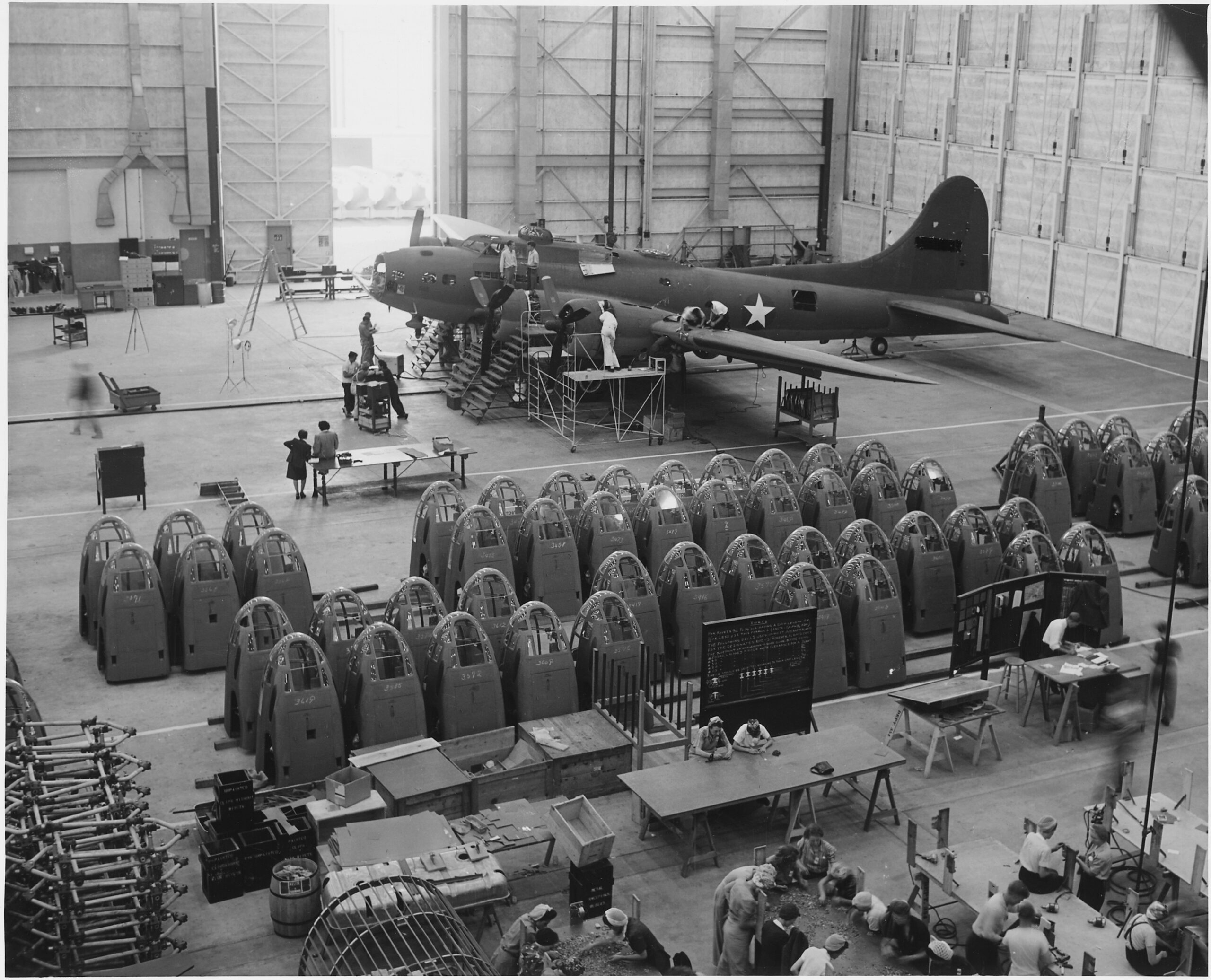
During the course of our operations over three or four years, we advanced over $11 billion [to build] plants. . . . We built up the aircraft operations—we built 15 or 20 plants for that. We built all the synthetic rubber plants, we built all of the magnesium plants, and we built aluminum plants. We actually financed everything you could think of. . . . Defense Plant was given carte blanche in drawing on the Treasury for the money that we needed.1
—John W. Snyder, Executive Vice President, Defense Plant Corporation (1940–43)
On February 3, 2025, President Trump signed an executive order directing his staff to submit plans for the creation of a United States sovereign wealth fund.2 In the year since, the Trump administration has rapidly acquired equity stakes in rare earths miner MP Materials, struggling semiconductor giant Intel, metals smelter Korea Zinc, and more. These deals have raised a host of questions for the future of U.S. industrial policy. Should the government own equity in private firms at all, and if so, under what conditions? How should these deals be structured? Should negotiations be conducted at the executive level, or should political leaders allow terms to be hammered out by professional staff?
These questions are not new. In the years leading up to Pearl Harbor, the Roosevelt administration created the Defense Plant Corporation (DPC), a subsidiary of the Reconstruction Finance Corporation (RFC), which acted as a government-owned industrial bank; the DPC’s mission was to accelerate the nation’s defense buildup, and its investments were clustered in industries that would today be considered dual-use. Four-fifths of the DPC’s investment included facilities related to aviation, metals, and synthetic rubber.3 These investments accounted for 96 percent of U.S. synthetic rubber production, 90 percent of magnesium production, 71 percent of aircraft and aircraft engine production, and 58 percent of U.S. aluminum smelting and refining.4 By war’s end, the DPC owned between 10 and 12 percent of the country’s entire industrial capacity.5
Government ownership of facilities was the key to the DPC’s success. The organization financed facilities and retained title, then leased them to private operators, who managed day-to-day operations and had the option to purchase the facilities outright after the war. (This arrangement lives on today in the form of the government-owned, contractor-operated, or GOCO, model used by the Department of War and other government agencies.) The DPC’s innovative leasing model separated asset risk, borne by government, from operational risk, borne by private lessees. This arrangement enabled Washington to shoulder the risk that private firms refused to bear, the possibility that defense-related capacity would become worthless in peacetime, while preserving private sector operational expertise and efficiency incentives.
The success of the DPC challenges the myth that America’s World War II manufacturing buildup was driven exclusively by patriotic industrialists. Virtually all of the DPC’s key players were government lawyers. While some business executives played an important role, many of the nation’s leading financiers and firms were initially hesitant to commit large amounts of capital to prepare for a war some believed may never come. Mobilization succeeded not because policymakers appealed to industrialists’ better angels, but because they designed institutional structures that made strategic investment compatible with private profit maximization.
Yet the DPC’s history also offers a cautionary tale about fund governance. Chairman Jesse Jones’s control of the RFC’s portfolio offered a mechanism to disburse billions of dollars in funding while bypassing the appropriations process, an arrangement that conferred tremendous political power with little accountability or oversight. Jones also insisted on personally negotiating major deals, a practice that slowed the defense program considerably in the leadup to Pearl Harbor and allowed incumbents to stifle competition. Effective governance requires empowering professional staff to execute transactions at speed while maintaining transparency and accountability through standardized deal criteria, independent oversight, and industry-standard due diligence.6
The following case study examines how the DPC overcame initial political resistance, scaled to finance thousands of facilities, and eventually became a model for government-backed industrial development. As policymakers design new financing mechanisms to channel private capital toward strategic industries, the DPC’s experience offers enduring lessons about risk allocation and the institutional safeguards necessary to prevent political capture without sacrificing operational speed.
Emergency Capitalism: The Rise of the RFC
On December 8, 1931, President Herbert Hoover, grasping for a way to pull the nation out of the Great Depression, called for the creation of an “emergency Reconstruction Corporation” during his third State of the Union address.7 Amid a wave of regional bank failures, Hoover argued that a government-backed lending organization was necessary to buttress the country’s railways, agriculture, and regional banks. He intended for the corporation to be temporary, winding down after just two years.8 Congress was receptive to the idea and quickly passed legislation, and on January 22, 1932, Hoover signed the Reconstruction Finance Act into law.9
Whatever Hoover’s intentions, the RFC did not wind down after two years. The election of President Franklin D. Roosevelt in 1933 gave the organization a second wind. Over the course of two decades, the organization would lend some $40 billion (and offer billions more in loan guarantees).10 It purchased and sold mortgages and securities, disbursed money to other government agencies, and purchased and stockpiled raw materials.
The RFC’s lending programs were not intended to serve as subsidies. By law, the RFC had to secure “reasonable assurance” of loan repayment before disbursing funds.11 Where the RFC differed from commercial banks was its risk tolerance. “The government, under present circumstances, can afford to take a chance that a bank cannot,” Jesse Jones told the Senate Committee on Banking and Commerce in 1938.12 In the wake of the 1929 crash, firms—especially manufacturers—needed loans with durations of ten years or more given the bleak business environment. The RFC stepped into the gap as an early proponent of term lending, providing firms with medium-term working capital and financing equipment purchases.13
The RFC’s role expanded largely due to the efforts of its long-time chairman Jones, who would run the organization from 1932 through 1945. The RFC was his personal fiefdom.14 One of the country’s largest real estate developers, Jones was a self-made multimillionaire. He “was in love with money and power, nurtured an incorruptible sense of personal ethics, and gave no quarter to rivals,” writes historian James Olson.15
Jones was also one of few men in Washington who could outmaneuver Franklin Roosevelt, weathering the president’s attempts to remove him not once but twice.16 The two men could not have been more different. Though a fixture in Texas Democratic politics, Jones was conservative by temperament. His main priority was maintaining the integrity of the RFC’s lending record. Though Jones and Roosevelt harbored an intense dislike for one another, they realized they needed one another. And as Olson points out, the RFC was not something the administration could do without:
[Roosevelt] saw the RFC as a bureaucratic tool perfectly designed to fit his administrative style—flexible, pragmatic, powerful, and independent. Blessed with massive financial resources, unparalleled congressional support, political insulation, and a dynamic, highly respected leader, the RFC gave the president freedom of action and power without strings attached.17
Roosevelt had been cautiously preparing the nation for war for well over a year when, in spring 1940, Hitler’s blitzkrieg incursion across the Low Countries into France shocked the American public. On May 26, with evacuations at Dunkirk underway, Roosevelt addressed a joint session of Congress, calling for a special $1.1 billion appropriation to rearm the Army, Navy, and Marine Corps.18 Stressing the role of air power in Hitler’s blitzkrieg invasion, Roosevelt also called for a massive expansion of aircraft production. “I should like to see this nation geared up to produce at least fifty thousand planes a year,” he stated.19
Roosevelt’s message sent waves of panic through Washington. Between the Wright brothers’ first flight at Kitty Hawk and the Nazi invasion of Poland in 1939, U.S. companies had produced an estimated total of thirty thousand planes of all kinds.20 The country had just three suppliers of high-performance aircraft engines. The president had not consulted the War Department in advance, and neither it nor his staff had any idea how the target could be met. Roosevelt alone appeared to have a plan, and it hinged on government-backed credit. That same night, in a radio fireside chat, he outlined an expansive role for the federal government in financing the defense program:
I know that private business cannot be expected to make all the capital investment required for expansion of plants and factories and personnel which this program calls for at once. It would be unfair to expect industrial corporations to do this, when there is a chance that a change in international affairs may stop future orders. Therefore, the Government of the United States stands ready to advance the necessary money to help provide for the enlargement of factories, the establishment of new plants, the development of new sources of supply for the hundreds of raw materials required. . . . The details of this are now being worked out in Washington, day and night.21
In the weeks that followed, conversation in Washington centered on how the nation could meet Roosevelt’s impossible benchmark. It was natural that many of these conversations would occur within the walls of the RFC. Throughout the 1930s, a decade when most of the nation’s institutions had withered, the government bank became an attractive home for the country’s top legal and financial talent. Jones’s staff in 1940 included two future Treasury secretaries, a future Supreme Court justice, the first secretary of the Air Force, and a future director of the New York Stock Exchange.22 Arguably the most important member of Jones’s staff, however, would prove to be a little-known Washington lawyer, Clifford J. Durr. Durr, the RFC’s general counsel, developed the DPC financing mechanism that spurred much of the country’s manufacturing buildup before and after Pearl Harbor.23
The first push to meet Roosevelt’s benchmark came in mid-June. William “Bill” Knudsen, a former General Motors executive and member of the newly established National Defense Advisory Commission (NDAC), asked Jesse Jones if the RFC would provide financing to build and operate a large aircraft engine plant near Cincinnati, Ohio. The plant would be operated by the country’s largest aircraft manufacturer, Curtiss-Wright Aeronautical Corporation, and was slated to produce over twelve thousand engines per year, providing a crucial headstart towards meeting FDR’s aggressive goal.24
The problems began when the RFC received the term sheet, a deal which NDAC intended as the standard template across other industries necessary for war production. The terms were as follows: (1) to cover the cost of plant construction, the RFC would lend the manufacturer 100 percent of the cost of the plant at a below-market 3 percent interest rate; (2) the loan would be secured via the mortgage on the facility; (3) the loan principal would be paid solely from an agreed upon portion of the price of components sold to the Army and Navy, amortized at a rate of $800 per engine; (4) the RFC would loan the manufacturer an additional $22 million for working capital, interest-free; (5) Curtiss-Wright would be granted title to the plant and would retain ownership after the war was over.25
Durr found these terms to be comically generous. “The manufacturer was to borrow from the RFC without pledging his own credit in any way,” he protested.26 In return, it would get to keep assets built almost entirely with taxpayer funding. The only capital expense paid by the manufacturer was land. “After investing no money, and incurring no risk, [the borrower] would receive title to a plant paid for by the government,” summarizes historian Gerald T. White.27 NDAC’s Donald Nelson agreed. Allowing defense contractors to receive “a new or better plant, free,” on top of substantial profits, was “unwarranted and unnecessary,” he argued.28
Jones ignored these objections and pushed the loan through. And yet, in a remarkable turn of events, Curtiss-Wright still turned it down. The standoff boiled down to bad incentives. “The aircraft companies did not wish to bear the expense of expansion because military orders might cease long before the plants could be paid for,” and civilian demand was unlikely to be sufficient for expanded plants to be profitable, explains a postwar Army Air Corps study.29 Legacy regulations passed after World War I also played a role. After that war, Congress, facing public outrage that contractors (smeared as “merchants of death”) had made excessive war profits, passed legislation capping their profits. Recent adjustments to the law had capped Curtiss-Wright’s profits at 8 percent of the contract price, and adding amortization payments from plant construction onto the price of the engines would artificially inflate the company’s profit margins.30
The Curtiss-Wright episode made clear that achieving Roosevelt’s goals would require an entirely new financing mechanism, one that aligned the incentives of contractors with the requirements of the defense buildup.
“Shotgun in a Corner”: The DPC Takes Shape
By summer 1940, most observers agreed that successful defense mobilization hinged on solving a central problem: how to incentivize large-scale capital investment in production capacity without creating windfalls for contractors. The challenge was achieving that balance at the speed and scale Roosevelt’s rearmament program demanded. A few weeks before the Curtiss-Wright fiasco unfolded, Durr was asked by his deputy, Hans Klagsbrunn, how he would structure the defense program if he were in charge. The key, Durr explained, lay in government ownership of facilities:
I stated that in my opinion the bulk of the money would have to be put up by the Government—and that if the Government put up the money it should own the plants. I also expressed the thought that in view of the speed required it would not be practical for the Government to try to operate many of these plants itself, but that existing organizations should be used so that these plants should be leased to private manufacturers.31
Durr’s solution restructured the allocation of risk in defense production. Government ownership placed long-term asset risk, the possibility that massive production capacity would become worthless after the emergency, on the government’s balance sheet where it belonged. Contractors would bear operational risk and earn reasonable returns for efficient production, but they would not receive valuable capital assets built at public expense.32 This division of risk created sustainable incentives: contractors could invest management capability and production expertise without betting their balance sheets on the durability of wartime demand.
The model offered three advantages. First, government ownership accelerated construction by eliminating the “unhappy dilemma of the manufacturer who could get no financial backing without orders, no orders without facilities, and no facilities without financial backing,” as Klagsbrunn noted.33 Second, it minimized windfalls to contractors. During World War I, Army Department contracts had baked in funding for contractors to build their own plants, allowing firms to retain valuable facilities built at government expense.34 And third, it gave operators greater freedom to operate the plant as they saw fit compared to service-owned plants under management-fee contracts.35
In the weeks following Roosevelt’s May 26 address, Durr and Klagsbrunn turned their vision into reality. They drafted a bill authorizing the RFC to make loans and purchase stock in corporations for national defense purposes. On his own initiative, Klagsbrunn inserted language empowering the RFC to make loans for “plant construction, expansion and equipment, and for working capital”; Klagsbrunn described these powers to Jones as a “shotgun in the corner,” borrowing one of the Texan’s favorite phrases.36
On June 14, Paris fell to the Nazi war machine, spurring a flurry of mobilization-focused legislation. RFC staff expected their amendment to pass smoothly. But one member singled out the proposal: Senator Robert Taft of Ohio. To Taft, the bill smacked of socialism:
[Government] could go into the business of manufacturing any kind of airplanes, any kind of strategic materials; yes, go into almost any and every thing. As far as I can see the Government could go into the business of buying corn and wheat; could, in fact, go into the business of running farms. It could go into the utility business, the oil business, or any and every kind of business that it might choose to go into. . . . If we create a corporation of this kind, the corporation will be gone forever from the care of Congress. The Corporation may do anything.37
Taft was correct that some New Dealers harbored ambitions for permanent government control of industry. While identifying risks of government overreach, however, he offered no mechanism to achieve the production capacity necessary to deter or defeat the Axis. This pattern persists today. Critics invoke “socialism” when opposing industrial policy initiatives ranging from the chips and Science Act to development banks. Their concerns about favoritism and mission creep are legitimate. Yet dismissing government intervention entirely leaves no mechanism to address chronic underinvestment in strategic industries. The challenge, then as now, is not whether government should intervene in strategic industries, but how to structure that intervention to achieve public goals without creating permanent state dependence.
Competing Mechanisms
Legislation containing the DPC’s leasing model was passed by Congress and signed into law on June 25, 1940, but industrialists and the U.S. banking sector remained deeply uncomfortable with the idea of government ownership.38 In a 1941 speech that the editorial board of the Wall Street Journal reviewed favorably, Emmet F. Connely, president of the Investment Bankers Association, said the following:
The initiative rests largely with business men and industrialists of the United States. If they throw their influence in the direction of direct government financing, they will find plenty of allies to help them among those with a socialist bent . . . it would be well if business men asked themselves what is going to happen to these new government-financed plants when the emergency ends.39
The belief that the defense buildup should be funded exclusively with private capital found favor with NDAC’s pro-business wing. Over the course of the year, the commission held a series of roundtables with several of the nation’s leading financiers, including Lehman Brothers and Guaranty Trust Co., focused on developing alternative financing mechanisms.40 In summer and fall of 1940, NDAC would launch two such mechanisms, a bankable contract called the Emergency Plant Facilities (EPF) contract and a five-year tax amortization program, intended to channel large amounts of private investment into the defense buildup.
On August 23, NDAC announced the EPF contract. The instrument was purpose-built to crowd in large amounts of private capital. Under EPF, contractors could build defense plants deemed essential by military officials with the government committing to recover construction costs via sixty equal monthly payments. These government payments would be provided directly to a financial institution, not to the contractor, as few firms had sufficient capital to build large-scale production facilities on their own.
For contractors, this structure offered several benefits. First, because the government covered all facility costs, these expenses did not factor into negotiations over the price of goods manufactured at these sites. Second, contractors faced minimal financial exposure since repayment was contractually assured. And third, contractors were given the option to purchase the facility at war’s end, either at cost-less depreciation or via direct negotiation with the War or Navy Departments.41
But the EPF contract suffered from a few fatal flaws. Before repayment could begin, construction had to be completed, then the contractor and lender had to secure a government certificate. Until these steps were completed, neither party could be certain that the government would approve their investment. To make matters worse, a repayment provision required the government to have sufficient funds on hand to pay off the entire balance of all EPF loans. “The effect of this provision,” notes White, “was to put the government in the position of paying interest to a bank on a loan while having on hand sufficient resources to pay off the principal.”42 The arrangement proved far too burdensome for both government and contractor. In 1941, aircraft manufacturer Curtiss-Wright, preferring the simplicity of the DPC’s loan program over the complexity of EPF, came back to Jesse Jones for financing.43
Tax amortization was a second avenue favored by many in the financial sector and Congress. After World War I, tax amortization was used to provide relief to manufacturers that had overbuilt facilities with minimal postwar value.44 Advocates of the policy, including those at NDAC, believed accelerated depreciation schedules could be a significant inducement for private investment.
In October, Congress included a tax amortization provision in the Second Revenue Act of 1940, allowing firms to write off the costs of defense facilities at a rate of 20 percent or more, an accelerated schedule compared to standard depreciation rates of 5 percent for facilities and 10 percent for equipment allowed by the IRS.45 “This gave corporate management and investors a double advantage: it enabled corporations to deflate their taxable earnings, while increasing their earning facilities,” summarized journalist Eliot Janeway.46
Tax policy did measurably contribute to the defense buildup. The provisions were applied to some $6.5 billion in facilities, roughly a quarter of total manufacturing investment immediately before and during the war.47 But the program turned out to be less of an inducement than NDAC hoped. The majority of projects funded under the program were relatively small (certificates granted by the War Department, the primary issuing agency, were for projects less than $300,000 on average).48
Like the EPF contract, tax amortization also faced problems of NDAC’s own making that undermined the program’s effectiveness. To qualify for tax amortization, manufacturers had to receive a certificate from both NDAC and the War or Navy Department. But disagreements among NDAC staff caused significant delays and created uncertainty for firms.49 As a result, Congress withdrew NDAC’s ability to issue certificates in October 1941, granting issuing power only to the War and Navy Departments.50
To Klagsbrunn, it was clear why tax amortization failed to live up to expectations. It boiled down to risk calculus. “While the period of risk for private concerns was shortened through tax benefits, it was not eliminated,” he wrote.51 Manufacturers still had to navigate wartime shortages of materials and labor, uncertainty surrounding government contracts, and risk of overbuilding. Unless something was done to fundamentally change the risk calculus, firms remained hesitant to invest at the speed and scale the war effort required.
As the year wore on, shortages of machine tools, including boring mills, grinding and milling machines, lathes and more, emerged as one of the most pressing obstacles to rapid expansion of aircraft production.52 Producers were hesitant to add capacity given the wild swings in demand that characterized the industry.53 The DPC developed a pool order system, essentially a series of government-backed advance purchase commitments, that solved this problem. “The pool order,” summarized Klagsbrunn, created “a guarantee of a market and a price for specific items of machinery that can be produced in anticipation of a single market.”54 The DPC also offered machine tool producers a 30 percent cash advance, providing them interest-free working capital.55 For U.S. industrial planners, the program had the added benefit of creating greater visibility over tooling orders, plus the ability to intervene and steer them toward the most critical projects.
Pooling efforts began roughly one year before Pearl Harbor and would quickly scale over the following year. In December 1940, NDAC urgently requested that the DPC pool tooling orders, and Schram agreed, committing up to $35 million. A few months later, the DPC agreed to purchase tools in support of the War Department’s emerging heavy bomber program, boosting its budget by $200 million.56 By war’s end, the DPC pool accounted for nearly half of machine tools manufactured in the United States between 1941 and 1945.57
The high degree of investment risk in the machine tool industry made it a logical target for government support. Many tools required six months or more to manufacture, and some machine tool manufacturers already faced a backlog of eighteen months’ worth of orders.58 Most manufacturers were smaller firms with limited access to capital for a rapid buildout. Many executives also remained wary due to their World War I experience, as the War Department had abruptly canceled their contracts after V-Day. Thanks to the DPC, however, World War II was a much more positive experience for the industry: pooling granted machine tool manufacturers the certainty and working capital they needed to expand and operate at full capacity, enabling in turn the rapid buildout of other wartime industries.59 As Secretary of War Robert Patterson wrote in 1946:
In the mobilization of industrial America for World War II the fundamental problem was to provide, where needed, machine tools and other production equipment, including gages, metal cutting tools and industrial specialities. . . . Pool orders proved very successful and assisted in meeting war requirements efficiently, and, therefore, will probably be used with any future emergency.60
By the end of 1940, the DPC had emerged as the essential financing vehicle for defense production.
The DPC Hits Its Stride
Between its creation in August 1940 and the war’s end in 1945, the DPC would finance over 2,300 facilities collectively worth $9.2 billion, roughly two-thirds of all new private industrial capacity added immediately before and during the war years.61
Rather than vetting and selecting projects itself, the DPC allocated capital at the direction of other government agencies. Nearly all project requests came from sponsor agencies within the defense establishment. The War Department and War Production Board were the DPC’s top sponsors, followed by the Navy Department.62
Though the DPC accepted direction from sponsor agencies, it maintained financial discipline through cost-sharing arrangements. The DPC “might take risks but was not supposed to incur losses, at least not large losses. Therefore it did not care to finance the plants up to 100%,” notes a postwar Army study.63 The solution was a novel mechanism called a “take-out agreement,” in which the sponsor agency agreed to pay a certain percentage of construction costs upfront and reimburse the RFC for the rest as appropriations became available.64 These agreements allowed sponsor agencies to stretch their funds up to 2.5 times as far compared to directly constructing facilities themselves.65
For months, the DPC operated like a finely tuned machine. For most deals, the small team of staff received applications from sponsor agencies and disbursed funding rapidly, often within twenty-four hours. As Janeway illustrates:
Each morning, the War Department would telephone its latest applications to Durr; Durr would process them for Snyder, Snyder would approve them for the lawyers; the legal staff would begin reducing the daily batch to contract form before lunch; the papers would be ready for transmission to the War Department by the end of the day; and the company with the contract would have its construction-and-tooling-up money the next day. No team of administrators, before or since, has achieved as much. It was a model of Governmental efficiency.66
“We were trying to attract as little attention to ourselves as possible . . . millions and millions of dollars we’re handing out,” Cliff Durr recalled later. “[We had] to move fast and without much overhead.”67
It took several months before RFC Chairman Jesse Jones realized that his lending agency had become a vital pillar of the defense program, without him even lifting a finger. Beginning in December 1940, he set out to reassert authority over the agency.68 Jones, Durr recalled later, was the kind of person who “liked to get power just to have it—and also sometimes to keep other people from using it.”69 He harbored a deep distrust of Roosevelt and was not a true believer in the necessity of the president’s defense program. Instead, what he cherished above all else was the RFC’s sterling lending record. The RFC’s portfolio was the source of his power and was referred to around Washington as “his money.”
Jones began his purge in early 1941 by arranging for the DPC chairman Emil Schram to be offered the chairmanship of the New York Stock Exchange. In his place, Jones selected Sam Husbands, a member of the RFC’s board and one of his allies. Jones used this transition to become much more involved in the DPC’s operations. His meddling would slow the entire program in the year leading up to Pearl Harbor.
There was nothing Jesse Jones loved more than making deals. The swashbuckling Texan “negotiated each loan like a country banker,” writes Janeway, “sharp-shooting for each point in slow motion, dragging out the bargaining to exploit the borrower’s need for cash, literally carrying his various deals around his pockets.”70 Jones’s preference for high-profile negotiations with executives clashed with the DPC’s typical practice of providing framework agreements, meant to prioritize speed and fairness.
Entering 1941, Roosevelt’s aggressive production goals required massive increases in the production of basic metals, especially aluminum. The math was daunting. Producing one pound of aluminum required two pounds of alumina feedstock, which in turn required roughly four pounds of grade A bauxite ore.71 In 1939, U.S. mines produced roughly 770 million pounds of bauxite, roughly half of which was used for production of aluminum ingots. In total, this left the defense program with just eighty-five to ninety million pounds of aluminum, less than the capacity of a single three-pot-line aluminum plant. NDAC plans called for a whopping thirty-eight pot lines to meet wartime demand.72
Expanding capacity meant dealing with Alcoa, one of America’s most powerful monopolies. Since “having started the industry in 1888, [Alcoa] had produced every pound of raw aluminum made in the country,” notes historian Maury Klein. “It controlled the mines that produced high-grade bauxite and the sources of electric power needed to convert it into aluminum.”73 The Department of Justice was actively prosecuting an antitrust case against the metals giant when the president gave his “fifty thousand planes” speech in 1940.
Given the lack of other producers, both NDAC and its successor organization, the Office of Production Management (OPM), relied on Alcoa as its only source of technical and market information. The metals giant assured U.S. industrial planners that its capacity was more than enough to cover the defense program. NDAC chair Edward Stettinius Jr. claimed that the country was headed for aluminum overcapacity as late as 1940. It was not until Knudsen’s OPM, prodded by the War Department, produced a report on estimates for Roosevelt’s aircraft program that industrial planners realized aluminum production would be short by at least six hundred million pounds.74
Rapidly expanding aluminum smelting capacity became one of the defense program’s top priorities in 1941. Seeking to break Alcoa’s monopoly, OPM proposed that half the new capacity be allocated to the company and half to other producers. In June 1941, DPC staff (without Jones’s knowledge) opened their first aluminum negotiations with Reynolds Metals Co., a new entrant that had experience fabricating aluminum foil and other finished products from Alcoa ingots.75 The DPC had completed a deal with Reynolds and was preparing to sign a term sheet when Jesse Jones waved off his staff and took over negotiations himself. Over the course of a week, Jones held a series of one-on-one talks with longtime Alcoa chairman Arthur V. Davis. Jones had no technical background or industry experience in metals production; the RFC chairman began negotiations with Davis by asking him to explain how the metal was made.76
A week later, the Texan handed Durr a memorandum outlining his proposed deal. The deal departed substantially from the DPC’s usual terms and appeared calibrated to maintain Alcoa’s monopoly. Key provisions were as follows: Alcoa would be allowed to build the entire six hundred million pounds of capacity, the entirety of OPM’s planned expansion program, while Reynolds would be allowed to operate one hundred million pounds of capacity built by Alcoa.77 If aluminum demand dropped below 75 percent of Alcoa’s total production capacity, the DPC would be required to make production cuts in its plants by double those required by the metals giant. Alcoa would be granted the ability to set prices of bauxite ore sold to DPC-owned alumina plants, effectively minting the metals giant’s monopolistic pricing practices as government policy.78 Alcoa would be compensated with a 15 percent share of net profits from DPC-owned aluminum plants. It would pay the remaining 85 percent to the DPC as a rental fee. The DPC would reimburse Alcoa in the event of loss, and it would finance a four-hundred-million-pound alumina plant at Hurricane Creek, Arkansas, to be operated by Alcoa, deepening the firm’s monopoly over the crucial feedstock.79
In response, Durr wrote a lengthy memo setting out why he believed the deal was not in the government’s interest. Among other issues, he wrote, the terms were likely in violation of antitrust law.80 Jones’s proposed deal was also panned by Congress and New Dealers. “The contract was very indefinite and contrary to good business principles . . . it contained few, if any, safeguards to the Government and was entirely too favorable to Alcoa,” concluded a Senate report.81 New Dealer Harold Ickes labeled the deal “about the worst contract the government has ever signed.”82
The DPC’s dealings with Alcoa point to a dilemma that continues to plague industrial policymakers today: is it a better use of capital to double down on established players, or should government prioritize funding new entrants that promise innovation and efficiency gains? Monopolistic practices can seriously harm an industry, but these firms are often the only players with sufficient knowhow and a track record of production at scale. As one OPM official reflected, “Our job is to get the materials. If we try to rebuild the business world at the same time I am afraid we wouldn’t get the materials.”83
In the case of the Alcoa deal, Jones’s delays and penchant for drawn out, personalized negotiation cost the country nearly as much as Alcoa’s behavior. Sorting through the controversy wasted valuable months: due to Jones’s delays, less than 10 percent of the new capacity was available at the time of Pearl Harbor.84 Shortages of aluminum would contribute to cascading snarls in aircraft production through much of 1942.85
Not all industries responded enthusiastically to the defense buildup. Many executives, particularly in capital intensive legacy sectors like steel, balked at the financial risk expansion entailed. Bethlehem Steel CEO Eugene Grace was willing to grant that substantial plant expansions would be necessary for the war effort. But because these facilities would carry “no commercial value,” he stated, “we are not warranted in spending our stockholders’ money for the added plant.”86
At first, Jones was willing to delegate dealmaking with steelmakers to the DPC’s executive team. The DPC successfully signed a deal with U.S. Steel, providing nearly a fifth of needed supply, as well as Chicago-area steelmakers Inland Steel and Republic Steel.87 Yet Grace’s Bethlehem Steel proved to be an exceptionally difficult negotiator. Eventually, Jones again found it necessary to insert himself directly into negotiations.
Ultimately, Bethlehem secured terms that were much more friendly than those offered to other steel firms. Even Jones was willing to admit the deal was “none too good a contract.”88 For Durr, already concerned by the Alcoa negotiations, the Bethlehem deal proved to be the last straw. On October 27, Durr resigned to become a Federal Communications Commissioner. Upon his resignation, Durr wrote a scathing memo to Jones and the RFC board, a copy of which he also leaked to Congress:
From the outset DPC has endeavored to follow the policy of equality of treatment to all manufacturers, and by adhering to this policy, it has, to a large degree, won the confidence of the manufacturers and reduced the time required for negotiations to a minimum . . . in times of emergency it would be fatal for the Government to concede that it is weaker than any of its corporations and that it must accede to their demands, however outrageous, in order to obtain arms and supplies with which to defend itself.89
Durr considered himself somewhat in line with the New Dealers in that he believed it was the government’s role to protect the public welfare, including from entrenched corporate interests. More simply, he believed it was his role to maximize the use of public funds in realizing Roosevelt’s objective. “I was a lawyer and the government was my client,” Durr said later. “I didn’t like the idea of government handouts and government subsidies. If the government put out the money, its money ought to be protected and it will get as much back [as possible].”90
The DPC in Review
It took Japan’s surprise attack on Pearl Harbor in December 1941 to finally push Jones to act with urgency. No longer was there time for Uncle Jesse to spend weeks haggling over individual deals with the country’s most powerful executives. To get funding out the door, the DPC deployed its standard term sheet, signing nearly 2,300 deals by war’s end.91 It is hard to argue with the results. Within four years, aluminum production capacity increased nearly eight times, peaking at 1.84 billion pounds in 1943.92 The DPC funded fifty-one synthetic rubber plants across the country, breaking Japan’s bottleneck and creating a remarkably successful new industry that produced over one million tons of rubber by 1945.93 The nation exceeded Roosevelt’s ambitious aircraft production target, manufacturing over ninety-six thousand planes in 1944.94
Given the urgency of industrial mobilization, the directors of the DPC optimized for speed above all else. “The essence of the entire operation was the reduction of ‘red tape’ to a minimum,” explains the organization’s final report.95 “For instance, one objective was action in all cases on a recommendation of a sponsor within twenty-four hours after it was received.”96 Unsurprisingly, this approach was not viewed favorably by the DPC’s postwar auditors. “We detected what seemed to us to be excessive disregard of cost and of other factors which affected the Government’s interest,” reads the DPC’s final audit.97 Much of their criticism focused on the DPC’s take-out agreements with sponsor agencies. Deferring to sponsor agencies allowed the DPC to maintain a lean administrative staff and sign deals at a rapid pace. Because their funding was not put to work, however, sponsor agencies were prone to moral hazard.
There were other due diligence issues as well. The DPC “did not fulfill its responsibility by carefully supervising the performance of the lessees,” the auditors concluded, as “it did not receive current reports of the production and sales of the various plants.”98 The DPC, along with other wartime RFC subsidiaries, also failed to develop a reliable accounting system, a grave issue for a government bank responsible for billions of dollars worth of investment:
No complete determination of the amounts actually invested in the individual plant projects has ever been made by the Company, and no accurate determination has been possible under the accounting methods employed. . . . Record-keeping practices in [RFC’s] companies have been heavily influenced by legal considerations presumably because so many of the officials are lawyers.99
This created confusion at war’s end: when operators went to turn over defense plants to the government, poor record-keeping meant the DPC could not be fully sure it had retaken possession of all the plants it had paid for.
These were serious oversights. Yet they must be evaluated against the DPC’s core function: assuming entrepreneurial risk that private capital would not bear during emergency mobilization. By shouldering asset risk while contractors bore operational risk (and retained purchase options), the DPC enabled capacity expansion at speeds impossible through traditional appropriations processes. “The DPC eased the budgets of the military and naval services . . . by requiring those agencies to provide at most a part and sometimes none of the costs of construction,” one observer notes.100 “Consequently, many plants were erected sooner than would otherwise have been possible.”101
In his memoirs, Uncle Jesse, despite his hesitance during the first two years of the defense program, would claim full credit for the creation and success of the Defense Plant Corporation.102 He did not mention Clifford Durr once.
Policy Lessons
The DPC’s experience offers a roadmap for contemporary efforts to rebuild strategic industries and reduce dependence on adversarial supply chains. America’s reindustrialization challenge today is primarily a capital allocation problem. The question facing policymakers is not whether to use equity, loans, or purchase commitments, but how to design sustainable financing mechanisms that maximize private capital leverage while maintaining fiscal discipline and avoiding the rent-seeking and political capture that has undermined previous industrial policy efforts. The lessons can be distilled into the following principles.
First, reindustrialization requires large-scale, government-directed investments in strategic industries. As Julius Krein has written, firms, contrary to neoclassical economic theory, tend to maximize shareholder value rather than profits, often maintaining investment hurdle rates far above their cost of capital.103 This leads to chronic underinvestment in capital intensive sectors, particularly where foreign subsidies have driven down returns on domestic production. Government investment promotion can enable projects whose returns fall below private sector hurdle rates but remain positive overall.
For modern-day financing mechanisms to survive political volatility, they must be self-sustaining. The DPC succeeded because it possessed revolving borrowing authority, recycling lease payments into new plants without awaiting annual congressional appropriations. Modern vehicles need similar insulation from the budget cycle.104 An elegant solution would be for Congress to establish an industrial development bank, the Industrial Finance Corporation of the United States (ifcus). A proposal partially modeled on the DPC, ifcus would provide patient capital to manufacturers in critical sectors. Modern development banks use a “callable capital” model, or funding activities through tax-advantaged debt backed by government guarantees, where callable capital represents the maximum taxpayers could owe (though historically public cost has been zero).105 This commitment allows the bank to issue its own bonds to private markets, effectively mobilizing massive liquidity at high leverage ratios, up to 15:1, while minimizing the impact on the federal budget.106
Given the obstacles to establishing and funding an entirely new agency, however, existing funding mechanisms, such as the Office of Strategic Capital, the Development Finance Corporation, the Energy Dominance Financing Office, and EXIM Bank, should be used for greater strategic effect in the meantime. Their overlapping authorities often target investments in the same industries and geographies. The administration should issue guidance clarifying priority sectors for investment and establishing a coherent division of labor across these tools.
Second, successful financing mechanisms depend on professional governance structures and industry standard due diligence to prevent political capture. The DPC’s history illustrates the risks of centralized control. Jesse Jones wielded tremendous power through 1941, personally negotiating major deals while sidestepping congressional oversight. This concentration of authority slowed the defense program critically in the lead up to Pearl Harbor and allowed politically connected incumbents to block competition from new entrants.
Research on government venture programs emphasizes the importance of “insulation,” creating layers between political appointees and investment decisions through professional intermediaries.107 Two features are key. First, transparent portfolio reporting and investment criteria subject decisions to market discipline and congressional accountability. And second, independent credit committees composed of finance professionals with commercial underwriting experience can ensure investment decisions reflect risk-return analysis. These mechanisms address what Josh Lerner identifies as the primary failure mode for public funds: decisions driven by political expedience or lobbying influence rather than commercial merit.108
Third, time spent in the private sector may not automatically make someone an effective policymaker. Bill Knudsen is the protagonist of Arthur Herman’s book Freedom’s Forge, required reading for industrial policy advocates. But when it came to both developing financing instruments and navigating a large bureaucracy, the OPM chair was out of his depth.109 Industry knowledge and technical expertise are a prerequisite for sound industrial policy, but so are favorable contracts and incentive structures that balance upside and risk for both parties. Such a role may be better suited for a project finance lawyer or private equity vice president than a start-up founder or Fortune 500 CEO. Indeed, it is worth keeping in mind that lawyers played a central role in the success of World War II’s industrial expansion. In his much discussed book Breakneck: China’s Quest to Engineer the Future, Dan Wang contrasts America’s “lawyerly society” with China’s “engineering state.”110 Yet, of the entire cast of characters involved in establishing the DPC, only two, Bill Knudsen and Jesse Jones, were not lawyers.111
Fourth, for purely defense-related products, government must recognize that it is the market, the sole source of demand that determines whether private investment is rational. Defense contractors depend entirely on government purchase commitments to justify capacity investment, yet decades of inconsistent procurement have systematically undermined this relationship. Consider the withering of the GOCO model originally pioneered by the Defense Plant Corporation. Decades of underinvestment in munitions by the Pentagon and Congress have left contractors saddled with facilities that are literally falling apart.112 Real transformation requires multiyear contracts backed by substantially increased funding, prioritizing the Navy and Air Force programs where production scaling and industrial capacity matter most.113 As an analysis of the Department of War’s GOCO model concludes:
Any government program that is built on unlimited future contractor liability . . . is inherently unsustainable. Such a program has the one-sided effect of limiting the costs of production for the government and assigning all downside risk for defense manufacturing to contractors.114
Industrial policy succeeds not by displacing markets but by restructuring risk allocation where markets systematically fail. The DPC demonstrated this principle, deploying massive amounts of public capital to build manufacturing capacity at speed and scale while using government ownership as a tool to avoid granting windfalls to private firms. Today’s reindustrialization efforts require the same balance: deploying patient capital to bridge gaps between commercial returns and national security requirements—with institutional safeguards that guarantee accountability.
This article originally appeared in American Affairs Volume X, Number 1 (Spring 2026): 25–50.
Notes
1 John W. Snyder, interview by Richard P. Schick, March 1980, transcript, Treasury Historical Association, Washington, DC.
2 U.S. President, Executive Order, “A Plan for Establishing a United States Sovereign Wealth Fund,” Exec. Order. No. 14196, Federal Register 90, no. 9181 (February 3, 2025): 9181–9182.
3 U.S. Congress, House, Report on Audit of Reconstruction Finance Corporation and Affiliated Corporations, Defense Plant Corporation, for the Fiscal Year Ended June 30, 1945—Volume 4, December 10, 1947, 80th Cong., 1st sess., 1947, H. Doc. 474, 3.
4 Gerald T. White, “Financing Industrial Expansion for War: The Origin of the Defense Plant Corporation Leases,” Journal of Economic History 9, no. 2 (1949): 158.
5 White, “Financing Industrial Expansion for War,” 158.
6 See: Josh Lerner, Boulevard of Broken Dreams: Why Public Efforts to Boost Entrepreneurship and Venture Capital Have Failed and What to Do About It (Princeton: Princeton University Press, 2009).
7 Herbert Hoover, “Third State of the Union Address,” December 8, 1931, University of Virginia Miller Center.
8 James S. Olson, Saving Capitalism: The Reconstruction Finance Corporation and the New Deal, 1933-1940 (Princeton: Princeton University Press, 1988), 14.
9 Reconstruction Finance Act and Emergency Relief and Construction Act of 1932, U.S. Code 15 (1940), §§ 601 et seq.
10 Olson, Saving Capitalism, 224.
11 Hyo Won Cho, “The Evolution of the Functions of the Reconstruction Finance Corporation: A Study of the Growth and Death of a Federal Lending Agency” (PhD Diss., Ohio State University, 1953), 79.
12 Cho, “The Evolution of the Functions of the Reconstruction Finance Corporation,” 79.
13 Cho, “The Evolution of the Functions of the Reconstruction Finance Corporation,” 80.
14 Maury Klein, A Call to Arms: Mobilizing America for World War II (New York: Bloomsbury Press, 2013), 76.
15 Olson, Saving Capitalism, 47.
16 Olson, Saving Capitalism, 14.
17 Olson, Saving Capitalism, 61–62.
18 Klein, A Call to Arms, 55.
19 Franklin D. Roosevelt, “Message to Congress on Appropriations for National Defense,” May 16, 1940, online by Gerhard Peters and John T. Woolley, The American Presidency Project; Arthur Herman, Freedom’s Forge: How American Business Produced Victory in World War II (New York: Random House, 2012), 10–11.
20 Clifford J. Durr, The Defense Plant Corporation, ed. Harold Stein, Public Administration and Policy Development, A Case Book (New York: Harcourt Brace, 1952), 293.
21 Franklin D. Roosevelt, “Fireside Chat 15: On National Defense,” May 26, 1940.
22 Eliot Janeway, The Struggle for Survival: A Chronicle of Economic Mobilization in World War II (New Haven: Yale University Press, 1951), 169.
23 Clifford J. Durr, interview by John Imhoff, circa 1967–1974, “Clifford Durr discusses the Defense Plant Corporation with John Imhoff, part 1,” Jack Rabin Collection on Alabama Civil Rights and Southern Activists, 1941–2004, Penn State University, State College, Penn.; White, “Financing Industrial Expansion for War,” 166–67. Another account credits Emil Schram and Jesse H. Jones alongside Durr and Hans Klagsbrunn, but Jones was allowed to review the piece and offer edits before publication. See: “The War Goes to Mr. Jesse Jones,” Fortune, December 1941, 90–93.
24 White, “Financing Industrial Expansion for War,” 165.
25 Durr, The Defense Plant Corporation, 294; White, “Financing Industrial Expansion for War,” 164–66.
26 Durr, The Defense Plant Corporation, 294.
27 Gerald T. White, Billions for Defense: Government Financing by the Defense Plant Corporation During World War II (Tuscaloosa: University of Alabama Press, 1980), 26; Durr, The Defense Plant Corporation, 296.
28 National Defense Advisory Commission, Minutes of the Tax and Finance Committee, August 9, 1940, War Production Board records, Record Group 179, National Archives, College Park, Md.
29 U.S. Army Air Forces, Expansion of Industrial Facilities Under Army Air Forces Auspices, 1940–1945, Army Air Forces Historical Studies: No. 40 (1946), 23. See also: Klein, A Call to Arms, 110–11.
30 On June 28, 1940, defense production profit limits under the Vinson-Trammel Act were increased to 12 percent before being lifted altogether. See: White, “Financing Industrial Expansion for War,” 165.
31 Clifford J. Durr, interview by Philip Edgar, submitted June 10, 1976, University of Alabama at Birmingham Oral History Collection, University of Alabama at Birmingham, Birmingham, Ala.
32 Hans Klagsbrunn, “Some Aspects of War Plant Financing,” American Economic Review 33, no. 1, pt. 2, supplement, Papers and Proceedings of the Fifty-fifth Annual Meeting of the American Economic Association (March 1943): 123.
33 Klagsbrunn, “Some Aspects of War Plant Financing,” 122.
34 Marshall D. Ketchum, “Plant Financing in a War Economy,” The Journal of Business of the University of Chicago 16, no. 1 (January 1943), 39.
35 White, “Financing Industrial Expansion for War,” 182.
36 Durr, The Defense Plant Corporation, 294.
37 U.S. Congress, Senate, Committee on Banking and Currency, To Amend Reconstruction Finance Corporation Act: Hearings Before a Subcommittee on S. 3938, a Bill to Authorize Purchase by Reconstruction Finance Corporation of Stock of Federal Home-Loan Banks, to Amend Reconstruction Finance Corporation Act, as Amended, and for Other Purposes, 76th Cong., 3d sess., May 14, 1940, 39; Cho, “The Evolution of the Functions of the Reconstruction Finance Corporation,” 84.
38 Act of June 25, 1940, ch. 427, An Act to Provide for the Creation of Corporations to Aid the Government of the United States in Its National-Defense Program, Pub. L. No. 76-664, 54 Stat. 572.
39 Ernest Lindley, “On the Defense Front,” The Washington Post, January 13, 1941.
40 White, “Financing Industrial Expansion for War,” 171; Advisory Commission to the Council of National Defense, Minutes of the Advisory Commission to the Council of National Defense (Washington, DC: Government Printing Office, 1946), 71–73.
41 White, Billions for Defense, 26–32.
42 White, “Financing Industrial Expansion for War,” 173–74.
43 Durr, The Defense Plant Corporation, 305.
44 40. Stat. 1078 (1919); E. C. Brown and Gardner Patterson, “A Neglected Chapter in War Taxation,” Quarterly Journal of Economics 57 (August 1943): 632–36.
45 54 Stat. 999–1005 (1940); U.S. Congress, Senate, Committee on Finance, Hearings before the Committee on Finance, Second Revenue Act of 1940, 76th Cong., 3rd sess., 168–69.
46 Janeway, The Struggle for Survival, 128.
47 White, Billions for Defense, 129.
48 White, Billions for Defense, 8.
49 White, Billions for Defense, 8.
50 55 Stat. 757–58 (1941).
51 Klagsbrunn, “Some Aspects of War Plant Financing,” 121.
52 See: Harless Wagoner, The U.S. Machine Tool Industry from 1900 to 1950 (Cambridge, Mass: MIT Press, 1966), 237–42.
53 Wagoner, The U.S. Machine Tool Industry from 1900 to 1950, 335–38; “Machine Tool Maker’s Dilemma,” Fortune 26 (Oct 1942), 106.
54 Klagsbrunn, “Some Aspects of War Plant Financing,” 126.
55 Klagsbrunn, “Some Aspects of War Plant Financing,” 126.
56 White, Billions for Defense, 85.
57 White, Billions for Defense, 83.
58 White, Billions for Defense, 84.
59 Wagoner, The U.S. Machine Tool Industry from 1900 to 1950, 335–38; “Machine Tool Maker’s Dilemma,” Fortune 26 (Oct 1942), 231–26.
60 Robert Patterson to Samuel M. Thrift, June 10, 1946, Machine Tool Pool files, Record Group 234, National Archives, College Park, Md.
61 United States Treasury Department, Final Report on the Reconstruction Finance Corporation: Pursuant to Section 6(c), Reorganization Plan No. 1 of 1957 (Washington, D.C.: U.S. Government Printing Office, 1959), 42–43.
62 Charles B. Henderson, The Reconstruction Finance Corporation, ed. Van Rensselaer Sill (New York: Odyssey Press, 1947), 232.
63 U.S. Army Air Forces, Expansion of Industrial Facilities, 41.
64 Henderson, The Reconstruction Finance Corporation, 227–28.
65 U.S. Army Air Forces, Expansion of Industrial Facilities, 41; Report on Audit of Reconstruction Finance Corporation and Affiliated Corporations, Defense Plant Corporation, 1947, H. Doc. 474, 2.
66 Janeway, The Struggle for Survival, 133.
67 Durr, interview by John Imhoff, circa 1967–1974, “Clifford Durr discusses the Defense Plant Corporation with John Imhoff, part 1.”
68 Janeway, The Struggle for Survival, 170.
69 Durr, interview by John Imhoff, circa 1967–1974, “Clifford Durr discusses the Defense Plant Corporation with John Imhoff, part 1.”
70 Janeway, The Struggle for Survival, 168.
71 Hans A. Klagsbrunn, “Wartime Aluminum and Magnesium Production,” Industrial and Engineering Chemistry 37, No. 7 (July 1945): 609.
72 Klagsbrunn, “Wartime Aluminum and Magnesium Production,” 608–17.
73 Klein, A Call to Arms, 160.
74 U.S. Congress, Senate, Investigation of the National Defense Program: Additional Report of the Special Committee Investigating the National Defense Program, Pursuant to S. Res. 71 (77th Congress), a Resolution Authorizing and Directing an Investigation of the National Defense Program, 77th Cong., 2d sess., 1942, S. Rep. No. 480, Pt. 5, 5.
75 Charles M. Wiltse, Civilian Production Administration, Bureau of Demobilization, Aluminum Policies of the War Production Board and the Predecessor Agencies, May 1940 to November 1945, Special Study No. 22 (Washington DC, 1946), 11.
76 Clifford J. Durr, interview by John Imhoff, circa 1967–1974, “Clifford Durr discusses the Defense Plant Corporation with John Imhoff, part 2,” Jack Rabin Collection on Alabama Civil Rights and Southern Activists, 1941–2004, Penn State University, State College, Penn.
77 Durr, interview by John Imhoff, circa 1967–1974, “Clifford Durr discusses the Defense Plant Corporation with John Imhoff, part 2.”
78 Senate, Investigation of the National Defense Program: Additional Report of the Special Committee Investigating the National Defense Program, 1942, S. Rep. No. 480, Pt. 5, 7.
79 White, Billions for Defense, 43.
80 Durr, interview by John Imhoff, circa 1967–1974, “Clifford Durr discusses the Defense Plant Corporation with John Imhoff, part 2.”
81 Senate, Investigation of the National Defense Program: Additional Report of the Special Committee Investigating the National Defense Program, 1942, S. Rep. No. 480, Pt. 5, 6.
82 White, Billions for Defense, 44.
83 Wiltse, Aluminum Policies of the War Production Board and the Predecessor Agencies, 54.
84 White, Billions for Defense, 44.
85 Wiltse, Aluminum Policies of the War Production Board and the Predecessor Agencies, 121–62.
86 “Bethlehem Earnings Best Since ’17, $10,807,318 Net Is $3.31 a Common Share—Grace Says Industry Can Meet Defense Needs,” New York Times, May 16, 1940.
87 White, Billions for Defense, 46.
88 White, Billions for Defense, 46.
89 Senate, Investigation of the National Defense Program: Additional Report of the Special Committee Investigating the National Defense Program, 1942, S. Rep. No. 480, Pt. 5, 28–29; 224–31.
90 Durr, interview by John Imhoff, circa 1967–1974, “Clifford Durr discusses the Defense Plant Corporation with John Imhoff, part 2.”
91 Treasury, Final Report on the Reconstruction Finance Corporation, 131.
92 U.S. Civilian Production Administration, Industrial Mobilization for War: History of the War Production Board and Predecessor Agencies, 1940–1945 (Washington, DC: Government Printing Office, 1947), 968.
93 See: Brady Helwig and Ben Noon, “The U.S. Synthetic Rubber Program: An Industrial Policy Triumph during World War II,” American Affairs 9, no. 1 (Spring 2025): 64–79.
94 “300,000 Airplanes,” Smithsonian Magazine, May 2007.
95 Report on Audit of Reconstruction Finance Corporation and Affiliated Corporations, Defense Plant Corporation, 1947, H. Doc. 474, 12.
96 Report on Audit of Reconstruction Finance Corporation and Affiliated Corporations, Defense Plant Corporation, 1947, H. Doc. 474, 12.
97 Report on Audit of Reconstruction Finance Corporation and Affiliated Corporations, Defense Plant Corporation, 1947, H. Doc. 474, 13.
98 Report on Audit of Reconstruction Finance Corporation and Affiliated Corporations, Defense Plant Corporation, 1947, H. Doc. 474, 16.
99 Report on Audit of Reconstruction Finance Corporation and Affiliated Corporations, Defense Plant Corporation, 1947, H. Doc. 474, 20.
100 Cho, “The Evolution of the Functions of the Reconstruction Finance Corporation,” 111.
101 Cho, “The Evolution of the Functions of the Reconstruction Finance Corporation,” 111.
102 Jesse H. Jones with Edward Angly, Fifty Billion Dollars: My Thirteen Years with the RFC (1932–1945) (New York: MacMillan Company, 1951), 315–608.
103 Julius Krein, “Financing for Critical Industries,” in The Techno-Industrial Policy Playbook, ed. Kelvin Yu, et al. (2025), 95–99; E. R. Yescombe, Principles of Project Finance, 2d ed. (Oxford: Academic Press, 2014), 259–60.
104 See: Josh Lerner, “When Bureaucrats Meet Entrepreneurs: The Design of Effective ‘Public Venture Capital’ Programmes,” Economic Journal 112, no. 477 (February 2002): F73–F84.
105 American Compass staff, “Policy Brief: A Domestic Development Bank,” American Compass, May 11, 2023.
106 American Compass staff, “Policy Brief: A Domestic Development Bank.”
107 Lerner, Boulevard of Broken Dreams, 159–85.
108 Lerner, Boulevard of Broken Dreams, 159–85.
109 See: Klein, A Call to Arms, 200–9, 294–27.
110 Dan Wang, Breakneck: China’s Quest to Engineer the Future (New York: W. W. Norton, 2025).
111 Durr, The Defense Plant Corporation, iv–v.
112 United States v. Kayser-Roth Corp., 910 F.2d 24 (1st Cir. 1990).
113 See: Eyck Freymann and Harry Halem, The Arsenal of Democracy: Technology, Industry, and Deterrence in an Age of Hard Choices (Stanford: Hoover Institution Press, 2025), 143–73, 274–75.
114 Robert M. Howard and Shawn T. Cobb, “Victory Through Production: Are Legacy Costs of War Scuttling the ‘GOCO Model’?,” Public Contract Law Journal 46, no. 2 (Winter 2017): 281.