
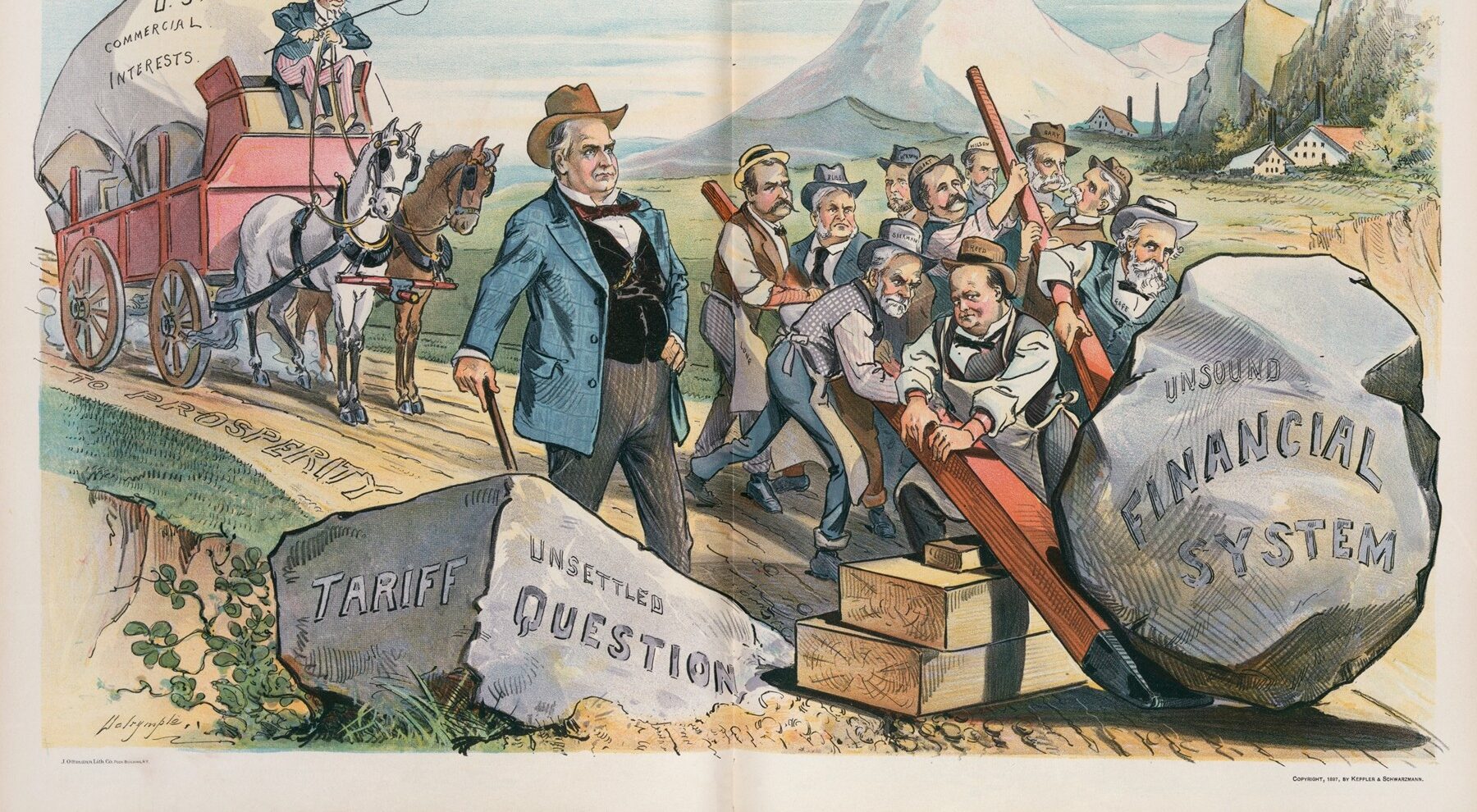
Trump’s Tariff Gamble and the Decay of the Neoliberal Order
What meaning—if any—can we discern in President Trump’s decisions to impose, and then pause, tariffs on the entire world? And what does this mean for the future of world order?
At the time of writing, Trump seems to be retreating from the most aggressive tariff actions, promising a new round of trade “deals,” including with China. Nonetheless, the economic and geopolitical shockwaves unleashed by “liberation day” have yet to subside. In the immediate aftermath, about $5 trillion was wiped off the value of American stocks alone, threatening contagion to the market for U.S. government debt, which seems to have persuaded Trump to pause implementation of the “reciprocal” tariffs. Meanwhile, the 10 percent global tariff remains in force. China, having retaliated, is now subject to tariffs exceeding 100 percent on most goods, while some Chinese firms allegedly transshipping through Southeast Asia face rates of up to 3,513 percent. Beijing shows no sign of backing down, warning others not to “appease” Trump at China’s expense or face retaliation. Much of the rest of the world is dumbfounded, scurrying to retain markets on both sides. The instinct of liberal governments is to cling to a world order in manifest crisis. The illiberal ones seem clearer-minded about what is happening. As Singapore’s prime minister put it, “the era of rules-based globalisation and free trade is over. . . . [What] the US is doing now is not reform. It is rejecting the very system it created.”
Western opinion is radically divided on how to interpret what the United States is doing. The dominant perspective, reflecting mostly liberal panic amid a relentless Trumpian offensive against globalist institutions and practices, is that Trump is simply irrational, insane, and destructive. Comparisons are made to nineteenth-century monarchic caprice and to 1930s fascist dictators. Conversely, a few commentators claim that Trump has a “longer-term vision,” or even that “Trump’s tariff chaos actually makes sense.” They claim to discern a masterplan at work, centered around the idea of a “Mar-a-Lago Accord,” which, by devaluing the dollar, would reset global trading relations in America’s favor. This idea, discussed in the financial press for some time, has now entered mainstream commentary and is even presented as the “one key thing” that solves the riddle of U.S. tariff policy.
If a detailed “grand strategy” seems implausible, however, neither does it seem wise to retreat to an account based purely on irrationality. “With Trump, anything is possible, so everything is plausible,” Corey Robin suggests. This may be a nice line, but it provides little analytical traction or political guidance at what seems like a pivotal historical moment.
This essay suggests that both camps have intuited part—but only part—of our disorienting reality. There is a relatively cohesive worldview animating Trump’s international economic policy, which is not reducible to Trump personally but is shared by important senior policymakers. Like most worldviews, it is partially rooted in reality, in concerns about unsustainable global economic imbalances and the hollowing out of American industry. Modeling themselves on Ronald Reagan, the Trumpians hope to reset global economic and security relations in favor of the United States, thereby rebooting American hegemony. At the same time, however, the Trumpian outlook, like most worldviews, is also heavily ideological. Particularly at the end of the End of History, thinking everywhere is clouded by the “four Ds”: decay (of the neoliberal order, state, and political parties), denial, disavowal, and delusion. A peculiar combination of nationalism, belief in tariffs as a magic wand, and the erratic personalism of the Trump regime decouples this worldview from reality. The plan, insofar as there is one, is internally contradictory even on its own terms, and seems more likely to deepen the decay of global neoliberalism, and of domestic hegemony, than to craft something new and stable to replace it.
The View from Trump World
Let’s first try to understand the Trump administration’s actions on their own terms, starting with their diagnosis of America’s geo-economic problems, then their prescribed solution. Donald Trump’s fixation on tariffs is, of course, nothing new. Indeed, perhaps the only consistent aspect of his economic worldview since the 1980s has been the belief that other countries are “ripping off” the United States and an obsession with tariffs as the solution. As early as 1988, he was suggesting that, since Kuwait exported oil under an American security umbrella, mostly to Japan’s benefit, the United States deserved 25 percent of the proceeds. While the enemy in the 1980s was Japan, by the 2010s it was China: both were—not unfairly—accused of erecting trade barriers, using domestic subsidies, and practicing currency manipulation to boost exports at the expense of U.S. manufacturers.
What is also different in 2025, in contrast to Trump’s first term, is that the president is not alone. In 2017, Trump had swept to victory unexpectedly; he was unprepared to wield power, could not manipulate Congress, and was heavily dependent on political appointees who did not share his views, resulting in endless churn, many unfilled offices, and a failure to deliver much beyond tax cuts and about two hundred federal judicial appointments. What is so striking about Trump’s second term is that, following years of preparation and the gestation of radical-right ideas in think tanks and business circles, he is surrounded by a team that, notwithstanding factional differences, broadly shares his worldview and is prepared to implement it by highly unconventional—including potentially illegal and unconstitutional—means.
On the economic side, this team includes individuals like Treasury Secretary Scott Bessent and Commerce Secretary Howard Lutnick, as well as Stephen Miran, chair of the president’s Council of Economic Advisers, and Peter Navarro, Trump’s senior counselor for trade and manufacturing, to name a few. Their writings and speeches, before and after taking office, describe a relatively coherent view of America’s fundamental and unsustainable economic problems, and the central role of tariffs—plus further neoliberal reforms at home—in rescuing the United States from managed decline.
The Trump team’s assessment hinges fundamentally around severe imbalances within the global economy, echoing (but not directly invoking) Matthew C. Klein and Michael Pettis’s argument in their 2020 book Trade Wars Are Class Wars. As Bessent puts it, “The current global economic system is in an unsustainable disequilibrium. Western middle- and working-class populations are growing increasingly wary of globalization. The only way to preserve the benefits of the international trading system is to question some of its mistaken assumptions and update them for the current moment.” Let’s summarize this critique, uncritically for the time being, which can be divided into four main claims.
For the Trumpists, a core problem is that the United States imports far more than it exports. America has for decades served as a consumer of first and last resort, allowing other countries to export their way out of underdevelopment, crises, and recessions. But this chronic and deepening trade deficit—now over $1 trillion annually—must be financed somehow. The main method to bridge the gap between national production and consumption has been government spending, which is increasingly financed by borrowing. As of 2024, the fiscal deficit had reached 7 percent of GDP, with debt servicing costs of $1.1 trillion—more than the defense budget. This is simply unsustainable.
Essentially, the Trumpists suggest that the U.S. trade imbalance has two main causes. First, the United States has been overly generous and arguably naïve. In the Cold War, America “generously” opened its market to allies and emerging postcolonial states for geopolitical reasons (this is not spelled out, but the objective was to spur capitalist development to win populations away from communism). After the Cold War, the U.S. policymakers proceeded on “mistaken assumptions” that liberalizing markets would bring security and economic benefits to the United States. In fact, trade liberalization empowered America’s chief geopolitical adversary, China, while hollowing out U.S. industry. This links to the second cause of the U.S. trade imbalance: the “deliberate policy choices of foreign governments,” including “tariff and non-tariff barriers to [U.S.] market access, currency manipulation, subsidies for preferred industries, forced technology transfers and outright theft of intellectual property,” and the suppression of domestic consumption, generating export gluts. The Trumpists explicitly argue that these policies are practiced well beyond China, including by ostensible allies and partners like Germany, South Korea, Japan, and Vietnam. Peter Navarro puts the case most belligerently, declaring “a national emergency triggered by trade deficits caused by a rigged system” populated by “cheaters.”
The second problem identified by the Trumpists is that the dollar’s status as a global reserve currency compounds the core problem of trade and fiscal deficits. If currencies are freely traded, in any normal economy, a persistent trade deficit results in currency depreciation. This is because there is relatively less external demand for its currency (to buy its exports) than for other currencies (which the economy needs to buy imports), causing its price to decline. A weakened dollar relative to other currencies would make U.S. goods cheaper for importers, causing exports to rise and thereby closing the trade deficit. Demand for a reserve currency, however, reflects not (just) the issuing economy’s fundamentals but rather (or also) the policy intentions of those holding reserve currencies—such as a desire to maintain the value of their own currencies, or defend them during a crisis, or to store savings for a rainy day, when they might be needed to purchase dollar-denominated commodities, for example. These motives sustain demand for dollar-denominated assets, including U.S. Treasury bills, which keeps the dollar artificially inflated, negating the normal adjustments that would help the United States attain trade balance.
A third problem for the Trumpists is the social consequence of this structural trade imbalance: the hollowing out of U.S. export manufacturing and associated social decay and political anger. Architects of free trade agreements simply assumed that overall welfare would rise and that the “losers” of globalization could retrain or otherwise be compensated. In reality, many communities have simply been devastated by deindustrialization. These communities have elected Trump twice and he is determined to redress their grievances.
A fourth, related problem, generally less well spelled out, is that a second possible adjustment—cutting government spending to reduce the consumption of imports—is also curtailed by the world’s reliance on the United States as a security provider. To be sure, the Trumpists firmly believe that discretionary government spending should be slashed to restore fiscal balance. Much U.S. government spending, however, is not “discretionary,” comprising highly popular “entitlement” programs (Social Security, Medicare, and Medicaid) that Trump has pledged not to cut, and defense spending, which most Trumpists believe needs to rise, given the threat from China. Crucially, moreover, U.S. defense spending is not merely used for national defense. It maintains global peace, security and stability, from which most other countries derive vast benefit, allowing them to underspend on defense while boosting their economies to gain even further competitive advantages against the United States.
In short, globalization has locked the United States into producing “global public goods” that it can no longer afford. Economically, it functions as a consumer of first and last resort, soaking up other countries’ export surpluses; and it provides the global reserve currency, which facilitates global trade and growth and allows other countries to stabilize their economies. On the security side, it provides a “security zone” or “umbrella” beneath which others shelter. Yet, as Bessent remarks, “This system is not sustainable.”
It is obviously possible to quibble with all these claims, pointing out, perhaps, that demand for U.S. Treasuries is not as inelastic as claimed but plateaued in 2018; to highlight that countries lacking a reserve currency have also experienced deindustrialization; or to argue that much U.S. defense spending is used for selfish and destructive ends rather than providing global security. Nonetheless, there is a basic truth to the Trumpists’ analysis. The existence of the global imbalances they describe is not disputed, even if their causes may be. The United States really does run a vast trade deficit and a partly associated vast budget deficit; the dollar’s status really does compound the problem; this really is associated with genuine sociopolitical upheaval; and the United States really does spend a lot on defense because of its global hegemonic role, from which some non-U.S. groups really have benefited.
And they are probably right that this is, in the long term, unsustainable. Globalism has clearly become politically unsustainable at home, as proven by the populist ructions that have brought Trump to power twice. The dollar as a reserve currency probably helps to suppress borrowing costs, enabling larger and more prolonged U.S. fiscal deficits than any other country could sustain. Yet even before Trump’s reelection, there were mounting questions about how long bondholders would tolerate this, with only the lack of any serious alternative to the dollar seeming to sustain the status quo. Would the United States be able to rapidly scale up borrowing in the event of a crisis or war and, if not, what would happen to its global security and economic roles? In short, can the United States go on paying the price of its global hegemony?
The Trumpian Solution
The Trumpists’ solution to this epochal challenge is to combine aggressive international trade policy with further neoliberal reforms at home. Internationally, the goal is to shift more of the costs onto others through what Bessent calls a “grand global reordering . . . equivalent [to] a new Bretton Woods . . . or the Treaty of Versailles.” The United States must “campaign to rebalance the international economic system,” in order to correct “the sources of imbalances in the international economy” and “more closely link security and economic relations to deliver the benefits that truly free trade can bring.” As Lutnick has said, tariffs are a central weapon in this campaign to “reset global trade” in America’s favor.
The Trumpists expect tariffs both to have direct economic effects and to create negotiating leverage that can drive further economic—and geopolitical—effects. In the short term, tariffs are expected to drive improvements in the trade balance and U.S. government revenue. Foreign exporters are expected to cut their prices to continue exporting into the United States (discussed further below), while foreign governments should reduce barriers to U.S. exports. The U.S. trade balance thus improves, as import costs fall and exports rise. Moreover, as tariffs are a tax paid to the U.S. Treasury, revenues increase: they anticipate about $300 to $600 billion annually (not too far off one academic estimate suggesting an upper bound of around $450 billion), which can be used to fund Trump’s promises to his base, including tax relief on tips and overtime. In the medium term, tariffs drive industrial reshoring to the United States as producers relocate production to get behind the tariff wall.
Importantly, this trade policy must also be complemented by domestic neoliberal reforms: cutting spending, regulation, tax, and energy costs, to boost the competitiveness of U.S. firms. Tariff revenues will eventually fall but be replaced by proceeds from higher domestic growth. U.S. domestic consumption and exports would rise as imports fall. The United States thus moves toward trade and fiscal balance while continuing as the world hegemon.
Crucially, the Trumpists expect foreigners ultimately to pay for tariffs. This persistent claim can seem maddening, since a tariff is a tax paid to the American government by the U.S.-based entity importing a tariffed good, which is likely to pass on at least part of the cost to U.S. consumers. The Trumpists, however, expect most of the cost to be externalized through currency exchange rate changes. This is spelled out most clearly in Stephen Miran’s now infamous paper, “A User’s Guide to Restructuring the Global Trading System,” but Scott Bessent also frequently invokes the same logic.
Miran’s argument goes something like this: The price of an import (Mp) equals the price charged by the exporter (Xp) multiplied by the currency exchange rate (R) multiplied by 100 percent plus the tariff rate (T), or Mp = Xp × R × (1 + T). To take a simple example, assuming a simplified exchange rate of $1 = ¥1, in which the United States was importing $100 of goods from China, then imposes a 10 percent tariff, but all other factors remain constant, the revised import price (Mp) is 100 (¥100 charged by the Chinese vendor) × 1 ($1 = ¥1) × 1.1 (1 + 10 percent tariff) = $110. China, however, could devalue the renminbi—a common tactic used to boost exports’ competitiveness. If Beijing devalues the renminbi by, say, 10 percent to avoid losing U.S. market share, Mp = 100 × 0.9 × 1.1 = $99. The “pass-through” cost of tariffs to the U.S. consumer is small (or even negative, in this example). This avoids domestic inflation, while U.S. government revenue increases, with the cost passed on to Chinese consumers through a reduction in the renminbi’s purchasing power.
Crucially, Miran and others argue, this is broadly what happened with Trump’s first China tariffs in 2018–19. China’s currency devalued, absorbing around three-quarters of the cost of the tariff; U.S. import costs only rose modestly; and any inflationary pressure was offset through cross-cutting dynamics and prudent (i.e., neoliberal) economic policy. One reason why tariffs must (again) be combined with neoliberal reforms at home is to continue to offset inflationary cost pressures on businesses.
The purpose of tariffs for the Trump administration, however, is not merely, or even principally, to send price signals through markets to change firms’ economic calculations and thus compel adjustments. Bessent is fond of saying that Trump has added a “third leg” to Alexander Hamilton’s two original functions of tariffs, revenue generation and industrial protection: creating leverage for negotiations with other states. The tariff weapon is explicitly intended to be used alongside military leverage, specifically the threat to remove security protection. And, as with the melding of economic and security pressures, the objectives of negotiations are dual in purpose.
The economic objective is to drive improvements in the U.S. terms of trade—pressuring partners to remove barriers to U.S. exports and distortive industrial and currency policies that “rig” trade against the United States. An even more ambitious possible objective, however, is the so-called Mar-a-Lago Accord, spelled out by Stephen Miran. This idea harks back to the 1985 Plaza Accord and 1987 Louvre Accord, through which the United States and its closest allies collectively agreed to devalue the dollar relative to their currencies, to address emergent trade deficits and revitalize America’s flagging export industries. Miran suggests that the threat or use of tariffs, plus threats to withdraw U.S. security support, could, “maybe,” compel a similar agreement today. This would require foreigners to sell their dollar-denominated assets in vast quantities, risking a crisis of confidence in the dollar. To avoid this, he floats Zoltan Poszar’s idea that holders of interest-bearing U.S. Treasury bills might swap them for a “century bond” bearing close to no interest. This would allow the United States to cut its debt servicing costs, boost the competitiveness of U.S. exports, and retain the dollar as a reserve currency—an important source of U.S. sanctioning power that Trump is committed to maintaining.
Miran is not wildly optimistic about the prospects for a Mar-a-Lago Accord, identifying several important barriers to which he has no obvious answer. First, unlike the 1980s, most U.S. Treasuries are not held by close U.S. allies or the key economies against which the dollar needs to be devalued; the EU aside, most are held by Asian and Middle-Eastern governments which are “not as friendly” as Japan, Germany, France, and Britain were to Reagan’s United States, and the required “mixes of sticks and carrots may be extremely challenging to get right”—a dramatic understatement. Secondly, most bondholders are not foreign governments but private investors who “will not be convinced to term out their Treasury holdings as part of some sort of accord” and may instead “flee the dollar.” Perhaps the most obvious objection is that the accord would be little more than a mask for an effective default on U.S. government debt, imposing enormous losses on bondholders which none would willingly accept.
For these reasons, it seems highly unlikely that many in Trump circles genuinely think that they can compel a Mar-a-Lago Accord or that this is the ultimate objective of tariffs. Even Miran is half-hearted, emphasizing that his discussion is not a policy recommendation but simply a set of options given Trump’s known red lines; he expects “revenue and fairness” to be the immediate goals, with a currency deal “maybe” following later. Apart from complaints about the undervalued renminbi, there are no signs of the wider Trump team gunning for a multilateral currency accord.
Conversely, there is ample discussion of the second objective: better burden-sharing on security. Miran has a long list of possible grievances to be redressed here. For example, countries that fail to contribute enough to NATO, side with America’s enemies, or facilitate Chinese transshipments to evade tariffs and other restrictions (such as semiconductor export controls), can be pummeled with higher tariffs until they submit. And if they don’t submit? The United States will withdraw security provision from those countries, thus sparing itself the cost of defending exploitative partners.
Through a fragmented series of bilateral negotiations, enabled by and therefore not inconsistent with Trump’s ninety-day pause, Bessent and Miran thus expect the globalist world order to be fundamentally refashioned into something new. Bessent envisages a world divided into three zones (or “buckets,” in his artless parlance): a “green” zone of friendly countries, genuinely open to U.S. exports, not using distortive industrial or other policies to “cheat,” enjoying no- or low-tariff trade with the United States, plus U.S. security protection; a “red” zone of enemy states who reject U.S. demands and suffer permanently high tariff barriers and (presumably) military hostility; and a “yellow” zone of intermediate countries, only semi-compliant and hence suffering middling tariffs and enjoying little in the way of U.S. protection. Who sits in each zone is not predetermined but the result of individual bargains.
In this framework, free trade is not entirely abandoned, but rather weaponized according to U.S security objectives, economic interests, and “values.” The flat, inclusive world of globalization, where it was assumed that economic interdependence would entail security, is replaced by a jaggedly segmented world. Only those willing to submit to U.S. “leadership” enjoy the residuum and benefits of the U.S.-backed economic system and security umbrella; the rest are cast out of Eden. This would undoubtedly be a world-historic reconfiguration of the global order. Highlighting such ambitions, the Trumpists explicitly hark back to President Ronald Reagan’s embrace of “supply-side economics” at home and aggressive trade and security policies abroad, believing they can carry off a similar reboot of American hegemony and refashioning of the world order.
Like Reagan, they implicitly accept that this will involve a wrenching readjustment of the American economy, entailing short-term political costs. Trump himself has said that “there will be a transition cost, and transition problems.” Bessent apparently sees this as an inescapable redistribution of wealth. Bemoaning the “massive distributional problems” created by globalization, through which “the coasts have done great, yes, and the middle of the country has just seen quality of life, life expectancy, decline,” with workers “eviscerated,” he almost commits a Freudian slip when explaining the tariffs to Tucker Carlson:
it’s to—I don’t want to say redistribute—but it is to give working Americans real wage gains and enhance their lives. . . . Wall Street’s done great. It can continue doing well. But it’s Main Street’s turn. . . . The top 10 percent of Americans own 88 percent of equities. . . . The bottom 50 percent has debt. They have credit card bills. They rent their homes. They have auto loans. And we’ve got to give them some relief. . . . The Democrats had this strategy called “compensate the loser.” . . . I don’t think the bottom 50 percent of Americans are losers. I think the system hasn’t worked for them. I think they are winners—it’s just a bad system. So we are going to fix the system.
The Trump circle has repeatedly declined to rule out a recession as part of this “‘fix.” They also anticipate possibly losing the mid-term elections. But again, as Bessent told Carlson, they take inspiration from Reagan, who also received a mid-term drubbing before going on to win forty-nine out of fifty States in 1984. The stakes are high, and one senses that even they think this is a gamble—the United States is at “The Last Chance Bar and Grill,” as Bessent puts it—but, in true neoliberal style, there is no alternative: “we have to try this . . . the old system wasn’t working.”
Anyone who still thinks that this proposed reconfiguration of U.S. external relations merely expresses the wild imaginings of a few Trump-adjacent lunatics, rather than deep structural pressures rising up through the American political system, would do well to recall the Biden administration’s approach to world affairs. Biden also tried to divide the planet, particularly in the wake of Russia’s invasion of Ukraine, into “democracies” and “autocracies,” pressuring the entire world to side with the United States against Russia and, by extension, China. While American diplomats would publicly proclaim that they were not trying to force countries to choose sides, only to provide them with a choice, privately, most developing countries experienced relentless U.S. pressure to reject Chinese aid, loans, infrastructure projects, technology, diplomatic initiatives, and so on. Biden not only kept Trump’s tariffs, he escalated them, seeking to halt China’s technological upgrading by choking off the supply of advanced semiconductors and manufacturing equipment. As China struggled to evade these restraints via third countries, Biden extended semiconductor controls to dozens of states thought to be involved in transshipment.
One of the Biden administration’s final acts was to introduce a “Framework for Artificial Intelligence Diffusion,” which divided the world into—you guessed it—three zones: a top tier of just seventeen countries that could be trusted to import AI chips and models without licenses, a bottom tier of twenty-three enemy states subject to export bans, and a middle tier subject to stringent export licensing requirements unless bilateral security deals could be reached. This latter tier included almost two dozen NATO allies plus key regional partners like India. Dubbed a “strategy of leverage,” the framework was intended to consolidate U.S. firms’ grip over AI data centers and pressure third countries into stopping cooperation with China and refusing to help Beijing evade trade restrictions. Given the centrality of semiconductors to contemporary production and technological progress, these controls would have far-reaching consequences, notwithstanding the Biden administration’s rhetoric of a “small yard, high fence,” a neologism meant to indicate the modest scope of export controls and rejection of full-scale decoupling.
At the same time, of course, Biden was adopting domestic industrial and trade policies—discriminatory tax breaks that approximate tariffs—meant to revitalize U.S. manufacturing (and thus steal insurgent working‑class voters away from Trump), much to the angst of allies like the EU who stood to lose U.S. export markets. While Trump’s actions are obviously much more disruptive than Biden’s more cautious and multilateralist approach, there are important continuities that underscore the common structural forces motivating both leaders. Not for nothing did Adam Tooze dub Bidenomics “MAGA for thinking people.” Even today, leading Bidenauts propose that the United States and its allies “pool their markets behind a shared tariff or regulatory wall erected against China,” creating a “coherent and interoperable bloc, with the United States at its core.” With the objective of “more burden sharing—and burden shifting,” they suggest “selectively opening allied and partner markets while creating higher barriers for Chinese goods.” But in a nicer way, of course.
Decay, Denials, Disavowals, Delusions
So far, I have sought to present the view from Trump world as neutrally as possible, without commentary or critique, in terms that its proponents would likely recognize and mostly accept, so as to grasp its rational aspects and intended future outcomes. Now it is time to explore the ideological blinkers and blinders in this worldview, which almost certainly mean that this plan, such as it is, will not work as intended.
The most important political dynamic at work in the world today is decay: things are falling apart, and the center cannot hold. Trump and his circle are themselves the product of a decaying neoliberal order, which is collapsing under the weight of its own contradictions. Trump’s rise and return reflects the widespread decay of representative democracy: the mutual withdrawal of citizens and those claiming to represent them, leaving a “void” in which populist challengers flourish. Like their counterparts elsewhere, America’s political parties have been hollowed out, facilitating Trump’s takeover of the Republicans. The U.S. state has also been weakened as the New Deal order was dismantled, bereft of substantive capacities that that might improve citizens’ lives, while overburdened with regulatory duties.
The strength of the Trumpists, unlike many liberals clinging to the old order, is their partial ability to detect, name, and respond to the contradictions of the neoliberal order. But rather than representing a meaningful solution to its decay, Trump is radically accelerating it. This may be seen in the ideological limitations of the Trumpists’ worldview, preventing them from seeing problems clearly, and the inescapable internal contradictions of their proposed solutions, which seem less likely to reboot U.S. hegemony than to deepen the rot, while inflicting considerable costs on friends and foes alike, both foreign and domestic. Treaty of Versailles–esque it may be, but not in the way that self-declared economic historian Scott Bessent seems to understand it.
Blind Spots of Imperial Nationalism
The Trumpists’ nationalism is the most powerful ideological influence on their diagnosis and prescription for America’s ills. On one level, it is undoubtedly a refreshing change for government officials to declare that their first duty is to represent and advance the interests of the citizens who elected them, after decades in which advancing intergovernmental globalism, imposing neoliberal “best practices,” and maintaining market stability were policymakers’ lodestars. In practice, however, the Trumpists are unable to truly serve the American nation. This is because they cling to atavistic and populist notions of the nation which fail to reckon with problems internal to the United States, directing all blame outward, and also to imperial fantasies of American greatness, entailing objectives likely to undermine the project of rejuvenating U.S. heartlands.
Perhaps one reason that Klein and Pettis are not explicitly invoked, despite their apparent influence on Trumpian thinking, is that they frame trade wars as class wars. It is not a huge leap from their post-Keynesian analysis to a Marxist one that sees U.S.-China imbalances as the result of the American and Chinese capitalist classes bearing down on their respective working classes: the Americans by offshoring, the Chinese by suppressing consumption, and both by repressing organized labor and wages. There is a protean class analysis lurking in the Trumpian story: references to the “working class” losing out to “coastal” and “wealthy” Americans and (whisper it) the need for redistribution. But, as good capitalists, the Trumpists clearly cannot bring themselves to recognize the role of U.S. businesses—or their willing handmaidens in both political parties—in creating the world that they are (again, not without reason) railing against. While casting the odd shade at Democrat policymakers, the Republicans are too steeped in blood themselves for any sort of rigor here. The Trumpians prefer a populist-nationalist framing that deflects all the blame outward: toward foreign “cheaters” who are “ripping off” the United States, which itself is guilty of little more than naïveté.
This disavowal and denial obviously precludes any deeper analysis of the serious problems of American capitalism. Nationalism provides the reassurance that, if only world markets were truly free, the United States would be undisputed number one: it is only by “cheating” that other countries can gain advantage. When it comes to manufacturing employment, although there is strong evidence that the “China shock” has destroyed hundreds of thousands of jobs in the United States, research suggests it is not the leading cause. Factors like automation are driving down employment numbers even in China itself. American businesses’ retreat from investments and productivity improvements in favor of boosting shareholder remuneration is also not considered as a possible cause of declining U.S. competitive advantage. Nor, amid much talk of gaps, is there any recognition of the yawning gulf that has opened between labor productivity and wages under neoliberalism, and the possibility that this, rather than only perfidious foreigners, may be responsible for social decay and political anger. Nor need we discuss the meager and flawed efforts to compensate for this dislocation, which are internal not external failures.
There is also, of course, no consideration of the possibility of closing the fiscal deficit by reversing the tax cuts that have caused it. Instead, tax cuts are simply affirmed as essential to spur the investment needed for economic growth. Ultimately, the Trumpists are Reaganites, unwilling and unable to take responsibility for a world created by Reaganism. The obvious vulgar Marxist explanation of this—a studied reluctance on the part of U.S. capital to redistribute wealth and power to workers—seems reasonably accurate here, in a further continuation from Bidenomics. All this disavowal allows tariffs to stand as the unlikely magic wand—with no need to discipline capital or pursue industrial policy, for example, as complementary initiatives.
Nationalism also frames the Trumpists’ imagined solution. The parameters are, of course, set by the continued desire for American “greatness,” by which is meant global power and domination—regardless of whether this is actually in the interests of the American people. One obvious (partial) solution to the twin deficits problem—preferred by Pettis—is for the United States to devalue the dollar and abandon its reserve currency status, which would (in theory) rebalance trade and make deficit spending impossible at the current scale, albeit at the cost of severe austerity. This is unthinkable for Trump, who sees this as a road to “third world status” and has threatened 100 percent tariffs on brics countries if they promote an alternative to the dollar. Bessent likewise insists, “We have a strong dollar policy.” Miran’s non-recommendations are simply framed around Trump’s commitment to dollar hegemony, despite clashing with his other stated objectives, as we shall see below. Another option, alongside the nonstarter of tax increases, might be to slash defense spending—but this, too, is unthinkable for Trumpian nationalists. Bessent derides Biden’s ten-year budget projections for envisaging a 21 percent cut in defense spending, warning that “you can’t keep your reserve currency status if you lose your defense umbrella.” The desire to maintain the American empire, with its interlocking economic prerequisites, is an iron cage that limits what is possible.
Imperiled imperial-nationalism also frames the Trump administration’s chosen method: coercive bargaining with other national entities, exploiting U.S. market power and security provision to bring them to heel or kick them to the curb. Even combined with security threats, however, this framing likely exaggerates the extent of American market power. Although Miran claims that foreigners have “only got the United States to sell to. There’s no alternative,” the United States actually absorbs less than 14 percent of world imports. Moreover, as Miran’s own discussion of the Mar-a-Lago Accord suggests, the reliance on interstate coercion fails to reckon with the extent to which, thanks to global Reaganism, power has ebbed away from governments into private (one might say, “invisible”) hands—hands which, in the Reaganite understanding, cannot or should not be forced. The Trump administration had no response to the stock market rout that followed the “reciprocal” tariffs announcement and was effectively forced to backtrack, via the ninety-day pause, when this threatened to spill over into a meltdown in U.S. Treasuries, spiking U.S. borrowing costs. This episode recalls Democratic Party strategist James Carville’s quip that he would like to be reincarnated as the bond market because “You can intimidate everybody.”
This is where denial and disavowal intersect with delusion, a plain misunderstanding of the nature of reality. It is an echo of Britain’s disastrous experience under Prime Minister Liz Truss, a Thatcherite who, railing against a world created by Thatcherism, undertook radical economic measures designed to liberate business, but was swiftly brought down by the bond markets that Thatcher and her successors empowered. Truss, still unable to understand what had happened to her, blames the “deep state,” while insisting that Trump “has been proven right about pretty much everything.”
Contradictions of Trumpism
Although the Trumpists are probably more strategic and—given U.S. structural advantages—less easily dispatched than Truss, their own delusion involves glaring omissions and contradictions at the heart of their approach. The most obvious concern the role of the dollar. The mechanism by which foreigners are assumed to pay for tariffs is that they devalue their currencies against the dollar. Even this account of what happened with China in 2018–19 is contested. But surely the mechanism breaks down entirely if the U.S. tariffs not just one big and important source of imports but all its imports. U.S. importers could force their Chinese suppliers to cut their de facto prices (or transship through or shift production to third countries) because they could threaten to source goods elsewhere. Indeed, Miran points to studies suggesting that higher “pass-through” costs applied only to goods for which alternative sourcing was not possible. But how can U.S. importers use this strategy when all suppliers are tariffed to some extent?
Furthermore, is it remotely credible that all foreign currencies can simultaneously devalue against the dollar, and by the scale needed to offset the tariffs proposed, in the range of 30–60 percent for America’s leading trade partners, and in China’s case, now over 100 percent? Devaluation on anything like this level would cause these countries to be unable to afford their imports, leading to a massive economic crisis. Even countries heavily dependent on the U.S. export market, like Vietnam (about 30 percent of its GDP), simultaneously rely heavily on imported components to make the goods they export to America. Devaluing on the scale required to save their U.S. export market would be like destroying the village in order to save it. Again, the notion that such “adjustment” is possible is a delusion borne from a nationalist macroeconomics that seems blind to the globalized production networks that Reaganite neoliberalism has fostered.
The more fundamental contradiction here is that getting foreigners to pay the costs of tariffs through devaluation is directly at odds with the desire to devalue the inflated U.S. dollar. The more that foreigners devalue, the more that (according to Miran’s model) imports continue to flow into the United States at roughly stable dollar prices. Inflation is controlled and revenue increases, but the trade deficit continues and there is no pressure to reshore industry and no domestic economic renewal. The dollar’s reserve currency status compounds the likelihood of this outcome which was, broadly, the story of Trump’s first administration.
Therefore, if the goal really is to reindustrialize and solve the twin deficits, tariff costs cannot be fully absorbed entirely by foreigners, nor can they be entirely negotiated away through a series of bilateral negotiations. They must drive firms to get around tariff barriers, perceived to be serious and permanent, by relocating production for the U.S. market inside the United States. This is one (not very convincing) way of reading the astonishingly high tariff rates imposed on “liberation day”: as a massive shock that foreigners cannot just adjust around. Yet, if that is the plan, then the Trumpists’ claims that foreigners will pay, and U.S. inflation will not rise, must be false. A significant “pass-through” cost must fall on domestic importers and consumers. This will compound the inflation that helped propel Trump back to power, with regressive consequences that will clearly harm “Main Street” and not simply redistribute wealth to it.
Negotiations with trading partners that might ease tariffs are also contradictory with this objective. To be consistent with the Trumpists’ stated objectives of rebalancing trade, negotiations should lead, at best, to only minor reductions in tariff rates. Moreover, until the rates are settled, businesses cannot make calculations about whether reshoring is economically advantageous. The uncertainty, coupled with the crisis of confidence introduced by Trump’s policies, will only delay investment. In the short term, at least, this makes recession likelier than renaissance in America.
Trumpists like Miran are partially aware of these trade-offs, but perhaps what makes tariffs so alluring to them is precisely the “heads I win, tails you lose” logic of their thinking. If the anticipated currency offset doesn’t happen, U.S. consumers will pay more, which will drive reshoring. If countries resist U.S. pressure for concessions, and instead accept higher tariffs, the U.S. government can save on the cost of providing security to them, while its revenues increase. If the EU defies the United States, retaliating with its own tariffs and boosting its autonomous defense capacities, the United States can cut security expenditure in Europe and focus on China, its real adversary. The Trumpists have likely convinced themselves that the United States cannot lose either way.
Accelerating Decay
Here we come to the way in which solid if partial analysis plus ideological delusions intersect with the decayed nature of the U.S. state, as embodied in the erratic and personalist decision-making of President Trump himself. Accounts proposing a “grand plan” at work are grossly deficient precisely because they neglect this factor.
There is very little evidence to support the idea that Miran’s “Guide to Restructuring the Global Trading System” is in fact the “master plan” informing the detail of American policymaking, or that the America First wonks are making the key decisions. We are long past the era of careful, technocratic rule, such that we could simply start screening a “West Wing for deplorables.” Miran emphasizes that the path to making his (pre-government) proposals work is “narrow,” requiring “careful planning, precise execution, and . . . steps to minimize adverse consequences”—precisely what has not happened. Miran predicted that, because Trump cares about market stability, he would not make sudden, unilateral, or dramatic moves that entail instability, but would pursue “graduated implementation” of tariffs. These would gradually ratchet up to a ceiling of 10 percent for most states—reserving higher rates for a handful of enemy states like China, aiming at 60 percent—with clearly stated demands to encourage foreign governments to comply, and ample “credible forward guidance” for business. Bessent thought similarly: “Adjustments are needed, but they must be carefully calibrated and deliberately paced . . . interventions must be well telegraphed in the form of forward guidance to provide negotiating leverage and time for markets to adjust.”
What happened instead, of course, was the president’s surprise announcement of immediate, extreme tariff rates, apparently calculated by AI chatbot, based on a country’s export surplus with the United States, divided by last year’s exports to the United States, with the product then halved to be “generous.” With this arbitrary approach, rates were not calibrated to put (or avoid putting) pressure on specific geopolitical targets. Nor were they adjusted to target the sort of higher-value-added goods that—as Miran freely admits—are the only ones for which reshoring has any chance of happening, while avoiding domestic inflation from tariffing goods the United States cannot profitably (or physically) produce itself. Countries like Bangladesh (37 percent), Sri Lanka (44 percent), and Cambodia (49 percent), which export labor-intensive items like garments, were among the hardest hit, as were countries like Madagascar (47 percent), which produce commodities the United States cannot (in this case, vanilla).
This approach reflects the decay of the American state, which began with Reagan’s dismantling of the New Deal administration, and which Trump is now radically accelerating. For many years, the state has proven unwilling to represent or aid the forces that Trump speaks for; indeed, it has often been hostile to them, and certainly to Trump personally. Trump’s response in his second term is to bypass the conventional policymaking apparatus as much as possible, while attacking the administrative state that might, in a now bygone era, have been tasked with developing and implementing a cautious plan of the sort Miran advocates. This approach creates the appearance of a sudden, authoritarian takeover of state power, generating the aforementioned comparisons with monarchic or fascist rule. But it is, in fact, a symptom of political decay, and the continued limits of Trump’s ability to seize, manage, and wield the state in the service of his base. It is much easier to run fast and break things than to build the capacities necessary to deliver a positive project.
We are left, therefore, with an approach that, internationally and domestically, amounts to a “shock-and-awe” onslaught intended to wrong-foot adversaries and impose desired changes by force. Domestically, this is already weakening important state capacities, involving mass firings, sometimes followed by panicked rehirings, of officials tasked with, among other things, securing U.S. nuclear weapons or tackling avian influenza. (The latter recently ripped through U.S. poultry farms, causing serious egg shortages that the Trump administration asked Denmark to help solve by increasing its exports, while simultaneously menacing Danish sovereign territory in Greenland.) Internationally, the tariff onslaught is bereft of strategic planning or implementation; the extremely high rates—which the administration now admits are not sustainable—seem intended only to create panic among foreign governments so that Trump can bring them to heel through his famed “art of the deal.”
This is the final delusion: the idea that Trump can singlehandedly refashion the world order during the ninety-day pause by striking bilateral economic and security agreements with the seventy-plus countries said to have approached the United States for talks. Trump has insisted on his personal involvement in these negotiations, reflecting his own deluded faith in his deal-making abilities. It took a full year for Trump’s first administration to renegotiate nafta, while “Phase One” of a U.S.-China trade deal took two years. The fact that Mexico, Canada, and China were the first countries to be slapped with U.S. tariffs in 2025 suggests that these agreements were not exactly satisfactory.
Predicting how Trump might react as frustrations inevitably mount is difficult. He might extend the pause to buy more time. But he could just as easily decide to end it, reflecting the “no-lose” logic of Trumpist thinking. Trump might equally bank a few concessions, call it a “win,” and proclaim that America is now great again—though the scanter the concessions, the less likely it is that his gamble delivers meaningful wins for his base. Moreover, if the Trump administration’s stance on inward and outbound investment, semiconductor exports, and bolstering global deterrence against China offer any guidance, continued high tariffs on, and wider confrontation with, Beijing seems likelier than any “grand bargain.”
Things Fall Apart
Both domestically and internationally, then, it seems highly unlikely that tariffs will be the magic wand that Trumpists imagine. At home, they seem likely to accelerate the ruling class’s loss of hegemony that began with the 2008 financial crisis. Much of America’s capitalist class is in open revolt against the tariffs, as expressed in the stock market meltdown. Their loss of effective control over policymaking is remarkable, even as they lobby frantically for carve-outs. Trump’s ruling coalition is also fragmenting. Elon Musk has denounced his colleagues while preparing to leave government. Congressional Republicans are finally bestirring themselves to claw back the tariffing power. A legal challenge to Trump’s tariffs is backed by the leader of the conservative Federalist Society, with whom Trump worked so closely in his first term to appoint federal justices.
High and broad tariffs are also likely to inflict serious harm on the disaffected citizens who propelled Trump back to power. His advisers expect midterm setbacks, as noted. But whether his base will stand firm in the longer term remains to be seen. Many have endured years of economic and social decay, a powerful reason to gamble on a populist president who promises to restore them to greatness. The Bidenauts at least intuited this, pitching toward the working class with industrial policy and infrastructure spending. But they failed to deliver sufficient gains to a desperate electorate and were punished over rampant cost-of-living increases. Trump’s floated tariffs seem set to fuel inflation, while his promised neoliberal economic reforms and government spending cuts hardly seem likely to be broadly popular. If the Democrats continue to offer little to working-class communities, perhaps voters will stick with Trump. But polls taken even before “liberation day,” showing collapsing support for Trump’s economic policies among everyone but self-identified “MAGA Republicans,” do not augur well. In short, if Bidenomics failed to restore hegemony at home, Trumponomics seems likely to erode it even further.
Internationally, the outcome of Trump’s Reaganite gamble is highly unlikely to be a “new Bretton Woods,” as Bessent suggests, nor any other kind of neat replacement for U.S.-led globalism. Bretton Woods was a multilaterally negotiated agreement, struck among close allies, reflecting both a rational assessment of the disorders of interwar capitalism and a willingness to impose the class compromises envisaged by the new order. Trump’s approach is a fragmented, hasty set of bilateral talks with alienated allies and indifferent states, reflecting a degraded understanding of reality and contradictory objectives, and no desire to make the class compromises necessary in the absence of any systemic challenge to capitalism. Bretton Woods was underpinned by a U.S. superpower, enjoying military and economic preponderance, willing to twist arms but also to compromise and behave “generously” to secure its hegemony against a perceived communist threat. Trump, confronting a relatively weakened United States, is unilaterally bullying and extorting America’s partners while his secretary of state (apparently without irony) simultaneously tries to rally them against “China’s unfair and coercive trade practices.”
Hegemony, in its Gramscian sense, is about the successful cultivation of consent from subordinated groups or states, which requires material concessions and ideological projects capable of convincing subordinates. By tearing away the velvet glove of consent and resorting to naked force, Trump is destroying, not rebooting, America’s global hegemony. The result will not be a new world order so much as the accelerated decay of the old.