In 2025, the American Society of Civil Engineers estimated that the total infrastructure maintenance gap for the nation’s roads is $684 billion in today’s dollars over the next ten years.1 This accumulated shortfall between the funding needed to maintain public infrastructure and the actual spending on those needs is known as “deferred maintenance.” When states delay road and bridge repairs, they create a liability that compounds over time, further constraining future budgets.2 The historic levels of funding provided by the Infrastructure Investment and Jobs Act of 2021 (IIJA) failed to address the flaws in federal policy that created the infrastructure maintenance problem.
America’s transportation infrastructure is the foundation on which its global economic competitiveness and quality of life depend. Often taken for granted, our highway system is unique globally in scale and complexity, with over forty-eight thousand miles of interstate alone.
The 8.3 million total lane miles in the United States are almost enough to reach the moon and back seventeen times. Most of these road miles are reaching the end of their design lives and will need large investments to remain the lifeblood that American families and businesses rely on. As roads degrade, cars get damaged, traffic gets worse, commutes get longer, and shipping times are stretched. If the necessary action is not taken to repair the country’s aging infrastructure, there could be losses amounting to almost $1.9 trillion in disposable income for American families, up to 344,000 jobs, and over $5 trillion in gross economic output.3 Congress has been punting on the issue of roadway maintenance since the inception of the federal highway system, and the crisis is reaching a breaking point.
With the IIJA set to expire in September of this year, Congress will need to reauthorize federal transportation spending, and this debate provides an opportunity to reorient the federal-state relationship in order to ensure America’s surface transportation infrastructure lasts.
History of Interstate Funding
Recalling the logistical challenges of navigating the vast breadth of the United States in his Army days, President Dwight Eisenhower told the nation in his 1955 State of the Union Address that “[a] modern, efficient highway system is essential to meet the needs of our growing population, our expanding economy, and our national security.”4 Eisenhower recognized and Congress agreed that interstate highways were a necessary and proper function of the federal government. The challenge, of course, was how to pay for it.
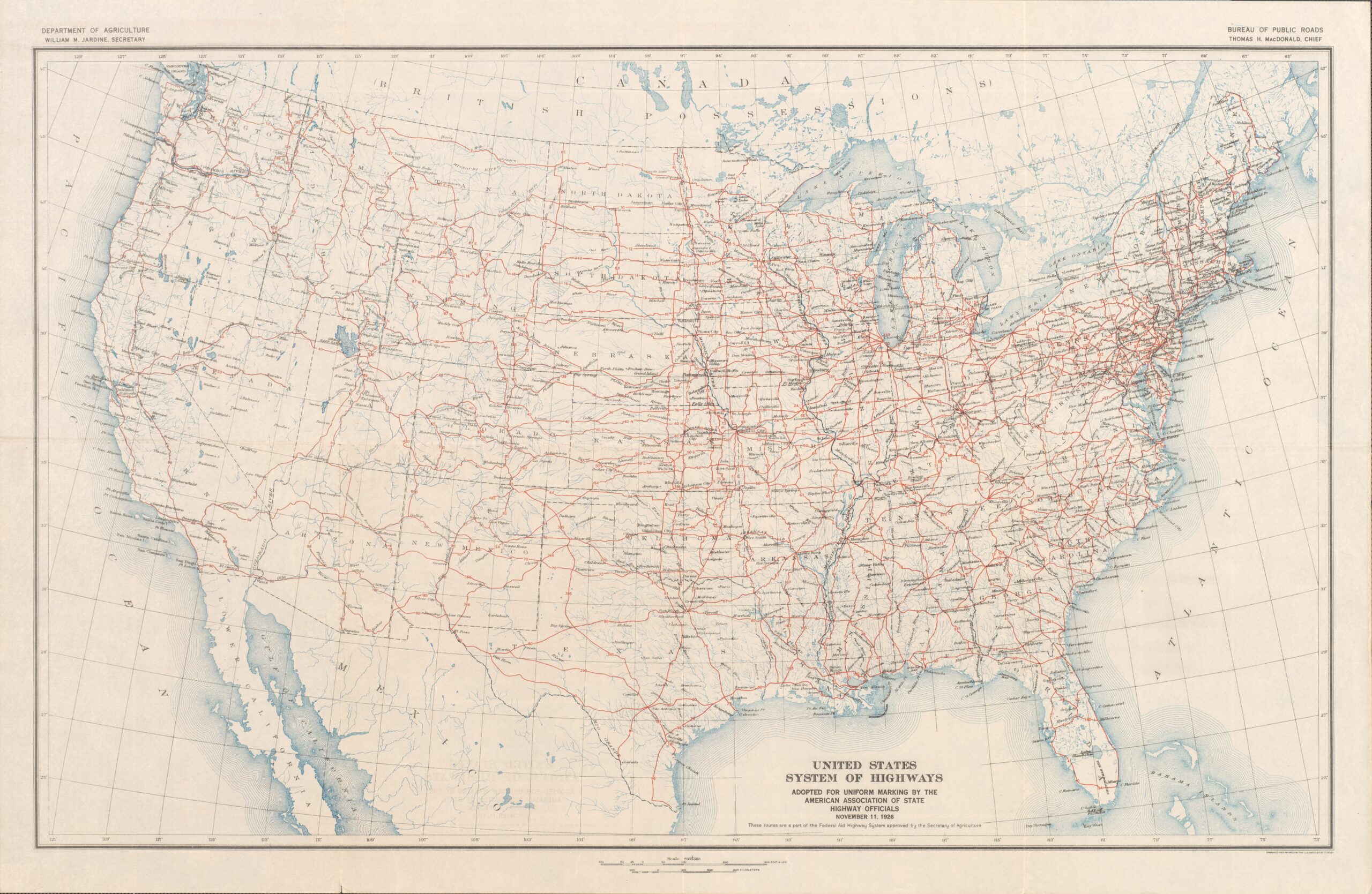
Franklin Roosevelt had signed into law the Federal-Aid Highway Act of 1938, which had instructed the Bureau of Public Roads (BPR), the predecessor of the Federal Highway Administration (FHWA), to study the feasibility of a toll-financed highway system across the country. The BPR concluded that tolling could not cover the substantial costs of such a system and large federal subsidies would be required for both initial construction and long-term maintenance. In April 1941, the administration found an alternative idea for a forty-one-thousand-mile national highway network built by state governments, but plans were put on hold by the Second World War. Roosevelt renewed his efforts with the Federal Highway Act of 1944, which settled on a 50/50 cost split between the state and federal governments for initial construction costs with only $225 million appropriated over three years.5
When Eisenhower entered office in 1953, only sixty-five hundred miles had been constructed with estimates stating that an additional $101 billion would be needed to complete the network.6 Congress responded with the bipartisan passage of the Federal-Aid Highway Act of 1956. This bill authorized $25 billion of initial funds to construct highways drawn from taxes on gasoline and the auto industry. The newly created Highway Trust Fund (HTF) would isolate those dollars to solely fund highway construction, free from the annual appropriations. Eisenhower increased the federal subsidy of initial construction funds from Roosevelt’s 50 percent to 90 percent to energize the buildout. This funding structure set a clear and finite self-contained mechanism to build out the National Highway System. The Highway Trust Fund had a clear economic logic: as the highway system grew, so too would the revenues raised from the gas and automotive taxes helping to fund the high upfront construction costs that the states could not meet. In exchange, the federal government required that the roads be kept toll-free.
By the early 1970s, states had constructed thirty thousand of the planned forty-one thousand miles of interstate. But growing political pressure on the HTF sought to divert funds to mass transit and the already burgeoning maintenance crisis. Mass transit systems, especially in the Northeast, were in freefall following the collapse of private transit operators. The 1973 federal reauthorization allowed states to divert up to 10 percent of HTF money to mass transit, and the 1982 Surface Transportation Assistance Act (STAA) created a Mass Transit Account within the HTF. Twenty years after the interstates’ inception, many highways were already showing significant signs of wear and tear. In 1975, Congress identified a $2.5 billion maintenance backlog and responded by creating the Resurfacing, Rehabilitation, and Restoration (and later Reconstruction) Program.7 The $175 million allocated annually did not cover the annual growth of the backlog, however, and through the 1980s, as increased portions of the highway fell into poor shape, funding remained geared towards expanding the interstate system.
In 1992, the last section of Eisenhower’s Interstate, the I-70 through Glenwood Canyon, Colorado, opened to motorists. As the original mission of the interstates neared completion, state and industry leaders feared that the federal government would step back from transportation spending.8 Instead, Congress passed the Intermodal Surface Transportation Efficiency Act (istea) of 1991. The istea proposed a new vision of a “national intermodal transportation (IT) system that is economically efficient, is environmentally sound, provides the foundation for the nation to compete in the global economy, and will move people and goods in an energy efficient manner.”9
The bill vastly expanded the modes of transportation eligible for federal funding, moving beyond highways and mass transit to include practically any “multimodal” project, such as bicycle infrastructure, local roads, and recreational trails. With only a 20 percent matching requirement for local funds, this enabled states to continue to build projects they would never fund themselves without considering the growing maintenance obligation of an expanding transportation portfolio. The istea turned the Highway Trust Fund from an instrument of national interest to a pass-through for local projects, a transformation that has continued through the past thirty years of reauthorizations. Since istea, each successive reauthorization has widened the scope of eligible investments but stopped short of imposing robust fiscal requirements on state DOTs to ensure they can afford ongoing maintenance. Explaining this imbalance calls for an examination of the contemporary political economy of surface transportation.10
Infrastructure Weeks and Infrastructure Years
State transportation systems require disciplined multidecade capital plans to operate effectively. The lifecycle of any given transportation asset exceeds all but the longest serving politicians and certainly a three-to-four-year federal reauthorization. With each transportation reauthorization, the federal government sets the transportation spending priorities of every state DOT, every major public transit agency, and the vast overlapping network of cities, counties, and Metropolitan Planning Organizations (MPOs).11 A full reauthorization is necessary to help states operate long-term plans on a multiyear roadmap; the alternative, one-year extensions, largely reimburse states for money already spent and leave long-term plans frozen in uncertainty. The last three presidents each tell a different story of transportation policymaking.
In President Obama’s second term, 2012’s Moving Ahead for Progress in the 21st Century Act (MAP-21), a two-year reauthorization, led into 2015’s five-year Fixing America’s Surface Transportation Act (FAST Act). These bipartisan bills focused on giving state agencies long-term predictability after a series of short-term extensions throughout Obama’s first term. Two key policy shifts happened as a result. First, the Highway Trust Fund was reinforced without raising the gas tax by using general fund transfers, a practice which FAST normalized. Second, MAP-21 introduced new requirements that agencies consider performance outcomes for the state of good repair in their assets, the first real maintenance obligation imposed by the federal government. While it was helpful to demonstrate that Congress could use reauthorization to place demands on the recipients of federal spending, this requirement was far from sufficient.
President Trump characteristically linked infrastructure quality to the ideal of American greatness. In 2018, Trump spoke about infrastructure as a national imperative at a union site in Ohio: “We will breathe new life into your very run-down highways, railways, and waterways. We’ll transform our roads and bridges from a source of endless frustration into a source of absolutely incredible pride. And we’re going to do it all under budget and ahead of schedule.”12
That year, the Trump administration released its Legislative Outline for Rebuilding Infrastructure in America,13 which laid out the key concepts that would persist through multiple unsuccessful attempts to pass sweeping infrastructure bills. Trump’s primary proposal involved reorienting transportation funding programs to focus on incentivizing state and local investment; the federal government would do this by rewarding projects that acquired nonfederal lifecycle funding while using innovative technologies and project delivery methods. A separate set of rural formula funds distributed to states would help counter the incentive program’s bias toward supporting financially viable urban megaprojects at the expense of Trump’s rural base. Trump’s policy outline also envisioned significant expansion to existing market-focused funding mechanisms operated by the U.S. Department of Transportation (usdot). This approach did nothing for the maintenance of existing assets but would have placed new construction on sounder footing. The proposed shift toward private and local investment proved unacceptable to Democratic leaders, leading Congress to simply extend the FAST Act.
President Biden capitalized on the renewed salience of infrastructure as an issue and the loose fiscal environment of the Covid-19 pandemic to pass the Infrastructure Investment and Jobs Act (IIJA). Where Trump envisioned a $200 billion federal investment spurring $1.5 trillion in investment by funding partners,14 the IIJA allocated $1.2 trillion in federal funds, including $550 billion in new federal spending through a transformative program aligning transportation spending with Biden’s economic and social vision for America. Against IIJA’s transformative ambitions, slow deployment timelines met dramatic cost inflation from supply chain disruption and increasing labor costs, causing project budgets to balloon before funding could be distributed.15 And yet even through these failures, the IIJA illustrates the real political power latent in reauthorizations of the Highway Bill.
Plans, Formulas, and Discretion
The central features of the Highway Bill are the planning requirements it places on agency and the scale of funding and eligibility requirements for its formula and discretionary funding programs. usdot requires two key planning documents in order to disburse funds to state DOTs: the State Transportation Improvement Program (STIP) and the Transportation Asset Management Plan (TAMP), each approved on four-year cycles.
The STIP lays out the projects on which a state plans to spend federal funds, requiring a fiscally constrained program of short-term transportation investment. Maintenance typically represents the bulk of this spending. These fiscal constraints, however, fail to take into account deferred maintenance and asset lifecycle cost, meaning that maintenance both future and deferred is not treated as a prohibitive constraint on new construction. istea introduced STIPs to provide federal guidance without federal direction after the completion of the interstate system.
TAMPs originated with MAP-21, but full requirements for the first wave of TAMPs were not solidified until the Trump administration in 2018.16 Within the National Highway System (NHS), even sections maintained by local or private entities, TAMPs require states to take inventory of pavement and bridge assets, maintain condition ratings in line with national standards for a “State of Good Repair,”17 and present a fiscal and operational strategy for achieving federal targets. States must meet performance outcomes or theoretically have federal funding withheld.
TAMPs reveal that even narrow requirements can meaningfully shape state behavior. By covering only pavement and bridge assets on the NHS, TAMPs set a modest scope and succeeded. Modern highways include a vast network of support structures from guardrails to camera poles to drainage ditches not included in the TAMP, and the NHS is only a small portion of a state’s road inventory. But within its purview, the TAMP keeps every state working toward consistent performance standards.
The TAMP requirement has never resulted in a loss of funding to any state, and the Biden administration’s addition of a resilience planning requirement largely amounted to an extra footnote. The STIP and the TAMP are largely procedural levelers—not substantive controls, but they demonstrate the ability of highway reauthorization to force agencies to begin considering fiscal restraint and asset stewardship. More aggressive approaches with these requirements exist in the realm of possibility but have not been tested.
With these plans approved, around 85 to 90 percent of the funds distributed by the usdot come from formula funding. Formula funding is distributed from a pool of money with set objectives measured for each program. The two largest, the National Highway Performance Program (NHPP) at $150 billion and the Surface Transportation Block Grant Program (STBG) at $75 billion, make up the majority of this pool. These two programs each have flexible eligibility requirements for projects, with NHPP focusing on highway reliability primarily through maintenance, and STBG focusing on distributions to MPOs and local governments. More specialized formula funding programs cover topics like air quality or highway safety spending.
This makes formula funding a powerful mechanism for influencing state transportation policy with key limits. Formula funding cannot change a state’s inventory of assets and its long-term maintenance obligations. A state with significant maintenance commitments does not lose those commitments if federal support disappears, and federal investment makes up only 20 to 30 percent of total state transportation spending. Thus, if a reauthorization attempted to solve the highway funding gap by taking dollars from mass transit, states would likely be forced to simply reallocate existing nonfederal highway spending to mass transit, minimally impacting topline numbers.
Formula funds retain significant power, however, through the high federal match on new construction projects, as states are seldom willing to leave federal dollars on the table. At $5 billion, the IIJA’s National Electric Vehicle Infrastructure (NEVI) Program represented a minor share of the overall formula funding pool. Nonetheless, it set the ambition for the development of a national system of electric vehicle chargers along the NHS for an EV transition that seemed inevitable during Biden’s presidency. This relatively modest funding was paired with a high degree of federal direction that required states to submit detailed deployment plans, imposing a uniform framework for this new infrastructure network with a small pool of funds. Despite political criticism from Republican politicians of parts of NEVI, no state refused NEVI funding, and each submitted federally compliant plans in a timely fashion. While funding attached to excessively burdensome requirements might be refused, targeted formula fund programs can create significant alignment from state DOTs on national priorities.
After formula programs, discretionary programs make up the remaining 15 to 20 percent of federal spending. Discretionary grants are ultimately a scalpel and lack the scale to entirely solve the problems they target. The Bridge Improvement Program (BIP), for example, allocated $12.5 billion over five years to major bridge replacements, reducing but not fully resolving the current bridge maintenance backlog, which is estimated to grow to $373 billion over the next ten years. Formula funding programs require sharp legislative definition, while discretionary funding can be shaped at the will of the current administration.
In 2009, the Obama administration introduced the Transportation Investment Generating Economic Recovery (tiger) Grant program for funding eclectic multimodal projects, typically outside of eligibility for formula funding, amid a push for “shovel-ready jobs.” Without any legislative modifications, Trump repurposed tiger as Better Utilizing Investments to Leverage Development (build), reusing tiger’s benefit-cost analysis criteria but giving preference to projects in rural areas. Biden introduced further criteria turning build to Rebuilding American Infrastructure with Sustainability and Equity (raise) with the IIJA. raise introduced further noneconomic criteria, including equity, climate, and accessibility.
Over the evolution of the program, benefit-cost analysis remained formally required, but its role was diluted as projects were assessed against less easily quantified social goals. In practice, this trend allowed discretionary funding to be directed toward projects aligned with administration priorities without altering the underlying structure of the program. Trump’s return to the White House reverted the program back to build, undoing Biden’s additional goals and resurrecting the rural preference. Discretionary grant programs, while much smaller than formula funding, provide the most direct executive control over usdot spending.
Federal planning requirements, formula funding programs, and discretionary grants provide the three principal levers through which policymakers shape national transportation policy. usdot offers financing tools through Transportation and Infrastructure Finance and Innovation Act (tifia) Loans and Private Availability Bonds that are accompanied by technical assistance. usdot also provides guides across numerous topics to local DOTs that lack the same expertise, embedding itself in industry practice. This positions usdot less as a piggy bank and more as a trusted partner, and reauthorization needs to embrace that legitimacy in pursuing systematic intervention. Radical approaches could undermine the public and private sector collaboration that has been the continued framework of America’s transportation successes. There are pathways to tackle the drivers of deferred maintenance to meet the crisis during the next reauthorization.
Rebalancing Transportation Investment
Solving the deferred maintenance problem is not simply a question of increasing spending but rather of reorganizing the entire system that identifies and delivers the projects supported by that spending. Highway spending is constrained by real limits: labor, materials, equipment, and institutional capacity that cannot be expanded overnight. While the United States retains the ability and the worthy ambition to deliver large, discrete projects, the more pressing task is sustaining and renewing the vast system already in operation. The federal government, deeply embedded in this ecosystem, cannot withdraw from its role, but neither can it spend its way out of this challenge. The next phase of federal transportation policy must operate as a kind of industrial policy for strengthening asset management requirements, encouraging innovative delivery methods, and requiring new funding streams to align federal support with the operation of what should be the world’s best transportation system.
The historical “worst-first” approach of fixing infrastructure when it broke or by the discretion of engineers can no longer suffice; these approaches may have worked in a time when infrastructure was far simpler and there was less of it. Asset management is the shift from fixing what’s broken to systematically repairing infrastructure at the right time to maximize performance and minimize long-term costs. This sounds simple, but it requires knowledge of asset performance amid varying environments and use cases, innovating lifecycle treatment strategies, and long-term financial forecasting. This was not possible before the advent of widespread, low-cost computing and will be further enabled by advances in AI.
Currently, TAMPs require that agencies implement asset management practices with definable performance outcomes for the NHS in only two asset classes: pavement and bridges. The relative success of this program demonstrates the growing technical ability for state DOTs to implement modern asset management practices. States will need to continue to extend asset management practices to more asset classes to gain a better assessment of the health and financial need of their total infrastructure portfolio. Some states are challenged by highly fragmented roadworks and contain municipalities with even sharper funding and ability gaps. The most advanced agencies are only in the early phases of considering asset management outside of bridges and pavement across their vast array of roadside assets, and that knowledge will need to percolate further to counties, municipal DOTs, and highway authorities.
Technology will be a great help to this effort. Drone inspections might allow state highway employees and civil engineers to collect amounts of data at a scope and scale beyond what ground-level inspections could achieve, and this information could be analyzed by AI models to detect early signs of degradation and prioritize repairs across a state’s entire road inventory. But as maintenance takes focus, reauthorization needs to continue to scrutinize and mandate new TAMP requirements as a condition for funding to help spur further managerial advancement. These new requirements need specific performance outcomes developed with industry that help create change, rather than extra paperwork. Reauthorization should also continue to support ARPA-I, which funds research into new transportation technologies, including advanced materials, digital asset management tools, and automation in construction and maintenance. Reauthorization should help agencies to adopt, implement, and advance an innovative climate for roadway maintenance.
Building Public-Private Capacity
The role of government in building and maintaining vast networks of highways stretches back to the Romans, and in modern highway departments, there exists a real tradition of civil service that recalls that storied civic heritage: multiple generations of highway employees from one family, spouses who met working for the highway, and memorials to workers who died building and maintaining it. State DOTs long relied on significant internal knowledge built up over careers by staff members moving between departments and districts. This kind of internal wisdom is difficult to build, however, in an era of frequent job hopping, and the ability for DOTs to innovate (as with most government agencies) relies on the continued ability of these public bureaucracies to work well and gain value from their contractors and private partners.
Contractors are often misunderstood as a cost-saving tool, but in reality, they are a way for agencies to acquire flexible expertise without taking on the risk and sunk cost of developing that talent themselves. Private contractors are not simply implementers of discrete projects but key partners in the management and execution of transportation programs. A seasoned maintenance contractor can be brought in to manage interstate maintenance at a set cost in order to leave staff bandwidth to manage the more varied, less easily defined challenges of state highways and secondary roads. Agencies are increasingly defined by their ability to direct, integrate, and extract value from private partners rather than by their ability to deliver every function internally.
Nowhere is this reconfiguration of public capacity more apparent than in the use of public-private partnerships (P3s), which demand that agencies take on a fundamentally different role as contract managers, risk allocators, and long-term stewards of complex agreements. A P3 is a contractual arrangement that allocates the financing, delivery, and long-term management of infrastructure between public agencies and private partners. P3s require significant expertise from the states that structure them, but at their best they align incentives by allowing private partners to share in the gains from cost savings. But the risk of unfavorable terms on a critical piece of infrastructure might make states nervous to implement them even as their existing contracting mechanisms are strained. Successful P3s require a supportive legal and administrative framework and expertise within agencies that cannot be achieved by one-off advisors, and one bad P3 can set a state back for decades.
While not all states would have the deal flow for a P3 office of the sophistication of the most active states, the expanding fiscal cliff facing state DOTs will require some new embrace of private funding partners in the near future. Just as TAMP requirements have pushed agencies to formalize asset management practices, a similar framework could require states to assess their current models of private sector collaboration and outline a path to building P3 capacity. Developing such requirements will take time but establishing them would help lagging states build the institutional capability needed to navigate an increasingly complex and resource-constrained transportation landscape. The Build America Bureau, which administers usdot’s federal credit programs, should also be empowered and funded to provide technical assistance to states in building capacity for alternative project delivery methods beyond those projects directly supported by federal financing.
Rethinking Eligibility
Rebalancing federal transportation spending starts with how projects become eligible for federal spending with the design of formula funds programs and the STIP. The current formula funding programs make lane expansion too easy as a solution for safety or reliability issues, and the federal match ratio should be limited to support rather than drive the development of expansion projects. usdot should retain the discretion to make significant investment in projects of national interest, such as major interstate corridors or freight-critical infrastructure, but this should not be a mechanism for local boosters to bypass regional funding constraints. At the same time, STIP approval should place greater weight on the long-term operations and maintenance costs of new assets, including funding sources and management strategies.
Because state DOTs do not control the full set of federally supported assets within their borders, a comprehensive balanced budget requirement is impractical. Such discipline can be imposed at the project level, however. New federally supported projects should be required to demonstrate sustainable funding for their lifecycle costs. This would return the risk of expansion to the states, which may choose to forgo federal funding and its associated requirements, including environmental review, prevailing wage laws, and Buy America provisions, in favor of faster, state-led delivery for marginal projects. Federal eligibility provides the platform to stop the growth of deferred maintenance, and thinking seriously about funding is the next step to decrease the backlog.
New Fiscal Pathways
The original idea of a toll-free interstate did not preclude the principle that the infrastructure should pay for itself. The taxes that funded the interstate were generated by the increased car use that the infrastructure would encourage. The modern HTF is insolvent, not simply because the gas tax hasn’t been raised to account for inflation, but because the rise of fuel-efficient and electric vehicles has decreased the demand for gas. A significant reason for ending the current generous federal share in new projects is that the funding source that set that share is gone. The highway trust fund requires regular general fund transfers, and states will need to seek out new revenue streams to fund the deferred maintenance gap. The question is if reauthorization will help or hurt that effort. If states needed to truly account for the economic value generated by their infrastructure portfolio, they’d find it insolvent, which is not the sole measure of the value of infrastructure—but the situation does demand fiscal action.18
First, states will need to look to increase base user fees like the gas tax or vehicle registration costs. Some states are exploring alternatives to gas taxes by taxing Vehicle Miles Traveled, since it directly accounts for the impact of a vehicle’s road usage rather than its gas usage. This will provide a start, but states also need to be more prudent in using tolling. State governments should resist both the temptation to hold tolls flat for long periods and the short-term political appeal of eliminating tolls once construction costs are paid off that creates an unfunded maintenance obligation. Tolls represent a natural funding stream that should be encouraged, and the federal government should loosen its current ban on interstate tolling, especially as six states already have grandfathered in rights to toll their interstate, and policy already allows tolling on new express lanes. This will require careful policy design to ensure that interstate toll revenues are not diverted to non-transportation uses in ways that undermine federal funding, but it could ease pressure for additional federal support and give states more flexibility to adopt the policies that best suit their needs.
With new highway projects and significant asset rehabilitations, state DOTs also need to consider how private financing can play an increased role in the system, including with public-private partnerships. States can enter into a concession agreement with a private contractor for a new highway extension or on managed express lanes, wherein they pay for the rights to operate a toll road in exchange for a profit with agreed upon limits on rates. The SR 400 managed lane project in Georgia won a $3.8 billion concession fee that could be applied to the state’s capital plans, including meeting deferred maintenance obligations.19 As the funding ratio for new construction shrinks, states will naturally be forced to seek out these arrangements, and the federal government’s financing programs, including tifia and Private Activity Bonds, provide a way to help make these projects become viable while extending technical assistance. In total, this will position usdot as a partner rather than a primary funding source.
Rightsizing the Footprint
The previous recommendations focus on reorienting the political economy of highway spending toward long-term fiscal discipline. But targeted interventions still play a role. Well-designed formula funding and discretionary grant programs can promote decisive action by incentivizing projects that reduce, rather than expand, long-term maintenance obligations.
Many states have overbuilt highway systems that exceed their fiscal and institutional capacity to sustain, yet conversion projects remain costly and politically difficult to advance. As programs such as NEVI have demonstrated, federal funding can help align political incentives with policy goals. A formula program specifically designed to support highway conversions and structured to reflect current funding and political realities would accelerate projects such as boulevard conversions, delivering both positive externalities and durable fiscal benefits. Similarly, targeted programs may also answer the concerns of rural areas. Long distances, low traffic volumes, and limited tax bases can challenge the ability of states with large rural areas to maintain their systemwide obligations. Federal policy could direct funds toward the preservation of critical rural corridors in fiscally sustainable ways and help to ensure the footprint matches the needs of the area. Clever program design provides a way to shrink the maintenance backlog and build political support for the greater project of restructuring transportation spending.
Beyond Highways
The story of the highway system is, in many ways, the story of public infrastructure more broadly. What appears as a transportation challenge is in fact a reflection of a deeper structural issue: governments built vast systems in an era of expansion but have yet to fully adapt to the demands of long-term stewardship. Transit, the other major asset class of the Highway Bill, now faces a fiscal crisis as farebox revenue has failed to recover in the wake of post-pandemic travel patterns. Long shaped by a perception of transit as a social service rather than a core economic function of metropolitan regions, many systems were never supported by the land use, pricing, or operational frameworks needed for long-term financial sustainability. The result is a growing gap between the scale of the system and the resources required to maintain it.
This pattern extends well beyond transportation. The public housing investments of the Great Society era now carry decades of deferred maintenance, with aging buildings requiring reinvestment at a scale far beyond available funding. Similarly, water and wastewater systems, particularly in older industrial regions, struggle with shrinking tax bases and mounting capital needs, leaving critical issues like lead service line replacement unresolved. In each case, the problem is not simply that infrastructure has aged but that the institutions responsible for managing it have not kept pace with the complexity, cost, and time horizon of the assets themselves.
Provisioning transportation networks represents both an economic need and an essential task in nation-building. America’s founding advocates for infrastructure spending viewed the task of binding the country together into one economy as identical to tying it together as a nation, and that begins with America’s roads.20 When that responsibility is not met, when roads deteriorate, transit becomes unreliable, and water systems become undrinkable; the effects are not confined to their immediate surroundings but ripple through the broader capacity of the state to deliver services effectively. Reversing this decline requires treating the stewardship of transportation systems as more than just another technical back-office function; rather, it must be recognized for what it effectively is: a core expression of public service itself. If we want institutions capable of building infrastructure, we need institutions capable of maintaining what exists.
This article is an American Affairs online exclusive, published May 20, 2026.
Notes
1 American Society of Civil Engineers, A Comprehensive Assessment of America’s Infrastructure (Washington D.C.: American Society of Civil Engineers, 2025)
2 Pew staff, “State and Local Governments Face $105 Billion in Deferred Maintenance for Roads and Bridges,” Pew, May 19, 2025.
3 American Society of Civil Engineers, A Comprehensive Assessment of America’s Infrastructure.
4 Dwight D. Eisenhower, “Annual Message to the Congress on the State of the Union,” Eisenhower Library, accessed April 2026.
5 Interstate System, Federal Highway Authority, September 19, 2023.
6 Richard F. Weingroff, “General Lucius D. Clay – The President’s Man,” Federal Highway Authority, June 27, 2017.
7 Richard F. Weingroff, “Origins Of The Interstate Maintenance Program,” Federal Highway Authority, June 30, 2023.
8 Strong Towns, Mission Accomplished: A Declaration of Victory on the National Interstate and Defense Highways Act and an Economic Vision for the Post-Expansion Era (Brainerd: Strong Towns, 2026)
9 U.S. Congress, House, Intermodal Surface Transportation Efficiency Act of 1991, H.R. 2950, 102nd Cong., 1st sess., introduced in House July 18, 1991.
10 For further context on the progression of Federal Highway Policy, see: Sam Sklar, “Steelmanning Reauthorization: Way More Than You Wanted to Know I,” Exasperated Infrastructures, March 19, 2026.
11 MPOs are federally mandated planning organization with varying degrees of power for urbanized areas with populations above fifty thousand. See: “Metropolitan Planning Organization (MPO),” Federal Transit Administration, November 21, 2022.
12 Donald J. Trump, “Remarks by President Trump on the Infrastructure Initiative,” Trump White House Archives, March 30, 2018.
13 Executive Office of the President, Legislative Outline for Rebuilding Infrastructure in America (Washington D.C.: Government Publishing Office, 2018)
14 “Building a Stronger America: President Donald J. Trump’s American Infrastructure Initiative,” Trump White House Archives, February 12, 2018.
15 “Increases in Highway Construction Costs Could Reduce IIJA Funding Allocated to Transportation Up to 40% Over the Next Five Years,” Bureau of Transportation Statistics, May 1, 2024.
16 “Transportation Asset Management Plans,” Federal Highway Administration, February 26, 2026.
17 “State of Good Repair,” Federal Highway Administration, September 29, 2015.
18 Strong Towns, Mission Accomplished.
19 “SR 400 Express Lanes Project,” Build America Bureau, accessed April 2026.
20 Tanner Greer, “The Making of a Techno-Nationalist Elite,” American Affairs 9, no. 4 (Winter 2025): 108–31.