The Interstate Highways run through America as asphalt and concrete strands, binding the nation together, facilitating interstate commerce, and enabling a uniquely mobile American culture. They are fundamental to the operating system of American life, yet few appreciate their scale as the largest public works project undertaken in U.S. history and one of the few engineered structures visible from space.1
America’s Interstate system emerged in its current physical and administrative form in response to the technological innovation of mass manufactured automobiles, defense needs amid the specter of the Cold War, and political compromises among different interest groups. Development started 110 years ago, with the passage of the Federal-Aid Road Act of 1916, marking the first time the federal government provided support for nationwide roadbuilding.2 The Interstate Highway System as we know it today was subsequently authorized when President Dwight D. Eisenhower signed the Federal-Aid Highway Act of 1956 into law.3
Seventy years after the passage of that milestone law, the expiry of the Infrastructure Investment and Jobs Act (IIJA) in September 2026 offers an opportunity to bring Eisenhower’s transportation legacy into the twenty-first century. As surface transportation legislation is due for reauthorization at the end of the 2026 fiscal year,4 Congress has an opportunity to leverage this process in order to advance industrial policy goals across a host of fields; foremost among these is a materials revolution in the raw materials and production processes used to make cement, concrete, and asphalt—the building blocks of American transportation and building infrastructure. This revolution can be accelerated by the scaling up of domestically manufactured, low-carbon variants of these essential materials.
Congress should approach this surface transportation reauthorization by channeling the intent of the 1956 law, which bolstered economic growth and national security. It should be noted, however, that utilizing surface transportation in this broader stimulative way would represent a departure from contemporary approaches to highway legislation.
In recent authorizations, debates centered on issues such as resolving the fiscal solvency of the Highway Trust Fund (HTF) and expanding federal support for multi-modal transportation (including as light rail and mass bus transit). In other words, authorizations tended to focus on what to build, how fast to build, and how to finance the system. But 2026 will push Congress to confront the question of what we build with; the materials revolution provides an answer and pursuing it will lead to valuable supply chain and emissions reductions benefits.
On the supply chain front, American reliance on imported cement is an overlooked but creeping vulnerability. Cement is the glue that binds rocks, sand, and water to form concrete; it is the second-most-used building material on the planet and is indispensable to our transportation and building infrastructure.5 U.S. reliance on imported cement grew from 15 percent in 2019 to 22 percent in 2024, driven by a lack of limestone supplies and a reduction in coal fly ash supply as an ingredient.6 Even with the administration’s tariff policy, imports fell to only 21 percent by 2025, highlighting a structural domestic supply deficit.7 With the data center buildout requiring one million tons of new cement by 2028, this reliance is expected to grow absent policy intervention that increases domestic supply.8 Policymakers must promote domestic cement production to ensure that the United States has enough to maintain our interstates while simultaneously keeping pace with the construction of key AI infrastructure.
From an emissions perspective, concrete accounts for roughly 7 percent of global carbon dioxide (CO₂) emissions, with 85 percent coming from the production of clinker, a precursor material that is mixed with gypsum and other rocks to make cement.9 If cement production were a standalone country, it would be the third-largest emitter on the planet behind China and the United States, outpacing India and the EU.10 While asphalt’s carbon footprint is, on a per-ton basis, 10–15 percent of concrete, it is used to surface roughly 94 percent of American roadways, so surface transportation is an opportune platform to help scale up innovative, low-carbon asphalt.11
Technologies exist for the domestic production of lower-carbon cement, concrete, and asphalt, but large-scale deployment faces two key commercialization barriers: market access regulation and financing. Fortunately, bipartisan legislation exists in the 119th Congress to mitigate these barriers and drive deployment in the United States. These include the Concrete and Asphalt Innovation Act (CAIA) in the Senate, cosponsored by Senators Thom Tillis (R-NC) and Chris Coons (D-DE), and the impact 2.0 Act in the House, cosponsored by Representatives Max Miller (R-OH) and Valerie Foushee (D-NC).12 With these policies, Congress has the legislative tools to make the next surface transportation reauthorization a vehicle for catalyzing domestic material innovation. If this can be accomplished, the upcoming surface transportation reauthorization would recover something Eisenhower understood instinctively: that building infrastructure and industrial capacity are not separate projects.
Eisenhower’s Original Model: Infrastructure as Industrial Policy
The original Interstate program succeeded because it was not treated as transportation policy alone but as an integrated project of economic modernization, national defense, and industrial expansion.
The groundwork for federal support for roadbuilding was figuratively and literally laid earlier in the twentieth century. By 1916, the Ford Model T boom was in full swing, and automobiles had proliferated as Americans increasingly relied on them for work and leisure. The only problem? Americans lacked a national road system capable of accommodating the growing number of automobiles. Out of three million miles of roads, only 350,000 could be described as surfaced, levying material economic costs on American industry and agriculture.13 A 1914 study commissioned by Congress found that it took an American farmer twenty-one cents in labor and time to move a ton of produce over U.S. roads versus just eight cents for a French farmer.14 Another study in 1915 found that it was more expensive for a Georgia farmer to ship a bushel of peaches twenty miles by road to Atlanta than for a California farmer to ship the same produce by rail across the country.15
Efforts to modernize America’s dirt roads resulted in the 1916 Federal Aid Road Act, Washington’s first foray into roadbuilding. Congress provided the Bureau of Public Roads (BPR), the forerunner to today’s Federal Highway Administration, $75 million over five years to cover half the cost of road improvement and construction by state highway administrations.16 Through the efforts of Thomas Harris Macdonald, Commissioner of the BPR, the 1921 Federal-Aid Highway Act was another milestone in federal roadbuilding legislation. The bill quintupled highway construction funding, authorizing $75 million per year for the BPR to cover road construction and improvement costs.17 The bill was instrumental in establishing the concept of a national road system, requiring 7 percent of state roads to be linked to those of another state.18 Post-1921, public and private actors continued to advance the dream of an interstate highway system for different ends. FDR used roadbuilding to provide employment during the Depression; between 1933 and 1940, the New Deal invested $1.8 billion in road construction and generated millions of man-years of employment, while companies like General Motors extolled the wonders of an interstate highway at the 1939 New York World’s Fair to build demand for automobiles.19
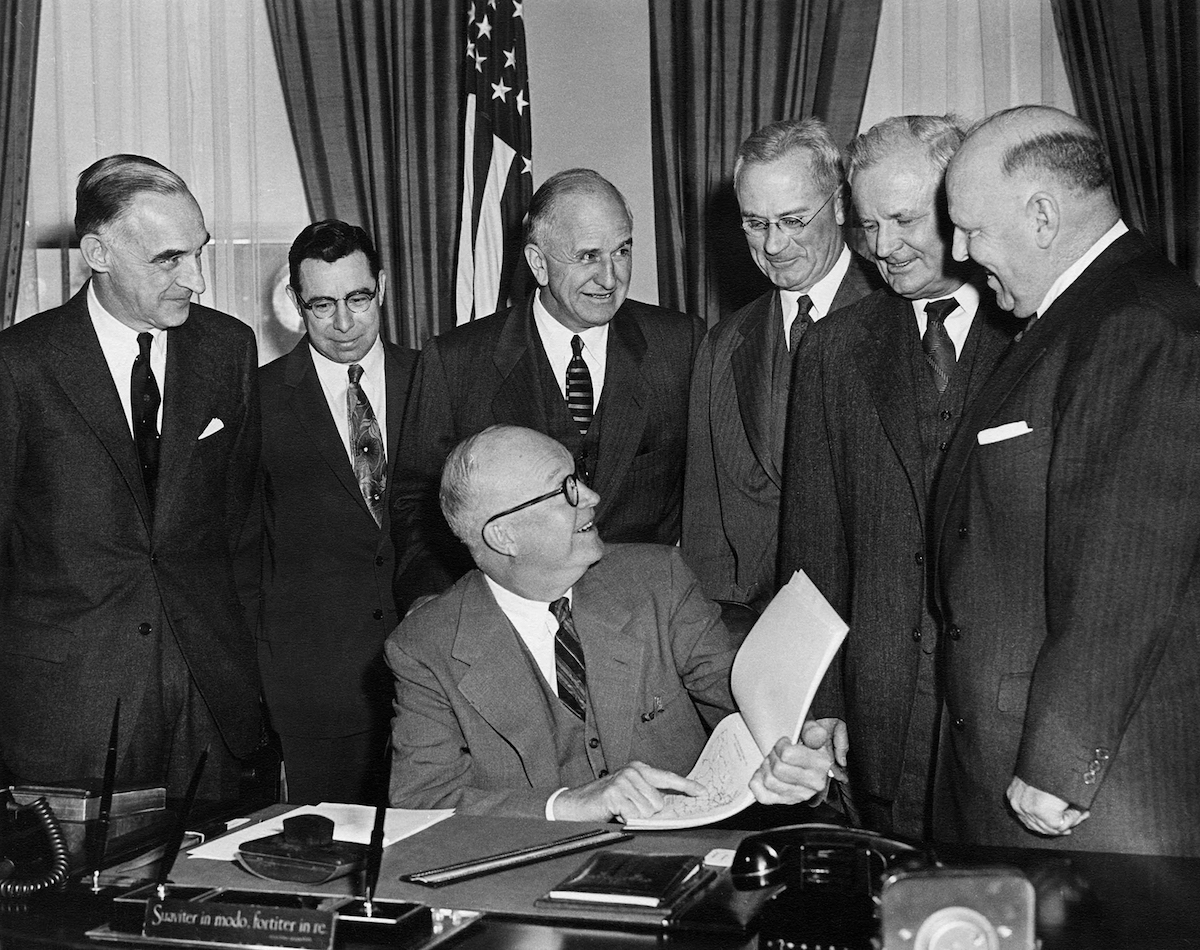
Thus, by the time Dwight D. Eisenhower was elected President in 1952, a groundswell of cross-sectional support existed to construct a nationwide road system. While the quest to construct the interstates was a decade-long collective endeavor, his personal leadership is critical to understanding the original intent of the interstates. As former Supreme Allied Commander of Europe in World War II and the president who signed the 1956 law to create the Interstate Highway Program, Eisenhower embodied the synthesis of industrial and national security policy, and his reasons for creating a national interstate system reflected that. As president-elect in late 1952, Eisenhower wrote a column for the Hearst papers in which he warned that “the obsolescence of the nation’s highways presents an appalling problem of waste, death and danger.”20 He then extolled the virtues of a modern highway system for American national security: “Next to the manufacture of the most modern implements of war as a guarantee of peace through strength, a network of modern roads is as necessary to defense as it is to our national economy and personal safety.”21
Eisenhower’s personal conviction that a modern, nationwide road system was essential to the national interest stemmed from two key experiences. First, as a Lieutenant Colonel, Eisenhower participated in the 1919 Trans-Continental Motor Truck Trip convoy from New York to San Francisco.22 This was an effort by the U.S. Army to test the viability of moving men and materiel from the East to the West Coast. By all accounts, it was a disaster. The journey took sixty-two days as the convoy hobbled over the continental United States at an average speed of five miles per hour.23 While serviceable in some segments, Army trucks and heavy vehicles frequently broke down on poorly maintained dirt roads, forcing Eisenhower to report back that “extended trips by trucks through the middle western part of the United States are impracticable until roads are improved, and then only a light truck should be used on long hauls.”24
Eisenhower’s second key experience was his exposure with the German autobahn system, both during the war and as military governor of occupied Germany; this underscored the centrality of a highway system to national defense. The autobahns had demonstrated their value to German military operations from the outset, enabling the German armed forces to mount the rapid infantry and vehicle maneuvers of the blitzkrieg and fight a two-front war. Eisenhower noticed that the autobahns remained resilient to Allied air attacks, in comparison to the crippled rail network, providing defense-in-depth and mobility to German forces despite heavy bombardment.25 Following the D-Day Invasion, the Allies themselves used the autobahns to pursue retreating German forces with speed. The impact of the autobahns in inspiring Eisenhower to create the interstates can be seen years later: a Transport Topics report on a 1955 White House meeting includes the following detail on Eisenhower’s justification:
The Chief Executive recalled that when he was Supreme Commander of the Allied Forces in Europe he was particularly impressed with the speed with which military supplies and personnel were moved over the German autobahns. After returning to the United States, he said, he found our cross-country highways compared poorly with the German network.26
The frustrations of the 1919 truck convoy experience and its contrast with the wartime efficiency of German road infrastructure later convinced Eisenhower to replicate the strategic advantages of the autobahns in the United States. Other reasons cited by him include the need to reduce congestion and its associated economic costs, adapt and modernize the transportation system to keep pace with the postwar explosion of vehicles, and reduce vehicular deaths.27 For vehicular ownership in particular, significant industrial policy was needed. Americans were buying nearly sixteen thousand cars a day since Eisenhower’s inauguration, and by 1955, nearly seven out of ten families owned a car.28 At the same time, World War II and the Korean War led to a production boom that severely damaged America’s roads, requiring investment in road infrastructure. Eisenhower also had an almost “pathological fear of a depression” and saw an interstate construction program as an almost Keynesian strategy to “flatten out the peaks and valleys in unemployment.”29 Beyond the military-industrial nexus, Eisenhower’s 1952 Hearst column also sheds light on his vision for the federal government to play a lead role in orchestrating the development of the interstates:
A solution can and will be found through the joint planning of the Federal, state and local governments. In this, the national government can supply leadership of the kind that is lacking today. It must provide an intelligent leadership to band all units of government in an efficient and honest attempt to build America into the great and prosperous nation it can become.30
To further exemplify the link between highways and defense, Eisenhower tasked his former West Point classmate, General Lucius Clay, with bringing his vision to life by appointing him as Chair of the President’s Advisory Committee on a National Highway Program (known also as the Clay Commission).31 Clay had distinguished himself as a master of industrial base management, first as Chief of Procurement for the Army during the war, and later as the hero who orchestrated the Berlin airlift to defy Stalin’s blockade.32
The Clay Commission was charged with designing a ten-year construction program to build a national system of highways that would be “self-liquidating,” i.e., a program that would not add to the national debt by paying for itself.33 The Clay Commission’s plan, endorsed by the White House in February 1955, proposed a construction program to build a nationwide network of interstates at a cost of $27 billion, accounting for a federal cost-share of 90 percent.34 The proposal would create the Federal Highway Corporation as a separate federal entity that would issue thirty-year bonds to fund construction, an accounting sleight-of-hand that would effectively move this debt off the government’s balance sheet.35 The debt and interest would be paid back by dedicated revenue from taxes on motor and lubricating fuel.
Despite deep support for federal construction of an interstate system, however, the proposal stalled in Congress. Democratic Senator Harry Byrd’s opposition to the proposal was a death knell. After the 1954 midterm elections, Democrats seized control of both chambers of Congress, and Senator Byrd took over as Chair of the Senate Finance Committee, giving him acute leverage over the financing details of the proposal. Byrd had a legendary aversion to any program that added to the federal debt, stemming from “almost pathological abhorrence for borrowing that went beyond reason to the realm of deep emotion.”36 Byrd objected to the creation of an agency that would issue debt outside the national debt limit and congressional budget control—but which would be implicitly guaranteed by the Department of the Treasury.
Congress then took up the mantle of legislating an Interstate Highway System, with proposals led by Democratic Senator Albert Gore Sr., Chairman of the Senate Subcommittee on Roads, and Representative George Fallon, Chairman of the House Subcommittee on Roads.37 Fallon’s proposal, in particular, adopted the fiscal architecture of the Clay Commission.38 The effort shockingly failed in the House, however, despite being introduced by a Democratic subcommittee chair, and it can be read as a cautionary tale in the perils of neglecting politics.
Historians attribute the bill’s defeat to jurisdictional warfare between committees and massive opposition from special interests. On the committee side, the powerful Ways and Means Committee, which would normally have taken charge of taxation-related legislation, resented being sidelined in developing the bill’s revenue mechanism. Ways and Means leveraged its control over members’ committee assignments to chill support for the bill. On the lobbying front, the trucking, gasoline, and tire industries waged a fierce opposition campaign. Trucking interests in particular were incensed, with American Trucking Association President Neil J. Curry claiming “the so-called pay-as-you-go plan . . . would charge 1 percent of all motor vehicles with 26 percent of the additional revenue requirements.”39 In a July 29, 1955, editorial titled “Good Roads, Lobbied Away”, the New York Times succinctly captured the root cause of the bill’s failure, quoting the Democratic floor leader, Representative McCormack of Massachusetts: “Everybody wants a road bill but nobody wants to pay for it.”40
Fortunately, Congress eventually recovered from this dysfunction and, in 1956, passed legislation that formally created the Interstate Highway System. Congress passed a joint bill on June 25, 1956, and President Eisenhower signed the Federal-Aid Highway Act of 1956, also known as the National Interstate and Defense Highways Act, into law on June 29.41 This successful effort succeeded where the previous one fell short, that is, by proactively addressing internal jurisdictional politics and external special interest negotiations. On the inside, the House Ways and Means committee kept authority over drafting the tax revenue section, while the House Public Works committee drafted the authorizing language. On the outside, Fallon, Gore, and the White House worked closely with various interest groups to reach an agreement on fuel tax increases.
The key innovation of the Federal-Aid Highway Act was the establishment of the Highway Trust Fund (HTF), a dedicated source of funding for highway construction and maintenance drawn from taxes on highway users. During testimony before the House Ways and Means Committee, Treasury Secretary George M. Humphrey suggested that the committee model the HTF’s financing after the Social Security Trust Fund, which would entail a clear linkage between highway user tax revenue and highway funding.42 The HTF endures today as a primary source of revenue for highway construction and maintenance, although it has not been solvent since fiscal year 2007.43 The 1956 legislation authorized $25 billion in the Highway Trust Fund for twelve years to construct forty-one thousand miles of interstate highways.44 This would be funded by an increase in federal tax on gas and diesel from two to three cents and would support the Clay Commission’s recommended 90 percent federal cost share for the development of an Interstate Highway System fit for the traffic needs of the postwar era.45 The bill also authorized the federal government to acquire rights-of-way to construct the system.46
After the bill’s passage, the BPR and state highway officials embarked on a spree of roadbuilding that fundamentally repatterned American life. Between 1956 and 1970, automobile ownership had grown from 72 percent to 82 percent as the interstates had vastly improved the speed and safety of intercity travel.47 By 1972, driving time from New York to Los Angeles had shrunk from an average of seventy-nine hours in 1956 to sixty-two, while the fatality rate had decreased by 80 percent despite a fourfold increase in vehicles in service.48 By compressing travel times between cities and other locations, the interstates turbocharged the existing migration from cities to suburbs and expanded opportunities for recreational travel. It also cemented the dominance of the trucking industry, as shipping goods by truck increased 257 percent between 1955 and 1990; it also drove American manufacturers to adopt “just-in-time” production practices of holding limited inventory.49 One significant consequence of the interstate buildout was deepening America’s addiction to gasoline, with consumption increasing from 55 billion gallons in 1956 to 115 billion in 1973, forcing the United States to start importing more quantities from Venezuela and the Middle East as domestic production peaked in 1970.50
The Interstate construction program also sparked a materials revolution with unprecedented demand-pull for cement, concrete, and asphalt. In 1961, the BPR put out a summary titled “The Size of the Job” to estimate the requirements of building forty-one thousand miles of highways through the “greatest peacetime public works program in history.”51 The summary estimated that the interstates would require enough “Portland cement concrete [to build] . . . six sidewalks to the moon.”
For context, Portland cement refers to the traditional form of cement used in the construction industry, first invented by British bricklayer and inventor Joseph Aspdin in 1824, when he combined powdered limestone and clay on his kitchen stove.52 The resulting formula was termed “Portland cement” for its resemblance to a limestone from the Isle of Portland.53 Today, Portland cement is produced by heating limestone, clay, shale, iron ore, and blast furnace slag in a kiln to form a compound called clinker which is then ground along with gypsum, limestone, and other materials to form Portland cement.54
Portland cements, including blended cements, now account for approximately 98 percent of cement production in the United States.55 In addition, “the . . . asphalt to be used in pavements, bases, and shoulders of the Interstate System would provide enough material to build driveways for 35 million homes.”56 According to the United States Geological Survey (USGS), U.S. production of construction sand and gravel grew from 320 million metric tons in 1950 to 810 million in 1971, with growth between 1950 and 1966 almost continuous, driven primarily by the interstate program.57
Building the interstates also drove innovations in materials design and civil engineering as engineers grappled with building roads to specification across varying terrain and within a twelve-year timeframe. As it was footing ninety percent of the bill, the federal government, through the BPR and American Association of State Highway Officials (aasho), started setting highway construction and safety standards.58 Prior to this effort, knowledge of concrete and asphalt, especially in terms of load-bearing and wear-and-tear factors was limited. The demands of building the interstates resulted in the creation of the aasho Road Test, a multiyear, multiorganizational effort including the Department of Defense (DOD), American Petroleum Institute (API), aasho, BPR, etc. that “established the relationships for pavement structural designs based on expected loadings.”59 As quoted directly by the Federal Highway Administration (FHWA), it is a “landmark in highway and bridge design that has never been equaled.”60
The transformative impact of this program highlights the synthesis of transportation, defense, and industrial policy that Eisenhower achieved with the 1956 program, all of which can be revived and reapplied in the upcoming reauthorization.
The Evolution of Surface Transportation Reauthorization
Once the Interstate buildout neared completion, reauthorization bills gradually shifted from system construction toward maintenance, flexibility, safety, equity, climate, and multimodal transportation.
While Eisenhower’s 1956 bill authorized $25 billion to finish building the Interstate Highway System by 1972, the end of construction was close but still ongoing by 1991 at a final federal cost of $114.3 billion.61 As the end neared, transportation and highway policymakers pivoted from construction to maintenance and modernization of the Highway System. Surface transportation reauthorizations since 1991 have reflected this shift and continued to expand surface policy priorities beyond Interstate construction.
The first modern reauthorization was the Intermodal Surface Transportation Efficiency Act of 1991 (istea). Not only did istea provide the final monies for the completion of the Interstate system, bookending Eisenhower’s project, but it also advanced three key policy innovations that endure today.62 First, istea profoundly increased state and local flexibility and autonomy. istea elevated the transportation planning needs of metropolitan areas by devolving responsibility for planning and implementation to Metropolitan Planning Organizations (MPOs), which now had the ability to invest federal monies directly and consider the social, economic, and environmental effects of transportation decisions.63 istea established the Surface Transportation Program (STP) as one of the core programs where states and localities had broad flexibility to fund projects of their choice, including capital costs for mass transit programs, highway safety improvements, and wetlands protection.64 The inclusion of transit projects in the STP highlighted istea’s second key innovation: widening the aperture of surface transportation policy from highways to include multimodal transportation, notably mass transit. Third, istea deepened the role of the federal government in promoting transportation research and development (R&D) with funding for intelligent vehicle systems, electric vehicles, magnetic levitation rail systems, and other advanced technologies.65
istea was succeeded by the six-year authorization of the Transportation Equity Act for the 21st Century (TEA-21) in 1998, a bill that built upon istea’s move of decentralizing decision-making and providing states and localities with flexibility in using highway program funding.66 TEA-21 represented a consolidation of istea but layered on one key innovation: a minimum funding guarantee for states.67 TEA-21 guaranteed all states a minimum return of 90.5 percent of a state’s revenue contribution to the Highway Trust Fund, providing funding certainty.68 This had the consequence of shifting highway funding from need- and policy-based design to formula-driven equity considerations. R&D investments in intelligent transportation systems and advanced vehicles continued.69
The next reauthorization occurred in 2005 under the George W. Bush administration. Titled Safe, Accountable, Flexible, Efficient Transportation Equity Act: A Legacy for Users (safetea-lu), this was a five-year authorization and the largest surface transportation bill to date, with $286 billion in authorized funding.70 While keeping istea and TEA-21’s flexibility, safetea-lu departed from the prior reauthorizations by including $14.8 billion in earmarks over and above formula funding for states.71 safetea-lu also marked the first time the HTF reached insolvency, requiring additional transfers from the Treasury’s general fund.72 safetea’s main policy priority, as reflected in the name, was improving highway safety by establishing the Highway Safety Improvement Program, which enabled states to use highway dollars to undertake projects to reduce fatalities.73
While R&D focused on previously included topics such as intelligent transportation systems, safetea-lu included discrete provisions to drive the direction of material innovation.74 Section 5202 (Innovative Bridge Research and Deployment Program) authorized $65.5 million to evaluate the application of innovative designs, materials, and construction methods for the construction and repair of bridges.75 In addition, section 6017 authorized the Secretary of Transportation to provide federal funds to increase the use of “recovered mineral components” as substitutes for Portland cement in transportation projects funded by federal dollars.76 In this respect, section 6017 was an early milestone in promoting environmentally sustainable material innovation through federal procurement and transportation policy, as the “increased use of recovered mineral components” called for by safetea-lu encompassed products such as coal fly ash and ground granulated blast furnace slag that can noticeably reduce concrete’s carbon footprint.77
safetea-lu was not immediately succeeded by a long-term authorization: several one-year extensions occurred before Congress passed the Moving Ahead for Progress in the 21st Century (MAP-21) in 2012.78 Due to the HTF’s insolvency in fiscal year 2008 and significant earmarks in safetea-lu, an earmark moratorium was placed in fiscal year 2011.79 MAP-21 reflected this emphasis on fiscal efficiency by reducing the number of federal programs by two-thirds and eliminating nearly all of the discretionary programs created by safetea-lu, including the Innovative Bridge Research program, which removed any dedicated focus on materials innovation.80 MAP-21’s most important policy innovation was establishing a performance management program, which required states, MPOs, and transit providers to set targets for highway condition and performance and invest federal funds to meet seven national performance goals.81
After a number of extensions, Congress passed the Fixing America’s Surface Transportation (FAST) Act in 2015 to authorize surface transportation programs from fiscal year 2016 to fiscal year 2020.82 For the first time in a decade, federal transportation programs had multi-year funding certainty required for long-lived capital projects.83 The FAST Act maintained key MAP-21 tenets, including the performance management framework. Its main innovation was elevating freight into a core formula program by establishing the National Highway Freight Program (NHFP) to provide dedicated funding for freight transportation projects.84 Another change was renaming the Surface Transportation Program (STP), created in istea to provide states and localities flexibility, to the Surface Transportation Block Grant Program (STBG).85 The “block grant” designation was a deliberate signal that the program was intended to give states and localities maximum flexibility in how they deployed formula dollars. On the R&D side, FAST hewed closely with previous reauthorizations: it did not have a specific focus on material innovation but did establish the Advanced Transportation and Congestion Management Technologies Deployment (atcmtd) program to provide 50 percent federal cost share for technologies that improved safety, mobility, and system performance.86
The most recent reauthorization occurred in 2021, when a Democratic trifecta passed the Infrastructure Investment and Jobs Act (IIJA). The IIJA authorized $365 billion in spending from fiscal years 2022 to fiscal year 2026, a 62 percent increase (in nominal terms) from the FAST Act.87 IIJA was notable in that, compared to other reauthorizations, it authorized more funding from the HTF, more funding from the Treasury’s general fund that would later have to be appropriated, and for the first time ever, from multiyear advanced appropriations which would need no further Congressional action to become available in subsequent fiscal years.88 This reflected the Biden administration’s bet on generational infrastructure investment to reindustrialize and revitalize U.S. manufacturing and productive capacity.
IIJA also made climate change mitigation and resilience a priority, with $18 billion authorized across core formula programs and discretionary programs.89 IIJA created two new formula programs: the Carbon Reduction Program (CRP) to fund projects that would reduce carbon emissions from motor vehicles, and the protect program to improve transportation infrastructure resilience.90 Other climate-related provisions included $2.5 billion in competitive grants to build out electric and hydrogen charging infrastructure and billions in demonstration funding for clean energy technologies, such as advanced reactors, carbon capture, and energy storage that had been authorized in the Energy Act of 2020.91 IIJA also provided $500 million in funding for first-of-a-kind commercial-scale demonstrations of clean industrial technologies. Cement and concrete were eligible for funding, but there was no dedicated funding for innovative, domestically produced, lower-carbon cement, concrete, and asphalt.
Over six reauthorization cycles, funding levels, policy priorities, and program scopes have expanded to encompass multimodal transport, safety, state equity, and climate. No bill, however, has dedicated funding or program authorization toward the material basis of America’s infrastructure. There have been attempts at federal support for material innovation, such as section 6017 of safetea-lu, which authorized federal funding to increase the use of recovered mineral components, but this area remains underexplored and underresourced.
The Real Bottleneck: Why Better Materials Are Not Scaling
Dedicated policy for material innovation is required because adoption cycles in cement, concrete, and asphalt typically occur over ten to twenty years.92 The United States simply cannot afford to wait this long to reduce its reliance on imports. Accelerating the adoption of innovative materials must address two key bottlenecks: market access regulation and financing.
Market access regulation in this case refers to the standards and specifications set by state DOTs when approving materials for use in public works projects. State DOTs block market access to innovative, lower-carbon materials when they use “prescriptive” standards and specifications. These standards are considered prescriptive because they specify the exact chemistry, type, and proportion of materials that can be used in public works, often according to a preset recipe. As a result, materials that may perform as required but do not conform to prescriptive standards are barred from the market.
Being excluded by state DOT specifications is a major hurdle to scaling up the use of innovative materials because government procurement drives roughly 50 percent of cement consumption, and within this segment, two-thirds of consumption is driven by the construction and maintenance of public roads, bridges, and highways.93 In addition, publicly funded highway programs account for 65 percent of asphalt consumption.94 Being excluded from public works construction, therefore, starves innovative producers of the revenue required to scale up. Unfortunately, this is a widespread phenomenon across state DOTs. A ClearPath study of material specifications of all fifty state DOTs found that “there is at least one type of prescriptive requirement for cement and concrete that exists in every state across the U.S., and that 48 states have some form of prescriptive requirements for asphalt,” highlighting the ubiquity of this regulatory regime.95
Prescriptive specifications have limited the use of materials that can reduce emissions and improve domestic supply chain resilience. One readily available solution to reduce concrete emissions is to reduce the amount of Portland cement in the mixture, the largest source of emissions, with materials known as supplementary cementitious materials (SCMs).96 SCMs include industrial byproducts mentioned previously, such as coal fly ash or blast ground granulated blast furnace slag, that have been used as partial cement substitutes for decades because they lower the cost compared to Portland cement and improve structural performance.97 They can also reduce emissions by up to 70 percent compared to a concrete mixture using Portland cement.98
While SCM use is allowed in state DOT specifications, deployment is capped by prescriptive requirements, such as maximum cement substitution rates and minimum cement content requirements. ClearPath’s analysis found that maximum cement substitution rates are the most prevalent form of prescriptive specification across states, with forty-four states having at least one incidence of this specification, while thirty-seven states have at least one example of minimum cement content.99 These specifications block increased usage of SCMs, even though tests have found that increased SCM can be tolerated, often with positive economics.100
This phenomenon also applies to asphalt. The main strategy to reduce asphalt emissions is to increase the use of recycled asphalt pavement (RAP), which can displace the use of virgin asphalt binder and aggregates, and reduce emissions by up to 30 percent.101 Three state DOTs, however, prohibit RAP outright, and thirty-one states have a maximum RAP substitution limit, with a median percentage of 28 percent, even though using up to 50 percent RAP is feasible.102
Prescriptive specifications not only block state DOTs from using readily available materials like SCMs, but they also block the deployment of earlier-stage, innovative products, such as belite clinker that offer deep emissions reduction potential but do not use Portland cement-based chemistry.103 Prescriptive specifications also exacerbate U.S. import dependency in two ways. First, maximum substitution rates for SCMs that limit their use force contractors and developers to import foreign Portland cement for concrete mixtures. Second, prescriptive specifications can and will limit the use of alternatives derived from domestic feedstocks. This will hinder the U.S.’s ability to replace the fifty million-ton shortfall in SCMs expected by 2050, driven by the decrease in supply of coal fly ash, the most commonly used SCM in concrete, which has been decreasing since 2002 due to coal plant closures.104 As a result, the United States will have to import more cement to make up for the reduction in SCMs like fly ash.
Speeding up the adoption cycle of innovative materials requires state DOTs to shift rapidly from prescriptive to performance specifications. Performance specifications eschew a recipe-based approach in favor of specific engineering outcomes, such as durability and compressive strength. Put simply: “a performance specification describes the end product that is desired. It does not describe how to achieve the result.”105 Performance specifications unlock market access for novel, domestically sourced, and/or lower-carbon materials, as materials do not have to conform to a set mixture and can be approved as long as they meet the state DOT’s performance requirements.
The case study of U.S. adoption of Portland Limestone Cements (PLCs) perfectly illustrates the catalytic role state DOT use of performance specifications can play. PLCs replace 15 percent of clinker with ground limestone to achieve an average emissions reduction of 8 percent.106 These were introduced in 2012, took roughly five years to be accepted by half of state DOTs, and only accounted for 6 percent of the cement market until 2021.107 By 2022, however, when almost all state DOTs had approved PLC, PLC use skyrocketed to 24 percent and reached 58 percent of cement shipments by 2024.108 State DOTs are trusted first movers whose approval of materials can unlock adoption by the wider market, and performance specifications are a key step on the path to adoption.
The second barrier to deploying innovative materials at scale is the difficulty in obtaining financing for first or nth-of-a-kind manufacturing facilities for lower-carbon, innovative materials. For earlier-stage technologies that have not moved down the cost curve, capital expenditure requirements range between $500 million and $1 billion, and capital markets are unwilling to provide appropriately priced financing.109 This problem is exacerbated by the merchant risk clean material producers face when competing in a low-margin industry where commodities are bought and sold on the spot market.110 In addition, the cement and concrete value chains are highly fragmented, with several layers of intermediaries between cement producers and final buyers, complicating the use of offtake agreements. This lack of offtake agreements heightens risk and erodes project bankability, preventing the construction of manufacturing facilities.
Innovative financing and procurement mechanisms are required to bring lower-carbon technologies to market. One solution is to tap into the government’s procurement power to commit to buying cement, concrete, and asphalt at specific volumes and prices in the future to provide revenue certainty for first-of-a-kind facilities or new products. This could derisk investment and unlock financing for these manufacturing projects. Innovative procurement has been used in other fields to accelerate speed-to-market for socially desirable and strategic technologies that would otherwise be underinvested in by the private sector.
One example of an innovative procurement mechanism is an Advanced Market Commitment (AMC), defined as “[a] binding commitment to create a market for an innovative product/service that is not yet commercially developed.”111 During the Covid-19 pandemic, the Trump administration created an AMC under Operation Warp Speed to accelerate the development of safe and effective vaccines.112 The federal government committed to pre-purchasing 100 million Pfizer vaccine doses at a price before clinical trials had concluded, reducing manufacturing scale-up risk and providing a strong incentive for Pfizer and other firms to invest in vaccine development.113 The AMC succeeded in bringing vaccines to market much faster than analyst expectations. The Department of War (DOW) also commonly uses AMCs to ensure an adequate supply of artillery shells. For example, in September 2023, the U.S. Army awarded General Dynamics $974 million to manufacture 155-millimeter shells for delivery in 2028; the volume and price-guaranteed contract provided the certainty for General Dynamics to expand production.114
Shifting to performance specifications and establishing federal purchasing AMCs for domestically produced, lower-carbon materials can accelerate the deployment of innovative materials currently being trialed, whether on a pilot scale or as isolated projects. For example, Amrize, the largest cement company in the United States, partnered with Meta and the University of Illinois Urbana-Champaign to design an AI-optimized concrete mixture that gained strength 40 percent faster to speed up data center construction time and simultaneously reduce emissions by 35 percent.115 Amrize’s ability to innovate was enabled by Meta’s willingness to use a non-prescriptive, performance standard. Expanding this practice to public works projects across states would yield similar speed and emissions benefits.
In another example, Terra CO2 is an American materials firm that has invented a technology to produce an SCM from locally abundant and cost-effective silicate rocks.116 This product has already been proven to reduce emissions by 70 percent relative to traditional Portland cement while achieving superior performance and is being commercially deployed as it complies with performance specifications, highlighting the market access benefits they provide.117 Terra CO2 has also invented a product that purports to replace Portland cement in concrete and eliminate carbon emissions, but bringing this to market will require broader adoption of performance specifications and the ability to scale up manufacturing facilities.118 Within the asphalt sector, California, Illinois, and Washington state DOTs have used performance specifications to pilot the increased RAP substitution rates, yielding emissions reductions as high as 15 percent just from initial trials.119
Expanding the deployment of better-forming, innovative materials is imperative for resolving existing weaknesses in the interstates and ensuring their maintenance as the U.S. embarks on an unprecedented buildout of AI data centers. The American Society of Civil Engineers (ASCE) in its 2025 Report Card for America’s Infrastructure reported that 22.6 percent of federal-aid highway pavements have “poor ride quality” while 39 percent of major roads are in “poor or mediocre condition.”120 The United States cannot rely on prescriptive specifications that block the use of innovative materials to solve this issue.
In addition, with hyperscalers expected to have spent over $400 billion on AI data center buildout in 2025 alone, demand for cement will skyrocket.121 The American Cement Association has already forecast that this will require one million tons of new cement by 2028.122 With reliance on imported cement hovering around 21 percent and SCM supply expected to decrease, policy intervention is required to expand the supply of domestic material manufacturing.123 Only then will the United States be able to maintain the interstates, key strategic infrastructure of the past, while building out data centers, strategic infrastructure for the future.
A Reauthorization Agenda for American Materials
Congress can turn the next surface transportation bill into a practical industrial strategy by pairing state specification reform with tools that create demand for innovative domestic materials.
Just as the 1956 Federal-Aid Highway Act was simultaneously transportation, defense, and industrial policy, the upcoming reauthorization can serve as a vehicle for materials innovation, supply chain security, and environmental performance, without choosing between them. Two bipartisan bills this Congress provide the first step in addressing the bottlenecks of market access regulation and financing that are blocking the deployment of domestically produced, lower-carbon cement, concrete, and asphalt. The aforementioned proposed legislation, CAIA in the Senate and the impact 2.0 Act in the House, form a bipartisan, bicameral solution set worth including in surface transportation reauthorization.
CAIA and impact 2.0 start to address the deployment challenges posed by prescriptive specifications on the state DOT level by authorizing a voluntary grant program at FHWA to accelerate the adoption of performance-based specifications.124 State DOTs can apply to this program and receive reimbursement for technical assistance, training, and equipment needed to modernize specifications to be performance-based. Providing resources to state DOTs is essential to catalyze a shift to performance specifications because state DOT engineers face asymmetric incentives; there is no reward for trying a new technique that works, but severe consequences if one fails.
In addition, prescriptive standards have been in use for over a century, so there is deep institutional inertia to maintain this regulatory framework. The institutional inertia is entrenched because under a prescriptive specification regime, state DOTs merely have to specify the recipe and the risk lives with the contractor who must follow it. Under a performance specification system, state DOT engineers bear more of the risk as they must create a performance specification that adequately achieves engineering performance and life-safety. While state DOTs have started adopting performance specifications piecemeal, breaking institutional inertia requires dedicated federal support to upskill state DOT employees and deliver the equipment required to test material performance 125
Both bills also offer an initial solution to the financing bottleneck. They amend a core formula program focused on state flexibility, the Surface Transportation Block Grant program, to enable the advance purchase of innovative materials.126 The bills expand the existing list of twenty-five eligible projects to authorize states to use STBG funds for projects that use domestically produced, innovative materials that provide an engineering or environmental benefit, and, further, for purchasing materials through a multi-year advance contract with a specified quantity and price. This provision adds several contracting guardrails to protect taxpayer funding, such as requiring states to only disburse funds once physical materials have been delivered on time and on specification, protecting state DOTs from upcharging and ensuring that recipients of purchase commitments demonstrate the ability to deliver contracted tons during the contract’s life.127 With this amendment, the bills effectively allow state DOTs to issue AMCs without authorizing new funding or creating a new program, which is important to reduce bureaucracy and costs in an environment where the HTF has been insolvent since fiscal year 2007.128
If used by state DOTs, this provision could provide a large demand signal for innovative material production. IIJA provided states up to $14.9 billion annually for STBG, with the largest states receiving over $1 billion per fiscal year.129 Using even a small percent of STBG funds for an innovative materials AMC can provide tens of millions in demand-pull for innovative, domestically produced, lower-carbon materials and catalyze additional capital investment to build out manufacturing facilities.
Including CAIA and impact 2.0 in the upcoming surface transportation reauthorization can deliver several economic and environmental benefits. Commercializing American innovation in construction materials can bring to market better performing materials, such as Amrize’s AI-optimized mixture mentioned above, that improve the quality and speed of private sector construction. Using these materials can also generate taxpayer savings by enabling the use of lower-cost, better optimized concrete and asphalt mixtures with increased durability, thereby reducing maintenance and replacement costs. For example, a Texas DOT field study found that applying performance specifications for asphalt across the state would save taxpayers $80 million annually.130 Similarly, the New Jersey DOT observed that using mixtures developed through performance specifications improved projected pavement lifespans by more than ten years compared with conventional asphalt specifications.131
Perhaps the most significant potential benefit of taking this course is enhanced supply chain security, enabled by regulatory and financing conditions that scale up domestic material production and provide a line-of-sight to emissions reductions from U.S. cement, concrete, and asphalt production.
Reauthorization as Industrial Revival
If Congress wants to channel the ambition of the 1956 highway law, the next reauthorization should go beyond the building of roads and bridges; it should help to build the domestic materials base those projects require and create the conditions for their widespread adoption.
In his memoirs, Eisenhower presciently predicted that the interstates “would change the face of America. Its impact on the American economy, the jobs it would produce in manufacturing and construction, the rural areas it would open up—was beyond calculation.”132 If anything, he underestimated the transformational impact the interstates would have on the structure of the American economy, land use, mobility, energy system, and, importantly, the material basis of our infrastructure. As the United States embarks on the next great buildout of strategic infrastructure in the form of AI data centers, it must ensure that the material supply chain for the interstates that underpin it all remains secure and modern.
The upcoming surface transportation reauthorization is a generational opportunity for Congress to accelerate the deployment of technologies that increase the supply of domestic cement, concrete, and asphalt with a lower carbon footprint. Bipartisan bills like CAIA in the Senate and impact 2.0 in the House offer a solution set to start achieving this goal and fill a persistent gap in previous reauthorizations. Let’s hope Congress channels the transformational legacy of Eisenhower’s 1956 bill to drive America’s next materials revolution.
This article is an American Affairs online exclusive, published May 20, 2026.
Notes
1 “National Interstate and Defense Highways Act (1956),” National Archives, February 8, 2022; Tom Lewis, Divided Highways: Building the Interstate Highways, Transforming American Life, (Ithaca: Cornell University Press, 2013), xiiii.
2 Lewis, Divided Highways, 11.
3 “National Interstate and Defense Highways Act (1956),” National Archives.
4 “An Act to Authorize Funds for Federal-Aid Highways, Highway Safety Programs, and Transit Programs, and for Other Purposes,” Public Law 58, U.S. Statutes at Large 135 (2021): 429–1308.
5 Jeremy Gregory, “Concrete,” Climate Portal, July 25, 2025.
6 U.S. Geological Survey, Mineral Commodity Summaries 2025 (Washington D.C.: U.S. Department of the Interior, 2025).
7 U.S. Geological Survey, Mineral Commodity Summaries 2026 (Washington D.C.: U.S. Department of the Interior, 2026).
8 ACA staff, “ACA Report Predicts U.S. Will Need 1 Million Tons of Cement for AI Infrastructure by 2028,” American Cement Association, September 9, 2025.
9 “Global Cement Industry Reports 25% CO2 Intensity Reduction—and Calls for Urgent Government Action to Accelerate Net Zero Mission,” Global Cement and Concrete Association, November 17, 2025; Cement & Concrete Industry Net Zero Action & Progress Report 2025/26 (London: Global Cement and Concrete Association, 2025).
10 Parth Kumar, “Cementing Possibilities,” Down To Earth, September 26, 2023.
11 “The Asphalt Pavement Industry Fast Facts,” National Asphalt Pavement Association, 2020; “Engineering,” National Asphalt Pavement Association, accessed April 2026.
12 U.S. Congress, Senate, Concrete and Asphalt Innovation Act of 2025, S. 1067, 119th Cong., 1st sess., introduced in Senate March 13, 2025; U.S. Congress, House, impact Act 2.0, H.R. 2122, 119th Cong., 1st sess., introduced in House March 14, 2025.
13 Lewis, Divided Highways, 10.
14 Lewis, Divided Highways, 10.
15 Lewis, Divided Highways, 10.
16 Lewis, Divided Highways, 10–11.
17 Lewis, Divided Highways, 18.
18 Lewis, Divided Highways, 18.
19 Lewis, Divided Highways, 23.
20 Dwight D. Eisenhower, “President-Elect Dwight D. Eisenhower on Good Roads,” Federal Highway Administration, accessed April 2026.
21 Eisenhower, “President-Elect Dwight D. Eisenhower on Good Roads.”
22 Lewis, Divided Highways, 89–90.
23 Lewis, Divided Highways, 89–90.
24 Dwight D. Eisenhower, “Eisenhower’s Army Convoy Notes 11-3-1919 Rock Island Arsenal,” Federal Highway Administration, accessed April 2026.
25 Eisenhower, “Eisenhower’s Army Convoy Notes 11-3-1919 Rock Island Arsenal.”
26 Richard F. Weingroff, “Kill The Bill: Why the U.S. House of Representatives Rejected the Interstate System in 1955,” Federal Highway Administration, June 30, 2023.
27 Eisenhower, “President-Elect Dwight D. Eisenhower on Good Roads.”
28 Lewis, Divided Highways, 122.
29 Lewis, Divided Highways, 86; Richard F. Weingroff, “Original Intent: Purpose of the Interstate System 1954-1956,” Federal Highway Administration, June 30, 2023.
30 Eisenhower, “President-Elect Dwight D. Eisenhower on Good Roads.”
31 Richard F. Weingroff, “General Lucius D. Clay – The President’s Man,” Federal Highway Administration, June 27, 2017.
32 Weingroff, “General Lucius D. Clay – The President’s Man.”
33 Weingroff, “General Lucius D. Clay – The President’s Man,”
34 Weingroff, “General Lucius D. Clay – The President’s Man.”
35 Weingroff, “General Lucius D. Clay – The President’s Man.”
36 Alden Hatch, The Byrds of Virginia : An American Dynasty, 1670 to the Present (Austin: Holt, Rinehart & Winston, 1969): 347.
37 Weingroff, “Kill The Bill: Why the U.S. House of Representatives Rejected the Interstate System in 1955.”
38 Weingroff, “Kill The Bill: Why the U.S. House of Representatives Rejected the Interstate System in 1955.”
39 Weingroff, “Kill The Bill: Why the U.S. House of Representatives Rejected the Interstate System in 1955.”
40 “GOOD ROADS LOBBIED AWAY,” New York Times, July 29, 1955.
41 “National Interstate and Defense Highways Act (1956),” National Archives.
42 Weingroff, “Kill The Bill: Why the U.S. House of Representatives Rejected the Interstate System in 1955.”
43 Ali E. Lohman, Surface Transportation Reauthorization: Federal Highway Programs (Washington D.C.: Congressional Research Service, 2026).
44 Lewis, Divided Highways, 122.
45 Lewis, Divided Highways, 122.
46 Lewis, Divided Highways, 122.
47 Lewis, Divided Highways, 122.
48 Earl Swift, The Big Roads: The Untold Story of the Engineers, Visionaries, and Trailblazers Who Created the American Superhighways (Boston: Mariner Books, 2012), 306.
49 Lewis, Divided Highways, 286.
50 Lewis, Divided Highways, 244.
51 “The Size of the Job,” Federal Highway Administration, June 27, 2017.
52 “Portland Cement: The Invention That Changed Building Forever,” Lath and Plaster, accessed April 2026.
53 Britannica Editors, “Portland Cement,” Encyclopedia Britannica, accessed April 2026.
54 “Cement and Concrete 101,” American Cement Association, accessed April 2026.
55 “Cement [Mineral Commodities Summaries 2026],” U.S. Geological Survey, accessed April 2026.
56 “The Size of the Job,” Federal Highway Administration.
57 Daniel E. Sullivan, “Materials in Use in U.S. Interstate Highways,” U.S. Geological Survey, 2006.
58 Lewis, Divided Highways, 136.
59 “aasho Road Test,” Federal Highway Administration, August 3, 2022.
60 “aasho Road Test,” Federal Highway Administration.
61 “The Dwight D. Eisenhower System of Interstate and Defense Highways,” Federal Highway Administration, June 27, 2017.
62 U.S. Congress, House, Intermodal Surface Transportation Efficiency Act of 1991, H.R. 2950, 102nd Cong., 1st sess., introduced in House July 18, 1991.
63 Robert Puentes, “Transportation Reform of 1991 Remains Relevant,” Brookings Institution, December 19, 2011.
64 U.S. Congress, House, Intermodal Surface Transportation Efficiency Act of 1991.
65 U.S. Congress, House, Intermodal Surface Transportation Efficiency Act of 1991.
66 Jeremy Plant, “Intermodal Surface Transportation Efficiency Act,” Center for the Study of Federalism, 2006; U.S. Congress, Senate, Surface Transportation Reauthorization Act of 2021, S. Rep. No. 117-41, 117th Cong., 1st sess., October 6, 2021.
67 “A SUMMARY – Investing in Our Future,” U.S. Department of Transportation, May 31, 2022.
68 “A SUMMARY – Investing in Our Future,” U.S. Department of Transportation.
69 “A SUMMARY – Investing in Our Future,” U.S. Department of Transportation.
70 Mary E. Peters, “DOT’s Fiscal Year 2009 Budget and the Final Year of safetea-lu Authorization,” U.S. Department of Transportation,” U.S. Department of Transportation, February 6, 2008.
71 Jeff Davis, “The Last Time A Surface Transportation Bill Was Earmarked: safetea-lu’s “Above-the-Line” Highway Earmarks,” Eno Center for Transportation, March 17, 2021.
72 Jeff Davis, “The Last Time A Surface Transportation Bill Was Earmarked: safetea-lu’s “Above-the-Line” Highway Earmarks.”
73 U.S. Congress, House, Safe, Accountable, Flexible, Efficient Transportation Equity Act: A Legacy for Users, H.R. 3, 109th Cong., 1st sess., introduced in House February 9, 2005.
74 U.S. Congress, House, Safe, Accountable, Flexible, Efficient Transportation Equity Act: A Legacy for Users.
75 U.S. Congress, House, Safe, Accountable, Flexible, Efficient Transportation Equity Act: A Legacy for Users.
76 U.S. Congress, House, Safe, Accountable, Flexible, Efficient Transportation Equity Act: A Legacy for Users.
77 U.S. Congress, House, Safe, Accountable, Flexible, Efficient Transportation Equity Act: A Legacy for Users.
78 U.S. Congress, Senate, Surface Transportation Reauthorization Act of 2021.
79 Lohman, Surface Transportation Reauthorization: Federal Highway Programs.
80 Lohman, Surface Transportation Reauthorization: Federal Highway Programs.
81 “Moving Ahead for Progress in the 21st Century Act (MAP-21),” Federal Highway Administration, August 17, 2012.
82 “Fixing America’s Surface Transportation Act or ‘FAST Act’,” Federal Highway Administration, March 1, 2022.
83 “Fixing America’s Surface Transportation Act or ‘FAST Act’,” Federal Highway Administration.
84 U.S. Congress, House, FAST Act, H.R. 22, 114th Cong., 1st sess., introduced in House January 6, 2015.
85 U.S. Congress, House, FAST Act.
86 U.S. Congress, House, FAST Act.
87 Lohman, Surface Transportation Reauthorization: Federal Highway Programs.
88 Lohman, Surface Transportation Reauthorization: Federal Highway Programs.
89 U.S. Congress, Senate, Surface Transportation Reauthorization Act of 2021, S. Rep. No. 117-41, 117th Cong., 1st sess., October 6, 2021.
90 U.S. Congress, Senate, Surface Transportation Reauthorization Act of 2021, S. Rep. No. 117-41.
91 U.S. Congress, Senate, Surface Transportation Reauthorization Act of 2021, S. Rep. No. 117-41; “Climate Benefits of the Infrastructure Investment and Jobs Act are Bigger than Models Suggest,” Bipartisan Policy Center, November 2021.
92 U.S. Department of Energy, Pathways to Commercial Liftoff: Low-Carbon Cement (Washington, D.C.: U.S. Department of Energy, 2023).
93 U.S. Department of Energy, Pathways to Commercial Liftoff.
94 “NAPA Fast Facts,” National Asphalt Pavement Association
95 Casey Kelly and Rafae Ghani et al., Paving the Way to Innovation (Washington D.C.: ClearPath, 2024).
96 U.S. Department of Energy, Pathways to Commercial Liftoff.
97 U.S. Department of Energy, Pathways to Commercial Liftoff.
98 Amory B. Lovins, Profitably Decarbonizing Heavy Transport and Industrial Heat: Transforming These “Harder-to-Abate” Sectors Is Not Uniquely Hard and Can Be Lucrative (Boulder: Rocky Mountain Institute, 2021).
99 Kelly and Ghani et al., Paving the Way to Innovation.
100 U.S. Department of Energy, Pathways to Commercial Liftoff.
101 Joseph Shacat, J. Richard Willis, and Ben Ciavola, “GHG EMISSIONS INVENTORY FOR ASPHALT MIX PRODUCTION IN THE UNITED STATES: Current Industry Practices and Opportunities to Reduce Future Emissions” (Greenbelt, Md.: National Asphalt Pavement Association, 2022)
102 Kelly and Ghani et al., Paving the Way to Innovation.
103 Kelly and Ghani et al., Paving the Way to Innovation.
104 Bryan Gottlieb, “Amrize, Meta Partner on Low-Carbon Concrete for Minnesota Data Center,” Engineering News-Record, August 5, 2025; Alison Premo Black, The U.S. Fly Ash Market: Production & Utilization Forecast, 2020 ed. (Aurora, Colo.: American Coal Ash Association, 2020)
105 “Prescription to Performance (P2P) Specifications Frequently Asked Questions,” National Ready Made Concrete Association, accessed April 2026.
106 U.S. Department of Energy, Pathways to Commercial Liftoff.
107 U.S. Department of Energy, Pathways to Commercial Liftoff.
108 U.S. Department of Energy, Pathways to Commercial Liftoff.; U.S. Geological Surveys, “Cement,” U.S. Department of the Interior, 2025.
109 U.S. Department of Energy, Pathways to Commercial Liftoff.
110 U.S. Department of Energy, Pathways to Commercial Liftoff.
101 “Next-Generation Low-Carbon Concrete Advance Market Commitment,” Innovate UK, accessed April 2026.
112 Sarosh Nagar et al., “Advance Market Commitments and Their Role in Public Innovation,” The Journal of Law, Medicine & Ethics 53, no. 3 (2025): 478–81.
113 Sarosh Nagar et al., “Advance Market Commitments and Their Role in Public Innovation.”
114 “Contracts For Sep. 27, 2023,” U.S. Department of War, September 27, 2023.
115 Bryan Gottlieb, “Amrize, Meta Partner on Low-Carbon Concrete for Minnesota Data Center.”
116 “Process,” Terra, accessed April 2026.
117 “AN INTRODUCTION TO OPUS SCM TM,” Terra, October 2024; “Performance of OPUS SCMTM with Granitic Feedstock,” Terra, October 2024.
118 Jonathan Kozlowski, “Trials Begin for Potential Replacement of Portland Cement,” ForConstructionPros.com, March 7, 2024.
119 Rachelle Habchi, Sindhu Raju, and Meghan Lewis, “Material Spotlights: Existing and Emerging Strategies to Decarbonize Construction Materials,” Carbon Leadership Forum, 2026.
120 American Society of Civil Engineers, 2025 Report Card for America’s Infrastructure (Washington D.C.: American Society of Civil Engineers, 2025), 153.
121 Peter Barber, “Data Centre Boom Sparks Deals Rush,” Financial Times, December 8, 2025.
122 ACA staff, “ACA Report Predicts U.S. Will Need 1 Million Tons of Cement for AI Infrastructure by 2028,”
123 U.S. Geological Survey, Mineral Commodity Summaries 2026.
124 U.S. Congress, House, impact Act 2.0.
125 These insights derived from interviews with employees at over ten state DOTs.
126 U.S. Congress, House, impact Act 2.0.
127 U.S. Congress, House, impact Act 2.0.
128 Lohman, Surface Transportation Reauthorization: Federal Highway Programs.
129 “Surface Transportation Block Grant (STBG),” Federal Highway Administration, September 22, 2025; “Table 4: Surface Transportation Block Grant Program (STBG),” Federal Highway Administration, November 26, 2025.
130 Elie Y. Hajj, Timothy Aschenbrener, and Derek Nener-Plante, “Examples of Successful Practices with State Implementation of Balanced Design of Asphalt Mixtures,” Transportation Research Record 2676, no. 5 (2022): 44–66.
131 Hajj, Aschenbrener, and Nener-Plante, “Examples of Successful Practices,” 44–66.
132 Dwight D. Eisenhower, Mandate for Change, 1953–1956: The White House Years (New York: Doubleday, 1963), 547–49