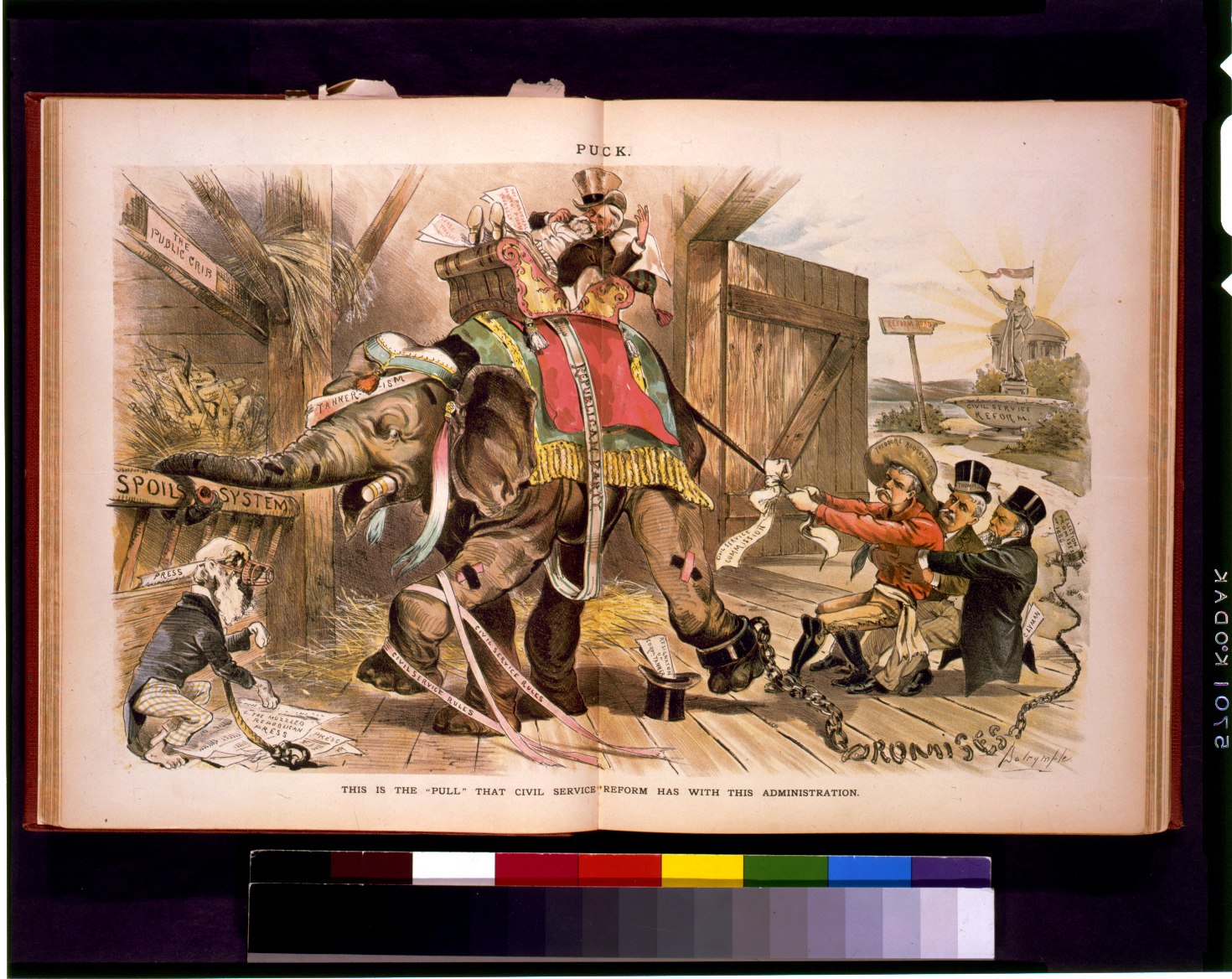
Under the old spoils system, the American government was remade every four years. Incoming presidents would purge more than ten thousand officials from the Post Office alone, sending postmasters and clerks packing to make room for political cronies. This churn lasted well into the twentieth century. As late as the Eisenhower administration, Republicans still had around seventy thousand federal jobs to hand out—nearly twenty times today’s number—yet they complained this was too few, even treating it as proof that patronage had been gutted.1
Although the government was built to reward allies, not cultivate expertise, an unremarkable press release from the Theodore Roosevelt administration showed that experts could sometimes carve out space within the patronage machine. It announced, in 1903, the appointment of a new head of the Steamboat Inspection Service, one Mr. George Uhler. He had been recommended by a committee of expert marine engineers, and the choice proved a sound one. Uhler went on to hold his post for nearly twenty years, serving under both Republicans and Democrats and even investigating the Titanic disaster. The article was only a single paragraph long, ending with the bland note: “Mr. Uhler knew nothing of the proposition to appoint him until the place was tendered to him. No politicians were consulted in the matter.”2
The tension between political influence and expertise still shapes debates today. Critics of the Trump administration’s civil service reforms, for instance, claim that these efforts will politicize the bureaucracy and thus inevitably hollow out its competence. Yet Uhler’s appointment suggests that political influence does not simply crowd out expertise; even during the height of the patronage era, genuine experts could rise to the top. Politicians took it for granted that the Steamboat Inspection Service should be run by an expert, even as they packed the Post Office with thousands of loyalists. The Service seems to have been built in a way that allowed experts to claim it.
Other agencies saw the same pattern. Across the federal government, islands of expertise flourished amid the sea of patronage. In the 1910s, a staff meeting of the Department of Agriculture’s bureau chiefs (the men just below the secretary who ran major agencies) could easily be mistaken for an academic conference. Nearly all of these political appointees were long-serving specialists in their fields, and two-thirds held graduate degrees. Even the department’s librarian had a master’s degree.3 These were not backwater posts: the department oversaw millions of dollars in aid and programs that politicians fought fiercely to control. Yet within these bureaus, appointees served for decades under both parties; even the most ruthless party bosses seemed to find some advantage in leaving these agencies to experts.
These agencies built lasting expertise under conditions that should have made it impossible. A PhD was then an exotic credential, awarded only a few hundred times a year nationwide.4 Bipartisan leadership was almost unthinkable, and “academic expertise” carried little weight with the nation’s dockworkers and prairie farmers. Still, the Progressives built agencies where those rare experts served seamlessly across administrations. Today, despite an abundance of credentialed experts, the government struggles to attract and keep the expertise that was broadly available to it a century ago. The institutionalization of expertise, improbable then and elusive now, was rooted in the way government agencies were structured.
At the turn of the twentieth century, agencies followed a distinct blueprint: they were organized by subject matter, not by abstract function. Each bureau focused on a single domain—such as soils, mines, or forests—and combined research, regulation, and grants under one roof. In the U.S. Department of Agriculture (USDA), the Bureau of Entomology, for example, studied insect-borne diseases, issued rules to contain them, and funded farmers to protect their crops, all as part of a single mission. This structure helped agencies recruit experts by offering broader, more meaningful work than corporations could, and it built a shared sense of mission rooted in a vocational community.
Today’s agencies look very different. After World War II, reformers dismantled the integrated subject matter bureaus and reorganized government along what they called “functional” lines. In this system, regulation is one bureau, research another, and grant administration still another; each bureau covers a wide range of subjects and is defined by its activity rather than its mission. It is the model we now take for granted. The Bureau of Entomology is gone, and USDA now houses all agricultural research in a single unit. New agencies were built this way from the outset: the Department of Housing and Urban Development, created in 1965, was designed as a grantmaking machine, never a vocational community.
The shift was a well-intentioned one and backed by a wide coalition of reformers, businessmen, and interest groups. Functional departments looked modern, rational, and efficient: they simplified charts, tightened chains of command, and promised to reduce duplication. But what seemed like sensible reform gradually hollowed out the structures that had made expertise durable. Once government agencies lost their vocational missions, they stopped drawing on networks of expertise and started looking like paper mills, less able to command political respect, and more vulnerable to capture and drift.
This history carries lessons for anyone hoping to rebuild government competence. First, organization is not a technical detail but the core of state capacity. The way agencies are structured determines who they attract, what work they privilege, and whether expertise can endure. Second, organization is never neutral. Every reorganization embodies political choices about whose voices count and which functions dominate, driven by coalitions bargaining for influence and control. Third, competence endures only when agencies are organized to draw upon professional networks and put that technical expertise to use for politicians. When functional reorganizations stripped agencies of that role, agencies lost talent and prestige. For government reformers today, the task is to design agencies that anchor vocational communities and make excellence indispensable once more.
Spoilsmen and Scientists
Progressive-era agencies were built to cultivate expertise in a world of grift and faction. They organized themselves around concrete subjects, which gave them a coherent mission and vocational networks to draw upon. Agencies asserted their professional identity through a set of strategies: adopting professional markers of vocation (e.g., uniforms, technical journals, ties to disciplinary societies), cultivating networks at the state and local level (agricultural offices, highway departments, health boards), and recruiting talent that was elite even by international standards. Their networks enabled them to prove their value to the public by carrying out work across the country.
These strategies gave the agencies deep roots in public life and a visibly proven record that commanded political respect. Historian Daniel Carpenter calls this phenomenon “bureaucratic autonomy,” defining it as an agency’s ability to pursue its agenda even in the face of opposition from politicians and organized interests.5 This definition, however, is better understood as a test of bureaucratic capacity than its source. Politicians often believed, as Carpenter himself notes, that these agencies possessed unique expertise and a proven track record of delivery. Agencies occasionally won fights with politicians, but most of the time there was no fight to begin with: they delivered value that politicians recognized. Their expertise was respected because they made it useful.
When these agencies were first established, they took no chances in signaling that they were founding vocations, not just opening offices. One striking marker was the widespread adoption of uniforms. The U.S. Public Health Service, organized as a paramilitary corps of doctors, did so as early as 1871. The Forest Service, too, quickly adopted a distinctive uniform. In 1917, the Coast and Geodetic Survey (precursor to today’s NOAA) followed suit. These uniforms placed civil servants in a lineage with the military, suggesting a vocation of national service. Internally, this reinforced a sense of mission; externally, it announced to Congress and the public that these were professions worthy of respect.
If uniforms marked agencies as experts, their ties throughout the country made their expertise useful. The Department of Agriculture illustrates this most clearly. The department, as Carpenter has shown, deliberately built networks that rooted it in every state and county: hiring from state agencies, partnering with land-grant universities, and distributing knowledge through its extension system. These ties created a constituency for the department and fostered a vocational culture that insulated it from patronage politics.6
Other agencies followed similar patterns. The U.S. Public Health Service, for instance, forged ties with hospitals and state health departments, giving it both national reach and a practical role in containing epidemics. These networks offered politicians something better than patronage: a presence in their districts, trusted local intermediaries, and a guarantee that their constituents were served.
This organizational structure also made the work appealing to genuine experts. A chemist or forester could spend a career ranging across the full breadth of a discipline, moving between laboratory research, regulatory practice, and service in the field. Such variety offered intellectual excitement and professional fulfillment that corporations rarely matched. It also reinforced balance within agencies: scientists could check the excesses of regulators, technical staff could counter grant writers vulnerable to interest group pressure, and the integrated mission in general centered vocational identity above any individual partial perspective.
The caliber of leadership underscored how appealing the organizations were. The Office of Public Roads, founded in 1905, was run by Logan Page, trained at France’s elite École des Ponts et Chaussées (“National School of Bridges and Roads”), who then built close ties with state highway departments. The Hygienic Laboratory, a precursor to the National Institutes of Health, was led by Joseph Kinyoun, who had studied under Robert Koch, the father of microbiology. The Bureau of Mines not only protected miners but won international prizes for its development of safer explosives.7 And of course, the distinguished George Uhler found himself with an unsolicited offer for the top job at the Steamboat Inspection Service. These were more than glittering résumés and prizes; they signaled that agencies were worth leaving in expert hands.
Above all, these agencies proved their worth by tackling projects no one else could. USDA’s extension system brought modern farming techniques to every corner of the country. The Bureau of Mines maintained research stations in mining country, such as Pittsburgh, and dispatched experts to help in mining disasters. The Public Health Service mobilized doctors during epidemics and pioneered disease control campaigns. By delivering visible, practical results, these agencies demonstrated to politicians that bureaucratic autonomy was an asset. Patronage might temporarily buy politicians allies, but only experts could rescue trapped miners, extinguish wildfires, or contain epidemics.
Expertise, then, was never just a matter of credentialism. It was a survival strategy. Progressive agencies built deep technical cores because, in the rough-and-tumble of American politics, only proven usefulness could protect them.
This system did not endure. Later in the twentieth century, these agencies were reorganized into “functional” departments, whereby all research was placed in one agency, all regulation in another, and grant programs in still another. The dismantling of this system was itself a political project, carried out by a coalition of three main groups with shared interests in reorganization. First, academic reformers supplied the ideas, presenting functional reorganization as more rational and drawing on experiments they had already pursued at the state level. Second, business leaders added prestige and resources, funding efforts to import the managerial practices of corporations. Finally, interest groups brought pressure, seeing subject matter bureaus as obstacles to capture and demanding structures that would make agencies more reliable allies. Long before Washington tried its hand at reorganization, this coalition had already sketched the blueprint of a new order.
Academic Reformers
The most significant reformers in this coalition were the academics who supplied the very idea of “functional reorganization.” They had cut their teeth in the chaotic world of state and local government, where they first reorganized fragmented offices into functional departments to create budgetary and administrative unity. What began as a least-worst fix for local disorder gradually hardened into a positive ideal, one they would later seek to apply to the federal government.
The principle of functional reorganization started as a practical response to the disarray of local government. By the late 1800s, state governments bore little resemblance to their original model of tight gubernatorial control. Reform movements had made many offices elective; one populist governor even thundered against the element of “monarchy” in his state, outraged that the state veterinarian was not chosen by popular vote.8 Later, single officials were displaced by independent boards and commissions. These changes had the effect of splintering authority. By the early 1900s, a governor might face more than a hundred separately elected or semi-independent officials, each with its own statutory duties and political base. In theory, they reported to him; in practice, he had little power to coordinate their work.
Reformers responded with two linked demands: a unified budget system and a unified executive branch. The logic was straightforward. To create a modern budget, scattered agencies had to be grouped into categories large enough to be legible. Functional grouping—placing all health and welfare agencies together, all education offices together, and so on—was simply the most obvious way to do it. This was bookkeeping, not theory. But once agencies were arrayed side by side in budget tables, the categories suggested themselves as a template for actually reorganizing the agencies into functional departments. The paper groupings hardened into real ones. A device for fiscal legibility became a template for administrative reform.
The budget theorist and government reformer A. E. Buck offered the clearest statement of this philosophy. Writing in the late 1920s, he looked back to Illinois’s pioneering reorganization of 1917, the first major success of the movement, and to New York’s more recent overhaul, which cut 180 agencies down to eighteen departments. From these and other cases, he distilled four principles of sound reorganization. First was “functional departmentalization of all administrative agencies,” the idea that all agencies should be grouped by activity into a dozen or so functional departments. Only after this came the other principles: clear lines of responsibility, direct gubernatorial appointment of officials, and the abolition of boards and commissions. That the principle of functional departmentalization led the list underscored its status as the foundation of the entire movement.9
The appeal of this thesis lay in both necessity and presentation. State governments had become so dysfunctional that almost any coherent scheme would have been an improvement. At the same time, reformers knew they faced an uphill political battle. To succeed, they needed a philosophy that looked rational, modern, and scientific. Functional reorganization hit the mark on both counts.
The approach soon migrated to the federal level. The same circle of reformers who had expanded the governor’s control in New York were brought to Washington by Franklin Roosevelt, who was, of course, New York governor before becoming president. They produced the Brownlow Report, which urged (among other things) the application of functional reorganization to the federal government. But unlike the chaotic state governments that functional reorganization was originally intended for, the federal government was already relatively well run. What had once been a pragmatic convenience at the state level was now promoted as doctrine, with little thought for how it might disrupt the established cultures of federal bureaus. Although, at this stage, it remained only theory, some observers immediately recognized the danger it posed to the autonomy of government agencies.
Gifford Pinchot, the legendary founder of the Forest Service, sounded the alarm. He was disturbed by the report’s proposal to strip forestry research from the Forest Service and move it into a separate research bureau, a measure that would split administration from science and thereby fracture the unified mission of forestry. His response is worth quoting at length: “In the opinion of the Brownlow Committee, the forest on private land is one thing, and ought to be handled in one department, while the precisely similar forest on public land is another thing, and ought to be handled in another department.” He added: “In other words, the Brownlow Report proposes to divide up the natural resources with which the federal government deals, not on the basis of use and protection, which is the only sensible basis, but on the artificial and constantly changing basis of ownership.”
Having described the scheme of functional reorganization, he then prophesied its consequences:
The proposals to transfer the national forests to the Conservation Department and leave forest research in the Agricultural Department, is bad administration of the very worst kind. If anything is proved in government work, it is that to separate administration and research means bad administration every time. As good an illustration as I know is the General Land Office in the Department of the Interior. Research it had none, and its mishandling of the public lands became a scandal, the stench of which is with us yet.10
Pinchot’s warning went beyond bureaucratic turf. He defended the very logic of the Progressive-era model: that research and administration had to remain intertwined within a unified mission if expertise was to thrive. His view carried weight not only because he had founded the Forest Service, but also because as governor of Pennsylvania he saw reorganization efforts up close from the executive’s side. From that vantage, he concluded that what worked as a stopgap for states did not fit the federal government and would only undermine its expertise.
In the fight for functional reorganization, academics supplied the ideas, but this episode shows how ideas can take on a life of their own. Their theories began as a necessity: first a way to organize budgets, then a makeshift framework for reorganizing government. They drew on what sounded scientific and happened to be close at hand, and they applied it to the federal government where it never truly fit. Yet their ideas aided the cause by giving reformers something they could genuinely believe in and present as scientific expertise—even though, like all beliefs, it was ultimately shaped by taste, chance, and circumstance.
Corporate Modernizers
A second group in the functional organization coalition was composed of businessmen who pushed to remodel government along corporate lines and financed the campaigns to bring it about. They lent their weight to nearly every reform fad of the early twentieth century—civil service, scientific management, and budget reform—and by midcentury were just as enthusiastic about functional reorganization.
This group believed that the methods of business were a universal language of efficiency that could, and should, be applied to government. At the very first annual meeting of the U.S. Chamber of Commerce in 1912, a signature resolution called for Congress to adopt a federal budget system.11 That effort would not succeed for nearly a decade, but businessmen quickly found traction at the local level. Across the country, chambers of commerce financed campaigns to professionalize the civil service, modernize budgeting, and reorganize government along functional lines. They often worked hand-in-hand with the same academic reformers described above, and these collaborations were a template for later federal reforms.
Their intellectual model came from the corporate world they knew best. In the early 1900s, firms were typically run ad hoc, with top executives directly managing overlapping departments. By the 1910s, DuPont had pioneered the multidivisional “M-form” which organized companies into product divisions overseen by a small group of functional vice presidents. The divisions were granted significant autonomy but in return were held strictly accountable for their profits and losses. Alfred Sloan popularized the model at General Motors in the 1920s, applying it to divisions for Chevrolet, Buick, and Cadillac.12 This structure, especially its coordinating layer of vice presidents, commanded enormous prestige among midcentury businessmen, who saw no reason why government should not follow suit.
Businessmen backed the functional reorganization movement to the hilt. They loaned executives for expert testimony, mobilized local business groups, and financed media campaigns. The resulting reorganizations bore their imprint: bureaus were grouped by activity and overseen by generalist assistant secretaries cast as the bureaucratic equivalents of corporate vice presidents. These officials managed broad functional areas and were charged with bringing the bureaus beneath them into line with that structure, akin to the shock troops of the reorganization.
The approach was, however, ill-fitted to the public sector. Corporations could measure divisions by profit and enter new product lines, but federal agencies operated under congressional mandates, with no equivalent performance metric. In the private sector, this combination of autonomy and accountability allowed corporations to move nimbly while delivering profits. Importing this extra layer of top management into cabinet departments, however, grafted a corporate hierarchy onto government without the conditions that made it effective in business.
This push to impose corporate management on the state was doctrinaire, but not cynical. Business leaders saw the reforms as the straightforward application of methods that had proven their worth at DuPont and GM. They took a genuine interest in how the state was run, and their involvement lent the broader reorganization movement an aura of neutral efficiency. With businessmen’s backing, the reforms were sold as plain common sense, even though they were deeply political.
Interest Groups
A third force behind reorganization came from the interest groups that federal agencies were meant to regulate or serve, who provided the pressure behind functional reorganization. Subject-oriented bureaus, with their expertise and sense of vocation, were designed to be resilient and hard to capture. That very independence, however, frustrated the recipients of federal largesse, who saw in functional reorganization a way to break down those defenses and create agencies easier to sway.
The farm lobby made the case most explicitly. In 1925, with agriculture in crisis, President Coolidge convened a national farm conference. Among its many recommendations was a demand to restructure USDA itself. The delegates argued that “service” (grants and technical assistance) should be separated from regulation. They declared:
In many of the Federal departments, both the service and regulatory functions dealing with the same commodity or industry are lodged in the same bureau. . . . In the discharge of the regulatory or police functions, officials of the departments are sometimes required to adopt the judicial attitude, sometimes a combined judicial and prosecutorial attitude, but more often an exclusively prosecutory. This attitude inevitably leads to a feeling of antagonism of interest between the department officials and the individual citizens or organizations which come into contact with the Federal agency. Such a feeling is the exact opposite of that which must maintain if the service functions of the agency, which depend upon a community of interest in advancing the welfare of the industry, are to be effectively discharged. . . . The Conference, therefore, recommends that in all branches of the Government, the service functions and the regulatory functions be separated as completely as possible in organization, personnel, and action [emphasis in original].”13
The purpose could hardly have been clearer. USDA’s technical bureaus had maintained a measure of independence by uniting research, service, and regulation under one roof. That mix gave officials a professional identity beyond farm advocacy, and it kept any one function from dominating. The farm lobby understood this and pressed for functional reorganization precisely to tilt USDA toward their control.
It is unsurprising that farmers wanted more aid. What is striking is the language they used. They pressed their case not in populist slogans but in the dry idiom of organizational charts: splitting “service” from “regulation” and redefining what belonged under which bureau. They showed that agency structure, however dry on paper, was a tool for power. By shifting boxes on an org chart, they could shift the balance of expertise and bureaucratic autonomy. Even a reform seemingly as tedious as bureaucratic restructuring was the product of a coalition, and every coalition requires pressure. Interest groups provided it. Functional reorganization, for all its administrative jargon, was a political issue through and through.
Postwar Reorganization
By the 1920s, reform coalitions were preaching functional reorganization. But did they really transform government? The Department of Agriculture, long the premier Progressive-era agency and the testbed for bureaucratic autonomy, offers the best case for comparison.
Around 1900, USDA had ten main bureaus, all reporting directly to the Secretary: the Weather Bureau, the Bureau of Plant Industry, the Bureau of Animal Industry, the Forest Service, the Bureau of Chemistry, the Bureau of Soils, the Bureau of Biological Survey, the Office of Public Roads, the Office of Experiment Stations, and the Bureau of Entomology. Each was organized around a concrete subject.
By 1960, the difference was stark. USDA now operated through four broad groupings that together contained fifteen substantive bureaus. The largest share of the department’s traditional functions had been pulled under the Assistant Secretary for Federal–State Relations, who oversaw the Agricultural Conservation Program Service, the Agricultural Research Service, the Farmer Cooperative Service, the Federal Extension Service, the Forest Service, and the Soil Conservation Service.
The other assistant secretaries (for Marketing and Foreign Agriculture, Agricultural Stabilization, and Agricultural Credit) oversaw bureaus devoted almost entirely to grants and aid, including commodity credit, marketing, and crop insurance. The mission of these functional bureaus was simply to give money away, each in a slightly different fashion.
The change was unmistakable. Apart from the Forest Service and the later Soil Conservation Service, the old missions had vanished. Instead, the department was defined by functions: research here, grants there, conservation somewhere else. USDA had gone from stewarding soils, plants, and animals to administering programs, most of them variations on distributing funds. The functional ideal had remade the government, and the coalition behind it had won.
The triumph of functional reorganization came in stages, gathering momentum through New Deal rhetoric and wartime necessity before the Hoover Commission of the late 1940s cemented it as administrative orthodoxy. The initial progress was made during the New Deal, during which the reformers enacted scattered experiments with functional organization. At USDA, administrators created a central planning division and a department-wide office to oversee science, despite the fact that bureaus like the Soil Conservation Service already carried out their own planning and research.14 Similar experiments appeared throughout the government, such as the President’s National Resources Planning Board. The impulse was the same: to separate planning from operations and research from administration, in the name of coordination and efficiency.
The Second World War accelerated the process. The sheer chaos of wartime administration made reorganization a practical necessity. Turnover was staggering. One contemporary noted that one division of the Social Security Board experienced a full 100 percent turnover during the war.15 Cabinet secretaries struggled to manage dozens of direct reports. The War Powers Act gave Roosevelt authority to reshape agencies temporarily, and he used it aggressively. Consolidation and concentration of authority became the order of the day.
USDA, for instance, took a decisive turn toward its later reorganization. In 1942, Roosevelt issued Executive Order 9069 at the request of his agriculture secretary, creating a near-modern structure along functional lines. Dozens of bureaus were grouped into four major umbrellas: the Agricultural Marketing Administration, the Bureau of Agricultural Economics, the Agricultural Conservation and Adjustment Administration, and the Agricultural Research Administration. Each of these was defined by function—marketing, economics, conservation, research—rather than by subject matter. The order gave the secretary discretion to phase in the changes, and on paper, they would expire with the war unless Congress made them permanent. In practice, however, the order had set a consolidation in motion that would be difficult to undo.
That disarray created a powerful demand for reform. Citizens and politicians alike concluded that something fundamental had to change. President Harry Truman responded by convening a bipartisan commission to rethink the executive branch, chaired by former president Herbert Hoover. Hoover’s stature as elder statesman and Republican affiliation lent credibility and gave the effort a bipartisan sheen.
The Hoover Commission formally consisted of twelve senior politicians but did most of its work through task forces that drilled into specific problems, from the mundane (paperwork management) to the monumental (organizing the new Department of Defense). Some of the Progressive-era reformers returned to the stage: A.E. Buck, for example, brought his canons of reorganization to bear on federal budgeting. The task forces also swarmed with businessmen, with industrialists and financiers testifying before these committees and often running them. On the whole, the commission’s membership reflected the broader postwar consensus that government should be remade according to prevailing conceptions of modern management.
USDA came in for especially close scrutiny. The agriculture task force drew heavily on agricultural researchers, supplemented by lobbyists and industry figures, nearly all of whom were sympathetic to reorganization. Their report put functional reorganization front and center, in precisely those terms: “To meet the present and prospective responsibilities of the Department of Agriculture, the committee proposes to group all activities in the Secretary’s Office and in six major functional administrations: Research, Extension, Agricultural Resources Conservation, Commodity Adjustment, Regulatory, and Agricultural Credit.”
The report stated that, under the proposed scheme, “Only the Administrators of the six Administrations [and three minor officials] will report directly to the Secretary. Assignment of responsibilities of present organizations in the Department to appropriate bureaus in the six functional Administrations should eliminate duplication and overlapping and the Secretary will have for the first time the framework for an integrated organization.”16
Functional consolidation was now held up as a model. By limiting the secretary’s direct reports to six “functional administrators,” USDA would no longer resemble a cluster of semi-independent bureaus but instead a modern corporation, with something like vice presidents overseeing broad lines of work. The design seemed to promise efficiency and clarity. The Hoover Commission’s final report on agriculture gave this doctrine a national platform. Its very first recommendation carried the title “Recommendation No. 1,” and it declared: “In general, we recommend an extension of the functional organization of the department and a better grouping of activities related to the same major purpose. The [goal] is to secure more concentration in the responsibility of direction, elimination of overlap, conflict and waste, and further, to make possible the realization of broad policies in the Department.”17
What was in fact a radical proposal—to dismantle subject matter bureaus that had anchored vocational expertise for decades—was reframed as common sense, the obvious way to run a modern organization. The coalition’s greatest triumph was rhetorical: functional reorganization ceased to look like one of many reform options and became the assumed baseline. The question was no longer whether to adopt it but only how quickly and how thoroughly to apply it. From there on, it was only a matter of execution, with scarcely a pause to ask what might be lost along the way.
Business leaders helped ensure that this rhetorical victory translated into political momentum. A business-led Citizens Committee for the Hoover Commission mounted a nationwide campaign to build support for the Commission’s recommendations. It financed publicity, mobilized local business groups, and framed functional reorganization as a patriotic, nonpartisan imperative. The committee also tracked the adoption of each recommendation and pressed for their swift enactment.
Their efforts paid off when the agricultural recommendations were soon embodied in executive orders. The Reorganization Act of 1949 gave the president broad authority to reshape departments. In 1953, Eisenhower seized the opportunity and issued Reorganization Plan No. 2, which Congress accepted with little resistance. On paper, the plan was nondescript: it merely granted the secretary of agriculture sweeping reorganization powers and created three assistant secretaries. In practice, it was the enabling step that let Secretary Ezra Taft Benson lock in the functional blueprint reformers had long supported.
Formally, the plan could have been used to reorganize USDA in almost any fashion. In practice, its purpose was clear: to lock in the functional model first tested under wartime emergency orders. Benson followed through. The subject matter bureaus that had anchored Progressive-era expertise were folded into the functional blocks that defined USDA by 1960. Marketing, research, conservation, and credit each became distinct domains, overseen by assistant secretaries who resembled corporate vice presidents more than scientific specialists.
The movement that had begun decades earlier now reached its decisive triumph. USDA had been the most contested arena and the broadest target of change. With functional reorganization established as unquestioned orthodoxy, further victories soon followed.
By the 1960s, the Navy—a proud holdout of the old bureau system—was reorganized into functional commands, ending a century-old structure. The venerable Bureau of Ships and Bureau of Yards and Docks disappeared into Naval Air Systems Command and Naval Sea Systems Command. Around the same time, the U.S. Public Health Service was gutted by a series of reorganizations in the late 1960s and early 1970s. Authority shifted away from uniformed medical officers and toward grant administrators at the National Institutes of Health, dismantling a once cohesive service in favor of a loose federation of research funding streams.
It became the default logic of government. New agencies created in the midcentury era took functional organization as their starting point. The Occupational Safety and Health Administration, for example, was founded with scant in-house engineering capacity, while the Department of Housing and Urban Development and the Department of Education were designed from the outset as grantmaking machines. In these cases, there was no gradual erosion of expertise, for they had lacked it from the beginning. The loss of professional identity was visible even in the simplest markers of vocation: in stark contrast to the Progressive era, after World War II, no new civilian agency (outside of law enforcement) has adopted a uniform.
Still, it would be too simple to ascribe the decline of state capacity to reorganization alone, given the many other transformations that reshaped American society in the decades since. The timing is, however, at least suggestive. In agriculture, this era marked the rapid ascent of the farm lobby as the dominant voice inside USDA. Scholars of agricultural policy note that the turning point toward interest group capture coincided almost exactly with the wartime functional reorganization later entrenched under Benson.18
Ultimately, the central fact was that both supporters and opponents described the likely consequences of functional reorganization in strikingly similar terms. Businessmen believed it would yield generalist managers on the corporate model. Farm groups expected agencies to become pliant to their demands. Pinchot warned that it would shatter vocational expertise. All agreed on the broad outlines; they differed only in whether they welcomed or feared the outcome. And the outcome was exactly what they foresaw: functional reorganization streamlined charts and clarified reporting lines, but it also weakened vocational expertise and made agencies more vulnerable to capture.
What started as a dream of reformers, then took root as a wartime expedient, and which was codified by the Hoover Commission, eventually hardened into the permanent architecture of government. Subject matter bureaus gave way to functional divisions, and with them went much of the autonomy and technical culture that had once anchored American state capacity.
Rebuilding Bureaucratic Autonomy
Experts have had no easy go of it lately. The Trump administration’s attacks on the federal bureaucracy and the populist revolt against credentialed authority are often described as the “death of expertise.” Yet that death was a long time coming. Long before today’s populists arrived, expertise had been stripped of its foundations and reorganized out of existence.
The core mistake was a shift in what we thought expertise was. The Progressive reformers built vocations that were tied to missions, visible to the public, and legible to politicians. Their successors redefined expertise as a credential: the knowledge of process rather than mastery of a craft. To businessmen and academic reformers alike, competence meant general managerial skill, not professional vocation. As this view took hold within the bureaucracy, “expertise” came to mean knowing the procedures rather than knowing the work. We have traded the civil engineer and the entomologist for the program analyst, the management consultant, and the diversity officer—experts who know how to manage the process but not how to do the work.
This redefinition of expertise hollowed out our idea of representation. We now equate representation with participation and diversity, as if the state were legitimate only when citizens can see themselves in its officials. The Progressives, by contrast, recruited from the country’s varied vocations and made that work visible to the nation. Expertise was representative not because it resembled the public but because it served the public, visibly and competently.
If we are to treat expertise as a vocation again, we must take its machinery seriously: the organization charts and hiring pipelines that make skills usable. The Progressives did this. Their institutions were built to make expertise endure, by recruiting promising candidates from vocational schools and professional societies, dressing them in uniform, and sending them to work alongside state engineers, agricultural agents, and university researchers. By contrast, we no longer ask such questions or build the institutions that would make the answers matter. We profess to want expertise but would have nowhere to put it if we found it.
Our government agencies suffer from numerous failures yet we refuse to rebuild the institutions that fail us. Consider one of the most consequential: the Navy cannot build ships. In 1940, faced with the same problem, Congress did the obvious: it created a Bureau of Ships, put engineers in charge, and got ships built. That bureau is gone, and we treat its return as unthinkable. Yet the remedy remains the same. If we want ships, we should once again have a Bureau of Ships to build them. The Progressives built boldly, and their successors dismantled with equal zeal; we alone act as if mistakes are irreversible.
Repairing our institutions will ultimately require returning to the vocational conception of expertise. Instead of asking how to make politicians defer to experts, the real task is, as the Progressives understood, to make expertise worth deferring to. They built vocations that turned policy into tangible results, so that both citizens and politicians could see results and take pride in them. We have built institutions that valorize process in place of vocation, producing a bureaucracy that neither embodies skill nor commands respect. What matters now is not saving “expertise” in the abstract but rebuilding the institutions where it can serve visibly and credibly—perhaps once again in uniform.
This article originally appeared in American Affairs Volume IX, Number 4 (Winter 2025): 90–107.
Notes
1 Paul van Riper, History of the United State Civil Service (Evanston: Row, Peterson, 1958), 491. For the post office: there were tens of thousands of politically appointed positions, and over ten thousand officials were routinely purged.
2 “Successor to Gen. Dumont; George Uhler of Philadelphia to Be Chief of the Steamboat Inspection Service,” New York Times, March 13, 1903.
3 Based on USDA data and author calculations. For data sources, see: U.S. Department of Agriculture, Annual Reports of the Department of Agriculture for the Fiscal Year Ended June 30, 1917 (Washington D.C.: U.S. Government Printing Office, 1918).
4 U.S. Department of Education, National Center for Education Statistics, “Table 318.10: Degrees Conferred by Degree-Granting Postsecondary Institutions, by Level of Degree and Sex of Student: Selected Years, 1869–70 through 2023–24,” Digest of Education Statistics, accessed October 2025.
5 Daniel Carpenter, The Forging of Bureaucratic Autonomy: Reputations, Networks, and Policy Innovation in Executive Agencies, 1862–1928 (Princeton: Princeton University Press, 2002), 14.
6 See his extensive discussion in: Carpenter, The Forging of Bureaucratic Autonomy, 179–326.
7 Robert Tuchman and Ruth Brinkley, A History of the Bureau of Mines Pittsburgh Research Center (Washington D.C.: U.S. Bureau of Mines, 1990), 9.
8 Charles Beard, “The Ballot’s Burden,” Political Science Quarterly 24, no. 4 (1909): 9.
9 A. E. Buck, “Administrative Consolidation in State Governments,” National Municipal Review 8, no. 9 (1919); see page 5 for his principles of reform, and pages 34–41 for his discussion of New York.
10 J. H. Stoeckeler, “Pinchot Says Reorganization Plan Wrecks Conservation Policy,” Forestry News Digest, June 1937.
11 Leonard White, Introduction to the Study of Public Administration (New York: Macmillan, 1926), 11.
12 The famous discussion of this is: Alfred D. Chandler Jr., Strategy and Structure: Chapters in the History of the Industrial Enterprise (1962; reissued, Wallingford, UK: Sothis, 2023), 52–163.
13 Quoted in: J. A. Burruss et al., Report of the Commission to Study the Condition of the Farmers of Virginia (Richmond, Va.: Division of Purchase and Printing, 1930), 99–100. Emphasis in original.
14 For planning, see: Richard Kirkendall, “Howard Tolley and Agricultural Planning in the 1930’s,” Agricultural History 39, no. 1 (1965). For centralization of science, see: C.A. Magoon et al., The Central Project Office in the Agricultural Research Administration (Washington D.C.: Agricultural Research Administration, 1950), 2–4.
15 Oscar M. Powell, “Adjusting Administration to War Time,” Social Security Bulletin 6, no. 11 (November 1943): 1.
16 Hoover Commission, Agricultural Functions and Organization in the United States: A Report with Recommendations (Washington D.C.: U.S. Government Printing Office, 1949), xiv.
17 Hoover Commission, The Hoover Commission Report on Organization of the Executive Branch of the Government (Washington D.C.: U.S. Government Printing Office, 1949), 238.
18 Gregory Hooks, “From an Autonomous to a Captured State Agency: The Decline of the New Deal in Agriculture,” American Sociological Review 55, no. 1 (1990): 29–43.