
An Iron Lady for Our Times: The March of Conservatism in Meloni’s Italy
What does it mean to be on the right these days? “If you want to truly understand the worldwide conservative revolution, then read this book,” Donald Trump Jr. writes in the foreword to I Am Giorgia: My Roots, My Principles (2025), the newly published English translation of Giorgia Meloni’s spirited telling of her meteoric rise to the top of Italian politics. In 2022, Meloni, at the age of forty-five, was sworn in as prime minister of Italy, to the cheers of kindred spirits in America.
As an uncompromising voice against the “poisonous ideologies” of the Left, and as an unapologetic champion of her party’s slogan of “God, Country, Family,” Meloni was rewarded for being “brave enough to tell the truth” to her countrymen, Tucker Carlson said in a segment on his Fox News show as she prepared to assume office. He played a clip of Meloni, speaking in English, earlier in the year, at the CPAC gathering of U.S. conservatives. “Everything we stand for is under attack,” she told the assemblage. “The only way of being rebels is to be conservative.”
It was quite a performance, and it continues to this day. Meloni’s gambit is to fashion herself not simply as the leader of Italy, a nation of marginal importance in global affairs, but as a global carrier of the torch of right-wing populism—and, to mix the metaphor, as a European bridge to the MAGA movement and to Donald Trump personally. She has his attention: “Meloni is a fantastic leader,” America’s forty-fifth and forty-seventh president gushes in a blurb displayed on the front cover of I Am Giorgia.
There’s an intriguing precedent to Meloni’s stratagem to hitch her star to an American president along with a transatlantic ideological movement. Back in the 1980s, Margaret Thatcher, as prime minister of Great Britain, emerged as a global champion of the free market, anti-government principles that Americans of that time knew as Reaganism. Indeed, she may have been a purer, stouter exponent of these principles than President Ronald Reagan himself. Now, some forty years later, conservatism has reformulated itself. And once again, a feisty woman from Europe, years younger than the man ensconced in the White House, has emerged as the vibrant voice of a resurgent Right.
Donald Trump Jr. is correct. It pays to try to understand Meloni to gain insight into the conservative populist movement that is reshaping politics across the West. The task is to examine her roots and self-styled identity; to evaluate her principles and vision; to see how she is applying her convictions to the pesky job of governing Italy and to her bid for the role of interlocutor with President Trump; and finally, to inquire into where Meloni and “Meloni-ism” may be headed.
Roots and Identity
Meloni is, in the first instance, a creature of Rome, where she was born in 1977. She grew up in the working-class enclave of Garbatella. By her account, her mother, trapped in a failing marriage, decided against an abortion just as she was about to undergo tests for the procedure. Her father cut out on the family anyway, and Giorgia and her sister were brought up by her mother and maternal grandparents in cramped circumstances.
I wandered around Garbatella back in the spring, and to my untrained eye, it was hard to tell whether the neighborhood, with numerous buildings in disrepair, was on its way up or on its way down. On its way up, I was informed by a lifelong native, the operator of a café. Back when Giorgia was a child, he told me, Garbatella was rife with crime and drugs. Now, it is viewed by artists and professional types as a trendy place to live.
At the age of fifteen, Meloni, who was bullied as a child—“fatso,” other children branded her—found her true family, her brothers and sisters, in a tightly-knit circle of political activists. She joined the Fare Fronte—Youth Front chapter in Garbatella. The group’s name meant “to stick together,” she relates in I Am Giorgia. Activism was “an all-consuming passion” which “seeped into every part of life—at school, in the afternoons, and on weekends.”
There was no time for “fashion, nightclubs, or shopping. . . . If you went out at night, it was with fellow activists, and inevitably, the conversations circled back to politics.” Her chapter was self-funded, and she took small jobs as a babysitter and as a wardrobe attendant to support this lifestyle. Her group took on tasks like cleaning up a crime-ridden park plagued by vagrancy. She did not attend university, the first prime minister of Italy not to have done so. She comes by her anti-elite credentials honestly, it might be said. Unlike the Oxford chemistry graduate Thatcher, the celebrant of the risk-taking entrepreneur, who said “there is no such thing as society,” Meloni studs the telling of her life story with testaments to the virtues of collective action for noble causes.
Although she does not touch on this point in I Am Giorgia, she was joining a political and social movement launched in the ashes of the Second World War by followers of Benito Mussolini, the Fascist dictator executed by Italian partisans in 1945. When Meloni was nineteen, she told an interviewer that “Mussolini was a good politician. Everything he did, he did for the good of the country, unlike the politicians of the last 50 years.” The enemy, in this framing, was the Left—that was the essential, no-quarter struggle of the times. This history is now largely forgotten, but the Italian Communist Party, a spearhead of militant resistance to Mussolini’s rule, was a weighty force in postwar Italy and the single largest communist party in the West. Even in the late 1980s, the party won second place in national elections for Italy’s lower house of parliament, the Chamber of Deputies, claiming nearly 30 percent of the popular vote.
In 2006, at age twenty-nine, Meloni was elected to parliament; two years later, she was the government’s minister of youth, the youngest ever minister in the history of the Italian Republic. And in 2012, she joined with cohorts in the founding of Fratelli d’Italia (Brothers of Italy), the party for which she is now the standard bearer. Brothers of Italy rules the government in Rome in a coalition with the populist, right-wing Lega and the center-right Forza Italia, the party founded and headed by the late Silvio Berlusconi.
It was Berlusconi who once described Meloni as “patronizing, overbearing, arrogant” and “offensive”—in other words, as an upstart woman with no place in the masculine realm of politics. The putdown was a gift to Meloni. Here was material to cement her branding as a gatecrashing politician and as a hard-charging woman with the strength of character to go up against the old boys’ club.
Yes, she proclaimed, she was a woman who, unmarried, bore a child and was raising that daughter on her own. As she well knew, she was hardly alone: the single-parent household, headed by a woman, was an increasingly common feature of Italian society. In the 2019 speech that helped catapult her to the premiership, at the Piazza San Giovanni in Rome, she followed “I am Giorgia” with the words, “I am a woman, a mother.” An entire chapter of I Am Giorgia is on “The Stronger Sex.” The book closes with life advice to her daughter, Ginevra: “don’t be afraid to swim against the tide. It will be hard, of course, but it will also make you stronger, more resilient, more determined.”
Identity politics, it turns out, can be fruitful ground for a canny right‑wing populist. This is an important point to be made about Meloni’s climb, one that is not lost on likeminded members of her generation in capitals across Europe. Mihail Neamtu, one year younger than Meloni, is an elected member of the Romanian Parliament, a cultural conservative with a doctorate in theology from King’s College London. When I asked him to share his thoughts, any thoughts, on Meloni, he responded in a lengthy email:
As the first woman to lead Italy, and to do so from the traditionally masculine bastion of the nationalist right, she embodies a paradox that liberal feminists often find difficult to assimilate. Her appeal does not lie in rejecting femininity, but in embracing it as a moral force. . . . Where modernity reduces identity to performative fragments, Meloni proposes something older: a vision of womanhood that is not a repudiation of tradition, but its vindication. This too is a form of populism, but of a different hue. It is not merely anti-elitist, but anti-fragmentary. It seeks to reweave the tapestry of collective meaning, not through abstract rights, but through concrete responsibilities—first to one’s family, then to one’s nation, and finally, to the transcendent order that sustains both.
That’s a mouthful, but it may be the case that Meloni got to where she is, in no small part, because of her ingenious framing of her womanhood. In her own time, Thatcher exuded feminine power, with her handbags, brooches, and coifed hair being iconic aspects of her matronly image. “In politics, if you want anything said ask a man, if you want anything done ask a woman,” she said in a 1965 speech, early in her time in parliament.
Meloni, though, hits this theme harder, making the case that her identity as woman and mother, and the moral obligations that come with it, are core aspects of her conservative worldview in what is, as Neamtu notes, an inversion of progressive feminist tropes. Unlike Thatcher’s emphasis on economic freedoms, and unlike modern feminism’s insistence on rights and recognition, Meloni grounds her conservatism in a deeper sense of duty.
Principles and Vision
In the good society, philosophers have long debated, does order come before justice? Or must there be justice first, to make order possible? Meloni’s unequivocal answer is order as the first priority, a lesson she may have imbibed from her youthful days as a tidier of Garbatella’s parks. And that’s the classic conservative answer as well.
From unkempt city parks to chaotic national borders, Meloni was a natural when it came to seizing on the European migrant crisis as political catalyst. This was a matter of high principle for her: that the nation must mean something, not in the abstract but in literal and physical form. It was helpful for her to have a foil.
In 2015, in the midst of vast numbers of new arrivals seeking refuge on Europe’s shores, including hundreds of thousands of Syrians seeking to escape their country’s civil war, German Chancellor Angela Merkel issued her famous declaration of open doors: “Wir schaffen das” (“We can manage this”). Not so, Meloni shot back. The danger of “ethnic substitution” as migrants streamed through Europe’s unlatched gates became a staple of her rhetoric. Three years later, a weakened Merkel announced she was stepping down as the leader of her party and would not run for a new term as chancellor. Meloni then intensified her appeals to, in her term, “Italian pride.” What was needed, she said in a message to Brussels after she became prime minister, was “a total paradigm shift” to “focus on the defense of the external borders” of the European Union. There, too, was a handy foil for Meloni—Brussels, ground zero for much-derided Eurocrats.
But a surprise, at least for me, as I embarked on this essay, is that Meloni, in the presentation of her ideas, does not devote all that much space to the nation. Perhaps she thinks “Italian pride” requires no great explanation. Anyway, in her speeches, in her writings, she is most impassioned, most insistent, in invocations of “the West.” That was also a favorite construct for Thatcher, who dubbed herself, after a taunt from the Soviet press which she cleverly appropriated, the “Iron Lady of the Western World.” It is on this broad ground that Meloni’s attributes as a culture warrior are most pronounced. She is a relentless expounder on the West, as in a 2024 speech to the Atlantic Council:
Well, for me, the West is more than a physical place. By the word West we do not simply define countries by specific geographical location, but as a civilization built over the centuries with the genius and sacrifices of many. The West is a system of values in which the person is central, men and women are equal and free, and therefore the systems are democratic, life is sacred, the state is secular, and based on the rule of law.
She went on to flag a present danger for the West: “oikophobia.” From the Greek—Meloni credited the English philosopher Roger Scruton for bringing this word to the fore—oikophobia is the fear of or aversion to one’s own home. This terrible form of dread, she told the Atlantic Council, with Elon Musk among the guests on this occasion, is defined by a “mounting contempt, which leads us to want to violently erase the symbols of our civilization, in the U.S. as in Europe.”
Ah yes, “symbols.” A cherished one for Meloni is the crucifix. “That symbol belongs in places of education, no matter what someone may or may not believe,” she says in I Am Giorgia, because “the crucifix contains the values on which our civilization is built. It is not about imposing a religious creed, but of teaching who we are.” The crucifix is a symbol that also suggests a boundary. It is characteristic of Meloni to seize on boundaries as intellectual and political tropes. She insists on such a borderline between Christendom and Islamic lands. “To be a good Christian is to ‘simply’ love your neighbor,” she writes—it has to be said, simplistically—in I Am Giorgia, but she has a caveat:
Islam, on the other hand, presents a sacred text that is itself divine and prescriptive, instructing believers in precise detail on what they must do. For this reason, while Christianity allows for the separation of religion and state . . . this separation is inconceivable for Islam. . . . These are not merely religious differences; they are two very different philosophical frameworks. Personally, I chose the Greek, Roman and Christian framework. It is the foundation I want to see prevail in Italy and Europe.
She closes this disquisition on a customary note of defensiveness, always the nod to her base: “Does this”—that is, her avowal of civilizational preference—“make me an ignorant xenophobe or a bigot?” As I read that artfully suspended rhetorical sentence, I could well imagine a chorus of “no’s” resounding, all the way from MAGA strongholds in America to the many parts of Europe in which conservative populism is thriving.
Principles into Practice: Governing Italy
She has, though, a day job, and that is to govern Italy. And there the question, as ever, begs: Is Italy governable, from the center? It’s a question that has been asked for centuries. And the answer tends to land on the side of no. In his judicious 2011 tome, The Pursuit of Italy, David Gilmour starts with a chapter on “Diverse Italies,” his made-up plural noun. “Fractured Geography,” he writes, poses that most immovable of barriers to a unified nation, or a would-be conqueror: “Italy,” Napoleon complained, “is too long.” Metternich memorably called Italy “une expression geographique,” a mere geographical expression.
That was harsh, but to this day, there’s not all that much that ties, say, Lombardy and Venetia, northern lands once ruled by the Austrian empire, with Sicily, the southern island possession presided over, at various times over the millennia, by Greeks, Arabs, Normans, and the Bourbons (and, very briefly, by the Austrian Habsburgs as well). Meloni’s hopeful nationalism collides against regionalism as a proud feature of Italian life.
Yet while regionalism enlivens Italian culture, it also nourishes perennial political instability. Since 1945, Italy has had nearly seventy changes in government. Coalitions are formed, coalitions crumble, life goes on. By this standard, Meloni’s most impressive achievement may be that her government still stands as she approaches, in October, three full years in office. In my own casual encounters with Italians, testimonials are readily offered. A smartly dressed young woman in Umbria, sipping a glass of wine at an upscale café, said she found Trump “scary” but used an Italian idiom—essere in gamba—to express her satisfaction with Meloni. The literal translation is “to be in leg”; the meaning is to be smart or competent. “Let’s say that a government elected by the people is stronger than a technical government elected by the [EU],” I was told by a middle-aged man in Garbatella. Meloni could not put it better herself.
Critics grumble about her creation of what they derisively call “Tele-Meloni,” her packing of RAI, Italy’s BBC-like national public television broadcasting company, with her chosen media manipulators, all to cast the most favorable image of her policies and to block out dissenting perspectives. The reality, anti-Meloni Italians told me, is that she is mostly sizzle, more talk than action. Trump, one such person said, accomplished more in the first hundred days of his second presidential term than Meloni has been able to do in her two years going on three.
There is some credence to this accusation. Consider her road-to-power issue of illegal migration. A year into her premiership, Meloni sparked headlines across Europe with a call for “a European mission, including a naval one if necessary,” to keep vessels packed with migrants from reaching the tiny Italian island of Lampedusa. Her Interior Minister demanded a blocco navale, or a naval blockade. Really? A naval blockade, in international law, is considered an act of war. Was the call here for Italy or the EU to go to war with, say, Tunisia, whose Mediterranean coastline was an embarkation point for the migrants? No such blockade materialized. In the meantime, a much-advertised Meloni plan to resettle migrants to Italy in detention camps in Albania, across the Adriatic, is bogged down in the courts. Conservative voices in the Italian press complain, just as such voices do in American media, that elite jurists are frustrating the popular will.
Still, Meloni can claim accomplishments on the culture war front. Last year, Italy enacted a law pushed by her Brothers of Italy to make it a criminal offense, punishable by up to two years in prison, for Italians to have children by means of surrogacy arrangements in foreign countries, even countries like the United States, in which surrogacy was legal. Protestors chanted “We are families, not crimes,” as the Senate debated the bill. But Meloni triumphantly called the statute “a common-sense rule against the commodification of the female body and children.” There must have been smiles at the Vatican, where Pope Francis had called for a global ban on the “deplorable” practice of surrogacy, although not specifically for the criminalization of the practice.
Her coalition won passage, too, of legislation to give Italy’s regions more sway over the tax revenues they collected from their residents: to permit the regions to keep more of such revenues, instead of passively sending the monies along to Rome, and to allow them to decide for themselves how to spend the funds on basic public functions like health and education. It may have seemed paradoxical for Meloni to back an initiative that, on the face of things, seemed to take power away from Rome. But here she displayed the pragmatism that has kept her coalition in power. The regional autonomy bill was a long-sought prize for coalition partner Lega, headed by Matteo Salvini. Lega’s base is in Italy’s relatively prosperous north (where the party once advocated for seceding and forming an independent state called “Padania”); many northern taxpayers chafe against what they see as subsidizing the comparatively poor south.
Such achievements, in any case, pale beside what Meloni, in an interesting choice of phrase, calls “the mother of all reforms.” That would be her plan to restructure the Italian Republic by bestowing upon the nation the gift of a prime minister directly elected by the people, to a five-year term of office. What is more, the idea is to give the coalition headed by this people’s prime minister a safety cushion of “bonus” seats to guarantee a coalition majority in parliament. As things now are, the prime minister is appointed by the President of the Republic, subject to consent in both houses of parliament. It is this rickety arrangement that has made for the crippling fragility of the Republic, Meloni argues.
Critics, not surprisingly, view the primierato reform as a naked power grab on her part, part of a long-simmering vendetta by the forces she represents to jettison the anti-Fascist constitution that Italy enshrined after Mussolini’s demise to guard against the renewal of dictatorial rule. Goodbye to parliament as a protector of democracy, the critics say. Whether the Italian people as a whole have the appetite for this far-reaching change remains to be seen. So far, the Senate in Rome has approved Meloni’s plan, but the Chamber of Deputies has not acted on it. Without two-thirds approval in each chamber—and the Senate failed to reach that threshold—the plan cannot go into effect unless Italian voters give their consent in a national referendum. In the meantime, Meloni bobs along as all Italian prime ministers do, at the mercy of political currents that, as Italians are fond of saying, can shift at any moment, at times for reasons that no one, even in hindsight, can truly comprehend.
A Transatlantic Bridge
To try to be a meaningful bridge from Europe to America, that’s a daunting project for even the most agile of European leaders. Understandably, most do not even try. The United States, after all, was born in revolt from Europe—from the “Old World.” The great exception proves the rule. Winston Churchill was a fellow member of the Anglosphere who came to power at a time of crisis, the Second World War, that begged for close cooperation between Europe and America. As for Thatcher, she was never, as Churchill was for Americans, an adopted folk hero. She was a link to the Reagan Revolution and its cadres.
In her Thatcher-patterned play for ideological sympathizers across the pond, Meloni’s target is what she vaguely calls, in I Am Giorgia, “a deeper America,” meaning the America “represented by the seventy-five million voters who supported Donald Trump in November 2020, who simply cannot be dismissed as a group of fanatics wearing horns and bison pelts.” (In the book, Meloni is writing post–January 6, 2021, but before Trump’s political comeback in 2024.) “Many of their concerns are ours as well,” she continues. “With this deeper America, we European conservatives will continue to engage in an increasingly stable and fruitful way.” How so? She trains her eye to a shared threat, thousands of miles from both the North American and European continents. “This alliance will primarily aim to curb the rise of China and its expansionism. Beijing no longer seems to have any limits.”
This is easy enough to say. In America, the declared task of curbing China is staple fare for both parties and virtually all ideological factions. The going gets tough on Russia and, in particular, the war in Ukraine. On this front, Meloni is staking out positions that expose fissures in the bridge she is seeking to construct.
Vladimir Putin launched Russia’s all-out invasion of Ukraine eight months before Meloni became prime minister. To the disappointment and, more than that, the outright anger, of some leading MAGA voices in America, she did not, on taking power, tilt toward Putin and Russia in the approved example of Hungary’s Viktor Orbán. To the contrary. Consistent with her view that “the West” must stand not only for its cultural affinities but also for its shared security responsibilities, she took the line that Ukraine had to be resolutely defended from naked Russian aggression.
In March of this year, in remarks to the press on the sidelines of a meeting of EU leaders in Brussels, she made what the Kyiv Post lauded as a “Game-Changing Proposal.” She suggested that, even without making Ukraine formally a member of NATO, the alliance could extend to Ukraine “the same protection that NATO countries have,” in other words, the crucial Article 5 guarantee by which an attack on any one NATO member is an attack on all. “I think this would be a stable, lasting, and effective security guarantee,” she said.
A week after she made this proposal, I happened to be speaking with Steve Bannon, Donald Trump’s former chief strategist and still influential adviser. Bannon has devoted years to the courtship of promising European figures like Meloni as part of his project to build a global conservative populist movement. He was livid over her Article 5 comments, and this was not surprising, since he vehemently believes and incessantly tells his followers that Ukraine is a security problem for Europe, not for America. “I went out of my way to make her an international member of our movement,” he told me—and in Italy to “push her” over the populist alternative, Matteo Salvini. “Let’s say she was the future. She is one of the most unique political talents I’ve ever seen.” But this effort “to split the baby” over security guarantees to Ukraine was an “insult” to the support that she had received from her friends on the right, Bannon said. A month later, he was still fuming. Meloni? “Tough, cunning, unprincipled, determined, ambitious. Perfect attributes for Italian politics,” he bitterly said.
Nevertheless, Meloni is hewing to her hard line on Ukraine, and on Putin as well. Some figures in the MAGA movement view Russia’s ruler, who has revived Orthodox Christian traditional values as a pillar of his rule, as an ally in the global effort to roll back “woke” ideology and policies. But Meloni rejects this embrace of the Russian strongman.
In June, in the wake of Israel’s military strikes on Iran’s nuclear facilities, Meloni spurned a suggestion that Putin, with his personal ties to Iranian and Israeli leaders, might play a role as a go-between to help end the conflict. “Putin, leader of a country waging war against another country, cannot be entrusted with the role of mediator,” she sternly told the press at the G7 summit in Canada. Here, too, in the morally inflected reprimand, an echo of Iron Lady Thatcher.
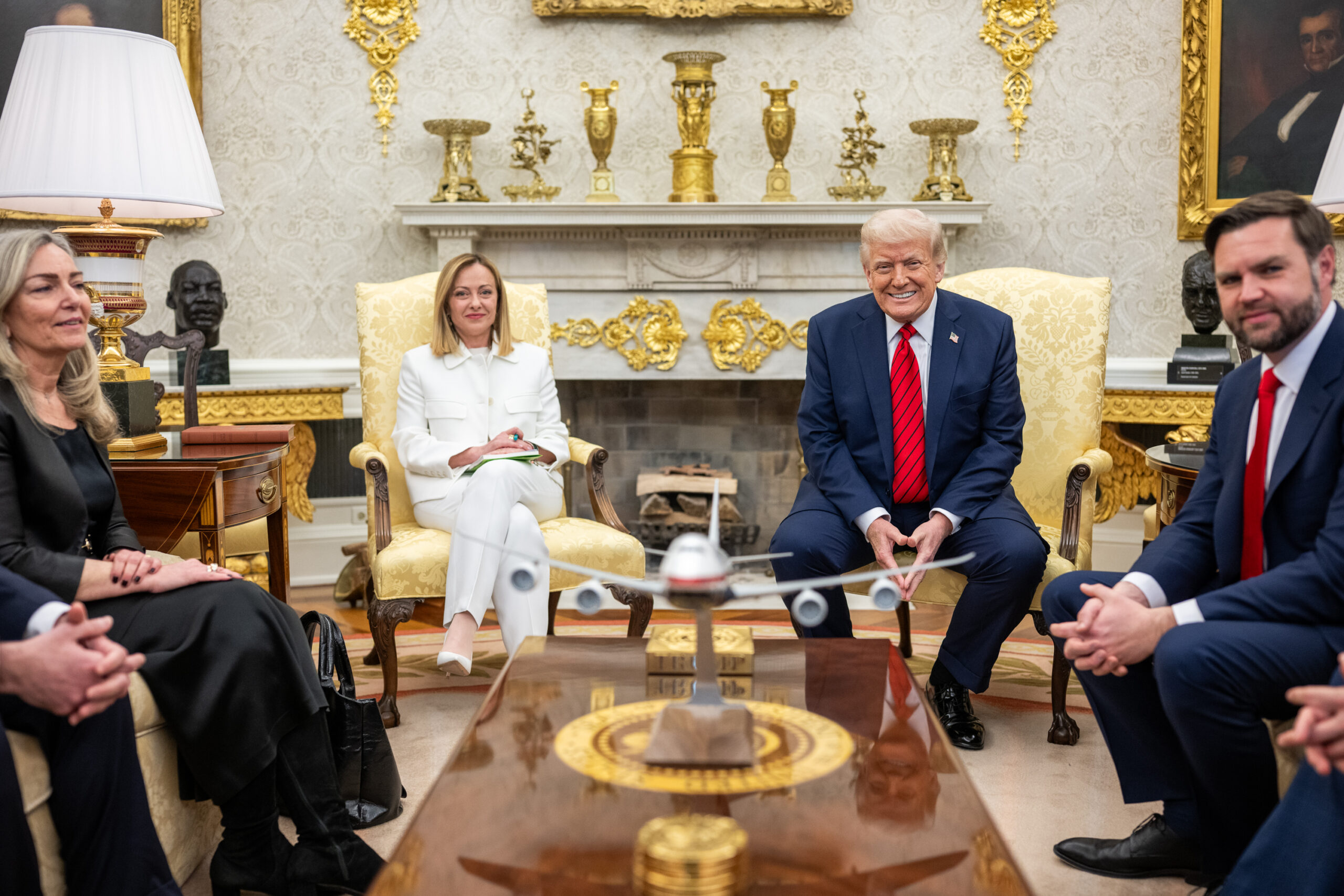
What matters most, Meloni understands, is her personal relationship to Trump. She was the only head of government in the EU invited to attend Trump’s second inauguration. As Bannon acknowledged to me, “Trump loves her.” In her “energy,” in her “game,” Trump sees her as “not like any other European politician,” Bannon said. With that precious thing to a European leader, the willing ear of the single most powerful leader on the planet, Meloni has ample opportunities to share her views with Trump, as in their amicable meeting at the White House in April.
Whether her muscular views on Ukraine and Putin have in any way shaped Trump’s thinking is difficult to tell. Mercurial as always, he has shifted back and forth, from the Bannon view that Ukraine is Europe’s problem to support for a deal opposed by Bannon which gives the United States a long-term stake in Ukraine’s mineral riches. At a meeting of NATO leaders in June, at The Hague, Trump faulted Putin for extending the war in Ukraine and praised NATO as “not a rip-off.” Score one for Meloni? She took the opportunity at the gathering to press Trump for ceasefires in Ukraine as well as Gaza. The only certainty is that she will use all of her “game” to try to tug Trump closer to her worldview.
The Future of Conservatism: A Political Metanoia?
In A History of Civilizations, published in 1963, Fernand Braudel scrutinizes the vicissitudes of time through a typically Olympian lens. In a chapter on “Unity in Europe,” he asserts the essential continuity underlying European culture across the ages:
Europe has had a single philosophy, or something very like it, at every stage of its development. At the very least there has always been what Jean-Paul Sartre liked to call “a dominant philosophy,” reflecting the needs of society at the time—no doubt because the whole of the West, at any given moment, has had a single dominant economic and social structure.
The best reason to pay attention to Meloni is the possibility that her project represents an emerging “philosophy” that may yet be far from dominant but could plausibly become so. That’s the case on her behalf made by her admirer in Bucharest, the conservative parliamentarian Neamtu. In his email to me, he took sober note of the “political tradition” from which she springs, a movement “heavily burdened with the symbolism of a defeated authoritarian past.” But that, he went on to say, was just the starting point:
Meloni has orchestrated a slow and careful transfiguration—a political metanoia, one might say—that has seen her party shift from ideological ostracism to center-right preeminence. This she accomplished not by severing herself from the past, but by reframing it. Rather than adopt the sterile language of managerial liberalism, she invoked the enduring symbols of nationhood—“God, Country, Family”—not as authoritarian totems, but as anchors of cultural memory in a society adrift. This is not a politics of nostalgia, but of continuity: an attempt to reassert the moral ecology of Italian life while speaking in democratic terms. She did not so much deny her roots as plant them anew in the fertile soil of electoral democracy.
Metanoia, from the Greek, means to change one’s mind and is suggestive of a profound transformation. Whether Meloni’s Brothers of Italy has actually undergone that metamorphosis can be debated. But if Meloni can somehow pull off her “mother of all reforms” and become the Italian Republic’s first directly elected head of government with a mandate from the people, that feat alone would mark her as a consequential stateswoman in the history of her country. And depending on how she governed, she could disprove the critics that think her real ambition is to be a second coming of Mussolini.
As to her effort to build a bridge across the Atlantic, the question is whether this work in progress can endure in a post-Trump America. From her standpoint, should she herself manage to remain in power, the best scenario is surely that Trump is succeeded by JD Vance (or someone like him). Unlike Trump, the Yale Law–educated Vance, a convert to Catholicism, likes to expound on, Meloni style, big-think matters of society. Even though as vice president, Vance has established himself as a biting critic of Europe, his critique, as in his charge that EU “commissars” are squelching free speech just as the continent’s leaders are retreating from Europe’s time-honored “most fundamental values,” sounds exactly like the critique that Meloni herself habitually makes of unwholesome trends in contemporary, read “progressive,” Europe. The two of them, Vance, the younger by seven years, could become populist brethren. But then again, Vance has also taken the Bannon line that America should largely detach itself from the security problems confronting Europeans.
If the Democrats take back the White House in the next election, it would likely entail failure for Meloni’s idea of forging ties with a “deeper America.” The Democrats are likely to have no more use for Meloni and her musings about the symbolic value of the crucifix than they did for Thatcher and her curious cogitations about whether society actually existed. But give Meloni this much: Thatcher’s libertarian-ish reveries have not aged well in the ranks of conservatism. Meloni is the one connecting with a more enduring conservative store of thought, of the customs-and-tradition variety that inspired Russell Kirk to write The Conservative Mind in the 1950s. Meloni-ism is apiece with traditionalism, and traditionalism is, generally speaking, a keeper for conservatives.