
The Madness of Leaders
REVIEW ESSAY
The Madman in the White House: Sigmund Freud, Ambassador Bullitt, and the Lost Psychobiography of Woodrow Wilson
by Patrick Weil
Harvard University Press, 2023, 400 pages
On Nixon’s Madness: An Emotional History
by Zachary Jonathan Jacobson
Johns Hopkins University Press, 2023, 448 pages
“Dictators are easy to read. Democratic leaders are more difficult to decipher. However, they can be just as unbalanced as dictators and can play a truly destructive role in our history.” So Patrick Weil writes in the final paragraph of his thought-provoking treatment of Woodrow Wilson as the “madman in the White House.” His case is built on the seemingly irrational obstinacy—“no compromise or concession of any kind,” Wilson vowed—that resulted in the U.S. Senate’s rejection of the Versailles Treaty that Wilson had labored so hard to negotiate at the Paris Peace Conference in 1919. The Senate’s action doomed U.S. membership in the League of Nations, which Wilson viewed as the vehicle to an enduring world peace after the wreckage of the Great War. Even those who hoped for Wilson’s success were baffled: “the factor of judgment does not function,” William C. Bullitt, an aide to Wilson in Paris, was told by a friend. “Many believe he is on the verge of insanity,” a reporter in Washington wrote in his diary as to opinion in the capital city on the occupant of the White House.
Fifty years later, Richard M. Nixon entered the White House trailed by headlines like “The ‘Real Nixon’ an Enigma,” from the front page of the Washington Post. By the time his shattered presidency concluded, with his resignation over the Watergate scandal, there was a widespread feeling in Washington, as one observer noted, that “he might go bats” at any time. In their bestselling book The Final Days, published in 1976, two years after Nixon left office, Watergate sleuths Bob Woodward and Carl Bernstein told of an unmoored figure who spoke to the portraits on the White House walls. Psycho-historians—this welded-together term was now in vogue—had no trouble finding a parallel: “unlike any president save Woodrow Wilson,” Fawn Brodie noted in her 1981 book, Richard Nixon: The Shaping of His Character, “Nixon went out of office suspected of suffering from severe mental illness.”
Brodie’s appraisal is cited in Zachary Jonathan Jacobson’s “emotional history” of Nixon, a notable virtue of which is his willingness to question casual, politically tinged assumptions made about Nixon’s supposed pathologies. The Weil and Jacobson volumes arrive at a moment when the cottage industry of presidential psychoanalysis—think Donald J. Trump—has become a full-blown retail enterprise. Terms like “narcissistic personality disorder” are bandied by experts and lay people alike. There are calls to repeal the so-called Goldwater Rule, by which the American Psychiatric Association in 1973 decreed it “unethical” for a practitioner “to offer a professional opinion” on a public figure like a presidential candidate without conducting a personal examination of the candidate. Presidents and presidential aspirants, it seems, occupy a permanent place on the national couch.
For better or worse, Sigmund Freud looms as a modern founder of the idea that personality can explain the actions of “great men” in “all fields of human endeavor,” as he put it. Freud was fascinated by Wilson’s behavior as a world leader and embarked on a rigorous scrutiny of his psychological makeup—the exploration that Weil resumes. For Jacobson, the debt is paid to the pioneering French historian Lucien Febvre. In his influential 1941 essay, “Sensibility and History: How to Reconstitute the Affective Life of the Past,” Febvre summoned historians to a new calling: “I am asking for a vast collective investigation to be opened,” he wrote, “on the fundamental sentiments of man and the forms they take. What surprises we may look forward to!” Surprises indeed. In the case of U.S. presidents, the personality-driven tack has borne such ripe fruit as Joshua Wolf Shenk’s 2005 book, Lincoln’s Melancholy: How Depression Challenged a President and Fueled His Greatness. Then, too, there is Robert E. Gilbert’s 2003 book, The Tormented President: Calvin Coolidge, Death, and Clinical Depression. Depression is not always the defining condition, as in John D. Gartner’s 2008 volume, In Search of Bill Clinton: A Psychological Biography, which frames Clinton as a “hypomanic” type, possessed of the “mildly manic personality that imbues some people with the raw ingredients it takes to be a charismatic leader: immense energy, drive, confidence. . . .”
Is it really the case that personality—the psyche—is the window to understanding what our presidents do in their times in office? The new Wilson and Nixon books both can be read with this core question in mind. Both are centrally concerned with their respective subject’s actions in the realm of foreign policy—the domain in which a U.S. president, liberated from the briar patch of domestic affairs, is freest to maneuver and presumably has the widest berth to act out distinctive features of personality. Yet it seems plausible that fairly mundane factors might account for a president’s dealings in the global arena. Or a president may come into office possessed of a foreign policy agenda that stems not from his personality but, say, from positions anchored in his party or in an ideological movement in which he rose to prominence. Why descend into the bog of personality when other explanations, available to the conventional historian or political scientist, may be in plain sight?
Wilson: “Never!”
In Madman in the White House, Weil resurrects and expands on an earlier inquiry, Woodrow Wilson: A Psychological Study, a collaboration between Freud and the diplomat Bullitt. The manuscript for what became that book was completed in 1932 but it was not until 1966, twenty-seven years after Freud’s death and one year before Bullitt died, that the work was published—and even then, in heavily-redacted form. (Bullitt, it seems, was worried that the “study” would damage Wilson’s reputation in the eyes of posterity.) Weil, a fellow at Yale Law School and founder of Libraries Without Borders, an international nonprofit group, discovered the original Freud-Bullitt manuscript in 2014, while perusing Yale’s archives. In drawing on his unexpected find for his book, Weil embraces the Freud-Bullitt thesis that Wilson’s wounded psyche is the key to understanding Wilson’s insistence on his vision of the post–World War I world.
Chapters like “Princeton Nightmares” and “Neurosis on the World Stage” guide us through this sometimes harrowing tale. There is certainly plenty to ponder. Weil notes that, in 1896, while teaching at Princeton, the overworked Wilson “had a breakdown and lost the use of his right hand.” In 1906, now president of the university, “he was again close to a nervous breakdown. One morning in May of that year, he woke up blind in his left eye.” Needing rest, he retreated to England for several months. Two years later, he experienced still another breakdown. “Tortured by nerves, neuritis, sick headaches and sour stomach,” he left stress-inducing Princeton for soothing Bermuda.
All of these traumas occurred in the adult, mature Wilson—he was turning forty the year he suddenly found himself without use of his right hand. Yet in 1913, just five years after his nerves forced him to repair to Bermuda, he entered the White House. His personality was fully formed, and America was stuck with it. And what lay beneath Wilson’s mental anguishes? “Freud and Bullitt saw fixation on the father as the primary feature of Wilson’s psyche,” Weil reports in affirmation of this diagnosis, straight from the textbook of classical psychoanalysis.
Ah yes, the father: Joseph Ruggles Wilson, a Presbyterian minister. Thomas Woodrow, born in Staunton, Virginia, in 1856, was Joseph’s third child and first son. It is typical for an adolescent boy to identify with the father, Weil notes, but these feelings generally recede as the child comes of age. Except not, it seems, in the case of Woodrow, for he “remained fixed on identification, constantly elevating his father’s ideal ever higher,” Weil tells us. This is believable. “My Precious Father,” Woodrow began in a letter on his election to the Princeton faculty at the age of thirty-three. He continued:
I suppose I ought to feel an immense accession of personal satisfaction, of pride but somehow, I can’t manage it. . . . It seems to me that the older I get the more I need you; for the older I get the more I appreciate the debt I owe you, and the more I long to increase it. It seems to me that my separation from you, instead of becoming a thing of wont, becomes more and more unendurable.
More and more unendurable? The “father fixation” explanation stakes its largest claim on Wilson’s refusal to compromise with the U.S. Senate on the Versailles Treaty language, when such a bargain stood well within reach. “Never! Never!”—such was his excited personal response to a deal-urging Republican senator. The paradigmatic episode in this drama took place on July 10, 1919, on Wilson’s presentation of the treaty to the Senate. Instead of opening the door to a bargain, he delivered a sermon in which America’s expanding role in the world, the provisions of the tablet-like treaty, and his own person were made out to be instruments of divine will: “The stage is set, the destiny is disclosed. It has come about by no plan of our conceiving, but by the hand of God who has led us into this way. We cannot turn back.” The conventional explanation for “this misstep,” as the Wilson biographer John M. Cooper Jr. put it, was “impaired political judgement.” But Weil, channeling Freud and Bullitt, does not accept that. “I believe Wilson simply could not speak the right message,” he writes. “To do so risked the disapproval of his superego and resulting personal collapse because it would have meant acceding to an imperfection of which his father Joseph would not have approved. Wilson did not have free choice as to the words he used; his father was always hovering nearby.”
This explanation is about as unadulterated as psycho-biography gets. It feels like a lot to swallow. Yet there is an alternative personality-driven explanation for Wilson’s seemingly unfathomable stubbornness that does not require resort to a psychoanalytical construct. It might be that Wilson was possessed of a genuine, and in his case unshakeable, religious faith in his mission—a true conviction that was not simply, as Freudians tend to think of religious belief, the outgrowth of an infantile need for an all-powerful father. Although Weil does not occupy himself with this explanation, the historian Malcolm D. Magee places Wilson’s religious convictions at the center of his 2008 book, What the World Should Be: Woodrow Wilson and the Crafting of a Faith-Based Foreign Policy. “While religious faith challenges the historian, it is an essential (though not exclusive) factor in the study of Woodrow Wilson’s foreign policy,” Magee, director of the Institute for the Study of Christianity and Culture at Michigan State University, asserts.
Of course, it might be said, as William James suggested in his classic book The Varieties of Religious Experience, that individual temperament can be a crucial component of religious belief. Just as some personalities seem impervious to belief in God, others are disposed to faith. It’s striking, in any case, that Wilson’s contemporaries felt compelled to account for his perplexing psyche, whatever its foundation. No less astute an observer than John Maynard Keynes, who attended the Paris Peace Conference and watched Wilson closely there, was drawn to this behavioral puzzle. Mindful of the patent deficiencies, as he saw them, of the Versailles Treaty, Keynes in 1920 wrote to an American Treasury official that “the President’s psychology was essential to explain how it came about.” One way or another, Wilson’s temperament—his personality—does seem essential to a grasp of his statesmanship.
Nixon: “I Want the North Vietnamese to Believe . . .”
As surprising as it may sound, to move from Weil’s treatment of Wilson to Jacobson’s On Nixon’s Madness is to have the sense of entering less muddied waters. Nixon’s “emotional history” does not appear to be all that complicated. Growing up in Whittier, California, the son of a grocer and gas station owner, he experienced the trauma of seeing his younger brother Arthur die of tuberculosis at the age of seven. Richard plunged “into a deep impenetrable silence,” his mother Hannah recalled. In Nixon’s own words, “for weeks after Arthur’s funeral there was not a day that I did not think about [him] and cry.” He was twelve years old at the time and his reaction does not sound abnormal. Jacobson recounts these details in his chapter on “The Sentimental Life of Richard Nixon.” Drawing on Garry Wills’s insightful portrait of Nixon in the 1969 book Nixon Agonistes, Jacobson stresses “Nixon’s fervent desire for the stoic,” what Wills called the effort to achieve “self-mastery” of churning emotions. Nixon agreed with this assessment of his psychic challenge. “I am an emotional man. I—I just believe in controlling it, and I’m pretty good at it,” he once said.
Was he, though, “pretty good” at it? “Even as he tried to fend off strong feelings, they threatened to overwhelm,” Jacobson reports. Hence, he continues, “that delicate balance between control and the effusion of emotion, manipulation and release” that defined Nixon’s emotional state. And from this straightforward, almost mechanical understanding of the workings of Nixon’s psyche, Jacobson draws a direct connection to Nixon’s famous “madman theory” of dealing with geopolitical rivals. In making this crucial link, Jacobson is striving to deliver on his “attempt to understand Nixon through his affective life.” Invoking a phrase from Febvre, Jacobson says the idea is to illuminate that “darkness where psychology wrestles with history.”
The madman theory, as Nixon explained to his trusted aide H. R. “Bob” Haldeman during a stroll on a beach during the 1968 presidential campaign, was for a president to act “obsessed, angry”—beyond restraint—as a bargaining stratagem. Nixon was at that moment concerned, foremost, with bringing the Vietnam War to an end. “I want the North Vietnamese to believe I’ve reached the point where I might do anything to stop the war,” Nixon said, as Haldeman later wrote of this exchange, the italics in Haldeman’s written account. The enemy must be told, Nixon continued, that “he”—Nixon—“has his hand on the nuclear button—and Ho Chi Minh himself will be in Paris in two days begging for peace.”
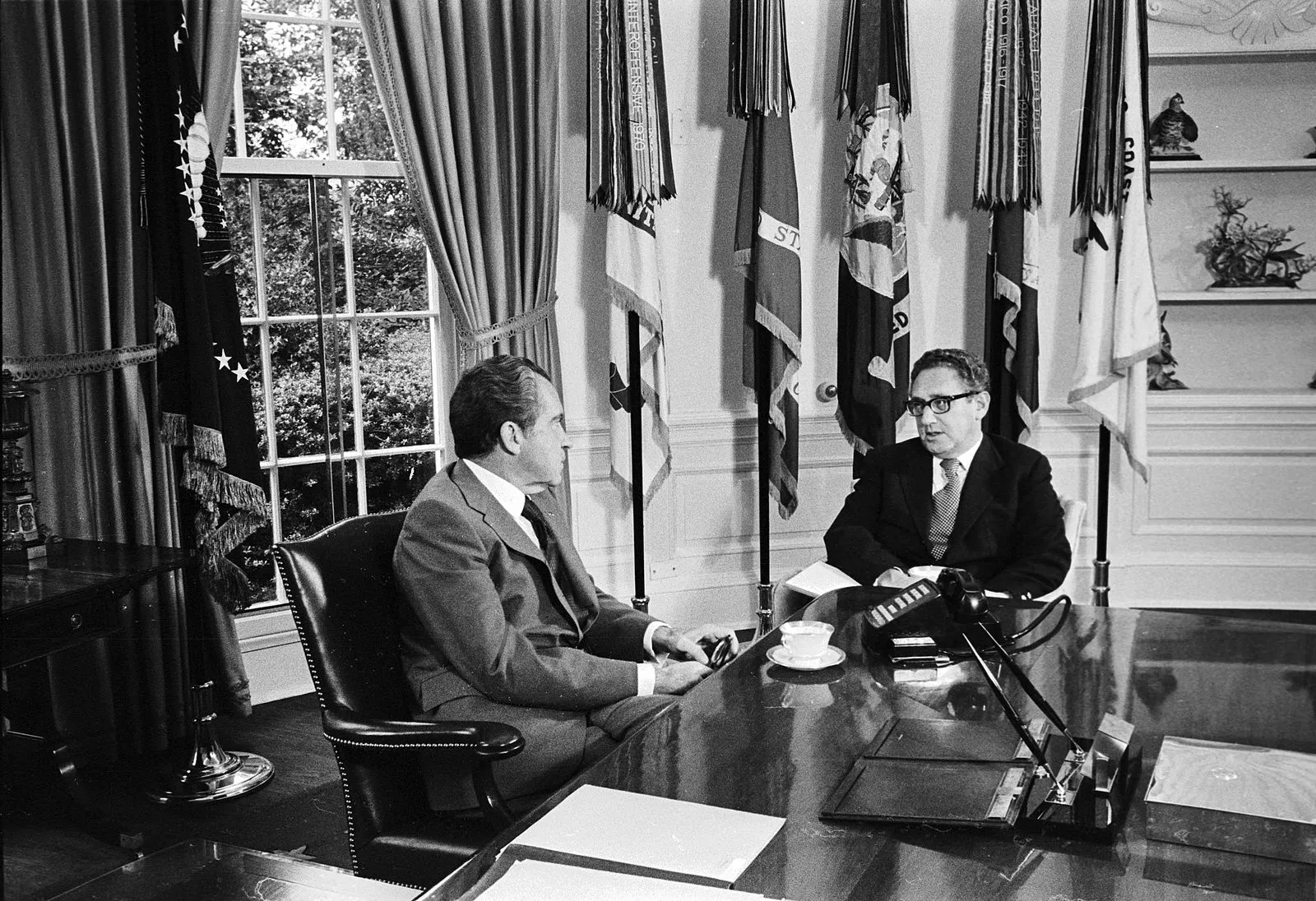
These were not idle musings. Once in office, Nixon tried to execute his plan, as Jacobson persuasively shows in the chapter on “Madness in Play.” In October 1969, in a top-secret operation aimed at both North Vietnamese leaders in Hanoi and their Soviet backers in Moscow, “Nixon sent formations of B-52s loaded with nuclear weapons to circle the Arctic. He deployed aircraft carriers as if the ultimate strike against the North Vietnamese were imminent.” As part of this “script,” Nixon met in the Oval Office with Anatoly Dobrynin, the Soviet ambassador to the United States. With his fellow schemer, Henry Kissinger, by his side, the president treated Dobrynin to a half-hour monologue featuring a rant on how he would “never” allow the Soviets “to break” him on Vietnam. Dobrynin bought the act. In his notes back to the Kremlin on Nixon’s “visibly nervous” mood, the ambassador assessed that “apparently, this is taking on such an emotional coloration that Nixon is unable to control himself.”
Mission accomplished, as to the sale of the performance—but not as to its desired effect, as neither Moscow nor Hanoi flinched in the face of Nixon’s “madman” pretensions. What’s more, as Jacobson notes, Nixon “failed to game” China’s uncowed response to the bluff, which was to mobilize nearly a million soldiers for the all-out war America’s president seemed to be threatening.
The question remains, though, as to how to understand Nixon’s embrace of the exotic madman theory. As Jacobson, an honest broker, recognizes, personality is not the only available explanation. To begin with, Nixon was not the inventor of the madman theory. That honor went to ivory tower academicians, to Cold War game-theorists like Thomas Schelling, who taught a games and strategy course at Harvard. In nuclear gamesmanship, Schelling told his class, one might decide to play the fool to achieve the rival’s capitulation: “You start dancing, closer and closer to the edge.” In “Political Uses of Madness,” a lecture he gave at Harvard, Daniel Ellsberg, the future leaker of the Pentagon Papers, noted the possibility, in the context of a nuclear threat, for a political actor “to seem ‘a little’ erratic, impulsive, unstable.”
As Jacobson takes care to say, neither Schelling nor Ellsberg actually advocated a madman strategy as later adopted by Nixon. The game theorists were ruminating on how Atomic Age “games” might be played. Nevertheless, Nixon, who prided himself on being a creative thinker in his cherished realm of foreign affairs, imbibed these cogitations, as did Kissinger (who served on the Harvard faculty, in the Government Department and Center for International Affairs, before entering the Nixon White House). In my read of Jacobson’s book, it seems more persuasive to regard Nixon’s national security strategies as a reflection of Cold War thinking in the U.S. foreign policy establishment, broadly defined, than as the direct consequence of his individual personality. Nixon himself was a self-described enthusiast of Wilson’s conception of a muscular mission for America in global affairs: “Wilson had the greatest vision of America’s world role,” he told Wills. “But he”—Wilson—“wasn’t practical enough,” Nixon observed, perceptively.
It can still be acknowledged that features of Nixon’s psyche encouraged his gravitation to the madman theory of how to outsmart adversaries. To situate Wilson and Nixon on the continuum of how much personality matters to presidential conduct, Wilson’s “hand of God” presentation of the Versailles Treaty to the Senate seems much more a function of distinctive personal character than does Nixon’s attempt to employ the madman theory in dealings with Communist rivals. Nixon’s bluff was always just that, as he knew himself, and bluffs, even of the audacious type, are common to geopolitical gamesmanship. Not common is a head of state who, whether in the grip of a father-fixation or a deeply felt religious conviction, imagines himself operating in world affairs as the unbending implement of the divine.
“The Power to Drag Others”
In his concluding chapter, “Personality in History,” Weil notes that “history and the fate of humanity are not only the products of ideas or structures or the hard material facts. Rather, they are also the consequences of individual action”—in other words, of personality. That’s all true so far as it goes, but it doesn’t go far enough. The lesson of the Wilson and Nixon examples is that personality doesn’t matter equally in their respective cases. It seems to matter a lot in our understanding of Wilson’s conduct, less so in our grasp of Nixon’s.
This lesson can inform an assessment of other presidents and perhaps even make for a general set of principles for thinking about personality as a driver of presidential action, in particular in the foreign affairs arena. Consider Ronald Reagan. It is certainly possible to take the personality-determined approach to his presidency. The seductive point of focus is his plight as the child of an alcoholic—his predicament as the son who, by his own account, once dragged his “passed out” father, Jack, in from the snow. That must have been formative. In “Ronald Reagan’s Presidency: The Impact of an Alcoholic Parent,” a 2008 essay in the journal Political Psychology, political scientist Robert E. Gilbert, the author of the book on a “tormented” Coolidge, asserts that Reagan was “aloof and distant . . . was prone to live in a world of make-believe . . . and craved approval and applause. Each of these behavioral characteristics was part of the psychological legacy left to this president by his long‑dead alcoholic father.”
Yet in understanding Reagan as a global actor—and foreign affairs was a consuming preoccupation of the Reagan presidency—how necessary or helpful is this line of inquiry into his psychological makeup? Reagan was the ultimate movement president of our times: He swept into office as the product and the validation of a long-in-the-making set of conservative principles that included, as a unifying conviction, militant opposition to the godless Soviet Union as the primal source of malevolence in the world. When Reagan, two years into his presidency, branded the Soviet Union “an evil empire” in a speech before the National Association of Evangelicals, he was giving voice to several generations of fervent anticommunists who believed in America’s ultimate and unequivocal victory in the Cold War, not in a sordid détente between the superpowers. And Reagan’s rhetoric found tangible expression in an enormous increase in the federal monies expended on the U.S. military as well as in military support for insurgents, like the Contras in Nicaragua, battling Soviet-backed governments in America’s backyard. Reaganite Cold Warriors thrilled to his description of the Contras as “the moral equivalent of our Founding Fathers.”
In these terms, the Reagan presidency, among presidencies of the last half century or so, can be situated at one end of a spectrum: There is no particular need to invoke personality to explain his conduct in world affairs. As for the opposite end of this spectrum, there can be no evasion of the need to grapple with the figure of Trump. At first glance, and even at second, Trump seems impelled by his unique personality, so much so that it’s hard to imagine any aspect of his political conduct that is not the product of some idiosyncratic impulse. Given the firmness of this conventional wisdom, a counterpoint can be offered. Trump’s China policy, as in the tariffs he placed on billions of dollars of Chinese-made goods, is best seen as rooted, not in his personality, but in the populist “America first” plank that bonded him to voters in the manufacturing-depleted Midwest and a transformed Republican Party no longer in thrall to free trade principles.
Yet this point aside, it is difficult to explain Trump’s global dealings without reference to his personality. In particular, his own attributes as an authoritarian personality type seemed to account for his evident fondness for—and perhaps envy of—strongman leaders like Vladimir Putin of Russia and Kim Jong Un of North Korea. Despite his clashes with China over trade, his admiration even seemed to extend to that country’s all-powerful leader, Xi Jinping. Two years into his presidency, on the news that Xi had consolidated his power in China, Trump remarked, in his joking but not only joking way, that Xi was “now president for life. President for life,” as he told a group of Republican donors. “I think it’s great. Maybe we’ll have to give that a shot someday.” There was nothing in the mainstream Republican tradition or even in the principal currents of the American political tradition that accounted for Trump’s attachment to the authoritarian model. Indeed, with his rudimentary knowledge of American history, it is nearly impossible to believe that he was emulating, in his own mind, a past president. He was on his own: “I’m an extremely stable genius,” he memorably informed the White House press corps.
In these arresting circumstances, the bog of personality more than beckons—it compels. His psyche is all about his domineering father, Fred Trump, Donald’s niece Mary, a clinical psychologist, ventured in her 2020 book, Too Much and Never Enough: How My Family Created the World’s Most Dangerous Man. “By limiting Donald’s access to his own feelings and rendering many of them unacceptable, Fred perverted his son’s perception of the world and damaged his ability to live in it,” she submitted. That particular explanation doesn’t have to be bought, anymore than the father-fixation diagnosis suggested for Wilson. But in whatever specific manner Trump can be explained, he has earned his spot as the embodiment of a personality-driven presidency.
Assessing the importance of the chief executive’s personality to a presidency may seem to have the flavor of a parlor game, along the lines of perennial efforts to rank the greatness of our presidents. Yet the effort to grasp the significance of personality can help answer a practical and recurrent question in our democratic life: as “We the People” assess fresh crops of presidential hopefuls, how much should we care about a candidate’s personality, as part of our overall mix of considerations? The answer is not obvious. It might seem prudent to steer clear from the candidate apt to deliver a personality-driven presidency. But then again, it all depends on the personality. In Siena College’s polls of presidential scholars, Franklin D. Roosevelt regularly places as America’s greatest president. FDR, a perpetual experimenter, sometimes seeming to be without firm ideological principles, put a lot of personal style into his presidency. He succeeded with “a first-class temperament,” as Oliver Wendell Holmes famously remarked.
In the introduction he wrote for what became Woodrow Wilson: A Psychological Study, Freud grappled with this question of “personality in history,” in Weil’s framing. As usual, Freud does not let us off with a comforting answer. “Fools, visionaries, sufferers from delusions, neurotics, and lunatics have played great roles at all times in the history of mankind,” he observes. “Usually they have wreaked havoc,” he points out. Except, he goes on to explain, that’s “not always” the case, as such persons “have given impetus to important cultural movements and have made great discoveries.” And what is more:
it is often precisely the pathological traits of their characters, the one-sidedness of their development, the abnormal strengthening of certain desires, the uncritical and unrestrained abandonment to a single aim, which gives them the power to drag others after them and to overcome the resistance of the world. So frequently does great achievement accompany psychic abnormality that one is tempted to believe that they are inseparable from each other.
But just when Freud has us most discomforted—are we to opt for “psychic abnormality” as the price for great achievement?—he pulls back. “This assumption is, however, contradicted by the fact that in all fields of human endeavor great men are to be found who fulfill the demands of normality,” he concludes.
Is it possible, though, that the personality-driven era of “great men”—which can sound like a quaint nineteenth-century conception with a Darwinian hue (think Bismarck et al.)—is coming to an end? Consider that question from an American presidential standpoint. As a matter of popular perception, the answer is clearly no. The general idea, as catered to by social and cable-news media, is that personality is everything: America’s destiny can be located in the makeup of the figure elected to lead the nation. Does Ron DeSantis have the right stuff? Does his determinedly combative nature, his evident relish for baiting critics on culture war issues like immigration and education, imply that America, under his leadership, will be even more riven by conflict on such matters?
Perhaps, but the prosaic reality is that the United States is currently led by an eighty-year-old man, Joe Biden, whose presidency seems guided less by his generally affable, gregarious personality than by the mainstream, rote concerns of the Democratic Party, such as the need to protect Social Security and Medicare and spend a lot of money on programs to combat global warming. Meanwhile, an enormous, routinized bureaucracy—the administrative state—keeps the federal government lumbering along. Indeed, one argument for another four years of Biden is that the continuity of this system makes his age—his personality—less important than it might otherwise be. America is safe and sound, even with an octogenarian at the helm, this notion goes. To extend that thought: the nation managed to survive four years of the rambunctious Donald Trump—and could survive another four years, if it comes to that. He couldn’t even build his wall. Perhaps the saving grace for the Republic in its 234th year is that presidential personality does not in the end matter nearly as much as we think it does.