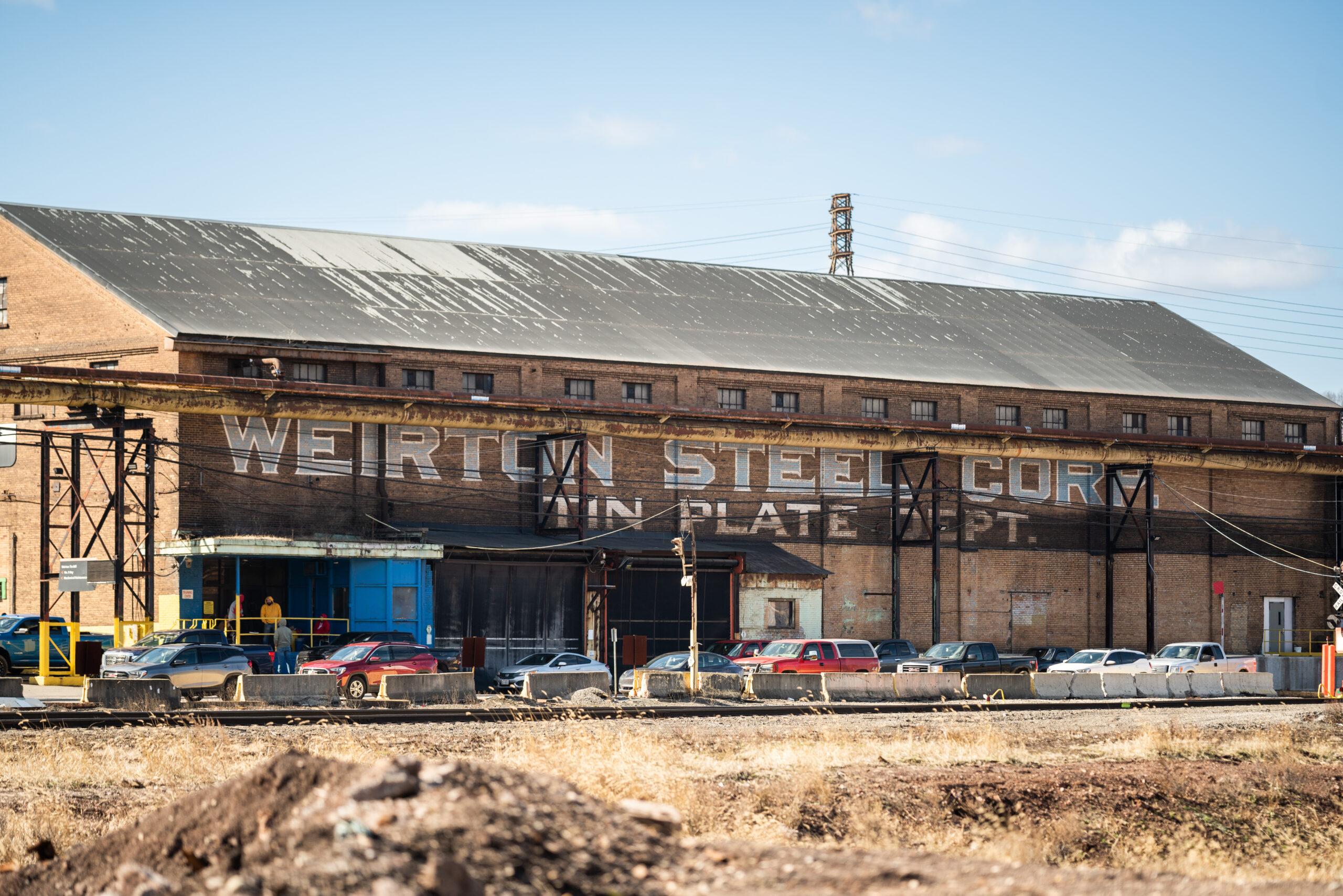
Along the Ohio River lies the site of Form Factory 1, a recent 550,000 square foot facility for the production of battery technologies. Battery manufacturer Form Energy broke ground in 2023 on the facility, an iron-air battery manufacturing plant built on the site of the former Weirton Steel mill. The Weirton Steel mill produced half of the world’s steel in 1950 and nearly 20 percent by 1970. 1 By the later 1970s, imports of steel from foreign nations were flooding U.S. markets and boxing out Weirton’s position.2 This phenomenon didn’t just impact Weirton but also other domestic manufacturers. Although calls grew nationally from steelworkers and their unions for antidumping, countervailing duties, and escape clause petitions, Weirton and the industry continued to suffer. In 1982, Weirton’s parent company National Steel announced its plans to shut down the steel mill. As an alternative to paying for shutdown costs and pension liabilities, the company offered employees the opportunity to buy the company through an Employee Stock Ownership Plan (ESOP).3 Employees decided to take pay cuts and bought the mill. With tax breaks and community support, the company was able to stay in operation and recorded strong profits for the next five years. Between 1984 and 1990, the company earned $500 million, with workers sharing $170 million of these profits.4 But Weirton Steel eventually shut down in 2003, declaring bankruptcy.
Irrespective of the plant closure, the Weirton experiment offers important lessons regarding the potential for industrial democracy to both save critical industries vital to national security and protect the economic well-being of our communities. Weirton lasted twenty years after its employee takeover and sustained six thousand jobs as the American steel industry was cratering.5 Employees were able to create a structure that advanced industrial democracy, protected community wealth, and prevented plant closures of small and medium manufacturers (SMMs). Initiatives such as these are needed in the face of both continued foreign competition and increasing private equity takeovers of manufacturers.
The State of Small and Medium Manufacturers
The federal government, and in particular the Biden administration, has already provided SMMs with varying levels of support and funding, through the National Institute of Standards and Technology’s Manufacturing Extension Partnership and the sixteen Manufacturing USA institutes. This support has focused on providing technical assistance and facilitating the adoption of smart manufacturing technologies and practices. Yet while the current programs have primarily focused on giving manufacturers the resources they need, they have not yet addressed the crisis of succession, governance, and longevity that are affecting SMMs.
Almost all manufacturing firms—98.6 percent—in the United States are considered small to medium sized.6 These companies are in the midst of a major transition in management and ownership, as 125,000 manufacturers are owned by baby boomers and 40 percent have no plans for succession.7 Overall, 60 percent of manufacturing businesses are managed by owners that are age fifty-five and older. This group of firms encompasses about 2.6 million workers8 and is a major economic anchor for small and “hollowed out” towns that both the Biden and Trump administrations claim to be eager to revitalize.
Private equity firms in the United States see an opportunity in such small suppliers. It’s not hard to see why. Government subsidies are increasing for the production of clean energy technologies and other strategic manufactured products. At the same time, the consolidation of larger manufacturers has put the latter in a stronger position to exert more bargaining power on their own small- to medium- sized suppliers. This, coupled with the lingering economic effects of a global pandemic, wars, and high interest rates, has squeezed these small suppliers’ profit margins. These developments, against the backdrop of a wave of retiring owners, have made them cheap and attractive to acquire, with the goal of making operational changes and eventually selling off the company.
Barbarians at the Gate
Private equity has long been politically controversial, and not without reason. Numerous studies have shown that there is greater potential for job loss when private equity firms take over a business.9 This is because the industry often uses levered funds to buy a company, extract value, and sell rather than investing for the long term. These transactions result in facility closures, job losses, and gaps created in local markets,10 harming economic development and the local industrial base. This has been the case across states in the Midwest,11 such as Indiana,12 Michigan,13 and Wisconsin.14 As Wisconsin senator Tammy Baldwin has noted, “Out of state, private equity firms have shut down Wisconsin manufacturing plants and stores and laid off our workers in Janesville, Waukesha and Green Bay. We need to rip up the predatory playbook that these private equity firms are using to leave workers with nothing but pink slips.”15
In Janesville, glass wall manufacturer Hufcor was acquired in 2017 by private equity firm OpenGate Capital. By 2021, the company shut down the plant and offshored production to Mexico, affecting 166 workers in Wisconsin.16 In 2015, OpenGate shut down facilities of laboratory equipment manufacturer Hamilton Scientific, causing 270 job losses across cities in Arkansas, Wisconsin, and Texas.17 In 2017, OpenGate shut down Pacific Crest Transformers causing job loss in Monterey, Mexico, and Medford, Oregon.18
Another more recent example is the acquisition of the contract drug manufacturer New Vision Pharmaceuticals by private equity fund Morgan Stanley Tactical Value.19 The fund acquired New Vision in 2018 and announced last February that it would shut down its plant in Tamarac, Florida, laying off eighty-eight workers.
PE’s influence affects not only these local manufacturers but also others critical to national security. Private equity has been involved in 1,500 acquisitions in the U.S. defense contracting sector since 2000.20 Data has found that PE-backed contractors declare bankruptcy at higher rates and that PE investment raises bankruptcy risk by up to 9 percent.21
Reciting these effects on national economic security recalls the 2012 presidential campaign, in which Republican presidential candidate Mitt Romney was attacked for his involvement in factory closures due to his role at the PE firm Bain Capital. Among other examples, Bain had acquired a Kansas City steel mill in 1993 only for the company to shut it down nine years later, drawing the ire of laid off employees.22
Just as concerning as closures is the potential for offshoring. A recent example of this risk to national security lies in the sale of liquid electrolyte manufacturer Novolyte Technologies in 2012.23 In 2012, U.S.‑based private equity firm Arsenal Capital Partners sold the country’s only liquid electrolyte manufacturer, a main component needed to develop lithium-ion batteries, to the German chemical company BASF,24 which later shut down the Zachary chemical plant in Zachary, Louisiana, laying off fifty-four workers.
PE’s influence on Germany’s industrial ecosystem of small suppliers further highlights the risk of this financing model for SMMs.25 Private equity companies began to invest heavily in German automotive suppliers around the beginning of the twenty-first century. PE’s entry into this sector resulted in a surge in the internationalization of German automotive suppliers. As they exited investments, PE investors attempted to find buyers globally, resulting in China scooping up the largest share of auto suppliers.26 One prominent case is the sale of the automated production manufacturer FFT by PE firm ATON to Chinese‑based Fosun International Limited.27
Such internationalization also accelerates the increasing disintegration and disconnect from regional and national production systems, with supply chains prioritizing international buyers and markets. In other words, value derived from the local manufacturing business is likely to be transferred out of a local economy. New ownership will mean changing supplier relationships and a decrease in the local multiplier relationship, which represents the benefit of a local company spending money within a local economy. Additionally, earnings and the securitization derived from a manufacturer’s capital stock flow to investors and owners living elsewhere, and who are disconnected from local communities. Overall, PE firms, through ownership, control over 600,000 employees in the U.S. manufacturing sector,28 and thus potential actions that disconnect local communities from integrated national supply chains can be significant.
ESOPs as Leverage
With these concerns in mind, a bipartisan group of senators has taken steps to introduce legislation to offer ownership alternatives to PE roll-ups. U.S. Senators Marco Rubio, Chris Van Hollen, and others last year introduced the Employee Equity Investment Act (EEIC Act).29 According to Van Hollen, “our goal is to make sure that as these small businesses, their owners retire, that instead of being bought up by private equity firms, including a lot of folks who may be foreign investors, that the investors be the employees themselves, and that the beneficiaries be the employees themselves.”30
The act would establish a program within the Small Business Administration (SBA) to give federal loan guarantees to Employee Equity Investment Companies (EEICs).31 EEICs would be private investment firms and lenders that would offer debt or equity financing to the company to establish an Employee Stock Ownership Plan (ESOPs). ESOPs are employee benefit plans that enable employees to own shares or “stock” in their company.
Owners of small manufacturing firms looking to sell their company could initiate an attempt to convert to an ESOP. Investment firms looking to participate in this program would apply for a section 301 license from the SBA to participate in the program as an EEIC. Section 301 allows the SBA to license and regulate these firms. These EEICs buyout the owner of the company and their shares are distributed among employees and the EEIC. Shares are kept in a trust that is managed by an independent trustee, which is typically a bank or professional trust company. For their part, the EEICs would also receive an ownership share in the company while the ESOP, representing employee shares, would be equal to at least 30 percent.32
This hasn’t been the only attempt to promote ESOPs over the past few years. In 2023, the Employee Benefits Security Administration within the Department of Labor began an initiative to address ownership and succession challenges through the advancement of employee ownership programs. This initiative was established through the Worker Ownership, Readiness, and Knowledge Act (WORK Act) that was included in the secure 2.0 Act of 2022. Funding for the program will increase gradually and will be used for education, technical assistance, and training of employees.33
ESOPs: Advantages and Disadvantages
The strength of the proposed EEIC Act is that EEICs can provide a greater incentive for owners to sell to employees, because they would receive a faster, and potentially higher payout, rather than selling to private equity.34 Previously, owners typically had to take part of their payment in the form of loans when selling to employees.
The weakness of the proposal is that, unfortunately, while ESOPs share some of the wealth of a company with workers that built it, they do not create a mechanism for workers to have input in day-to-day decision-making nor any leverage against management. ESOPs also don’t necessarily guarantee that employees of small private manufacturers have a say in decision-making related to sales, relocations, business closures, and other similar decisions.
This decision-making power depends on various factors such as how the ESOP is structured, the type of corporation, the corporation’s charter, and the state the firm is incorporated within. The ESOP does not necessarily offer workers any operational control and could be used to unjustifiably punish and reward employees.
Attempts by current private equity firms, such as KKR, to obfuscate the governance shortcomings of current ESOP plans have recently become popular. Private Equity groups have created organizations such as Ownership Works to promote ownership plans, and in many cases these plans have resulted in large payouts for existing employees. But, ultimately, ESOPs don’t fundamentally change the capital-labor relationship as voting rights are still linked to property instead of labor. It’s undoubtable that ESOPs have historically, and even recently, provided some economic benefits to workers; as the economist Susan Holmberg puts it, “they are a move in the right direction and a step that can be taken within the current shareholder primacy system.”35 But as Holmberg also notes, these types of profit-sharing plans do not give employees governance rights or operational control. Managers and shareholders still have the leverage to enact policies and make decisions that harm workers. PE firms can still shut down factories vital to local communities and national security against employee and community wishes. Overall, these efforts by PE firms tend to be another form of “corporate greenwashing.”
Historically, ESOPs have functioned as a means for owners to write off taxes. The benefit that accrued to employees has primarily focused on tying their financial fate to the earning power of capital. Perhaps one of the greatest risks associated with ESOPs involves the potential for an increase in wages to be substituted with more equity or increased company shares as a compensation enhancement tool used by management. As the economist Ben Fine puts it, “at various times, for reasons of incentives and of control as much as for ideological reasons, capitalists find it convenient to vary the way in which wages are assessed and paid.”36 There have been many prominent ESOPs in history that serve as examples. Take, for example, the debacle at United Airlines in the 1990s.37 An ESOP bought just over half of the company’s equity in 1994. In return, employees took five-year pay cuts that were as high as 15 percent. After the transaction, the employees and management were embroiled in a bitter confrontation over workplace issues. In 2002, the value of worker shares in the ESOP plummeted as the company declared bankruptcy.
There are even more notable cases of ESOPs that highlight heightened financial risk and illustrate their shortcomings. This risk stems from the third parties that are hired to appraise the companies’ value, which lessens the ability of employees to evaluate risk.38 Since 2009, the Department of Labor has filed twenty-eight lawsuits related to ESOP fraud.39 Between 2010 and 2014 for example, the DOL recovered $241 million from companies for these practices. For instance, this happened with specialty gas and welding manufacturer Maine Oxy-Acetylene Supply Company, in which management concealed the share price from employees after terminating the ESOP. Luckily, the WORK Act passed in 2022 mandates that the DOL establish “acceptable standards and procedures” for good faith market valuation of businesses acquired by an ESOP.
Further, economic studies show the inclusion of ESOPs in unionized firms can end up leading to less leverage for employees in conflicts with management.40 Because employees have a share in the company, they are less likely to strike as labor action could potentially affect the company’s valuation. Although unionized ESOPs are rare, the threat of strikes is important leverage for unionized firms.41 Overall, there are many issues associated with ESOPs that exacerbate risk for employees, such as the lack of control over the transferability of shares, the lack of financial disclosures, the potential for deferred compensation, and the lack of leverage over management.
Ultimately, a better model to aspire to may be worker cooperative enterprise for many SMMs. The silver lining of the bipartisan bill is that it also applies to worker cooperatives, which combine this exact idea of ownership and governance, where ESOPs fall short. In this model, workers completely own and manage a business.
The benefits of worker cooperatives are significant. These structures disincentivize firm relocation because employees participate in significant business decisions.42 Additionally, there is greater job security during economic downturns, and these businesses tend to be more committed to local economic development. Economic studies have shown that worker cooperatives have longer-term survival rates than conventional small businesses.43
The Role of Private Investment
Although it is critical to recognize the limitations of private equity and other funding models, it’s also important to note that the goal shouldn’t be to completely reject financing from private equity groups or disparage certain contributions made by these investment funds. After all, a main goal of the Biden administration’s industrial policy was to use public investment to crowd in private investment.44 Instead, the goal should be to provide workers and communities leverage in key decisions, such as those affecting the sale or closure of a firm.
Private equity can provide benefits. SMMs in the United States suffer from various disadvantages,45 such as reliance on few sources of expected revenue. In addition, these companies must contend with limited access to funding for upgrades and expansions, cash flow uncertainty, limited balance sheet liquidity, and lower rates of return on capital. Smaller revenue streams also lead to these companies facing restricted loan capacity and a lack of collateral which can be used for financing. Thus, private equity investors offer SMMs considerable resources to shore up their disadvantages. A major U.S. national security and economic problem has been the lack of investment in and adoption of advanced manufacturing technologies, in which the United States suffers from a widening trade deficit. Additional investment capital is needed for SMMs to implement advanced manufacturing techniques that can make them globally competitive. The lack of such investments have been a major reason for the decline of manufacturing in the United States.46
One noteworthy policy from the Biden administration addressing this issue has been the Advanced Manufacturing Forward program launched in 2022. This program was developed by the Small Business Administration and the Department of Defense Office of Strategic Capital. It pools money from private equity investors and prime contractors in the aerospace and energy industry to fund advanced manufacturing technology for their smaller suppliers.
Additionally, these types of private investments, particularly by private equity, can be contingent on worker approval as well. Workers and their unions can build up various means to assert their investor activism and pressure private investors to accede to their demands, reducing the potential for private investment to break down companies. Take, for example, private equity firm Cerberus Capital’s takeover of Chrysler in 2007. The takeover was at first met with skepticism by the UAW but later supported after receiving assurances that pension liabilities would be protected.
Strengthening the Community Banking System
But rather than rely mainly on private investors such as PE funds lacking the incentives to invest in patient capital, there lies a prime opportunity to develop and utilize community banking institutions to fund U.S. SMMs. Community banks and community development financial institutions (CDFIs) can act as primary trustees for SMMs during ESOP and cooperative conversions and are more likely to engage in relationship banking and have a local focus, with the goal of ensuring that small firms continue to operate within their communities.
National funding for upgrading SMMs could come through CDFIs and community banking institutions that engage in equity and debt financing. These institutions would have a much stronger and patient incentive in keeping existing manufacturing facilities up and running in their towns and regions. We’ve already started a version of this model.
Consider the State Small Business Credit Initiative (ssbci) from President Biden’s American Rescue Plan. Ssbci was first started in 2010 as part of the Small Business Jobs Act of 2010 and aimed at providing state funding to help them expand their small businesses. In 2010, $1.5 billion in funding was given to states. By 2017, this funding helped crowd in twenty-five hundred loans made to manufacturing enterprises totaling $2.5 billion.47 The American Rescue Plan passed in 2021 increased the funding for ssbci to $10 billion. Various financing mechanisms have been implemented through the ssbci loans program, such as capital access, collateral support, loan guarantee and participation programs. Overall, funds provided by the ssbci can be used for loan guarantees and other financing mechanisms for SMMs. Yet while these programs have provided SMMs with capital support, they need to be expanded so that community financial institutions can continue to provide support for manufacturers, and in particular as both a viable alternative to private equity financing and to fund both ESOPs and cooperative conversions.48 An industrial strategy that advances both community-led economic development and industrial democracy is needed.
Toward Industrial Democracy
For ESOPs to truly serve as a bulwark against the kinds of roll-ups that decimate local towns and jeopardize national security, they need to incorporate voting power on key decisions. A move toward employee ownership is a good start to the paradigm of economic democracy that the industrial strategies of Republican as well as Democratic administrations should embrace.
Overall, the move towards structures like ESOPs are beneficial for multiple reasons. Employee-owned businesses pay higher wages than most companies and are less likely to suffer layoffs, according to former Council of Economic Advisers chair Jared Bernstein.49 Additionally, there is broad support across the political spectrum for these types of structures, as made especially clear by the fact that the EEIC bill is bipartisan.
In order to realize the goal of both the Biden and Trump administrations of bringing back manufacturing, the government will need a clear vision for how small suppliers are governed and what role they play in our communities. If not, any such policy runs the risk of investors rolling up critical suppliers or selling them to larger corporations, eroding a resilient and competitive industrial base of SMMs. A path toward industrial democracy that pairs worker ownership with control, likely through legislation, is the best way to stop this. In the words of founding father and former treasury secretary Albert Gallatin, “Democratic principles upon which this Nation was founded should not be restricted to the political processes but should be applied to the industrial operation.”50
This article originally appeared in American Affairs Volume IX, Number 1 (Spring 2025): 30–39.
Notes
1 “Site History,” Weirton Frontier Crossings, last accessed January 5, 2025.
2 Barry Eichengreen and Hans van der Ven, “U.S. Antidumping Policies: The Case of Steel,” in The Structure and Evolution of Recent U.S. Trade Policy, edited by Robert E. Baldwin and Anne O. Krueger (Chicago: University of Chicago Press, 1984).
3 Steven Greenhouse, “Employees Make a Go of Weirton,” New York Times, January 6, 1985.
4 John D. Russell, “Lessons from the Recent Failure of Weirton Steel’s ESOP,” Labor Notes, April 30, 2004.
5 Sustaining the Rust Belt: A Retrospective Analysis of the Employee Purchase of Weirton Steel.
6 Emily Bergstrom and Max Chaoulideer, Employee Ownership for Manufacturers: A Tool to Create Resilient Supply Chains and Quality Jobs (Oakland: Project Equity, July 2023).
7 Bergstrom and Chaoulideer, Employee Ownership for Manufacturers.
8 Andrew Stettner and Audra Ladd, The Challenge of Business Succession in Manufacturing and the Opportunities for Diversifying Ownership (New York: Century Foundation, August 2022).
9 “Effects of Private Equity Investments,” Private Equity Stakeholder Project, last accessed January 8, 2025.
10 Andrew Stettner and Audra Ladd, The Challenge of Business Succession.
11 Lydia DePillis, “This Company Got a $10 Million PPP Loan, Then Closed Its Plant and Moved Manufacturing Jobs to Mexico,” ProPublica, June 30, 2021.
12 IBJ Staff, “Indianapolis Chemical Maker Closing 159-Worker Plant,” Inside Indiana Business with Gerry Dick, August 10, 2023.
13 Kurt Nagl, “Auto Parts Maker Shiloh to Shut Down Warren, Michigan, Plant, Lay Off 107 Post-Bankruptcy,” Crain’s Cleveland Business, June 15, 2023.
14 Steven Greenhouse, ”Wisconsin Workers Fight Factory Move to Mexico: ‘Anxiety Is Through the Roof,’” Guardian, July 18, 2021.
15 “Warren, Baldwin, Brown, Pocan, Jayapal, Colleagues Reintroduce Bold Legislation to Fundamentally Reform the Private Equity Industry,” Office of U.S. Senator Elizabeth Warren, October 20, 2021.
16 Steven Greenhouse, “Workers Fight Factory Move to Mexico.”
17 Private Equity Stakeholder Project and Americans for Financial Reform, OpenGate Capital: Vulture Capitalism in Action (Chicago: Private Equity Stakeholder Project, July 2021).
18 OpenGate Capital: Vulture Capitalism in Action.
19 Joseph Keenan, “Florida CDMO New Vision Pharmaceuticals Shutters Plant, Lays Off 88 Workers,” Fierce Pharma, February 15, 2024.
20 Charles Mahoney et al., “Leveraging National Security: Private Equity and Bankruptcy in the United States Defense Industry,” Business and Politics 26, no. 3 (September 2024): 362–81.
21 Mahoney et al., “Leveraging National Security.”
22 “Romney’s Steel Skeleton in the Bain Closet,” NBC News, January 6, 2012.
23 Advanced Science News, “BASF Acquires Novolyte Technologies,” Advanced Science News, May 4, 2012.
24 Advanced Science News, “BASF Acquires Novolyte Technologies.”
25 Christoph Scheuplein, “Private Equity as a Commodification of Companies: The Case of the German Automotive Supply Industry,” Journal of Economic Policy Reform 24, no. 4 (2021): 472–87.
26 Scheuplein, “Private Equity as a Commodification of Companies.”
27 Kane Wu and Julie Zhu, “Chinese Buyers Eye German Industrial Firm FFT in Deal That Could Top $700 mln,” Reuters, October 12, 2017.
28 Private Equity Stakeholder Project, Private Equity Labor Scorecard, report, November 2023.
29 “Van Hollen, Rubio, Phillips, Moore Introduce New Bipartisan, Bicameral Bill to Boost Employee Ownership of Businesses,” Office of U.S. Senator Chris Van Hollen, May 16, 2023.
30 Aspen Institute, Owning the Future: Creating the Next Generation of Employee Owners (Washington: The Aspen Institute, June 2023).
31 Corey Rosen, “Employee Equity Investment Act Introduced in Both Houses with Bipartisan Support,” National Center for Employee Ownership, May 17, 2023.
32 Rosen, “Employee Equity Investment Act Introduced.”
33 Rosen, “Major Wins for Employee Ownership in New Spending Bill,” National Center for Employee Ownership, January 3, 2023.
34 Rosen, “Employee Equity Investment Act Introduced.”
35 Susan R. Holmberg, Fighting Short-Termism with Working Power: Can Germany’s Co-Determination System Fix American Corporate Governance? (Washington: Roosevelt Institute, October 2017).
36 Ben Fine, “ESOP’s Fable: Golden Egg or Sour Grapes?,” in Political Economy and the New Capitalism, edited by Jan Toporowski (London: Routledge, 1999).
37 Karla Walter and Danielle Corley, Mitigating Risk to Maximize the Benefits of Employee Ownership (Washington: Center for American Progress, October 2015).
38 Ruth Simon, “Trachte Building Systems Case Shows How Employee-Stock-Ownership Plans Can Go Awry,” Wall Street Journal, June 22, 2014.
39 “Employee Remedies for ESOP Fraud,” Donahoo & Associates, PC, last updated November 17, 2023.
40 Peter Cramton et al., ESOP Fables: The Impact of Employee Stock Ownership Plans on Labor Disputes, Staff Report no. 347 (New York: Federal Reserve Bank of New York, September 2008).
41 Rachel M. Cohen, “Could Expanding Employee Ownership Be the Next Big Economic Policy?,” Intercept, December 26, 2018.
42 Shannon Rieger, Reducing Economic Inequality through Democratic Working-Ownership (New York: The Century Foundation, August 2016).
43 Democracy at Work Institute and the U.S. Federation of Worker Cooperatives, “2019 Worker Cooperative State of the Sector Report,” Democracy at Work Institute.
44 Brian Deese, “Remarks on Executing a Modern American Industrial Strategy,” The White House, October 13, 2022.
45 Anthony C. Mulligan, “Issues for Small Manufacturing Enterprises,” in New Directions in Manufacturing: Report of a Workshop (Washington: National Academies of Sciences, Engineering, and Medicines, 2004).
46 White House, The State Small Credit Business Initiative and Rebuilding the U.S. Manufacturing Base (Washington: The White House, May 2023); Suzanne Berger, “How Finance Gutted Manufacturing,” Boston Review, March 1, 2014.
47 White House, State Small Credit Business Initiative.
48 “Impact Investing and Employee Ownership,” University of Michigan Economic Growth Institute, 2022.
49 “Jared Bernstein Finds Employee Stock Ownership Plans Reduce Inequality in Wealth and Wage,” Employee-Owned S Corporations of America, last accessed January 10, 2025.
50 James Blake Wiener, “Albert Gallatin: A Swiss Founding Father?,” Swiss National Museum, last updated December 6, 2021.