
2 María Verónica Alderete, “The Effect of Broadband on Economic Growth in Latin America: An Approach Based on a Simultaneous Equations Model,” Cepal Review no. 138 (December 2022): 7–24.
November 20, 2023
Broadband, Business Formation, and Economic Growth in the Global South: Assessing China’s Impact
An historic irony is that the Communist Party of China has fostered an unprecedented wave of entrepreneurship in the developing world, by building mobile broadband networks throughout the Global South. A notionally communist party, that is, has become the most effective propagator of capitalism on record. This conclusion is richly supported by data on broadband usage, business formation, and economic growth.
There is a wealth of literature denouncing China for imposing “debt traps” on countries participating in the $1 trillion Belt and Road Initiative (BRI), and other studies that present China as “an international lender of last resort” for the world’s poorest countries. To be sure, some of China’s loans to the Global South have contributed to subsequent economic problems in debtor countries. But some have contributed to their economic well-being. To my knowledge, none of China’s critics has attempted a net assessment of the impact of China’s investment and trade activity in the Global South. This study attempts to do so, at least in part, using simple and robust measures of economic growth and its causes.
Internet Access, Business Formation, and
Economic Growth
Just as railroads turned local products into world-market commodities during the nineteenth century, mobile broadband turns marginalized people in the developing world into actors in the global economy. China’s trillion-dollar investment in the Belt and Road Initiative has digitized communications in scores of developing countries, with transformative effects. This writer advised Huawei in its Mexico expansion plans as an investment banker in 2014–15, and reported that the Chinese telecommunications firm helped reduce the cost of broadband in Mexico by 67 percent for low-income users and increase the percentage of internet users from 44 percent in 2014 to 75 percent in 2023. The shift in China’s export patterns toward the Global South reflects this transformation.

In 2019, Julia Voo of Harvard’s Belfer Center warned, “Between 2000–2019, an estimated 3.3bn internet users from Africa, Asia, Latin America, and the Middle East came online in contrast to only 1.1bn internet users from Europe, North America, and Oceania. China’s strategic approach toward the Global South over the past two decades, which has manifested in sales of telecommunications infrastructure, has resulted in Chinese domination of today’s rapidly growing telecommunications markets in the region, edging out international competition for contracts.” Of course, America has offered no competition, because it no longer produces telecom equipment.
The link between digital technology and economic well-being is not controversial. International Monetary Fund economists wrote in a January 9, 2023, blog post:
Digital technologies can increase the efficiency of the public and private sectors, expand financial inclusion, improve access to education, and open new markets by allowing companies to serve distant customers. For instance, during the pandemic, digitalization improved the allocation of precious resources for health and social benefits, allowing a prompt provision of relief while keeping leakages of public spending in check. Digitalization has helped support resilience during the pandemic, where, combined with large fiscal support, remote work and online sales protected workers, students, and businesses.
Strong statistical evidence shows that the buildout of broadband infrastructure predicts future GDP growth. Figure 2 compares the rate of change in internet usage to the rate of change of GDP in a universe of eighteen developing countries between 2000 and 2022. Each column shows the correlation between a contemporaneous value of one variable with lagged values of the other variable. Lagged values for internet usage have a much higher correlation with contemporaneous values of GDP growth than vice versa. In year three, for example, we observe that changes in internet usage three years earlier show a 38 percent correlation with that year’s GDP growth.1
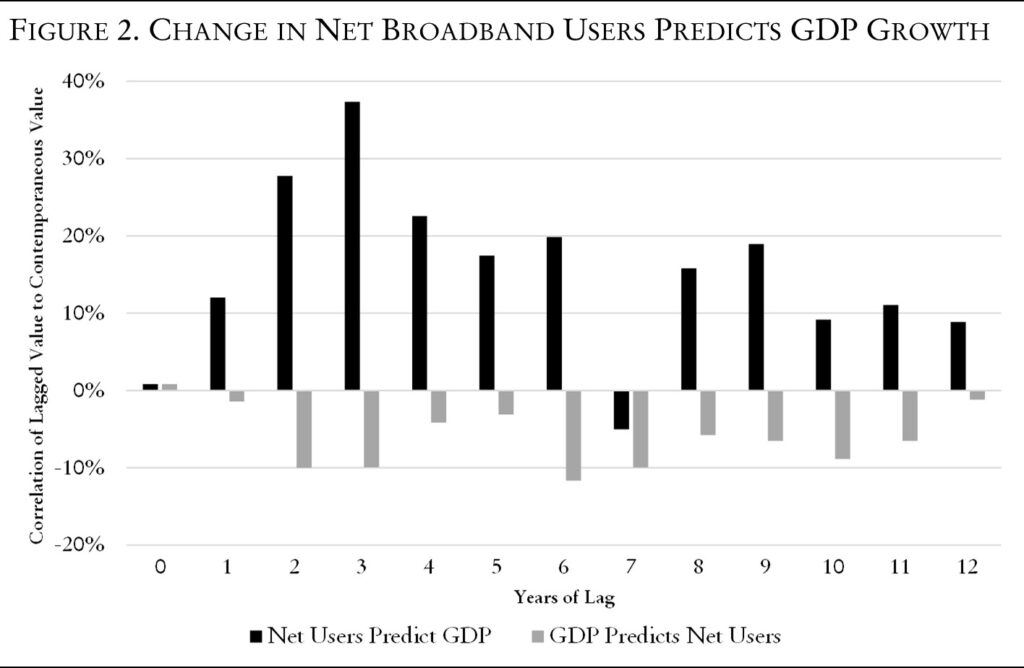
This intuitive presentation is consistent with academic studies of the impact of broadband on economic growth. One study reported that, in Latin America, “a 1-percentage-point increase in mobile broadband penetration produces a gain in GDP growth of 0.20 percentage points.”2
The fact that the buildout of internet infrastructure in the developing world consistently precedes GDP growth leads to a key inference: access to the internet in the Global South is not a luxury made possible by GDP growth, but rather a determinant of future GDP growth. China’s most visible investment in the Global South, in other words, promotes economic growth.
This raises another question: how does access to broadband foster economic growth? The answer suggested by the data is that it promotes entrepreneurship.
When the proportion of internet users in a given country crosses the 60 percent threshold, business formation—at least in some countries—takes off. That’s not surprising. Broadband allows individuals at the margin of society to make electronic payments, secure credit, identify suppliers and customers, and all for the cost of a $100 smartphone. Railroads drastically cheapened the cost of moving goods, and broadband cheapens the cost of moving data.
Western commentators have subjected some of the large-scale projects that China has undertaken through BRI to extensive scrutiny. These include ports, railway lines, and other infrastructure. But the grassroots impact of mobile broadband and the applications it makes possible may have the greatest impact on economic growth in the Global South.
An entrepreneurial surge did not happen in every country where broadband became available, however. The eighty-five countries shown in figure 3 exclude the developed world and very small economies, but include virtually all the developing world. The vertical axis shows the World Bank’s measure of new business registrations; depending on the country, that may or may not be an accurate measure of business formation. Nevertheless, the regression is significant at the 99.9 percent confidence level.
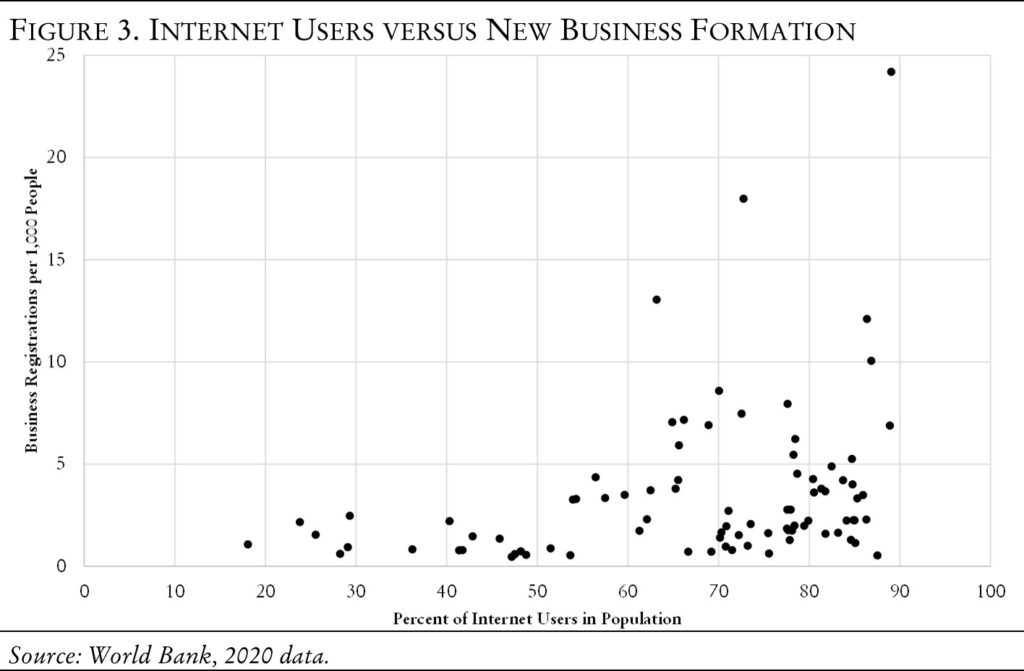
Business registrations, to be sure, are only one index of entrepreneurial activity. The smartphone enables a wealth of other economic stimuli. With electronic payments, governments can collect sales tax from people who previously worked outside the formal economy. Broadband also cheapens the delivery of public services, including health and education.

In several developing countries, farmers use mobile phones to find the best prices for their products. In Kerala, India, fishermen use mobile phone services to boost their profits by finding out when average fish prices stabilize and fall. They can avoid product (fish) wastage and high transaction costs by collecting market information via mobile phones. Both buyers and sellers thus achieve a higher level of well-being.
The case of Brazil is especially interesting. In the wake of the Global Financial Crisis, the rate of business formation dipped from 2.7 new registrations per 1,000 to 1.6 registrations as the national economy suffered low growth and high inflation. The rate of growth of internet users fell in parallel. As the economy recovered and the rate of growth of internet use increased, so did new business registrations.

India, by contrast, has a far lower rate of business formation than other large developing countries. This corresponds to the low rate of broadband penetration (45 percent of the population, well below the 60 percent threshold above which business formation tends to rise). It should be noted that business formation is low not because of a lack of entrepreneurial character among Indians. Indians who want to be entrepreneurs tend to emigrate. One-third of the graduates of the Indian Institutes of Technology, the country’s most prestigious universities for science and engineering, leave the country, and account for 65 percent of Indian migrants to the United States, according to a National Bureau of Economic Research study.
Additional Applications
In the popular literature, artificial intelligence is associated with the frontiers of technology. Artificial intelligence applications enabled by broadband, moreover, may have a bigger short-term impact on the poorest economies than on wealthy ones. Huawei designed mobile phone apps to connect customers and merchants, as well as users and funders. In Ghana and Kenya, I was told by representatives of the two countries’ mobile providers that artificial intelligence uses customers’ payment patterns to open lines of microcredit. At Huawei’s Intelligent Finance Summit for Africa in Cape Town in March, sub-Saharan region chief Leo Chen said, “In Africa, there’s an even greater imperative for banks to embrace digitization, as it allows for greater financial inclusion.”
Enabling entrepreneurs is one great benefit of digitization in the Global South. Another is controlling corruption. Writing in the Journal of Telematics and Informatics in 2021, three researchers reported, “In developing countries, businesses and individuals make transactions worth billions every day using physical cash. Such cash payments are often insecure, difficult to trace, and these attributes of cash payments stimulate illegal activities and foster the growth of shadow economies. With the advent of financial technologies including mobile money, digital payment options offer an opportunity to control corrupt behaviors and activities.” The study tested the relationship between digital payments in 111 developing countries from 2010–18, and found strong empirical evidence to support the thesis.
Corruption seeps into every crevice of economic life in the Global South. A Mexican of my acquaintance took a job with the water company of a certain city, in which he was supposed to turn off service to users in default. No one’s service was suspended, however. Rather, the employee took a bribe, kept 30 percent, and passed the rest up the management chain. Small-scale corruption is just as corrosive as large-scale corruption, and digital payments help to eliminate both.
Only 6 percent of people in high-income OECD countries are unbanked, compared to nearly half in the Global South, according to the World Bank. The United States has nearly thirty bank branches per 100,000 in population, compared to four in the least developed countries. Mobile broadband and inexpensive smartphones can provide the poorest countries with quick access to financial services at a fraction of the cost of brick-and-mortar banking. Billions of people now on the margin of the world market can gain access to payment services and micro-credit, promoting local entrepreneurship.
What the data show, in summary, is that China’s growing economic presence in the Global South fosters entrepreneurship and reduces corruption.
Chinese Investment and Authoritarianism
Western commentators often allege that China seeks to undermine democracy and support authoritarianism. Writing in Foreign Affairs in 2021, Charles Edel and David Shullman aver:
Although some analysts continue to argue that China does not pose an ideological threat to prevailing democratic norms and that the CCP does not export its ideology, it is clear that the CCP has embarked on a drive to promote its style of authoritarianism to illiberal actors around the world. Its goal is not to spread Marxism or to undermine individual democracies but rather to achieve political and economic preeminence, and its efforts to that effect—spreading propaganda, expanding information operations, consolidating economic influence, and meddling in foreign political systems—are hollowing out democratic institutions and norms within and between countries.
Edel and Shullman do not mention any individual countries where China has contributed to authoritarian practices. It is certainly the case that facial recognition, for example, can be used by authoritarian governments to track individuals, but democracies use the technology as well, for example, to identify passengers boarding civilian flights.
I have not found any empirical study that compares China’s economic footprint in developing countries with the degree of authoritarianism of the regime. As a stopgap, I compared China’s largest markets, ranked by percentage change in exports between January 2016 and July 2023, with the Freedom House rankings for the same countries. (Excluded from the sample were African countries and former Central Asian republics of the Soviet Union, many of which have little history of democratic government.) The results are shown in figure 6.
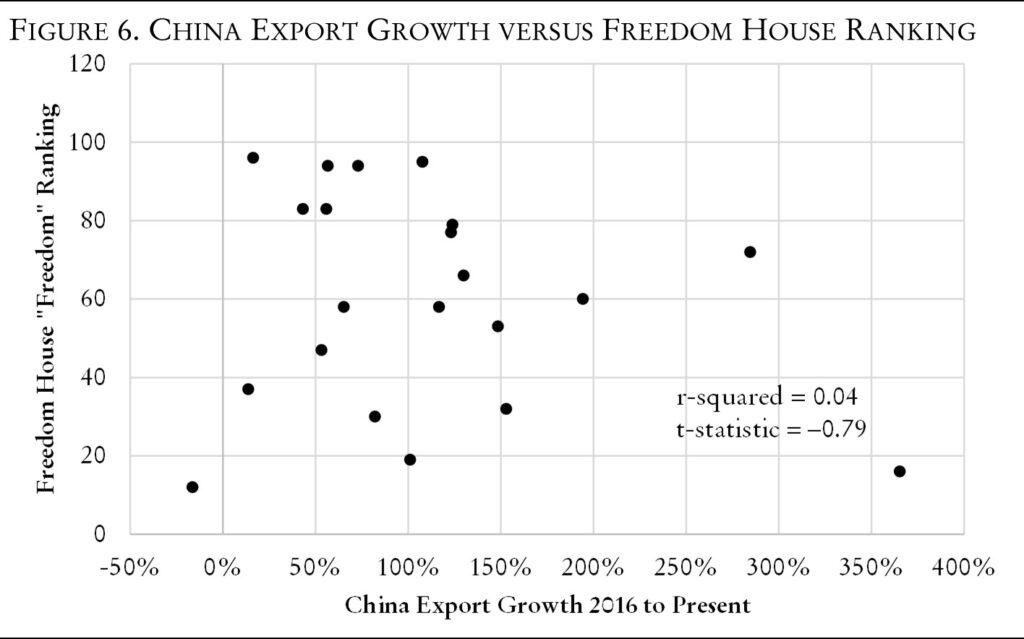
The result is close to a random plot, with an r-squared of regression of just 4 percent. China’s exports to Russia topped the list, but the next nine countries have elected leaders. China has not, to my knowledge, been accused of meddling in the internal affairs of Brazil, Mexico, Turkey, Malaysia, India, or South Africa. By contrast, China’s exports to Pakistan and Iran, two repressive countries, barely grew or declined since 2016.
There is no empirical evidence that China uses its economic power to foster authoritarianism. It would be more accurate to say that China is indifferent to the political systems of countries with which it trades. American officials and research organizations have warned that Chinese control of communications infrastructure will give China access to sensitive data. Heritage Foundation analyst Ana Rosa Quintana wrote in 2021: “Latin American governments must carefully weigh their options as they pursue their 5G future. This next-generation technology is not solely about reaching faster Internet speeds; it is also about maintaining sovereignty over critical sectors and infrastructure. Protecting nations means restricting Huawei—which often function as an extension of the Chinese Communist Party’s security enterprise—from dominating the region’s wireless networks.” Yet I asked a senior Mexican official who formerly directed the country’s intelligence service whether he was worried about prospective Chinese eavesdropping. “This is Mexico,” he replied, “We don’t have any secrets worth stealing.”
Perceptions of China in the Developing World
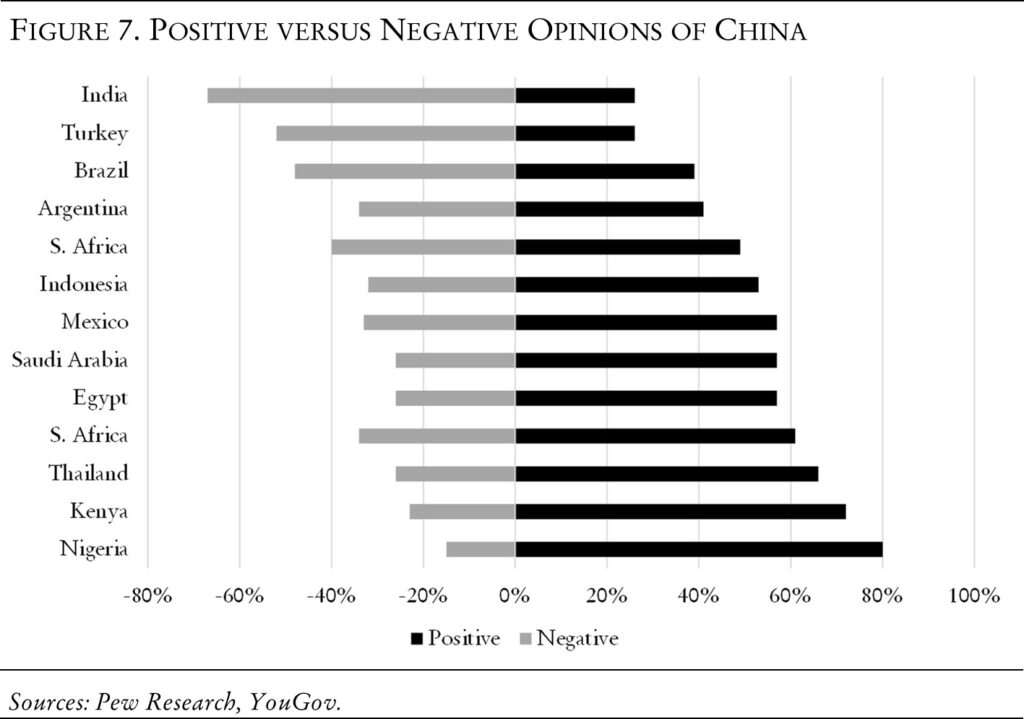
China’s more than $1 trillion of loans through the Belt and Road Initiative entail a significant number of high-profile problems. These developing economies are often cartelized and corrupt, and face challenges ranging from political instability to inadequate infrastructure. Foreign investment in the Global South, outside of East Asia, has stagnated since the Global Financial Crisis, according to unctad data. Nevertheless, as a newcomer without strong relationships in the Global South, China has chosen to become an agent of transformation in local economies, beginning with mobile broadband and the ecosystem of businesses that grow from it. Perceptions of China are most favorable in countries where China has the biggest trade and investment footprint. A 2022 study by YouGov notes:
an obvious divide between the West and other parts of the world is general sentiment towards [China]. This includes majorities in nine out of twelve non-Western countries in the sample with positive views of China’s role in the world. In another example of a V-shaped pattern, there are also signs that China’s reputation may be bouncing back after the pandemic in places beyond the West. In Mexico, for example, positive views of China fell from 73% in 2019 to 50% in 2021 but changed direction this year to 59%. In both Egypt and Saudi Arabia, the positive portion for this year is 57%, up from 47% and 41% respectively in 2021. Thailand, Kenya, and Nigeria show a similar jump of at least 15% over the same period.
Among the largest countries in the Global South, only India, Brazil, and Turkey reported a negative opinion of China in a 2023 Pew Research survey, similar to the results of the 2022 YouGov survey. The United States Institute of Peace reported in 2021: “We find that China is generally viewed favorably. We’ve asked this question in 16 countries in both 2014–15 and 2019–20. In the most recent surveys, 60% of respondents said that China’s influence is ‘somewhat’ or ‘very positive.’ This is down slightly from 65% who held this view five years ago, with declines in 10 of the 16 countries, including large drops in Gabon (22% decline) and Namibia (18% decline). However a few countries report increases, led by Ghana (13% increase).”
The positive image of China in the Global South is the outcome of careful cultivation. Chinese companies have adapted successfully to local conditions and overcome historical animosities. A July 2022 Carnegie Endowment study reports:
On average, Indonesians distrust China and many Chinese firms. Yet Huawei and to a lesser extent ZTE have successfully positioned themselves as trusted cybersecurity providers to the Indonesian government and the Indonesian nation. This has been no easy feat given long-held Indonesian animosity toward China. Many Chinese companies have faced protests over concerns they were taking local jobs. Huawei and ZTE have suffered no such fate. Nor has there been a broad coalition of Indonesian voices against using Chinese technology in critical telecommunications infrastructure. In short, Indonesians care a lot more about Chinese cement plants than they do about Huawei involvement in 5G networks.
This is a vastly different conversation to those happening in rich liberal democracies. Huawei and ZTE have been able to achieve success in Indonesia, despite a sense of ambivalence among the Indonesian political and defense establishment about Chinese intentions and growing Western scrutiny over the use of Chinese technology in broadband networks.
The authors of the Carnegie Endowment study conclude, “If rich liberal democracies are concerned about this trend, then they need to offer workable alternatives that place Indonesia’s enormous digital development needs at the heart of any value proposition.”
China’s market share in broadband infrastructure is hard to determine, but it makes up the majority in the Global South. Huawei’s 2020 market share in the global service provider networks market was 37.3 percent, versus 16.5 percent for Nokia. Since its market share in the United States and Japan is zero, the proportion must be considerably higher in the Global South. According to one estimate, Huawei components comprise 70 percent of Africa’s 4G networks. Huawei has become the leading infrastructure provider in Brazil. In Mexico, Huawei provided the majority of equipment for the Red Compartida (shared network) that the country established in 2014 to expand broadband coverage. Among the most important economies of the Global South, only India buys the majority of its infrastructure from Huawei’s competitors, although Indian telecom providers use a substantial amount of Huawei equipment.
China’s economic growth, starting in the late 1970s, was the great economic event of the second half of the twentieth century. The per capita GDP of the world’s most populous country grew twenty-seven-fold between 1979 and 2022 in terms of real purchasing power parity, according to the World Bank. A second wave of transformation is now underway in the rest of the Global South. This may be the great economic event of the first half of the twenty-first century, and the United States is largely a bystander.
This article originally appeared in American Affairs Volume VII, Number 4 (Winter 2023): 78–89.
Notes
1 The countries are Bangladesh, Brazil, Chile, China, Colombia, Egypt, Indonesia, India, Kazakhstan, Kenya, Mexico, Malaysia, Nigeria, the Philippines, Singapore, Turkey, Vietnam, and South Africa, as reported by the World Bank Indicators Database. The rate of GDP growth and the rate of change of internet usage were calculated as the first principal component of the two series, respectively. The first principal component is a common factor orthogonal to other determinants of growth. First principal component explains 42 percent of the variation of change in internet usage across the universe and 48 percent of change in GDP growth, and is highly significant in both cases.