
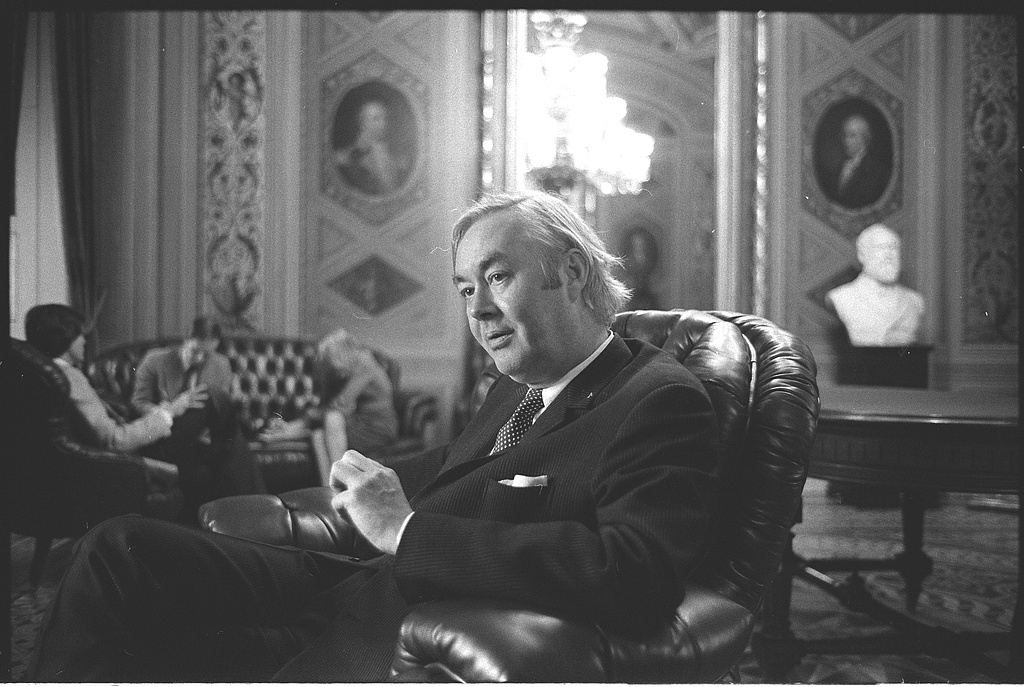
Dinners with Moynihan
“Lind,” the voice on the phone told me one day in the mid-1990s, “I’ve been talking trash all day with Al D’Amato. Can you meet me tonight for dinner?”
That is how dinners or lunches with Daniel Patrick Moynihan typically came about. My phone would ring and a secretary would tell me, “Please hold for Senator Moynihan.” Then the familiar voice in those familiar clipped tones would say something like the sentence above—or, to use an example from another occasion: “Michael, I’ve been listening to Donna Shalala [Bill Clinton’s Secretary of Health and Human Services] testify all morning and I need a break. Can you meet me at two o’clock?”
That particular evening at Bice, an upscale restaurant on Pennsylvania Avenue that is now defunct, Moynihan explained what he meant by “talking trash with Al D’Amato.” The two New York senators, one Democrat and one Republican, had teamed up to battle a coalition of western states that did not want garbage from the East Coast buried inside their borders. New York had lost the battle. “You should write an article saying we should consolidate all of those underpopulated western states into one, so that they only have two senators,” Moynihan told me that night, expressing a thought which has probably occurred to more than one East Coast politician.
On looking into the subject, I discovered that the federal Constitution prevents two or more states from being consolidated into a single state against their will. As my friend Walter Russell Mead pointed out to me, however, the Constitution does permit a single state to divide itself into two or more states, with the approval of its own people and Congress. In an article entitled “75 Stars,” in the January/February 1998 issue of Mother Jones, I argued that the best way to reduce the malapportionment of the U.S. Senate would be for populous states like New York, California, and Texas to divide into smaller successor states, each with two U.S. Senators. I sent a copy of the article to the Senator who had suggested the topic.
In October 1998, my mail included a copy of “The Fisc,” Moynihan’s annual report to the people of New York, in which he meticulously documented how little the state received in federal subsidies compared to the federal taxes its residents paid. “Dear Michael: Here in the 22nd edition of our annual study of the balance of payments between the states and the Federal government, I fear you have been implicated,” he wrote in the note that accompanied the report. “See pages 17–21. In my introduction I address the emerging issue of Senate apportionment. Mother Jones permitted us to incorporate the maps from your superb “75 Stars” piece which, along with a few of your quotes, added immeasurably to our report.” New York, the state that Moynihan represented in the Senate, had been divided into four new states with a total of eight senators. I regret not having asked him which of the four New Yorks he would have preferred to represent.
Coming a Long Way
Daniel Patrick Moynihan (1927–2003) shared the record with Jacob Javitz for representing New York in the U.S. Senate for four terms (1977 to 2001), until Chuck Schumer set a new record by winning a fifth term in 2022. Moynihan had come a long way from his birthplace in Tulsa, Oklahoma. When his alcoholic father deserted the family, Moynihan as a boy moved to Manhattan with his mother, who tended bar in Hell’s Kitchen, then a heavily Irish American slum. During the Depression, the young Moynihan shined shoes and worked as a longshoreman before attending City College of New York, which charged no tuition.
His service in the Navy during World War II allowed him to attend Tufts University, where he received two undergraduate degrees—one in naval science and one in sociology—and an MA from the Fletcher School of Law and Diplomacy as well as a PhD in history. His education included a Fulbright scholarship to the London School of Economics (LSE). Being a member of New York governor Averell Harriman’s staff led to his marriage to a fellow staffer, Elizabeth Brennan, and to service in the Kennedy and Johnson administrations. In 1965, as an appointee in the Labor Department, he wrote the still controversial report “The Negro Family: The Case for National Action.”
Leaving the Johnson administration, he taught at Wesleyan and Harvard, and like many of the liberals who later became known as neoconservatives, he grew increasingly antagonistic toward the radical Left. Still a Democrat, Moynihan joined the Nixon administration as an adviser, and served as U.S. ambassador to India (a post held in the Kennedy years by another eminent liberal intellectual, John Kenneth Galbraith). His time as an eloquent and fiery U.S. ambassador to the United Nations, where he defended the United States and denounced resolutions equating Zionism with racism, made him a celebrity and helped him to win one of the two U.S. Senate seats from New York in 1976.
This kind of impressive cursus honorum is typically achieved by bland careerists with conventional opinions. But Moynihan was a controversial and highly original public intellectual as well as an appointed and elected official at the highest levels, writing books that bear rereading today, including Beyond the Melting Pot, with Nathan Glazer (1963), Maximum Feasible Misunderstanding: Community Action in the War on Poverty (1969), On the Law of Nations (1990), Pandaemonium: Ethnicity in International Politics (1994), and Secrecy: The American Experience (1998). While Moynihan admired Woodrow Wilson as a champion of liberal internationalism, he more closely resembled Theodore Roosevelt in his range of intellectual interests—and he shared what Roosevelt’s daughter Alice described as her father’s wish “to be the corpse at every funeral, the bride at every wedding and the baby at every christening.”
A Practical Politician
From 1991 until his death in 2003, Daniel Patrick Moynihan invited me to dinner with him once or twice a year. He never invited anyone else on these occasions and never discussed anything personal. He wanted an intellectual sparring partner, I came to realize, and I did what I could to carry out that demanding assignment.
Our acquaintance began during the Gulf War in 1991, when I held a minor position at the State Department’s Foreign Service Institute. In the winter 1990/91 issue of the National Interest, the foreign policy quarterly where I later worked as executive editor under the founding editor, Owen Harries, I reviewed On the Law of Nations under the title “Moynihan’s Law.” I took issue with a number of Moynihan’s assertions in the book, but I concluded by endorsing his critique of conservatives who rejected the very idea of international law. I concluded: “Even if occasional violations of international and constitutional law helped the United States during the Cold War, “it would be a mistake to believe with Andrew Marvell that ‘the same Arts which do gain/ A Pow’r must it maintain.’ In the changed circumstances of the 1990s, it would be a sad irony if a hostility to the very idea of public international law should handicap efforts by the successor generation of American conservatives to promote the peaceful, pluralist, and prosperous world order that American conservatives have sought for so long.”
To my surprise, soon after the issue appeared I received a phone call at my office in the State Department’s Center for the Study of Foreign Affairs, where I was then employed. “Can you take Senator Moynihan’s call?” a secretary asked. Our first conversation lasted for an hour and a half, ranging from international law to the Gulf War and the debate over the end of the Cold War, which Moynihan with some justification claimed to have foreseen.
I didn’t hear from him again until he sent me a note from his home in Pindars Corners in upstate New York on August 31, 1991. “Dear Mr. Lind: Is it Dr.? Buckley thinks you’re St. Paul” (William F. Buckley Jr., had asked Moynihan to cosponsor me as a term member of the Council on Foreign Relations). Moynihan went on to criticize an article in Foreign Policy magazine which had been written, not by me, but by William Lind, a conservative military expert. On September 9, I sent my reply: “Dear Senator Moynihan: For the record, I am not who you think I am. . . . My life would be simpler if Mr. (William) Lind would only write about urban policy, or if my last name were even more uncommon—say, Moynihan.”
Our first meeting took place during an intermission at a conference on the former Soviet Union that the Nixon Center held in Washington in 1992. “So you’re Michael Lind,” he said, as he looked down on me (every time I joined him later, I, at five-foot-ten, was surprised again by how tall he was at six-foot-four).
That meeting led to the first of our mealtime seminars, at La Brasserie near the Capitol. I remember vividly how animated he became when he brought the conversation around to the subject that was then dominating his thoughts. “Last weekend half a dozen young men were murdered here in Washington.” He banged the table. When he grew intense, emotion shattered his sentences into phrases. “Murdered! Gangland style. In 1929 the St. Valentine’s Day Massacre made headlines across the country. Across the world. We have a St. Valentine’s Day Massacre here in the capital every weekend. Front page news? No. Page fourteen.”
Not long afterward, as I was sitting at my desk at the National Interest, Irving Kristol, the publisher, handed me the Winter 1993 issue of the American Scholar, telling me, “This is very important.” The article was “Defining Deviancy Down” by Daniel Patrick Moynihan. I recognized most of it from my conversation at lunch with the Senator.
In 2002, not long before his death, Moynihan for some reason mailed me a decade-old offprint of “Defining Deviancy Down.” “For Michael Lind with great respect. 2002,” he wrote on the cover. For my benefit Moynihan had gone over the essay page by page, using a yellow magic marker to highlight a number of sentences. Here are a few:
I proffer the thesis that, over the past generation, since Erickson wrote, the amount of deviant behavior in American society has increased beyond the levels the community can “afford to recognize” and that, accordingly, we have been re-defining deviancy so as to exempt much conduct previously stigmatized, and also quietly raising the “normal” level in categories where behavior is now abnormal by any earlier standard. . . . The third category, the normalizing, is to be observed in the growing acceptance of unprecedented levels of violent crime. . . . Consider the St. Valentine’s Day Massacre. In 1929 in Chicago during Prohibition, four gangsters killed seven gangsters on February 14. The nation was shocked. The event became legend. It merits not one but two entries in the World Book Encyclopedia. . . . James Q. Wilson comments that Los Angeles has the equivalent of a St. Valentine’s Day Massacre every weekend.
Critics sometimes derided Moynihan as an impractical intellectual in politics. But he took great pride in being a no-nonsense politician who could get things done for his constituents. In different conversations over the years, he returned to one of his obsessions—the need to repaint a bridge in New York. He was at his theatrical best, declaiming on this subject over supper: “During World War II, the Lincoln Tunnel was built in a matter of weeks. Weeks! Workers died—but it was built! For years I have been trying to get Hell Gate Bridge repainted. Can’t be done. There’s always another permit. Another bureaucracy.” Shortly before the end of his last term, the bridge finally acquired its first new coat of paint in eighty years. Moynihan was present for the ceremony. He would have been honored by the conversion of the former U.S. Post Office next to New York’s Penn Station into Moynihan Train Hall—and pleasantly surprised that its grand opening came in 2021, only eighteen years after his passing.
During one of our suppers in Washington, an elderly lady from New York came over and introduced herself. Moynihan joined her and her family at their table for what must have been half an hour before returning to ours. When I moved to New York in 1994, at a time when the Senate delegation from the state was shared by Moynihan and Al D’Amato, I joined his constituency. “Dear Senator Moynihan,” I wrote. “Now that I am a New Yorker, I proudly tell people that I am represented by one of the most colorful and flamboyant characters in the United States Senate—and by you as well.”
Cautious Liberals and Reckless Neoconservatives
“Dear Michael: Here is Caste and Class, as promised. I hope you will find it as rewarding as I have done over the years,” Moynihan wrote on January 18, 1993, in the note that accompanied his gift of a copy of John Dollard’s 1937 sociological study of class and race in Indianola, Mississippi, Caste and Class in a Southern Town. In his foreword to the University of Wisconsin Press reprint of 1988, Moynihan wrote that the book is a “work of epic consequence.”
Whatever the influence of Dollard’s work on scholarship, its influence on Moynihan’s thought was profound. Moynihan, an Irish American from a broken family, clearly identified with Dollard, a sociologist of an older generation who died in 1980. In his foreword, Moynihan wrote, “He was Irish; his father, a railroad engineer killed in a wreck; he was not himself from the right side of the tracks, as the saying then was. . . . He knew well enough that the Irish of the North had had a touch of caste problems and had responded through politics with considerable effect.”
Dollard’s ideas were more important for him than Dollard’s example. To quote the foreword again: “I think, in particular, of the proposition that ‘The usual human response to frustration is aggression. . . .’ It happens that I spent part of the 1970s as an American ambassador in Asia [India] observing and reporting on a wide range of what might be called post-colonial political debate. I was early on struck by the persistence, almost the centrality, of this explanatory device.”
In our conversations, Moynihan emphasized that it had come to him as a great revelation in his youth that caste and class are two different things. Most liberals and socialists, and many conservatives, assume that people are rational economic actors. In both its left-wing and right-wing forms, this optimistic doctrine holds out the hope that proper economic policies can remove the sources of political conflict. But identity politics, the politics of caste, ethnicity, and nationalism, is fundamentally nonrational. Schemes for social reform inevitably will be wrecked, if the reformers pay too little attention to the communal sentiments of the human animal. This was a theme he developed at length in his study of postcolonial nationalism, Pandaemonium (1992).
I could share Moynihan’s admiration for John Dollard, but not his veneration of Sigmund Freud. To Moynihan, as to many of his generation, Freud had been one of the great minds of history, a figure with the epochal importance of Newton or Einstein. I tried to interest him in the revisionist literature that claimed that Freud had been discredited by modern neuroscience. But I sensed that this was a lost cause and did not press the issue.
Moynihan had no attachment to Freud’s particular theories, as far as I could tell. Freud, like Dollard, owed his place in Moynihan’s personal pantheon to the fact that he symbolized a tough-minded social science that combined aspirations for rational reform with a recognition of the irrational element in human nature. This recognition led many neoconservatives of his generation to turn against social science and reform altogether. Following his youthful intellectual encounters with Dollard and Freud, Moynihan retained his Enlightenment liberalism, but his was a chastened liberalism, like that of Edmund Burke, or Immanuel Kant, who observed, with a nod to Ecclesiastes: “From the crooked timber of humanity nothing straight can be made.”
Nikita Krushchev once asked, “What kind of communism is it that can’t make sausage?” Hardline communist ideologues responded by deriding Krushchev as a heretical “practicist.” “Practicism” is a pretty good description of the tough-minded liberalism that Moynihan shared with Nathan Glazer, Daniel Bell, James Q. Wilson, Samuel P. Huntington, and other first-wave “neoconservatives” (the term was coined, as an insult, by Michael Harrington). Several of the original neoconservatives preferred to call themselves “paleoliberals.” In addition to maintaining the liberal anticommunism of Truman, Kennedy, and Johnson after the debacle in Vietnam, most of the early neoconservatives believed that liberal social policies needed to be based on sound empirical research and corrected by the lessons of experience. They were cautious liberals, but liberals still, for whom the alternative to misguided social policy was well-informed social policy.
By 1991, when I went to work for Irving Kristol’s The National Interest as executive editor, this kind of neoconservatism was almost moribund. Half a decade earlier Daniel Bell had resigned as coeditor of the Public Interest, Kristol’s other intellectual quarterly, as the original focus of the neoconservatives on empirical social research had given way to apologetics for right-wing Republican causes like opposition to gun control, supply-side economics, and “the culture war.” The emphasis on skepticism and scholarship that united the early neoconservatives like Moynihan and Bell could not survive the alliance of the movement with dogmatic southern Protestant fundamentalists and equally dogmatic secular libertarians, alliances that resulted in my departure from neoconservatism in the mid-1990s.
Moynihan had been spoken of as a possible neoconservative Democratic presidential candidate in the 1970s. In the following decade, however, he alienated many of the neoconservatives with his criticisms of the Reagan administration’s contempt for international law and its covert war in Central America. In spite of his disgust with the increasingly imperial cast of neoconservative thought, he remained friendly with many of the older neoconservatives. Only once did the topic come up in conversation. “We must not break with our friends!” he said emphatically. When I pointed out that he had been vilified in print by several leading neoconservatives for his foreign policy views, the senator pursed his lips tensely and would say nothing more on the subject.
The Moynihan who pleased the neocons when he denounced the alliance of the Soviet bloc and the nonaligned nations against the United States and Israel in the 1970s was the same Moynihan who alarmed the neocons when he denounced the United States as an international scofflaw in the 1980s and 1990s. A lifelong admirer of Woodrow Wilson’s foreign policy who upon retirement joined the Wilson Center in Washington as a fellow, Moynihan believed as sincerely in the idea of the United Nations as he did in the ideal of international law. The purpose of opposing Soviet aggression, in his view, was to allow the UN system to function—not to enable world domination by the United States. More eloquently than anyone else, in On the Law of Nations, he sounded the alarm about the repudiation of the very idea of international law by many neoconservatives, including some of his former allies.
Moynihan would have been appalled if he had lived to witness President George W. Bush’s appointment of John Bolton as U.S. ambassador to the UN. During Bush’s first term, Bolton played a key role in the scuttling of the anti-ballistic missile treaty, the nuclear test ban treaty, and conventions governing small arms proliferation and biological weapons. “If I were redoing the security council, I’d have one permanent member because that’s the real reflection of the distribution of power in the world,” said George W. Bush’s nominee for the important UN post that was once held by Daniel Patrick Moynihan.
The Moynihan Report
Moynihan’s memory will always be entwined with the controversy over the so-called Moynihan Report, “The Negro Family: The Case for National Action,” a study that he prepared for internal circulation while working in the Labor Department under President Johnson. When it was leaked to the press, Moynihan was denounced as a racist for using the phrase “tangle of pathology” by fellow liberals and leftists who did not realize he got the term from the black scholar Kenneth B. Clark. The psychologist William Ryan denounced Moynihan for “blaming the victim.”
The Left denounced Moynihan as sexist as well as racist. Radical feminists criticized Moynihan’s characterization of female-headed one-parent families as “matriarchy,” while some Black Power radicals claimed that the fatherless family was a legitimate expression of black culture, and it was racist to suggest that it was worse for children than a two-parent family. But Moynihan’s view that public policy should minimize obstacles to the flourishing of the one-earner, two-parent family was the consensus among New Deal and Great Society liberals and mainstream black civil rights leaders. The New Deal combined public employment for unemployed men, single and married, in programs like the Civilian Conservation Corps (CCC) and Works Progress Administration (WPA), with direct cash relief for unmarried mothers via Aid to Families with Dependent Children (AFDC) so they could be full-time homemakers.
The consensus in favor of the two-parent, male-breadwinner family was shared by black civil rights leaders. In 1967, A. Philip Randolph and Bayard Rustin published “A Freedom Budget for All Americans,” with a foreword by Martin Luther King Jr. and research supplied by the economist Leon Keyserling. The first three priorities of the ten-point race-neutral plan, designed to help the white poor as well as the black poor and other groups, were “To provide full employment for all who are willing and able to work, including education and training to make them willing and able,” “To assure decent and adequate wages to all who work,” and “To assure a decent living standard to those who cannot or should not work.” Those who “cannot or should not work” included “the physically disabled, the elderly, women with young children, etc.” (emphasis added).
On March 1, 1970, the New York Times provided further ammunition to critics of Moynihan, then a Democrat serving in the Nixon administration, when it published a misleading article by Peter Kihss entitled “‘Benign Neglect’ on Race Is Proposed by Moynihan.” The headline quoted a phrase from a leaked memo by Moynihan out of context, implying that he was advising the Nixon administration to neglect black Americans. In fact, he was arguing that the administration should quietly support efforts to help black Americans while ignoring provocations by right-wing racists and leftist radicals:
The time may have come when the issue of race could benefit from a period of “benign neglect.” The subject has been too much talked about. The forum has been too much taken over to hysterics, paranoids, and boodlers on all sides. We may need a period in which Negro progress continues and racial rhetoric fades. The administration can help bring this about by paying close attention to such progress—as we are doing—while seeking to avoid situations in which extremists of either race are given opportunities for martyrdom, heroics, histrionics or whatever.
But the damage had been done. “Tangle of pathologies” and “benign neglect” were lifted out of context and attached to the phrase “blaming the victim” to make Daniel Patrick Moynihan the first major target of what would later be called “cancellation” by the liberal Left.
Nearly sixty years after the Moynihan report, the ritual denunciation of Moynihan by thinkers on the left continues. For example, in 2015, Touré Reed published an essay on Nonsite.org entitled “Why Moynihan Was Not So Misunderstood at the Time: The Mythological Prescience of the Moynihan Report and the Problem of Institutional Structuralism.” Reed divides the liberals of the 1960s into two groups—a good group of “economic structuralists” including John Kenneth Galbraith, Gunnar Myrdal, and Michael Harrington, whom he opposed to villains in the form of “institutional structuralists,” including Walter Heller of Johnson’s Council of Economic Advisers and Moynihan, who allegedly ignored economic structure and blamed “the character deficiencies of the poor.”
Among the many problems with this arbitrary and unhistorical dichotomy is the fact that, by Reed’s own definition, Moynihan was not an “institutional structuralist” who blamed the victim, but rather an “economic structuralist” who “viewed poverty through the lens of political economy and thus identified redistributive programs, including work relief and job training, as the most effective weapons to combat poverty.”
That Moynihan viewed poverty “through the lens of political economy” is clear from the report:
From 1951 to 1963, the level of the Negro male unemployment was on a long-run rising trend, while at the same time following the short-run ups and downs of the business cycle. During the same period, the number of broken families in the Negro world was also on a long-run rise, with intermediate ups and downs.
Did Moynhihan blame the “character deficiencies of the poor” for the high percentage of black female-headed single parent families? No, he blamed low wages for black men:
Because in general terms Negro families have the largest number of children and the lowest incomes, many Negro fathers literally cannot support their families. Because the father is either not present, is unemployed, or makes such a low wage, the Negro woman goes to work. Fifty-six percent of Negro women, age 25 to 64, are in the work force, against 42 percent of white women. This dependence on the mother’s income undermines the position of the father and deprives the children of the kind of attention, particularly in school maters, which is now a standard feature of middle-class upbringing.
Moynihan made it clear he was talking about low-income black men and women who often toiled at terrible jobs for poverty wages, not the black middle class. Reinforcing his “political economy” explanation, Moynihan notes the correlation within the black community between higher incomes and stable traditional families:
There is much evidence that a considerable number of Negro families have managed to break out of the tangle of pathology and to establish themselves as stable, effective units, living according to patterns of American society in general. . . . It might be estimated that as much as half of the Negro community falls into the middle class. However, the remaining half is in desperate and deteriorating circumstances.
Moynihan concluded that “during times when jobs were reasonably plentiful . . . the Negro family became stronger and more stable. As jobs became more and more difficult to find, the stability of the family became more and more difficult to maintain.”
According to Reed, “economic structuralists” favored “redistributive programs, including work relief and job training, as the most effective weapons to combat poverty.” Again, Moynihan fits the definition. As a U.S. senator from New York he favored a public jobs guarantee and tried unsuccessfully to revive a version of the New Deal’s Civilian Conservation Corps (CCC), the American Conservation Corps, which passed Congress only to be vetoed in 1984 by President Reagan.
What about other kinds of redistribution? Here is Moynihan in the report complaining that the U.S. welfare state is too miserly, particularly toward mothers and children:
The American wage system is conspicuous in the degree to which it provides high incomes for individuals, but is rarely adjusted to insure that family, as well as individual needs are met. Almost without exception, the social welfare and social insurance systems of other industrial democracies provide for some adjustment or supplement of a worker’s income to provide for the extra expenses of those with families. . . . The Federal minimum wage of $1.25 per hour provides a basic income for an individual, but an income well below the poverty line for a couple, much less a family with children.
During his time in the Nixon administration Moynihan promoted the Family Assistance Plan, a guaranteed minimum income for all families with children. The plan died in Congress, but it was a precursor for the child tax credit and aspects of the earned income tax credit (EITC). When it comes to redistribution, as well as work relief, Moynihan fits Reed’s profile of an “economic structuralist.”
It is true that Moynihan worried that an unjust economic system, by causing family breakdown and high rates of illegitimacy among low‑wage workers, could create a self-perpetuating cycle of economic and social failure, which higher wages and better jobs by themselves could not necessarily correct in the absence of other reforms. That his view was far from defeatism is clear from his most famous aphorism, delivered during a speech in 1986 at Harvard: “The central conservative truth is that it is culture, not politics, that determines the success of a society. The central liberal truth is that politics can change a culture and save it from itself.”
Touré Reed, then, constructs and attacks a false image of Moynihan as someone who blamed the poverty of low-income black Americans on family structure alone. That was not Moynihan’s view, but a version of it was embraced in the late twentieth century by many on the American right, who claimed that a major if not the sole cause of black poverty—and perhaps poverty among other groups—was a lack of marriage, enabled and encouraged by a too-generous welfare state. The mainstream right and some centrist neoliberals embraced the facile theory of the “the success sequence,” which holds that people who complete a high school education, work full time, and marry before they have children are unlikely to be poor. This is true, just as it is true that British families with castles and titles tend to be rich. It does not follow that the way to become rich is to obtain a castle and a title of nobility.
Moynihan rejected the right’s misappropriation and manipulation of his scholarship. I know, because I asked him, in one of those wood-paneled steak restaurants which provided an old-fashioned New York City atmosphere in sterile downtown D.C. Did he believe that the black family breakdown that he documented in the 1960s was the result of liberal social policies in the Northern cities, as many conservatives claimed?
His answer was that the trends toward out-of-wedlock births that the Moynihan Report documented could be traced back to the 1930s and 1940s—the very time of the Great Migration of black Americans from the fields of the South to the cities of the North, where they encountered racism in the northern labor market. It was chronologically impossible for the alleged effect—the disintegration of the black family in the 1940s and 1950s—to be the result of the alleged cause, the War on Poverty and the liberalization of welfare policy in the 1960s and later, as many conservatives claimed.
In our conversation, he rejected the argument that liberal social policy could be blamed for black family breakdown—the argument on which the Right had based its entire program of welfare reform. Moynihan’s support for reasonable welfare reform was not based on the premise that it would reduce illegitimacy or increase the marriage rate among the poor, in the absence of economic reforms like wages that could support a one-earner, two-parent family and a more family-friendly welfare state. Moynihan denounced and voted against the Republican welfare reform embraced by Bill Clinton, on the grounds that it was far too punitive toward single mothers and their children. “Barbaric” is how he described it to me over dinner once. “No civilized society forces mothers to leave their infants and go to work.” On this issue, I sensed the influence on him of Catholic social thought, as I did when he described late-term abortion to me as “infanticide.”
In an essay entitled “Moynihan Redux: Legacies and Lessons” in the Annals of the American Academy of Political and Social Science (January 2009), Douglas S. Massey and Robert J. Sampson report:
Toward the end of Moynihan’s life, lawmakers proposed tackling ‘family pathology’ not with jobs programs but with federal benefits to promote marriage. Asked to comment, he said, “If you think a government program can restore marriage, you know more about the government than I do.”
While Moynihan was right about many things in the report, he was wrong about one big thing. Like many liberal intellectuals and policymakers in the 1960s, he assumed that the postwar economic boom would continue indefinitely and that the major challenge was to allow the black working class to enjoy the prosperity and stability that middle‑class black Americans and much of the white working class already enjoyed.
Instead, the “thirty glorious years” after 1945 came to an end in the United States and Europe in the 1970s as a result of oil shocks and the technological stagnation of the industries of the second industrial revolution, like automobile manufacturing. Having no idea how to boost productivity, and using the contribution of wage-push inflation to overall inflation as an excuse, the neoliberal economists and policymakers who took over both parties, beginning with Carter and Reagan, launched a half-century program to crush the power of workers to bargain for higher wages, by means of an inflation-eroded minimum wage, deregulation, de-unionization, outsourcing, and global labor arbitrage in two forms—the offshoring of production to low-wage workers abroad and the flooding of many American occupations with low-wage, unskilled workers, both legal and illegal.
When, at the end of the twentieth century, the computer revolution began to take off, the arrangements of a new Gilded Age had already been locked into place under Ronald Reagan, Bill Clinton, and George W. Bush. Instead of highly-automated robot factories with well-paid workers who could support a family by working four days a week, many U.S. corporations transferred production to sweatshops using poor, unfree labor in Mexico and South China. Firms that could not offshore their activities cut labor costs at home by thwarting unionization and outsourcing janitorial and other jobs to independent contractors, while CEO pay ballooned, reinforced by stock buybacks that boosted executive wealth at the expense of productive investment. During the New Deal era of strong unions and regulated capitalism, the CEOs of productive manufacturing firms and national union leaders were household names. In the 2000s, as in the 1900s, the most famous business leaders tended to be bankers like Jamie Dimon or tycoons like Jeff Bezos and Mark Zuckerberg who owned virtual infrastructure like online retail, social media, and search engines, the equivalents of the financiers or railroad and electricity barons of the pre–New Deal era.
As a result of this half-century oligarchic revolution from above in the United States, the same trends that alarmed Moynihan when they seemed confined to the black community in 1965 are now characteristic of much of American society. When Moynihan wrote his report in 1965, the illegitimacy rate for black Americans was 24 percent, and it was 3.1 percent for white Americans. In 2018, 69.4 percent of black Americans were born outside of marriage, along with 51.8 percent of Hispanics, 28.2 percent of white Americans, and 11.7 percent of Asian-Americans.
In the report Moynihan wrote, “There is considerable evidence that the Negro community is in fact dividing between a stable middle-class group that is steadily growing stronger and more successful, and an increasingly disorganized and disadvantaged lower-class group.” Substitute “American” for “Negro” in the first sentence and you have a description of the growing class divide in the United States in the first half of the twenty-first century, now that stable marriages, along with well-paying jobs with good benefits, are becoming luxuries of the college-educated overclass that are beyond the reach of working-class Americans of all races.
Race and Class
While Moynihan’s capacity for alcohol was legendary, I never saw him inebriated, except on one occasion. Without being visibly affected, he could consume impressive quantities of wine. During our suppers and lunches, I was able to hold up my end of the conversation only by drinking water and sipping occasionally at a single glass of wine, while he would empty a bottle or two.
I’ll never forget one dinner at Bice, in which a young waiter periodically brought a bottle of wine to refill his glass, only to withdraw across the room until it was time for another refill. “Where is that damn wine?” Moynihan murmured, after he had emptied another glass. The next time that the waiter approached, the senator seized the bottle and planted it on the table with great decision. Astonished, the waiter slowly and silently backed away. From that point on, Moynihan had the bottle to himself.
Only once did I see Daniel Patrick Moynihan drunk. One day in 1995 he summoned me for supper. When I arrived, he was at the restaurant bar, disconsolate and on the way to inebriation. He turned to me and said bitterly, “I have been talking to the White House. The president has decided to ‘mend it,’ not ‘end it.’” By “it,” he meant affirmative action.
By the 1990s, public criticism of racial preferences had become taboo for Democratic politicians. Moynihan had been deeply hurt by the allegations of racism with which the radical Left had greeted the Moynihan Report. I could understand his unwillingness to take a public stand on the racial preference issue. In private, however, Moynihan made it clear that he was true to the older liberal integrationist tradition in opposing race-based public policy.
In one of our first conversations in the early 1990s, I had asked him if there were any basis to the assertion, commonly made by liberals, that President Lyndon Johnson had made the case for racial quotas in the commencement address he had delivered at Howard University in Washington, D.C., on June 4, 1965. Defenders of racial preferences often quoted one sentence in particular: “We seek not just legal equity but human ability, not just equality as a right and a theory but equality as a fact and equality as a result.”
Moynihan’s response to my question had been an emphatic outburst: “Nonsense! Nonsense! The Howard speech had nothing to do with racial quotas. Nothing whatever.” He knew, he told me, because he and Richard Goodwin had drafted the speech. “What Dick Goodwin and I had in mind were social programs,” he told me, in the staccato style that became more pronounced whenever he was impassioned. “Good jobs. Good schools. Safe neighborhoods. Not quotas. That’s what we meant.” A few days after that discussion, he mailed me a mimeographed copy of the final draft of the address. In it there was not a word about affirmative action, but a great deal about race-neutral social reform: “Ability is stretched or stunted by the family that you live with, and the neighborhood you live in—by the school you go to and the poverty or the richness of your surroundings. It is the product of a hundred unseen forces playing upon the little infant, the child, and finally the man.”
Moynihan combined the sociologist’s keen sense of the psychology of caste and ethnic conflict with the instincts of an elected politician from a working-class background. He understood that the white working class had defected from the Democratic Party partly out of resentment of affirmative action programs that gave blacks and Latinos advantages in college admissions and business loans on the basis of race, and resentment of welfare programs that paid people to stay at home, while they had to work. The same logic that led Moynihan to oppose race-based public policy in favor of race-neutral universalism, if only sotto voce, inspired his advice to the Clinton administration to tackle welfare reform before attempting a radical reform of the health care system. Only when race-based public policy had been replaced by color‑blind policy, and welfare had ceased to provoke the resentment of the white working class, might it be possible for liberals to create a transracial majority in favor of major extensions of government like universal health care. (In the event, as I have noted, Moynihan opposed the particular Republican welfare reform that Clinton endorsed and signed into law as inhumane.)
Now it was 1995. Thirty years after President Johnson, in the speech drafted by Moynihan and Goodwin, had proposed helping disadvantaged black Americans by means of race-neutral social policy, President Clinton had decided not to use his great authority to replace the divisive policy of racial preferences with race-neutral programs that might help the white poor and the white working class along with disadvantaged blacks and Latinos. Long before they doubled down on racial quotas in every aspect of society in the name of “diversity, equity, and inclusion,” most Democrats by the 1990s had rejected the advice of Martin Luther King Jr., in his 1967 Foreword to “A Freedom Budget for All Americans”:
The long journey ahead requires that we emphasize the needs of all America’s poor, for there is no way merely to find work, or adequate housing, or quality-integrated schools for Negroes alone. We shall eliminate slums for Negroes when we destroy ghettos and build new cities for all. We shall eliminate unemployment for Negroes when we demand full and fair employment for all. We shall produce an educated and skilled Negro mass when we achieve a twentieth century educational system for all [emphasis in the original].
That night Moynihan was drunk before our dinner began. After dinner, as we walked out of the restaurant, a waiter chased us for half a block. The senator had forgotten his credit card. I had to help him home.
Maximum Feasible Misunderstanding
In the fall of 2002, Moynihan summoned me to lunch at one of the mahogany-paneled restaurants where the maître d’ and waiters all seemed to know him. I had no way of knowing that this would be the last time I would see and speak with him.
At the time he was serving on President George W. Bush’s advisory panel on Social Security reform. Moynihan favored a system of private retirement accounts as an “add-on” to a conventional benefit, a preference he shared with Al Gore, who had suggested something like it in the 2000 presidential campaign, and with Bill Clinton, who as president had formulated a similar system but stopped short of proposing it. To his dismay, many liberals had savaged Moynihan for his supposed apostasy. “On the first day of our commission meetings,” he told me, his voice quivering, “the afl-cio picketed us. Picketed us!” He thought of himself as a lifelong friend of the labor movement, and it was clear that he was deeply hurt.
I quoted a line from an op-ed he had written, in which he had expressed the hope that a system of private accounts, along with other programs, would help all citizens to have “an estate! For doormen, as well as those living in the duplexes above.”
“Exactly!” he replied. He confirmed for me that his interest in private retirement accounts arose from the same logic that had inspired his sponsorship, with former senator Bob Kerrey of Nebraska, of “Kid-Save” legislation giving each American child a small nest egg. The goal in each case was to help working-class and middle-class Americans acquire property. The classic New Deal welfare state had succeeded at the task of income maintenance for the elderly and unemployed and, thanks to federally-guaranteed home loans and tax policies, had helped most American families become homeowners. With some other progressive thinkers Moynihan believed that the federal government, building on these earlier successes, should help ordinary people accumulate modest financial “estates.” His critics on the left had failed to understand that, for Moynihan, private Social Security accounts of one kind or another were a means to the end of more widespread financial asset ownership by working class Americans.
A child of the working class himself, Moynihan shared its suspicion of patrician reformers. In 1969, in Maximum Feasible Misunderstanding, he had lamented the displacement of old-fashioned mass politics by foundation- and billionaire-funded “astroturf” community action organizations staffed by the children of the affluent and rich who crusade for “social justice” for fun and profit. From KidSave to the Family Assistance Plan, Moynihan’s policies for helping disadvantaged Americans sought to cut out these elite intermediaries, by providing the needy directly with jobs at good wages or with cash, if they could not work.
We corresponded several times after that, but I never saw him again.
The Republic That Ought to Be
If I had to choose one memory of Daniel Patrick Moynihan as a surrogate for the rest, it would come from a dinner conversation in the late 1990s. With a table to ourselves at Bice by the window overlooking Pennsylvania Avenue, we talked until most diners had left and the staff were preparing to close for the night.
Suddenly, after he had brought the conversation around to one of his favorite subjects, urban planning, the senator startled me by pushing our empty dishes and glasses aside. I should not have been surprised. Because Moynihan was in the habit of illustrating his arguments, no surface capable of being sketched on was safe during our dinners.
Pulling a green felt-tip pen from his pocket, Moynihan began scribbling furiously on the table-top, which to the relief of the waiters, who looked on in perplexity, was made of disposable paper, not cloth. As a member of the commission that oversaw planning in Washington, D.C., Moynihan long had been involved with the evolution of the capital. Before my eyes, in bold, green strokes, the senator sketched out part of the master plan, explaining it as he drew.
After we left the restaurant, he used words to illustrate the master plan for me as we strolled slowly down Pennsylvania Avenue to his apartment. This was to go here, and that was to go there. . . . With the ivory dome of the Capitol glowing in the distance, he stood on the sidewalk, pointing to invisible buildings and imaginary plazas.
Listening to his impassioned explanation of the plan, I noticed that an elderly tourist couple, recognizing him, had stopped nearby. They watched, as spellbound as I, as Daniel Patrick Moynihan slowly turned in the streetlight, declaiming and gesturing, a great good wizard conjuring up the luminous capitol of the republic that ought to be.