The eyes of the world are fixed on Ukraine. There is no doubt that Beijing is watching the war closely and learning lessons from both the battlefield and the coordinated Western response. Western elites want Xi Jinping to conclude that it is not worth attacking Taiwan, as the price would be too great.
Some analysts take a less optimistic view: what China’s leaders have seen will convince them to act swiftly, “in hopes of avoiding the type of quagmire into which Moscow has stumbled.”1 While the Western democracies may believe they have deterred China from invading Taiwan, perhaps the result of their action will simply be a change in Chinese strategy to one that is more decisive and devastating to Taipei.
Still others go a step further, claiming that developments in Ukraine will provide an incentive for Beijing to resort to “nuclear signaling” in order to exert psychological pressure on both Taiwan and its allies. Beijing hopes to scare Washington into refraining from direct intervention, with the result that Taiwan will be contained and cut off, while U.S. allies in Asia will come to understand that they are alone. As Evan Montgomery and Toshi Yoshihara note, “Beijing’s growing arsenal of strategic and theater nuclear capabilities only makes this type of scenario more plausible.”2
Shortly before the Russian invasion, President Zelensky regretted at the Munich Security Forum that Ukraine had exchanged nuclear weapons for security guarantees without substance. Along with these weapons, he said, his country gave up its own security. Similar questions are now being confronted in Asian capitals.
Following the invasion of Ukraine, along with the pandemic and the American withdrawal from Afghanistan, several assumptions about the international order are open to revision. Bilahari Kausikan, former permanent secretary of the Singapore Foreign Ministry and current chairman of the Middle East Institute, recently stated, “I do not think Japan or South Korea are eager to become nuclear weapon states. Such a decision will be politically very painful and internally divisive. But however reluctantly, the inherent logic of their circumstances will inexorably lead them in that direction.”3
In Seoul and Tokyo, questions are certainly being asked about how credible U.S. extended deterrence is. During the Cold War, some European countries asked themselves the very same question. Those that had sufficient technological resources and political will made the decision to become self-reliant: Britain and France recognized that their security could not depend on Washington. It seems likely that in the face of doubts about American commitment and potential nuclear blackmail from China, some Asian countries will consider the nuclear option, as well.
This solution is bound to meet great political and cultural resistance in Japan. Technologically, however, the implementation of such a decision would not be difficult, given Japan’s developed nuclear sector. The country’s political elites seem ready for this, if we take a cue from former prime minister Shinzo Abe, who stated a few days after the Russian attack on Ukraine that “it’s important to move toward that goal [of denuclearization], but when it comes to how to protect the lives of Japanese citizens and the nation, I think we should conduct discussions by taking various options fully into consideration.”4
In the same interview, Abe demanded that the United States abandon its attitude of ambivalence toward Taiwan’s security in the event of a Chinese invasion. Why is Taiwan so important from the Japanese point of view? As Tanner Greer explains, “Lose Taiwan, and Japan loses the ability to keep the PLA Navy hemmed up against their own coastline. Lose Taiwan, and Japan loses control of its most important supply lanes. Lose Taiwan, and Japan loses the extended island chain defense system that protects its home waters.”5 Cultural resistance to nuclear weapons is strong in Japan, but overcoming it will prove less traumatic than the prospect of being cut off from supply chains, losing its defense capability, and ultimately being at the mercy of Beijing.
In South Korea, basic security assumptions are also being reconsidered. Last year, a RAND Institute report stated that “by 2027, North Korea could have 200 nuclear weapons and several dozen intercontinental ballistic missiles (ICBMs) and hundreds of theater missiles for delivering the nuclear weapons.”6 According to the authors of the report, the United States is not prepared to deal with the consequences of such a large buildup and, even more worryingly, is not taking any steps to prepare for it. Each successive missile test by North Korea strengthens the case supporting a South Korean nuclear deterrent. As opinion polls have shown, more than half of Koreans support equipping the country with nuclear weapons to deal with potential threats from Pyongyang.7 And while a majority still points to Kim Jong-un’s North Korea as the biggest threat, more than half believe China will become a greater menace in the next ten years. The last time Korea asked the U.S. to reintroduce American nuclear weapons was in 2010—President George H. W. Bush removed them in 1991—but to no avail. Most Koreans, however, do not necessarily want American weapons, preferring an independent nuclear deterrent.
A Japanese or South Korean attempt to obtain nuclear weapons would be risky in many ways. It could trigger a preemptive strike—by North Korea against South Korea, for example. Even if it did not provoke an aggressive response, however, it could result in unwelcome diplomatic outcomes. It would put a serious strain on relations with the United States, which serves as the “policeman” of nonproliferation.
Thus a more likely scenario involves these countries adopting a nuclear opacity posture similar to that developed by Israel. Indeed, as the American “unipolar moment” fades, nuclear opacity may become an increasingly attractive option for regional powers facing growing geopolitical risks—and such opaque proliferation might be in line with U.S. interests as well.
The Nuclear Revolution
The acquisition of nuclear weapons by the great powers in the twentieth century marked a profound transformation of their mutual relations. Theorists of this change, such as Robert Jervis, Kenneth Waltz, and Michael Mandelbaum, refer to it as the “nuclear revolution.” This revolution affected the relationship between nuclear-armed states, the way war was waged, the thinking of political elites, and the relationships within alliances.
The first dimension of the nuclear revolution concerns the relationship between states possessing nuclear weapons: the likelihood of direct conflict between nuclear powers greatly diminishes. Never has a nuclear state been invaded (an exception might be Israel in 1973, although the Arabs limited their attack to the “disputed territories”). As Waltz claims, “contemplating war when the use of nuclear weapons is possible focuses one’s attention not on the probability of victory but on the possibility of annihilation.” Nuclear revolution means that, in the event of an attack, no state can bet on the rationality of the other state, which compels special prudence. Even if the achievement of some political goals by military means remains attainable, as Jervis explains, in a conflict between nuclear states, simple military victory is no longer possible.8
This new logic leads to a change in the thinking and attitudes of leaders of nuclear states. This process, called “nuclear learning,” has, counterintuitively, a strong stabilizing effect. Vladimir Putin’s former adviser, Sergey Karaganov, states that “nuclear weapons were the greatest ‘civilizing tool’ for [Soviet] elites. They cleansed their ranks of all radicals and ideologues, and they strengthened the pragmatists who saw their main goal in averting a nuclear war or the clashes that had the potential to escalate to a nuclear conflict.”9 If nuclear war means annihilation of both sides, then the conflict cannot be total, and insecurity on one side leads to insecurity on the other. This mutual fear forces caution and prudence. As McGeorge Bundy once observed, “for sane men on both sides the balance of terror is overwhelmingly persuasive.”
To some, this leads to the erroneous conclusion that the nuclear revolution is illusory. If both sides are afraid to resort to nuclear weapons, this reasoning goes, then these threats cancel each other out. This argument is valid only insofar as one can say with certainty that lower levels of violence are isolated from higher ones. In the case of a showdown between nuclear states, however, no one can be sure where the escalation will end.
Others argue that, according to nuclear revolution theories, “war cannot be won, geopolitical competition is senseless; in turn, countries need not compete intensely for power and security.”10 This is a caricature that has little to do with the assumptions embedded in these concepts. Nuclear revolution theorists do not argue that war or competition between nuclear states is impossible, only that it will be limited, as the fear of annihilation increases restraint, and that each side’s perception of the other becomes more important than before. In a contest between two nuclear powers, the smallest issues and peripheral conflicts suddenly become relevant as indicators of whether states will stand firm against their opponents in future crises.
Another view, “nuclear nihilism”—the belief that nuclear weapons had no stabilizing or restraint-enhancing effects—is refuted by history. It was the fear of nuclear escalation that made President Truman reluctant to expand the scale of American involvement in Korea.11 He feared it would set in motion an escalation spiral that he would not be able to stop or predict. The Russian reaction was similar, writes Vladislav M. Zubok. After Stalin’s death, the Soviet leadership unanimously and hastily sought to “put out the Korean conflagration,” fearing destruction at the end of the slippery slope of escalation.12
Nuclear weapons changed irreversibly the reasoning of all Cold War leaders. This was true even for someone as stubborn and ruthless as Mao. At first, the Chinese leader underestimated the importance of the bomb, but later his beliefs quickly became similar to those of other leaders of countries with nuclear arsenals. He grasped not only that China could not maintain its position without nuclear weapons but, moreover, that conflict with other nuclear powers could create risks over which no one had control. The specter of nuclear retaliation would stand behind his call to “dig tunnels deep, store grains everywhere, and never seek hegemony.”13
The nuclear revolution crossed barriers of culture, ideology, and personality, producing a similar effect everywhere. Among the many examples of how the possession of nuclear weapons altered the behavior and reasoning of Cold War–era leaders, none stands out like the Cuban Missile Crisis.
Numerous statements by both John F. Kennedy and Nikita Khrushchev indicate that nuclear weapons crucially influenced their behavior. The sharply escalating tensions of the Cuban Missile Crisis, the hysteria of American public opinion, and contradictory signals coming from Cuban and Soviet intelligence all made Khrushchev feel that the situation could deteriorate rapidly and unpredictably. Nuclear weapons greatly lowered Khruschev’s risk tolerance, leading him to reject the dogmas about war and strategy imposed by Stalin.14 Nuclear learning also shaped Kennedy’s worldview in a lasting way, reinforcing his restraint and making his calculations on Laos or the Berlin crisis more prudent.
Charles de Gaulle focused on another question: in the age of nuclear revolution, would alliances still matter? Americans had intervened in the First and Second World Wars, but would they have been willing to do so, asked the French general, if the Germans had been in a position to threaten their existence? The answer, de Gaulle thought, was no, and hence the bomb made such alliances obsolete.
Nuclear revolution theorists like Jervis held a similar belief when they questioned the effectiveness of “extended deterrence.” They cited the example of Southeast Asia, where during the Cold War Chinese nuclear weapons failed to stop Vietnam from invading Cambodia, just as Soviet weapons failed to stop Chinese intervention in Vietnam. “The combination of the supreme penalty that war would bring and the diminished importance of allies,” wrote Jervis, “has made the superpowers more cautious and less willing to challenge each other, especially for the benefit of their weaker partners, than they had been in previous eras.”15 The lesson de Gaulle learned from the nuclear revolution was simple: there can be no independence without nuclear weapons, and countries without them will be nothing more than satellites of other nuclear powers. Israel and Taiwan came to a similar conclusion when they chose their own paths to nuclear opacity.
Israel’s Nuclear Opacity
Israel has never officially admitted that it possesses a nuclear arsenal. It can, however, be said with a high degree of probability that the country obtained one in 1966–67. Of all the states that possess these weapons, Israel is the only one that has never openly conducted nuclear tests. Deterrence can be thought of as a spectrum: at one end a nuclear test confirming possession of the bomb, and at the other end opacity, that is a situation, as Avner Cohen explains, “in which a state’s nuclear capability has not been acknowledged, but is recognized in a way that influences other nations’ perceptions and actions.”16
Israel was not the first to introduce nuclear opacity. The trailblazer here was France in the second half of the 1950s, where bureaucrats worked on weapons without official directives from their superiors but simply with their tacit approval. This was a short-lived attitude, ended by Prime Minister Guy Mollet after the Suez Crisis, when he abandoned the posture of opacity. Secrecy and the absence of an official long-term strategy would also constitute a feature of Israel’s nuclear program. Unlike in the case of France, however, Israel’s opacity remained permanent.
Nuclear opacity arose as a reaction to the special combination of circumstances facing Israel. It was an outcome of, among other things, relations with the United States, the perceptions of Arab states, and the resistance of the Israeli scientific and political establishment. A determined elite, notably David Ben-Gurion, Shimon Peres, and Ernst David Bergmann, had to find their way to opacity.
There is no doubt that without the determination of Ben-Gurion, Peres, and Bergmann, the project would not have come to fruition. Ben-Gurion felt that the constant threat of annihilation loomed over Israel. For him, self-sufficiency was an existential issue, and the defense of the country’s existence, he thought, must remain in the hands of Israel. This vision was shared by the chemist Bergmann, who introduced Ben-Gurion to the science of nuclear weapons. Peres’s role was to organize personnel and seize international opportunities to make the program a reality. This undertaking required tremendous effort and boldness: Israel, compared to other countries that had built the bomb, was not as wealthy, nor did it have as developed an industrial base or the necessary technology.
Peres was not only instrumental in organizing teams of scientists that worked on the project. To create a nuclear weapon, Israel needed a reactor and equipment to reprocess plutonium. Americans had no intention of transferring these technologies, but Peres spotted an opportunity: France was open to cooperation. Its position in North Africa in 1955–56 was weak and rapidly deteriorating. The Mollet government saw the president of Egypt, Gamal Abdel Nasser, as complicit in the situation in Algeria. A strong Israel, the French reasoned, would constitute a counterweight to an overly threatening Egypt. When Nasser nationalized the Suez Canal, Peres exploited the situation to strengthen the alliance with France. Without French expertise and technology, the Dimona reactor—located in the Negev Desert—would never have been built.
It was the United States, however, that posed the greatest international challenge to the Israelis. The attitudes of American presidents toward Tel Aviv’s nuclear endeavors illustrate the importance of the individual factor in politics. The first president to learn of the Israelis’ likely intentions was Eisenhower. When he was shown an aerial photograph of the Dimona complex, he remained silent and did not ask for further information. Those who provided the photographs to him got the impression that the American president wanted Israel to build its own bomb.17
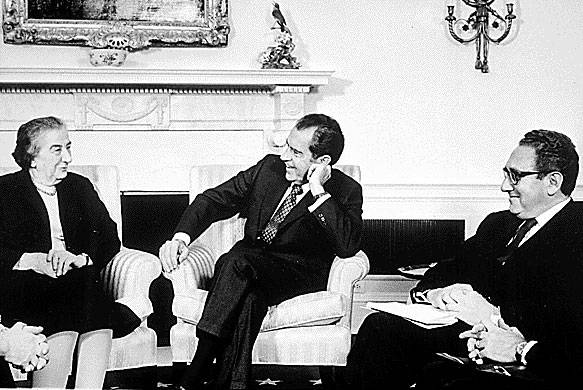
President Kennedy had a radically different approach. His staunch opposition to Israel’s nuclear program set him apart from other American Cold War presidents. He demanded two inspection visits a year to ensure that Israel did not acquire its own bomb and threatened Ben-Gurion and his successor, Prime Minister Levi Eshkol, that if they did not agree to them, they would jeopardize the American commitment to Israeli security.18 His successor, Lyndon Johnson, did not show a similar determination, trying to avoid a crisis between the two countries. The Nixon administration accepted the arrangement on the condition that Israel maintained the opacity of its nuclear program. Overt deterrence would have undermined the U.S. image as a leader of nonproliferation, which Washington did not want to allow.
The belief that the proliferation of nuclear weapons would contribute to undermining U.S. security was essentially a view held only by Democratic administrations. Their resistance to proliferation made no distinction between allies and enemy states. Nixon and Kissinger, by contrast, viewed the Non-Proliferation Treaty as an ineffective, if not futile, effort. During his campaign, Nixon criticized the treaty for preventing the transfer of “defensive nuclear weapons” to allies. Moreover, Henry Kissinger believed that sooner or later all regional powers would acquire the bomb and that it would be better for U.S. allies to have their own deterrence instead of relying on America. “Kissinger,” writes Cohen, “appeared to be saying that if he were an Israeli, he would get nuclear weapons and that the United States should not try to talk Israel out of it.”19
In the context of Israel’s geopolitical environment, nuclear opacity proved to be a difficult, though effective, solution. The Arabs at first refused to believe that Israel had weapons, convinced that it was nothing but a ploy to intimidate them. When it became harder and harder for them to doubt it, opacity allowed them not to react. This attitude did not prevent the Arab attack in 1973, but as Cohen, who is himself a non-proliferation advocate, admits, it had the effect of limiting their war ambitions. The effectiveness of nuclear opacity became clear later on, as the Arabs slowly realized that the conflict with Israel could not be resolved by military means. It is highly likely that had it not been for nuclear opacity, Egypt, Palestine, and Jordan would not have been so open to making peace deals in the years that followed. Nuclear opacity changed their attitude, pushing them toward negotiations.20
Taiwan’s Unfinished Project
As Ben-Gurion pursued the creation of an Israeli bomb, one of his greatest concerns was secrecy. He avoided discussing the program, and funding for the nuclear project ran outside the official budget. The Israeli principle of kdushat ha-bitachon, “the sanctity of security,” certainly played an important role. The absence of this hard-to-replicate atmosphere probably contributed to Taiwan’s failed path toward nuclear opacity.
Like Israel, Taiwan realized in the late 1950s that it must have “an option for a rainy day,” as Peres once put it. In 1958, President Chiang Kai-shek asked the United States to arm Taiwan with nuclear weapons, but Washington refused. The Eisenhower administration, however, decided to place a U.S. nuclear deterrent on the island. This would be taken away in 1974 as a consequence of America’s opening to China.
The U.S. deterrent stationed on the island did not soften the shock Chiang experienced when China conducted a successful bomb test in October of 1964. He did not expect Beijing to reach the stage of nuclear testing so quickly. When Chiang wanted to set the wheels in motion for Taiwan’s nuclear program, he, like Ben-Gurion and Peres, had to reckon not only with the United States, which was watching everything closely, but also with Taiwan’s own scientific and military establishment, which did not believe that the project was possible or even desirable.
The parallels to Israel do not end there. As David Albright and Andrea Stricker note, the design of Taiwanese facilities imitated the Dimona complex, and one of the most important advisers on the project was Bergmann himself. He shared President Chiang’s conviction that Taiwan desperately needed the bomb to ensure its own security and that the path Israel had chosen would be the most appropriate (his portrait reportedly hung in Taiwan’s war academy until 1988). Taipei’s determination was strengthened by the loss of its United Nations seat in 1971 and the fact that the Communist mainland had gained international recognition as the legitimate government of China. This solidified Chiang’s belief that Taiwan had no choice but to opaquely build its own existential deterrent.
Down the line, the program’s progress caused concern for President Jimmy Carter, who decided to force Taiwan to abandon it. He later hardened Taiwan’s resolve when he made public that he was tearing up the U.S.-R.O.C. Mutual Defense Treaty, informing Taiwan only twenty‑four hours before announcing the decision. Taipei went immediately into a state of “total diplomatic shock,” as Albright and Stricker put it.21
In the 1980s, the project was pushed forward by General Hau Pei-tsun. He was responsible for reconstituting and expanding projects that had been hindered by American pressure. The development of the program was shrouded in secrecy so as not to arouse the suspicions of Beijing and Washington. Taiwan saw in the nuclear deterrent its only option to secure its existence, believing neither that the United States would be willing to risk its territory to repel a Chinese invasion (if Beijing threatened to use nuclear weapons) nor that American aid would arrive in time. The Taiwanese were confident that they could develop a bomb before both allies and enemies knew about it.
To maintain opacity, Taiwanese scientists developed technological solutions that allowed them to perform the necessary tests without an actual detonation. They ran meticulous and complex computer simulations and, through these opaque methods, not only were they confident of the bomb’s performance without a real test, but they also maintained a so-called hot standby, ready to build a weapon in a short time frame if the situation called for it. Opacity did not last long, however, as one of the key figures in the program defected to the United States and released all the details of the project to U.S. intelligence.
After that, Washington did everything in its power to end Taiwan’s nuclear weapons program. Albright and Stricker cite an internal U.S. memo that justified this decision. It argues that treating nuclear weapons as a deterrent is illusory, and their introduction would only increase regional instability and put Taiwan at risk. The document further warned that by building the bomb, Taiwan was exposing itself to the threat of a preemptive strike from China. Albright—a proliferation opponent who thought the U.S. decision was correct—points out the inconsistency of this remark; after all, Taipei chose opacity and developed breakout technologies precisely to avoid drawing unwanted attention. Regardless, under pressure from Washington, Taiwan had to give up its quest to acquire a nuclear deterrent.
More recently, Xi Jinping’s threats of reunification by force have only grown in strength, and Chinese incursions into Taiwan’s air, sea, and cyberspace have only gained in frequency. As analysts at the Australian Strategic Policy Institute argue, “weak security guarantees from the United States, coupled with escalating aggression from China, may soon present Biden with a Taiwan that believes its only option for survival is to take a page from the Israeli playbook and restart a covert nuclear weapons program.”22 The Taiwanese have seen what fate China has imposed on Hong Kong and do not want to follow suit: almost 90 percent of the population does not want reunification.23
Taiwan’s internal political situation has also changed since the 1980s. One of the reasons the United States opposed Taipei’s nuclear program was the fear that the military would seize power and impose a dictatorship. Today that fear has no justification; Taiwan is a healthy and vibrant democracy. What has changed is the attitude toward nuclear power, negative in most of the population.24 Nevertheless, the scientist who went over to America’s side and revealed the secrets of Taiwan’s program alleges in Albright and Stricker’s book that if only there were the will and determination, Taipei could easily return to its nuclear project.
Stability through Opacity
The U.S. allies in Asia face two problems. First, it is extremely difficult for them to catch up with China in the domain of conventional armaments; Beijing’s advantage here is too great (which is particularly visible in the case of Taiwan). Secondly, the credibility of the U.S. nuclear umbrella remains questionable. While extended deterrence may have been credible in the Cold War era when it concerned Western Europe—because if it had fallen into Soviet hands the balance of power would have shifted sharply to America’s disadvantage—it is hard to believe that Washington would risk a nuclear war for the sake of Taipei. The loss of Taiwan and the reordering of Asia would be hard to swallow, but probably not enough to put the existence of the United States on the line. Does Taiwan’s “silicon shield,” TSMC, provide a sufficient rationale for Washington to deter China and risk a nuclear exchange? In the end, the economic crisis resulting from cutting off semiconductor supplies seems easier to stomach than the risk of armageddon, just as setting back technological progress a dozen years is preferable to losing the conditions that make any progress possible at all.
Michael J. Mazarr suggests that Washington must become more “flexible” when it comes to imposing its norms and values if it wants to maintain the order it created after 1945.25 Perhaps one of those principles that should be open to flexibility is nonproliferation. Nuclear proliferation is inherently dangerous, but it may be worth considering whether strictly imposing nonproliferation norms on allies today is contrary to the interests of the United States. It is worth recalling that today no U.S. ally in Asia possesses nuclear weapons. A crucial, though not the only, reason why Israel was able to embark on the path of nuclear opacity, and Taiwan was not, was the tacit approval of U.S. leadership.
One cannot rule out the possibility that Washington could one day face two theaters of war, both in Europe and in Asia. The question is whether it will have enough resources to meet these challenges or whether it will be forced to choose between one or the other. Jacob Helberg put forward the idea of “decentralized deterrence”—a strategy that would allow the United States “to avoid overextension and defend the international order the U.S. has created.”26 This posture would allow Asian allies to shoulder more responsibility and deter Chinese aggression.
Deploying U.S. nuclear weapons in Taiwan or South Korea is unrealistic for a number of reasons. The most important of these is that it is difficult to predict the reaction of China and North Korea to such a development. The risk of a catastrophic response would be too great. The same is true of overt nuclear programs, which could lead to a preemptive strike by the threatened states. For these reasons, it seems that if any of these countries decide to become self-reliant when it comes to their own security, they will choose the path of opacity. The question is how the United States will react.
Bilahari Kausikan argues that for Japan or South Korea there is no other way. An Asia in which not only China, North Korea, Russia, or India but also Japan and South Korea possess nuclear weapons, Kausikan argues, will be more stable, even if this stability would be preceded by a period of uncertainty. “Independent nuclear deterrents,” asserts Kausikan, “will keep Japan and South Korea within the U.S. alliance system. With India and Pakistan in the equation, a multipolar nuclear regional balance will freeze the existing configuration of the Indo-Pacific, preventing its domination by any single major power.” He goes on to explain that this would be tantamount to the end of the “China Dream,” insofar as the latter means a hierarchical order in Asia with the PRC at the top. Perhaps, then, the path to multipolar stability in Asia leads through nuclear opacity.
This article originally appeared in American Affairs Volume VI, Number 3 (Fall 2022): 113–25.
Notes
1 Hal Brands, “
Putin’s Struggles in Ukraine May Embolden Xi on Taiwan,”
Bloomberg, April 21, 2022.
2 Evan Montgomery and Toshi Yoshihara, “Leaderless, Cut-off, and Alone: The Risks to Taiwan in the Wake of Ukraine,” War on the Rocks, April 5, 2022.
3 Bilahari Kausikan, “China’s Strategic Dilemmas” (keynote address to the Royal Australian Air Force Air and Space Power Conference, Canberra, Australia, March 22, 2022).
4 Richard Lloyd Parry, “It’s Time Japan Considered Nuclear Weapons, Says Shinzo Abe,” Times (London), February 22, 2022.
5 Tanner Greer, “Losing Taiwan Means Losing Japan,” Scholar’s Stage, February 26, 2020.
6 Bruce W. Bennett et al., Countering the Risks of the North Korean Nuclear Weapons (Santa Monica, Calif.: RAND Corporation, 2021), ix.
7 Arius Derr, “China, Not North Korea, Driving Major South Korean Support for Nukes,” NK News, February 22, 2022.
8 Robert Jervis, The Meaning of the Nuclear Revolution: Statecraft and the Prospect of Armageddon (Ithaca: Cornell University Press, 1989), 32.
9 Harold Brown et al., “Nuclear Weapons in the Modern World,” Nuclear Disarmament and Nonproliferation: A Report to the Trilateral Commission, no. 64 (2010): 65.
10 Keir A. Lieber and Daryl G. Press, The Myth of the Nuclear Revolution: Power Politics in the Atomic Age (Ithaca: Cornell University Press, 2020), 167.
11 S. David Broscious, “Longing for International Control, Banking on American Superiority: Harry S. Truman’s Approach to Nuclear Weapons,” Cold War Statesmen Confront the Bomb: Nuclear Diplomacy since 1945, eds. John Gaddis, Philip Gordon, Ernest May, and Jonathan Rosenberg (Oxford: Oxford University Press, 1999), 34.
12 Vladislav M. Zubok, “Stalin and the Nuclear Age,” Cold War Statesmen Confront the Bomb, 59.
13 Shu Guang Zhang, “Between ‘Paper’ and ‘Real Tigers’: Mao’s View of Nuclear Weapons,” Cold War Statesmen Confront the Bomb, 203.
14 Vladislav M. Zubok and Hope M. Harrison, “The Nuclear Education of Nikita Khrushchev,” Cold War Statesmen Confront the Bomb, 156.
15 Jervis, The Meaning of The Nuclear Revolution, 37.
16 Avner Cohen, Israel and the Bomb (New York: Columbia University Press, 1998), ix.
17 Cohen, Israel and the Bomb, 83.
18 Cohen, Israel and the Bomb, 193.
19 Cohen, Israel and the Bomb, 324.
20 Cohen, Israel and the Bomb, 342.
21 David Albright and Andrea Stricker, Taiwan’s Former Nuclear Weapons Program: Nuclear Weapons On-Demand (Washington, D.C.: Institute for Science and Internation Security, 2018), 138.
22 Alex Littlefield and Adam Lowther, “Would a Nuclear-Armed Taiwan Deter China?,” Australian Strategic Policy Institute, December 24, 2020.
23 Chen Yu-fu and Jonathan Chin, “Nearly 90 Percent of Public Identify with Taiwan,” Taipei Times, August 11, 2021.
24 Angelica Oung, “Taiwan’s Nuclear Memories,” Taipology (substack), March 14, 2022.
25 Michael J. Mazarr, “How to Save the Postwar Order,” Foreign Affairs, May 6, 2022.
26 Jacob Helberg, “Unified Threats Need Decentralized Deterrence,” Foreign Policy, May 11, 2021.