In the spring of 1852, with the scars of the Mexican-American War still fresh, a steamboat captain, one Richard King, rode into the Wild Horse Desert of South Texas with a plan to buy as much land as he could get his hands on.1 Over the course of the next two years, King would acquire roughly sixty-eight thousand acres between two Spanish and Mexican land grants.2 Then, in 1854, with drought on the brink of hollowing out the nearby village of Cruillas, he would cross the border, acquire the village’s entire cattle herd, and offer the villagers homes and wages in exchange for their labor. Those villagers who accepted came north and became los kineños, King’s men.3 Over the years, the ranch he assembled in this manner would peak at 1.2 million acres, larger than Rhode Island: the largest working ranch in America.4 To King—and his home state, Texas—land was a thing you owned: something a man stocked and worked and made profitable.
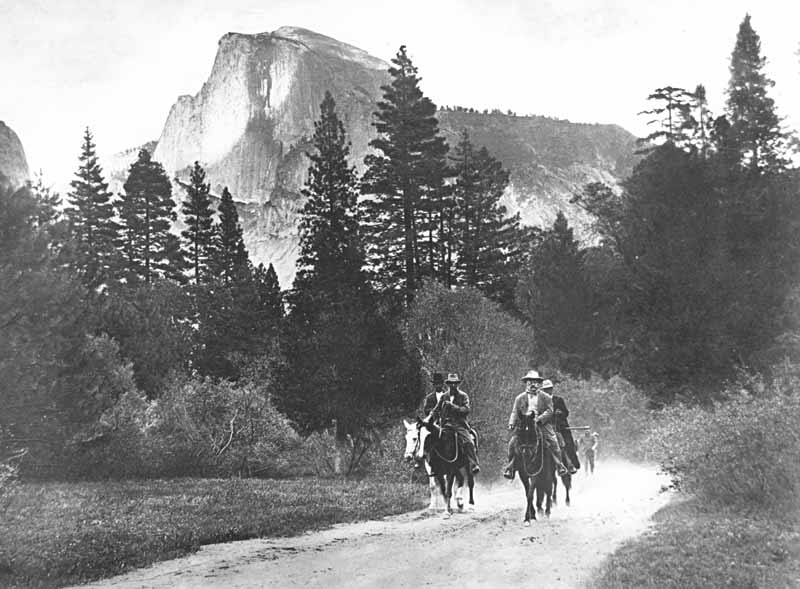
Half a century later and half a continent away, a man with a very different conception of land, the Scottish-born wanderer John Muir, lay still on one of the grand granite domes of Yosemite, staring up at the sky. Seated next to him on the rock was the sleeping body of the President of the United States, Teddy Roosevelt. The night was the result of months of planning, an attempt by Muir to lure the President into the backcountry of California to have him agree to protect the wilderness that Muir so loved.5 The next morning, Roosevelt, waking through five inches of fresh snow, was delighted.6 He would later write that a night among the sequoias was “like lying in a great solemn cathedral.”7 Muir’s gambit had worked. Yosemite Valley and the Mariposa Grove would be returned to the federal government.8 To Muir, and the state he called home, land was a cathedral, a sacred trust that demanded preservation.
Despite their differences in outlook, both men shared a peculiar mania for land. Each was seized by that grand American obsession, the ever-present symbol of freedom that separated the New World man from the Old, yet each wanted to use it in precisely the opposite manner of the other. King wanted to develop the land to its fullest extent; Muir wished to preserve it. In holding these beliefs, each was a paradigm of his state: King of Texas, Muir of California. And as time passed, these two men would become not merely paradigms, but prophets of their respective homes, as each, it turned out, had found himself in a state that would take his commandments to heart.9
Texas versus California
Even at the start, when both states conceived of land as a near inexhaustible resource, Texas always did it bigger. The state handed out land at a scale unimaginable back east; empresario grants, keepsakes of Texas’s Mexican heritage, were forfeit if you didn’t work them.10 It wrote the homestead into its constitution.11 And Texas, unique among Western states, kept its own public domain when it joined the union.12 To own land in Texas was to be free.
California began with a similar impulse but rapidly inverted it. The Gold Rush land grab and the great ranchos of the state’s early years had barely passed into memory before California began reimagining its landscape as a sacred patrimony. Yosemite was first set aside in 1864, a mere fourteen years after statehood. Over the next century and a half, that patrimonial idea would spread from the mountains, valleys, and coastline into the ordinary politics of settlement itself, until even houses began to be treated as part of the landscape to be preserved. In California, over time, the highest civic act became holding land still, or guarding its beauty from those who would use it.
There is a temptation to slot this story under the two states’ traditional labels: Texas, the land of property rights; California, the land of regulation. But the truth is nearly the reverse. Texas does not actually hold that all property is sacred in the way property is commonly considered. It holds that the productive, extractive use of property outranks the passive holding of it. In California, a neighbor’s right to be heard can stop you from building on your own land; in Texas, a stranger’s right to use it can take it from you.13 As our legal academy is fond of pointing out, property is a bundle of rights, with none more impactful than possession and development. California has made the first sacred, Texas the second.
But how did these two states develop such opposing systems of property rights? To answer that question requires winding back to the moment that both decided that they had had enough of that great American bogeyman, the railroad. In the latter decades of the nineteenth century, the railroad owned both states, and by the waning years of that century, both states were desperate to change this status quo.14 But to tame the railroads, the two states went in opposite directions: California scattered power into the hands of every citizen, while Texas gathered it into a single expert agency. Following the consequences of these decisions to their end is the rest of this story.
The Right to Preserve
California’s right to preserve was built in three steps: first, its citizens won the right to bypass their representatives; then, the environmentalists picked up that tool and turned it on nature; finally, the homeowners took what the environmentalists had taught them and turned it on the tax bill.15 Each step of the process armed and expanded the preservationist coalition that has come to dominate California today.
The desire to bypass representatives came directly from the citizenry’s hatred of the railroad. In California’s case, the Southern Pacific, a sprawling behemoth that at one time controlled 85 percent of the track in the state and supplied its governor, Leland Stanford, who was nine parts rail magnate for every one part public official.16 The tales are as egregious and compelling as one might expect of a nineteenth-century railroad. Common activities included handing out bucketfuls of free rail passes to judges, legislators, and editors; cultivating “independent” railroad commissioners who would simply route public complaints back to the company; and buying off any regulation or bad press. In one particularly brazen correspondence, Collis Huntington, one of the railroad’s founders, wrote that “it is a man’s duty to go up and bribe the judge.”17 One wonders what other duties he conceived of in his free moments.
But, as is common in these histories, the company overreached. On a May morning in 1880, near a small settlement called Mussel Slough, it sent a federal marshal, a railroad land appraiser, and two local ruffians to clear out a crop of California wheat farmers from their land.18 Said land had originally been advertised by Southern Pacific at a price of between two and a half and five dollars an acre. Once the farmers had dug the ditches and built the houses, however, it was conveniently repriced at twenty to thirty-five.19 Unwilling to accept this miscarriage of justice, the farmers fought back. Seven men died in the ensuing gunfire and five survivors went to jail for resisting.20 These killings would be turned into the novel named for the railroad’s lasting epithet: The Octopus.21 Even more egregiously, a few years after publication of the book in 1901, in the middle of trying the city machine’s bagman, a local graft prosecutor was shot in the head in open court.22 Burning with rage and impotence from decades of such incidents, Californians decided this was the final straw; they needed to arm the citizenry directly.23
Arming the citizenry is exactly what Hiram Johnson promised and delivered. Johnson, the man who stepped in to finish the graft prosecution after his colleague was nearly murdered in broad daylight, ran for governor in 1910 on a simple platform of kicking the Southern Pacific out of politics.24 His inaugural address set out a principle that still animates the state today: government must “eliminate every private interest” and be “responsive solely to the people,” to place “in the hands of the people the means by which they may protect themselves.”25 He won and in a single special election in 1911 handed Californians the initiative, the referendum, and the recall.26 In one fell swoop, California had provided its citizens with the ability to operationalize institutional distrust of representative government.
But the rights in question were tools, and a tool needs an object to act upon. So the question arose: what would the citizenry demand to be heard about? For decades, the answer was: not much. Statewide initiative use remained comparatively modest for decades, reaching a low in the 1960s.27 It was not until the 1970s that these tools would be dusted off and turned on a task wholly unsuited to their function.28 But, as with any tool, improper use occurs most often when urgency meets unpreparedness.
California’s rapidly degrading environment supplied said urgency. By the 1950s and 1960s, the degradation of nature was visible all across the state: Los Angeles was choking on smog; the San Francisco Bay was fighting open burning of trash and sewage seepage; and in 1969, an oil spill in Santa Barbara poured so much crude into the channel that the beaches turned black. In 1970, the dam broke. At first, the changes came through the normal statutory process. The California Environmental Quality Act (CEQA), signed by then governor Ronald Reagan in 1970, looked similar to its federal cousin, the National Environmental Policy Act (NEPA), but was substantially worse.
Where NEPA only told agencies to study the effects of a proposed project and disclose them, CEQA ordered agencies to adopt every feasible measure to reduce harm and, most impactfully, let almost anyone sue if they hadn’t.29 But even this was not enough for voters, who, two years later, alarmed at private development along the shoreline, picked up the tools available to them and passed Proposition 20. Proposition 20 created the California Coastal Commission, an organization with incredible powers to halt and slow development over nearly the entirety of California’s 1,100-mile coastline, including by requiring a public hearing for any sizable coastal development permit application.30 That same year, the state Supreme Court read CEQA to cover not only public works but almost any private project that needed a permit. And so, California, in the space of just two years, extended the tools of public participation into nearly every decision to modify the physical world.31
The resulting stories are absurd and colorful.32 San Francisco spent four years producing a 1,353-page environmental review on the impacts of bike lanes. The University of California, Berkeley, was nearly forced to turn away three thousand students when enrollment growth was found to be an environmental impact, (only reversing when the legislature stepped in).33 The University of Southern California had to level racketeering charges at a landlord who was using CEQA to stall housing for 1,600 students to get him to stop.34 And these are only some of the one-offs. Ongoing grifts also abound. For example, construction unions have learned that frivolous environmental objections are an incredibly effective tool to pressure builders into project-level unionization agreements. Of course, once such agreements are signed, such objections are quietly withdrawn.35 Similar stories pockmark the history of the Coastal Commission.
This preservationist surge (and resulting absurdity) would likely have been limited had the initiative not provided the ability to bypass the legislature. In most places where individuals wish to live, building restrictions have a feedback loop: restrictions drive up prices, which in turn drive up property taxes, the cost of which creates a tax revolt with the goal of reducing tax pressure by any means necessary. Unsurprisingly, when inflation sent assessments spiraling in the mid-to-late 1970s, California homeowners found themselves sitting on a wildly appreciating, illiquid asset, with skyrocketing payments. This problem could have been solved by making construction easier, thereby driving down home price appreciation. But instead, advocates took advantage of the recently revitalized initiative structure to implement a property tax system that went all in on preservation. Proposition 13 extended the prior logic of incumbency from permitting to the tax bill: it made it so that property is reassessed only when ownership changes or new construction is completed, rewarding those who never move.36 This insane system eviscerated California’s public finances, forcing the state to rely on the most volatile revenue in the country, the capital gains of its richest one percent, to fill the hole it left behind.37 Counterfactuals are always difficult, but it is near impossible to imagine a state legislature passing such an amendment given the impact on the budget.
And so, between CEQA, the Coastal Commission, and Proposition 13, the state became frozen in amber, supported by an insurmountable coalition of environmentalists and homeowners, dedicated to preserving the state exactly how it was in the 1970s, and armed with the tools to ensure the least change possible.
The Right to Develop
Texas took a different approach to its railroad problem. Rather than arming its people like California, Texans decided they would rather arm a single man. From that one decision would come, in time, an agency that would control the world’s oil supply for decades, the ability of a pipeline to condemn whatever land it needs, the creation of private developer governments, and the state’s current tax structure that pays off everyone involved in the development process.38 The method of governance in Texas rarely varies: the state is happy to lend its power to private hands, so long as those hands get to building.
But first, the man: James “Big Jim” Hogg was a three-hundred-pound behemoth who served as the florid face of Texas antitrust.39 In 1890, Hogg was elevated from his position as attorney general to become the first native-born governor of Texas, running on a promise to break the rail barons.40 Texans went wild for the man, not just in electing him, but supporting his proposed constitutional amendment to authorize a railroad commission by a public vote of greater than two to one.41
His baby, the Railroad Commission of Texas, was born the next year in 1891, and Hogg knew he needed to give it a face that would establish its character. He chose John H. Reagan, “the Old Roman,” the man who had written the federal law regulating interstate railroads, an old friend of Hogg’s who was so convinced of the importance of the assignment that he agreed to resign his seat in the United States Senate to run the enterprise.42 Unsurprisingly frightened by the powers and character of the newly established commission, the railroads sued almost immediately, claiming that its rate-setting power was a theft of property. In response to the claim, the U.S. Supreme Court handed down the bargain that still governs American rail regulation today: the state may set rates, but they must be reasonable, and a company may always go to court.43 The case bore the chairman’s own name and established that the commission had real, autonomous power.44 Texas had tamed the railroads, but then came the oil.
On January 10, 1901, just outside Beaumont, in a proprietor’s fourth attempt to drill the salt dome, a small well suddenly began coughing up mud and drilling pipe. Minutes later, oil began to spurt out of the hole, rapidly becoming a hundred-foot-tall geyser.45 This was Spindletop. Over the course of the next nine days, nearly a million barrels of oil would spurt from Sour Spring Mound, covering the landscape in warm black rain.46 The population of Beaumont tripled within a year, and by the end of the next, there were hundreds of wells and five hundred companies on the field, including both of what would later become known as Gulf and Texaco.47 The lesson Texas drew from Spindletop was the mirror of California’s: the ground makes you rich, and the only sin is leaving wealth in it.
The discovery of oil also rewrote what property meant in Texas. In 1904, the Texas Supreme Court decided that groundwater was too “secret, occult, and concealed” for any court to regulate, so a man simply owned whatever his well drew up, even if that meant he drained his neighbor dry.48 When applied to oil, this “rule of capture” created a frenzy. The fastest drill was all that mattered, and the mineral estate, previously an afterthought in most land transactions, became severed and dominant.49 Across growing swathes of Texas, wealth now came from the ground, not what was on it.
The only question remaining for the rapidly expanding industry was who ought to regulate it. Already relying upon the state’s antitrust powers to block Standard Oil’s entrance into the new fields, the legislature decided to sign regulatory authority for the whole industry over to its major antitrust agency, the Railroad Commission.50 A 1917 law declared pipelines “common carriers” and gave them to the agency; the power of eminent domain would be tied to that common-carrier status in 1925.51 Two years after the 1917 law, it would pair that authority with authority over production itself, giving the agency near-full authority over the industry that would come to define the state, even if that authority was very light touch at first.52
This light-touch attitude held until the discovery of the East Texas field in 1930, a field so large and productive that the frenzy it created collapsed the price of crude oil to a quarter a barrel. To stem the bleeding, the governor tried to send in the national guard to shut the field by force but found his order struck down by the courts.53 What was upheld were the commission’s efforts to cap production through “prorationing,” a method by which each well would be granted a particular quota up to which it could produce.54 Smarting from the low prices and preferring state regulation to federal, the Texas oilmen, in a fit of deeply uncharacteristic communitarian spirit, acceded to the commission. As a consequence, from the 1930s into the 1970s, those quotas effectively set the price of oil for the planet.55 The system was so successful that OPEC would later be modeled on it.56 And so the agency Hogg had built to tame private power had become the indispensable servant of private oil. Around it formed the coalition that still runs the state—producers, royalty owners, and the regulators themselves—each with a stake in keeping the oil moving. Where California’s sacred object was the landscape, held in trust and defended by citizens, Texas’s was the subsurface.
It is worth dwelling on the screen between private and state power at the commission, as it was almost comically thin. To wield the state’s power of eminent domain, a pipeline company historically only needed to check the “common carrier” box on a one-page Railroad Commission form.57 This fact was best represented in a 2012 case concerning a rice farm that refused a carbon dioxide pipeline company permission to survey its land, when, in response to the denial, the company simply filled out a one-page form and submitted it to the Railroad Commission to override the landowner’s decision.58 The Texas Supreme Court, unsurprisingly, balked at the ease of the process, holding that “a private enterprise cannot acquire unchallengeable condemnation power . . . merely by checking boxes on a one-page form.”59 This should have been a resounding victory for the landowner. But on remand, the company proved that it really was a common carrier, and in 2017, it got the land anyway.60 This preference structure runs consistently across the oil patch, with the surface owner’s deed yielding to the midstream owner’s need to move the product. It is proof positive that in Texas, at least in the oil patch, use outranks holding.61
By the late twentieth century, this idea of owner primacy, born in the mineral estate, had expanded to become the basic operating system of Texas governance. For example, Houston is still the only major American city that has never adopted zoning.62 Its massive suburban growth has been powered by a system that pulls both its design and powers from the oil field. In Texas, when a developer wants to build a new project, the state provides the option to wrap his acreage into a Municipal Utility District (MUD): this district is a unit of government, but one effectively controlled by the applicant and vested with the sovereign’s powers.63 The district can raise taxes, sell public bonds to pay for the water mains and streets that it creates, and, like the mineral estate before it, condemn private property.64 The same power that lets a pipeline take a rancher’s land to move oil lets a developer’s district take land to build its water and drainage works. It is the logic of the mineral estate applied at the surface: the state hands a private owner a shard of its own coercive power so that he can put land to productive use, and the passive holder gives way. Hundreds of these districts ring Houston alone, each one a small private government whose sole purpose is to develop the land.65 The developers who charter them are a standing lobby of their own, the suburban heirs of the oilmen.66
Much as in California, Texas’s coalition is heavily supported by its tax structure. Texas leans heavily on the property tax (nearly half of state and local tax revenue, assessed continuously at market value), which is disproportionately distributed locally, so new construction is a substantial boon for the community.67 Every new subdivision, well, and warehouse pays the county’s and the school district’s bills, so the surest way to cut your neighbors’ taxes is to welcome the next project: the community itself is enlisted in development’s coalition. Each tax bill is both derivative and constituent of its governance structure. The picture is admittedly not pure development: Houston’s private deed restrictions function as a kind of zoning, and oil’s share of the state economy has roughly halved since the 1980s even as production has set records.68 But the thread—state authority being granted to private power for the purpose of development—is unmistakably central. In Texas, if you wish to build it, you not only can; if you don’t, the state will find someone else who will.
Drawing Lessons
Despite common protests to the contrary, each of these systems delivers exactly what it has promised to its citizenry. Texas’s development has built the beating heart of America’s energy industry and the cheapest big-city housing in America.69 A median home there costs around $300,000 against California’s $800,000, with about two and a half times as many housing permits being issued per person. Texas also forces its citizenry to bear the costs of this preference unevenly, often sending said costs to those least able to afford it: the border-town colonias without running water, the millions of Texans under sixty-five with no health insurance (at 19.2 percent, the worst rate in the nation), and the hundreds of dead attributable to the grid failures from Winter Storm Uri, to give a few examples.70 California’s impulse to preserve has protected the most beautiful coastline in the country and its most participatory government, at the cost of incredible physical stasis.71 The state builds almost nothing today; homebuilding per person has fallen by nearly three-quarters from its 1970s levels.72 Every year, it exports tens of thousands of its own people to Texas.73 And for those who can’t cut it, California leaves many of them destitute, with roughly a quarter of all homeless people in the United States now living there, in the richest state in the union.74
So, by comparing the development and current structure of these two distinct regimes of property rights, what lessons can reformers learn? First, don’t be afraid to use whatever political tools are available to create a sturdier coalition (and ideally split the opposition). In California, the 1911 amendments handed the environmentalist movement, which likely would have found some vehicle to preserve land regardless, a uniquely cheap and universal tool with which to bind their interests to the much larger group of homeowners, who, without Proposition 13, would have been much less stable coalitional partners.75 This has given California environmentalists an incredible amount of influence and staying power, far more than they have had outside the state. California’s housing advocates have already had some success with legislation but should consider propositions focused not on building more homes, but on strengthening and improving alignment with allies such as the construction unions.
Second, betting big on shaping the regulatory structures around rapidly growing industries can have substantial payoffs. In the case of Texas, the rule of capture, alongside the decision to grant the Railroad Commission’s eminent domain powers, coordinated and entrenched the growing oil-owner coalition, and became the prototype for the developmental model of the whole state. The AI and data center industries are set to require new rules in California and Texas, respectively, the promulgation of which will provide an opportunity for political entrepreneurs to lay the groundwork for future coalitions. To take just one example, how the rules are set around energy market pricing for data centers in Texas may determine whether the state keeps its pro-development bona fides in the long run. If the state allows data centers to drive up electricity prices, even if just in the short to medium term, it may accidentally create its first major antidevelopmental coalition, anchored by disgruntled ratepayers. Avoiding this outcome should be a strong priority for any who wish to see America reindustrialize.
Finally, reformers should be wary of purely materialist explanations of development. There is a temptation with such a story to presume that because each state’s respective resources play such a dominating role, each state’s outcomes are preordained. But this is incorrect. Resources determine the size and shape of the pitch, but it is the specifics of the regulatory structure, tools, and actions of individuals that determine the composition of the teams, and thus the development of the state.
To drive the point about materialism home, it is worth considering Pennsylvania, which sits atop the Marcellus Shale—a play whose scale rivals the early Texas fields—and which, by materialist logic, ought to have become a second Texas. Indeed, in 2012, its legislature tried to make it one: Act 13 swept aside local zoning, ordered drilling permitted by right in every district, and handed condemnation power to gas corporations for storage. But the statute did not hold up in court. This is because Pennsylvania had already armed a different coalition forty years earlier, when it wrote an environmental rights amendment into its constitution in 1971. That amendment was then invoked by the state’s high court in Robinson Township v. Commonwealth to strike down the statute’s core provisions in 2013 (the condemnation grant followed in 2016), neatly demonstrating the power of entrenching yourself first.76
In sum, every regulatory or fiscal decision endows a particular coalition with rents, and that coalition becomes a durable political force that will defend that structure long after the reason for it is gone. It is vanishingly unlikely that any of the authors of the Texas commission or the California amendments intended to create today’s coalitions, but the structures they put in place provided the space for enterprising political entrepreneurs to fill. So, given that regulatory structure is first and foremost a machine for arming coalitions, the first question to ask of any rule is not what it intends but what it makes cheap, and for whom. For the built environment, the relevant question is: does this structure hand out a cheap, widely held veto, or a cheap, widely held right to build? For political questions more broadly: who gets the rents? Who gets standing? Which rights take precedence? There is a limited window for determining the answers to these questions for any particular resource, and determining exactly who is likely to benefit requires a level of foresight that is often lacking in legislative drafting. But getting the answers correct is critical, as early decisions carry an outsized weight. Once a coalition becomes entrenched, you will undo the incentive structure only at high cost, against the coalition’s organized resistance, and never all at once.
After all, King’s land still pays and Muir’s cathedral still stands. A century on, each state still loves the land as its respective prophet once taught it to. But, who knows, a new prophet could be born tomorrow.
This article originally appeared in American Affairs Volume X, Number 3 (Fall 2026): 79–93.
Notes
1 John Ashton and Edgar P. Sneed, “The History and Legacy of King Ranch: A Texas Icon,” Texas State Historical Association, December 10, 2014.
2 Ashton and Sneed, “The History and Legacy of King Ranch,” Handbook of Texas Online, accessed June 2026.
3 Tom Lea, The King Ranch (2 vols., Boston: Little, Brown, 1957).
4 “King Ranch,” Encyclopaedia Britannica, accessed June 2026; Ashton and Sneed, “The History and Legacy of King Ranch: A Texas Icon.”
5 “John Muir and President Roosevelt [March 14, 1903],” National Park Service, accessed June 2026.
6 “John Muir and President Roosevelt,” National Park Service.
7 Carl M. Cannon, “Great American Stories: America’s Crown Jewels,” RealClear Public Affairs, February 25, 2025.
8 “John Muir and President Roosevelt,” National Park Service.
9 “King Ranch,” Handbook of Texas Online; National Park Service, “John Muir and President Roosevelt.”
10 Eugene C. Barker, “Empresario,” Texas State Historical Association, accessed June 2026; “Land Grants,” Texas State Historical Association, accessed June 2026; Coahuila and Texas State Colonization Law, Decree No. 16 (March 24, 1825), art. 26, reprinted in H. P. N. Gammel, comp., The Laws of Texas, 1822–1897 (Austin: Gammel, 1898), 1:99–106.
11 Joseph W. McKnight, “Homestead Law,” Texas State Historical Association, September 1, 1995.
12 “Texas Annexation Questions and Answers,” Texas State Library and Archives Commission, accessed June 2026; “Oil & Gas Exploration and Surface Ownership,” Railroad Commission of Texas, accessed June 2026.
13 Friends of Mammoth v. Board of Supervisors, 8 Cal. 3d 247, 256–59 (1972); Texas Rice Land Partners, Ltd. v. Denbury Green Pipeline-Texas, LLC, 363 S.W.3d 192, 196–202 (Tex. 2012).
14 Tracy Westen, Democracy by Initiative: Shaping California’s Fourth Branch of Government, 2nd ed. (Los Angeles: Center for Governmental Studies, 2008), 36; “RRC History,” Railroad Commission of Texas, accessed June 2026.
15 Westen, Democracy by Initiative, 31–36, 57–65; Friends of Mammoth, 8 Cal. 3d at 256–59; Alameda County Assessor, “Proposition 13.”
16 Westen, Democracy by Initiative, 35–36.
17 C. P. Huntington to David D. Colton, 1877, reprinted in How Congressmen Are Bribed: The Colton Letters (n.p., ca. 1880).
18 Richard Maxwell Brown, No Duty to Retreat: Violence and Values in American History and Society (New York: Oxford University Press, 1991), 105–110.
19 Brown, No Duty to Retreat, 94–105.
20 Brown, No Duty to Retreat, 87–115.
21 Brown, No Duty to Retreat, 87–127; Richard J. Orsi, Sunset Limited: The Southern Pacific Railroad and the Development of the American West, 1850–1930 (Berkeley: University of California Press, 2005), 92–104.
22 Westen, Democracy by Initiative, 39.
23 Westen, Democracy by Initiative, 39–42.
24 Hiram W. Johnson, “Inaugural Address,” January 3, 1911, Governors’ Gallery, California State Library; Westen, Democracy by Initiative, 39–40; George E. Mowry, The California Progressives (Berkeley: University of California Press, 1951), 119–24.
25 Johnson, “Inaugural Address.”
26 Westen, Democracy by Initiative, 40–42; California Secretary of State, “Secretary of State Bowen Marks 100th Anniversary of California Direct Democracy,” October 10, 2011.
27 Westen, Democracy by Initiative, 57–61.
28 Westen, Democracy by Initiative, 57–65.
29 Friends of Mammoth, 8 Cal. 3d at 256–59, 271–72; Cal. Pub. Res. Code §§ 21002.1(b), 21167.
30 California Coastal Commission, “History”; California Coastal Commission, “The California Coastal Commission’s Legal Authority to Address Climate Change.”
31 Friends of Mammoth, 8 Cal. 3d at 256–59, 271–72; California Coastal Commission, “History.”
32 Friends of Mammoth, 8 Cal. 3d at 256–59.
33 Save Berkeley’s Neighborhoods v. Regents of University of California, 51 Cal. App. 5th 226, 232–34, 239–40 (2020); Supreme Court of California, Supreme Court Minutes, March 3, 2022, 276–77.
34 University of Southern California et al. v. Conquest Student Housing LLC et al., No. 2:07-cv-05737 (C.D. Cal. filed Sept. 4, 2007); Second Amended Complaint, paragraphs 5, 11, 42–43, 64, reproduced in Los Angeles City Council File No. 07-1998 (Oct. 23, 2007), 79–81, 87–88, 93.
35 Wonderful Real Estate Development LLC v. Laborers International Union of North America Local 220, No. 1:19-cv-00416, slip op. at 3–6 (E.D. Cal. Jan. 8, 2020), ECF No. 60.
36 Alameda County Assessor, “Proposition 13”; Legislative Analyst’s Office, California’s Tax System: A Visual Guide (Sacramento: Legislative Analyst’s Office, April 2018), 20–22; Tax Foundation, “Property Taxes by State and County, 2026.”
37 Legislative Analyst’s Office, California’s Tax System: A Visual Guide, 12–14; Legislative Analyst’s Office, “Top 1 Percent Pays Half of State Income Taxes,” December 16, 2014.
38 “RRC History,” Railroad Commission of Texas; Texas State Library and Archives Commission, “Hazardous Business: The Oil Wars,” accessed June 2026; Texas Rice Land Partners, 363 S.W.3d at 196–202; Texas Commission on Environmental Quality, “Water Districts”; “Property Tax,” Texas Comptroller of Public Accounts, accessed June 2026.
39 “RRC History,” Railroad Commission of Texas; Robert Cotner, “Hogg, James Stephen,” Texas State Historical Association, February 21, 2021; Humanities Texas, “James Stephen Hogg,” Texas Originals transcript.
40 Cotner, “Hogg, James Stephen”; “RRC History,” Railroad Commission of Texas.
41 “RRC History,” Railroad Commission of Texas; Texas Legislative Council, Amendments to the Texas Constitution Since 1876 (Austin: Texas Legislative Council, May 2024).
42 “RRC History,” Railroad Commission of Texas; Ben H. Procter, “Reagan, John Henninger,” Texas State Historical Association.
43 Reagan v. Farmers’ Loan & Trust Co., 154 U.S. 362, 390–99, 410–12 (1894).
44 “RRC History,” Railroad Commission of Texas; Reagan v. Farmers’ Loan & Trust Co., 154 U.S. at 390–99, 410–12.
45 “Hazardous Business: The Oil Wars,” Texas State Library and Archives Commission.
46 “Hazardous Business: The Oil Wars,” Texas State Library and Archives Commission; Daniel Yergin, The Prize: The Epic Quest for Oil, Money, and Power (New York: Simon & Schuster, 1991), 82–89.
47 Robert Wooster and Christine Moor Sanders, “Spindletop Oilfield,” Texas State Historical Association; Diana Davids Olien and Roger M. Olien, Oil in Texas: The Gusher Age, 1895–1945 (Austin: University of Texas Press, 2002), 25–32, 48.
48 Houston & Texas Central Railway Co. v. East, 98 Tex. 146, 149–50 (1904); Sipriano v. Great Spring Waters of America, Inc., 1 S.W.3d 75, 76–77 (Tex. 1999).
49 “Oil & Gas Exploration and Surface Ownership,” Railroad Commission of Texas.
50 “RRC History,” Railroad Commission of Texas; “Hazardous Business: The Oil Wars,” Texas State Library and Archives Commission.
51 “RRC History,” Railroad Commission of Texas; Texas State Library and Archives Commission, “Hazardous Business: The Oil Wars”; Amanda Buffington Niles, “Eminent Domain and Pipelines in Texas: It’s as Easy as 1, 2, 3—Common Carriers, Gas Utilities, and Gas Corporations,” Texas Wesleyan Law Review 16 (2010): 271–93.
52 “RRC History,” Railroad Commission of Texas.
53 Judon Flambrough, “Yours, Mine or Ours? The Rule of Capture and Subterranean Fluids,” Texas Real Estate Research Center, December 22, 2014; “Hazardous Business: The Oil Wars,” State Library and Archives Commission; Sterling v. Constantin, 287 U.S. 378 (1932); “RRC History,” Railroad Commission of Texas.
54 “RRC History,” Railroad Commission of Texas.
55 Keith Sill, “The Macroeconomics of Oil Shocks,” Business Review, Federal Reserve Bank of Philadelphia, Q1 2007, 21–22; “RRC History,” Railroad Commission of Texas.
56 “RRC History,” Railroad Commission of Texas.
57 Tex. Nat. Res. Code § 111.019(a); Railroad Commission of Texas, “Form T-4: Application for Permit to Operate a Pipeline in Texas,” cited in Texas Rice Land Partners, 363 S.W.3d at 197–98.
58 Texas Rice Land Partners, 363 S.W.3d at 196–202.
59 Texas Rice Land Partners, 363 S.W.3d at 204.
60 Denbury Green Pipeline-Texas, LLC v. Texas Rice Land Partners, Ltd., 510 S.W.3d 909, 912–13, 916–18 (Tex. 2017).
61 Texas Rice Land Partners, 363 S.W.3d at 196–202; Denbury, 510 S.W.3d at 916–18; Railroad Commission of Texas, “Oil & Gas Exploration and Surface Ownership.”
62 “Development Regulations,” City of Houston Planning and Development Department, accessed June 2026.
63 Texas Commission on Environmental Quality, “Water Districts”; Tex. Water Code §§ 49.211–49.212, 49.222, 54.501 et seq., accessed June 2026.
64 Tex. Water Code §§ 49.211–49.212, 49.107, 49.222.
65 Laila Assanie and Michael Weiss, “Harvey Highlights Houston MUD Bond Development Funding,” Federal Reserve Bank of Dallas, Second Quarter 2018, 4–5.
66 Texas House Committee on Special Purpose Districts, Interim Report to the 85th Legislature (Austin: Texas House of Representatives, 2016), 16, 22; Assanie and Weiss, “Harvey Highlights Houston MUD Bond Development Funding,” 4–5.
67 Texas Comptroller of Public Accounts, “Property Tax”; Texas Comptroller of Public Accounts, “Property Tax Cuts as Large as Texas,” Fiscal Notes, December 2023.
68 “Development Regulations,” City of Houston Planning and Development Department; “Deed Restrictions,” City of Houston Legal Department; Fannie Mae, House Price Risks in Oil-Producing States: Repeat of the 1980s? (Washington, D.C.: Fannie Mae, 2015), 2; Railroad Commission of Texas, “Oil & Gas Historical Production Data.”
69 U.S. Census Bureau, “QuickFacts: Texas”; U.S. Census Bureau, “QuickFacts: California”; U.S. Census Bureau, “2025 Annual Building Permits,” Building Permits Survey, 4; U.S. Census Bureau, “U.S. Population Growth Slows Due to Historic Decline in Net International Migration,” January 27, 2026.
70 “Key Facts about the Uninsured Population,” KFF, June 16, 2026; “February 2021 Winter Storm-Related Deaths – Texas,” Texas Department of State Health Services, December 31, 2021.
71 “History,” California Coastal Commission, accessed June 2026; California Secretary of State, “Secretary of State Bowen Marks 100th Anniversary”; Friends of Mammoth, 8 Cal. 3d at 256–59.
72 California Department of Housing and Community Development, California’s Housing Future, 3–4; U.S. Census Bureau, “2025 Annual Building Permits,” 4.
73 U.S. Census Bureau, “State-to-State Migration Flows: 2024 American Community Survey 1-Year Estimates,” table 1, accessed June 2026.
74 U.S. Department of Housing and Urban Development, “HUD Releases 2025 Annual Homelessness Assessment Report to Congress,” May 29, 2026; “Estimates of People Experiencing Homelessness by Sheltered Status,” KFF, 2025.
75 Westen, Democracy by Initiative, 31–36, 57–65; Friends of Mammoth, 8 Cal. 3d at 256–59, 271–72.
76 Robinson Township v. Commonwealth, 83 A.3d 901 (Pa. 2013); Robinson Township v. Commonwealth, 147 A.3d 536 (Pa. 2016) (invalidating the § 3241 condemnation power); Pa. Const. art. I, § 27; Act 13 of 2012, 58 Pa. Cons. Stat. §§ 3241, 3301–3309.