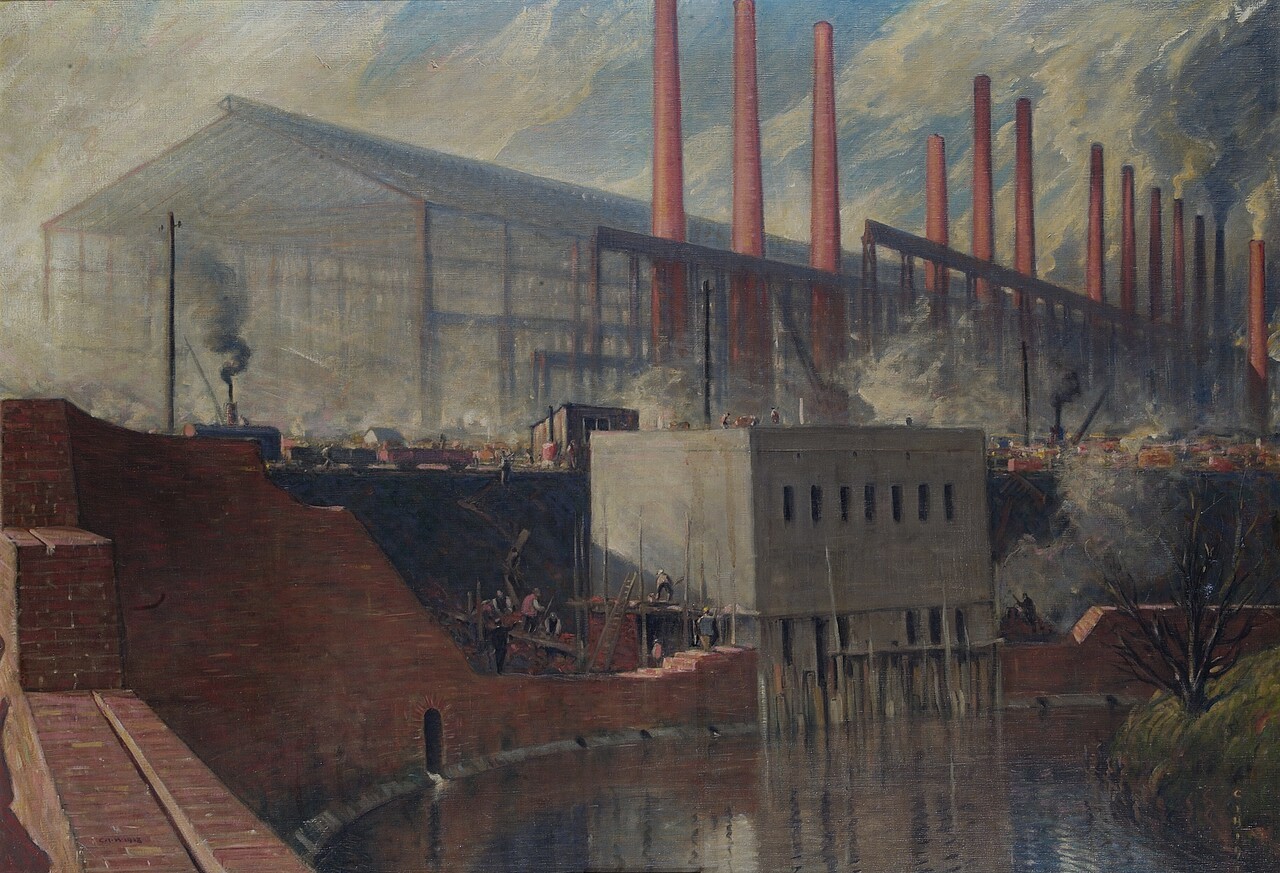
On August 12, 2000, Pat Buchanan began his address accepting the Reform Party’s nomination for president by calling the endorsement he had recently received from the Independent Steel Workers Union of Weirton one of the proudest moments of his life.1 Eighteen months earlier, Buchanan had kicked off his campaign in Weirton because even then that West Virginia town was a powerful symbol of the forgotten men and women of America that globalization had left behind.
Buchanan was determined to change that. His mother had grown up in the nearby Mon Valley of Pennsylvania. He knew firsthand the hardship that had come to America’s industrial heartland. In that August acceptance speech at a convention center in Long Beach, California, he asked: “What has happened to our country, when we walk away from people like this? What has happened to our country?”
This essay will explore how abandoning integrated steel mills like Weirton has eroded the American way of life, weakened our manufacturing base, and ultimately undermined our national security. More importantly, it seeks to show that deindustrialization was a choice and argues that we must now make the choice to reindustrialize. The reindustrialization of our steel industry is not only possible; it is utterly necessary if America is to regain its status as an industrial republic and remain a global superpower.
Weirton’s Rise
Weirton’s namesake is Ernest T. Weir. A Scotch-Irish Pittsburgher born in 1875, Weir entered the steel business at a young age. He purchased a failing steel company in Clarksburg, West Virginia, in 1905 and a few years later moved the operation to the small town of Hollidays Cove in West Virginia’s Northern Panhandle.2 By 1913, this site became America’s second-largest producer of tinplate, thin sheet steel coated with tin, which was used primarily to make cans of soup or vegetables.3
By the time the company was officially renamed Weirton Steel Company in 1918, an entire town had grown up around the mill. The Weirton Improvement Company provided workers with homes, utilities, a police force, and fire protection.4 Although Weir was resistant to organized labor, he paid employees more than the national average, and Weirton was one of the first mills in the country to adopt an eight-hour shift.5 For decades, Weir ensured that the citizens of the town that bore his name enjoyed some of the highest per capita income levels and the highest percentage of home ownership in the state.6 Weirton offered more than material wealth. The city also developed a swimming pool, golf course, football stadium, and public library. Soon, a robust civic life grew around these public amenities. A Weirton steelworker could walk to his shift, coach Little League on Saturday, and attend church on Sunday. It was the American Dream.
When America went to war, it was the industrial output of towns like Weirton that won the day for the Allies. Weeks after Pearl Harbor, the newly established War Production Board (WPB) asked the steel industry to devise plans to increase output and retool for military production. Weirton Steel was the first steel mill in the nation to respond. Over the next four years, Weirton’s output was unmatched.7
Its mills produced seventy thousand eight-inch howitzer shells every month during the war. It also made three billion thirty- and fifty-caliber bullet jackets.8 By the end of the war, Weirton had broken seven world records for open-hearth steel production and manufactured eight brand-new products. These included alloy steel with special qualities for aircraft parts and gun barrels, bonderized sheets that could be painted without primer, and electro-plated tinplate that provided excellent corrosion resistance. Looking back on the plant’s performance, Lloyd Hargest, the former chief of statistics and reports for the Army-Navy Production Award Board of the Pittsburgh Ordnance, argued that Weirton Steel’s wartime performance was “the acme in loyalty and devotion to its country’s cause in time of war.” He believed that “Weirton alone, among all the great steel plants in the United States, can boast such a record.”
As a testament to this performance, in March 1944, Weirton earned the Army-Navy “E” Award for excellence, which was given to only about 5 percent of war production facilities.9 Thousands of workers attended the ceremony, despite torrential rainfall. Soaking wet, Larry Lafferty, the president of the Weirton Independent Union that would later endorse Buchanan, declared proudly that:
Our most cherished record is the fact that we have never lost one minute of production since long before Pearl Harbor. And this is our solemn pledge—we are determined not to lose one minute of production time between now and the war’s end. I declare that there will be no strikes, slow-downs or sabotage of our beloved country in these mills.10
Weirton was true to its promise. More than 750 work stoppages occurred at other steel plants during the war.11 Weirton had zero stoppages. The mill’s workers had every reason to keep the furnaces burning. Some five thousand Weirton Steel employees served in the armed forces during World War II, and 120 of those men would carry gold stars on the company’s honor roll, marking those who never came home.12 The workers at the mill were forging shells and bullet jackets for their own sons, brothers, and neighbors.
After the war, many of those veterans came back to the mill and worked night shifts to support their families while studying by day on GI Bill scholarships at the new College of Steubenville, today’s Franciscan University.13 Faith, family, and work were not separate for them. They were part of a single integrated way of life built around producing steel. At its peak in the 1950s, Weirton made half of the tinplate steel in the world.14 The mill supported a town of nearly thirty thousand people and provided work for thirteen thousand men and women.15
Weirton’s Fall
Weirton’s rise was neither an accident nor an inevitability. It was the result of specific policies and choices made by specific men in American history. The same was true of its fall, which was just as spectacular.
In 1957, Ernest Weir died. Two years later, the United States became a net importer of steel. Increasingly, foreign governments began subsidizing their steel industries and dumping product into the U.S. market at artificially low prices.16 As a result, steel imports rose dramatically through the 1960s and ’70s. Washington not only failed to stop this attack on American steel, it actively subsidized the undercutting of American steel. Through the Marshall Plan, Washington poured millions into rebuilding Western Europe’s steel industry.17 We did the same thing in Japan, too, supervising industrial policy that made coal and steel top national priorities by 1948.18
Despite the steel industry’s urging, America’s leaders refused to apply the same logic at home, and workers in places like Weirton paid the price. As Harry Caudill, a historian of the region, wrote in Night Comes to the Cumberlands:
A curious facet of America’s fabulous foreign aid program since the end of World War II lies in the circumstance that the poor Kentucky mountain counties have been taxed to restore or industrialize foreign countries, few of whose citizens live so poorly as a majority of the inhabitants of the Cumberland Plateau . . . we are at last going to have to face squarely the fact that we have at home the same needs and shortcomings we have been struggling so hard to combat abroad, and, call it what we will, a Marshall Plan for our own chronically and otherwise incurably depressed areas appears to be the only solution.19
The late 1970s and early 1980s were the tipping point for Weirton. As the Republican Party celebrated the dawn of the Reagan Revolution, Weirton was being destroyed by a combination of rising energy costs that resulted from the 1979 oil shock and the brutal recession triggered by Paul Volcker’s interest rate hikes. Between 1978 and 1982, the mill saw net sales drop by nearly $200 million, operating expenses climb by $24 million, and pretax earnings swing from a $16 million profit to a $104 million loss.20 On March 2, 1982, National Steel announced that it would sell off Weirton Steel.21
When no corporate buyer emerged, something amazing happened. The steelworkers of Weirton decided to buy the mill themselves. They organized parades, donation drives, and telethons.22 “We can do it” became the town’s motto, and they did. In September 1983, workers voted eight-to-one to purchase their own mill for $194.2 million, becoming the largest employee-owned company in the United States overnight.23
This came at a cost. Employees took 20 percent pay cuts to make the deal work.24 But in the subsequent years, the workers of Weirton proved that they could run the plant at a profit. They posted earnings of $48.3 million and sales of $845.5 million in the first nine months of 1984, and they enjoyed sixteen consecutive profitable quarters after the transition.25
But eventually the reality of a market rigged against American steel took its toll. When President Clinton again failed to stop cheap foreign steel from flooding the United States during the 1998 Asian currency crisis, Weirton went under.26 Having lost more than $700 million in five years, the company declared bankruptcy in 2003.27 For the next twenty years, the plant was sold off and stripped for parts like an old car, until it did nothing but make tinplate steel from other mills. But even this was taken from the patriots at Weirton.
In February 2024, the International Trade Commission blocked antidumping tariffs on tinplate steel from Canada, China, Germany, and South Korea.28 President Biden did nothing. Shortly thereafter, Cleveland-Cliffs announced Weirton’s permanent closure and the layoffs of its remaining nine hundred workers. Just like that, 115 years of continuous American steelmaking came to an end.
Industrial Deterrence and the Military-Industrial Complex
This same story played out in countless other steel towns across the American heartland. Their story is not merely an economic tragedy but a strategic disaster of the highest order. To understand why, we must recover the concept of industrial deterrence.
As Under Secretary of War for Policy Elbridge Colby and other national security thinkers have argued, successful deterrence depends upon maintaining a credible threat to an aggressor and an unacceptable cost for aggression against the United States.29 Yet contemporary discussions of deterrence have become almost entirely military in character. They focus on ships, missiles, force posture, and defense budgets, but they largely ignore the industrial base that supports our military.
Industrial deterrence begins from a different premise. America’s adversaries are not only assessing the weapons we can deploy today but also the productive capacity, supply chains, strategic resources, and skilled workforce we will be able to mobilize tomorrow. A nation that cannot replace losses, expand production, or sustain a prolonged conflict is less capable of deterring one in the first place.
Today, policymakers on both sides of the aisle have demonstrated an inability to understand industrial deterrence. They default instead to a narrow conception of national security organized around military installations and defense appropriations. But it hasn’t always been this way.
When America rose to global power status in the late nineteenth century, protecting steel was central to the national agenda. In fact, Weirton’s founding would have been impossible without the McKinley Tariff of 1890, which more than doubled the duty on tinplate (from 30 percent to 70 percent) with the explicit aim of building a domestic industry.30 The Republican Party Platform of 1896 defended this approach, declaring: “We renew and emphasize our allegiance to the policy of protection, as the bulwark of American industrial independence, and the foundation of American development and prosperity.”31
For most of the twentieth century, America’s leaders continued to believe in this policy. They understood that mills like Weirton were every bit as consequential for America’s national security and long-term success as any military base. Accordingly, they protected them and treated them as national security assets.
World War II vindicated the wisdom of this strategy and the military importance of maintaining strong domestic supply chains. Companies like the Singer Corporation pivoted production lines from making sewing machines to churning out pistols, aviation instruments, and rangefinders.32 More famously, Ford moved from making cars to making one B-24 Liberator bomber per hour. Rock-Ola Manufacturing, which made jukeboxes before the war, leveraged its expertise in complex, spring-loaded mechanics to mass produce 230,000 M1 Carbines.33
There are countless other stories of American manufacturing companies that contributed to the war effort in this way. Weirton was the first mill in the country to respond to the War Production Board’s call for help, but it wasn’t the only one. Since America had invested in maintaining a strong domestic industry before the war ever started, our industrial sector was able to quickly repurpose production lines to ultimately achieve victory.
This is the essence of industrial deterrence, which our nation also applied to avoiding a direct conflict with the Soviet Union. NSC-68, the 1950 National Security Council document that laid out our Cold War deterrence strategy, made it clear that maintaining a capable “mobilization base” was critical to prevailing against the Soviets.34 That same year, Congress passed the Defense Production Act (DPA), which officially transformed every factory in America into a latent military asset. All the while, the government was stockpiling billions of dollars’ worth of critical raw materials such as cobalt, titanium, and tin so that America didn’t need to rely on overseas supply chains.35 In fact, the National Industrial Equipment Reserve was storing away more than 130,000 heavy machine tools in case they needed to be deployed to factory floors in a crisis.36
These intentional investments in industrial capacity were not considered wasteful but strategic. The core of this belief was that excess production wasn’t a problem to be avoided. Rather, it could deter our enemies in the present and be put to good economic use in the future. As President Franklin Delano Roosevelt declared in 1940:
Our defense efforts must not be blocked by those who fear the future consequences of surplus plant capacity. The possible consequences of failure of our defense efforts now are much more to be feared. And after the present needs of our defense are past, a proper handling of the country’s peacetime needs will require all of the new productive capacity, if not still more. No pessimistic policy about the future of America shall delay the immediate expansion of those industries essential to defense. We need them.37
The enemy of this approach was the neoliberal consensus that emerged during the latter half of the Cold War. There are many ways to define this consensus, but one of its most crucial assumptions was that the commercial industrial base and military production were separate concerns. Two major developments followed from that premise. First, since America’s manufacturing base was deemed inessential to national security, it could be dispersed across a network of anticommunist allies bound to us through trade. Second, with our industrial base thus surrendered, the Pentagon needed to take a new approach to military production.
In his 1961 farewell address, President Eisenhower dubbed this new approach the “military-industrial complex,” contrasting it directly with the traditional American idea of maintaining a country whose “makers of plowshares could, with time and as required, make swords as well.”38 Today, many people still invoke the term to describe the vast size and scope of American military production, but they have forgotten that what we have now is actually far narrower than the system of industrial deterrence that came before.
It is not only narrower but also, as Eisenhower predicted, more inclined to the consolidation of power. This is because the absence of an industrial base means the Pentagon is, for most defense manufacturers, the only customer in town. As Palantir’s Shyam Sankar argued in Mobilize, that makes the military-industrial complex a “monopsony,” a single-buyer market.39 Any company with just one customer is not a business, it is a vendor or supplier. Separated from the broader commercial industrial base, these companies become less dynamic, less attractive to top talent, and less innovative.
The predictable result of this system is our current reality. Where we once had a robust domestic industry with the dual-use capability of supplying the military with everything it needed and more, today we have a weak set of unreliable allies and five bloated prime contractors. This system can produce some exquisite products, but it struggles to deploy them at scale or meet even modest procurement goals. As we enter a new period of great power competition, policymakers in Washington should ask themselves which of these arrangements provides the superior deterrent effect.
America’s Fragile Steel Supply
Nowhere is the answer more obvious than in the steel industry itself. To see why, we need to examine how American steelmaking has evolved over the past fifty years.
The most significant change is in the type of mills that dominate American steelmaking. In the 1970s, the United States made more than 80 percent of its steel in integrated mills, with more than 125 blast furnaces operating across the country.40 But America has not built a single new integrated mill since Bethlehem Steel finished Burns Harbor in 1969, and today only about a dozen blast furnaces are still operating.41 For the most part, they have been replaced by Electric Arc Furnace (EAF) mills, which produce the overwhelming majority of American steel today.42
Most policymakers have overlooked the significance of this shift because they don’t understand how integrated mills work or what makes them different from EAFs. That is a luxury we can no longer afford. The difference between these two mills is the difference between an industrial base that can defend this nation and one that cannot.
An integrated mill takes in metallurgical (met) coal, iron ore, and limestone, and it produces raw steel from scratch. Many countries around the world are unable to produce steel from scratch without major imports because premium metallurgical coal only exists in a few spots on earth. America is an exception.43 We sit on top of one of the best deposits of metallurgical coal in the world, and it is concentrated in the Pocahontas Seams of southern West Virginia.44
These coalfields were surveyed in the late nineteenth century by Stonewall Jackson’s former mapmaker, Jedediah Hotchkiss, and ever since then they have been widely regarded as producing the finest metallurgical coal anywhere on earth.45 Indeed, this is why America’s steel industry was historically concentrated in what is now known as the Rust Belt. Western Pennsylvania and Ohio had easy access to the metallurgical coal of West Virginia, which to this day supplies about 70 percent of all the metallurgical coal used in American steelmaking.
Because it begins with these raw ingredients and creates steel from scratch, an integrated mill can produce extremely high-quality steel with almost no impurities. This makes integrated mills especially well suited to supply the most demanding military applications, which depend on precise chemistry control.46
EAFs work differently. These mills begin with steel scrap from old cars and demolished buildings and melt it down to produce new steel. A central reason for their proliferation over the past fifty years is that they require a much smaller physical footprint than integrated mills, are cheaper to construct, and can be built almost anywhere. Moreover, EAFs can respond to market conditions by reducing or ramping up production, whereas the blast furnaces of integrated mills must run twenty-four-seven or risk catastrophic damage.
EAFs have limitations, however. Most of the scrap that they rely on is contaminated with copper, tin, and other impurities that limit the quality of the steel.47 For many commercial applications, this doesn’t make a difference, but for the highest-grade military applications it certainly does. Some EAFs can overcome this limitation. Using cutting-edge technology and blending scrap with direct reduced iron (DRI), EAFs can nearly replicate the highest-quality grades of steel produced at an integrated mill.48
This is a remarkable technological accomplishment, and the possibility of using EAFs to produce more military products should be explored further. But from an industrial deterrence perspective, the deeper problem with EAFs is the scrap that they run on.
While Appalachia still maintains met coal resources that could last for centuries,49 scrap is a recycled product that is fundamentally limited by the amount of steel in our economy.50 This supply is known as the steel-in-use base, and America’s stands at roughly four billion tons.51 Worse still, the scrap supply is also inelastic. Unlike met coal, which we can mine and extract more of on demand, only about sixty to eighty million tons of steel (less than 2 percent of the overall steel-in-use base) become available as scrap each year.52 Without demolishing buildings or impounding cars, there’s no easy way to change this supply limitation.
This is why EAFs, while they may be more commercially viable than integrated mills, provide a much weaker industrial deterrent. Through an economic lens, integrated mills are being dismissed as relics of a former age to our detriment. Through the lens of national security, they remain invaluable to America’s ability to make more steel without importing it. For this reason, the collapse of our integrated mills cannot be ignored.
Finishing Capacity
The collapse of integrated steelmaking is only the first half of the story, though. Once raw steel is produced, it still has to be transformed into military goods through a specialized process known as finishing. Traditionally, finishing was concentrated in the same regions as America’s integrated mills and relied on the same highly skilled workforce that had been built up over generations. As those mills have been shut down, however, America’s finishing capacity has also declined. And today, in critical category after critical category, we have acute supply chain vulnerabilities.
Consider naval steel. Today, the Navy cannot meet its own goal of building two Virginia-class and one Columbia-class submarine each year. One of the main reasons we struggle to meet even these modest goals is that we rely on single points of failure throughout the finishing supply chain.53 For example, one steel operation in Coatesville, Pennsylvania, provided up to 95 percent of all the armor plate used in America’s ships and submarines as recently as 2018.54 As a result, any equipment failure or labor disruption at that singular mill puts America’s entire submarine supply at risk.
This should remind us how critical American steelworkers are to our national security. Our country can allocate capital to build new steel mills, but training a workforce to man the mills takes generations and relies on passed-down knowledge that is hard-won and easily lost. This is especially disturbing in this case because submarines are arguably the most critical strategic asset in America’s arsenal when it comes to deterrence. They carry roughly 70 percent of America’s deployed and strategic nuclear warheads, and their ability to operate undetected is the ultimate insurance policy in any great power conflict.55
Our munitions supply tells a similar story. The 155-millimeter artillery shell is among the most important munitions on the modern battlefield, and each one begins as a two-thousand-pound bar of steel.56 As of 2022, however, only two plants in Pennsylvania, the Scranton Army Ammunition Plant and its sister facility in Wilkes-Barre, could forge that steel into a finished shell body.57
The war in Ukraine exposed this bottleneck. When the war began, America was producing about fourteen thousand 155-millimeter shells per month. In the spring of 2023, however, Ukraine was burning through six to eight thousand rounds per day, meaning that our entire annual output amounted to about three weeks of one war.58 Then Senator JD Vance observed this mismatch between our interventionist foreign policy and our decaying industrial base. He argued that despite drastically ramping up production, we could still only produce 360,000 shells per year, less than one-tenth of what Ukraine claimed to need.59 Experts refused to listen. Many in Washington brushed this warning aside and advocated for increasing our support to Ukraine anyway. As a result, America once again found itself overstretched.
This same problem appears throughout our military supply chains. We are living off the industrial inheritance of the twentieth century. The M1 Abrams tank is emblematic. We haven’t built a new one from scratch in nearly forty years.60 Instead, we keep old Cold War–era tanks in a warehouse, stripping them down and rebuilding them to “like-new” condition.
But it’s not just submarines, artillery shells, and tanks that we need to be worried about either. Industrial deterrence requires us to consider nonconventional vulnerabilities, too. Our electrical grid is the best example of such a vulnerability. The modern grid requires massive transformers built around cores of specialized grain-oriented electrical steel (GOES).61 Despite its importance, American GOES relies on a fragile supply chain with zero redundancy. Cleveland-Cliffs’ Butler Works in Pennsylvania is the only mill in the nation that can melt and roll the raw steel needed for GOES, while its Zanesville Works in Ohio provides the precise cold-rolling and thermal treatments to finish it.62
As a result, America’s rapidly expanding electrical grid depends on transformers from Mexico, South Korea, and China to keep the lights on.63 This is a serious problem for industrial deterrence because in any major conflict, a powerful adversary like China will almost certainly try to take down the American grid. Without a dramatic increase in domestic transformer production, our ability to rebuild will increasingly depend on the very country attacking us.
Partly due to this vulnerability, in 2024, Cleveland-Cliffs announced plans to reopen Weirton as a transformer factory.64 The site was a natural fit. Within easy reach of both Butler and Zanesville, Weirton had the infrastructure and highly trained workforce necessary to help turn that GOES into transformers and thus greatly reduce America’s dependence on foreign imports. Unfortunately, though, in a May 2025 round of cost-cutting, Cleveland-Cliffs walked away from the deal, citing a $483 million quarterly loss and a desire to focus the company on its core strength of supplying steel to the automotive industry.65
The way this deal to give Weirton a second chance fell apart represents the whole problem in miniature. Again and again, a gap emerges between what is commercially viable for steelmakers and what is strategically vital for American deterrence. This is the gap that then Senator Marco Rubio was referring to in 2019 when he said that “the market will always reach the most efficient economic outcome, but sometimes the most efficient outcome is at odds with the common good and the national interest.”66 And it is precisely the gap that industrial policy must step into.
The good news is that Republicans are beginning to do so. In the wake of the collapsed deal in Weirton, I led a group of policymakers including Senator Bernie Moreno and Congressman Rick Crawford, the chairman of the House Permanent Select Committee on Intelligence, in urging President Trump to invoke the Defense Production Act to address these critical vulnerabilities in our transformer industry. This April, he did just that and declared that “grid infrastructure and its associated upstream supply chains, including transformers” and “electrical core steel” are “critical technology items essential to the national defense.”67
This policy on transformers should be a model for other parts of our fragile steel industry. That means capital for furnaces and finishing lines, of course, but also resources dedicated explicitly to training and supporting the skilled workforce that runs them. And we need those policies now. For while we have spent five decades allowing our integrated mills to rust and our finishing capacity to wither, our number-one geopolitical opponent has been doing the exact opposite.
The Steel Dragon
Indeed, the fragility of America’s steel supply chain and the need to urgently address its vulnerabilities become all the more clear when we examine China’s steel industry.
Today, China is running a version of the industrial deterrence playbook that we abandoned. The Made in China 2025 plan makes this abundantly clear, stating explicitly that “building an internationally competitive manufacturing industry is the only way China can enhance its comprehensive national strength, ensure national security, and build itself into a world power.”68 Moreover, the plan calls for “military-civil fusion” and suggests policies such as the promotion of “two-way transfer and conversion of military and civilian technologies.”
The end goal, by 2049, the centennial of the Chinese Communist Party’s rise to power, is to lead the world in technology and industrial systems. China is well on its way. It currently accounts for roughly 30 percent of global manufacturing, and that share is projected to approach 50 percent by 2050.69 To put that in perspective, it rivals what the United States claimed in the late 1940s, when most of the world’s industrial economies lay in ruins.70
Even more relevant for the purposes of this essay, however, is that China’s steel industry has already achieved this level of dominance. Today, China produces more than half the world’s steel and makes about as much steel in a month as the United States makes in a year.71 It wasn’t always this way. In 1977, China had almost no modern blast furnaces and its finishing capacity was so poor that it had to rely on imports for almost any complex steel product.
Around the same time, Beijing began to pour massive amounts of money into building new blast furnaces and integrated mills.72 Often, China built these mills from the bones of idle American ones, buying them, stripping them for parts, and shipping the equipment home. The old Kaiser Steel mill in Fontana, California, the largest integrated steel mill on the West Coast, was a case in point. Its steelmaking equipment was bought by China’s state-owned Shougang Group in 1993, transported to China, and rebuilt as one of that country’s most advanced mills.73
Over the ensuing decades, China built an extensive network of new integrated mills. Today, its blast furnaces are extremely large, new, and the most technologically advanced in the world. China alone produces roughly 60 percent of the world’s metallurgical coal, yet its steel industry’s appetite is so vast that Beijing is also the world’s largest met coal importer, bringing in more met coal from places like Mongolia, Australia, and Russia.74 Its finishing capacity is unrivaled, and it can produce and export steel products for everything from aerospace and aircraft carriers to electrical steel.
In short, fifty years ago, the whole country of China could produce about as much steel as a handful of major U.S. mills. Today, Beijing has a vertically integrated supply chain that can outproduce every other country on the planet combined. This industrial asymmetry between our two countries has become a strategic vulnerability for America, one that Beijing is exploiting.
To offer just one example, China’s steel dominance allows it to support a shipbuilding capacity that, as Senator Todd Young detailed in these pages this spring, is more than two hundred times greater than our own.75 Because of this, China’s navy now outnumbers our own in terms of the number of vessels, although not yet in terms of displacement. China can build—and, in a war, replace—warships at a pace no American effort can currently match. That industrial advantage is the foundation of Beijing’s anti-access strategy in the Western Pacific, and it is already undermining our ability to deter a potential future conflict with China.
Reversing Course
The good news is that it is not too late to reverse course. Doing so doesn’t mean we need to accept the Chinese Communist Party’s agenda. As then Senator Rubio pointed out in 2019, “our market-based economy and free society operate with an efficiency and openness that is impossible in China’s command-and-control regime.”76 But it does require abandoning the neoliberal consensus that enabled China’s industrial rise at America’s expense and returning to the industrial deterrence approach that made America the strongest and most prosperous nation on earth.
To do so, we must reimagine many of our most pressing national security problems as industrial capacity challenges rather than military procurement challenges. We must implement policies that align commercial incentives with our strategic interests, so that it once again becomes profitable for private firms to build and sustain the capacity our deterrence depends on. And, ultimately, we must reintegrate our national security infrastructure with a strong and independent commercial industrial base.
It won’t be easy. Wall Street’s profit-maximizing logic is opposed to even modest tariffs to protect American industry, and it will fight even harder against the much higher tariffs and direct federal investment required to rebuild once great mills like Weirton. But doing so is necessary, not only for our national security but for our identity as a country that is independent, self-sufficient, and capable of standing on its own two feet.
The first step is to ensure cheap and reliable access to met coal. For nearly two decades, Democrats in Washington have waged a regulatory and financial campaign to ruthlessly destroy the coal industry. The whole program was disastrous, but the extent to which ideology led climate activists to dismiss the strategic stakes of America’s coal industry is best demonstrated by their refusal to distinguish between the thermal coal we need for power plants and the rarer metallurgical coal essential for steelmaking.
President Trump ended that era last April by classifying met coal as a critical mineral, opening the door to expedited permitting, federal financing, and long-term purchase agreements of the kind the government already signs for coal-fired power serving military installations.77 Now, those tools must be used at scale.
From the mine, the work moves to the mill. More than one hundred blast furnaces have closed over the past fifty years, and our virgin steel output has cratered by nearly eighty percent.78 EAFs have proliferated in their place, but they are complements to integrated capacity rather than substitutes for it. To turn the tide, we need to start with tariffs. The steel industry’s decline was driven first and foremost by Washington’s failure to protect America’s steel industry from state-backed foreign companies, and major new investment will remain unlikely until we establish a tariff regime strong enough to let American mills compete on a level playing field.
Beyond tariffs, we also need to provide direct federal investment to the steel industry. Such an effort would be aided greatly by a new industrial bank that is committed exclusively to domestic projects and supported by invoking the Defense Production Act to streamline NEPA reviews and minimize permitting delays. One good model for such an institution could be the U.S. International Development Finance Corporation (DFC). Established by President Trump in 2018 and now chaired by Secretary of State Rubio, the DFC deploys American capital to counter Chinese influence in the developing world. In less than ten years, it has spent more than $40 billion on projects across the globe, including $553 million for a railway and a mineral port in Angola and $125 million to rehabilitate the Elefsis Shipyards in Greece.79 If the government matched this level of investment to support the domestic steel industry and used those funds to seed development, provide loan guarantees, and become minority shareholders in new steel projects right here at home, we could dramatically increase the number of integrated steel mills in America in less than a decade.
Finally, this steel must still be finished into military goods. Here, the solution is to restore the relationship between our military and our commercial industrial base. Today, the Pentagon has a bad habit of being a bad customer, one that buys just enough on the narrowest possible terms. Meanwhile, American industry has come to see supplying the warfighter as a distraction rather than a duty. This breakdown has been especially damaging in the steel industry, where some suppliers have shut down finishing operations that are crucial for specialized military products.
Thankfully, an answer is already emerging. Increased funding for the Pentagon’s Office of Strategic Capital and its Industrial Base Analysis and Sustainment program is a good sign. So is the movement of patriotic capital that has led to the success of companies like Palantir and Anduril. So far, however, too much attention is being given to cutting-edge, frontier technologies, and older industries are largely being overlooked. Steelmaking may be less glamorous, but it is every bit as strategically vital. Because it has been neglected for so long, even modest investments in critical bottlenecks could make an outsized difference. Young founders hoping to build the next great American defense company should look hard at the fragile finishing lines on which so much of our force depends, and Washington should put capital behind them when they do.
Weir Still Standing
Each of these policies would go a long way toward restoring America’s steel industry, but they will only deliver their full deterrent effect if they are pursued together. Like any chain, America’s steel supply chain is only as strong as its weakest link. The mines, the mills, and the finishing facilities must all work together, or they won’t work at all.
These policies must also be pursued now. China’s stranglehold on more than half of global steel production has already eroded American deterrence in the South China Sea. Without urgent action, that same weakness will spread to every region where American interests depend on American steel, making a cataclysmic conflict with China more and more likely.
There is a second clock running, too. While China has surpassed us in nearly every measure of steel manufacturing, what it still can’t replicate is America’s free and creative industrial workforce. This is our greatest advantage over our geopolitical adversaries, but it ages every year. Our country’s specialized machinists, welders, and metallurgists are only growing older, and if we don’t restore the mills where they work, they won’t be able to pass their knowledge on to the next generation.
Human capital is every bit as important as financial capital, and an elite industrial workforce is itself a deterrent to our enemies. As Secretary of the Treasury Scott Bessent explained in his remarks before the Reagan National Economic Forum, America’s welders and machinists represent “a reservoir of practical capability” that can help our country “adapt quickly” in times of conflict.80
In towns like Weirton, that reservoir still exists. No steel has been made there since 2024, but roughly eighteen thousand people live there, including hundreds of the best steelworkers in the country. These are men with the technical knowledge and metallurgical expertise needed not only to make steel but to innovate and invent new products on the factory floor. Many of them are the sons and grandsons of the veterans who fought in World War II, and of men like Larry Lafferty, the president of the Weirton Independent Union, who so boldly promised that the mill would not stop pouring steel until America was victorious.
These men still believe in that promise. Visit their union hall and they will offer you a T-shirt that says, “Weir Steel Standing.” They understand, in a way that our own military leaders and titans of industry have forgotten, the importance of Weirton to American security. In fact, that sense of duty and patriotism is why so many of them stay and continue to hope that someone in government or industry will be willing to make the investment necessary to reignite the mill that helped make America a global superpower.
In 2000, Buchanan asked: “What has happened to our country, when we walk away from people like this?”
The answer is American decline. Our industrial base has collapsed, and along with it our sense of ourselves as a society that produces real things. In its absence, we have become increasingly atomized, divided, and unsure of our national purpose. And all of this has, in turn, eroded our deterrence and invited aggression from our enemies. Today, we are a country that can create submarines powered by nuclear fission and guided by artificial intelligence, and yet we struggle to pour enough steel to put more than a handful of them in the water each year.
So, we need to ask a new question. What will happen when we stand with the people of Weirton once again? What will happen when we implement the policies necessary to revive the American steel industry?
If we make the necessary choices, we will do more than just reinstate America’s industrial might as a deterrent force. We will also see the flourishing of communities that have been neglected and abused for decades.
Individual workers will be the first to benefit. Men and women in places like Weirton have been told repeatedly to leave their homes, learn to code, and look for jobs elsewhere. Implementing these policies would bring heavy industry back to the American heartland and allow them to put their amazing talents to good use once again. Steelmaking is more than a job, too. This type of honest and high-paying blue-collar work gives workers a sense of pride and permanence that simply can’t be replicated by stocking cheap Chinese goods in retail stores, flipping burgers at the local fast-food chain, or receiving a Universal Basic Income check in the mail.
These jobs will also benefit families. Steelmaking will provide economic stability that encourages young men and women to marry, buy homes, and raise children. Steel jobs have traditionally paid enough to raise a family on a single income, and they have come with health insurance, benefits, and other protections that make having a large family much more feasible. The mill’s regular shifts will mean that a father is home for family dinner, in the bleachers on Friday night for his son’s football game, and in the pew on Sunday. Over time, week by week, this compounds into something that is increasingly rare in American life: intergenerational communities where grandchildren and great-grandchildren can lead happy, prosperous lives without having to move hundreds of miles away from their relatives.
In turn, these communities can build a rich civic life. Today, we marvel that almost every steel town in America used to have an active theater, an opera house, a public library, a debating society, and a daily newspaper, but these institutions were simply the byproduct of a strong domestic industrial base. If we restore that industrial base, we will see a resurgence of the kind of idyllic communal life that the whole world identifies with the American Dream. Workers will have more money to put in the offering plate. Companies will invest in swimming pools, ballfields, and libraries, as Weirton Steel once did. And state and local governments will have a stronger tax base to draw on for schools, water systems, and any number of improvement projects. In due time, the Rust Belt will once again be known as the Steel Belt.
All of this will make our nation strong and formidable. Reviving the steel industry represents a first step toward rebuilding a reintegrated military and commercial industrial base that can stand on its own two feet, surge production when necessary, and support America’s industry and military from its excess rather than its scarcity. Such a nation is not only capable of winning in battle, but more importantly, it can deter an aggressor without having to fire a single shot or lose a single life. American industrial independence is the key to this future. It will enable us to provide for our families, deter our adversaries, and, God willing, secure a lasting peace.
This article originally appeared in American Affairs Volume X, Number 3 (Fall 2026): 3–24.
Notes
1 Pat Buchanan, “Transcript of Pat Buchanan’s Acceptance Speech,” ABC News, August 12, 2000.
2 David T. Javersak, “Weirton Steel,” e-WV: West Virginia Encyclopedia, April 16, 2026.
3 Alexander P. Moore, ed., The Book of Prominent Pennsylvanians: A Standard Reference (Pittsburgh: Leader Publishing, 1913).
4 “Weirton Steel Corporation,” Encyclopedia.com, June 11, 2018.
5 “National Intergroup, Inc.,” Britannica Money, accessed July 2026; “Steel: How Much a Ton?,” Time, April 21, 1941.
6 David T. Javersak, “Weirton,” e-WV: The West Virginia Encyclopedia, April 16, 2026.
7 “Weirton Steel Corporation,” International Directory of Company Histories, via Company-Histories.com, accessed July 2026.
8 Paul Zuros, “History in the Hills: There Always Is a Best,” Herald-Star, April 13, 2024.
9 Zuros, “History in the Hills: There Always Is a Best”; Naval History and Heritage Command, “Army-Navy E Award: Miscellaneous Documents and Images,” September 15, 2020.
10 Zuros, “History in the Hills: There Always Is a Best.”
11 Zuros, “History in the Hills: There Always Is a Best.”
12 Paul Zuros, “History in the Hills: Local History on Film,” Weirton Daily Times, March 29, 2025.
13 Emily Stimpson Chapman, “The Heart of Franciscan: 75 Years of Faith and Reason,” Franciscan Magazine, Winter 2022.
14 Garphil Julien, “Evaluating Financing Models for Small and Medium Manufacturers,” American Affairs 9, no. 1 (Spring 2025): 30–39.
15 Ella Jennings, “What Happened to Weirton? Part 3: As Goes the Mill,” West Virginia Public Broadcasting, July 15, 2019.
16 David G. Tarr, “The Steel Crisis in the United States and the European Community: Causes and Adjustments,” in Issues in US-EC Trade Relations, ed. Robert E. Baldwin, Carl B. Hamilton, and André Sapir (Chicago: University of Chicago Press, 1988), 173–200.
17 Curt Tarnoff, The Marshall Plan: Design, Accomplishments, and Significance, CRS Report No. R45079 (Washington, D.C.: Congressional Research Service, January 18, 2018), 11.
18 Tetsuji Okazaki, “Industrial Policy in Japan: 70-Year History since World War II,” Japan Spotlight, March/April 2017, 57–61.
19 Harry M. Caudill, Night Comes to the Cumberlands: A Biography of a Depressed Area (Boston: Little, Brown, 1963), 366.
20 Sherman Cahal, “Weirton Steel,” Abandoned, March 1, 2026.
21 Jonathan Rowe, “Weirton Steel: Buying Out the Bosses,” Washington Monthly, January 1, 1984.
22 Jennings, “What Happened to Weirton? Part 3.”
23 Patricia C. Matthews, “Workers Buy Weirton Steel,” EBSCO Research Starters, 2023; Peter Behr, “Weirton’s Gamble: Employe Ownership of Plant Poses Risk, Sacrifice, Reward,” Washington Post, September 25, 1983.
24 “Weirton Steel Corporation,” Encyclopedia.com.
25 Cahal, “Weirton Steel.”
26 Anick Jesdanun, “US: Brazil, Japan Dumped Steel,” CBS News, February 12, 1999.
27 Fred Schneyer, “Steel Woes Push Weirton into Bankruptcy,” Plansponsor, May 19, 2003; Glenn Beamer, “Sustaining the Rust Belt: A Retrospective Analysis of the Employee Purchase of Weirton Steel,” Labor History 48, no. 3 (August 2007): 277–99.
28 John Raby, “Cleveland-Cliffs Will Shutter Its West Virginia Tin Plant and Lay Off 900 after a Tariff Ruling,” WOUB Public Media, February 15, 2024.
29 Elbridge A. Colby, The Strategy of Denial: American Defense in an Age of Great Power Conflict (New Haven: Yale University Press, 2021).
30 “Tariff of 1890 (McKinley Tariff),” Federal Reserve Bank of St. Louis, accessed July 2026.
31 Republican Party, “Republican Party Platform of 1896,” American Presidency Project, accessed July 2026.
32 Kyle Mizokami, “When the Singer Sewing Machine Company Built the Best .45 Pistol Ever Made,” Popular Mechanics, September 26, 2018.
33 “Rock-Ola and the M1 Carbine: Jukeboxes Meet Firearms,” Powder and Lead, 2023.
34 Office of the Historian, U.S. Department of State, “NSC-68, 1950,” Milestones in the History of U.S. Foreign Relations, accessed July 2026; “Statement of Policy Drafted by the Director of the Policy Planning Staff (Nitze),” July 30, 1952, in Foreign Relations of the United States, 1952–1954, National Security Affairs, vol. 2, pt. 1, doc. 14 (Washington, D.C.: Government Printing Office, 1984).
35 Arman Sidhu, “The Rise and Fall of the US Strategic Mineral Stockpile,” Geopolitical Monitor, April 2, 2026.
36 U.S. Congress, Senate, Committee on Interior and Insular Affairs, Minerals, Materials, and Fuels Economic Subcommittee, Accessibility of Strategic and Critical Materials to the United States in Time of War and for Our Expanding Economy, S. Rep. No. 1107, 83rd Cong., 2d sess. (Washington, D.C.: Government Printing Office, 1954).
37 Franklin D. Roosevelt, “Fireside Chat, [December 29, 1940],” American Presidency Project, accessed July 2026.
38 Dwight D. Eisenhower, “President Dwight D. Eisenhower’s Farewell Address [1961],” National Archives, accessed July 2026.
39 Shyam Sankar and Madeline Hart, Mobilize: How to Reboot the American Industrial Base and Stop World War III (New York: Simon & Schuster, 2026).
40 U.S. Congress, Office of Technology Assessment, “Technology and Industry Restructuring,” chap. 8 in Technology and Steel Industry Competitiveness, OTA-M-122 (Washington, D.C.: U.S. Government Printing Office, June 1980), 247–64.
41 Indiana Historical Bureau, “Legacy of Steel / Burns Harbor Steel Plant,” Indiana Historical Markers, installed 2018; Global Energy Monitor, Global Iron and Steel Tracker, June 2026 (V1) release, accessed July 2026.
42 Karel Eloot et al., “EAF Steel: Beyond the Blast Furnace,” McKinsey Global Institute, June 30, 2026.
43 Brian N. Shaffer et al., Metallurgical Coal—Deposits, Production, Resources, Market Dynamics, and Supply Chain Risks, U.S. Geological Survey Fact Sheet 2026-3061 (Reston: U.S. Geological Survey, 2026).
44 C. Stuart McGehee, “Pocahontas No. 3 Coal Seam,” e-WV: The West Virginia Encyclopedia, April 25, 2024.
45 “Flat Top–Pocahontas Coal Field,” West Virginia Explorer, accessed July 2026.
46 U.S. Department of Commerce, Bureau of Industry and Security, Office of Technology Evaluation, The Effect of Imports of Steel on the National Security: An Investigation Conducted under Section 232 of the Trade Expansion Act of 1962, as Amended (Washington, D.C.: U.S. Department of Commerce, January 11, 2018), 46.
47 CRU and Clean Air Task Force, Decarbonization Pathways and Policy Recommendations for the United States Steel Sector (Boston: Clean Air Task Force, April 14, 2025).
48 AMS Editorial, “Nucor’s Blueprint for Low-Carbon Steel: EAF Technology, Scrap Control and Transparent Reporting,” Automotive Manufacturing Solutions, June 16, 2026.
49 See Table 5 in: Shaffer et al., Metallurgical Coal.
50 “Raw Materials,” World Steel Association, accessed July 2026.
51 David A. Buckingham, Steel Stocks in Use in Automobiles in the United States, U.S. Geological Survey Fact Sheet 2005-3144 (Reston: U.S. Geological Survey, 2006).
52 Christopher A. Tuck, “Iron and Steel Scrap,” in Mineral Commodity Summaries 2026 (Reston: U.S. Geological Survey, 2026), 104–5.
53 Eric J. Labs, Testimony on Challenges Facing the Navy’s and Coast Guard’s Shipbuilding Programs and the Shipbuilding Industrial Base (Washington, D.C.: Congressional Budget Office, April 22, 2026).
54 National Iron & Steel Heritage Museum, “The Coatesville Steel Site,” Roll That Steel! Rolling, Coatesville, and the World’s Largest Plate Mill, accessed July 2026.
55 Johnny R. Wolfe Jr., “Statement of Vice Admiral Johnny Wolfe, USN, Director, Strategic Systems Programs, before the Subcommittee on Strategic Forces of the Senate Armed Services Committee on FY 2026 Budget Request for Nuclear Forces and Atomic Energy Defense Activities,” May 20, 2025.
56 W. J. Hennigan, “Inside the U.S. Army Plant Making Artillery Shells for Ukraine,” Time, February 3, 2023.
57 Marc Levy, “Long War in Ukraine Highlights Need for U.S. Army to Modernize Ammo Production,” PBS NewsHour, April 23, 2023.
58 Tara Copp, “Why the 155mm Round Is So Critical to the War in Ukraine,” Military Times, April 23, 2023.
59 J. D. Vance, “The Math on Ukraine Doesn’t Add Up,” New York Times, April 12, 2024.
60 Lolita C. Baldor, “Tank Manufacturing Plant in Small Ohio City Plays Big Role in Ukraine War,” PBS NewsHour, February 17, 2023.
61 U.S. Department of Commerce, “Publication of a Report on the Effect of Imports of Transformers and Transformer Components on the National Security: An Investigation Conducted under Section 232 of the Trade Expansion Act of 1962, as Amended,” Federal Register 86, no. 220 (November 18, 2021): 64606–85.
62 Sonal C. Patel, “U.S. Power Sector Trade Groups Flag Critical Electrical Steel Crunch,” Power, May 25, 2023; U.S. Department of Energy, Large Power Transformer Resilience: Report to Congress (Washington, D.C.: U.S. Department of Energy, July 2024), 15; “Butler Works,” Cleveland-Cliffs Inc., accessed July 2026; “Zanesville Works,” Cleveland-Cliffs, accessed July 2026.
63 See “Dependence on Foreign Equipment and Materials” in: U.S. Department of Energy, Large Power Transformer Resilience, 15; Azhar Fayyaz, “Bridging of the Supply-Demand Gap for Large Power Transformers in the U.S. to Take Time,” PTR Inc., August 25, 2022.
64 “Cleveland-Cliffs Announces Its New State-of-the-Art Electrical Transformer Production Plant in Weirton, West Virginia,” Cleveland-Cliffs Inc., July 22, 2024.
65 Craig Howell, “Cleveland-Cliffs to Stop Investment in Weirton Transformer Project,” Weirton Daily Times, May 8, 2025; Aaron Parker, “Cleveland-Cliffs Pulling the Plug on Development of Transformers Production Plant at Weirton Facility,” WV MetroNews, May 7, 2025.
66 Marco Rubio, “American Industrial Policy and the Rise of China,” American Mind, December 10, 2019.
67 Executive Office of the President, “Presidential Determination Pursuant to Section 303 of the Defense Production Act of 1950, as Amended, on Grid Infrastructure, Equipment, and Supply Chain Capacity,” Federal Register 91, no. 77 (April 23, 2026): 21931–32.
68 PRC State Council, “Notice of the State Council on the Publication of ‘Made in China 2025’,” trans. Center for Security and Emerging Technology, March 8, 2022.
69 “Fact of the Week: A New Study Finds the US Share of Global Manufacturing Will Fall to 11 Percent by 2030,” Information Technology and Innovation Foundation, February 18, 2025.
70 Kristen D. Burton, “Great Responsibilities and New Global Power,” National World War II Museum, October 23, 2020.
71 Bruno Venditti, “Ranked: The World’s Largest Steel-Producing Countries,” Elements by Visual Capitalist, May 23, 2026; “December 2025 Crude Steel Production and 2025 Global Crude Steel Production Totals,” World Steel Association, January 23, 2026.
72 “Shanghai Baosteel Group Corporation,” Encyclopedia.com, accessed July 2026.
73 William Hamilton, “Launching California’s Steel Junk on a Passage to China,” Washington Post, March 19, 1993.
74 “Coking Coal,” Critical Raw Materials Alliance, accessed July 2026.
75 Todd Young, “Rebuilding America’s Sea Power,” American Affairs 10, no. 1 (Spring 2026): 3–11.
76 U.S. Congress, Senate, Committee on Small Business and Entrepreneurship, Made in China 2025 and the Future of American Industry, hearing, 116th Cong., 1st sess., February 27, 2019, S. Hrg. 116-22 (Washington, D.C.: U.S. Government Publishing Office, 2019).
77 “Fact Sheet: President Donald J. Trump Reinvigorates America’s Beautiful Clean Coal Industry,” White House, April 8, 2025.
78 Marc Levy, “Fatal Explosion Raises Questions about U.S. Steel Plant’s Future,” Claims Journal, August 20, 2025.
79 U.S. International Development Finance Corporation, “DFC Announces Investments Supporting Development along Lobito Corridor,” December 4, 2024; U.S. International Development Finance Corporation, “DFC Commits $125 Million to Modernize Elefsina Shipyard in Greece, Establish Critical Energy Supply Hub in the Mediterranean,” November 6, 2023.
80 Scott Bessent, “Remarks by Treasury Secretary Scott Bessent before the 2026 Reagan National Economic Forum: While America Slept,” U.S. Department of the Treasury, May 29, 2026.