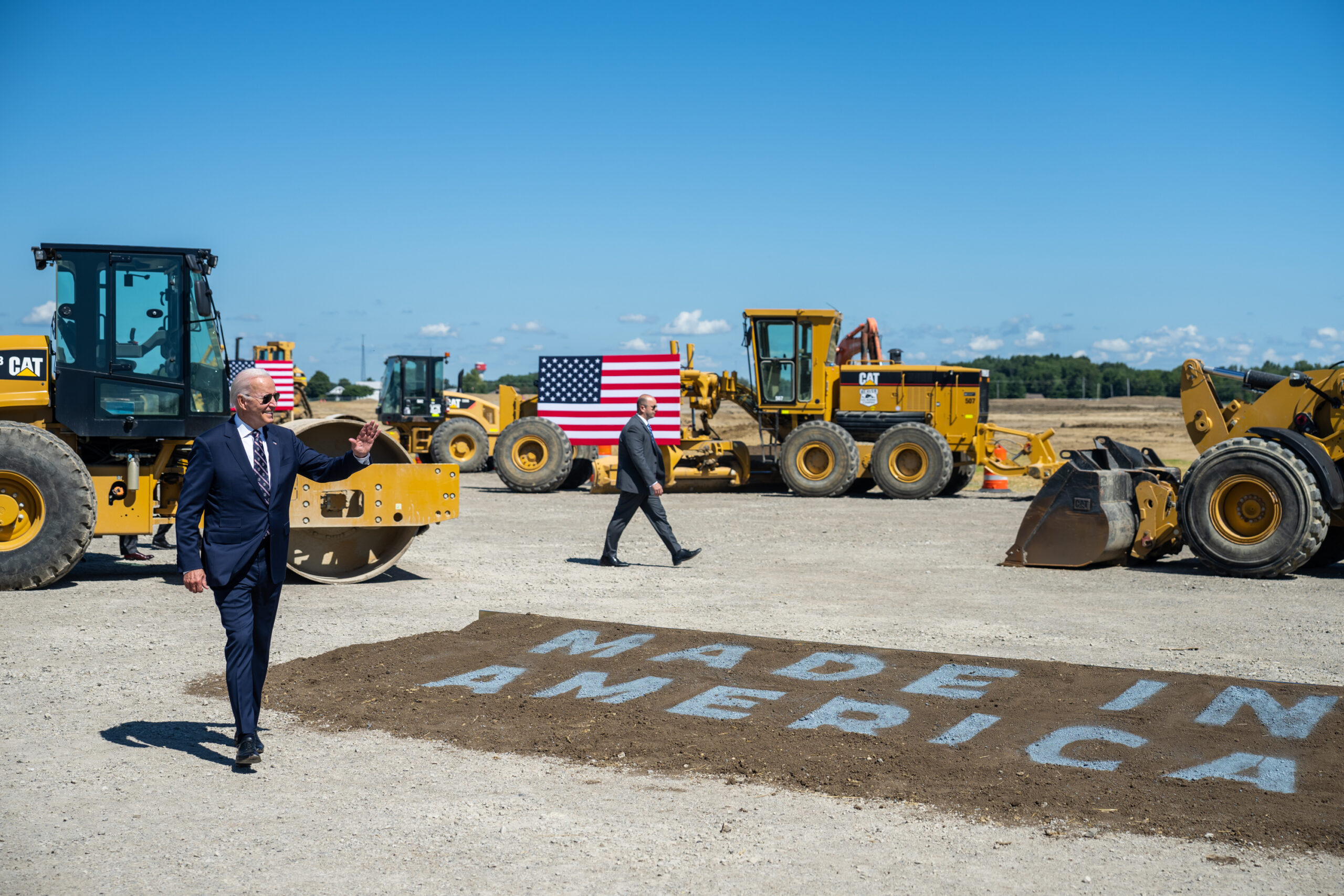
A parade of luminaries spoke in front of two yellow Beaver diggers. From one digger’s boom draped a huge, pristine American flag. Occasionally, as a state official, politician, or corporate executive spoke, another construction vehicle trundled along far behind them, moving over a vast expanse of cleared, soon-to-be-disturbed earth. The delegation led by President Joe Biden had come to central Ohio’s Licking County in September 2022 to break ground on a new industrial site. Spanning more than one thousand acres of Ohio farmland, the site would soon be home to two semiconductor fabrication plants for Intel.
Although less than twenty miles from the state’s busy capital of Columbus, this corner of Ohio had been relatively quiet one year earlier: old farmhouses, oaks and maples, and what one longtime resident called “oceans” of corn.1 Now, Licking County was freighted with history and expectation. Intel, the Silicon Valley giant that once embodied Cold War America’s technological might, boasted that its facilities there would be the largest private sector investment in Ohio’s history. The price tag for the new development surpassed $20 billion. Officially Intel Ohio One, it was christened “Silicon Heartland” by the firm’s chairman Patrick Gelsinger. In remarks at the groundbreaking, Biden triumphantly declared that “the industrial Midwest is back.”2
Intel executives like Gelsinger may mostly have had profits—and a far-reaching turnaround for their long-troubled company—in mind. The Ohio politicians present in September 2022, including Governor Michael DeWine and Lieutenant Governor Jon Husted (both Republicans), were doubtless enthused at the prospect of growth, long-term employment gains, and technological innovations, concentrated in a strategic industry that was new to their state.
But Biden’s syrupy description of the sprawling site in Licking County as a “field of dreams” was suggestive of additional hopes. In Field of Dreams (1989), a spectral voice whispers to midwestern farmer Ray Kinsella that “If you build it, he will come.” Biden envisioned the “revival” of industrial production in America’s Rust Belt as charting a path to a new, durable political majority for his party. The plan seemed simple enough: build a new economy, and voters would come.
Yet, shortly before Biden dropped his reelection bid in the middle of 2024, only one-quarter of voters signaled that his suite of economic policies had “positively impacted them personally.” Americans polled were just as likely to credit then former president Donald Trump with public investments in manufacturing, infrastructure, and technological research and development as they were the actual, incumbent Democratic initiator of these investments.3
In the wake of Trump’s 2024 election victory, understanding the policy and political failures of the last administration’s flagship economic program is critical to any long-term strategy for Democratic revival. Reckoning with the practical, granular impacts, both good and ill, of the Biden interlude across individual factories, firms, and towns, as well as whole regions and sectors, is a necessary prerequisite for understanding how the Biden presidency squandered its moment and how the next generation of industrial policy advocates in the Democratic Party might avoid falling into the same traps in the future.
And one way to reach such an understanding may be to follow U.S. Route 62, through the exurbs and farmland of Licking County and toward Columbus. Because after nearly four years—after almost half a million tons of concrete, acres of eco-friendly landscaping, and the rise and fall of one CEO, Pat Gelsinger, the chip industry’s leading evangelist, whose whole tenure coincided with and became inseparable from the Biden administration—not a single semiconductor chip has been fabricated in Licking County.
The question of why this is the case encompasses the larger story of the Biden era as well as the regional idiosyncrasies of Intel Ohio One. The development’s stalled delivery, ultimately, spotlights Intel’s challenges (and missteps) more than it indicts industrial policy per se. Intel Ohio One’s story is nevertheless useful for making sense of the past half-decade of industrial policy experimentation precisely because challenges on the private sector side have been so impactful, no less than the troubles encountered on the side of government.
Intel Ohio One: The Site
Intel Ohio One occupies a one-thousand-acre site in Licking County in the New Albany International Business Park, near the tony Columbus suburb of New Albany, which is in neighboring Franklin County. First announced by Intel and the Ohio state government in January 2022, Intel Ohio One was the company’s first new stateside manufacturing location in four decades.
Intel committed to building two new semiconductor chip fabrication facilities (a chipmaking plant is usually called a “fab”), although the site has capacity for as many as eight of these factories. The Intel Ohio One fabs are designed to produce the 14A node, a state-of-the-art chip that is slated for prototype production between 2028 and 2030, with mass production early in the next decade. The site is also intended to become a hub of research and development for future chip models. It, therefore, represents Intel’s long-term aim of dominating the development and production of the most advanced chips used to process information, collectively (and nonspecifically) described as “leading-edge logic chips.”
The semiconductor industry was a product of America’s technological growth and implicit industrial policy regime during the Cold War. Initially, the Department of Defense was the American semiconductor industry’s largest customer for chips. Private sector demand outstripped that of the Pentagon in the late 1960s, not long before the first international competitors for U.S. firms emerged in Japan. Competition from Japan spurred the development of a semiconductor-focused industrial policy in the 1980s, although its architects in the nominally free-market-oriented Reagan administration studiously avoided the term. The Reagan administration executed an aggressive trade policy against Japanese high-technology firms and, in 1987, sponsored the creation of sematech, a public-private R&D consortium led by Intel’s former CEO Robert N. Noyce.
While American firms such as Intel and Advanced Micro Devices had regained ground on Japanese competitors by the 1990s, two entwined business trends that accelerated in that decade transformed the U.S. industry again: the “fabless revolution” and the foundry business model.
The “fabless revolution” saw new Silicon Valley firms, notably Nvidia, design leading-edge logic chips without intending to manufacture them in-house. Instead, East Asian chipmakers emerged as dominant manufacturers of leading-edge chip designs, especially those of U.S. firms. The mass production of corporate clients’ chip designs is the foundry business model; this model is today most associated with Taiwan Semiconductor Manufacturing Company (TSMC), which controls 58 percent of the global foundry market.4 Intel, founded in 1968 by executives from an earlier Silicon Valley chipmaker, Fairchild Semiconductor, is today the only major U.S. firm that designs, manufactures, and sells processor chips (this is the Integrated Design and Manufacturing model, or IDM).5
The result of the fabless shift and the rise of East Asian foundry chipmakers was the dramatic decline of stateside chip manufacturing capacities, the problem that Bidenomics sought to address three decades after the fact. Given, as well, the geopolitical and meteorological risks that abound in the Asia-Pacific region, President Biden made the case for a return to domestic semiconductor manufacturing a centerpiece of his agenda when he entered office in 2021.
Bidenomics and the Body Politic
Its architects intended for Biden-era industrial policy to reshore, expand, and regionally disperse the U.S. semiconductor industry and to entrench green energy. Both of these ambitious objectives would contribute to a strengthened American industrial base and create jobs.
Yet Bidenomics, especially when viewed from the vantage point of central Ohio, stumbled in two ways that threatened these laudable goals. First, problems endogenous to the Biden White House’s key partner, Intel, frustrated political goals in a way that casts doubt on how policymakers structured their relationship with the private sector. Second, the deployment of federal funds proved sluggish in a way that worked to discredit the whole program. These intricate moving parts and the relationships between them were part of the foundational logic of Bidenomics. Indeed, in August 2022, analysts at the Rocky Mountain Institute, a research nonprofit focused on green energy, excitedly analogized the Biden administration’s industrial policy to a human body.6
The 2022 chips and Science Act (chips), designed to revitalize and expand the U.S. semiconductor chip industry, was the “brain.” chips would fund all parts of the semiconductor R&D process, from basic technological research to the development of new chip designs and types. The 2022 Inflation Reduction Act (IRA) was the “heart”: it would pump capital around U.S. semiconductor, green energy, and electric vehicle (EV) industries. The 2021 Infrastructure Investment and Jobs Act (IIJA), finally, was industrial policy’s “backbone.” IIJA would both rehabilitate and build new “traditional” infrastructure (i.e., roads, ports), while also funding EV chargers, broadband expansion, and battery manufacturing, creating, in other words, the foundation for industries targeted by Bidenomics to actually deploy and grow. IIJA made up the lion’s share of federal dollars appropriated in the near term: nearly $840 billion by the end of Biden’s presidency.7
Chips’s price tag totaled $54 billion, of which $39 billion was earmarked for grants and tax incentives for new manufacturing facilities. The remainder aimed to fund R&D, both civilian and military, including a new National Semiconductor Technology Center (NSTC). The NSTC would be a public-private consortium that, to an extent, resembled sematech. A $200 million slice of chips funding, meanwhile, went to support companies’ workforce development programs, which would receive substantial input from higher-ed partners in shaping curricula and designing training courses.8 Although several other agencies were involved in deploying chips funds, the highest-profile aspects of the legislation—setting overall strategic goals, driving corporate partnerships, and establishing regionally dispersed manufacturing research institutes—would be overseen by the Department of Commerce.9
The national part of Intel Ohio One’s story is, unsurprisingly, about chips. But the IRA also helps clarify the political and economic dimensions of Intel’s “Silicon Heartland” (a phrase beloved by Intel executives which I have never heard organically uttered in Ohio). The IRA, like the IIJA that inaugurated Bidenomics, carried an enormous price tag, and calculating its economic effects has proven to be enormously complex. A bricolage of tax credits, guaranteed loans, and direct subsidies scattered across multiple federal agencies, the IRA’s total potential impact over a decade was once projected to exceed $1 trillion, in part because many of its tax credits were uncapped.10 The IRA aimed to spur the development and uptake of both existing and new green energy technologies (although it also included more than $100 billion in subsidies for Affordable Care Act coverage). According to a 2022 McKinsey analysis, a mélange of tax credits, loans, and grants added up to $394 billion for green energy and $367 billion for energy infrastructure.11
The IRA’s byzantine structure and costing nonetheless served to clarify something critical about the character of Biden-era industrial policy. Economist Daniela Gabor has popularized the understanding of the Biden administration’s industrial policy objective as one of “derisking.”12 Gabor’s cynical take on American derisking is that it means “bribing private capital to support certain policy priorities,” a characterization which consciously implies Bidenomics lies closer to “market-friendly” neoliberalism than to a new paradigm based on state-led “market-crafting.”13 Gabor’s critique is important but, in a sense, it misleads. As historian Brent Cebul points out, the underlying ethos of derisking, that is, leading private firms to invest in desired sectors and places, was not a neoliberal one. Rather, it was a core modality of economic development policy during the height of “big government”: the New Deal.14
Derisking itself, then, has long been key to economic planning, American-style. Yet one question raised by the tangled experience of Bidenomics has been whether, in pursuit of derisking, policymakers imposed too few requirements on private sector partners. For example, economic geographer Madhumitta Dutta (an expert on workforce development in Ohio) and historian Susannah Glickman argue that the Biden White House offered companies like Intel too many financial carrots and deployed too few regulatory sticks.15
This gets at the crux of Ohio’s difficulties with the semiconductor investments initiated under Biden. Intel’s problems became industrial policy’s problems, imperiling not only a particular project but the reputation of industrial policy writ large.
One should not overlook, however, the fabled implementational shortcomings of such a large and multifaceted undertaking as Bidenomics. Analysis by the Financial Times around the time that Biden left office showed that a plurality of IRA- and chips-supported manufacturing projects that had been started were on track. Pauses or cancellations in started projects were, according to firms, due to factors such as skilled labor shortages, lingering issues of inflation and high interest rates, and uncertainty as to the future of public investment under Trump 2.0 (an uncertainty that has never, as we will see again, been dispelled).16 Even Noah Smith, a soft skeptic of Bidenomics, had reason to hail a “boom” in factory construction as well as to laud the successful launch of stateside chipmaking at TSMC’s new fabs near Phoenix, Arizona.17
Nonetheless, as Biden prepared to leave the White House, only 17 percent of appropriated funds across chips, IRA, and IIJA had been spent.18 Comprehensive permitting reform, a paramount objective of many industrial policy advocates, languished unfulfilled.19 Intel Ohio One seemed, in this context, more representative of Bidenomics than was TSMC’s Sunbelt success story.
Many of industrial policy’s woes, then, seemed concentrated around the unfinished factory site in exurban and rural central Ohio. There was some irony here. President Biden had talked in September 2022 of a Rust Belt rebound. But the Greater Columbus region was not a microcosm of the Midwest’s industrial decay. In fact, it was one of the Midwest’s authentic postindustrial success stories.20
Ohio and the Columbus Way
Columbus appears so typically American, it is where many fast food franchises go to taste-test new products. “The city is located in the heart of the heartland after all,” business reporters once enthused, “and companies believe its residents typify U.S. consumer behavior.”21 Indeed, I have been informed more than once that rookie TV journalists are dispatched to Columbus to learn a “neutral” (i.e., “universal”) American accent.
From the perspective of history or economic sociology rather than market research, claims of Columbus’s all-American, midwestern typicality seem strange. Ohio’s state capital has diverged markedly from the classic narrative of the region’s industrial cities.
Today, the state capital is the most populous of Ohio’s urban “big three” (Cincinnati, Columbus, and Cleveland). But this is really a novel development of the past two or three decades. A 2015 Harvard Business School case study tied the city’s postindustrial economic dynamism to its effective civic and political stewardship.22
Nineteenth-century Columbus had a robust but unspectacular manufacturing economy. Historically, no single industry came to dominate Columbus’s economy in the way that, say, steel did Pittsburgh’s or automaking Detroit’s, two cities that became metonymic for their respective industries. Columbus also skipped the explosive industrial growth of Cleveland, in northeastern Ohio, which shifted from being the center of Gilded Age oil production into a critical node of U.S. iron and steel industries, as well as a hub of automotive industry branch plants.23 In the early postwar years, Cleveland’s population was as much as 25 percent larger than Cincinnati’s and Columbus’s combined.
Columbus, instead, developed a diversified economy that now encompasses financial services (regional firms of the “stadium bank” type), health care, higher education, and retail.24 The Ohio State University (OSU), which has grown dramatically over the past three decades, sits at the center of a regional higher education ecosystem comprising around fifty two- to four-year institutions. Columbus’s present-day economy remains, it is worth noting, less reliant on industrial employers than those of the other “big three” cities: 4.7 percent of jobs in Franklin County (home to Columbus) are in manufacturing, compared to 9.3 percent in Cuyahoga County (Cleveland) and 9.5 percent in Hamilton County (Cincinnati). Of the eleven counties that make up the “Columbus region,” predominantly rural and less populated Logan and Union have the highest proportional concentration of manufacturing jobs.25
I first heard the phrase “the Columbus Way” from a local civil servant in January 2026, but I had unwittingly been introduced to the concept—an ethos of civic leadership and economic development—soon after moving to Ohio the previous fall. At a Columbus Foundation reception for faculty at the area’s higher-education institutions (Kenyon College, my employer, is about sixty miles from downtown Columbus), various business executives lauded the collaborative spirit that existed between private sector firms and public agencies’ proven capacity to foster public-private economic partnerships in the region. (The Columbus Partnership’s CEO also breathed a public sigh of relief about the then recent announcement of an Nvidia investment partnership with Intel, which could, allegedly, help get Intel Ohio One back on track.) Of course, panegyrics to public-private cooperation and the spirit of local boosterism are hardly unique to central Ohio. In Columbus’s case, however, one may hear local elites’ rhetoric echoed by voices from prestigious national institutions, ranging from Harvard University to the Brookings Institution.
The smaller scale of Columbus’s local power elite and the city’s lack of an industrial anchor firm combined to push its business leaders into formalizing economic collaboration at the turn of the twenty-first century.26 In 2002, John F. Wolfe, a representative of Columbus “old money” (the Wolfes owned the Columbus Dispatch until 2015), and Leslie H. Wexner, the sinister retail mogul behind L Brands (who is linked to Jeffrey Epstein), established the Columbus Partnership.27 A membership-based nonprofit, the Columbus Partnership is formally comprised of around seventy CEOs. In practice, it functions as the hub of a regional economic development wheel, the spokes of which include public-private agencies like One Columbus (established by the Partnership in 2010 as Columbus 2020), nonprofit groups such as Smart Columbus, and local governments themselves.
The Columbus Partnership has, over time, won public and private grants for development in the region and undertaken seemingly cosmetic but high-profile civic identity-boosting schemes like its annual “orientation” festival for the city’s thousands of new higher-ed students. Its impact, however, really stems from its convening power. By bringing together regional business elites, the Partnership has amassed the credibility to set strategic goals for regional economic development. It has also sought to diffuse an ethos of collaboration, both public-private and inter-firm, across the area.
According to one economic development official, the area’s public administrators share a sort of “gentleman’s agreement”: one municipality will refuse to support a business moving from another in the Columbus region (to “poach” a firm) unless there has first been a discussion between all governmental and private stakeholders. This sort of attitude, according to the region’s boosters, exemplifies the Columbus Way. The Partnership’s former president Alex Fischer boasted in 2017 that Columbus had become “a highly networked economic juggernaut.”28 This attitude, crucially, extends to the Columbus region, not just to the city itself.
Greater Columbus’s GDP has doubled since 2002. Tech-related attention over the past half decade, moreover, has been due in part to the region’s less manufacturing-intensive economy. OSU business economist Bill LaFayette, for example, argues that Columbus’s high concentration of services industries required greater information technology (IT) support, leading the region to seek to attract data center construction, as well as courting Intel.29 One does not need to be a booster for the Columbus Way to believe that this outlook and its public-private institutional clustering have played a critical role in the region’s growth. A 2024 study of persistent inequality in Columbus’s public schools, for example, observes that “aggressively embracing public-private partnerships” has led to the metropolitan region’s impressive top-line growth.30
One other important piece of Ohio’s developmental jigsaw puzzle was put in place in 2011. That year, the administration of Governor John Kasich authorized JobsOhio. Although technically a private nonprofit organization focused on economic development, JobsOhio is effectively “state-supported”: it is funded via a franchise from the state’s Division of Liquor Control—a franchise originally bought noncompetitively—for the storage, sale, and distribution of high-proof spirits. JobsOhio played a vital but not fully clear role in securing Intel’s investment in Ohio.
Columbus’s much touted overall success and its dense, growth-focused network of local power elites provide essential context for Intel’s investment in the region. While Columbus’s Battelle, a nonprofit R&D center, has undertaken some semiconductor-related research in the past, chipmakers had no presence in Ohio prior to 2022. Indeed, semiconductor-chipmaking was not even included in the ten “target industries” identified by JobsOhio as aspirations for sectoral growth at the start of the decade. Reputedly, Ohio had not made Intel’s first shortlist for new sites in 2021. But in May 2021, Intel contacted JobsOhio to solicit bids for a new fab. Given just three days to assemble bids, One Columbus was the only one of JobsOhio’s regional affiliates that put something together in time, an indication more of Greater Columbus’s well-honed competencies in business boosterism than of any particular standout advantages for semiconductor-chipmaking that the region held over others in Ohio. Intel, the Columbus Dispatch later reported, “made it clear” that central Ohio was a “long shot.” One prior preferred site had, apparently, been Foxconn’s science park in Milwaukee, Wisconsin.31
State-level tax incentives secured during 2022, including a June 2022 budget that made more fiscal carrots available to “megaprojects,” swayed Intel, according to public reports.32 Ohio policymakers, including Governor DeWine and state legislators, were, however, only in a position to secure the investment via this means because of Greater Columbus assembling an infrastructural package that included land and higher-ed partners.
From Promise to Peril: The Life Cycle of Intel Ohio One
Intel purchased its thousand-acre site in Licking County in June 2022. The land purchase reflected, to an extent, the way in which economic interests can imbricate and blur when market-crafting happens at state and local levels. JobsOhio granted Intel $125 million to buy the Licking County land from Leslie Wexner’s New Albany Company, a private development firm.33 (Wexner himself established New Albany, which abuts the fab site, as a master-planned community in the mid-1990s.) The New Albany Company had itself only purchased the land beginning in summer 2021, at least one or two months after Columbus’s densely networked civic and business leaders were notified of Intel’s potential Ohio investment (at that stage, as noted above, a “long shot”) and then prepared their internal bid for consideration to JobsOhio.
All of this predated chips’s passage. Major legislation can take its time winding through Washington: a forerunner bill to chips first appeared in Congress in June 2020 before losing momentum. Intel’s high-profile dealmaking in Ohio was, as best as I can tell, undertaken partly as a way to build the needed momentum for chips itself. Federal funding, CEO Gelsinger averred more than once, would be critical for making sure the planned fab came to fruition.
Gelsinger, who became Intel’s chief executive in 2021 after several difficult years for the company, aligned himself very closely with the Biden administration and its agenda of reshoring the semiconductor industry. chips represented, in Gelsinger’s words, “the most critical industrial policy legislation since World War II.”34
Intel’s close working relationship with the Biden White House and Secretary of Commerce Gina Raimondo, whose department oversaw the bulk of chips disbursement, emerged from the confluence of Gelsinger’s long-term commercial aims with the administration’s strategic industrial policy objectives. In the decade and a half before Gelsinger took the reins, Intel missed out on two successive chipmaking bonanzas, namely the demand booms for smartphone and Artificial Intelligence (AI) chips. The firm retained its focus on fabricating PC and data center processor chips, a corporate strategy characterized by historian Chris Miller as choosing near-term profits over long-range innovation; Intel doubled down on its historical quasi-monopoly but began losing ground in these markets anyway during the 2010s.35
Gelsinger’s revival strategy had two primary components: first, turbocharge stateside production to compete with TSMC and Samsung in fabricating leading-edge logic chips, and second, invest in Intel’s nascent foundry business.36 This strategy, in effect, aimed to attack TSMC’s market dominance on both its flanks: a U.S.-owned firm would not only fabricate the world’s most advanced chips, but it would mass-produce chips for external customers. These ambitions were perfectly aligned with those of the Biden White House, which correctly viewed chipmaking repatriation as a geopolitical as well as a domestic political and economic project.37
Yet while understandable, even unimpeachable, in theory, Gelsinger’s bold two-part revival strategy has effectively also caused Intel Ohio One’s sluggish rollout. During 2024, its worst-ever fiscal year, Intel’s share price fell by 60 percent (this is what led to Gelsinger’s December 2024 ouster from the top job). Internal and external critics placed a large portion of blame for this on the cost of Gelsinger’s decision to simultaneously roll out both parts of his strategy: increase development and fabrication of leading-edge logic chips while building up a foundry business from virtually nothing. Foundry facilities, in particular, require an enormous number of orders to ensure profitability, something that Intel’s foundry business initially lacked.38
Intel Ohio One embodied these growing pains. The vast Licking County site was originally intended to develop and then mass produce a new, leading-edge chip (the 14A node) while also scaling up production of the extant 18A node for foundry customers. (Due to the stalled progress, however, the 18A node is now unlikely to play any role in Ohio.) At one thousand acres, the site is larger than Intel’s Ocotillo campus in Chandler, Arizona (seven hundred acres), and the one at Rio Rancho, New Mexico (two hundred acres), each of which has been supported by chips and is currently operational (Chandler’s brand new Fab 52 began production in October 2025).39 Ocotillo and Rio Rancho built upon existing Intel manufacturing sites in their respective locations. Moreover, each of those chips-supported sites primarily focus on one fully-developed Intel product, which contrasts with Intel Ohio One’s (hypothesized) broad range of products. Ocotillo manufactures the 18A node—although it remains unclear whether a robust enough foundry customer base yet exists for this product; Rio Rancho, meanwhile, specializes in advanced packaging, a rare example of twenty-first-century in-house Intel innovation.40
This is not to suggest that U.S. firms like Intel should avoid grand ambitions tout court. The prosaic reality is that Intel’s 2021–24 leadership bit off more than they could chew in the near term. I heard here in central Ohio that one lesson from Columbus’s twenty-first-century boomtimes has been that economic development success usually comes in “ones and twos” rather than “home runs,” and, relatedly, that it is a dangerous business to try and be “the next thing.” From a skeptical perspective, Intel in the early 2020s appeared both to attempt to rewrite its twenty-first-century history (when industrywide, stateside production declined even as Intel bypassed the early years of the smartphone and AI revolutions), and to try to become a new TSMC.
And just as Intel under Gelsinger seemed to bank everything on the Biden administration, so too did the administration bank almost everything on Intel.41 The firm’s mistakes became the mistakes of the Biden era writ large. In effect, Bidenomics transposed these private sector missteps into the political arena. The firm and the federal government found themselves so closely entwined that they were unable to move forward easily or coherently. Given this, it is also worth asking: did procedural bottlenecks play a role in Intel Ohio One’s torturous delays?
The answer to this question is opaque, shrouded in the secrecy of internal deliberations. In November 2024, after Trump’s victory and shortly before the Biden White House’s valedictory release of chips funds, the Ohio Capital Journal reported Intel’s frustration at its two-year wait for federal lucre. Intel, however, refused to comment on why the funding had gotten stuck, citing “private conversations.”42 Later that month, chips funding for Intel’s fab developments at last became available. This came two years after the Licking County groundbreaking. The chips-funded $7.86 billion was, however, around $750 million less than had been publicly suggested by government and private stakeholders since mid-2022.43
One Democratic state legislator, William P. DeMora, places more blame on Intel than the federal government for the delay, suggesting that Intel moved too slowly on regulatory compliance and other federal Commerce Department requirements around social outcomes (although the latter plays into some common right-leaning critiques of chips, as explained below). Federal regulatory roadblocks to fab construction, however, were eased by the 2024 Building Chips in America Act, which Ohio’s Democratic senator Sherrod Brown cosponsored in 2023 due to the slow pace of chips-supported factory-building.44
A common Republican criticism of chips is that it imposes such onerous requirements on firms, notably the provision of various social benefits (e.g., childcare), that businesses cannot build and operate. This was a favored critique of Ohio Republican Bernie Moreno, who defeated Senator Brown in 2024, until he admitted that he had not actually looked at chips’s text.45 But as Madhumitta Dutta and Susannah Glickman point out, many of chips’s “requirements” for social provisions, including “local involvement in planning, union participation . . . environmental stewardship, reinvestment for ‘excess’ profit-sharing,” are “noncommittal,” requiring an aspirational written plan rather than statutory commitments of the kind that could truly slow project delivery.46
This is not to suggest that Bidenomics imposed no procedural bottlenecks. The case of Intel Ohio One, however, suggests that bottlenecks, which have had such deleterious effects in arenas like blue-state housing construction, were not the primary substantive cause of the Biden era’s industrial policy’s woes.
In December 2025, the New York Times reported that TSMC executives responsible for the Taiwanese chip giant’s chips-supported Phoenix fabs were frustrated by a proliferation of conservation-oriented regulations. Most of those cited, such as a requirement to “replant protected species of desert flora,” were state rather than federal regulations.47
Procedural bottlenecks that might unduly raise costs or at times delay projects ought to be cleared; efforts like the one championed by Senators Brown and Mark Kelly, the Building Chips in America Act, indicate that pro-industrial policy Democrats are aware of this. But the more fundamental obstacles that Biden-era industrial policy seemed to confront, at least in Licking County, were the structural and self-imposed flaws in its favored U.S.-based corporate champion, Intel. And far from giving too much leeway to corporate champions, as left-wing critics of Bidenomics argued, the administration seemed responsive to these private sector flaws: in fact, the Commerce Department reduced Intel’s chips funding at the end of 2024, as noted above, because of Intel’s internal missteps.48
Lessons for Industrial Policy
Today, progress toward making Licking County the central node of a new chipmaking ecosystem in the Midwest continues at a glacial but steady pace. Intel Ohio One is currently slated to properly open its doors in 2030 or 2031; there is, in all likelihood, little chance of Intel and its Columbus-region partners actually abandoning Intel Ohio One. From the perspective of economic development officials in Greater Columbus, very few mistakes were made on the part of Ohio stakeholders. Senator Moreno called in August 2025 for a fraud investigation, launching vague imputations at Intel’s Malaysian-born CEO Lip-Bu Tan.49 But no one in central Ohio seems to take these threats, or Moreno himself, all that seriously.
At the same time, there is a clear lack of optimism about Intel Ohio One ever reaching the Olympian heights that Gelsinger promised in 2022. Even the estimates of ten thousand jobs associated with the construction and operation of the fabs have been scaled back.
Intel Ohio One raises four issues with useful implications for industrial policy in the years ahead: (1) the lack of a clear public view into the economic development process, (2) the political impact of federal funding delays, (3) the internal problems that arose from a corporate champion’s overreach and missteps, a critical point, and (4) the proper interrelationship between different scales of political and economic authority.
Dutta and Glickman argue that Biden-era industrial policy’s key weakness was its “asking for little [from private sector partners] in return” for public investment.50 This formulation could be reframed: government should ask for more in certain ways, but rather than asking for more in terms of social programs, policymakers ought to ask for more and better insight into firms’ corporate strategies; they should look to disperse (where possible) funding provision to a greater number of private sector partners, and ask companies to break down their plans into clear and logical “steps” that public officials can actually follow and make sense of. By the latter point, I mean government should prioritize sites that focus on a particular product or innovation rather than expansive but hard-to-define visions of growth that easily degenerate into hype; it should reward firms that lay the formative conditions for a new industry to grow in a certain region rather than seeking to will an entire sectoral ecosystem into being with one “Big Bang”-style project.
It would be naïve to suggest that the entire chain of processes—that is, the inside baseball of economic development—be played in the open, in full public view. The excesses of community input, after all, have a lot to answer for in regard to the anti-growth political economy of several blue states.51 Nonetheless, the sheer opacity of Intel Ohio One’s delays has served no one well. Arguably, the problem began even before Intel committed to the Licking County site, in the murky sequence of events by which One Columbus learned of the bidding opportunity, Wexner’s New Albany Company acquired land that it later sold to Intel at a preferential price, and Intel used funds it received from JobsOhio, One Columbus’s statewide partner.
Intel Ohio One has suffered from persistent overpromising, by both elected officials and Intel executives. Ohioans concerned about its prospects, including higher-ed students drawn to Intel-sponsored research and technical programs, have very little ability to track when and how the project has been delayed. Some of this is a case of political miscommunication. The entire experience of Biden-era industrial policy, at national, state, and local levels, was marked by unclear messaging that did not lay out plausible public timelines and failed to connect the dots of various development projects.
Additionally, the lack of legible public information turned federal delays into a political football. As noted above, I do not believe that delayed chips funds formed the decisive factor in slowing down Intel Ohio One’s development. But these delays did serve to discredit the project in political terms. In 2025, Vivek Ramaswamy, the hyper-caffeinated MAGA acolyte running to succeed Governor DeWine, suggested that his administration would focus on tax cuts and broad deregulation rather than public investment. GOP politicians will serve up precisely this sort of reheated trickle-down farrago if policymakers fail to cultivate public buy-in for industrial policy measures like chips. Beyond political communication, industrial policy implementation would also benefit from further attention to streamlining regulatory and compliance processes, regardless of whether or not this was the main cause of an industrial project’s delayed development outcome.
Could delays in Intel Ohio One, similar to issues around a chips-supported expansion of Intel facilities in Oregon, have been avoided if the federal government had made a more realistic assessment of Intel’s structural ability to execute its high-stakes manufacturing revival strategy?
When it comes to industrial policy, the government ought to have substantial insight into recipient companies’ corporate strategies and accounts. Policymakers should also have the flexibility to alter or adapt grants and tax incentives based on corporate partners’ performance. The Biden administration’s reduction of Intel’s chips funding in late 2024, as it was leaving office, was a belated example of this, one that ultimately carried material economic significance as well as important symbolic weight. This is not a question of the government intruding into strategic and managerial decision-making in the C-Suite. Rather, it is a matter of national policymakers evaluating executives’ plans, ensuring a degree of accountability, and transferring the focal point of business risk away from the public sector (which, in practice, likely ends up falling on state or local government) and toward private sector recipients of public investment.
A 2024 report from the American Economic Liberties Project, where several Biden White House alumni today work, contends that the U.S. semiconductor industry’s high level of corporate concentration militated against positive socioeconomic results from industrial policy.52 There is some irony in the fact that Bidenomics became so intertwined with Intel given that, as Brown University sociologist Andrew Schrank points out, in other arenas of the economy it was closely associated with a resurgence of antitrust policy.53 Chipmaking requires eye-wateringly high capital costs and, for many jobs, an extensively trained workforce. Nonetheless, it could make sense to look more closely at how industrial policy like chips can stimulate intra-sectoral competition—or, at the very least, avoid channeling funds to projects where a firm seeks to go beyond its own expertise and competencies, as has arguably been the case with Intel Ohio One.
One possible, unintended consequence of light-touch government oversight of corporate partners is an eventual escalation of the state’s role. This is, in effect, what happened to Intel when the Trump administration dramatically took a 10 percent equity stake in the troubled tech company in September 2025. Of course, it is far too early to see how this strange MAGA experiment in sector-specific dirigisme will play out.54 But Trump’s move potentially represents a profound extension of the federal government’s industrial policy toolkit that could steer the United States away from indicative planning of the sort that has worked so well in American history—and toward a riskier approach that could replicate Intel’s Biden-era missteps in the public sector itself.
Seeing Like a Local Power Elite
The problems that bedeviled Bidenomics’ key corporate champion leads to the fourth issue raised by Intel Ohio One, and it provides possibly the most significant lesson from central Ohio. This concerns the proper interrelationship between the three sources of political and economic authority at play in a project like that in Licking County: the federal government, the private sector (Intel), and the complex, interconnecting network of interests and stakeholders that comprise a local power elite.
Intel Ohio One’s delays have certainly seemed mysterious to many ordinary Ohioans in Greater Columbus. The Biden administration could have benefited from more robust strategic oversight and coordination vis-à-vis their corporate champion. But how much did the region’s local power elite know about Intel’s wider corporate strategy? How many strategic discussions about this took place directly between federal policymakers and the local power elite—those who, more than the White House, are really charged with implementation of economic development?
Just as it would be unrealistic to expect the development process to be fully open to public view, it is implausible to suggest that local power elites could intervene in C-Suite decision-making (especially in the case of multinational corporations). Nevertheless, boosterish local elites, such as those who run the Columbus Partnership, have the greatest stake in and responsibility for regional development. They are owed, in my view, access to supra-regional decision-making processes and the capacity to pull policy levers—for instance, reclaiming unused public-supported funds, or determinative input into the terms of engagement between federal agencies and corporate partners—that shape local developmental outcomes.
Intimations of such a viewpoint had emerged in the 2026 Ohio gubernatorial race. Attorney General Dave Yost, briefly Ramaswamy’s rival for the GOP nomination, argued that JobsOhio needs legal authority to “claw back” funds from underperforming corporate partners—explicitly inspired by, of course, the example of Intel Ohio One. Former public health official Amy Acton, the Democratic contender, echoed Yost’s argument and called, somewhat sweepingly, for greater “transparency.”55 Aside from these minor rhetorical interventions, Ohio’s 2026 gubernatorial election is not being fought on the terrain of industrial policy. What Yost’s and Acton’s interventions do suggest, however, is a bedrock political interest in greater state and local public oversight of projects like Intel Ohio One.
Would granting local power elites greater access to such projects simply create more procedural encrustations on the developmental process? I would argue that this need not be the case. Local power elites have the most pronounced interest in expeditious delivery of major economic development projects. What if, for example, local stakeholders had veto power over certain requirements for select projects, from federal permitting procedures to add-ons like social care provisions? Conceivably, in my view, allowing local interests more access to higher-level stages in the developmental process could speed up the course of projects like Intel Ohio One.
Moreover, the fundamental relationship between the different scales of political and economic authority in this case often seems to resemble a Venn diagram—Intel working closely with federal policymakers and Ohioan stakeholders—rather than a horizontal framework wherein the local power elite could easily access federal policymakers and help shape the regional implementation of federal policies and procedures.
The precise structure of such a reformed arrangement can, and must, be debated. But the essential principle I suggest is that local power elites be granted direct, even prioritized, input into the delivery of local and regional development projects.
One more lesson from the Columbus Way lies in how the city’s development regime previously worked with the region’s peculiar character, one grounded in its diversified economy, rather than pursuing a single anchor employer. The economies of old-line industrial cities like Pittsburgh, Detroit, or Lowell, Massachusetts, were often organized around one anchor industry—steel, automaking, textiles, etc. There are traces of this historic trend in the story of Bidenomics: the administration arguably saw the route to dispersed revitalization as creating new regional economies dominated by a single high-tech industry. But Columbus’s twenty-first-century local power elite saw things differently: they had encouraged the area’s economic diversity and long avoided chasing the moonshot of a single predominant regional industry.
Biden-era policymakers were, in my view, correct to focus on productive sectors of the economy. But a single “mega site” intended to reconfigure a regional economy around one industry—and one company—may well be less effective than, first, fostering a broader range of smaller manufacturers and, second, seeding a larger number of a particular corporate partner’s smaller production sites across more regions. This points to one of the peculiarities of Intel Ohio One. In September 2022, President Biden proclaimed that the Rust Belt would soon be “back.” But Greater Columbus wasn’t part of the Rust Belt. It was the growth region in a state elsewhere scarred by deindustrialization and hobbled by persistent economic stagnation.56
In this context, the Biden administration’s enthusiasm for locating a new Rust Belt anchor industry in Ohio’s most dynamic region appears to have misread some economic signals. The stated aim of Biden’s high-tech-oriented industrial policy was to foster new growth in “left behind” regions. The political dividends of this approach were to be Democratic votes in ancestrally blue but reddening electoral districts. This political and economic calculation applied only imperfectly to Greater Columbus.
Industrial Policy after Bidenomics
Bidenomics stumbled in central Ohio after politicians and policymakers at every level made grand promises and set dauntingly high expectations. These promises and expectations exacerbated the more fundamental cause of failure: Intel’s record of mismanagement and firmwide struggles worsened what would already have been a political and public relations failure. It is not, in my view, coincidental that certain other chips-supported Intel sites, such as Ocotillo and Rio Rancho, have made much better progress. Unlike in central Ohio, in Arizona and New Mexico, Intel’s reach did not exceed its grasp. The firm simply seemed to be trying to do far too much in its Ohio “mega site.”
It would be unfortunate if Democratic leaders took away from the tangled experience of Bidenomics that they should retreat from ambitious developmental policymaking. For the policy thinkers behind “Bidenomics,” working out how to implement industrial policy more efficaciously is imperative (“the need,” enjoined one recent report, is to “move swiftly to deliver on-the-ground results for working people”).57
Worryingly, however, some senior Democratic figures associated with pre-2016 orthodoxy have used the 2024 defeat to argue that the party ought to refocus on redistribution and more prudent, ameliorative management of America’s “neoliberal” economic settlement. Ghosts from the Clinton and Obama eras now castigate Biden-era Democrats’ experimentation with market-crafting and predistribution.58
One way, meanwhile, to interpret the high-profile and influential “abundance agenda” is as an intellectual foundation for implementing large-scale public initiatives more quickly, while reducing the capacity of organized interest groups (such as environmental nonprofits or labor unions) to shape public-sector procedure. Abundance advocates argue that this capacity on the part of interest groups has slowed the speed and eroded the efficiency of state delivery.59 There is considerable merit to this argument. But some experts, such as economic sociologist Andrew Schrank, argue that critiques of “red tape” often act to obscure underlying, substantive political disagreements. Regardless, “red tape” does not seem to have been the most critical factor in Intel Ohio One’s problems.
Industrial policy can, over the medium- to long-term, reap political and economic rewards in precisely the ways that President Biden intended Bidenomics to do. If these sanguine outcomes are to prevail, however, then future Democratic administrations ought to look closely at local and regional cases like Intel Ohio One and focus on lessons such as those laid out above.
The danger entailed by the mixed track record of Bidenomics is that ideologues will seek to use its shortcomings to discredit industrial policy as an economic paradigm. But concluding that industrial policy per se is doomed would be a profound mistake. As a development official in Franklin County said, after asking me rhetorically whether industrial policy works, “I thought Alexander Hamilton settled that debate two hundred years ago.”
This article originally appeared in American Affairs Volume X, Number 2 (Summer 2026): 116–35.
Notes
I would like to thank John Kent for his exceptional research assistance and informative discussions about industrial policy and Intel. Henry Haile and A. J. Molina also provided valuable research assistance. Thanks to Michael Cuenco, Jeffrey Gottke, Julia Marino, Andrew Schrank, and Graham Stokes for their insights and guidance.
1 Alan Miller, “Intel Neighbors Pull Up Stakes After 4 Years of Change, Heartbreak,” Columbus Dispatch, January 21, 2026.
2 Joseph R. Biden, Jr., “Remarks at a Groundbreaking Ceremony for an Intel Corporation Manufacturing Facility in New Albany, Ohio,” American Presidency Project, September 9, 2022.
3 Sara Dorn, “Most Voters Are Unfamiliar with Biden’s Signature Economic Plans, Poll Finds—as Inflation, Economy, Are Top Election Concerns,” Forbes, May 8, 2024.
4 For this brief overview of the U.S. semiconductor industry, see: Todd Achilles, Erik Peinert, and Daniel Rangel, Reshoring and Restoring: chips Implementation for a Competitive Semiconductor Industry (Washington, D.C.: American Economic Liberties Project, 2024), 23–26; Susannah Glickman, “Semi-Politics,” Phenomenal World, June 24, 2023; Chris Miller, Chip War: The Fight for the World’s Most Critical Technology (New York: Scribner, 2022), 209–13.
5 This is true of processor chips, but most major memory chipmakers (e.g., Micron) operate with an IDM model. The industry’s memory chip sector is also more competitive than the processor chip sector; see: Achilles, Peinert, and Rangel, Reshoring and Restoring, 13–14, 18.
6 Lachlan Carey and Jun Ukita Shepherd, “Congress’s Climate Triple Whammy: Innovation, Investment, and Industrial Policy,” Rocky Mountain Institute, August 22, 2022.
7 Jessie Blaeser, Benjamin Storrow, and Kelsey Tamborrino, “What Has Biden Wrought?,” Politico, December 23, 2024.
8 This describes the funding structure and initial rollout of chips. But it is important to note that the Trump administration’s enacted and threatened cuts to science funding and November 2025 shutdown of Natcast, the nonprofit established to launch the National Semiconductor Technology Center, have created profound uncertainty around chips’s future.
9 The Commerce Department’s National Institute of Standards and Technology (NIST) was chips’s key agency. Other significant government players in chips were the National Science Foundation, which received a plurality of chips funds to oversee basic and translational research and fund workforce development, and the Department of Energy.
10 The fiscal picture has become less clear since 2025 because Congressional Republicans have endeavored to claw back IRA funds. These efforts are, however, contested between the House and the Senate and subject to additional contestation in situations where GOP-held Congressional districts could benefit from IRA funding. See: Riki Fujii-Rajani and Sanjay Patnaik, “What Will Happen to the Inflation Reduction Act Under a Republican Trifecta?,” Brookings Institution, January 6 2025.
11 Justin Badlam et al., “The Inflation Reduction Act: Here’s What’s In It,” McKinsey & Company, October 24, 2022.
12 Having borrowed the term “derisking” itself from European Commission President Ursula von der Leyen, Gabor first applied it to European governments before arguing that it also explained U.S. policymakers’ approach. See: Daniela Gabor, “The (European) Derisking State,” SocArXiv Center for Open Science, May 2023.
13 Skanda Amarnath et al., “Varieties of Derisking,” Phenomenal World, June 17, 2023.
14 Brent Cebul, “Bidenomics: Farewell to an Idea?,” New York Review of Books, January 15, 2025.
15 Madhumita Dutta and Susannah Glickman, “Chips on the Table,” American Prospect, January 30, 2025.
16 Amanda Chu and Alexandra White, “Has Joe Biden Spurred an American Manufacturing Renaissance?,” Financial Times, August 16, 2024.
17 Noah Smith, “Biden’s Tarnished Industrial Legacy,” Noahpinion (Substack), January 6, 2025.
18 Jessie Blaeser and Kelsey Tamborrino, “4 Takeaways on Biden’s Massive Spending Plans,” Politico, May 8, 2024.
19 Blaeser, Storrow, and Tamborrino, “What Has Biden Wrought?.”
20 In a topical pairing, the conservative Manhattan Institute recently contrasted Columbus’s growth with the decline of Vice President J. D. Vance’s hometown of Middletown; see: Jordan McGillis, “Hello, Columbus,” City Journal, August 1, 2025.
21 Aimee Groth and Karlee Weinmann, “New Fast Food Products Get Tested First in Columbus, Ohio,” Business Insider, November 2, 2011.
22 Jan W. Rivkin, “The Columbus Partnership [Case Study 9-715-462],” Harvard Business School Case Collection (May 2015).
23 Delaney Murray and Madeleine Quackenbush, “After Industry: Cleveland’s Renaissance as the Rust Belt Poster Child,” Midstory, July 7, 2021.
24 Rivkin, “The Columbus Partnership.” On the idea of the “stadium bank,” see: David Dayen, “Revenge of the Stadium Banks,” Intercept, March 2, 2018.
25 The “Columbus region” here refers to the “Central Region” of JobsOhio, the state’s private but state-supported nonprofit economic-development agency. JobsOhio financially supports public-private economic development agencies in each of its seven regions; in the case of the “Central Region,” this agency is One Columbus. These regional agencies are not formal subsidiaries of JobsOhio, although they de facto function as something close to this. The Columbus Partnership works closely with One Columbus and, in fact, originally established it prior to JobsOhio’s creation. The eleven counties that make up the “Columbus region” are Franklin, Delaware, Fairfield, Knox (home to Kenyon College), Licking, Logan, Madison, Marion, Morrow, Pickaway, and Union.
Ohio was, as of 2025, the third-largest state by manufacturing employment. On manufacturing employment in Ohio, see: Ohio Manufacturers’ Association, 2025 Ohio – Manufacturing Counts: The Economic Impact of Ohio Manufacturing (Columbus: Ohio Manufacturers’ Association, 2025).
26 I have borrowed the phrase “local power elite(s)” from historian Brent Cebul, who characterizes the Democratic Party’s New Deal and postwar developmental regime as premised on administrative devolution. Economic development, though heavily reliant on federal funding and practicable primarily in a context of Keynesian national fiscal policy, was generally delivered by “local power elites” who shaped the development process and managed it, often via public-private partnerships. See: Brent Cebul, Illusions of Progress: Business, Poverty, and Liberalism in the American Century (Philadelphia: University of Pennsylvania Press, 2023).
27 Rivkin, “The Columbus Partnership.”
28 Alex Fischer, “For Columbus, Public-Private Partnerships are Key to Economic Development,” Brookings Institution, May 17, 2017.
29 Albert Lee, “While Surrounding Cities Shrink, Columbus is a Growing Midwest Metropolis,” Midstory, February 1, 2022.
30 Jason Reece and Victoria Abou-Ghalioum, “Urban Schools and the Growth Machine,” in Community Development and Schools: Conflict, Power and Promise, ed. Mildred E. Warner, Jason Reece, and Xue Zhang (New York: Routledge, 2024), 48–65, at 50. A countervailing theory for Columbus’s apparent success emphasizes the growth of state government over the past few decades (Indianapolis, another state capital, has experienced similar regional trend-defying growth in the twenty-first century). This emphasis is, however, congruent with an argument for the significance of Columbus’s historically diversified economy; see: Richard Vedder and Nicholas Jadwisienczak, “A Special City?: We Know Why Columbus is Growing while Ohio Declines,” Columbus Dispatch, September 10, 2025.
31 Mark Williams, “Here’s How Ohio Won a Bid by Intel to Build the World’s Largest Chip Factory,” Columbus Dispatch, January 21, 2022.
32 Williams, “Here’s How Ohio Won a Bid by Intel to Build the World’s Largest Chip Factory.”
33 Mark Williams, Jim Weiker, and Julie Fulton, “Intel Spends $111 million on 750 Acres of Land for Its New Albany Factories,” Columbus Dispatch, July 6, 2022.
34 Patrick Gelsinger quoted in: Barbara Ortutay, “Chipmaker Intel to Cut 15,000 Jobs as It Tries to Revive Its Business and Compete with Rivals,” Associated Press News, August 1, 2024.
35 Miller, Chip War, 191–96, 236–40; Ana Swanson and Tripp Mickle, “The White House Bet Big on Intel. Will It Backfire?,” New York Times, October 24, 2024.
36 Miller, Chip War, 333.
37 Shubham Dwivedi and Gregory D. Wischer, “Not All Semiconductors Are Created Equal,” National Interest, April 27, 2022. Kenneth Flamm and William B. Bonvillian, “How Intel’s Innovation Problem Became a National Security Crisis,” American Affairs 9, no. 1 (Spring 2025): 40–54.
38 Max A. Cherney, Stephen Nellis, and Anirban Sen, “Intel CEO Gelsinger Forced Out After Board Lost Confidence in Turnaround Plan,” Reuters, December 2, 2024.
39 Intel also received chips and Science Act support for an expansion of R&D and production facilities in Oregon, which has been subject to similar delays as Intel Ohio One. Intel’s new Oregon investment did, however, build on an existing, longstanding Intel presence in Oregon. On the planned expansion of Intel’s facilities in Oregon, see: Intel Corporation Press Release, “Press Kit: Intel in Oregon,” Intel Newsroom, August 4, 2022. On job cuts and issues with this investment, see: Nick LaMora, “Intel Layoffs Continue in Washington County with Hundreds of Jobs Cut,” Beaverton Valley Times, November 14, 2025.
40 Lauren Goode, “The Ridiculously Nerdy Intel Bet That Could Rake in Billions,” Wired, April 6, 2026.
41 My view is that policymakers should not interpret the problems with Bidenomics as a repudiation of industrial policy-style interventions in principle. In one recent qualified defense of Bidenomics, however, sociologist Andrew Schrank argues that the Biden administration’s industrial policy avoided the typical error of industrial policy: placing too much emphasis on large, potentially oligopolistic corporate champions. Schrank points as evidence for this to the Biden administration’s concurrent pursuit of more aggressive, activist antitrust policy (associated with Lina Khan, chair of the Federal Trade Commission from 2021– 25). Yet, in my view, a case study such as Intel Ohio One demonstrates that the Biden administration overly relied on single corporate champions (in this case, Intel), possibly as an attempt to speedrun the reshoring of the high-technology industry. For Andrew Schrank’s defense of Bidenomics, see: Andrew Schrank, “Can Industrial Policy Still Do Big Things?,” Issues in Science and Technology (Winter 2026): 64–68.
42 Morgan Trau, “Where Is the chips Act Funding for Ohio’s Intel Plant?,” Ohio Capital Journal, November 12, 2024.
43 Intel Corporation Press Release, “Intel, Biden-Harris Administration Finalize $7.86 Billion Funding Award Under U.S. chips Act,” Intel Newsroom, November 26, 2024.
44 Nick Evans, “Intel Facility would Avoid ‘Redundant’ Environmental Review Under U.S. Sen. Sherrod Brown Bill,” Ohio Capital Journal, July 21, 2023; Madeleine Ngo, “Biden to Sign Bill Allowing Chip Projects to Skirt Key Environmental Review,” New York Times, October 1, 2024.
45 Trau, “Where Is the Chips Act Funding for Ohio’s Intel Plant?.”
46 Dutta and Glickman, “Chips on the Table.”
47 Peter S. Goodman, “18,000 Reasons It’s So Hard to Build a Chip Factory in America,” New York Times, December 2, 2025.
48 Some in the administration argued that this reduction merely partially offset a separate $3 billion Department of Defense contract awarded to Intel. This latter contract, however, would likely have been awarded regardless of the nature of Intel’s chips funding. See: Tripp Mickle and Ana Swanson, “Washington Curtails Intel’s Chip Grant After Company Stumbles,” New York Times, November 24, 2024.
49 Max Filby, “Sen. Moreno Says Intel’s Ohio Could Become a ‘White Elephant,’ Urges Fraud Investigation,” Columbus Dispatch, August 7, 2025.
50 Dutta and Glickman, “Chips on the Table.”
51 On the idea of blue states adopting or drifting into an anti-growth political economy, see, for example: Jerusalem Demsas, “The Democrats Are Committing Partycide,” Atlantic, November 14, 2024.
52 Achilles, Peinert, and Rangel, Reshoring and Restoring.
53 Schrank, “Can Industrial Policy Still Do Big Things?.”
54 The Roosevelt Institute’s Todd Tucker, a senior policy advisor in the Biden White House, argued that the Left ought to work from this “state capitalism” playbook, albeit with distinctly progressive ends in sight. See: Todd N. Tucker, “Don’t Let Trump Define What State Capitalism Can Be,” New Republic, September 6, 2025.
55 Jessie Balmert and Max Filby, “How Will Ohio’s Next Governor Handle Intel Delays? Yost, Ramaswamy and Acton Weigh In,” Columbus Dispatch, March 16 2025. Jeremy Pelzer, “Ohio AG Dave Yost: State Has Little Power to Claw Back $600M from Intel,” Cleveland.com, March 26, 2025.
56 The Columbus region is offsetting population trends of ageing and numerical decline seen elsewhere in Ohio. See: David DeWitt, “Ohio Is Largely Losing Population and Growing Older Except in the Greater Columbus Area, Study Shows,” Ohio Capital Journal, November 2, 2022.
57 Hannah Garden-Monheit and Tresa Joseph, Building a More Effective, Responsive Government: Lessons Learned from the Biden-Harris Administration, (New York: Roosevelt Institute, 2025), 15.
58 For an example of this critique of the Biden administration’s industrial policy, see: Jason Furman, “The Post-Neoliberal Delusion,” Foreign Affairs 104, no. 2 (March/April 2025): 133–47. On “predistribution,” see, for example: Steven K. Vogel and Sunny Malhotra, “The Predistribution Solution,” (New York: Roosevelt Institute, 2025).
59 Marc J. Dunkelman, Why Nothing Works: Who Killed Progress–And How To Bring It Back (New York: PublicAffairs Books, 2025); Ezra Klein and Derek Thompson, Abundance (New York: Avid Reader Press, 2025).