The days of the United States propping up the entire world order like Atlas are over.
—National Security Strategy of the United States of America, 20251
A year after Donald Trump’s return to office, many are still wondering: what do he and his followers want in and from the world? Under him, Washington has seemingly lurched wildly from one position to another: imposing tariffs, then reducing them; seeming to appease Russia, then arming Ukraine; preaching peace, then bombing Iran, invading Venezuela, and menacing Greenland. Is there any method to the apparent madness?
The recent National Security Strategy (NSS), published in November 2025, provides some clues. It is obviously risky to rely on any formal policy document as a guide to what Trump will actually do. His first NSS, published in 2017, was widely seen as initiating a “New Cold War” with Russia and China by declaring that “revisionist” powers, not terrorists, were now the primary threat to U.S. security. Yet Trump continued to pursue both a trade deal with China and friendly relations with Russia.2 With three more years of Trump to go, and possibly another term with JD Vance or another Trumpian successor, we must try to understand what is driving the regime controlling the world’s foremost power. Moreover, as I have argued previously in these pages, there is now a substantial cadre of officials clustered around Trump, indicating the formation of a collective worldview and political project that goes beyond the president’s idiosyncrasies.3 Furthermore, much of what Trump has done in his first year is in fact consistent with the new NSS, making it a worthwhile object of study.
The analytical task, then, is to mediate between two unacceptable extremes: that there is a careful grand strategy at work, or that Trump is simply demented. My position is that there is a somewhat coherent worldview guiding the Trump administration, and it is essential to try to understand it. At the same time, the American republic’s decay has given rise to a highly personalistic, populist regime, headed by a deeply erratic individual—and understanding this, and its consequences, must feature in any account of U.S. policy.
The NSS reveals an emerging “America First” worldview marked heavily by paleoconservative ideology and a decisive rejection of the so-called liberal international order, which is now fractured beyond repair. Contrary to many existing commentaries, though, the NSS does not signal a realist retreat into nineteenth-century-style spheres of influence or balance-of-power politics. It is better understood as a fusion of radical right-wing ideology—attacking liberal globalism and defending “Western civilization,” while tolerating political and cultural differences with rival powers—and traditional American supremacism favored by more familiar conservative camps: Pentagon planners, China hawks, and the U.S. Treasury clique. These factions unite under the nationalist slogan of “America First,” but they have different understandings of American interests. Ultimately, however, in Trump’s populist regime, it is the president’s own definition of the national interest that will win out. The decline of representative democracy, expressed and accelerated by Trump, thus results in policies that are sometimes in tune with, and sometimes deeply at odds with, the interests of the American people and even its most powerful interest group: big business.
Guiding Ideology: Realism or Paleoconservatism?
To decode the NSS and avoid mistaken interpretations, we must distinguish two ideological formations: realism, a dominant tradition in International Relations (IR) theory, and the outlook of the radical Right.
Understanding realism matters because many have interpreted Trump’s attacks on the liberal international order as signifying the return of a realist world. Realism argues that states inhabit an anarchic international system, lacking a world government to enforce rules. Consequently, states must engage in self-help to survive and thrive, ruthlessly prioritizing their self-interest and deterring potential enemies by enhancing their power against rivals, independently or in alliances with other states.
Realists disagree over whether states will or should seek only the power necessary to survive (“defensive realism”) or maximize their power to guarantee victory (“offensive realism”). Across these divisions, however, they generally promote a foreign policy characterized by a laser-like focus on core national interests, the avoidance of peripheral commitments, and an emphasis on restraint and prudence, particularly when dealing with dangerous great powers. This puts realism decisively at odds with the “utopian” or liberal tradition of foreign policy, dominant since the end of the Cold War, which seeks peace through spreading democracy, promoting economic interdependence, and creating liberal institutions domestically and internationally. Realism’s leading American proponents, voices in the wilderness for many years, have been academics like Stephen Walt and John Mearsheimer, as well as the broader policy and intellectual community at the Quincy Institute for Responsible Statecraft.
A superficial reading of the NSS may suggest that realism has now triumphed over liberalism in U.S. policymaking. Indeed, Defense Secretary Pete Hegseth summarized the document as: “Out with idealistic utopianism, in with hard-nosed realism.”4 This phrase recurs in the new National Defense Strategy (NDS), published just as the present article went to press. Much in the NSS would seem to support this interpretation, and realist-minded individuals presumably did help to write it. Realist-sounding phrases litter the document: “The purpose of foreign policy is the protection of core national interests; that is the sole focus of this strategy.”5 “It is natural and just that all nations put their interests first and guard their sovereignty.”6 “The outsized influence of larger, richer, and stronger nations is a timeless truth of international relations,”7 and so on. While insisting that “America and Americans must always come first,”8 the NSS advocates a narrow focus on just five “core, vital nationalist interests” and five “priorities,”9 as well as a ruthless prioritization of world regions. This has led some to argue that the NSS marks a return to great power politics, marked by accommodation between dominant states and their respective spheres of influence, entailing a narrow U.S. focus on the Western Hemisphere alongside appeasement of Russia and China elsewhere. As we will see, this interpretation misreads the strategy’s intentions and likely effects.
More importantly, it misses the powerful influence of radical conservative ideology, without which much of the NSS, and current U.S. policy, makes little sense. In America, radical right-wing thought has been developed principally by paleoconservatives like Sam Francis, Paul Gottfried, and Pat Buchanan. Amid a growing populist backlash against neoliberalism, their ideas, once fringe, have influenced a burgeoning movement and been translated into Trumpian policymaking by figures like Steve Bannon and Stephen Miller.
The paleoconservative worldview can be summarized as follows.10 The world’s problems are caused by the ascendancy of a liberal managerial elite. This elite emerged as the result of a transition from classical bourgeois society, marked by individualism, virtuous self-restraint, and deliberation among rational representatives, to a complex mass society in which control over the economy, society, and politics shifted to large-scale bureaucracies. This facilitated the emergence of a “new class” whose claims to technical expertise positioned them to run such bureaucracies and who seek to manage society toward collective improvement.11 Paleoconservatives hate the “new class” because it spreads liberal values, degrading traditional cultures and hierarchies of race, gender, class, and nation.
Paleoconservatives and the wider populist Right are openly waging a “culture war” against the new class. Domestically, they battle liberals and seek to restore traditional culture, understood as being descended from a “Christian” or “European” heritage and often coded or explicitly framed in ethnonationalist terms. They seek to roll back the managerialist institutions created by the new class, a project which extends internationally, since they understand post–Cold War U.S. hegemony as an extension of the new class’s project.
As they see it, globalization and its attendant institutions, such as the United Nations, the World Trade Organization, and the World Economic Forum (among others), have locked in “globalist” rules and values, promoting liberal governance and trampling on national sovereignty and cultures. The U.S. state, under globalist domination, has been key to this project, promoting free trade and mass migration policies at home and liberal interventionism abroad, including through military interventions. Betrayed by their globalist elites, the middle class and working people of America have suffered disastrous economic and cultural consequences.
The populist Right prefers and promotes a multipolar world order. But here, “multipolar” does not mean, as IR realists use the term: a roughly equal distribution of power among several major states. Rather, reflecting the movement’s appropriation of postmodernist cultural relativism and postcolonialism’s critique of cultural hierarchies, it means a “live-and-let-live” approach among different civilizations with the aim of preserving each group’s cultural integrity and distinctiveness. It seeks to revitalize Western civilization against the cultural and demographic threats of the non-West, while coexisting peaceably but separately with other civilizational blocs in a relatively thin, pluralist international society, cooperating only where interests align.
Such a view bears no resonance with the mid-twentieth-century realism of figures like Henry Kissinger, who “saw realpolitik as a prudent means to institutionalize a global liberal order in America’s image”; instead, it harks back to nineteenth-century and early twentieth-century realists like Otto von Bismarck and Carl Schmitt, who saw the world as a collection of particular cultures. Foreign policy’s purpose “is ‘not to convert others to what presently suits American political and cultural tastes’, but to guarantee the physical and cultural integrity of the nation.”12 The MAGA Right’s “realism” is, therefore, a form of populist isolationism, counseling restraint against the globalist ambitions of the new class. This produces an orientation that, especially in its foregrounding of national interests over liberal values and commitments, sometimes looks like realism but is quite distinct, even violating many realist precepts.
The 2025 NSS’s novelty is its incorporation of the populist Right’s agenda alongside traditional—and partly compatible—concerns for American supremacy under the slogan “America First.” The populist Right’s influence produces unprecedented official commitments to anti-globalism, Western civilizational renewal, and a modus vivendi with rival civilizations. Yet continued (and more conventional) commitments to American primacy blunt this radical agenda, suggesting continued global power projection and confrontation with China, rather than reversion to an exclusively hemispheric foreign policy.
The Right’s Embrace of Multipolarity
The populist Right’s fixation on new class elites is expressed clearly and forcefully in the NSS’s opening, which conveys a damning account of America’s post–Cold War foreign policy record, as it was shaped and implemented by them:
Foreign policy elites convinced themselves that permanent American domination of the entire world was in the best interests of our country. . . . [They] badly miscalculated America’s willingness to shoulder forever global burdens to which the American people saw no connection to the national interest. They overestimated America’s ability to fund, simultaneously, a massive welfare-regulatory-administrative state alongside a massive military, diplomatic, intelligence, and foreign aid complex. They placed hugely misguided and destructive bets on globalism and so‑called free trade that hollowed out the very middle class and industrial base on which American economic and military preeminence depend. They allowed allies and partners to offload the cost of their defense onto the American people, and sometimes to suck us into conflicts and controversies central to their interests but peripheral or irrelevant to our own. And they lashed American policy to a network of international institutions, some of which are driven by outright anti-Americanism and many by a transnationalism that explicitly seeks to dissolve individual state sovereignty.13
Ensuring American “security” now means rolling back globalism at home and abroad. The paleoconservative insistence on restoring traditional cultural boundaries and hierarchies domestically pervades a document that is traditionally focused exclusively on external threats. Amid a long list of “wants,” the U.S. government now seeks “the restoration and reinvigoration of American spiritual and cultural health. . . . We want an America that cherishes its past glories and its heroes, and that looks forward to a new golden age. We want a people who are proud, happy, and optimistic . . . a gainfully employed citizenry . . . [and] growing numbers of strong, traditional families that raise healthy children.”14
Among the NSS’s ten “basic principles” are commitments to the “primacy of nations” against sovereignty-sapping international organizations, “sovereignty and respect,” and being “pro-American worker.” Another basic principle is “competence and merit,” not “favored group status,” which implicitly refers to affirmative action and other “woke” measures that, by promoting incapable individuals, risk the collapse of “complex systems” like infrastructure and national security—outcomes that “would render America unrecognizable and unable to defend itself.”15 But in this view, prioritizing merit certainly does not mean recruiting the best and brightest from overseas: “In our every principle and action, America and Americans must always come first.”16 Indeed, the NSS’s first listed priority is headlined by the assertion, “The Era of Mass Migration is Over,” citing the damage wrought to “social cohesion.”17
Turning to external policy, this restorationist domestic project is umbilically linked to “restoring Europe’s civilizational self-confidence and Western identity”18 in a section entitled “promoting European greatness.” There is no real discussion of Russian aggression. The fundamental problem, the NSS states, is that Europe risks “civilizational erasure” thanks to the misrule of its liberal globalist elites, who are transferring sovereignty to the EU, enabling mass migration, and undermining traditional liberties like free speech. The result is “cratering birth rates, and loss of national identities and self-confidence.”19 Reflecting the radical Right’s view of civilizational identities as ethnically based, the NSS frames migration as a racialized threat to European identity and thus to U.S. national security, warning that, as countries become “majority non-European,” they may well reject the U.S. alliance.20
The “lack of [civilizational] self-confidence is most evident in Europe’s relationship with Russia,” the NSS argues. Objectively, “European allies enjoy a significant hard power advantage over Russia by almost every measure, save nuclear weapons . . . [and yet] many Europeans regard Russia as an existential threat.”21 The implication is that if Europe’s elites were not so contemptible, they would realize that they do not need U.S. help to perpetuate the Ukraine War and contain Russia. But “European officials . . . hold unrealistic expectations for the war,” ensconced in “unstable minority governments . . . trampl[ing] on basic principles of democracy to suppress opposition. A large European majority wants peace, yet that desire is not translated into policy . . . because of those governments’ subversion of democratic processes.”22 Reframed as a cultural problem, America’s task is to “make Europe great again” by intervening to support “aligned countries” and “patriotic” (i.e., other radical right-wing) forces to seize power and restore European “civilizational self-confidence,” which will allow the United States to end the war and restore strategic stability with Russia.
These arguments and assertions do not make sense from a conventional realist perspective. Yet it is now American policy, as reflected in Vice President JD Vance’s explosive speech at the Munich Security Conference in February 2025, which stated that Europe’s greatest security challenge was not “any . . . external actor” but the “threat from within, the retreat of Europe from some of its most fundamental values.”23 The NSS, like Vance, frames these values as liberal ones—democracy and free speech—but if the Trump administration’s repressive domestic conduct reveals anything, this is merely a tactic to remove barriers to the ascent of the radical Right in Europe, which would permit a more overt focus on traditional hierarchies.
The radical Right’s ideology influences U.S. relations with non-Western powers in the opposite direction, reflecting its distinctive approach to multipolarity. While Europe will face political subversion to reorient it toward traditional Western values, as defined by America, non-Western powers will be left alone, their civilizational differences to be recognized and respected. The United States will be “respectful of other countries’ differing religions, cultures, and governing systems.”24 In contrast to universalist campaigning for liberal and globalist causes, the new U.S. foreign policy will “seek good relations . . . with the nations of the world without imposing on them democratic or other social change that differs widely from their traditions and histories . . . even as we push like-minded friends to uphold our shared norms.”25
Past U.S. policy in the Middle East, for example, is characterized as counterproductively “hectoring these nations—particularly the Gulf monarchies—into abandoning their traditions and historic forms of government.”26 Likewise, in Africa, “American policy . . . has focused on providing, and later on spreading, liberal ideology.”27 All that is to change with a live-and-let live approach to dissimilar civilizations. This meshes nicely with Russia and China’s encouragement of multipolarity and tolerance for illiberal systems. Such restraint might also be music to realist ears, but attacking one’s allies is hardly a realist tenet. That the United States will no longer act as the major sponsor of the liberal international order makes sense only as a by-product of the domestic rise of the populist Right.
Trumpian Geopolitics: Not Just Spheres of Influence
The embrace of multipolarity in the populist Right’s sense does not mean that Trump has simply given up on U.S. primacy and great power competition. Many have argued along these lines, given Trump’s menacing of Panama, Venezuela, and Greenland, as well as his appeasement of Russia over Ukraine.28 Some China-watchers, noting the relaxation of bilateral tensions, have likewise concluded that the so-called New Cold War is over.29 But these judgements are inconsistent with the stated policy and behavior of the United States. And here we begin to see the continued influence of more traditional actors and perspectives, which impede a full embrace of paleoconservative populist isolationism.
There are three reasons to doubt that Trump intends to retreat from U.S. hegemony and into a diminished, purely hemispheric policy. The first is that the United States remains explicitly committed to global primacy. The key objective, stated on the NSS’s very first page, is that “America remains the world’s strongest, richest, most powerful, and most successful country for decades to come.” “America First” clearly means not just putting America’s national interests first but also retaining first place in the global hierarchy. This desire to maintain hegemony pervades the NSS, much as it guided Trump’s earlier tariffs policy.
Rebooting U.S. primacy is seen to require two rather contradictory goals. The first is the pursuit of aggressive trade and industrial policies that break from globalism but not entirely from neoliberalism. The favored approach reflects what political economy scholars Illias Alami and Adam Dixon call “state capitalism”: an enhanced state “role in promoting, supervising and owning capital” alongside “muscular forms of statism,” resulting in a “mutated neoliberalism.”30
The government will advance economic security through securing supply chains (involving intelligence agencies monitoring vulnerabilities), encouraging reindustrialization using tariffs, spurring technological innovation, and revitalizing the U.S. military-industrial base.31 These measures will be coupled with tax cuts and “deregulatory efforts” to unleash cheap energy supplies and encourage investment.32 While the United States limits imports at home, it will also boot doors open for American capital abroad. “Every U.S. government official . . . should understand that part of their job is to help American companies compete and succeed.”33 Particularly in the Western Hemisphere, officials are expected to “identify strategic acquisition and investment opportunities” for U.S. firms, seek U.S. government financing, and pursue “sole source contracts for our companies,” whilst attacking regulatory barriers to U.S. goods, services, and capital.34 This agenda extends to Europe, the Middle East, and Africa.35
The second mechanism for restoring U.S. primacy is to shift costs onto allies. This is contradictory insofar as a ruthless prioritization of economic and strategic self-interest gives other states far fewer reasons to collaborate with Washington. Enhanced burden-sharing is clearly an attempt to square a continued insistence on U.S. primacy with the view of the U.S. Treasury clique—headed by Treasury Secretary Scott Bessent, Commerce Secretary Howard Lutnick, and others—that U.S. hegemony in its current guise is unaffordable. The solution is to shift the costs of maintaining world order onto others. To this end, America will establish a “burden-sharing network,” “potentially” rewarding partners who increase defense spending and replicate U.S. export controls with better deals on trade, technology, and weaponry.36 The NSS also speaks of “consolidating our alliance system into an economic group.”37
The subsequent NDS makes the burden-sharing plan more explicit. The United States will focus on homeland defense and deterring China, while regional allies are expected to confront subordinate threats like Russia, Iran, and North Korea with more limited U.S. assistance.38 This is redolent of the Nixon Doctrine which, amid waning U.S. power and looming defeat in Vietnam, sought to diffuse responsibility for anti-communist vigilance to middle powers.
The second reason to doubt that Trump is seeking a closed-off, hemispheric sphere of influence is that the NSS specifically rejects granting rival powers their own spheres. To be sure, the NSS does strike a somewhat populist isolationist tone, declaring on the very first page: “the affairs of other countries are our concern only if their activities directly threaten our interests.”39 More subtle, however, is discussion of one of the ten declared “principles” of U.S. policy, “Balance of Power”:
The United States cannot allow any nation to become so dominant that it could threaten our interests. We will work with allies and partners to maintain global and regional balances of power to prevent the emergence of dominant adversaries. As the United States rejects the ill-fated concept of global domination for itself, we must prevent the global, and in some cases even regional, domination of others. This does not mean wasting blood and treasure to curtail the influence of all the world’s great and middle powers. The outsized influence of larger, richer, and stronger nations is a timeless truth of international relations. This reality sometimes entails working with partners to thwart ambitions that threaten our joint interests.40
On the one hand, the United States actively forswears the new class’s goal of “global domination” and appears to retreat to a realist position of preventing any rival hegemon from dominating the world. On the other, the United States will still prevent “the global, and in some cases even regional, domination of others” (emphasis added); this clearly does not signal permission for rival great powers to enjoy their respective “spheres of influence,” since they may not even enjoy regional hegemony “in some cases.” As discussed below, those cases clearly include China. And, since the United States ascribes to itself the role of containing rival powers, it must retain the capacity for global power projection: a de facto commitment to America’s role as the arbiter of world order.
The third reason can be found in Trump’s stances and behaviors, which, along with other passages from the NSS, indicate a continued disposition toward global activism, not a retreat into spheres of influence. American intervention in Iran, Trump’s plans for a global “Board of Peace” to govern Gaza and beyond, the U.S. bombing of Nigeria in the name of preventing a “Christian genocide,” none of these actions are consistent with a disciplined focus on an American “sphere of influence,” or even clear national self-interest. Moreover, the NSS itself commits the United States to intervention in four other regions beyond its hemisphere: Europe, the Middle East, Africa and Asia; indeed, only Antarctica is not mentioned.
The objectives in these sections are often consistent with the Pentagon’s traditional strategic objectives, notably denying key terrains or resources to adversaries. In Europe, as discussed earlier, the United States claims a continued role in “[m]anaging European relations with Russia.”41 In the Middle East, the NSS paints a rather rosy picture of burgeoning regional peace, enabling Washington to transition away from failed globalist “nation-building” interventions to promoting trade and investment. But, as the document also asserts, the United States “will always have core interests in” combating Islamist radicalism, preventing Gulf energy supplies falling “into the hands of an outright enemy,” keeping the Straits of Hormuz and the Red Sea open, and ensuring that “Israel remain[s] secure.”42 This last commitment is put forward without explanation and surely violates both the principle of “America First” and any realist logic, since leading realists have long argued convincingly that U.S. national interests are no longer served by the alliance with Israel.43 Africa receives scant mention (just three paragraphs), but the administration envisages interventions for peacemaking, counterterrorism, and trade and investment.44
Enter the Donroe Doctrine
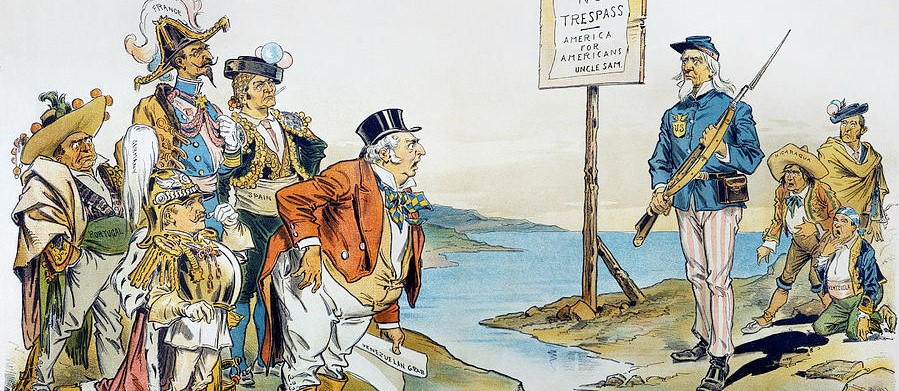
None of this is to deny the Trump regime’s intense focus on the Western Hemisphere. The NSS explicitly endorses the Monroe Doctrine, adding a “Trump corollary,”45 which commentators have dubbed the “Donroe Doctrine” following the intervention in Venezuela. The objectives in the Western Hemisphere are stabilizing and cooperating with Latin American regimes to reduce migration and drug trafficking, to prevent “hostile foreign incursion or ownership of key assets,” and to secure access to resources for “critical supply chains” and “to key strategic locations.”46 The NDS clarifies these locations as Greenland, the “Gulf of America”, and the Panama Canal, all the focus of U.S. interventions (or calls for interventions) over the past year.
Driving this focus on homeland and hemispheric security is not just the paleoconservative complaint that U.S. borders are being overrun by immigrants and drugs, requiring bolder national defense; crucially, it is also rivalry with China, coded as “pushback” against “non-Hemispheric competitors.”47 Ironically, in line with Beijing’s diplomatic practice, considerable effort has gone into not naming China throughout the NSS, but China nonetheless haunts the document. The NSS baldly states: “We want other nations [in the Western Hemisphere] to see us as their partner of first choice, and we will . . . discourage their collaboration with others.” U.S. diplomats will—as they have for years—warn of the “hidden costs” of collaboration with “others,”48 including “espionage, cybersecurity [threats], [and] debt-traps,” and use “U.S. leverage in finance and technology” to compel governments to reject “such assistance.”49
This helps make sense of many things the administration has done in its near abroad. Secretary of State Marco Rubio’s first overseas trip was to Latin America, where he warned countries against collaborating with China. Trump’s first pressure campaign in the region was directed at Panama, and was aimed at ejecting a Chinese company from ownership of the ports at each end of the Panama Canal. His raid on Venezuela may make little sense from the perspective of U.S. oil majors (see below), but it does if the objective is to squeeze China out of Latin America, since Venezuela is its closest partner. Trump’s Greenland grab is also animated by rivalry with China and Russia. Trump claims the area is “covered with Russian and Chinese ships all over the place. . . . I love the people of China. I love the people of Russia. But I don’t want them as a neighbor in Greenland, not going to happen.”50 Despite media reporting that the NDS deprioritizes China as a threat to focus on the American homeland, that document actually “prioritizes Homeland defense and deterring China” together, reflecting the intertwining of these two objectives.51
The desire to dominate the Western Hemisphere and compete with China finds inspiration in both paleoconservatism and more traditional doctrine, undergirding their accommodation under Trump. For paleoconservatives, defending America’s nation and culture requires strong hemispheric defense. Their writings sometimes lionize the expansionism of the imperial presidents whom Trump so admires, celebrating their “robust nationalism.”52 Pat Buchanan, who promoted “America First” in his 1992 presidential bid, argued that Trump’s desire to acquire Greenland, first floated in 2019, reflected a “venerable tradition of American expansionism,” noting darkly that “China, the aspiring superpower of the 21st century, has exhibited an interest” in the island.53 Paleoconservatives like Buchanan have also long been critical of China as a “Frankenstein’s monster” created by globalists’ misguided free trade policies. Yet their populist-isolationist instincts also induce caution. Even Buchanan was ambivalent about a new Cold War, cautioning against mindless confrontation or meddling in Taiwan, and instead proposing “coexistence,” in line with the paleoconservative commitment to multipolarity.54
The NSS also contains evidence indicating the continued influence of traditional China hawks and Pentagon geostrategists. Although some media reporting suggests that normal interagency processes were eschewed when drafting the NSS, parts bear the usual hallmarks of collective drafting. The section notionally about “Asia” apparently seeks to commit the United States to competition with Beijing that extends globally, not just to the Western Hemisphere or the Indo-Pacific. The NSS states that “To thrive at home, we must successfully compete” in Asia.55 The basic objectives here reflect deep continuity with the first Trump and Biden administrations. They include conventional geostrategic objectives: restoring “a military balance favorable to the U.S. and our allies in the region,” deterring war over Taiwan, and keeping the South China Sea open to international shipping.56 The only real novelty here is the demand that “allies and partners” do much more to contain China, reflecting the Treasury view of the costs of U.S. hegemony.57
The NDS insists that the U.S. will pursue “strategic stability . . . deconfliction and de-escalation,” and that the goal is “not to dominate China; nor is it to strangle or humiliate them,” but rather to deter Chinese aggression through “strength, not confrontation.”58 Nonetheless, this stance still amounts to a strategy of containment, with China not even permitted to dominate its own near abroad, or even achieve what Beijing regards as national reunification with Taiwan. Moreover, the NSS’s stated objective to “rebalance America’s economic relationship with China” amounts to a demand that Beijing dismantle its entire growth model, since it includes “ending (among other things)—predatory, state-directed subsidies and industrial strategies; unfair trading practices; job destruction and deindustrialization; grand-scale intellectual property theft and industrial espionage.”59
These objectives likely mean that, however much paleoconservatives may seek accommodation with China, long-term animosity is baked into the Trumpian foreign policy platform. The decision to avoid naming China as the principal threat is likely a tactical one, reflecting the administration’s desire to avoid antagonizing Beijing as Trump and the Treasury clique pursue a “deal” to refashion Sino-U.S. relations in Washington’s favor. After his initial tariff onslaught, Trump has repeatedly soft-pedaled anti-China measures, notably around semiconductor export controls, to allow his negotiators room to pursue this grand bargain.60 China now enjoys a trade-weighted average tariff rate (37.5 percent at the time of writing) not vastly higher than that of many U.S. partners and allies, including India (34.3 percent), which the NSS repeatedly singles out as a country that the United States must cultivate as an anti-China ally.61
The trouble is that the objectives sought by Washington amount to a demand for China’s full capitulation on its “four red lines”: “the Taiwan issue,” the defense of China’s version of “democracy and human rights,” the maintenance of “China’s chosen path and system,” and “China’s right to development.”62 An anti-globalist position can tolerate China’s version of democracy and human rights and its authoritarian system. But the economic changes sought would both fatally undermine that system, which relies on leveraging globalization to deliver higher-value-added growth, and threaten China’s development model. Consequently, no satisfactory grand bargain is likely on these grounds. And, so far, the Chinese seem to be winning the game of chicken.
From this perspective, the China hawks and Pentagon planners are likely cultivating a fallback position of global rivalry with China for when talks eventually collapse. The section supposedly about “Asia” notes the need to develop with allies “a joint plan for the so-called ‘Global South,’” mobilizing private finance and the international financial institutions (suitably reformed around U.S. interests), so that the United States remains “the global partner of first choice”63 (emphasis added). And Europe will still be pushed “to take action to combat mercantilist overcapacity, technological theft, cyber espionage, and other hostile economic practices,” presumably from China.64 There is, therefore, considerable continuity in the Trumpists’ strategic orientation on China, making it too early to declare an end to the new Cold War; this is likely a temporary détente.
Delusions contra Democracy
What, then, are we to make of the NSS and of Trump’s foreign policy? It obviously marks the end of the liberal international order, to the dismay of globalists everywhere. As the NDS states, the United States will no longer expend resources to “uphold cloud-castle abstractions like the rules-based international order.”65 But is there anything to welcome here? After all, radical conservatives are hardly alone in perceiving that globalism has been hugely problematic. Some leftists have also criticized liberal elites for waging destructive forever wars and erecting transnational governance arrangements that lock in neoliberal economic policies, hollow out democracy, and harm their own citizens; and they, too, have called for rebuilding national sovereignty.66
From this perspective, an ostensible U.S. retreat from globalism to a more “focused definition of the national interest,” respect for sovereignty, and a “predisposition towards non-interventionism”67 could be positive for world peace. The continued commitment to U.S. primacy, however, as it is envisioned by the NSS, clearly entails no real respect for the sovereignty of others. Moreover, the personalist nature of Trump’s populist regime means that, in practice, the determination of the American national interest is left to him to decide, resulting in highly erratic, often delusional policymaking that breeds international disorder.
Anti-globalists may read Trump’s NSS as an example of what Philip Cunliffe demands in his recent book, The National Interest: Politics After Globalization. In light of the disastrous consequences of globalist policies, Cunliffe urges readers to abandon democracy promotion and economic liberalization and to instead refocus political debate and practice on the national interest. This would, he argues, induce much greater international restraint because the nation is limited to a fixed population and territory. A politics truly grounded in national sovereignty would also encourage respect for other sovereign states, creating the basis for peaceful international cooperation.68
But that is clearly not happening in the second Trump administration. Trump claims to be the president of peace while rampaging around the world, haranguing and extorting allies, bombing other countries, abducting foreign leaders, and threatening to annex foreign territory. One might conclude that Cunliffe is simply wrong, perhaps dangerously so: foregrounding the national interest will always result in this kind of aggressive, imperialist policy. I want to suggest a different interpretation.
The first trouble is that the Trumpian counter-elite is clearly wedded to American primacy, even as they reject its liberal or globalist versions. This sustains an irreconcilable contradiction between the interests of the American nation, understood as a limited, bounded political community, and the interests of the American state as an imperial formation. This contradiction manifested over tariffs: Trump’s determination to maintain U.S. dollar hegemony means that tariffs simply cannot serve his ostensible goal of domestic reindustrialization.69 The NSS’s expansive definition of national interests will also pull the American state into foreign conflicts, despite the radical Right’s ostensible aversion to them. As the NSS itself notes, “For a country whose interests are as numerous and diverse as ours, rigid adherence to non-interventionism is not possible.”70
This is not simply about the problematic ideological inheritance of American exceptionalism or the residual influence of China hawks and Pentagon planners. It reflects the material interests acquired by U.S. business and the American state in the world’s capitalist economy. It really is the case, for example, that the American economy would suffer from any closure of key sea lanes, which calls for global power projection to avoid such a scenario. Indeed, it was the globalization of U.S. business interests around the start of the twentieth century that originally generated “a new vocabulary of national security.”71 As the NDS states, ultimately, Chinese hegemony in Asia must be denied to sustain “access to the world’s economic center of gravity, with enduring implications for our nation’s economic prospects, including our ability to reindustrialize.”72 This reality places objective limits on the embrace of the paleoconservatives’ populist isolationism. The latter may have plundered Gramsci for guidance on their culture war theories, but their rejection of his treatment of class and capitalism creates a huge blind spot in their worldview.
Second, and relatedly, a true politics of national sovereignty of the kind Cunliffe wants requires a functioning representative democracy; its absence is what causes “America First” to manifest as imperialist doctrine and shambolic, gangster-like behavior. As Cunliffe notes, a lack of meaningful democratic debate over what interests the nation should pursue is what has caused foreign policy to ossify around elite agendas or inherited structures like Cold War alliances. That debate must, he says, be revitalized to redirect policy to serve the interests of citizens.
Yet contemporary populism, radical right-wing or otherwise, is a symptom of the advanced decay of representative democracy; it does not signify its revitalization. Populism expresses hostility toward narrow, self-serving elites and their works, but it does not rebuild mass participation in public life or restore the ties of political representation destroyed through decades of globalism. Instead, the populist leader postures as the embodiment of the nation, uniquely positioned to divine the popular will and the national interest. This empowers Trump to make decisions that are ultimately divorced from the interests of most Americans, and even from the interests of its most powerful group: organized business.
That is obvious when considering the war on Venezuela. What distinguished this from recent U.S. imperial behavior was Trump’s brazen and predatory expression of U.S. interests, without any effort to frame the intervention around international legality or global welfare, unlike, say, the 2003 Iraq War. The objectives, openly stated, were to remove a “narco-trafficker” harming Americans and to restore U.S. access to Venezuelan oil. Unfortunately for the administration, the U.S. oil majors appear utterly disinterested. This is because Venezuelan oil is excessively costly to extract, especially after years of internal mismanagement and infrastructure-crippling U.S. sanctions, not to mention low global oil prices.73 At a meeting held after the operation, where Trump sought to mobilize $100 billion from U.S. oil companies, Exxon Mobil’s CEO flatly stated that Venezuela was “uninvestable.”74 Trump “retaliated” by saying he would prevent that firm, which does not want to go back into Venezuela, from returning to Venezuela.
Under Trump, then, the American state claims to be putting “America First,” especially the interests of U.S. capital, but U.S. capital is clearly disinterested in Trump’s adventures. Trump’s tariffs, opposed by virtually every American business group, is the ultimate illustration of the unrepresentative nature of his policy. Far from the state acting as the ideal collective capitalist, as structuralist Marxist theory supposes, the Trump administration does not even bother to consult the supposed beneficiaries to see if its proposed policies would serve their interests; they are only approached after the fact, when misalignment is revealed.
This state-society disconnect is an artefact of the advanced decay of America’s representative democracy, which has caused even big business to lose meaningful control over the state. Since successfully ushering in neoliberalism in the 1970s and early 1980s, big business has neglected organizing politically to articulate a national project, retreating to sectionalist lobbying of a corrupted and easily seduced Congress. The decline of popular representation under neoliberalism, however, has generated a populist reaction that caused business to steadily lose control of the Republican Party to Trump and, consequently, for Congress to surrender its power to an increasingly authoritarian executive branch. Accordingly, U.S. capital’s traditional methods of influence and control are no longer effective. Individual oligarchs like Elon Musk, Nvidia’s Jensen Huang, Meta’s Mark Zuckerberg, and Apple’s Tim Cook can still influence decisions, but only by courting the emperor himself, and they only promote their peculiar interests or ideologies, not those of their wider class.75
If organized business cannot imprint its interests on foreign policy, what chance does the average American have? Congress remains fundamentally supine; the main institutional channel for the democratic formulation of the national interest remains blocked. This allows Trump to impress his own personal vision of the national interest on U.S. foreign policy, one that is highly idiosyncratic and often fundamentally delusional.
To be sure, Trump’s decisions do not occur in a vacuum: as the NSS suggests, there are identifiable factions vying for influence, each pulling in somewhat different directions. The paleoconservatives, instinctive populist-isolationists, want global retrenchment, a focus on defending the national homeland and culture, and a rejection of globalist, neoliberal policies to the benefit of U.S. workers. The Pentagon and China hawks, however, reject isolationism: they remain committed to American primacy and a wider definition of U.S. interests, including denying key strategic theatres—Europe, the Middle East, and Asia—to rival powers. The NDS makes clear: “Ours is not a strategy of isolation”; the globalists’ “foolish and grandiose adventures” are over. “But we will not retreat.”76 The U.S. Treasury clique, meanwhile, thinks U.S. hegemony is unaffordable, not necessarily undesirable. It favors burden-shifting and aggressive trade and industrial policies but also continued neoliberal practices like tax cuts and deregulation, consistent with the libertarian instincts of paleoconservatives but not, it seems likely, their desire for national renewal along populist lines.
The nationalist commitment to American primacy papers over these differences at the doctrinal level. But decision-making on specific issues, especially when arbitrated over by an extremely arbitrary populist leader, will often surface deeper disagreements. Trump’s foreign policy will sometimes match the interests of his supporters, and sometimes not. The MAGA base appear satisfied that the attack on Venezuela reflects the national interest, but pressure on Iran, U.S. involvement in Gaza, and the menacing of Greenland are all highly unpopular.77
The NSS and NDS even create explicit carve-outs for Trump’s idiosyncratic fixations. The NSS ostensibly defines U.S. interests narrowly, declaring that “we cannot afford to be equally attentive to every region and every problem in the world” and that “sustained attention to the periphery is a mistake.”78 Yet it explicitly allows Trump to act wherever he likes in the name of peacemaking, “even in [areas] peripheral to our immediate core interests,” on the fanciful grounds that it increases stability and U.S. influence, “realign[s] countries and regions toward our interests” and opens markets, while the only “resources required” are supposedly “presidential diplomacy,” entailing “relatively minor costs of time and attention.”79 This obviously reflects Trump’s delusional belief that his supposed powers as a dealmaker will magically pacify entrenched conflicts. Similarly, the NDS, despite insisting on prioritizing “the most dangerous threats to Americans’ interests,” commits to providing Trump “with the operational flexibility and agility required for other objectives . . . against targets anywhere.”80 This is simply individual caprice dressed up as national strategy.
The Trump regime’s biggest delusion, however, is that “America First” can restore U.S. primacy in the absence of any incentives for others to cooperate with its agenda. The NSS implies that the United States can do literally whatever it likes, and other states will not only have to accept it but will also collaborate in the restoration of U.S. primacy. In this view, the United States can and will impose tariffs and reindustrialize America through interventionist policies; anyone else adopting this approach for themselves, however, is guilty of “predatory” behavior and must be crushed. The United States can dominate the Western Hemisphere, but rivals may not hegemonize their nearby regions. European allies will face political subversion and pressure to cut barriers to U.S. firms, but they are also expected to increase defense spending and join Washington’s confrontation with China. But, of course, such one-sided policies give other countries little reason to work with the United States.
Indeed, the retreat from globalism leaves America’s continued claim to world leadership devoid of any serious justification. As the NSS frames it, in the Western Hemisphere, “The choice all countries should face is whether they want to live in an American-led world of sovereign countries and free economies or . . . one in which they are influenced by countries on the other side of the world.”81 In Asia, “What differentiates America from the rest of the world—our openness, transparency, trustworthiness, commitment to freedom and innovation, and free market capitalism—will continue to make us the global partner of first choice.”82 These statements are unmoored from reality, ignoring the abandonment of these supposed values and institutional arrangements by the Trump administration itself.
The Post-American Moment
If the United States was ever “trustworthy” or “committed to freedom,” its menacing of its own NATO allies is causing even the most gullible to reconsider. These justifications for American leadership seem weirdly copy-pasted from the era that Trump himself has decisively ended. Going forward, it is not at all clear anymore why many countries would consider an American-led order superior to one led by China, which at least promises “win-win cooperation for mutual benefit” and adherence to the United Nations Charter as the foundation of its various global “initiatives.” At the very least, whatever one might think of its authoritarian values and form of government, China increasingly appears to be the more sane, stable, and predictable partner on the world stage.
Casting off a globalist cloak to reveal nothing but naked coercion will almost certainly hasten the decline of America’s global power. Some allies in Western Europe and Northeast Asia will most likely continue cooperating with the United States because they see no alternative given the external threats they face from Russia, China, or North Korea. But even these countries now see the United States itself as a potential or actual threat. Accordingly, they will most likely join the global majority in pursuing not renewed subordination to Washington, but “polyalignment,” a policy of maintaining and cultivating relations with many external partners, including China, as a hedge against American aggression.83
As Prime Minister Mark Carney made clear at Davos recently, even Canada now openly declares such a policy. This makes it highly unlikely that the United States will be able to “consolidat[e] our alliance system into an economic group,” as the NSS proposes, or outsource the maintenance of U.S.-desired regional orders to eager subordinates, as the NDS envisages.84 Even where interests ostensibly intersect, unrestrained American power politics will erode the conditions needed for cooperation.
As Gramscians have long emphasized, the genius of the postwar American elite was to convince ruling and some subordinate classes in other states that U.S. leadership functioned not just to America’s benefit, but also to theirs. This involved some sharing of wealth and power by providing public goods, such as security and market access, and creating multilateral institutions that constrained U.S. behavior. Coupled with the use of violence against enemy states and recalcitrant social forces in a shared struggle against communism (and other common threats), this strategy secured other states’ willing cooperation with the U.S. global agenda for decades.85 This context allowed two earlier presidents, Nixon and Reagan, to shift the costs of U.S. leadership onto allies after periods of crisis and decline. But that context has vanished. Its mounting contradictions—particularly after the Cold War, the rise of China, and the hollowing of America’s democracy and economy—has led the Trumpists to see the grand bargain as a raw deal in which others “ripped off” America. But providing substantial benefits to followers was always the price that the United States paid for leadership.
And as Americans will soon discover, absent any such concessions, other states have no reason to follow the United States. A leader without followers is just someone taking a walk—possibly off a cliff. The Trumpists, after all, cannot have it both ways: “America First” will increasingly mean America alone.
This article originally appeared in American Affairs Volume X, Number 1 (Spring 2026): 190–213.
Notes
1 National Security Strategy of the United States of America (Washington D.C.: White House, 2025), 12.
2 David E. Sanger, New Cold Wars: China’s Rise, Russia’s Invasion, and America’s Struggle to Defend the West (London: Scribe, 2024), 96–97.
3 Lee Jones, “Trump’s Tariff Gamble and the Decay of Neoliberal Order,” American Affairs 9, no. 2 (Summer 2025), 3–23.
4 Paul McLeary, “Hegseth Declares End of US ‘Utopian Idealism’ with New Military Strategy,” Politico, December 6, 2025.
5 National Security Strategy of the United States of America, 1.
6 National Security Strategy of the United States of America, 9.
7 National Security Strategy of the United States of America, 10.
8 National Security Strategy of the United States of America, 11.
9 National Security Strategy of the United States of America, 5, 11–15.
10 Here I draw on: Rita Abrahamsen et al., World of the Right: Radical Conservatism and Global Order (Cambridge: Cambridge University Press, 2024). I am particularly indebted throughout to conversations with, and the superb scholarship of, Jean-François Drolet and Michael Williams.
11 See: Julius Krein, “James Burnham’s Managerial Elite,” American Affairs 1, no. 1 (Spring, 2017), 126–51.
12 Jean-François Drolet and Michael C. Williams, “America First: Paleoconservatism and the Ideological Struggle for the American Right,” Journal of Political Ideologies 25, no. 1 (December 2020): 28–50.
13 National Security Strategy of the United States of America, 1–2.
14 National Security Strategy of the United States of America, 4.
15 National Security Strategy of the United States of America, 9–11.
16 National Security Strategy of the United States of America, 11.
17 National Security Strategy of the United States of America, 11.
18 National Security Strategy of the United States of America, 5.
19 National Security Strategy of the United States of America, 25.
20 National Security Strategy of the United States of America, 27.
21 National Security Strategy of the United States of America, 25.
22 National Security Strategy of the United States of America, 26.
23 J.D. Vance, “Remarks by the Vice President at the Munich Security Conference,” American Presidency Project, February 14, 2025.
24 National Security Strategy of the United States of America, 4.
25 National Security Strategy of the United States of America, 9.
26 National Security Strategy of the United States of America, 28.
27 National Security Strategy of the United States of America, 29.
28 See: Stacie E. Goddard, “The Rise and Fall of Great-Power Competition: Trump’s New Spheres of Influence,” Foreign Affairs, April 22, 2025; Monica Duffy Toft, “The Return of Spheres of Influence,” Foreign Affairs, March 13, 2025.
29 See: Suisheng Zhao, “The Rise and Fall of a New Cold War: The US–China Great Power Rivalry from President Trump I to II,” Journal of Contemporary China, January 7, 2026.
30 Ilias Alami and Adam Dixon, The Spectre of State Capitalism (Oxford: Oxford University Press, 2024).
31 National Security Strategy of the United States of America, 13–14.
32 National Security Strategy of the United States of America, 6–7.
33 National Security Strategy of the United States of America, 18.
34 National Security Strategy of the United States of America, 18–19.
35 National Security Strategy of the United States of America, 27–29.
36 National Security Strategy of the United States of America, 12.
37 National Security Strategy of the United States of America, 22.
38 2026 National Defense Strategy: Restoring Peace through Strength for a New Golden Age of America (Washington D.C.: Department of War, 2026), 4, 13, 19–20.
39 National Security Strategy of the United States of America, 1.
40 National Security Strategy of the United States of America, 10. Emphasis in the original.
41 National Security Strategy of the United States of America, 25.
42 National Security Strategy of the United States of America, 28–29.
43 John J. Mearsheimer and Stephen M. Walt, The Israel Lobby and US Foreign Policy (New York: Farrar, Straus and Giroux, 2007).
44 National Security Strategy of the United States of America, 29.
45 National Security Strategy of the United States of America, 5.
46 National Security Strategy of the United States of America, 5.
47 National Security Strategy of the United States of America, 15.
48 National Security Strategy of the United States of America, 17.
49 National Security Strategy of the United States of America, 17.
50 Sarah Smith, “Trump Says US needs to ‘Own’ Greenland to Prevent Russia and China from Taking It,” BBC News, January 9, 2026.
51 2026 National Defense Strategy, 4.
52 Christopher Hooks, “Real Men Steal Countries,” New Republic, June 18, 2025.
53 Pat Buchanan, “Greenland: Trump’s MAGA Idea!,” Buchanan.org, August 23, 2019.
54 Pat Buchanan, “Coexistence or Cold War with China?,” Buchanan.org, January 26, 2021.
55 National Security Strategy of the United States of America, 19.
56 National Security Strategy of the United States of America, 23–24.
57 National Security Strategy of the United States of America, 24.
58 2026 National Defense Strategy, 4, 18.
59 National Security Strategy of the United States of America, 21.
60 See: Joris Teer, “Tech War 2.0: The Dangers of Trump’s ‘G2’ Bargaining with an Emboldened China,” European Institute for Security Studies, December 16, 2025.
61 National Security Strategy of the United States of America, 21–24.
62 China’s National Security in the New Era (Beijing: Information Office of the State Council of the People’s Republic of China, 2025), 32.
63 National Security Strategy of the United States of America, 22.
64 National Security Strategy of the United States of America, 27.
65 2026 National Defense Strategy, 4.
66 Philip Cunliffe et al., Taking Control: Sovereignty and Democracy after Brexit (Cambridge: Polity, 2023).
67 National Security Strategy of the United States of America, 8–9.
68 Philip Cunliffe, The National Interest: Politics after Globalization (Cambridge: Polity, 2025). For a similar argument, see: Wolfgang Streeck, Taking Back Control? States and State Systems After Globalism (London: Verso, 2024).
69 Jones, “Trump’s Tariff Gamble and the Decay of Neoliberal Order.”
70 National Security Strategy of the United States of America, 9.
71 Julius Krein, “Defending the Nation,” Claremont Review of Books 26, no. 1 (Winter 2026).
72 2026 National Defense Strategy, 10.
73 Matt Huber, “US Oil Capital’s Interests in Venezuela?,” Matt Huber (Substack), January 5, 2026; Matthew Zeitlin, “The 4 Things Standing Between the U.S. and Venezuela’s Oil,” Heatmap, January 5, 2026. Responding to suggestions that Venezuela could replace Canada in supplying oil to the United States, one expert estimated the investment required for this at around $1 trillion. See: Ricardo T. Noel, “The $1 Trillion Myth: Why Venezuela Won’t Replace Canada”, Reddit, January 5, 2026.
74 Natalie Sherman, “Trump Seeks $100bn for Venezuela Oil, but Exxon Boss Says Country ‘Uninvestable’,” BBC News, January 9, 2026.
75 Alex Bronzini-Vender, “Class Cleavages,” Phenomenal World, December 2, 2024. See also: Mark Mizruchi, The Fracturing of the American Corporate Elite (Cambridge, Mass.: Harvard University Press, 2013).
76 2026 National Defense Strategy, 4, 24.
77 Sohrab Ahmari, “Why MAGA Supports the Capture of Nicolas Maduro,” UnHerd, January 3, 2026; Piotr Smolar, “Trump’s MAGA Supporters Split over his Foreign Policy,” Le Monde, August 29, 2025.
78 National Security Strategy of the United States of America, 15.
79 National Security Strategy of the United States of America, 13.
80 2026 National Defense Strategy, 5.
81 National Security Strategy of the United States of America, 18.
82 National Security Strategy of the United States of America, 22.
83 See: Jessica DiCarlo et al., “Polyalignment and the Second Cold War: Navigating Great Power Rivalry,” special issue of Third World Quarterly, forthcoming.
84 National Security Strategy of the United States of America, 22.
85 Robert W. Cox, Production, Power, and World Order: Social Forces in the Making of History (New York: Columbia University Press, 1987).