One of the great tropes of the past few of decades has held that the United States has peaked. We incessantly heard from the declinists that the world was more globalized, that China was poised to dominate, and that the United States needed to work with its “allies and partners.” They repeatedly prophesied that the United States was somehow fading away and would no longer be the world’s dominant power.
In actuality, especially in the Western bloc, the reverse has come to pass. Regardless of whatever happens next with China––disintegration post-Xi, stable plateauing, or continued strengthening––the United States dominates the West to an even greater extent than in the past. Compared to us, our “allies and partners” now are arguably weaker than ever.
Consider the ten largest high-income OECD economies, the closest we have to peer economies and how they have evolved since the end of the World War II. A simple way to look at long-term trends in various countries’ level of prosperity is to review each country’s “expenditure-side real GDP at chained PPPs,” a measure that reflects the total value of goods and services purchased, adjusted to make prices comparable over time and across borders.1
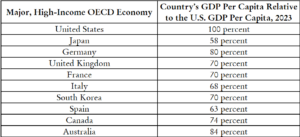
The data reveal a striking gap. Every major high-income OECD country trails the United States in GDP per capita, a fact digested long ago. Crucially, however, the gap is not narrowing; it is widening. The United States is not merely more prosperous than its peers; it is becoming more prosperous at a faster rate than its peers. The oft-repeated tale of American decline dissolves under the weight of these comparisons. The United States benefits from enduring and accelerating economic strength while our allies whither.
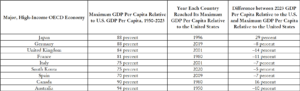
Detailed data going back to 1950 reveals what has happened. While each country is its own case with its own history and factors, a broader pattern is notable. Many countries spent several decades after World War II becoming increasingly wealthier. They seemed on track to catch up to and even exceed the United States in economic capacity. By 1990, nearly all of the countries that are today our closest peer economies had a GDP per capita roughly 70 to 85 percent of ours. Yet more than thirty years after the end of the Cold War, we see the same clustering around the 60 to 80 percent range. This stagnation is most notable in European countries.
The Trump administration’s National Security Strategy (NSS) highlights one element of this phenomenon: “Continental Europe has been losing share of global GDP—down from 25 percent in 1990 to 14 percent today—partly owing to national and transnational regulations that undermine creativity and industriousness.”2 But Europe is not just falling behind relative to global GDP, as if the result of quicker economic growth in China and elsewhere in the Global South. What has happened to Europe is connected to what has happened in East Asia; this is a phenomenon namely consigned to our partners.
These economic peers we are leaving behind all happen to be allies with treaties of mutual self-defense, either as NATO members or Asia-Pacific treaty allies. The result of their accelerating economic decline is that the Western world increasingly is becoming the American world. This divergence poses consequences for our relationship with Europe, straining the reciprocal basis of the longstanding, continent-spanning security umbrella.
Pushing allies to increase their defense spending as a percentage of GDP has limited value if their underlying GDP is plateauing. The problem is not simply that large, high-income allies of the United States have displayed a profound negligence by shirking their defense spending duties, but that these countries have actively hollowed out their productive capabilities through burdensome regulations focused on, for example, climate. The United States is left to shoulder a double burden: allies whose defense spending as a percentage of GDP has been irresponsibly low, and allies whose GDP has decayed to the point of watering down a “normal” level of defense spending.
Take, for example, NATO allies, many of whom failed to meet the defense spending target of 2 percent of GDP for many years. With the impetus of Russia’s invasion of Ukraine, twenty-three of thirty-two NATO allies now meet the two percent target, up from just six in 2021. While this is welcome progress, spending 2 percent of a plateaued GDP on defense is far less useful than it might have been.
Thus, so long as the United States continues to grow faster than our allies, the U.S.-aligned world will grow increasingly dependent on its nucleus. This poses a fundamental challenge: we find ourselves in alliances with countries that frequently lack the ambition and capability to become more productive. Even worse, some of them actively try to weaken us.
The Case of C3SD
As the NSS notes, Europe has pursued policies of “regulatory suffocation.”3 “We reject the disastrous ‘climate change’ and ‘Net Zero’ ideologies that have so greatly harmed Europe, threaten the United States, and subsidize our adversaries,” it asserts.4 The European Union has passed major legislation which, starting in 2029, will burden all major companies operating under their jurisdiction with stringent climate rules. These rules will extend out to firms’ global operations, including U.S. business. Given how many U.S. companies export to Europe, operate in the European market, or otherwise are involved in the supply chains of companies in Europe, a significant portion of the American economy would fall under these climate regulations. The law, titled the Corporate Sustainability Due Diligence Directive (CS3D), has earned the ire of the Trump administration, which pressed the EU to repeal it or significantly reform it.
In December 2025, the EU did reform CS3D, including a reduction in the number of companies covered by the legislation. Yet the much touted reforms are far from a complete solution and continue to be problematic. A February 2026 study found that the reforms to CS3D reduce initial compliance costs by approximately 30 percent for U.S. industry. Nontheless, the measurable initial compliance costs add up to between $637 billion and approximately $1 trillion, and these still represent a backdoor “Green New Deal” imposed on much of the U.S. economy.5 Thus, unwilling to scrap the law due to leftist pressures within several member states, the EU still ends up with legislation that is damaging.
Although, of course, the EU and NATO are not the same, the overlap is enormous. This overlap creates an inconsistency, one characterized aptly by Deputy Secretary of State Christopher Landau after a diplomatic visit to Brussels.6 Landau observed that when almost the same countries compose the EU and NATO, they can appeal to either identities at different moments for their own advantage. As NATO states, these countries insist on transatlantic cooperation for their own interests and for ours. In their capacity as EU member states, however, these same countries pursue agendas contrary to American interests and which undermine American security. The practical outcome is that the same European countries whose defense is subsidized by the United States are simultaneously trying to deindustrialize both the United States and Europe itself.
Evidently, this dynamic cannot hold. The United States will only grow more contemptuous of an enfeebled, deindustrialist EU; the EU will only grow more dependent on the United States and resentful of that dependence. January’s fracas over Greenland illustrates this tension. The Trump administration felt NATO was incapable of meaningfully defending or developing Greenland. It was probably right to do so. Europeans, for their part, felt that the United States disregarded the sovereignty of one of their own and treated them with a disdain inconsistent with the history of transatlantic alliances. They were probably right as well. Can effective alliances, especially in war or crisis, really be forged between two parties who are increasingly misaligned?
Strong and Weak Alliance-Blocs: EU vs East Asia
One cannot blame Europe; they are getting a great deal for now, enjoying America’s defense support. But confronted with such allies, what should America do? It is time to reexamine the fundamental duty of an ally and to rethink the role of alliances in America’s future.
An alliance with mutual defense obligations should be earned. Dependable nations, in order to be faithful allies, cultivate their own economic and military capabilities so that they can provide aid in times of need. The nation that cannot take care of its own backyard will be unable to provide meaningful support for its neighbors and friends. What any nation should seek is an alliance of the strong.
Alliances are only valuable when all members remain economically and militarily capable of contributing. A Europe with an industrial base, economy, and defense capacity all in decline is a liability to itself and to the United States, especially while China continues to invest heavily into their capabilities in these spheres.
U.S. allies in the Western Pacific vary in their commitment to principles of strong alliances, but signs give cause for optimism. Taiwan, a quasi-ally, continues to invest heavily into its AI and chipmaking abilities as well. Their government has sought to increase defense spending to 3 percent in the near term and 5 percent in the long term. In Japan, ruling coalitions have progressively abandoned postwar pacificism and commenced constitutional reforms to expand their military. South Korea continues to make deep bets in its own, already-mature manufacturing industry while increasing defense spending to 3.5 percent of GDP. Refreshingly, these countries are far less inclined to deindustrialize than Western Europe.
More importantly, our partners in the Western Pacific do not seek to export policies to deindustrialize the United States while they benefit from American support. This noninterference distinguishes our Asia-Pacific allies from our European allies, and the reasons for this difference are manifold.
For one, Europe operates within a cultural context of imperialism, the contemporary expression of which is found in the EU’s attempts to impose European regulatory and cultural frameworks on the rest of the world. Going back centuries, European nations viewed themselves as enlightened and bearing a responsibility to educate the rest of the world. Europeans sought to proselytize, not only religiously but also culturally. Over the past few centuries, Europe’s national powers imposed their political and religious worldviews on African, Asian, and American societies.
Europe’s self-perceived enlightened status, akin to a teacher for the non-European world, explains not only its contemporary anti-industrialist impositions on the rest, but also its rent-seeking. In this context, “backwards” countries need Europe to bestow upon them evolved civilization, and for Europe to do so, it requires resources. Thus, in the European mind, the world fairly pays its dues because it needs European prosperity. Onerous regulation and imposed deindustrialization are not rent-seeking in the European view; they are the tuition paid for European moral education. From the perspective of European elites, such regulation is tacitly civilizing, and they doubtless see the United States as being in dire need of such instruction. In this framework, it is only logical that we should subsidize Europe without asking for recompense, all while Europe exports its regulatory policies unilaterally.
American allies in the Asia-Pacific, however, tell a different story. Even when our allies have pursued their own anti-growth or anti-industrialist policies, they have never indulged a cultural drive to impose those frameworks on the rest of the world. That is why the Asia-Pacific, while economically and strategically important for the rest of the world, has not produced European-style universalist missions to shape it. Today, diverse and dynamic cultures, political systems, and economies run parallel in the region, each with their own distinct national mission and identity.
Furthermore, the European Union’s political centralization also allows it to wield power collectively against the United States. Although dysfunctional and inefficient in many ways, the EU does enjoy the benefit of scale. By banding together, European countries have created an entity that is America-sized, enabling Europe to vie for global economic leadership that a continent of fractured nation states coud never match. Practically, this gives the EU leverage over companies and industries; it is too big to ignore.
In contrast, national sovereignty still partitions the Asia-Pacific, with individual national interests reigning supreme. Multilateral organizations in the Asia-Pacific, such as ASEAN, exist to link nations together. Yet ASEAN’s fundamental principles are those of non-interference, national sovereignty, and intergovernmental consensus: all in direct contradiction to the EU’s emphasis on supranational bureaucracy. As such, the Asia-Pacific’s divided political terrain does not allow for collective regulatory overreach towards the United States.
Hence, this is the strategic landscape America confronts among its alliance blocs today: a unified, legally hostile Europe and a fragmented, increasingly fortified Asia-Pacific. And in this context, the United States must forge alliances that are reliable, responsible, and resilient for the future. In Europe, the list of U.S. treaty allies benefitting from American defense capabilities has grown markedly as NATO has expanded, yet it is unclear how many of these countries will be able to meaningfully help the United States in a time of need. They certainly have not shown willingness nor ability to meaningfully assist in the present Iran conflict, despite entreaties from the Trump administration. With good reason, the NSS states as a priority “ending the perception, and preventing the reality of NATO as a perpetually expanding alliance,” especially by admitting nations not aligned with America’s national interests.7
Instead, Asia-Pacific alliances hold greater insight for the future. Since the 1950s, the United States established intentional, bilateral security treaties with carefully selected allies in the region. For this reason, the list of treaty allies there has largely remained static: Japan, South Korea, the Philippines, Thailand, and Australia. These various alliances of mutual self-defense all date back over seventy years. Compare this with the 2004 NATO expansion, in which the United States pledged itself to the defense of Bulgaria, Estonia, Latvia, Lithuania, Romania, Slovakia and Slovenia all at once, and the more durable model becomes clear.
A Continent of States: Cause for Optimism in Europe?
As troubling as the transatlantic relationship may be, there are reasons to foresee a strategic shift in the not too distant future. It is impossible to change the Brussels psychology, but the structural facility of the EU, which underwrites it regulatory leverage over the United States, may change; the same can be said as well for the importance of NATO.
The EU’s immense size has revealed its various subgroups of countries with distinct interests. What keeps the EU together is its common market, the framework for which appears very stable owing to its popularity across the European political spectrum. The EU’s political aspect—its regulatory arm, at odds with American industrialization––gets a more varied reception among member states. Whether fractured by unsustainable expansion or existing pressures among member states, it is entirely possible for the EU to fragment politically while maintaining the underlying structure of a common market.
Different blocs of countries within the EU might pursue their own regulatory agendas, potentially including groupings of European countries that might want to become even more anti-industrial, and others that might embrace reindustrialization. The legislative battle to pass CS3D exposed these fractures. Central European manufacturing economies like Czechia and Slovakia abstained from the vote, as did technically innovative ones like Estonia and Finland. A shift to factionalism does not require any kind of radical change within the EU’s current framework. Indeed, it already exists in the “Visegrad Four” (Poland, Czechia, Slovakia, and Hungary), but other groupings are entirely possible and are being discussed in certain European capitals.
A second and related change is the increased focus on defense in the EU. There is a growing perception in Europe that common defense should not only be facilitated through NATO but also through the EU and national governments. Emblematically, the CEO of Rheinmetall, Germany’s largest arms manufacturer, claims that his firm is on track to make over 1.5 million 155 millimeter artillery shells a year (155 millimeter shells are the basic munition for all NATO armies). This is more than the entire U.S. defense industry; the Pentagon aimed for 100,000 shells a month by October 2025, or 1.2 million a year, and fell considerably short. Rheinmetall, furthermore, is making these shells along the Russian frontier, opening factories in Latvia, Lithuania and soon, in Ukraine itself. Funding for Rheinmetall’s production comes from NATO, the United States, and the German government, but also from the EU, which invested €130 million into the effort in 2024.
Rheinmetall’s example shows that Europe can still build. In some ways, shell-making seems like the last thing modern Germany would excel in. It is energy-intensive in a country with skyrocketing electricity costs, borne from a misbegotten reliance on Siberian gas and the Central European sun. It violates the German postwar tradition of pacifism that has only just become obsolete. Nonetheless, one firm has managed to outpace the American defense establishment in a consequential way. Others may be prepared to do so soon.
The war in Ukraine has precipitated this shift, but it is likely that the shift will endure even after the eventual end of that conflict. Germany has approximately doubled its defense spending under Chancellor Frederich Merz and intends to hold spending at a heightened figure through 2029.8 Whether this shift eventually encompasses all EU member states or only comes to define specific countries, the effect on the United States will be similar. The gradual militarization of European states will not mean that NATO will disappear, but it will reduce its importance over time. What this means practically is that America’s role as Europe’s defense guarantor can be expected to diminish as Europe becomes increasingly self-sufficient militarily.
Combined, these two trends––the political shift from a monolithic to a multi-zonal EU, and the military shift towards European self-sufficiency––have the potential to create a more stable and healthy transatlantic relationship. The United States will increasingly deal with a Europe of nation-states, not a supranational bureaucracy. This does not necessarily portend weaker transatlantic ties, but a more diversified approach. With a less monolithic EU, the United States will be able to pursue a more differentiated foreign policy. American ties with various groupings of European states may become stronger and weaker respectively. For example, Washington may look at the countries of Central Europe, with their manufacturing economies and strong sense of sovereignty, and conclude that Czechia, Hungary, Slovakia, Poland, and perhaps Austria could form an independent, like-minded bloc on trade and defense issues.
This “Europe of nation states” will continue to struggle against the “Europe of Brussels,” however. The ever increasing expansion of the EU as both a political body and a regulatory power is a problem unlikely to abate soon. Furthermore, as Europe’s economic might dwindles, Brussels will be increasingly desperate to maintain control in order to preserve what clout it can. Germany, France, Italy, Spain, the Netherlands, and Poland together comprised 72 percent of the EU’s GDP in 2025. For Brussels to lose any one would be a serious blow to the EU’s prospects. Germany, in particular, forms the heart of the EU now, but the instability of German policy in recent years means the past is no prologue. Germany has lurched from dependence on Russian energy to a stridently anti-Russian position; from admitting 1.1 million migrants under Merkel in 2015 to a growing anti-migration consensus; from near total demilitarization to, as mentioned, a doubling of defense spending. Germany has made and unmade all-in policy bets in recent years. If it chooses to decouple from the EU, the exit could come just as quickly.
Indeed, this logic may drive the EU to attempt to expand itself, perhaps into Southeastern Europe or even Turkey. Declining powers are often expansionist ones; if leaders determine that growth is out of the question, one’s wealth can only be increased through expansion. Brussels will not let the EU shrink, or decentralize, without a fight.
Even as the EU might try to expand, however, the shift toward a less monolithic EU is already underway. We see it in the evolving incongruity between the Eurozone, the Schengen Area, and now defense cooperation. Thus, one can make out future coalitions of the willing––working together with the United States on aligned initiatives, within the EU––on the horizon. As it becomes clearer that the EU can function in a multipolar way, the United States will find more opportunities to pursue its interests, and transatlantic relations will ultimately benefit.
From an American strategic point of view, Europe may come to resemble our map of East Asian allies. With a smaller number of deeper allies, the nature and purpose of alliances changes. A deep alliance becomes a rarified commodity that cannot be squandered. Currently, the United States is more or less locked into to its alliances, which gives allies a certain amount of leverage. A shift to a less monolithic Europe will unlock room for the United States to make more decisions about who to work with and when, altering the power dynamic.
A New Balance
Pursuing this opportunity calls for the following: first, the United States must help the EU break its doom loop of stagnant GDP, meager defense spending, and overregulation. Each factor worsens and necessitates the others. For instance, paltry defense spending is necessary if the pie isn’t growing fast enough to accommodate the social spending to which voters are accustomed. Flatlined GDP creates the popular demand for overregulation, as the role of government shifts from encouraging production of new goods to managing the distribution of what is left. We must resist the worst ideas from Brussels, not only for our own sake but also for the sake of European dynamism and the continent’s reliability as a partner. We do not want weak allies.
We must also be willing to encourage the best of European production again, for their sake and our own. The United States is failing to meet its own 155 millimeter shell production goals because labyrinthine contracting rules limit our efforts to just two U.S.-based producers. Keeping the defense supply chain within our borders is a worthwhile goal. But if Rheinmetall can be trusted to help build the F-35 in Germany, perhaps it can be trusted to make low-tech howitzer shells in use since the Franco-Prussian War, especially if it did so in the United States through its American subsidiary.
Our goal must not be a redux of World Wars I and II, when the United States used its superior industrial might to arm European powers. The goal must not be a wealthy deindustrialized Europe rich enough to buy the products of American industrial might, but a Europe dynamic enough to have its own robust production, with both continents benefiting from the other’s capability.
Simply put, a healthy alliance should include strong economic and industrial capacity on both sides. For the United States, continually propping up weaker allies diverts resources from the renewal of our own industrial capacity, a foundation of national strength. As Europe loses the ability to act as a unified bloc, Washington can pursue diplomacy that is multilateral: a more multidimensional approach that is tailored to the circumstances and capacities of each of Europe’s diverse nations. In so doing, our relationship with Europe may come to resemble our far healthier security relationships in the Asia-Pacific region, where we work with individual countries to pursue shared goals. The “Europe of Brussels,” which stymies U.S. efforts to improve its relationships on the continent, must give way to the “Europe of nation states,” defined by reciprocity and vitality.
Future alliances between the United States and European countries, alongside likeminded partners in the Asia-Pacific, ought to increase each other’s capabilities to produce the military and economic resources necessary to counteract external threats in an uncertain world.
This article is an American Affairs online exclusive, published May 20, 2026.
Notes
1 Robert C. Feenstra, Robert Inklaar, and Marcel P. Timmer, “The Next Generation of the Penn World Table,” American Economic Review 105, no. 10 (2015): 3150–82.
2 National Security Strategy of the United States of America, (Washington, D.C.: White House, 2025), 25.
3 National Security Strategy of the United States of America, 25.
4 National Security Strategy of the United States of America, 14.
5 Harold Furchtgott-Roth, “The EU’s December 2025 Changes to CS3D: Quantifying Costs to US Industry,” Hudson Institute, February 2, 2026.
6 Christopher Landau (@DeputySecState), “My recent trip to Brussels for the NATO Ministerial meeting left me with one overriding impression . . . ,” X post, accessed April 1, 2026.
7 National Security Strategy of the United States of America, 27.
8 “Germany Wants to Double Its Defense Spending? Where Should the Money Go?” Atlantic Council, August 28, 2025.