Nuclear energy is the only proven source of zero-carbon, firm, and dispatchable power at industrial scale. Yet in the United States, it remains effectively inert, and virtually nothing new has been built. The paradox is not just technical; it is civilizational. How can a nation capable of deploying global military force, sequencing the human genome, and coordinating monetary policy at planetary scale be systemically incapable of building nuclear reactors?
Support for nuclear energy, at least rhetorically, is near universal at this point. Successive administrations have publicly declared its importance. The Department of Energy (DOE) continues to allocate substantial funding.1 The Nuclear Regulatory Commission (NRC) reformed its procedures.2 Congress has enacted bipartisan incentives.3 Private developers have produced dozens of designs. Investment capital sits in wait. Demonstration projects have been announced. And yet, the empirical record is stark: only three commercial reactors, including one legacy restart at Watts Bar, have been completed in the past thirty years.4 Vogtle Units 3 and 4 are the only new-build reactors started and completed since the 1980s.5 Both were delayed, over budget, and largely anomalous. We have consensus. We do not have construction.
It was not always this way. In the decades following the Atomic Energy Act of 1954, the United States treated nuclear energy as sovereign infrastructure. The federal government coordinated the fuel cycle, owned the enrichment plants, directed reactor design, and maintained custody of strategic materials. Naval propulsion programs, public utility partnerships, and international technology sharing all operated under the logic of state-aligned deployment.6 The sovereign frame is much more than a theory; it is the frame we once used to great success and have since abandoned.7
Conventional explanations—such as regulatory inefficiency, permitting bottlenecks, market conditions, or public skepticism—identify real frictions but miss the underlying inertia. For instance, despite the NRC’s procedural reforms, licensing delays persist because the system lacks a unifying mandate, revealing a deeper misalignment.
What we are confronting is a failure of classification: a category error. Nuclear energy is not just one option among many within a diversified clean energy portfolio; it is strategic sovereign infrastructure, analogous to missile defense, civil aviation control, or central banking. It is a system whose development cannot be delegated, whose coordination cannot be crowdsourced, and whose permanence transcends commercial return. As long as we continue to frame nuclear deployment as a market‑based policy challenge, we will remain frozen—not because of bad actors, but because the logic of the frame itself cannot produce motion.
This kind of reclassification has precedent. In 1950, the U.S. National Security Council policy document entitled United States Objectives and Programs for National Security, also known as NSC-68, reframed the Soviet threat not as a regional or ideological contest, but as a civilizational struggle requiring permanent infrastructure, centralized coordination, and an open-ended strategic doctrine.8 Similarly, the creation of the Federal Reserve in 1913 did not simply adjust policy; it replaced an incoherent patchwork of local banks with a sovereign institution that could issue irreversible signals and anchor national expectations. In both cases, the conditions on the ground had not changed. But once the frame shifted, the system could finally respond.9 Just as these historical reclassifications unlocked systemic action, nuclear energy demands a similar doctrinal shift to break its decades-long freeze.
This essay will make the case for a doctrinal correction; it will argue that all existing efforts to scale nuclear deployment are structurally misaligned, and that only a reframing—not as invention, but as restoration—can return nuclear energy to the policy architecture that makes sense. Once this categorical classification is corrected, the contradictions can be resolved, and the next moves become legible.
The False Frame: Nuclear as Market Energy
For decades, nuclear energy has been conceptualized as a marginal entrant in the competitive energy marketplace, one low-carbon source among many, to be evaluated primarily by its cost profile, risk exposure, and market fit. Policymakers, regulators, think tanks, and even nuclear advocates have absorbed this logic. But this frame misdiagnoses the game, treating a multiplayer coordination challenge as a market competition, leading to subsidies and reforms that fail to assure commitment across actors. Within this frame, the dominant strategy has been to improve nuclear energy’s relative competitiveness: reduce capital cost, accelerate permitting, align incentives, secure investor confidence, and craft better public messaging.
This was not always the prevailing logic. In its formative decades, nuclear energy was treated by the United States as a sovereign function: state-directed, centrally coordinated, and institutionally protected.10 The market frame did not replace a failed strategy: it emerged as a placeholder once coherent national direction decayed. As Cold War urgency receded, institutional confidence in both corporate leadership and federal authority eroded. Public trust in centralized direction, whether military, corporate, or technocratic, eroded under the weight of Vietnam, inflation, and regulatory backlash. Nuclear energy, once nested in this architecture, became collateral damage in a broader crisis of legitimacy.
The unraveling of coordination was not merely political. It was institutional and legal, though not directed at nuclear energy itself. Reformers in the 1970s, reacting to perceived bureaucratic excess and regulatory capture, embedded procedural constraints across the administrative state.11 Environmental statutes introduced layers of adversarial oversight that prioritized transparency and legal challenge over coherence and execution. The regulatory center of gravity shifted toward the courts. Standing rules were relaxed, citizen suits multiplied, and statutes like NEPA became primary instruments for challenging, delaying, or procedurally exhausting federal projects. These changes, while not aimed at nuclear energy development directly, rendered the deployment of sovereign-scale infrastructure increasingly untenable.
The institutional mechanics of this drift were captured empirically by Magali Delmas and Bruce Heiman in their comparative study of the French and American nuclear programs.12 They demonstrated that the U.S. combination of fragmented power, activist access to the courts, and weak bureaucratic cohesion destroyed credible government commitment—raising transaction costs, encouraging litigation, and ultimately driving reactor cancellations—while France’s unified technocratic bureaucracy preserved it. The resulting divergence was stark.
In the United States, construction lead times lengthened from roughly three to thirteen years while France held steady near six; average project delays reached thirty-four months versus six in France; interest-during-construction climbed to roughly 30 percent of capital expenditure; and 134 reactors were cancelled while France built fifty-six.13 By 1990, nuclear energy supplied about 20 percent of U.S. electricity compared with more than 75 percent in France. Their analysis remains the clearest historical evidence of how structural fragmentation, not ideology or technology, paralyzed the U.S. nuclear enterprise.
Consequently, a doctrinal vacuum formed: as institutional alignment unraveled, the logic of build-out drifted into abstraction,14 and the nation retreated from sovereign deployment into fragmented, market-based improvisation. Nuclear energy was never privatized by design: it was orphaned by drift.15
What emerged from that vacuum was not a coherent strategy but structural misclassification. Nuclear development was absorbed by a market frame that, however well intentioned, was never meant to handle sovereign infrastructure. This was not because the technology failed but because the frame that now governed it rested on a false premise: that nuclear energy can and should be deployed through the same decentralized coordination mechanisms that govern wind, solar energy, or natural gas.
As a result, every policy recommendation that flows from this frame is misaligned. Regulatory reform is pursued as if efficiency alone could drive deployment. Tax credits are expanded as if marginal financial tweaks could unlock motion. Developers are incentivized as if private actors can coordinate sovereign infrastructure build-out without a central mandate.
Even pronuclear rhetoric has internalized the limitations of this frame. Advocates argue for nuclear energy’s climate value but measure it by levelized cost of electricity (LCOE).16 They demand permitting acceleration without reframing the mission. They appeal to market logic, hoping to outperform renewables on speed, cost, or modularity—as if nuclear energy’s legitimacy depends on beating solar energy at its own game. But it was never meant to be in that game; it cannot meaningfully be detached from the sovereign because of its inherent attributes. The rapid expansion of public litigation, NEPA-based injunctions, and risk-averse regulatory behavior when national direction dissolved in the 1970s were not anomalies but the logical conclusion of drift.17 Nuclear power never had a viable pathway to self-orientation, became procedurally overexposed, and thus became hostage to misclassification.
The market framing does not just constrain: it actively distorts. It leads us to ask the wrong questions, propose the wrong solutions, and interpret the absence of motion as a failure of will rather than a structural impossibility. Under this logic, Americans could spend another decade issuing subsidies, tweaking regulations, and yearning for a nuclear future in speeches, and it will still build nothing at scale. The frame itself is the freeze. To understand why this is true—and why even well-funded, bipartisan, and technically sound initiatives continue to stall—we must step outside the assumptions of the market paradigm and examine the structure of the game that governs decision-making.
Diagnosing Strategic Coordination Failure
This architecture is most clearly revealed through the logic of a multiplayer coordination failure. Nuclear deployment in the United States is systemically frozen. Every actor involved in nuclear build-out has a rational reason to wait. Developers hesitate without guaranteed demand. Fuel suppliers delay without volume commitments.18 Investors require anchor customers. Utilities demand regulatory certainty. Regulators resist political exposure. Each player is conditioned by incentives that discourage unilateral action, and every actor sees the risks of going first more clearly than the rewards of trying.
This dysfunction is best understood through the lens of game theory. The structure we are trapped in resembles a signaling game with broken credibility, a stag hunt without assurance, and a coordination game without a focal point. The more rational each actor becomes, the more paralyzed the system gets, as no one can initiate without risking failure if others defect.
This sort of paralysis is not unprecedented. In the early years of the space race, U.S. progress was also hamstrung by fragmentation and uncertainty.19 Multiple agencies pursued overlapping programs. Industry lacked direction. Congress withheld funding. The public was skeptical. No actor could credibly commit because each was waiting for others to show resolve, a dynamic that mirrors the U.S. nuclear ecosystem today. It was only after Kennedy’s 1961 moonshot declaration that systemic actors aligned. NASA was empowered, capital flowed, and the mission became legible. That is what a credible initiator does: it collapses ambiguity, realigns expectations, and unlocks motion.
The interdependencies among actors can be mapped across the nuclear ecosystem. These actors do not operate in isolation. Their decisions are shaped by recursive feedback loops: public skepticism, fueled by unclear government messaging, heightens regulatory caution, which delays licensing and further deters developers. Each actor’s hesitation reinforces the system-wide perception of risk, creating a self-reinforcing cycle of stasis.
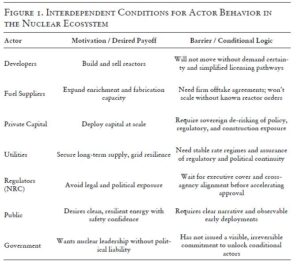
Even when some attempt to move (i.e., licensing reform, or pilot projects) the remaining actors see these moves but interpret them as weak, conditional, or reversible. No one is willing to act in a committed way unless they believe others are committed, and no internal signal is strong enough to change expectations. Ambiguity circulates. The game is recursive. And the longer it persists, the more rational inaction becomes.
Furthermore, even modest goals, such as deploying a small fleet of standardized SMRs, are hostage to the same interdependencies. Licensing reform won’t matter if no one is building. Manufacturing won’t expand production if orders aren’t firm. Fuel enrichment won’t expand without clear demand. The paralysis is invariant to scale. The problem is not how big the goal is. The problem is that unlocking the game requires an actor capable of issuing a signal and absorbing the strategic first-mover risk.
We can formalize the outcomes of these interdependencies in game theory terms. Signaling game: each actor sees weak signals, but without a sovereign commitment, no signal becomes self-confirming. The Nash equilibrium is stasis, and everyone waits. Stag hunt: the high payoff equilibrium (scaled industrial deployment) requires mutual commitment, but the risk-dominant strategy is defection, small moves that protect capital but preserve systemic paralysis. Coordination game: all actors may want nuclear to succeed, but without a coordinating focal point, their conditional strategies neutralize each other.
These analogies—signaling games, stag hunts, and coordination games—are complementary lenses, each highlighting distinct aspects of the same fundamental coordination failure. To clarify how these dynamics intertwine in practice, consider the following simplified stag hunt model depicting a strategic interaction between developers and the government:
Here the payoff-dominant equilibrium is (5,5): both actors move, unlocking scaled deployment. But the risk-dominant strategy is (1,1): both wait, trapped by uncertainty and mistrust. In formal terms, the “wait-wait” outcome dominates under uncertainty because each actor’s expected loss from moving unilaterally (regulatory exposure, sunk cost, political risk) exceeds the potential gain from coordination, a standard risk-dominance condition. The refusal to move to the payoff-dominant equilibrium is not ideological but structural. The system remains frozen not because developers are irrational, but because there is not a signal strong enough to realign expectations and shift behavior. Only a sufficiently credible signal, one that visibly commits national authority, raises every actor’s belief that others will act, crossing the cooperation threshold and moving the system from risk-dominant inaction to payoff‑dominant cooperation.
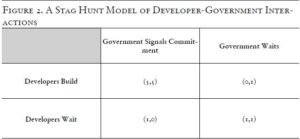
This simplified model encapsulates the broader multiplayer, multigame dynamic. It captures how actor preferences rationally lead to cautious inaction (stag hunt), illustrates how the absence of credible commitments perpetuates uncertainty (signaling game), and underscores why clear expectations around a shared focal point are necessary for coordinated action (coordination game). Thus, the stag hunt scenario serves as an integrated representation of the multiple interwoven dynamics sustaining nuclear paralysis.
It must also be understood that not all signals are equal. In a multiplayer coordination freeze, only signals perceived as highly credible can effectively shift collective expectations and catalyze coordinated action. Credibility here is also structural. Strategic communication theories highlight three necessary attributes.20 These are: visibility, irreversibility, and costliness.
Visibility ensures universal clarity among stakeholders. The signal must be observable by all actors simultaneously, leaving no ambiguity about its existence or intent. True visibility creates common knowledge in strategic theorist Thomas Schelling’s sense, where every actor knows that all others have observed the same signal, enabling expectations to converge without further communication. Private assurances, subtle policy shifts, or backchannel communications, no matter how genuine, lack necessary clarity and fail to trigger widespread coordination. Visibility implies public, formalized actions: a high-profile directive backed by concrete measures.
Irreversibility guarantees enduring commitment. Credible signals must structurally embed consequences, making retreat prohibitively costly. Symbolic gestures, rhetorical proclamations, or unfunded initiatives can be easily revoked and fail to produce credible assurance. Truly irreversible signals entail institutional restructuring, bureaucratic commitments, contractual obligations, or substantial financial allocations; such actions create entrenched political and institutional momentum.
Costliness differentiates substantive commitment from cheap talk. A credible signal must involve significant political capital, institutional investments, or meaningful financial outlays. Such signals clearly reveal seriousness of intent, indicating that retreat or reversal would incur real losses. Relatively inexpensive measures—press releases, pilot programs, or easily reversable regulatory changes—do not cross the credibility threshold because stakeholders anticipate their inherent fragility.
Crucially, these three criteria reinforce each other. Visibility without irreversibility and costliness remains symbolic; costliness without visibility and irreversibility risks obscurity or trivialization; irreversibility without visibility and costliness appears bureaucratic or accidental. Only their simultaneous presence—visibility, irreversibility, and costliness—generates a signal credible enough to trigger broad-based strategic realignment of beliefs.
Historically, executive-led initiatives clearly embodying these credibility criteria—such as France’s Messmer Plan, Kennedy’s Apollo program, and Eisenhower’s Interstate Highway System—have successfully overcome entrenched coordination freezes and catalyzed sustained collective action. In contrast, recent U.S. nuclear initiatives, despite occasional visibility, have consistently lacked structural irreversibility and sufficient political costliness, reinforcing caution and mistrust among stakeholders.21
In prior eras, when the United States deployed nuclear infrastructure under a sovereign posture, the multiplayer freeze was suppressed.22 But the logic of the freeze is not immutable: it emerges when no actor claims the mantle of direction. And that is where we now find ourselves. Every serious effort to revive U.S. nuclear energy capabilities, however well-funded, technically viable, or politically popular, eventually stalls. The problem is not the actors. It is the architecture of decision-making. The frame miscasts nuclear as something that can emerge from decentralized alignment. In reality, only highly credible coordination can unfreeze the game.
The Correct Frame: Nuclear as Strategic Sovereign Infrastructure
To move beyond paralysis, we must reclassify nuclear energy not as a market commodity but as strategic sovereign infrastructure. This is the shift that resolves the contradiction. Nuclear energy belongs to the civilizational stack, alongside the interstate, missile defense, aerospace command, and central banking. It is infrastructure that enables continuity, resilience, and national permanence. It is not priced by marginal cost; it is valued by what the nation becomes capable of once it is built. And unlike other energy assets, it fuses four sovereign characteristics:
(1) Strategic permanence: nuclear reactors operate on timelines measured in generations. Their lifespans approach nearly a century, anchoring baseload energy capacity across electoral and market cycles.23 The Shippingport Atomic Power Station, the first U.S. commercial reactor, ran from 1957 to 1982, and its decommissioning helped define modern end-of-life protocols.24 Like highways and aircraft carriers, reactors are designed to last. Their permanence ensures energy security over decades, a sovereign trait essential for national planning.
(2) Defense alignment: nuclear energy has been embedded in the nation’s security architecture since the inception of the Naval Nuclear Propulsion Program. Led by Admiral Hyman Rickover, the program deployed over two hundred naval reactors by 1979 with an annual operating budget of $2 billion.25 These reactors not only supported forward military operations but drove technology transfers to the civilian sector. Nuclear energy should not be seen as adjacent to defense but as an integral part of the defense industrial base, with immense dual-use potential.
(3) Supply-chain sovereignty: the nuclear fuel cycle is not merely another industrial supply chain but a strategic asset. From 1946 to 1974, the Atomic Energy Commission exercised full federal control over uranium enrichment and fabrication, securing strategic materials for both civilian and military use.26 The United States holds approximately 8 percent of the world’s identified uranium reserves, behind Australia, Kazakhstan, and Russia, and it still maintains strategic mining, milling, and enrichment capacity that few other nations possess. Sovereign control of the fuel cycle is a prerequisite to scaled deployment.
(4) Industrial baseload capability: with a capacity factor exceeding 90 percent,27 nuclear energy provides unmatched grid reliability and high-intensity industrial power. In the 1970s, nuclear plants stabilized U.S. grids during energy crises while renewables remained absent from the baseload mix. Solar energy’s 25 percent capacity factor and wind’s intermittency make them unsuitable substitutes. Nuclear grids enable steel, chemical, desalination, and data systems to operate at sovereign scale.
Taken together, these four characteristics distinguish nuclear energy not just by degree, but by kind. It is not modular like solar energy, not short cycle like gas, and not fungible like liquified natural gas (LNG). Its fuel cycle, its deployment horizon, and its regulatory architecture demand federal custodianship. A nation either provides assurance—of fuel, deployment, regulation, and lifetime custody—or it does not deploy at scale.
Seen through this lens, it becomes clear why every effort within the old paradigm fails. Markets cannot initiate a sovereign-scale build-out. They cannot underwrite century-long commitments. They cannot harmonize fuel cycles, licensing regimes, and national defense postures. They lack both the temporal scope and the coordination authority. The nuclear challenge does not entail problems of cost or efficiency but of initiation under uncertainty. No combination of deregulation, indirect incentives, or distributed ambition has ever resolved that. Only sovereign coordination can.
This does not require the state to own the system. Ownership is not the signal: direction is. Asking the market to deploy nuclear energy is like asking it to build a navy. It can construct the hulls, run the yards, fabricate the parts, but someone must declare and preside over the mission. Historically, the United States understood this distinction and treated nuclear assets accordingly. Admiral Rickover’s naval reactors, the Atomic Energy Commission’s control of the fuel cycle, and regulated utility deployments all operated under this sovereign frame.28
Reframing nuclear energy in this way changes the institutional logic. The role of the state is not to subsidize it into viability: it is to declare its permanence and set the vector. Sovereign direction does not crowd out markets; it activates them. Once the mission is defined—clearly, irreversibly, and at scale—capital, talent, and industry align around execution.
The restoration of the sovereign frame also resolves what Delmas and Heiman identified two decades ago as the structural paradox of nuclear governance: the very democratic attributes that normally enhance credibility—divided power, judicial independence, and procedural openness—destroyed it in the American nuclear sector. Their comparative analysis showed that where France’s unified technocratic bureaucracy sustained credible commitment, the U.S. system’s pluralism dissolved it, raising transaction costs and institutional uncertainty.29 This is the same contradiction that has doomed every modern initiative: well-funded, well-intentioned, and technically sound efforts still fail because they try to generate momentum in the absence of a national signal. The sovereign frame corrects that dysfunction not through centralization, but through coherence—a single, visible declaration that restores credibility across every actor in the system. Sovereign infrastructure does not move by incentive. It moves by declaration and sustained direction-setting. The difference between motion and stasis is not money or engineering. It is categorical clarity.
The moment we treat nuclear like the other systems that secure national survival, not as a speculative investment class or climate footnote, we gain coherence. The public understands its purpose. Institutions realign their posture. Decisions converge around durable objectives. And what was once politically fragile becomes structurally anchored. The result is not just more energy but institutional resilience and national capacity.
Reframing the Core Questions
Reframing the canonical questions—posed across policy, regulatory, and public forums— exposes the distortions of the market frame and reveals how categorical realignment can restore institutional clarity and strategic coherence.
On cost: under the prevailing market frame, nuclear energy’s high capital expenditures and long construction timelines are treated as evidence of its economic inefficiency. Policymakers and investors compare its levelized cost of electricity against renewables or natural gas,30 concluding that nuclear energy is simply uncompetitive without heavy subsidies. This logic treats nuclear assets and infrastructure like a merchant commodity, one project among many, subject to short-cycle cost comparison.
But within the sovereign frame, these same characteristics reflect nuclear energy’s true role: permanent strategic infrastructure; the capital intensity involved is a signal of its function. It enables baseload energy sovereignty, industrial revival, and grid resilience. This doctrinal lens reframes the question: not “Is it too expensive?” but “What is the cost of not having it?”
On initiation and investment: viewed through the market optimization lens, nuclear projects are avoided by investors due to their exposure to regulatory risk, permitting uncertainty, and long development cycles. Capital seeks flexibility, clarity, and short-to-medium-term returns. Nuclear energy, as currently framed, fails those criteria, and so the absence of investment is seen as market rationality.
Under the sovereign infrastructure frame, however, the absence of investment is not a judgment on nuclear energy’s value: it is evidence of a missing signal. Markets do not initiate century-scale, strategic infrastructure systems. They scale what has been declared. The Federal Reserve, the interstate highway system, and national defense architecture were not market-led initiatives; they were sovereign missions that mobilized market capacity. Since nuclear development falls into this same category, the failure to attract the needed investment is not in capital markets. It is in the refusal to assign strategic initiation to the only actor capable of issuing it: the state.
On delivery and timelines: under the current paradigm, nuclear energy’s sluggish pace is often attributed to permitting bottlenecks, protracted environmental reviews, and legal opposition under NEPA and APA statutes.31 Reform efforts focus on expediting licensing timelines, consolidating hearings, and streamlining NRC procedures. The diagnosis implies that deployment is a process engineering problem, one of regulatory throughput and bureaucratic inefficiency.
But through the sovereign frame, the delays are understood as structural. Systems built to endure a century—with implications for national defense, supply chain permanence, and industrial policy—cannot move within a regulatory regime that lacks sovereign direction. Speed follows clarity of mission. Without a federal declaration that nuclear is essential national infrastructure, regulatory actors will default to caution, fragmentation, and risk aversion.
On public legitimacy: the market frame treats public skepticism as a failure of communication. Advocates argue that the public simply doesn’t understand the science and that nuclear energy’s unpopularity stems from outdated fears or misinformation. Solutions are framed in terms of marketing: better messaging, influencer campaigns, and public education.
The sovereign frame exposes a deeper truth. Public support is not primarily a function of information but of perceived purpose. Public opinion varies. Environmentalists may resist due to legacy concerns, while energy security advocates embrace nuclear projects. But a sovereign declaration of strategic necessity aligns these perspectives by transcending technical disputes. When a technology is seen as essential to national survival, as spaceflight was during the Cold War, or the internet during the post-9/11 cybersecurity build-out,32 public ambivalence generally yields to alignment. Nuclear energy’s wavering public legitimacy reflects its institutional ambiguity. Until it is declared, visibly and authoritatively, as a permanent pillar of national resilience, the public will mirror the system’s uncertainty. Legitimacy follows clarity.
Opponents of nuclear energy often point to the issue of radioactive waste as a permanent disqualifier. Under the market frame, waste is positioned as a technical liability and political hazard, an unresolved externality that undermines the technology’s long-term viability. Interim storage is treated as a stopgap; permanent repositories are politically elusive. Political resistance to waste repositories persists because no institution has asserted durable custodianship. Like defense stockpiles or strategic petroleum reserves, it requires stewardship, not avoidance. The challenge is less technical (nuclear byproducts are among the most containable industrial materials33) than categorical: the refusal to claim institutional ownership. A sovereign frame renders the issue administrable rather than existential.
The Executive as Sovereign Actor
Given the current multiplayer freeze, institutional fragmentation, and doctrinal vacuum around nuclear deployment, only the national executive—specifically, the president—is capable of issuing this signal in this moment. The executive alone combines narrative authority to speak with one voice, institutional visibility to command the federal apparatus, velocity of action to initiate immediately, and concentrated responsibility to own the outcome. In a coordination game defined by ambiguity, the signal’s credibility stems from the cost to reverse, requiring a singular, visible first mover.
Congress, by design, is fragmented, procedurally slow, and lacks a single voice, making it incapable of such initiation under these conditions.34 While a congressional signal might be legally harder to undo, strategic irreversibility arises from commitment, not law—reshaping expectations across actors through sunk cost and consequence. The private sector or regulatory agencies similarly lack authoritative scope, comprehensive institutional reach, and the political insulation necessary to initiate large-scale coordination with credibility and force.
Again, history supports this determination: most sovereign projects, like NSC-68, the Apollo program, and Truman’s Executive Order 9981 (which desegregated the Armed Forces), began with executive signals that bound institutions through clarity and action, not legislation. The necessity and sufficiency of the executive branch reflect the structural reality of today’s nuclear terrain, grounded in coordination logic and historical precedent.
Without a credible sovereign signal issued at the executive level, the coordination freeze endures. Developers, utilities, financiers, and regulators remain trapped in conditional stasis, each waiting for institutional commitment. A genuine executive signal collapses ambiguity, aligns expectations, and permits coordinated action.
Presidential direction is necessary, but not every executive action meets the threshold of sufficiency. Symbolic, superficial policy-oriented orders do not. To shift expectations system-wide, the signal must be a publicly authoritative, institutionally embedded executive action—or a coordinated series of actions—anchored in the machinery of government (organization, budgets, procurement, binding timelines) and, therefore, difficult and politically expensive to reverse. In short: visible, embedded, and effectively irreversible.
Recent rapid reversals of certain Trump- and Biden-era executive actions illustrate precisely the importance of this distinction.35 In contrast, institutional signals, defined by deep bureaucratic reorganization, substantial financial investments, regulatory permanence, and multistakeholder embeddedness, consistently resist easy reversal.36
Issued appropriately, this credible sovereign signal would anchor nuclear deployment architecture, much as the Federal Reserve anchors monetary stability or U.S. Cyber Command anchors digital security. This structural anchoring does not imply executive overreach or centralized control; Congress retains appropriations authority, courts retain review authority, and the NRC retains licensing authority. Rather, executive initiation provides the necessary clarity, purpose, and institutional alignment that fragmented bureaucratic or legislative actors cannot deliver alone. Nothing less will suffice if the objective is national-scale nuclear deployment.
Furthermore, a sovereign signal does not require expanded executive authority nor extensive new layers of bureaucracy—it reasserts strategic clarity, leveraging the institutional capacity that already exists. Federal agencies and regulatory bodies, such as the NRC, DOE, and financial entities like the LPO, currently operate within fragmented mandates, unclear strategic goals, and misaligned incentives. The sovereign signal resolves this fragmentation through institutional realignment: clarifying mandates, realigning regulatory frameworks, and reorienting existing institutions toward unified national deployment objectives.
Likewise, a sovereign frame does not reject markets. The market remains the central executor—activated, not replaced, by clear sovereign direction. Strategic clarity from the sovereign resolves coordination paralysis by reducing uncertainties that currently inhibit private investment and action. When sovereign clarity explicitly defines mission objectives, crystalizes regulatory expectations, and credibly commits institutional support, private sector actors can confidently mobilize capital and deploy resources at scale. Markets thus transition from hesitant coordinators to decisive executors.
This is the architecture that every sovereign system in the United States relies on: the state sets the direction, and the market delivers scale. This is how we built Apollo. This is how we built highways. This is how we must again build reactors. None of those systems were built by market logic alone. Each began with a national declaration that made the mission unambiguous and made private execution possible.
In May 2025, the Trump administration issued executive orders that marked a repositioning of nuclear energy toward the sovereign infrastructure frame and moved to reassert federal leadership in its deployment. These steps matter. They streamlined aspects of NRC licensing, directed initial deployments at federal sites, and emphasized nuclear energy’s role in national security and economic resilience. For the first time in decades, the executive branch acknowledged nuclear not as a marginal market asset but as a strategic foundation.
Yet measured against the standard of a credible sovereign signal and the criteria outlined above, these actions remain incomplete. They created visibility but not irreversibility. No singular authority was empowered to centralize direction, leaving oversight fragmented across agencies. Nor did the orders carry sufficient costliness. Without binding procurement guarantees or structural financial commitments, many actors still see high risk and uncertain returns.
The result is progress without permanence. The orders reintroduced momentum but did not resolve the multiplayer freeze. Stakeholders remain cautious, trapped in conditional hesitation, waiting to see if commitments will deepen or dissipate. Breaking that cycle will require unmistakable action: binding institutions, sovereign procurement, and financial structures that embed permanence and realign expectations decisively.
A Sovereign Framework Agenda
Nuclear deployment cannot succeed under fragmented authority. Today, responsibility is divided among DOE, NRC, DOD, EPA, OMB, CEQ, and others, each operating within its own mandate, none accountable for national outcomes. This diffusion guarantees paralysis: no agency can move boldly without fearing exposure, and no investor can trust that commitments will hold.
Historically, the United States proved that coherence is possible. The Atomic Energy Commission once unified licensing, fuel-cycle management, and reactor deployment under a single authority, enabling the construction of more than a hundred reactors by 1979. When the AEC was dissolved and its functions split between DOE and NRC, that coherence vanished. Realignment therefore does not invent new machinery; it restores what once worked.
Restoration does not mean resurrection. The architecture that once worked need not be rebuilt as it was; what must be recovered is its coherence: the clarity of mission, hierarchy of responsibility, and unity of direction that allowed separate institutions to act as one system. The goal is to recover sovereign coherence, and in a way that is suited to modern law, markets, and institutions.
The first steps toward this restoration require precision, not proliferation. A “Minimum Viable Sovereign Signal” (MVSS) should be the objective. That is, the smallest set of executive‑led actions that simultaneously achieve visibility, irreversibility, and costliness. The MVSS is doctrine‑first: not “do everything,” but do the few things that realign expectations, so that coordinated action becomes the rational strategy for every major actor. In the current terrain, only the president can issue a signal with sufficient scope and consequence to reset the game. Congress codifies and funds; NRC licenses; courts review; but the initiation that makes scale legible must be executive‑led.
The recent executive orders took important first steps by elevating nuclear projects as strategic infrastructure and directing early deployments. They deserve unqualified credit. The task now is to convert momentum into permanence—to bind the federal apparatus, align the market, and anchor expectations so thoroughly that retreat becomes more costly than advance. The MVSS does that through four pillars the executive can initiate immediately while preserving the NRC’s independence and inviting Congress where statute is required.
First, the executive should establish a Nuclear Deployment Command (NDC) within the Executive Office of the President. Its mandate would be to: align missions and budgets across agencies; integrate federal schedules for siting, environmental review, interconnection, and procurement; arbitrate interagency conflicts that otherwise drift; and direct a focused program around standardization, brownfield conversion, and federal demand. Housing this nucleus at the presidential level makes the signal legible to every actor and embeds accountability where it belongs. The NRC remains the safety regulator; the NDC would coordinate the mission so that licensing is predictable and inputs arrive on time. The NDC should be permanent—analogous to a general staff for sovereign infrastructure—because a nation that intends to operate reactors for a century needs a coordinating structure that endures. By situating the NDC at the center of government, it embeds accountability at the presidential level and makes drift conspicuous.
Second, the executive must restore licensing and siting coherence by turning repetition into repeatability and uncertainty into scheduled process. The United States should prioritize standardized reactor designs and reuse of existing industrial sites, especially retired coal and gas plants, as the default pathway for early waves. Instead of bespoke, one‑off applications, the executive can lead a federal brownfield pipeline: prescreen sites; publish model data packages for hydrology, seismic, cooling, and transmission; and align executive branch permits to a single, public timetable. This does not touch the NRC’s adjudication; rather, it improves the quality and completeness of what applicants bring to it and disciplines every non‑NRC decision around a common clock. It also narrows procedural attack surface by unifying records and elevating disputes early. The message is simple: licensing will remain rigorous, but it will no longer be indefinite; siting will remain local, but it will no longer be ad hoc. By championing standardization and brownfields, the sovereign shortens years of drift without lowering standards and demonstrates that prior analytic work inside government is being taken to its highest and best use.
Third, the executive should remove uncertainties around fuel by constituting a Strategic Nuclear Fuel Reserve (SNFR) with a contract‑first, inventory‑second posture. The administration has already moved to revive the fuel cycle; what remains to be done is to entrench its permanence. Federal custody of a multicommodity reserve (natural uranium, LEU, haleu, and selected advanced fuels), combined with binding offtake and capacity‑reservation options across conversion, enrichment, and fabrication, turns supply from a market variable into a strategic constant. The SNFR can start with a working stock sized to the first deployment wave, designate federal standards and storage, and scale by trigger as orders harden. This is not a stockpile for a hypothetical fleet; it is a visible, durable assurance that no viable project will stall for lack of fuel. When miners, converters, enrichers, and fabricators see long‑dated, sovereign contracts, they invest; when developers and lenders see assured fuel, they build.
Fourth, the executive should make the economics legible by pairing immediate federal power purchase agreements (PPAs ) with a congressional path to durable finance. Multidecade PPAs from mission agencies—Defense, Energy, and the General Services Administration—are the single clearest executive lever: visible to the entire market, irreversible across election cycles, and costly in the way credibility requires. They can transform reactors from speculative ventures into bankable assets. On that base, Congress should charter a Nuclear Construction Finance Corporation (NCFC) to normalize construction finance into permanent market architecture. The NCFC would function to pool and securitize construction loans across a fleet, capitalize a shared completion reserve to address the cost overrun concerns, and issue federally wrapped senior tranches, so cost-of-capital and interest-during-construction fall as repetition grows. The executive should champion and transmit that design to Congress while using existing tools to prepare the initial pipeline. Sequencing matters. PPAs come first to unlock motion now; NCFC follows to prevent reversion to episodic effort. In this structure, the sovereign sets the floor and the market supplies the scale.
These four moves, taken together, meet the doctrine’s credibility tests. They are visible: a White House command node, a published site pipeline and schedule, named offtake contracts, and public procurement. They are irreversible: embedded in organizational hierarchies, federal timetables, storage and governance for the reserve, and multidecade obligations that cannot be unwound cheaply. And they are costly: political capital is spent; budgets are committed; ownership of outcomes is centralized where the public can see it. Crucially, none of this asks the NRC to be anything other than what it is. Independence is preserved; predictability is restored.
Two supporting elements follow immediately once the MVSS is in motion. First is workforce: an Atomic Corps that recruits, trains, and deploys the engineers, operators, and skilled trades required for generational build-out. Modeled on the permanence of the service academies and the national labs, it would couple scholarships and accelerated certifications to named projects, with regional hubs near laboratories and industrial anchors. Second is litigation posture: the sovereign should accept its share of process risk by unifying executive branch records and schedules, elevating disputes quickly, and defending approvals with urgency and discipline. Neither is a substitute for the MVSS; both make it sturdier.
Finally, foreign policy and exports follow from domestic credibility. Infrastructure is a geopolitical anchor: the nation that exports reactors exports standards, alliances, and supply chains that last for half a century. But civil nuclear diplomacy is downstream of a robust domestic program. Once the United States is plainly building at home, it can responsibly expand abroad: modernize long-term cooperation agreements; pair export financing from the Export–Import Bank of the United States and the U.S. International Development Finance Corporation with standardized American reactor designs; offer fuel supply guarantees; and, where appropriate, spent fuel return options that give allies confidence in choosing American systems over adversarial alternatives. Align these offerings with trusted partners across the fuel cycle to secure enrichment and fabrication capacity in friendly hands. This serves not as a substitute for domestic deployment, but as its extension: exporting permanence after we have proven it.
This is the opening salvo the moment demands. It does not attempt to solve everything. It does the few things that realign expectations so thoroughly that scale can logically follow. With the MVSS in place, developers stop waiting for someone else to move; suppliers stop hedging on volume; capital stops pricing in paralysis; utilities stop assuming delay; regulators stop operating in a vacuum. The sovereign issues the signal. The market does what only it can do. And the country regains the ability to build.
Strategic Risk and Tradeoff Analysis
A sovereign doctrine must not only declare what is necessary. It must account for what it demands. Its legitimacy rests not on perfection, but on a clear reckoning with risk: what is gained, what is surrendered, and what happens if it fails. The tradeoff is not between boldness and caution. It is between motion and managed decay. Sovereign action may misfire, but at least it moves while the market framing paralyzes. Once this is understood, incrementalism will no longer be seen as the middle path but as the mechanism by which failure is delayed, routinized, and made permanent.
If the sovereign doctrine misfires—if the centralized signal fails to activate scale, or if institutional resistance proves intractable—the risks are measurable. We may overextend political capital. We may misallocate budgetary resources. We may generate backlash from entrenched incumbents. These are not trivial consequences.
Worse still, if the doctrine is executed prematurely or incoherently (for example, if a presidential signal is issued without interagency cohesion, delivery capacity, or durable political groundwork37), it risks triggering strategic whiplash. In this failure mode, nuclear deployment stalls midcourse, regulatory backlash intensifies, and public trust erodes as a failed signal reinforces perceptions of government overreach and incompetence. The result is not mere inaction: it is reputational damage to the very idea of sovereign coordination. A failed doctrine risks discrediting the strategic posture it seeks to normalize, making future attempts politically radioactive. The freeze, once broken, could ossify into something worse: disillusioned institutional inertia masquerading as prudent restraint.
But even this risk—reputational, structural, ideological—is preferable to the alternative. The doctrine may falter in its first execution. It may trigger backlash, fragmentation, or premature exhaustion. But those outcomes can be corrected. Signals can be reissued. Budgets can be rebalanced. Trust can be rebuilt. But what cannot be recovered is time. And what cannot be forgiven is drift masquerading as caution. The greatest danger for nuclear energy is not sovereign overreach but sovereign absence.
This is why sequencing matters. Doctrine must precede signal. Signal must precede action. A reconciled frame is not a blank check: it is a coordination architecture. It tells every actor what comes next, and why. It reduces the risk of failure by aligning the system around a common expectation before motion begins. That is the strategic safeguard: when doctrine is clear, even early stage errors are recoverable. When doctrine is absent, even small wins decay into fragmentation.
If the market frame continues to govern, the outcome is not merely slow progress. It is structural stasis. We already know the contours of this future: endless pilot projects, no new operational reactors; billions in funding, no scaled deployment; procedural reforms without regulatory confidence, and political rhetoric without institutional alignment.38 This is not low-risk caution. It is high-cost entropy. The system continues to consume capital, credibility, and time, all while producing paralysis. But this stasis is not inevitable; it is a choice sustained by the illusion of incremental progress.
Incrementalism is often framed as prudence, appealing to risk-averse policymakers who fear bold shifts. But in a multiplayer coordination game, half-signals do not accumulate. They cancel. Fragmented initiatives entrench ambiguity. The middle path sustains the illusion of motion while preserving the architecture of inaction. In game theory terms, there is no equilibrium between frames. Either the sovereign asserts coordination authority or the market logic persists. Mixed strategies collapse into the dominant paradigm.
This doctrine, by design, concentrates responsibility in order to unlock motion. It sacrifices deniability to achieve direction. It frontloads strategic clarity at the expense of consensus flexibility. That is the tradeoff. And it is not hidden. It is fundamental. But the upside is asymmetric: if the doctrine works, even partially, the system thaws. Motion begins. Build-out becomes imaginable, unlocking energy sovereignty, industrial revival, and national resilience. And an industry long trapped in a recursive stalemate finally gains a lever it can pull. The real risk is not doctrinal clarity. It is mistaking entropy for prudence and institutional paralysis for policy restraint.
Doctrine or Drift: The Mission before the Market
We have not failed to build nuclear energy because of technology, capital, or will. We failed because we forgot what it was. And we tried to deploy it using instruments built for something else. Nuclear energy is no mere market commodity awaiting optimization; it is a civilizational backbone requiring declaration, permanence, and sovereign posture. We cannot deploy what we cannot frame. And we cannot frame what we have misclassified.
To adopt the sovereign frame is to accept its implications. Coordination does not happen by default. Strategic permanence does not emerge from market noise. The sovereign must issue the signal clearly, credibly, and irreversibly. That act changes the game by unlocking motion and clarity. It reassigns institutional posture and capital flow. It gives a generation the permission to build.39 It is the only path that resolves the frozen game.
To reject this doctrine is to affirm the status quo, the stalled frame, the fractured architecture. In practice, only one architecture can govern. Either the market frame—slow, distributed, investor-dependent—continues to define the boundaries of motion, or the sovereign frame takes its place and redefines the field entirely.
This article originally appeared in American Affairs Volume IX, Number 4 (Winter 2025): 132–57.
Notes
The author writes pseudonymously. In an age in which identity too often overshadows argument, this work is offered on principle: that authority lies in the strength of logic, not its origin.
1 U.S. Government Accountability Office, Nuclear Energy Projects: DOE Should Institutionalize Oversight Plans for Demonstrations of New Reactor Types (reissued with revisions on Sept. 15, 2022), GAO-22-105394 (Washington, D.C.: U.S. Government Accountability Office, 2022); U.S. Government Accountability Office, DOE Loan Programs: Current Estimated Net Costs Include $2.2 Billion in Credit Subsidy, Plus Administrative Expenses, GAO-15-438 (Washington, D.C.: U.S. Government Accountability Office, 2015).
2 The U.S. Nuclear Regulatory Commission reformed licensing in 2020. See: “Advanced Reactors,” U.S. Nuclear Regulatory Commission, September 9, 2025.
3 The advance Act reflects support. See: U.S. Congress, Senate, Energy Permitting Reform Act of 2024, S4753, 118th Cong., 2nd sess., introduced in Senate July 23, 2024.
4 Almost all the U.S. nuclear generating capacity comes from reactors built between 1967 and 1990. Until 2013, there had been no new construction starts since 1977, largely because for a number of years gas generation was considered more economically attractive and because construction schedules during the 1970s and 1980s had frequently been extended by opposition and compounded by heightened safety fears following the Three Mile Island accident in 1979. A further PWR, Watts Bar 2, started up in 2016 following Tennessee Valley Authority’s (TVA’s) decision in 2007 to complete the construction of the unit, and Vogtle 3 and Vogtle 4 were connected to the grid in 2023 and 2024 respectively. See: “Nuclear Power in the USA,” World Nuclear Association, updated October 22, 2025.
5 Vogtle Units 3 and 4 were completed in 2023–2024, costing over $30 billion, an outlier due to scale and delays. See: Slade Johnson, “Plant Vogtle Unit 4 Begins Commercial Operation,” U.S. Energy Information Administration, May 1, 2024.
6 The 1954 Act centralized control, including fuel cycle and naval reactors led by Rickover. See: Atomic Energy Act of 1954, Public Law 703, U.S. Statutes at Large 68 (1954), 919–61; Richard G. Hewlett and Francis Duncan, Nuclear Navy: 1946–1962 (Chicago and London: University of Chicago Press, 1974).
7 After 1979 (the year of the Three Mile Island incident), the U.S. nuclear energy sector shifted from a sovereign frame to a market-driven paradigm, a drift driven by trust erosion, regulatory hardening, and policy fragmentation. The 1986 Chernobyl disaster amplified global antinuclear sentiment, further entrenching U.S. regulatory caution and canceling roughly fifty planned reactors by 1990. Deregulation policies, starting with the 1978 Public Utility Regulatory Policies Act (purpa) and culminating in the 1992 Energy Policy Act, shifted utilities to market competition, leading to financial instability and utility bankruptcies (e.g., Washington Public Power Supply System defaulted on $2 billion in 1983). The 1998 U.S. Enrichment Corporation (USEC) privatization transferred uranium enrichment to market actors, fragmenting the fuel cycle and reducing federal oversight, a move that exacerbated supply chain vulnerabilities.
8 NSC-68 framed the Cold War strategically. See: Executive Secretary to the National Security Council, United States Objectives and Programs for National Security (Washington D.C., U.S. Department of State, U.S. Department of Defense, 1950).
9 The Federal Reserve Act centralized policy. See: Federal Reserve Act, Public Law 43, U.S. Statutes at Large 38 (1913), 251.
10 “The nuclear industry is unique in that the federal government itself is largely responsible for creating as well as sustaining it. . . . Nuclear energy is wholly and completely a product of government design, promotion, and subsidy.” See: Robert J. Duffy, Nuclear Politics in America A History and Theory of Government Regulation (Lawrence: University Press of Kansas, 1997), 20.
11 “Public-interest liberals fused to regulation a moralized commitment to adversarial legalism. They hoped to escape from politics into law, and through law to develop ideals suitable for a new, environmental age.” See: Gabriel L. Levine, “Beyond ‘Big Government’: Toward New Legal Histories of the New Deal Order’s End,” Michigan Law Review 121, no. 6 (2023): 1006.
12 Magali Delmas and Bruce Heiman, “Government Credible Commitment to the French and American Nuclear Power Industries,” Journal of Policy Analysis and Management 20, no. 3: 433–56.
13 Delmas and Heiman, “Government Credible Commitment to the French and American Nuclear Power Industries.”
14 In the years after Three Mile Island (1979) and Chernobyl (1986), public trust eroded and NRC rules tightened. See: J. Samuel Walker, Three Mile Island A Nuclear Crisis in Historical Perspective (Berkley: University of California Press, 1997), 239.
15 USEC privatization (1998) was intentional, but the shift was uncoordinated after Three Mile Island. See: Energy Policy Act of 1992, Public Law 102–486, U.S. Statutes at Large 106 (1992), 2776–3133; Federal Reserve Act, Public Law 104–134, U.S. Statutes at Large 110 (1996), 1321–381.
16 The Nuclear Energy Institute emphasizes climate benefits but uses LCOE in policy discussions. See: Julian McCallum, “Nuclear Costs in Context,” Nuclear Energy Institute, February 2025.
17 Duffy observes that the decentralization of political control has fractured authority over siting, regulation, and planning, preventing coordinated recovery efforts even when national support exists. See: Duffy, Nuclear Politics in America, 124, 172–73.
18 NuScale cites demand and licensing barriers; Centrus needs offtake for haleu. See: Business Wire staff, “Utah Associated Municipal Power Systems (uamps) and NuScale Power Agree to Terminate the Carbon Free Power Project (CFPP),” Business Wire, November 8, 2023; “Centrus Makes First Haleu Delivery to U.S. Department of Energy,” November 7, 2023.
19 Pre-1961 space efforts were fragmented until Kennedy’s signal unified them. See: Roger E. Bilstein, Stages to Saturn: A Technological History of the Apollo/Saturn Launch Vehicles (Washington D.C.: National Aeronautics and Space Administration, 1980); John M. Logsdon, John F. Kennedy and the Race to the Moon (New York: Palgrave Macmillan, 2010).
20 See: Thomas Schelling, The Strategy of Conflict (Cambridge: Harvard University Press, 1960), 21–25; Michael Spence, “Job Market Signaling,” Quarterly Journal of Economics 87, no. 3 (August 1973): 355–74.
21 Recent nuclear initiatives stalled due to reversibility and insufficient political commitments. See: Shelley Welton and Conor Harrison, “Lessons in Climate Derisking: The United States’ Failed Nuclear Renaissance,” University of Pennsylvania Law Review 173, no. 3 (2025): 710, 718.
22 From 1954–1979, the Atomic Energy Commission oversaw over two hundred reactors under federal coordination. See: J. Samuel Walker and Thomas R. Wellock, A Short History of Nuclear Regulation, 1946-2009 (Washington, D.C.: U.S. Nuclear Regulatory Commission, 2010).
23 Average lifespan is sixty to eighty years. See: “Nuclear Power Plant Life Management,” International Atomic Energy Agency, accessed October 2024.
24 Shippingport operated from 1957–1982. See: Office of the Assistant Secretary for Nuclear Energy, Decommissioning of the Shippingport Atomic Power Station (Washington D.C.: U.S. Department of Energy, 1982).
25 The program encompassed more than two hundred naval reactors by 1979. See: Duncan, Francis, Rickover and the Nuclear Navy: The Discipline of Technology (Annapolis: Naval Institute, 1990): 303–4.
26 The Atomic Energy Commission held this monopoly from 1947–1974. See: Alice L. Buck, A History of the Atomic Energy Commission, (Washington, D.C.: U.S. Department of Energy, 1983): 8; “Nuclear Fuel Cycle Overview,” World Nuclear Association, September 23, 2025.
27 The capacity factor is 90 percent for nuclear energy versus solar energy’s 25 percent. See: “Electric Power Annual,” U.S. Energy Information Administration, accessed September 2025.
28 Rickover centralized naval reactors; the Atomic Energy Commission controlled enrichment until 1974. See: Francis Duncan, Rickover and the Nuclear Navy: The Discipline of Technology (Annapolis: Naval Institute, 1990): 31, 327–29; Buck, A History of the Atomic Energy Commission, 8.
29 Delmas and Heiman, “Government Credible Commitment to the French and American Nuclear Power Industries.”
30 LCOE prioritizes renewables’ lower costs ($30–60/MWh solar versus $60–90/MWh nuclear) in reports. See: “Levelized Costs of New Generation Resources in the Annual Energy Outlook 2025,” U.S. Energy Information Administration, April 15, 2025; “Lazard’s Levelized Cost of Energy+ (LCOE+),” Lazard, accessed October 2025.
31 NEPA/APA lawsuits delay NRC licensing, averaging five to seven years per review. See: Council on Environmental Quality, Environmental Impact Statement Timelines (2010–2018) (Washington D.C.: Executive Office of the President, 2020).
32 Spaceflight gained support post-Sputnik; internet expanded post-9/11 via cybersecurity initiatives. See: Logsdon, John F. Kennedy and the Race to the Moon; Cybersecurity and Infrastructure Security Agency, National Infrastructure Protection Plan: Partnering for Critical Infrastructure Security and Resilience (Washington, D.C.: U.S. Department of Homeland Security).
33 Nuclear waste is vitrified, with low volumes (~20 tons/year per reactor vs. millions for coal) See: IAEA editorial staff, Radioactive Waste Management Solutions for a Sustainable Future (Washington D.C.: International Atomic Energy Agency); U.S. Department of Energy, Seventh National Report for the Joint Convention on the Safety of Spent Fuel Management and on the Safety of Radioactive Waste Management (Washington D.C.: U.S. Department of Energy).
34 Congress’s fragmentation precludes it as a first mover in this gameboard.
35 Rapid reversals of recent executive actions (e.g., immigration policies, international agreements) illustrate superficial policy signals lacking institutional embedding.
36 Durable executive initiatives (e.g., Interstate Highway, Apollo, wartime mobilization, recent infrastructure acts) exemplify embedded regulatory alignment and sustained resource commitment. See: William G. Howell, Power without Persuasion: The Politics of Direct Presidential Action (Princeton: Princeton University Press, 2003): 17–19; Terry M. Moe and William G. Howell, “Unilateral Action and Presidential Power: A Theory,” Presidential Studies Quarterly 29, no. 4 (December 1999): 860–61; David Epstein and Sharyn O’Halloran, Delegating Powers: A Transaction Cost Politics Approach to Policy Making under Separate Powers (Cambridge: Cambridge University Press, 1999): 240–42.
37 U.S. Government Accountability Office, Nuclear Power: NRC Needs to Take Additional Actions to Prepare to License Advanced Reactors, GAO-23-105997 (Washington, D.C.: U.S. Government Accountability Office, July 27, 2023).
38 There have been no new reactors since Vogtle; NuScale’s Idaho pilot failed. See: How Many Nuclear Power Plants Are in the United States, and Where Are They Located?, U.S. Energy Information Administration, accessed October 2025; Business Wire staff, “Utah Associated Municipal Power Systems (Uamps) and NuScale Power Agree to Terminate the Carbon Free Power Project (CFPP)”; U.S. Department of Energy, “Advanced Reactor Demonstration Program,” accessed October 2025; “Nuclear Power in the USA,” World Nuclear Association.
39 The Atomic Energy Act of 1954 enabled the construction of over one hundred reactors by 1979. See: Atomic Energy Act of 1954, Public Law 703, U.S. Statutes at Large 68 (1954), 919–61.