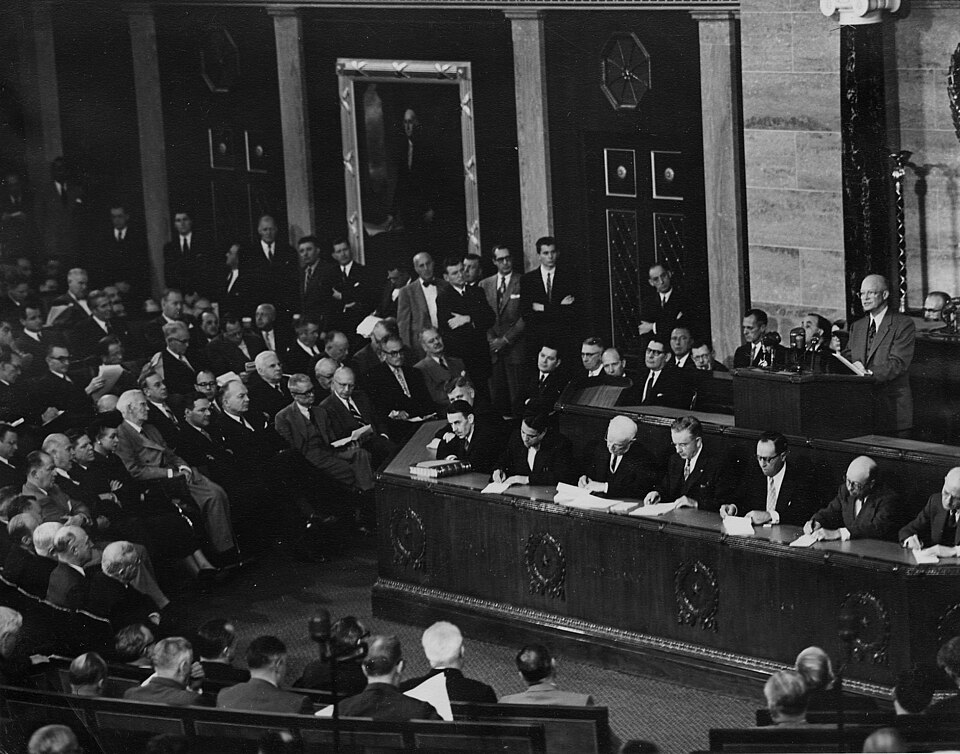
[The economy] is the cornerstone of our military security. Consequently, when we say “strength,” when we are building up the security and the military strength of the United States we are talking also about the strength of the economy.
—Dwight D. Eisenhower, 19581
The early Cold Warriors used a phrase to talk about the long competition with the Soviet Union: “security and solvency.” The tagline appeared on the 1952 Republican platform and was interspersed throughout President Eisenhower’s speeches over the course of the decade.2 An elegant, pithy phrase, it is shorthand for a foundational idea of American statecraft: the measure of our ability to deter (and if necessary) win wars is inextricably bound up with American economic dynamism and productive capacity.
This was an idea not discovered in a lecture hall or corporate boardroom, but a hard-won fact of American life. When Eisenhower planted his boots on the Normandy sand as supreme allied commander, he did so with an “overwhelming superiority” in war materiel brought forth by American industry.3 The battlefields of Europe proved beyond any remonstration that the fate of the free world rested upon that same free world’s capacity to create, build, and make anew.
Those days are far behind us. Production in this country is harder than it has ever been. At the peak of World War II, the United States had built ninety-nine shipyards to help its fleet stay at sea.4 Nearly 1 percent of the U.S. population was part of that workforce.5 Today, that number is roughly a dozen yards while the attrition rate for first-year shipbuilders is about 50 percent.6 In just a few years of wartime production, the United States built orders of magnitude more vessels than our principal naval foe, the Imperial Japanese Navy, ever had at their peak. Now, the average U.S. warship is nineteen years old.7 All nine U.S. Navy shipbuilding programs are running far behind schedule.8 And most alarmingly: China is outbuilding the United States in warships at a 3.3-to-1 ratio, while the Office of Naval Intelligence assesses that China has 232 times the shipbuilding capacity of the United States.9 We’ve essentially traded multiple Liberty ships per day for a handful of long-range munitions per year.
Undoubtedly, this is an especially acute vertical of military-industrial decline, but few better demonstrate the relationship between America’s capacity to build things and our ability to drive the strategic outcomes that we want. Over the past thirty years, deliberate policy choices have surrendered Eisenhower’s “solvency” in the industrial context. Now we must deal with the consequences for our security.
So, what does this mean? A prevailing observation from current conflicts is that magazine size rules the battlefield. A state’s capacity to outproduce its foe is—to a degree not seen in decades—determinant to victory or defeat. This has been called a new dimension of “strategic depth”: a classical concept of war in which a country can leverage its characteristics to buy itself time and flexibility in how it organizes its defenses.10
With the rise of techno-industrial warfare and far-reaching hypersonic missiles, it is increasingly argued that strategic depth is not just confined to terrain or the geography of a map.11 It is our ability to achieve self-sustainment in a protracted conflict. And it is increasingly an area where allied strength is at risk. Russia in recent years managed to build 4.5 million artillery rounds, of 152 and 155mm vintage, on an annual basis.12 By contrast, last year saw projections that the United States and Europe produced just 1.3 million, about three times less than Moscow.13 In the domain of drones, American analysts suggest that China has the ability to direct its commercial drone industry to retool for the production of one billion weaponized platforms annually without slowing its economy; one Department of War estimate assesses that the United States today only has the capacity to build 100,000 drones per year.14
It is obvious that by this yardstick, U.S. strategic depth is rapidly shallowing. In fact, it’s as shallow as it has ever been. The inability of the U.S. industrial base to even marginally scale up defense production is well documented; less widely known or appreciated is the basic inability of American economic and government actors to construct entirely new loci of manufacturing. A thicket of defense acquisition bureaucracy, a precarious regulatory environment, insufficient extant infrastructure, and fragile supply chains have the combined effect of almost prohibiting the United States from creating anything altogether new.
Struggles to build new things are only exacerbated by the federal government’s entrenchment in anachronistic weapons-buying practices (and, of course, buying anachronistic weapons themselves). Long-running assumptions about the character of the next war—that it would be short, sharp, and dominated through American technological overmatch—have hindered our Pentagon planners from investing in the kinds of mass-producible-by-design weapons that we need. Industry has responded logically to this by consolidating and underinvesting in its own research and development, leading to critical points of failure.
In the last thirty years, the United States has gone from fifty-one major defense companies to just six.15 We have two major shipbuilding companies, two major torpedo providers, and just three tactical missile companies which dominate the market.16 Less than 1 percent of the annual defense budget in 2024, by contrast, went to defense technology companies.17
Doubling down on buying the same things in the same way that we have been doing for decades increasingly comes with profound supply-chain vulnerabilities. Bending steel and creating high explosive components is no longer a solely “made-in-America” proposition. There’s a Chinese chokehold on these vital parts of our supply chain. Beijing controls 55 percent of the world’s steel, 38 percent of the world’s gallium (an element used in advanced electronics), 88 percent of rare earths, and 59 percent of synthetic graphite supply.18 The extent of economic leverage that China wields today is completely different from anything the United States has ever faced in its previous contests with strategic rivals. Consider that during the Cold War, the CIA could afford to source titanium for our Blackbird jets because the preponderance of other equipment could be easily assembled in a domestic setting.19 The United States is simply not in a position to do such a thing in the current competition with Beijing. Recovering the capacity to build sophisticated systems will demand a total divorce from adversarial supply chains.
Finally, there is the question of time as it relates to our defense preparedness problem. American strategic depth hinges on the ability to buy time. Our adversaries, conversely, are looking to run the clock in their favor. The unfortunate reality is that the dynamics of deterrence increasingly favor the latter.
It is now Beltway consensus that China appears to be preparing for an attack on Taiwan by 2027. The so-called window of maximum danger, the time at which the United States will be retiring large numbers of Reagan-era weapons systems while their modern replacements remain on order, begins in the next few years and lasts through the early 2030s.20 It’s not just successor weapons that are slow, either. The average time to take a given weapons system from development to deployment is now over twelve years, which is about four times as long as it took to do the same in 1950.21
Twelve years is simply a time horizon we do not have the luxury of accepting. Take the words of usindopacom commander Admiral Samuel Paparo for additional caution: “the closer we get to 2027, the less relevant that date becomes . . . we must be ready today, tomorrow, next month, next year, and onward.”22
We are not ready. Far from it. Conventional wargaming of a Sino-American conflict since the early 2020s have largely assessed that the United States would run out of precision munitions in a matter of days or weeks; that fact has not yet meaningfully changed. The arms backlog to Taiwan, which is again coterminous with our inability to even provision our own forces, is now the rough cost equivalent of an aircraft carrier-and-a-half or nearly a half-dozen nuclear attack submarines.23 Some munitions that Taiwan ordered in 2015 did not arrive until nearly a decade later, at the end of 2024. None of these data points fare well when putting them up against the vast scale and sophistication of Xi Jinping’s war machine, which his generals boast is built to “win future wars.”24
In one sense, these trends are all overdetermined. The pandemic, inflation, poor industry performance, and an entrenched, calcified Pentagon designed for a different era clearly hinder our ability to scale up efforts at military superiority. But in another more overriding sense, they are attributable to a single macroeconomic fact: American policymakers spent the last three decades outsourcing our manufacturing base while asking the defense industry to consolidate. We sold the proverbial farm, and now we want to grow crops. That’s not how farming works, and it’s certainly not how defense works, either.
The famed historian John Keegan predicted a half-century ago that the “new warfare” would be one in which the congruence of high military technology and commercial manufacturing would be such that “motor cars mimic missiles and machine tools machine guns.”25 But what if we stopped building either at any formidable scale?
That is exactly what has happened. China is responsible for nearly one-third of global manufacturing; the United States touts less than half that. This is not sustainable for a global hegemon. To crib Eisenhower and the early Cold Warriors, we have neither solvency nor security. There is no solvency because it is too hard to build in this country. Because it is too hard to build, our security is deteriorating. And there is little time left to change either of these stubborn facts.
Production Is Deterrence, the Factory Is the Weapon
If the American Century is to continue, we need to find a way out of this strategic cul-de-sac. Correcting for three decades of bad macroeconomic thinking solely through buying the same things we’ve been waiting for our industrial base to deliver is hopeless. Neither can we wait for a general war with our greatest adversary to hope for some kind of industrial revival. Instead, policymakers should focus on what is possible to execute within a relevant time horizon to the threats we face.
That effort begins with an understanding of what kind of competitive advantages the United States still has. Here, there is a clear answer: Uncle Sam is the software superpower. We lead the world in software engineering talent, compute power, and most verticals of artificial intelligence development. President Trump put it well in a recent vignette, where he explained that an adversary told him that his country cannot duplicate the strategic advantage of Silicon Valley. “We have things that nobody else can have,” Trump said.26 He’s right. Our commercial technology development and deployment vastly outpace the rest of the world’s. But how can we operationalize that for national defense?
The answer lies with applying technology to the very design of how weapons production works. Today, most of our high-performing armaments are not designed to be mass produced. A large part of the reason why B-24 Liberators could be built at massive scale by the same analog factories and infrastructure as a 1941 Ford was because the two vehicles shared basic requirements and processes when it came to metallurgy, engines, tires, and other key components. That couldn’t be less true of a 2025 Ford Bronco and a B-21 stealth bomber. In fact, the process to weld a nuclear submarine resembles artisanal craftsmanship much more than it does an exercise in industrial might.
This takes us back to a basic set of questions: what would it mean to build weapons that are mass producible by design, and how would you do it? Elon Musk observes: “the extreme difficulty of scaling production of new technology is not well understood. It’s 1000% to 10,000% harder than making a few prototypes. The machine that makes the machine is vastly harder than the machine itself.”27 Indeed, creating new high-rate industrial workflows demands answers to many of the aforementioned problems: one needs a secure and accessible supply chain, supporting infrastructure, and the right contracting model from government. But all of those crucial considerations are subordinate to one criterion: the blueprint of your weapons system.
Rebuilding the Arsenal of Democracy necessitates recommitting to the principles that made it work. As President Roosevelt remarked in 1941, it means building with “all possible speed.”28 Speed cannot be achieved without simplicity in design.
It is this fact that will distinguish old industry from the new. My company, Anduril Industries, sources nearly 90 percent of the parts for its products from commercially available components, and we use digital tools (including artificial intelligence) to design our weapons.29 Built with the same industrial processes used to build bathtubs, our Barracuda missiles are inherently more producible, more affordable, and more autonomous than similar weapons in their class, unlocking new concepts of operation (conops) that are more survivable, effective, and sustainable than through the sole use of existing exquisite weapons like the jassm or lrasm.30 The balance sheet speaks to its affordability and producibility: we can build a Barracuda in 50 percent of the time with 50 percent fewer parts needed to build competing solutions.31 Our philosophy is similar when it comes to our autonomous “loyal wingman” fighter jet for the U.S. Air Force, called YFQ-44A.32 Its Williams FJ‑44-4 engine is commonly used in Cessnas and business jets; we use the same airframe composite materials found in airliners, and we designed our own landing gear so that it can be machined from scratch in any shop in America.
Through this simplicity of design, Anduril is taking its inspiration from American history. In his classic Freedom’s Forge, Arthur Herman recalls that at the height of World War II, Ford Motor Company had more productive capacity than Mussolini’s Italy. Ford’s secret sauce was that they imitated the production processes of cars by housing all elements of the machine under one roof.33 Fuselages, wings, and engines would all be assembled in a single, mile-long smooth sequence rather than being put together piecemeal at several facilities. This process allowed for accelerated learning, sharing of ideas, and ease of management.
It also happened to accord with the golden rule of airplane manufacturing, called Wright’s Law. Developed in 1936 by aircraft engineer Theodore Wright, the theory’s basic postulation was that for each doubling of airframe output, labor (and therefore cost) would be reduced by a significant percentage.34 We are applying a similar outlook to our YFQ-44A jet at Anduril. Instead of locking the prototype design in a singular “block” variant, we are instead making constant updates and refinements to prototypes that incorporate lessons learned from manufacturing and testing the tails that came before them. This effort has already spurred design and process changes that have drastically reduced the amount of engineering and integration labor associated with building YFQ-44A.
We took another lesson from Ford’s war-winning wisdom: let’s build it all under one roof. Our factory Arsenal-1 is a $1 billion investment in Columbus, Ohio, where we plan to build Fury alongside many of our other products. The facility will host thousands of employees, occupy five million square feet, and produce large quantities of our platforms annually.35 We’ve already broken ground on it.
What this all amounts to is our theory of how to extend America’s shallow strategic depth: production is deterrence and the factory is the weapons system.36 In other words, the best demonstration of America’s warfighting capacity was our ability to sustain ourselves in conflict. If Xi and his Central Military Commission run the numbers and see that because of factories like Arsenal-1, they won’t have a munitions superiority, it changes their calculus. The prospective war elongates, and they suffer unacceptable losses. As such, the war itself never comes to pass. One defense innovation expert recently put it well: we have typically measured our combat power in the number of tanks or planes we have, but in 2025, the factory itself is the weapon.37
Hardening the Heartland
Making a billion-dollar investment, no matter how much you believe in its intended outcome, cannot solely be an exercise in political altruism. There needs to be a credible business case for such significant capital expenditure. We selected Arsenal-1’s location for those business reasons. After reviewing more than three hundred sites, we determined Columbus was the right fit for a variety of standout characteristics.
First, we considered the economic geography. The Dayton–Columbus corridor was once festooned with some of America’s crown jewels in manufacturing: AC Delco built automotive parts in Dayton. The state once dominated glass manufacturing. Dayton steel was integral to midwestern supply chains. None of the families who manned those factory floors suddenly disappeared. Many of them are still there and ready to work.
As a third-generation Ohioan, I happen to be related to many of them. Two of my grandfathers worked at Ford. Another worked at Frigidaire. My mother worked at the elevator company Fujitec. Blue-collar manufacturing is a way of life here. It builds families, and it still persists. Central Ohio boasts a strong, manufacturing-centric talent pipeline, and the aerospace industry surrounding Wright-Patterson Air Force base. We felt there was a strong workforce to draw from as a result.
Second, there is an incredible ecosystem of partnerships available to us. The deep bond between defense research and public universities goes back to the days of darpa supercomputers and the Manhattan Project. We felt this was a natural next step in this American tradition. To that end, the Ohio State University has extreme vocational relevancy with research in hypersonics, uncrewed aircraft, and other industrial sciences. There are 100,000 students within an accessible distance to our large-scale production facility, contending to help us create rapid pipelines for employment and skills development. State investment in two-year associate programs, technical colleges, and certification centers in Central Ohio will also produce key collaborative opportunities for our future workforce.
Third, we had extraordinary partners in state and local governments as well as local economic development authorities. When building a mass production facility from the very start, there are several practical questions that immediately arise. What is our energy infrastructure? How can we ensure that there is ease of transportation to the facility? What kind of permitting regulations are in place that might hinder rapid construction? We benefited from an extraordinarily competitive economic development package through JobsOhio, paired with local incentives. Inevitably, scores of complications materialize as a company scales and looks to start hiring a thousands-strong labor force. But from the start, we felt we had a trusted partner in the Ohio state government.
This is worth pausing on. The next war will be deterred by large stocks of weapons. But those weapons will be available only through decisions made by economic actors to permit industrialists to build. Anduril now has substantial production facilities driving economic development in Rhode Island, Mississippi, and Ohio because those state and local partners combined fundamental workforce access with business-friendly environments.
The nature of our capitalist system is such that the budgetary dimensions of deterrence matter. Buying certain kinds of weapons can be cost prohibitive. A defense industrial revival must be made to be a good investment, not just good security policy. Just as it was a bipartisan policy choice to deindustrialize and erode our defenses, it is no less of a conscious decision by policymakers today to buy different kinds of weapons in a different fashion.
This deep relationship between economic choice and military strength has long been legible to American strategists. At the height of the Cold War, the renowned Pentagon planner and iconoclast Andy Marshall’s competitive theories for harnessing the wellsprings of American techno-industrial superiority led to a growing emphasis on stealth, precision strike, and space-based assets. These ideas became the foundation for the Second Offset strategy, the set of defense programs which ultimately aided in the defeat of the Soviet Union.
Marshall himself saw the full life cycle of the Arsenal of Democracy: he worked the factory floor to build it during the 1940s, planned its expansion at the RAND Corporation in the 1950s, and then stewarded its ultimate Cold War victory through the 1980s. Through it all, Marshall was an unrepentant believer in capitalism as the vanguard of American power. He listened to Friedrich Hayek’s lectures, and he studied under Milton Friedman.38 These teachers sharpened his economic and strategic thinking alike. A good competitive strategy, Marshall thought, might challenge conventional thought, but it would do so aided by careful attention to empirical facts, qualitative edges, and emerging opportunities. We should follow his lead.
Today, that arsenal which Marshall labored to build is finally coming back together after decades of crumbling. We can use it to win the competition of the next decade and beyond; doing so is well within our grasp. But it will require active, affirmative, and specific policy choices tailored to the enduring advantages that the United States already has over the course of long-horizon timelines, not just what appears to make sense over a year or two; it is up to us to choose wisely.
This article originally appeared in American Affairs Volume IX, Number 4 (Winter 2025): 57–67.
Notes
1 Dwight D. Eisenhower, “Remarks at Annual Convention of the United States Chamber of Commerce,” American Presidency Project, April 30, 1958.
2 James Reston, “Eisenhower Asks ‘Security’ for U.S. and ‘Solvency,’ Too,” New York Times, September, 26, 1952; “Republican Party Platform of 1952,” American Presidency Project, July 7, 1952.
3 Dwight D. Eisenhower, “General Dwight D. Eisenhower’s Order of the Day (1944),” National Archives, June 6, 1944.
4 Aaron L. Friedberg, “In the Shadow of the Garrison State: America’s Anti-Statism and Its Cold War Grand Strategy,” (Princeton: Princeton University Press, 2000)
5 Friedberg, “In the Shadow of the Garrison State.”
6 Justin Katz, “Navy, Industry Has ‘Got to Adjust’ to Realities of Shipyard Worker Pay: Service Official,” Breaking Defense, September 19, 2025.
7 Michael Brown, “The Empty Arsenal of Democracy,” Foreign Affairs 104, no. 3 (May/June 2025): 136–48.
8 Justin Katz, “Navy Lays Out Major Shipbuilding Delays, in Rare Public Accounting,” Breaking Defense, April 2, 2024.
9 Chris Panella, “Top Admiral Says China Is Outbuilding the US on Warships at a Shocking Rate,” Business Insider, April 18, 2025; Joseph Trevithick, “Alarming Navy Intel Slide Warns of China’s 200 Times Greater Shipbuilding Capacity,” TWZ, July 11, 2023.
10 Nadia Schadlow, “New Dimensions of Strategic Depth,” First Breakfast (Substack), June 10, 2025.
11 Schadlow, “New Dimensions of Strategic Depth.”
12 Katie Bo Lillis et al., “Exclusive: Russia Producing Three Times More Artillery Shells Than US and Europe for Ukraine,” CNN, March 11, 2024
13 Deborah Haynes, “Russia Is Producing Artillery Shells Around Three Times Faster than Ukraine’s Western Allies and for about a Quarter of the Cost,” Sky News, May 26, 2024.
14 Martin C. Feldmann and Gene Keselman, “Factories First: Winning the Drone War Before It Starts,” War on the Rocks, July 17, 2025; Heather Sommerville, “America Turns to Ukraine to Build Better Drones,” Wall Street Journal, March 11, 2025.
15 Becca Wasser and Philip Sheers, From Production Lines to Front Lines (Washington D.C.: Center for a New American Security, 2025).
16 Wasser and Sheers, From Production Lines to Front Lines.
17 Heather Somerville, “Investors Are Betting on Defense Startups. The Pentagon Isn’t,” Wall Street Journal, January 25, 2024.
18 Wasser and Sheers, From Production Lines to Front Lines, 13; Yanmei Xie, “An Anatomy of Industrial Involution in China,” RAND Corporation, October 23, 2025.
19 Ben R. Rich, Skunk Works: A Personal Memoir of My Years at Lockheed (New York: Back Bay, 1996).
20 Kate Bachelder Odell, “America’s Military Faces a ‘Window of Maximum Danger’,” Wall Street Journal, October 7, 2022.
21 U.S. Government Accountability Office, Weapon Systems Annual Assessment: DOD Leaders Should Ensure That Newer Programs Are Structured for Speed and Innovation, GAO-25-107569 (Washington, D.C.: U.S. Government Accountability Office, 2025); Elliott V. Converse III, History of Acquisition in the Department of Defense, Volume I: Rearming for the Cold War, 1945–1960, (Washington, D.C.: Office of the Secretary of Defense Historical Office, 2012), 614, 619; Carlton Haelig, Stuck in the Cul-de-Sac: How U.S. Defense Spending Prioritizes Innovation over Deterrence (Washington D.C.: Center for a New American Security, 2025), 7.
22 Jim Garamore, “Indo-Pacific Commander Gives Unvarnished View of Situation in Region,” U.S. Department of War, November 20, 2024.
23 Eric Gomez and Joseph O’Connor, “Taiwan Arms Sale Backlog, September 2025 Update: Partial Deliveries, Future Schedules and Co-Production News,” Taiwan Security Monitor, September 2025.
24 Arathy J. Aluckal, Han Huang, and Greg Torode, “China’s War Technology on Parade,” Reuters, September 3, 2025.
25 John Keegan, The Face of Battle: A Study of Agincourt, Waterloo, and the Somme (New York: Penguin, 1983).
26 Donald J. Trump, “Remarks: Donald Trump Announces the Golden Dome Missile Defense System,” Roll Call, May 20, 2025.
27 Elon Musk (@elonmusk), “The extreme difficulty of scaling production of new technology is not well understood. It’s 1000 % to 10,000 % harder. . . . (X post), X, September 22, 2020,
28 Franklin Delano Roosevelt, “The Great Arsenal of Democracy,” American Rhetoric, December 29, 1940.
29 Pat Morris, “Why We’re Building Surface-Launched Barracuda-500,” Anduril, September 23,2025.
30 Christian Brose, “Barracuda-100M Completes Another Successful Flight Test for Army High Speed Maneuverable Missile Program,” Anduril, July 16, 2025.
31 Anduril Industries, “Anduril Unveils Barracuda-M Family of Cruise Missiles,” Anduril, September 12, 2024.
32 Kate B. Odell, “Christian Brose on the Coming Revolution in Military Tech,” Wall Street Journal, July 18, 2025.
33 Arthur Herman, Freedom’s Forge: How American Business Produced Victory in World War II (New York: Random House, 2013).
34 Ezra Klein and Derek Thompson, Abundance (New York: Avid Reader Press, 2025).
35 “Rebuild the Arsenal,” Anduril, accessed October 2025.
36 Stacie Pettyjohn and Hannah Dennis, “Production Is Deterrence,” Center for a New American Security, June 28, 2023.
37 Defense Innovation and Acquisition Reform, 119th Cong. (2025) (statement of Nathan Diller, CEO, Divergent Industries).
38 Andrew F. Krepinevich and Barry D. Watts, The Last Warrior: Andrew Marshall and the Shaping of Modern American Defense Strategy (New York: Basic Books, 2015).