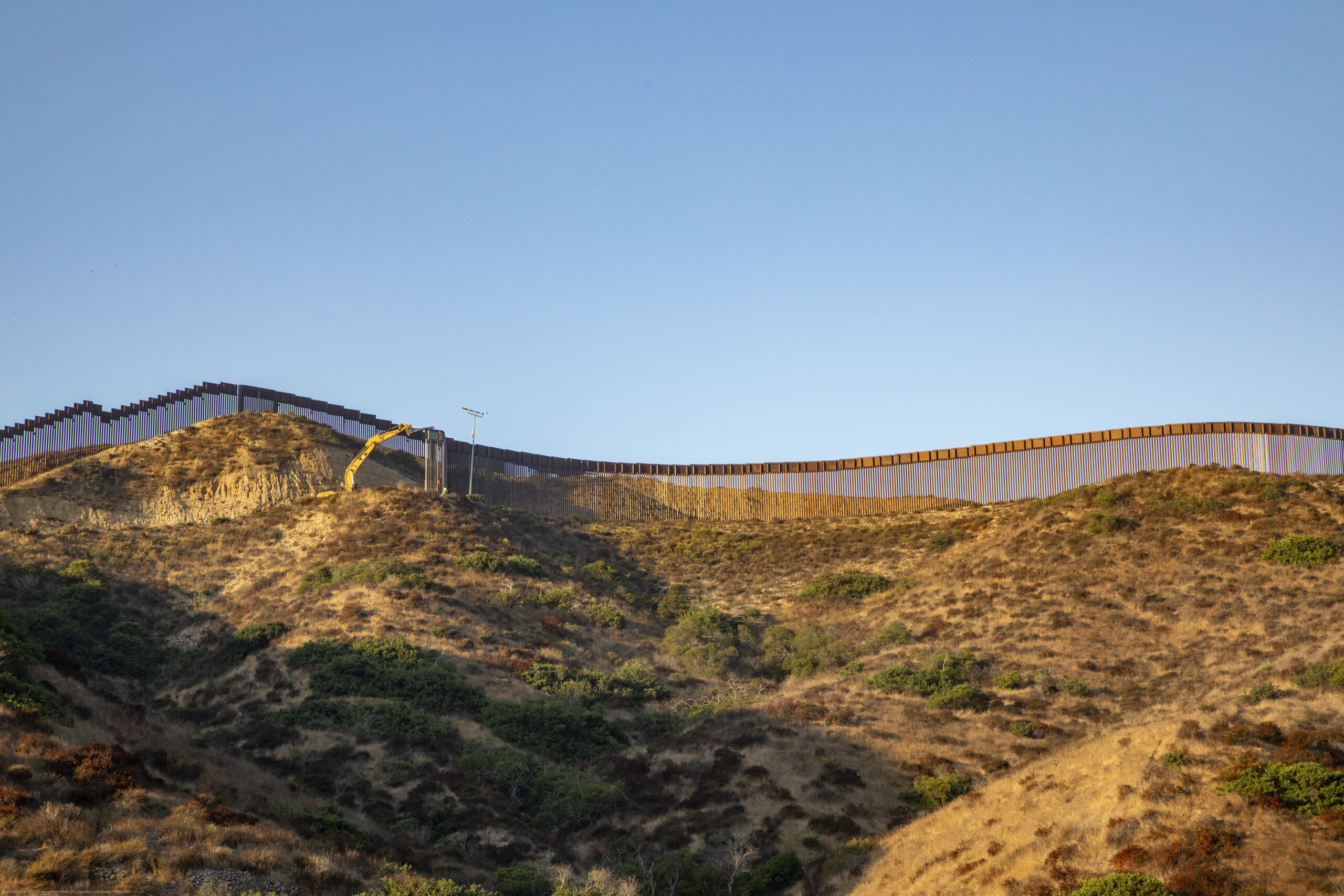
In the four years of the Biden administration, U.S. Customs and Border Protection (CBP) had border encounters with some eleven million migrants from 181 countries. Border patrol agents were serving meals, handing out blankets, driving migrants to the airport, and changing diapers. Migrants were living in squalid camps. It was the worst migrant crisis in U.S. history, each year setting a record for illegal migrant border arrests. Three months after President Donald Trump took office, border arrests had dropped by 93 percent.1 Military vehicles patrolled the border on the ground, with helicopters in the sky.
Under Biden, over 2,700 migrants were confirmed dead between fiscal years 2021 and 2024.2 This helps to explain why a record number of CBP agents committed suicide, eighteen in 2022 alone.3 Border patrol agents were quitting in droves. Under Trump, applications to work at CBP, the Coast Guard, and Immigration and Customs Enforcement (ICE) have skyrocketed.4
Under Biden, migrants’ social media posts showed nearly all who reached the border were getting in. Now, social media show ICE arrests, deportations, and migrants stranded on the Mexican side. The new message is clear: Don’t bother coming. You probably won’t get in. And it’s not worth the cartel smugglers’ fees or risking your life on the journey. But America’s borders are still far from secure. Terrorism threats, narcotrafficking, and human trafficking remain—not only on the southern border, but increasingly on America’s northern border with Canada.
Over two million known “gotaways,” a record, crossed into the United States during Biden’s term.5 (A gotaway is someone observed unlawfully crossing the border but not apprehended or turned back.) Some four hundred on the FBI’s terror watchlist were arrested while crossing between ports of entry, and more were likely among the gotaways.6 Many are still in the country. And the leading cause of death for Americans aged 18–45 remains illegal fentanyl, produced and trafficked by Mexican cartels: last fiscal year, the CBP apprehended over twenty-one thousand pounds of fentanyl at U.S. borders.7
Trump came in with a plan to first seal the southern border, then start mass deportations. And he vowed to take out the cartels. The following first looks at present and potential future strategies for securing the southern border, then explores the nature of the cartels and strategies against them.
The Militarization of the Southern Border
Soon after his inauguration on January 20, 2025, President Trump began militarizing the southern border. He sent 6,500 additional troops, adding to the 2,500 left by Biden. In April, he created new National Defense Areas (NDA) along the border, which operate much like military bases. They were created by transferring to the Department of Defense (DoD) jurisdiction over several federal lands, such as the Roosevelt Reservation, a sixty-foot-wide strip hugging the southern borders of California, Arizona, and New Mexico. A 170-square-mile strip along the base of New Mexico became the New Mexico National Defense Area, and a sixty-three-mile strip running southeast from El Paso (the western tip of Texas) to Fort Hancock became the Texas National Defense Area. Now, anyone crossing illegally into an NDA can be detained by the U.S. military, handed over to border patrol for arrest, and prosecuted under federal law.
Trump also sent a brigade of Stryker armored vehicles and a battalion of Black Hawk and Chinook helicopters for air support into the NDAs.8 Sources report that migrants approaching the border on the Mexican side have turned and fled upon seeing the Strykers in the distance. “The ability of the military to detain illegal migrants is a force multiplier,” said Mark Krikorian, executive director of the Center for Immigration Studies. “It will make it very hard for illegal migrants to get in.”9
Establishing NDAs along the border avoids legal conflicts with the 1878 Posse Comitatus Act, which generally bars the use of the military in civilian law enforcement. The major exception to the Posse Comitatus Act is the 1807 Insurrection Act, which allows the president to federalize national guard units and send in the military to suppress civil disorder and insurrection. In June, Trump cited the Insurrection Act when he sent Marines to quell anti-ICE protests in Los Angeles. This followed numerous precedents, such as the deployment of U.S. troops to the same city by President George H. W. Bush in order to quell the Rodney King riots of 1992.
Arizona and New Mexico were created from federal lands acquired from the Mexican-American War (1846–48) and the Gadsden Purchase (1854); today, they still contain many diverse federal lands within one hundred miles of the border which are available for military use. This hodgepodge has been managed by numerous agencies, such as the Bureau of Land Management, Forest Service, and Department of Agriculture, which are all under the executive branch and thus can be transferred by the president to DoD jurisdiction.
U.S. Indian reservations along the border were, however, excluded from the NDAs, and they remain a weak link in border security.10 In fact, it is likely that the sealing of the border along NDAs will cause more illegal migrants to funnel through these Indian reservations, especially the largest, the Tohono O’odham Reservation in Arizona. With a sixty-two-mile border with Mexico and only about eleven thousand residents in an area the size of Connecticut, the Tohono O’odham Reservation has become a major drug and human smuggling corridor. Its tribal chairman, Verlon Jose, testified before the House of Representatives that, in the first quarter of 2024 alone, Tohono O’odham tribal police seized nearly two million dose units of fentanyl, ten kilograms of fentanyl powder, seven hundred pounds of methamphetamines, ninety-seven kilograms of heroin, and 626,303 illicit Oxycodone pills. Jose also said homicides on the reservation had increased by 200 percent and assaults by 64 percent.11
While the Tohono O’odham Nation’s tribal government generally cooperates with the U.S. Border Patrol, many of its younger members have lucrative connections with drug traffickers. The tribe has consistently opposed a border wall, arguing that its members live on both sides of the border and need to travel across freely.12 It would be wise for the Trump administration to start a program that recruits Tohono O’odham youth to play an active role in securing the border, pulling them away from working with the cartels with incentives that could include scholarships and pathways to careers in law enforcement.
To further boost immigration enforcement at the border, Trump revived and expanded the “287(g) Program” (nicknamed for section 287(g) of the Immigration and Nationality Act), which allows the Department of Homeland Security (DHS) to deputize state and local police to assist ICE Enforcement and Removal Operations (ERO) in identifying and removing criminal aliens. Such deputized police can interview individuals to determine their immigration status, detain them until ICE takes custody, and issue a Notice to Appear (NTA), which initiates the removal process. (An ICE map shows that state laws or policies prohibit California, Washington, Oregon, New Jersey, and Connecticut from working with ICE in the 287(g) Program.13)
As more overland smuggling routes are cut off under Trump, smugglers have increasingly targeted U.S. coastlines. But under Trump, the U.S. Coast Guard has roughly tripled its personnel along the southern border’s coastal regions.14 Trump even deployed two Navy warships off the coasts of the border, the USS Gravely near the Texas-Mexico border in the Gulf of Mexico and the USS Spruance near the California-Mexico border in the Pacific Ocean. (In 2023, the USS Gravely was shooting down incoming Houthi missiles off the coast of Yemen in the Red Sea.) Both ships are destroyers carrying Coast Guard Law Enforcement Detachments on board, which the administration says will handle “maritime related terrorism, weapons proliferation, transnational crime, piracy, environmental destruction, and illegal seaborne immigration.”15 And to increase the jurisdiction of the Coast Guard and the CBP’s Air and Marine Operations (AMO), in April, Republicans in the House introduced the Extending Limits of U.S. Customs Waters Act, which would expand U.S. territorial waters from twelve to twenty-four nautical miles offshore.
While the U.S. side of the border is now far more secure, it is important to recognize that the Mexican side remains dominated by cartels, along with police who are either corrupt or outgunned (or both). Cartels maintain extensive underground tunnel systems across the border, like the one from Tijuana to San Diego discovered by the CBP in June.16 And the cartels still operate hundreds of stash houses on both sides of the border, where they keep migrants, drugs, and guns. Under Trump, ICE has been working closely with CBP and local police to carry out raids on cartel stash houses. In June, for instance, ICE tipped off local police about a stash house in Mercedes, Texas, and the police found sixteen migrants from Nepal, Albania, Mexico, Honduras, and Guatemala.17 Some stash houses have been found far from the border, like the one raided in May in Meadville, Pennsylvania, which contained fifteen illegal migrants.18 In short, Trump has restructured territory and regulations so that the border patrol has gained the assistance of both the U.S. military and state and local police in enforcing immigration laws.
Walls, Drones, and Guns
At 1,954 miles, the U.S.-Mexico border is the longest international border between two countries that are highly economically unequal. While it is the most crossed border in the world, long stretches are extremely remote and virtually uninhabited. It is in such remote regions that criminals and terrorists often seek to cross. One example is Texas’s Big Bend National Park, which spans 118 miles along the border and is 80 percent desert with twenty miles of mountains. Another hotspot for criminals crossing is the Bootheel region of southwest New Mexico, which is covered by extinct volcanic calderas and has a population density of less than one person per square mile. Other than criminals and migrants, ranchers, hunters, and hikers are among the few to be found here.
The vast emptiness of these areas is a double-edged sword for border security. On the one hand, those crossing into the United States must travel long and grueling distances on foot just to get to a road or a town, giving the border patrol more time to spot and stop them. Krikorian says that “Around border cities like El Paso, Nogales, and Tijuana, cross in and you can disappear in no time. Not in Big Bend. Some parts of it are like the moon.”
On the other hand, remoteness also makes it difficult for the border patrol to monitor and travel to locations to make arrests. In light of this, former CBP Director Jason Owens (who retired in April 2025) has suggested several key improvements.19 One is an overall increase in “persistent surveillance,” which is the use of technology like cameras and sensors to continuously monitor and track activity along the border. Current examples include aerostats, which are tethered surveillance balloons; Integrated Surveillance Towers with cameras and advanced sensors; unattended ground sensors, which can detect and send alerts of seismic, acoustic, infrared, and other forms of activity; and mobile surveillance, which uses cameras and other sensors mounted on trucks, drones, or other vehicles.
Owens says that the CBP is working to increase its use of artificial intelligence, especially training AI systems to spot imagery patterns indicating illegal border crossings. This would heavily reduce the need for personnel to monitor surveillance video screens. Owens says that more persistent surveillance can also better provide concrete evidence of the specific numbers of border crossings, which the CBP needs to justify funding from Congress.
To consolidate the progress made, Owens also supports the construction of border walls, which continues under Trump, especially in Arizona and Texas. He says that while it is true that for every thirty-foot wall, there is a thirty-one-foot ladder that smugglers can use to scale it, the point of border walls is not just to stop illegal crossings but to slow them, giving the CBP time to arrive. Others, including some ranchers and conservationists, have argued that the access roads created for border wall construction inadvertently make it easier for smugglers to get to the border to pick up migrants. But the CBP consensus is that what works is not just a wall but a wall system. This entails having a primary high wall or fence, followed by a second fence one hundred to two hundred yards farther in, creating an enforcement zone in between, with lighting, state-of-the-art surveillance, and paved roads that CBP vehicles can use to respond quickly.
Trump has expanded the role of the CIA in gathering intelligence about the cartels, especially through drones. Under Biden, the CIA had begun secret spy drone flights over Mexico to hunt for the locations of fentanyl labs. In February, Trump expanded the number of these flights to unprecedented levels, mapping targets deep in Mexican territory.20 CIA spy drones use hyperspectral imaging, which reads a wide range of wavelengths across the electromagnetic spectrum and can relatively easily detect the spectral signature or “footprint” of chemical emissions from fentanyl labs. Drones can also spot the cartels’ illegal landing strips in Mexico. The United States can hand off these locations of labs and landing strips to Mexican authorities, who can act to dismantle them.
The cartels, however, also have drones of their own, which for years they have used to monitor the size and movements of U.S. military and law enforcement units at the border. Cartels have also used “kamikaze” drones to drop improvised explosive devices (IEDs) on Mexican police and border patrol.21 In June, Mexican police in the state of Chiapas responded by unveiling their own armed drones, some carrying semiautomatic machine guns, and using nets to capture the cartels’ drones.
Trump has now also deployed counter-drone capabilities around the southern border, including tracking enemy drones, jamming their systems, and shooting them down.22 The effective deployment of drones is a key way for the United States and Mexico to battle cartels while minimizing the sort of shootouts that have led to the murder of so many innocent Mexicans. Overall, Trump’s militarization of the border puts forces in place in case the cartels try to retaliate against U.S. operations.
One of the least publicized but most crucial facets of the fight against cartels is the need to stop gunrunning from the United States into Mexico. This is one of the most effective steps Washington can take without setting foot on Mexican soil. By varying estimates, 50 percent to 85 percent of the guns found at cartel crime scenes in Mexico came from the United States, which has effectively served as Mexico’s arsenal next door. An estimated 200,000 to 500,000 firearms sold in the United States are smuggled into Mexico each year.
There is only one legal gun store in all of Mexico, run by the military and located on a military base.23 And Mexico has extremely strict gun laws requiring extensive background checks and psychological testing. But in the United States, on Guns.com and many other websites, one can buy an AR-15 or AK-47 semiautomatic rifle that fires forty rounds per minute. The cartels “use our own freedoms against us,” said Drug Enforcement Agency (DEA) Special Agent in Charge Matthew Allen at a recent Senate Judiciary Committee hearing titled “The Thin Blue Line Protecting America from the Cartels.”24
The Jalisco New Generation Cartel (CJNG) and Sinaloa Cartel—the same two cartels most active in trafficking fentanyl to the United States—are the main gunrunning cartels. They pay thousands of U.S. citizens to buy firearms for them; these third-party buyers are called “straw purchasers.” Most of these guns are bought from a relatively small number of gun stores and websites in the border states, which U.S. law enforcement is now aiming to crack down on. Once bought, the guns are brought to a cartel representative and driven across the border. Even in a small sedan, some gunrunners pack up to thirty guns hidden in secret compartments. Smugglers take advantage of the astounding fact that extremely few vehicles leaving the United States for Mexico are stopped, let alone searched, on either side. An increase and improvement in weapons searches of vehicles leaving the United States for Mexico would finally create a significant risk of gunrunners being caught. In short, by cracking down on gunrunning, U.S. authorities can drastically reduce the cartels’ firepower and thus give Mexican law enforcement a chance.
Cooperation with Mexico, Not Direct Intervention
To be sure, the U.S. military has far more firepower and intelligence gathering capability than Mexico’s government. But despite speculation about how imaginary conflicts between U.S. Special Forces and Mexican cartels would play out, direct intervention by U.S. troops in Mexico should only be an extreme last resort, for several reasons. First, it infringes on Mexico’s sovereignty, notably at a time when the Western world has been defending the sovereignty of Ukraine and Israel. “We will never accept the presence of the United States army in our territory,” said Mexican President Claudia Sheinbaum on May 1, after Trump offered U.S. intervention. “No, President Trump, our territory is inviolable, our sovereignty is inviolable, our sovereignty is not for sale.”
From a historical perspective, infringing on Mexican sovereignty would risk galvanizing Mexicans and cartels against the United States, by stirring up historical anti-imperialist sentiment. The United States once took 55 percent of Mexico’s territory with the Treaty of Guadalupe Hidalgo (1848) that ended the Mexican-American War. The United States captured Mexico City in 1847 and Veracruz in 1912, and it sent forces under General John J. Pershing on a yearlong “Punitive Expedition” chasing Pancho Villa in Mexico from 1916 to 1917. Thus, using the U.S. military directly in Mexico risks reviving these bitter memories and uniting Mexicans and cartels against a common foreign enemy; it may even open the door for the cartels to advertise some moral legitimacy, much like how Colombia’s former FARC guerillas claimed their narcotrafficking was a means of Marxist resistance. Already, the cartels have a significant fanbase in Mexico, exemplified by the musical subgenre of ballads known as “narcocorridos,” which glorify the exploits of cartels and celebrate drug traffickers as heroes.
Direct intervention also risks putting the blood of innocent Mexicans on U.S. hands. The cartels are deeply embedded in Mexican society, and in any armed conflict with them, the probability of collateral damage is extremely high. One example is the Mexican army’s 2023 capture of Sinaloa Cartel leader Ovidio “El Ratón” (The Mouse) Guzmán, the son of the cartel’s longtime leader Joaquín “El Chapo” Guzmán Loera, who since 2019 has been serving a life sentence in a supermax prison in Colorado. In the small town of Jesús María in Sinaloa, the Mexican army launched a predawn raid on The Mouse’s hilltop mansion, capturing him within ten minutes. But getting him out was not so easy.
For the next ten hours, Jesús María became a war zone. The army closed all streets out of the city and cut all water, electricity, and telecommunications. Sinaloa Cartel members sprayed bullets from mounted machine guns and lit dozens of cars and military vehicles on fire. Residents hid in their homes in the dark. The Mexican army deployed Black Hawk helicopters, airplanes, armored vehicles, and hundreds of soldiers. By evening, the army had claimed one of its biggest victories ever over the cartels. But the fighting left twenty-nine dead, including ten soldiers and thirty-five wounded. The Mouse was extradited to the United States, where he now awaits trial.
This capture of The Mouse exemplifies the sort of bloody conflict in which direct intervention in Mexico could embroil U.S. troops. And the slightest U.S. misstep would make global headlines. Marco Rubio calls Trump “a builder, not a bomber,” and Trump ran on a promise to stay out of “foolish wars.” The question, then, is to what extent can the United States rely on the Mexican government to cooperate and execute? And given that several of Mexico’s past governments have had a history of being influenced by cartels, can its current government be trusted?
“In order to have real cooperation between the US and the Mexican government, there has to be trust. But this takes years,” said Mariana Campero of the Center for Strategic and International Studies.25 “If your own agents are working in a foreign country, you can’t have someone revealing their secrets.”
Under Mexico’s last president, Andrés Manuel López Obrador, known as AMLO, trust was at a minimum. AMLO shut down intelligence cooperation between Mexico and the United States, including disbanding an elite Mexican antinarcotics unit trained by the DEA.26 But while Sheinbaum is a member of AMLO’s Morena party and ran as his protégé, her approach to security is very different from AMLO’s.
Sheinbaum came to prominence as the mayor of Mexico City from 2018 to 2023. Her chief of police was Omar García Harfuch, a relatively young but old-school cop known for being tough on crime and truly committed to public service. “It’s not about having a firm hand,” Harfuch said on a Mexican talk show, “it’s about having an efficient hand, doing your job well.”27 In 2020, Harfuch was shot three times in an assassination attempt when a twenty-eight-man CJNG hit squad opened fire on his SUV. But he survived and stayed on the job, and with Harfuch running security, both homicides and high-impact crime in Mexico City dropped over 50 percent during Sheinbaum’s mayoral term.
Upon her election last year, Sheinbaum appointed Harfuch to lead Mexico’s Secretariat of Security and Civilian Protection (SSPC), the country’s main public safety agency. She reported in June that their new National Security Strategy caused Mexico’s national murder rate to drop by 25.8 percent, twenty-two fewer murders per day, from September 2024 to May 2025.
Harfuch and Sheinbaum have discussed Mexico’s security issues with U.S. officials, including FBI Director Kash Patel, Ambassador to Mexico Ron Johnson, Deputy Secretary of State Christopher Landau, and several members of Congress. To what extent the Trump administration or the U.S. Congress will offer Mexico funding, weapons, and technology for security is unclear. What is clear is that “Omar García Harfuch is the closest figure [in Mexico] to developing intimate, close relationships with the political elite in Washington, DC,” according to Tony Payan, Director of the Mexico Center at Rice University.28 Payan says Harfuch is “dear to” the members of Congress who have met him, and they “really believe that he can make a difference, that he is a true cop . . . an agent who can certainly work with the United States.”
In 2024, Sheinbaum reorganized Mexico’s security structure, making Harfuch’s SSPC the central coordinating agency for all national intelligence, both civil and military.29 This puts Mexico’s military and National Guard (which AMLO formed in 2019) under Harfuch’s effective oversight. “With these new powers, the SSPC has become a kind of super-ministry,” says Jonathan Maza Vasquez of the Wilson Center, “resembling a hybrid between an Office of National Intelligence and a Department of Justice.”30
Harfuch has declared a “zero tolerance” policy on government corruption. He demonstrated this last November 22 with Operation Swarm, in which twenty-four public officials with ties to cartels, including police chiefs, were arrested in twelve municipalities across Mexico. In June, Harfuch visited Sinaloa’s cartel-ravaged capital, Culiacán, with 1,200 soldiers from the National Guard and four hundred SPCC agents. The security challenges in Culiacán were highlighted by the fact that two police officers and two young men were murdered there on the same day that Harfuch walked its streets.
Campero said she believes that “If there’s willingness on both sides, and governments are smart enough, [U.S.-Mexico] cooperation could really restart. And if Sheinbaum can cooperate on intelligence, it would be a tremendous improvement from AMLO.” There have been positive signs. After Trump threatened 25 percent tariffs in February, Sheinbaum sent ten thousand National Guard troops to the border. And on February 27, five days before the tariffs were set to kick in, something unprecedented happened in U.S.-Mexico relations: in a single day, the Mexican government transferred twenty-nine cartel kingpins to the U.S. Department of Justice (DOJ), nearly half the number extradited by Mexico over the past five years. The Biden administration had been asking Mexico to transfer these kingpins for years. “This tells me that Sheinbaum is willing to work with the US,” said Campero. “Politically, she has to do it in a way that doesn’t appear that the US is intervening on Mexico’s sovereignty. But I think she can do that.”
Despite the restored cooperation between the U.S. and Mexican governments, there are reasons to question the reliability of Sheinbaum and her Morena Party. Past DEA and DOJ investigations uncovered significant evidence that members of AMLO’s presidential campaigns took millions from cartels in return for promises to facilitate cartel operations.31 This year, the Trump administration revoked the U.S. visas of several Morena politicians with cartel ties, including the governors of the states of Baja California and Tamaulipas.
Sheinbaum is also continuing AMLO’s controversial project of radically reshaping Mexico’s core state institutions. A key example is AMLO’s successful push last year for “judicial reform,” a constitutional reform which made the over seven thousand judges in Mexico—including the Supreme Court—elected by the people. This made Mexico the first and only country where voters elect all judges at every level of the judicial branch. This sea change was advertised as a step toward making Mexico more democratic and removing corrupt judges.
But to journalist Leo Zuckermann and other observers, judicial reform is a move to entrench the Morena Party’s hegemony by destroying checks and balances: eliminating judges who have blocked the Morena agenda, controlling the courts that arbitrate elections, and thus making it difficult for other parties to participate in government.32 Indeed, in Mexico’s first-ever judicial elections in June, most of the judges elected were backed by Morena. Turnout was just 13 percent.33
Aside from changing the balance of power within the courts, the Morena party also has a supermajority in both houses of the Mexican Congress, and Sheinbaum enjoys a public approval rating of over 80 percent. Many believe the party is on its way to the sort of hegemony that existed in Mexico under the Partido Revolucionario Institucional (PRI), which ruled as a one-party state for seventy-one years (1929–2000). In short, it appears that for years to come, it will be the Morena Party that the United States will have to work with in the fight against cartels.
The Cartels: Decentralized, Diverse, and Dangerous
The U.S. Northern Command estimates that the cartels now influence 30–35 percent of Mexico’s territory. They are ruthless and have turned whole cities into battlegrounds, where dead bodies are found lying in the streets, hanging from bridges, or stuffed in cars, and residents are afraid to leave their homes. Cartels have killed over four thousand Mexican police officers, as well as soldiers and judges. One prominent example is Culiacán, the capital of Sinaloa and headquarters of the Sinaloa Cartel. A bloody civil war between rival factions erupted there after the 2016 capture of El Chapo, and it has left over one thousand dead and thousands missing.34
Over the last two decades, Mexico’s administrations have tried contrasting approaches to the cartels. In 2006, President Felipe Calderón declared “la guerra contra el narco” (“war against narcotrafficking”), enlisting the military in the fight. But this led to the doubling of homicides to 120,000 over his term, along with twenty-six thousand missing persons.35 A centerpiece of Calderón’s approach was the “Kingpin Strategy” to eliminate cartel leaders. But there were always new kingpins waiting to emerge, and the strategy created power vacuums in which infighting led to the fragmentation and multiplication of cartels and increased violence. Since 2006, there have been over 460,000 homicides in Mexico, over five times U.S. homicides per capita over the same period.36
AMLO reversed course by declaring that Mexico’s war against cartels was over. He ended the Kingpin Strategy, saying “We want peace, and we are going to achieve peace,” and from 2018 to 2024, he preached a policy of “abrazos, no balazos,” or “hugs, not bullets.”37 This allowed the cartels to run rampant. Throughout his term, AMLO adamantly denied that the cartels produced fentanyl, until finally acknowledging it for the first time in a March 2024 interview on 60 Minutes.
Mexico’s cartels have grown from roughly ten thousand members in the 1980s to over 120,000 today. They have become the fifth-largest employer in Mexico, employing up to 185,000, according to a study in Science.38 Roughly thirty thousand children, some as young as six years old, are now involved with the cartels, as part of what Reuters reported as a “deliberate strategy” by cartels to prey on kids’ “hunger for support and connection.” Cartels recruit young men and boys especially via social media, such as TikTok and Twitch, and through chats on video games like Fortnite and Call of Duty.39 Children are used in everything from aiding kidnappings to acting as “coyotes” to bring migrants across the U.S. border under the notion that it is harder for the United States to prosecute minors.
Some cartels operate like military units. They recruit from Mexican special forces and use ex-military members to train others. In fact, the original thirty-one members of Los Zetas, one of the most violent cartels, were deserters from Mexico’s most elite special forces unit, the Special Forces Airmobile Group. And today, cartels are recruiting former Colombian soldiers who are veterans of Colombia’s drug wars.
To say the cartels are heavily armed would be an understatement. One of the biggest factors creating a severe imbalance in firepower between the cartels and Mexican police is the Barrett M82 rifle, a cartel favorite. It can penetrate body armor, concrete walls, and even tanks. Only Mexican special forces can match this, leaving local police unable to fight. Cartels also have AR-15 and AK-47 machine guns, body armor, rocket grenades, IEDs, and more. Loaded with cash, they drive massive SUVs, some converted into “narco-tanks.” Some cartels have FGM-148 Javelin missiles, which can take out both tanks and low-flying helicopters, and shoulder-launched FIM-92 Stinger missiles, which can take down commercial planes. Javelins and Stingers are made only for the U.S. military. But the DoD reported that it lost track of thirty-five Javelins in Iraq in 2003, and Stingers have been sold on the black market since the United States gave over two thousand of them to the Mujahideen in Afghanistan in the 1980s.40
Some cartels now wear military uniforms, and many have become so brazen that they openly unmask their faces while in uniform.41 But generally, identifying cartel members can be difficult, as they can blend in with the general population. They hide their identities with aliases, fake IDs, coded language, and encrypted messages. Cartels can terrorize civilians into going silent or giving false intelligence to Mexican authorities. Some, like the CJNG, are now hiring hackers to breach government security agencies. And cartels are often decentralized and compartmentalized, meaning many members only know a handful of immediate contacts and are unaware of the larger organizational structure, leaving them unable to identify the key players. Many cartels have infiltrated legitimate businesses, political parties, and even government institutions, making it hard to distinguish between legitimate actors and criminals.
Cartels’ financial transactions are often as challenging to track as their members. They commonly go through Chinese money laundering organizations (CMLOs), who have long helped China-based investors obtain dollars on the black market because of Chinese laws limiting citizens’ ability to purchase foreign currency to $50,000. CMLOs have a complex variety of money laundering methods involving burner phones, shell companies, cryptocurrency, and Chinese payment apps like WeChat and Alipay. But often, laundering cartel dollars centers on finding either Chinese merchants in the United States or China-based investors, who buy the cartels’ dollars by depositing the equivalent in Chinese renminbi in the CMLO’s Chinese bank account, outside the view of U.S. law enforcement. CMLOs then use the Chinese account to either buy goods in China and ship them to cartel-owned shell companies in Mexico or the United States, or to buy goods from the shell companies and ship them to China.
There are thousands of cartel members living in the United States. “Their influence extends into the very heart of our neighborhoods,” said the DEA’s Allen. He recounted a recent DEA raid on a suspected cartel safehouse in downtown Los Angeles:
[O]ur teams encountered a chilling sight. . . . Inside a converted warehouse, just blocks from the DEA’s own office, was a floor-to‑ceiling mural of Nemesio Oseguera Cervantes, known as “El Mencho,” leader of CJNG. He was depicted in a bulletproof vest bearing the CJNG insignia, a shrine glorifying perhaps the most violent drug trafficker in modern history. The message was unmistakable: “We are here. We are among you.” It doesn’t stop there. The daughter and son-in-law of El Mencho were living in a gated Riverside community, just down the street from the Chief of Police. When we moved in on that location, we seized an estimated $2.25 million in illicit assets: garbage bags stuffed with Rolex watches, designer handbags, and cash. These cartel figures were living in luxury, embedded in our communities, hiding in plain sight.42
On his inauguration day, President Trump wasted no time in signing Executive Order 14157, which designated eight cartels as foreign terrorist organizations (FTOs) and specially designated global terrorists (SDGTs). Besides narcotrafficking, these cartels control most of the migrant smuggling, arms trafficking, and sex trafficking across the U.S.-Mexico border. They have diversified into all sorts of criminal activities, from online phishing to hijacking cargo trains inside the United States,43 timeshare fraud,44 smuggling endangered totoaba fish to China in exchange for fentanyl precursors,45 terrorizing avocado farmers in Michoacán into giving them a cut of their profits,46 and smuggling into Texas oil and gasoline stolen from Petróleos Mexicanos (pemex), Mexico’s state-owned oil and gas company.47
At first glance, the FTO designation for cartels may seem like just a label. But under the Anti-Terrorism Act (officially, the Antiterrorism and Effective Death Penalty Act of 1996), it opens a vast array of possibilities for legal attacks on the commercial and financial systems that support cartels. The FTO designation allows not just the Department of Justice but any U.S. citizen who has suffered damages from a cartel to sue any individual or business—from banks to social media companies to agribusinesses to restaurants—that has knowingly provided material support to that cartel. Such trials can take place in any U.S. court from the federal to the state and local levels. If the defendant is convicted, the United States can freeze their assets, sanction their exports, and ban individuals from entering U.S. territory. For example, an American injured by members of the Jalisco New Generation Cartel while on vacation in Mexico could sue a Mexican auto dealer proven to have knowingly sold SUVs to the cartel, and the dealer’s U.S. assets could be frozen or seized.
There is a great deal of precedent for such litigation in cases involving aiding foreign terrorist organizations, especially those in the Middle East. In May, for example, Mohammed Azharuddin Chhipa was sentenced by a Virginia court to over thirty years in prison for using cryptocurrency to send over $185,000 to ISIS in Syria. As increasing numbers of Mexican businesses are convicted in U.S. courts, their assets frozen, visas and passports revoked, and products sanctioned, it could become very costly to collaborate with cartels.
Shifting Fentanyl Frontiers
Fentanyl is an extremely addictive synthetic opioid, up to fifty times stronger than heroin. Legal fentanyl is used in tiny amounts for general anesthesia, such as during heart surgery. Just two milligrams, the equivalent of ten to fifteen grains of table salt, is enough to kill a person. The casualties across America have affected all ages and socioeconomic groups, from babies and toddlers exposed to their parents’ illegal drugs to high-school cheerleaders and football players and inmates in prison.48
Fentanyl was invented in 1959, but illegal fentanyl did not become a major public health issue in the United States until 2019, when the Sinaloa Cartel began producing it to sell in U.S. markets. Today, deadly traces of fentanyl are showing up regularly in every sort of illegal drug, from cocaine to marijuana to methamphetamines. Illegal fentanyl comes in pills, powder, bars resembling street chalk, and many other forms. The pills are typically blue and stamped “M30” to look like oxycodone (Oxycontin or Percocet), but some come in rainbow colors resembling candy; this anodyne appearance, and the fact that fentanyl is easily mixed with drinks and other drugs, has lead many to ingest it unknowingly. “The cartels are producing fake prescription pills laced with fentanyl for as little as 10 cents each and selling them for as much as $25 per pill on our streets,” says Allen. “The profit margins are staggering.” Moreover, fentanyl is often laced with the animal tranquilizer xylazine, known as “tranq” or “tranq dope,” which rots flesh and bone and often leads to amputations.49 In short, the likelihood that any illegal drug is laced with fentanyl makes this perhaps the deadliest time in history to be experimenting with drugs.
A key legal obstacle to stopping fentanyl trafficking is the “de minimis” rule found in section 321(a)(2)(C) of the Tariff Act of 1830. Under this rule, low-value shipments are exempt from taxes and duties and thus are minimally searched and inspected. In 2016, the threshold for the de minimis exception was raised from $200 to $800, and this has been exploited by narcotraffickers who send precursor chemicals, pill presses, molds, pill dyes, and other items used in fentanyl production into the United States. In April, the Trump administration eliminated de minimis treatment for shipments from China. But Chinese exporters still send shipments via other countries, such as South Korea, and often use false invoices, fraudulent postage, and deceptive packaging. The de minimis rule is “really hurting and harming us now, because anything under that $800 threshold is not being subject to search or customs inspection, so that allows these parts and pieces to come in,” said Jason Stevens, Special Agent in Charge for Texas Homeland Security Investigations.50 In response, Senators Lindsay Graham and Sheldon Whitehouse proposed the bipartisan Closing the De Minimis Loophole Act in May, which would phase out de minimis for all countries after a four-month transition period. President Trump later signed an executive order ending the exemption for all countries on July 30.
The Corporate Transparency Act (CTA) of 2021 was meant as a step toward exposing U.S. shell companies used to make illegal shipments, including fentanyl-related products. The CTA required many U.S. companies to report information about their beneficial owners (i.e., their true owners) to the Financial Crimes Enforcement Network (FinCEN). In March, however, the Treasury Department suspended this beneficial ownership reporting requirement for U.S. companies and individuals. Senator Whitehouse says this is a step backward, arguing that “Treasury’s new rule guts the CTA by exempting all U.S.-formed companies—over 99% of the law’s scope. This watered-down rule blindfolds law enforcement’s ability to track down fentanyl traffickers and other transnational criminals who routinely use U.S. shell companies, and it directly contradicts the Administration’s supposed top priority, to go after cartels.”51
The small quantity of fentanyl needed to produce a high and its totally synthetic nature make it relatively cheap to manufacture and ship. In an approach termed “shotgunning,” cartels send massive quantities of fentanyl across the border, knowing they will still make money even if much of it gets intercepted. U.S. Border Patrol agents have found fentanyl in places like car floor tiles, door panels, a compartment under the toilet of a bus, and balloons that were ingested or stuffed inside bodily cavities. Once across, fentanyl is trafficked all over the country, via everything from commercial trucks to airline luggage. Entire trucking companies have been convicted of smuggling fentanyl, like Carin Trucking, which the DEA busted in 2024 for smuggling 680,992 fentanyl pills from Mexico to Los Angeles inside fire extinguishers in scrap metal loads.52
Fentanyl trafficking connects Mexican cartels to every U.S. state, from New York to Montana, South Dakota, and Alaska. For example, on May 6, 2025, the DEA made its largest fentanyl bust in history, bringing down a narcotrafficking ring spanning five states. It seized a record-breaking 396 kilograms—nearly half a ton—of fentanyl pills in Albuquerque, New Mexico, while simultaneously arresting a Sinaloa Cartel-linked ringleader in Salem, Oregon, and seizing more drugs and cash in Phoenix, Las Vegas, and Layton, Utah. One kilogram of fentanyl can kill 500,000 people.53
Arizona is the entry point for most illegal fentanyl coming into the United States. The largest fentanyl trafficking hub is “Ambos Nogales” or “Both Nogales,” the pair of cities both named Nogales straddling Arizona’s border with Mexico. On the Mexican side, Heroica Nogales is a bustling industrial city of 260,000 and a gateway for factory products from the northern states of Mexico coming into the United States. Through the ports of entry in Nogales, Arizona, some 380,000 trucks, 3.7 million cars, 889 trains, three million pedestrians, and ten million people enter the United States every year.54 This immense volume of traffic makes it challenging for the CBP to spot fentanyl smugglers.
Nonetheless, the CBP has seized millions of fentanyl pills at Arizona points of entry. For example, in August 2024, the CBP seized some four million pills, around one thousand pounds of fentanyl, hidden in the frame of a pickup’s trailer at the Port of Lukeville on the Arizona-Mexico border. The CBP interrogates drivers with trained detectives, and it searches vehicles using drug-sniffing dogs, handheld chemical analyzers, and immunoassay strips that can detect fentanyl in other drugs. Border agents keep Naloxone available, a drug that rapidly counteracts the effects of opioid overdoses in both humans and dogs.55
Most illegal fentanyl is produced by the CJNG and the Sinaloa Cartel, and the DEA has tracked the activities of these two cartels in nearly fifty countries. The cartels produce fentanyl in Mexico using chemical precursors imported mostly from China but also from India and other countries. The precursors are “cooked” by chemists in cartel labs, and the final product is sent across the border to the United States. Increasingly, however, cartel members are showing up on university campuses in Mexico, some disguised as janitors, to recruit chemistry students to become fentanyl cooks.56 The Trump administration has used tariffs to push China to crack down on Chinese exporters of fentanyl precursors. But meanwhile, the cartels are aiming to be able to produce their own fentanyl precursors soon.
Moreover, cartels are increasingly shifting fentanyl trafficking northward from the U.S.-Mexico border to Canada, which is emerging as a new cartel hub of fentanyl production and trafficking. In its 2025 National Drug Threat Assessment, the DEA warns: “In addition to the synthetic drug threat from Mexico, elevated synthetic drug production in Canada—particularly from sophisticated fentanyl ‘super laboratories’ such as the type seized by the Royal Canadian Mounted Police [RCMP] in October 2024—presents a growing concern for the United States.”57 The Port of Vancouver is becoming a major entry point for fentanyl precursors from China. On tourist visas, cartel members travel from Mexico to Vancouver and other Canadian cities and enlist local gangs to deal fentanyl and other drugs for them, which can quadruple the gangs’ income. The cartels are taking advantage of the fact that, at 5,525 miles, the U.S.-Canada border has immense stretches that are unprotected.
Canada is cracking down on fentanyl and illegal migration. As Trump’s tariffs on Canadian steel and aluminum have jumped from 25 percent to 50 percent, Canada’s government reported that illegal crossings from Canada into the United States dropped 90 percent from January 2024 to January 2025, due in part to a 56 percent increase in RCMP patrolling of Canada’s border and ports.58 But besides fentanyl smuggling to the United States, fentanyl use is fast becoming a major issue in Canada itself. A 2024 report by University of Toronto addiction psychiatry professor Dr. Robert Kleinman found that among all opioids seized in Canada, those containing fentanyl and fentanyl analogs, like carfentanil, rose from 3 percent in 2012 to 68 percent in 2022.59 The next decade will see a race between organized criminals seeking to use Canada as a trafficking base and Canadian authorities, who must step up law enforcement and border protections to unprecedented levels.
The Trump Strategy’s Early Returns
Over Biden’s four years, “The whole world came to this country,” said Trump border czar Tom Homan; “they knew you cross the border, get released within 24 hours, get a free plane ride to the city of your choice, get a free hotel room, three meals a day, free medical care.”60 Trump ended the border crisis quickly by restoring policies that worked and eliminating ones that failed. He restored the “Remain in Mexico” policy (officially the Migrant Protection Protocols), ending the Biden-era catch‑and-release protocols—and making catch, detain, expel/deport the norm once again, as it had been for decades, and as it is in most countries around the world.
Trump also ended the Biden administration’s blatant abuses of immigration parole. Very different from criminal parole, immigration parole is a special permission from one of the border agencies (e.g., DHS, CBP, ICE) giving migrants already deemed “inadmissible” a two-year legal status and, for adults, work eligibility. Under U.S. law, immigration parole is only to be used in rare exceptions involving “urgent humanitarian reasons or significant public benefit.”61
But the Biden administration invented new mechanisms to give out immigration parole like candy. One was an abuse of the CBP One app, originally created under the first Trump administration in October 2020 to help commercial trucking companies with scheduling cargo inspections. The last administration repurposed the app to orchestrate a new lottery system allowing 1,450 migrants per day to make appointments with the CBP. Of some 985,000 migrants who made the appointments, nearly everyone received immigration parole and was released into the United States. In 2022, the Biden administration also created four programs known collectively as “CHNV,” the “Processes for Cubans, Haitians, Nicaraguans, and Venezuelans.” CHNV granted immigration parole to some 532,000 migrants from these countries, even as many of them demonstrated no “urgent humanitarian reason” to enter.
In fact, longtime border investigator Todd Bensman interviewed thousands of migrants on the southern border over the past five years, and he found that many granted immigration parole under CHNV had been living and working safely and securely for years, with residency and asylum, in countries like Chile, Peru, and Brazil. A former fellow with the Center for Immigration Studies and now Senior Advisor to Tom Homan, Bensman said, “I’ve never met a Haitian who’s lived in Haiti for [the past] four, five, six, or eight years. Yet the Washington narrative was that they were fleeing directly from Haiti. . . . Living domiciled in a safe third country is an automatic disqualifier for the US asylum they’re claiming.”62 And hence the migrants often discard their IDs from those third countries so they can make up a story on their applications for U.S. asylum.
The Biden administration also assured Americans that it had vetted these migrants, but this was absurd. “Vetting only works in developed societies, like Europe and Japan, where they have advanced identification systems,” says Krikorian.63 “The Department of Homeland Security might have checked the US’s own criminal database, and maybe Interpol, but they couldn’t check the countries of origin. The places where illegal aliens are most likely to come from are the places where vetting is essentially impossible.” In short, nearly every one of the roughly 1.5 million migrants who entered the United States through Biden’s CBP One app and CHNV—again, all of whom were previously deemed “inadmissible”—was treated as a rare special case and granted immigration parole without being vetted in any serious way.
Trump ended these immigration parole scams. On the first day of his current term, he signed Executive Order 14165, “Securing Our Borders,” which terminated the existing CBP One app and revoked immigration parole status for the 985,000 who had entered using the app.64 On April 24, Trump also terminated immigration parole for the 532,000 who entered under CHNV, and this was later upheld by the Supreme Court on May 30.
Trump’s DHS has facilitated ways for illegal aliens to exit the United States smoothly, providing several incentives to do so. It repurposed and rebranded the CBP One app as “CBP Home,” which assists illegal aliens who register to voluntarily self-deport immediately. In fact, doing so secures their ability to apply to return later legally. On the other hand, “If they don’t [self-deport],” said DHS Secretary Kristin Noem, “we will find them, we will deport them, and they will never return.”65 And through the Trump administration’s “Project Homecoming,” registering through the CBP Home app also gives illegal aliens cost-free travel out of the United States, a waiver of any fines, and a $1,000 exit bonus.66 Project Homecoming even allows them the chance to “wrap up work, school, or personal matters” before leaving the United States, “and [to] organize their return in an orderly and legal way.”
Some argue that illegal migrants should not be rewarded with such perks. But the Trump administration argues that these benefits are still far cheaper than the $17,000 it costs to find, arrest, detain, and deport a single migrant.
New Challenges
With the return of the Trump administration, the worst of America’s self-induced border crisis ended abruptly. Trump’s new National Defense Areas and personnel increases have made the U.S.-Mexico border more secure than ever. The Biden-era programs that encouraged asylum fraud and immigration parole have been eliminated. But challenges remain. Now, the main task at the southern border is to plug the security gaps that persist, including the remote areas and Indian Reservations where gotaways slip through and illegal drugs gush in. Congressional funding for high-tech persistent surveillance and border wall systems can dramatically enhance border security in long-neglected areas.
After witnessing the deluge of fake documents used by migrants to enter the United States and fool employers, the Trump administration can consolidate the progress it has made by supporting a shift away from paper identification systems to electronic ones, which are much less prone to counterfeiting. Krikorian says making it mandatory nationwide for employers to use E-Verify would make it much harder for illegal aliens to obtain jobs—and much easier for ICE to identify illegal workers to deport. Some form of E-Verify is already required in twenty-three states; expanding it across the country would help turn off the economic magnet for illegal migration.67
Yet, as in its first term, the Trump administration’s stance remains unclear. In June, for instance, the president paused ICE apprehensions at farms, restaurants, and hotels, while suggesting illegal workers in such places might be able to stay if their employers could “take responsibility” for them.68 This was then quickly reversed, although Homan clarified that ICE would prioritize apprehending criminals when investigating workplaces.69 Taking a clear, unequivocal stand in support of mandating E-Verify across the United States would be a big step toward a system where immigration law is applied evenhandedly, and in which employers and workers alike can be certain whether they are complying with it.
Narcotrafficking and the fentanyl crisis have no quick solutions. They require a multifaceted approach that includes educating the public, dismantling the cartels, and blocking Chinese suppliers. Domestically, educational campaigns must continue to spread the message that with fentanyl, “one pill can kill.” The United States should prioritize drastically reducing the tidal wave of guns flowing from U.S. gun sellers into the hands of cartels in Mexico with a focus on increasing outbound border inspections. Passing the bipartisan Closing the De Minimis Loophole Act will allow the CBP to inspect millions of packages to stop fentanyl production equipment, gun parts, and other illegal cartel shipments. And the United States now has an open door to make creative use of Trump’s foreign terrorist organization designations to bring legal pressure to bear on the U.S. gun shops, straw buyers, Chinese money laundering organizations, and others who aid cartels. Squeezing the cartels’ supply of guns and laundered money will go a long way toward giving Mexico’s government a chance to fight back against them.
U.S. security cooperation with Mexico’s government is warming up again after years of stagnation. While carefully monitoring for leaks, the United States can provide Mexico with intelligence that can empower its enforcement authorities to intercept shipments and destroy fentanyl labs, cartel landing strips, and cartel strongholds. In particular, the United States can assist Mexico with technology for inspections at its ports, especially the Port of Manzanillo, a key entry point for fentanyl precursors at which Chinese operators exercise control.
Mexico’s era of “hugs, not bullets” is over, and as Mexicans debate whether to militarize again against the cartels, the prospect of violence overwhelming major cities like Culiacán and Colima may eventually leave them no choice. With Omar García Harfuch at the steering wheel on Mexico’s security matters, the United States seems to have an effective ally. Sheinbaum has declared Mexico off limits to U.S. direct intervention. But since the Mexican government’s failed war on cartels of years past, things have changed: the Mexican army and National Guard are stronger, and Washington is now fully onboard to assist. The cartels have nothing that can contend with U.S. Navy ships, and naval support to stop maritime narcotrafficking along Mexico’s coastline is a much less risky and invasive possibility than sending U.S. troops.
Some believe Mexico needs to build mega-prisons, like the one that has allowed El Salvador to incarcerate tens of thousands of gang members. But as long as the cartels retain their current massive firepower advantage over Mexican authorities, rounding up cartel members will be difficult. Some, like journalist Luis Chaparro, believe the United States should conduct a psychological operation (PSYOP) to turn the cartels against each other.70 The United States certainly has a major opportunity to use its technological leadership to disrupt the social media messaging and indoctrination though which cartels are recruiting Mexican youth—and to support a strong nationwide media counternarrative in Mexico educating the public about specific ways through which ordinary citizens can contribute to dismantling the cartels. And as new narcotrafficking, human trafficking, and terrorist threats emerge along America’s vast northern border, they pose unprecedented challenges requiring escalation of U.S.-Canada cooperation.
One silver lining of the border crisis of the past four years is that it has heightened Americans’ awareness of border threats. As a disastrous chapter closes in the nation’s quest for border security, the United States is more prepared now that a new chapter is just beginning.
This article originally appeared in American Affairs Volume IX, Number 1 (Spring 2025): 158–83.
Notes
1 Dan Gooding, “
Visualizing the Plunge in Border Crossings under Trump,”
Newsweek, July 2, 2025.
2 María Inés Taracena, “Migrant Deaths and Disappearances Are Part of Biden’s Legacy on Immigration,” Prism, January 15, 2025.
3 Lauren Villagran, “Haunted by Migrant Deaths, Border Patrol Agents Face Mental Health Toll,” USA Today, October 1, 2024.
4 Press Release Office, “The U.S. Border Patrol, the U.S. Secret Service, and the U.S. Coast Guard Are Breaking Recruitment Records Under President Trump and Secretary Noem,” Department of Homeland Security, May 16, 2025.
5 “Startling Stats Factsheet: Fiscal Year 2024 Ends with Nearly 3 Million Inadmissible Encounters, 10.8 Million Total Encounters since FY2021,” Homeland Security Committee Republicans, October 24, 2024.
6 “Biden-Harris Administration Has Intentionally Left Us Vulnerable”: Pfluger, Higgins Deliver Opening Statements in Hearing on Terror Threats from the Border,” Homeland Security Committee Republicans, September 19, 2024.
7 Office of the Press Secretary, “Fact Sheet: President Donald J. Trump Closes De Minimis Exemptions to Combat China’s Role in America’s Synthetic Opioid Crisis,” White House, April 2, 2025.
8 Wes Shinego, “Pentagon Deploys Stryker Brigade, Aviation Battalion to Southern Border,” DOD News, March 1, 2025.
9 Mark Krikorian (executive director of the Center for Immigration Studies) in discussion with the author, June 2025.
10 “Border Tribes,” NAEPC.com, accessed June 2025.
11 Testimony of the Honorable Verlon Jose, Chairman before the U.S. House of Representatives Committee on Appropriations Subcommittee on Interior, Environment, and Related Agencies, 118th Cong. (2024) (statement of Verlon Jose, Chairman).
12 “No Wall,” Tohono O’odham—Native Sovereign Nation, accessed June 2025.
13 “Delegation of Immigration Authority Section 287(g) Immigration and Nationality Act,” U.S. Immigration and Customs Enforcement, accessed June 2025.
14 Salvador Rivera, “US Coast Guard ‘Tripled’ Personnel to Prevent Maritime Human Smuggling,” Border Report, March 31, 2025.
15 U.S. Northern Command Public Affairs, “USS Spruance Deploys to U.S. Northern Command Area of Responsibility,” U.S. Northern Command, March 22, 2025.
16 “San Diego Sector Border Patrol Uncovers Sophisticated Cross-Border Drug Smuggling Tunnel,” U.S. Customs and Border Protection, June 18, 2025.
17 “South Texas Stash House Discovered by ICE Rio Grande Valley Leads to the Arrest of 16 Illegal Aliens,” U.S. Customs and Border Protection, June 3, 2025.
18 Acting Chief Patrol Agent James P. D’Amato (@USBPChiefBUN), “Through interviews and investigations, Erie station coordinated a joint operation with HSI-Erie, ICE-ERO Fugitive Ops. . . .,” X.com, May 22, 2025.
19 Ironclad, “Ex-Border Patrol Chief: Inside the Collapse: Serving Under Biden, Cartels, & the Next Phase of War,” YouTube, June 2, 2025.
20 Julian E. Barnes, Maria Abi-Habib, Edward Wong, and Eric Schmitt, “C.I.A. Expands Secret Drone Flights Over Mexico,” New York Times, February 18, 2025.
21 CBS/Associated Press, “Drug Cartels are Sharply Increasing Use of Bomb-Dropping Drones, Mexican Army Says,” CBS News, August 23, 2023.
22 Brandi Vincent, “DOD to Deploy Counter-Drone Capabilities at US-Mexico Border as Cartels Surveil Troops,” DefenseScoop, April 29, 2025.
23 E. D. Cauchi, “Mexican Drug Cartels Pay Americans to Smuggle Weapons across the Border, Intelligence Documents Show,” CBS News, September 18, 2023.
24 Testimony of Matthew Allen at “The Thin Blue Line Protecting America from the Cartels,” Hearing before the U.S. Senate Committee on the Judiciary, 119th Cong. (2025) (statement of Matthew Allen, DEA Special Agent in Charge).
25 Mariana Campero (Non-resident Senior Associate at the Center for Strategic and International Studies) in discussion with the author, June 2025.
26 Drazen Jorgic, “Exclusive: Mexico Shuts Elite Investigations Unit in Blow to U.S. Drugs Cooperation,” Reuters, April 19, 2022.
27 Mónica Garza, “Omar García Harfuch: No voy a permitir que el miedo me paralice, El Nido de la Garza,” YouTube, October 6, 2023.
28 Tony Payan and David M. Satterfield, “Claudia Sheinbaum’s Balancing Act: Part 1,” Baker Institute for Public Policy, June 9, 2025.
29 Jonathan R. Maza Vázquez, “The Structural Redesign of Security in Mexico,” Wilson Center, December 11, 2024.
30 Vázquez, “The Structural Redesign of Security in Mexico.”
31 Tim Golden, “Drug Traffickers Said They Backed an Early Campaign of Mexico’s President. But U.S. Agents Were Done Investigating,” ProPublica, July 19, 2024.
32 José Cárdenas, “Políticos abusan del poder e instituciones de justicia: Leo Zuckermann,” YouTube, June 24, 2025.
33 Diego Oré and Sarah Morland, “Turnout in Mexico’s First Judicial Election Estimated at 13%,” Reuters, June 2, 2025.
34 Lizbeth Diaz, “Gunmen Attack Sinaloan Media Outlet amid Intra-Cartel War,” Reuters, October 18, 2024; Silber Meza, “Culiacán Dispatch: The Mexican City Torn Apart by the Sinaloa Cartel’s Bloody Civil War,” Organized Crime and Corruption Reporting Project, December 13, 2024.
35 CFR.org Editors, “Mexico’s Long War: Drugs, Crime, and the Cartels,” Council on Foreign Relations, February 21, 2025.
36 CFR.org Editors, “Mexico’s Long War: Drugs, Crime, and the Cartels.”
37 Casey Quackenbush, “‘There Is Officially No More War.’ Mexico’s President Declares an End to the Drug War amid Skepticism,” Time, January 31, 2019.
38 Rafael Prieto-Curiel, Gian Maria Campedelli, and Alejandro Hope, “Reducing Cartel Recruitment Is the Only Way to Lower Violence in Mexico,” Science, September 21, 2023.
39 Rubi Bledsoe, “The Role of Social Media in Cartel Recruitment,” Center for International and Strategic Studies, May 28, 2025; Reuters Videos, “Mexico’s Cartels Recruit Children and Groom Them into Killers,” Reuters, May 28, 2025.
40 Steve Fisher, “Mexican Cartels Boast of Increased Lethal Firepower, Including Some Weapons from the U.S.,” USA Today, June 29, 2024.
41 Victoria Dittmar, “No More Masks—Jalisco Cartel Members Reveal Their Faces,” InSight Crime, July 8, 2021.
42 Allen, testimony on The Thin Blue Line Protecting America from the Cartels.
43 Julian Resendiz, “Grand Theft Cargo: Sinaloa Cartel Targets US Rail Companies,” Border Report, June 5, 2025.
44 “Mexican Cartels Target Americans in Timeshare Fraud Scams, FBI Warns,” Federal Bureau of Investigation, June 7, 2024.
45 Jorge Ventura, “Cartels Trade ‘Cocaine of the Sea’ for Fentanyl Chemicals,” News Nation, February 14, 2025.
46 Agustín del Castillo and Fred Pearce, “In Mexico’s ‘Avocado Belt,’ Villagers Stand Up to Protect Their Lands,” Yale Environment 360, May 2, 2025.
47 “Mexican Cartel Crude Oil Smuggling Schemes,” U.S. Department of the Treasury Office of Foreign Assets Control, May 2025.
48 Erin McCormick, “‘They Died Because They Tried It Once’: A US High School Was Ravaged by Fentanyl—and Came Back from the Brink,” Guardian, September 14, 2024; Media Relations Division, “Mother Charged with Murder in Fentanyl-Related Deaths of Toddler Twins,” County of Los Angeles—District Attorney’s Office, July 16, 2024; Logan Smith, “Five Sentenced for Delivering Fentanyl That Killed Colorado Inmate,” CBS News, December 15, 2024.
49 Julie Wernau, “‘Tranq’ Turns More Illicit Drug Users into Amputees,” Wall Street Journal, June 9, 2024.
50 Testimony of Jason Stevens at The Thin Blue Line Protecting America from the Cartels, Hearing before the U.S. Senate Committee on the Judiciary, 119th Cong. (2025) (statement of Jason Stevens, Homeland Security Investigations Special Agent in Charge).
51 Sheldon Whitehouse and Stephen Deleo, email message to author, July 3, 2025.
52 Thom Mrozek, “17 Charged in Scheme to Smuggle Fentanyl and Other Drugs Hidden Inside Fire Extinguishers Across U.S.-Mexico Border,” United States Attorney’s Office—Central District of California, February 14, 2024.
53 “Facts About Fentanyl,” United States Drug Enforcement Agency, accessed June 2025.
54 “Ports: World-Class State of the Art Facilities,” Greater Nogales, Santa Cruz County Port Authority, accessed June 2025.
55 John Davis, “Fighting the Opioid Scourge,” U.S. Customs and Border Protection, March 4, 2024
56 Natalie Kitroeff and Paulina Villegas, “Mexican Cartels Lure Chemistry Students to Make Fentanyl,” New York Times, December 1, 2024.
57 Strategic Intelligence Section, 2025 National Drug Threat Assessment (Washington D.C.: Drug Enforcement Administration, 2025).
58 “Key Data,” Privy Council Office—Canada’s Fentanyl Czar, March 13, 2025.
59 Robert A. Kleinman, “Fentanyl, Carfentanil and Other Fentanyl Analogues in Canada’s Illicit Opioid Supply: A Cross-Sectional Study,” Drug and Alcohol Dependence Reports 12 (September 2024).
60 Shawn Ryan Show, “Tom Homan—The U.S. Border Czar, SRS #200,” YouTube, May 15, 2025.
61 “Humanitarian or Significant Public Benefit Parole for Aliens outside the United States,” U.S. Citizenship and Immigration Services, January 24, 2025.
62 Todd Bensman (fellow at the Center for Immigration Studies) in discussion with the author, July 2022.
63 Krikorian, in discussion with the author.
64 Donald J. Trump, “Securing Our Borders,” White House, January 20, 2025.
65 “DHS Launches CBP Home App with Self-Deport Reporting Feature,” Department of Homeland Security, March 10, 2025.
66 Donald J. Trump, “Establishing Project Homecoming,” White House, May 9, 2025.
67 Krikorian has made this case through op-eds. See: Mark Kirkorian, “There Is No Border Security Without E-Verify,” Compact, May 11, 2023.
68 Patrick Thibodeau, “Trump’s Stance on E-Verify Checks Shifting over Time,” TechTarget, December 2024; Ramesh Ponnuru, “Donald Trump’s Immigration Plan Needs a Hard Reset,” Washington Post, June 22, 2025.
69 Mark Moran, “Homan Says Immigration Operations to Continue at Farms, Hotels,” UPI, June 19, 2025; Dasha Burns, “Border Czar Tom Homan Says ‘No Amnesty’ for Undocumented Farmworkers,” Politico, July 10, 2025.
70 Shawn Ryan Show, “Luis Chaparro—Navy SEAL and Journalist Discuss Combatting Cartels with a Psyop, SRS #82 Part 2,” YouTube, November 8, 2023.