We are witnessing an ongoing transformation of our political regime, in which sovereignty (that is, the authority to decide) has gradually been relocated from its constitutionally prescribed setting, which granted a presumptive deference to the majority, to a set of mutually supporting technical and moral clerisies. These staff a state-like entity that expands its dominion on two fronts: the “woke” revolution and the colonization of ordinary life by technical expertise.
These appear unrelated, but share an underlying logic. Both displace and delegitimize vernacular practices, as well as the understandings that support them. On both fronts, the legitimacy of the ruling entity rests on an anthropology that posits a particular kind of self—a vulnerable one, which the governing entity then positions itself to protect. Both developments expand the reach of managerial authority, generate new bureaucratic constituencies, and disqualify common sense as a guide to reality. On both fronts, the entity expands through claims of special knowledge.
The net result is that, instead of a separation of powers, initiative and discretion are concentrated in what I will call the Humanitarian Party. It encompasses the diverse organs of a sprawling parastate that includes corporations, foundations, media, universities, and NGOs, and gathers these to a shared political vision. It identifies classes of people needing special protection (sexual and racial minorities, the immunocompromised, “climate refugees”), adopts them as clients, and conspicuously puts these before us in idealized form.
Thus presented, recognition clients serve as mascots for various programs of social control that are powered by an ideal of compassion. However compassionate, such programs transfer power to a class of social managers and political rent-seekers. This subterranean class war is what distinguishes the new minoritarianism from the interest-group politics known to postwar liberal theory, which set out to explain how organized minorities were able to punch above their weight in democratic contests to secure their interests.1 In the new dispensation, recognition clients do not act on their own behalf to secure their interests. Rather, they are used by others as emblems of a deep and miasmic tendency to “harm” that emanates from the majority. Whether it is a deliberate strategy or not, by the device of constant moral emergency that swirls around the vulnerable, Western political elites free themselves from the constraints imposed on them by their own majority populations.
Liberal practice has perhaps never conformed well to liberal theory. Like every regime, it tends toward oligarchy. The question is, on what basis is rule legitimated? In adopting a victimological basis for legitimacy, today’s elites have taken up a project that is unlikely to prove stable.
The New Class and the Rise of the Party-State
There is a tradition in sociology, dating at least from James Burnham’s The Managerial Revolution (1941), that seeks to understand the rise of a “new class” that came with the transformation of the economy from one of small proprietors to one of large corporations, and a parallel growth of state bureaucracy. On both fronts, private and public, there was a new layer of managers in society that didn’t fit into the old Marxist categories of labor or capital, nor did they correspond to the mold of a “petite-bourgeois” middle class (tradespeople, independent farmers, and self-employed professionals). Their interests as a class rested not on bodily effort, nor on ownership of the means of production, but on claims to knowledge. Essentially, their job is to tell other people what to do.2 It follows that they are more invested than the other classes in having authority, which may have a moral basis or a scientific basis.
As far as I am aware, the concept of the “party-state” was first offered by the Yugoslav minister-turned-dissident Milovan Djilas to account for the divergence between theory and practice in the regime that called itself Communism.3 The state showed no signs of withering away. But it was indeed changing form, becoming instantiated in a “new class” of managers or bureaucrats, just as in the liberal West. Their rule answered to imperatives generated entirely within the party, and treated the larger society as a well of resources to be used while pursuing ends that were sometimes at odds with, even plainly hostile to, that same society.
The idea of the party-state offers a number of analytical levers that are useful beyond the context of mid-twentieth-century Communism; they can also bring into sharper clarity the divergence between theory and practice in the regime that calls itself “liberal democracy.” The term “party-state” suggests that the state itself is partisan, rather than neutral, with respect to the parts of the body politic. More obliquely, having this concept in hand makes it easier to see that some functions we associate with the state are in fact distributed and devolved to non-state entities that work symbiotically with the state, and that this symbiosis drives them to coalesce into something resembling a party. The result is a system of governing that cannot be held to account by the usual mechanisms known to liberal theory for the purposes of limiting the power of the state. This party-state tends toward “absolute” (that is, unaccountable) power, exercised on behalf of those who are members of the party.
Delegates and Trustees
Political scientists distinguish two ideal types of representation: the delegate model and the trustee model. The delegate enters the legislature merely to channel the collective will of his constituents, whereas the trustee answers to the higher authority of his own conscience and understanding. The fact of his election (recall use of the same term in the context of Protestant religion) is significant, and suggests to the trustee that it would be irresponsible of him to just defer to the error and confusion of his constituents, no less than it would be irresponsible of a father to defer to his child’s untutored preferences in matters that touch on the child’s interests.
Technocracy tacitly repudiates the delegate model of representation and stakes its legitimacy on the ideal of trusteeship. Modern society is said to be too complex to be effectively governed by democratic processes, and requires specialized expertise. Expertise confers title to rule, then.
Under technocracy, common sense is disqualified as a guide to reality: what is visible is mere appearance. Folk knowledge and vernacular intuitions are rendered problematic, epistemically. And this clears the way for them to be discredited morally as well, through a kind of slippage. For example, we are given to understand that stereotypes are always wrong, but in which sense, epistemically or morally? Is a good person one who abstains from noticing patterns?
Hannah Arendt defined ideology as “the knowledgeable dismissal of what is visible.” If what is visible has little epistemic standing, its dismissal is made easier. One may dismiss what is visible precisely because of one’s knowledgeableness, one’s expertise, if one supposes one’s knowledge to be complete and therefore impervious to challenge by mere appearances. Expertise and ideology seem naturally to fall into alliance, then. If the premise of technocracy is that expertise confers title to rule, then it stands to reason that in a technocratic regime, the term “expert” will be adopted by someone who wants to rule, just as the ideologue does. Both prefer the trustee model of representation over the delegate model.
Representation and Recognition
In statistical language, a “representative sample” is a subset of a population that exhibits a distribution of some trait that resembles the distribution of that same trait in the larger population. One can also speak of an individual case as “representative” if it falls close to the mean of some distribution. This sense of “representative” has an obvious affinity with majoritarian politics. A parliamentary representative who adopted the delegate model of political representation would thereby be acting as a “representative” also in this statistical sense, trying to reflect the average opinion of his constituents.4
Another way we use the word is when we speak of “representations” of reality—visual or narrative depictions that may or may not be representative in the statistical sense. That is, they may be typical or not. Further, they may be pointedly antitypical, constructed or selected precisely to counter stereotypes. Our society is saturated with such antitypical representations. Why is that? And why are “underrepresented” groups so overrepresented in depictions of social reality? My hunch is that here we are dealing with a new form of political representation. If we can trace a convincing connection between representations of social reality and political representation as usually understood, doing so will help bring into view the contours of this new thing, the Humanitarian Party.
Consider the spectacle of a patriotic parade, with lots of flags waving and floats sponsored by various businesses. The Fourth of July parade would be one example, the Pride parade another. In the first, it is the flag of the United States that is flown, and the floats are likely to be sponsored by local businesses and voluntary associations—boring groups like the Chamber of Commerce, the Kiwanis, or the local VFW. In the latter, it will be the rainbow flag flying everywhere, and the floats will be sponsored by global commercial entities like Citibank or Deloitte, as well as NGOs such as the Human Rights Campaign. Local businesses will have a conspicuous presence at the Pride parade as well, indicating their alignment with the moral center of gravity of the whole, to which one feels it is proper to show allegiance (just as in a Fourth of July parade circa 1960, but of course it is a different moral center). In 2023, both parades are conducted, but it is hard to say which has the flavor of officialdom and which is countercultural. It probably depends on what part of the country they take place in, and likely corresponds to an urban-rural divide as well.
If the Fourth of July is a performance of national unity, subsuming all to a common allegiance, the Pride parade instead enacts a distinction—between those who are encouraged to be proud (a minority), and those who are enjoined to recognize and celebrate the proud (the majority). It isn’t a hard distinction, because by celebrating the proud, an unproud member of the majority can elevate himself into the circle of affirmation. The proud have a generous and ecumenical spirit that may be accessed through the liturgy of allyship.
As a first approximation, let us say that the Humanitarian Party is made up of all whose interests require a reduction of the majority’s “owned space,” whether by quarantine of its moral sensibilities to the private realm or restriction of its political prerogatives on questions of the economy. And in fact, the Party appears to consist of a coalition of constituencies that fall into these two basic categories, material and moral. One function of NGOs and foundations (and portfolio managers beholden to DEI metrics in investment analysis) is to serve like connective tissue between them, converting money capital into moral-political capital and conversely making money capital available for the prosecution of moral-political campaigns. Such campaigns generally aim to reeducate the majority toward greater affirmation of the Party’s recognition-clients, and toward less prejudice in favor of the typical.
One sign of the success of such a campaign is that one may no longer refer to the typical as the normal (as in “normal people”), without the speaker sensing that he has committed a faux pas. Norms in the moral sense—standards of behavior and ideals that, by tacit agreement, ought to be upheld—are to be severed entirely from norms in the statistical sense, the “representative.” We are to take our bearings not by the typical but by the exemplary. And this is where the crafting of images becomes important.
The marginal is overrepresented in depictions of life, and this has a hortatory feel. Of course, this has always been the case: we erect statues of heroes who are exemplary rather than typical. But under the great moral inversion of our time, this gets very weird. One feels beset by images, not of the great but of the abnormal presented as idol, most markedly in advertisements. It may be a picture of a gender-atypical whom one feels subtly enjoined to affirm because he/she appears in association with a prestigious brand. Or one is presented with an obese person (of uncertain sex) in lingerie and we understand that we are to admire this person’s defiant self-love. Or it may be a depiction that isn’t as outlandish as these images are, yet registers at some level of one’s brain for being pointedly anti-stereotypical. A common appearance in popular entertainment is the petite young woman who easily dispatches three burly male attackers. We are shown an ultra-monogamous gay male couple, or a black man wearing a Baby Bjorn at a PTA meeting.
Such counterprogramming can become quite in-your-face when the demographic targeted for treatment with such images is thought to be one especially in need of this kind of political therapy, as when Sports Illustrated put a transgender person on the cover of its annual swimsuit issue—as though to say, we know where you live, affectively speaking. It is at the most intimate recesses of the person that the revolution must be prosecuted.
My hunch (it is nothing more) is that the severing of the normative from the “normal” (or healthy), and the saturation of public space with representations that are not representative, accomplishes some deep political conditioning, however deliberately. In tandem with a colonization of the lifeworld by expertise, and the disqualification of common sense as morally and epistemically suspect, it has a disorienting effect. People lose confidence in their own intuitions, indeed their sense of reality. This erodes self-confidence as well, the assertive basis of self-government. These are perhaps the psychic preconditions that give the Party latitude to delimit the influence of “representative” bodies (in the parliamentary sense) and transfer power to itself.
The Party rules by moral pretension as protector of innocents, whose innocence sometimes lies simply in being “other” than the existing stock of citizens. Humanitarianism requires that one have “not the least preference, and perhaps even a tad of healthy dislike, for one’s own,” in the words of Pierre Manent.
In September 2021, about fifteen thousand Haitian migrants flooded across the Rio Grande in Del Rio, Texas. Border Patrol agents were inconsistent in their response, largely passive under the gaze of so many news cameras, perhaps sensing that their ostensible mission as laid out in law is at odds with the basis on which the ruling party asserts its moral authority: humanitarianism. But at one point, a couple of Border Patrol agents on horseback undertook to prevent some migrants from crossing the river. The long reins of their horses looked enough like whips that they could be designated as such in a national press facing more demand than supply for images that could be tagged white supremacist. (That so many Border Patrol agents are Hispanic did not matter.) Perhaps the really offensive thing about the pictures of men on horseback was that they represented, not a bureaucratic immigration process (with its corresponding sociology) but spirited competence in the realm of material things. Horsemanship. None of the migrants were injured, but these images carried a political hazard. They evoked the founding self-image of the nation, providing an uncomfortable contrast to the managed, surveilled, and softened “human resource” material that is the preferred subject of post-democratic rule. Such energy was being discharged by the horsemen on behalf of the border, that sine qua non of the nation. This was all deeply wrong, from the perspective of the Party.
President Biden was unequivocal: “I promise you, those people will pay. There is an investigation underway right now and there will be consequences.” He meant the Border Patrol agents, not the illegal border crossers. The head of state spoke, not on behalf of the written laws of the state, but on behalf of the party-state, as upholder of the humanitarian morality. Here was a case where the nominal state ran directly up against the party-state, and it was clear where the real power resides.5
I believe such episodes are surface manifestations of a deeper contest over the status of the nation as a political form.
Diversity and the Nation
The birth of the modern nation-state saw the development of a new way of being in the world, which we may call the democratic consciousness. In the premodern society of Europe, the lives of most people took place at a sub-national level, revolving around the parish, the manor of the local lord, the grazing and hunting commons, and the marketplace. Those who governed them, on the other hand, lived and thought at a supra-national level. The clergy were delegates of a “universal” (that is, Catholic) church. Aristocrats traced their genealogies through networks of dynastic families for whom “national” borders were of little importance. In short, the ruling element in society was cosmopolitan, while the larger part of it was parochial. (We might view this as the original version of David Goodheart’s distinction between “somewhere” people and “anywhere” people in today’s society.)
In pre-liberal political thought, the desideratum was non-tyrannical government, in which the ruling element acts as steward of the common good because it holds itself responsible to a higher authority, namely God. But there came a point, Pierre Manent writes, where “one is no longer content with being governed in a tolerable way, one wants to govern oneself. And to govern oneself, the distinction within the body politic between the part that commands and the part that obeys has to end. All the parts of the body politic have to fuse together; a homogeneous body animated by a common will has to be produced.”
This is the crux of a longer argument by which Manent establishes an intimate relation between the modern democratic project for self-government and the formation of a “national” consciousness that is somehow uniform. If the distinction between rulers and ruled is to be overcome, the locus of their affections must be a shared one, an “imagined community” of the nation (to use the term of Benedict Anderson). It is not enough to identify a common material good, one must constitute a common people, an “identity.” Manent writes of Tocqueville:
The equality that concerns him is not simply a juridical or moral equality that is by itself invisible; it is also not an “objective” equality that offers unquestionable, visible signs for all to see, so that one could say with assurance that they are equal. What concerns him is the equality that takes effect in the element of representation, in the self-awareness of the citizens. They look upon one another as like beings; they cannot help looking upon one another as like beings.6
Something like Rousseau’s “general will” would seem to be necessary for self-government to become a coherent idea: “One could say that since only an individual can govern himself then, in order to govern itself, a body politic must become as much as possible like an individual; and the nation is this individual body politic.”7 In this line of thought, the nation is not only an arena of affiliation intermediate between the parochial and the cosmopolitan, it is also an integration of command and obedience that makes self-government conceivable as the expression of a coherent will. Of course, if the nation really had the integrity of an individual, there would be no politics within it. But it is the experienced (or imagined) likeness between parts that makes it tolerable to be commanded by others; they rule as “representatives” of oneself.
Identity politics reintroduces an internal articulation of the body politic “in the element of representation.” That is, there is an intentional differentiation of the body politic in the public depictions of its parts, as well as in their standing in law and policy (some are protected classes) under the civil rights regime. The premise of identity politics is precisely that we are not “like beings.” We must accept our place in a moral typology of citizens that runs along an axis of victims and oppressors.
Social scientists have discovered that diversity erodes social trust, which is surely a precondition for collective self-government.8 If we follow Tocqueville’s train of thought, social trust is just the tip of a larger psychic iceberg: for there to be government predicated on equality, we have to be able to stand in one another’s shoes, and imaginatively identify with one another. The more similar citizens are, the easier this is. For the visible distinctions of ethnicity to be accommodated within democratic political culture, it would seem to be crucial that they not be made to stand for a moral typology as well, as this destroys the imaginative premise of self-government, and of the political form that gives expression to that ideal, the nation.
One can be in favor of diversity, and opposed to the nation as a site of chauvinistic loyalties. But if Manent’s Tocqueville is right, one cannot honestly promote diversity as an expression of democratic commitment. “Diversity” was always the refrain of the aristocratic critique of democracy (which Tocqueville himself shared in). The complaint is that democracy produces a leveling of the human landscape, the movement toward sameness that seems to be a stubborn corollary of equality. In the twentieth century, this worry shows up in sociological writings about “mass society” and the “other-directed personality.” In philosophy, Kierkegaard wrote about our tendency to internalize “the Public” as a kind of substitute for individuality, and Heidegger spoke of “das Man” as a generalized, anonymous consciousness that we take up as our own.
Social survey research was invented in the 1930s by the Roper and Gallup firms. In The Averaged American (2008), Sarah Igo tells the story of how surveys had an educative effect on those who participated in them, and on the broader society. One began to think of oneself as a “representative” of a more general class. This would seem to align with the psychology Manent refers to, in which citizens view one another as “like beings.” But if early social surveys had this effect, they quickly took a different turn. Through abstraction and reaggregation, social statistics could also have a differentiating effect. In doing marketing research, Igo writes, polling firms eventually discovered that “their object was nothing so vague as the public, but . . . more focused demographic groups.” There was more money to be made in catering to niches than in targeting the median consumer, and if necessary, such niches could be summoned into being through the feedback loops that may form between targeted messaging and our propensity to form imagined communities.
Social statistics “prompted some to imagine themselves into new collectives or forge a minority consciousness.” We might call these the first virtual communities, composed of individuals who are spatially separated and do not know one another. For example, data on the prevalence of homosexuality in the massively best-selling first Kinsey Report (1948) provided an epistemic foundation for gay identity politics. Today, “engagement” algorithms on social media seem to confect new sexual identities through teens’ natural propensity toward imitation and need for affiliation.
In the mid-twentieth century, marketers’ desire for a more fully legible population and the additional profits to be had through market segmentation helped usher in the fragmentation of the body politic. When the newly constructed social categories coincided with the “protected classes” of civil rights law, a powerful constellation of forces emerged that would reverse the trajectory toward imagined sameness by which the nation first emerged as a political form.
The Americans with Disabilities Act of 1990 had the effect of extending the logic of civil rights to wider swaths of the population. It established civil torts as the mechanism for seeking accommodations for those with disabilities. This adversarial framing meant that the absence of such accommodations could be viewed as analogous to the “hostile environment” standard in civil rights litigation.
As the sociologist Gabriel Rossman points out, disability is a “social construction.” As such, the concept of disability offers the therapeutic welfare state unlimited scope for expansion, along lines that reinforce the minoritarian mindset. “We are currently seeing the development of intangible, unverifiable, and often socially contagious disabilities like ‘long covid’ as oppositional identities. The Americans with Disabilities Act gives presumptive validity to these identities and claims based on them.”9 For an oppositional identity to be tenable, there must be some force opposing it, causing harm to the vulnerable. The healthy or otherwise normal falls under a kind of political suspicion as identities multiply, each defined against the majority according to the victimological template.
The ranks of recognition clients are swelled by a symbiotic dynamic between therapeutic vulnerability specialists and bureaucrats who function as harm antennae, corresponding to the helping professions and the DEI cadres that sit astride institutions. Together they posit a fragile self afloat in a field of harms, needing protection. This festival of solicitude is parasitic on the cohesion of the nation, but it is the lifeblood of the party-state.
If there is no “American,” if that identity rooted in the shared dignity of the citizen quits the field of political contest because it is demoralized (America is a shameful thing), then there is more latitude for the material dispossession of ordinary citizens through the collection of moral-political rents, ultimately cashed out in material terms. To be on the winning side of this process is to belong to the Humanitarian Party.
The Corporate-State Nexus
As I write this, several items are in the news: Bud Light has suffered a boycott from consumers after initiating a social media affiliation with the transgender influencer Dylan Mulvaney. A few weeks later (even after the damage to Bud Light’s bottom line was evident), Bud Light’s competitor Miller Light released an ad featuring angry feminist beer makers claiming that beer was invented by women. The gritty brewers and hop-farmers (actresses, of course) righteously smash Miller Light’s own previous promotional images from a more benighted era that featured women in bikinis. This ad, too, led to a consumer backlash. The two beer makers are competitors, but what exactly are they competing for?
At roughly the same time, Fox News fired the personality that drew its largest audiences, and suffered a mass exodus of viewers. Are these the actions of “market actors” as understood in free market doctrine? Whatever else they accomplish, these episodes indicate that power is circulating in ways not accounted for in the official story we tell about ourselves.
The theory of the free market presumes a universe of small proprietors such as Adam Smith was acquainted with. It has little purchase on a corporate economy such as ours, in which ownership is divorced from control. Individual stockholders don’t determine the actions of the corporation, its managers do, largely in response to demands by asset managers and institutional investors. Woke signaling may damage the brand with consumers, but enhance it with capital markets. Such signaling may be advantageous to actors within the corporation who correctly view their career prospects as depending not on the long-term fortunes of the firm, nor even on its short-term stock price, but on their standing within a nomenklatura whose members float between posts in the party-state and routinely “fail upward.”
How does this work? To understand the field of forces that creates such career opportunities, one must first understand what a corporation is, and how toward the end of the twentieth century they started to get more thoroughly folded into state purposes. In a seminal article in the American Political Science Review, political theorist David Ciepley showed that corporations are, in legal fact and historical origin, creatures of the state, a collectivized form of property created by government charter and enjoying legal privileges that cannot be comprehended under the rubric of private property and contract.10 In medieval times, a charter was granted by the crown to a group of investors to carry out some project in the public interest, such as building a road. Private investors undertook the financial risk, and in exchange were granted certain immunities such as limited liability. Once the purpose was accomplished, the corporation was dissolved. At some point, government charters became generic and permanent, no longer tied to a specified public purpose. Corporations also became “persons” with constitutional rights in the United States, but were shielded from responsibility in various ways (in addition to limited liability, they enjoy privileges called “entity shielding” and “asset lock-in”). The resulting bad behavior has mostly been an object of criticism from the Left.
It is from the Left that Ciepley makes a crucial point that needs to be grasped by the Right, if it is to stop soothing itself with the kind of hopes expressed in the slogan “Go woke, go broke”:
If the corporation were a private, contractually established business entity—a kind of glorified partnership—it would respond to market forces like one. But in key respects it does not, for reasons directly related to its governmental provenance. Specifically, because government places corporations under different rules of property and liability, they malfunction when the logic of market liberalism is indiscriminately applied to them, even turning toxic—displaying elevated irresponsibility and depressed productivity.
Defenders of “the free market” have for the most part simply ignored the features of a corporate economy that make it fundamentally different from the imaginary thing they prefer to talk about, and stayed within the dichotomy of private-public that structured economic debate between liberals and socialists during the Cold War. In this counterfactual universe of ideal types, the “free market” was superior to “state planning” for reasons that were ultimately epistemic: market transactions generate and communicate information, in the form of prices. No state planner could hope to survey the whole universe of transactions between butchers, bakers, and their customers, and thereby arrive at an accurate picture of the supply and demand of meat and bread. Lacking such an accurate picture, the planned economy will suffer massive misallocations of resources: rotting, excess meat and not enough bread, or the reverse.
In 1990, with the Berlin Wall fallen and the Soviet Union on the verge of disintegration, free market economists were feeling triumphant. James Buchanan, who had received the Nobel Prize in economics in 1986, gave a speech in Australia that has recently been dug up by Christopher Caldwell, who offers it as an exhibit of the times (in an article forthcoming in First Things). In a remark that was revealing, Buchanan conceded that the information advantage of the market is fragile, and obtains only if it is not “interfered with” by exogenous political forces or ideals. He said,
The only proviso here is that the value scalar, the measure through which disparate goods and services are ultimately compared, must be that which emerges from the voluntary exchange process itself. If the value scalar is, itself, determined by the centralized socialist planners, there is, of course, no reason to think that the private ownership economy will “work better” in generating more “value” along this measure.
This is not a minor proviso. If capitalism requires total purity and noninterference to function as advertised, then it must dissolve all rival systems of value, as Caldwell points out. It cannot admit one chosen by socialist visionaries, but neither can it tolerate culturally specific traditions and heterogeneous human aspirations that resist reduction to a common scalar. All must become fungible through abstraction, made commensurate in the medium of money. This is the critique of capitalism common to Marx and to many European conservatives, cheerfully admitted by the Chicago economist.
Capitalist economy seems to require as its partner a liberal state, then—one that is scrupulously agnostic on matters of “values” so as not to interfere with market valuations. The cultural revolution of the 1960s had released Americans from all manner of moral restraints, and in this respect the body politic had been brought into greater alignment with the value-agnosticism of liberal theory. But a funny thing was happening to the liberal state even as Buchanan and the free marketeers were celebrating their victory, as Caldwell also indicates. The Civil Rights Act of 1964 established one moral principle that, by the 1990s, stood as a new absolute: nondiscrimination against minorities. Logically, this left the majority as the antipode of absolute value. Over the following decades, the nondiscrimination principle would shape-shift into “diversity” and become arguably the prime legitimizing principle of American institutions. As “protected classes” multiplied, by a process of subtraction the majority emerged as the malevolent thing they needed protection from. The new regime could not operate without promoting and maintaining a kind of moral scalar among parts of the body politic, rival to the value scalar that would arise from “pure” exchange (for example in labor markets, absent affirmative action). This moral hierarchy, founded on an implicit animus against the majority, is at odds with the mutual identification that makes the “imagined community” of the nation possible.
As Caldwell has shown in The Age of Entitlement, the diversity imperative arose not through a process of organic social change, but by a massive build-out of the legal and bureaucratic regime that we call civil rights, which now permeates every aspect of society. It is enforced by the federal government, aided by a civil tort industry that brought innovations such as the “hostile environment” concept, now a mainstay of civil rights litigation seeking punitive damages for emotional pain. It is the root of workplace restrictions on speech and behavior, and generates an ambient vigilance against impure thoughts that extends beyond the workplace—what we call political correctness. Given the reality of diversity as moral mandate in our institutions, it seems fair to say that a principle exogenous to market exchange now orders the economy of the United States in significant ways. In certain respects, and to some degree, what we have is a state-directed economy, organized on the principles of anti-racism, anti-sexism, and anti-ableism
Or perhaps it would be better to say a party-directed economy, since the enforcement of asymmetric civil rights is partially distributed and devolved to non-state actors.11 The wide adoption of ESG standards means that capital markets are now heavily tilted by metrics of diversity, equity, and inclusion. Does this violate the implicit duty of investment managers to maximize returns? In 2004, the United Nations concluded that not only was it permissible for investment companies to integrate ESG issues into investment analysis, but it was part of their fiduciary duty to do so.
This is not as outrageous as it may sound to an American conservative. The irony is that ESG arose, not as conspiracy to place politics over profit, but precisely as an outgrowth of shareholder activism, as refracted through a layer of asset management that stands between shareholders and firm managers. As Julius Krein points out, “ESG frameworks generally define their purpose as simply helping companies avoid various reputational, political, and indeed financial risks.” In fact, “when the original developers of ESG outlined the concept in a white paper in the early 2000s, they expressed the same enthusiasm for ‘profits over politics’ voiced by today’s ESG critics” on the right.12
There is a political frame for the market; political approval precedes market approval. Within the frame, profits really do accrue to actors aligned with the regime. As Krein points out, the American Right has completely failed to grasp this, and fallen back on politics-denying, free market mantras in expressing its largely ineffectual pique against ESG. To insist on the primacy of profits is merely to abstain from articulating an alternative political frame for investment (or, stated another way, to hanker after a previously hegemonic framing without any of the conditions and structures necessary to institutionalize it in the present).
The existing political frame created by the rise of the party-state has generated its own reality: firms conceived for the purpose of meeting the need of investment managers for someplace virtuous to park their clients’ money. Here is a case of demand (for capital) summoned into existence by supply, an inversion of the usual market logic. But the impact of the Party is much broader than such boutique cases would indicate. As of 2018, $30 trillion in assets were invested in ESG-linked products,13 and the figure is projected to rise to a third of global assets under management by 2025, according to a 2021 Bloomberg analysis.14
About 70 percent of shares in U.S. firms are held by institutional investors (pension funds, mutual funds, and hedge funds, primarily). Portfolio managers, then, are in a position to enact the coordination between Party and capital that ESG represents. As key nomenklatura, they are sometimes directed to carry out “capital strikes” against firms (or “red” states) that go against the Party.15
Capital is now heavily invested, for example, in the premise of climate catastrophe that underwrites sustainable energy projects. Some of these are fantastical, examples of what Emmet Penney calls “energy Lysenkoism” that will never make a profit even with state subsidies. But because they are party-aligned, they can extract investment capital from the real economy, for example from pension funds that hold the savings of workers, even while smuggling a “degrowth” ideology into the energy market, which tends toward energy poverty, hurting the working class. The premise of climate catastrophe has been systemically woven into our own version of state capitalism. It is now a scientific assertion that is too big to fail on merely scientific grounds, which helps to explain why honest expression of the empirical uncertainties surrounding the severity of climate change can get one labelled with “climate denial”—not a good career move.
By analogy with the politically forced climate consensus, the premise of white supremacy underwrites an ESG-enforced system of DEI rents that are the price of gaining access to capital in the United States. Diversity really is an asset for firms operating in the U.S. corporate-state nexus, in the same way that being party-aligned is a strength for Chinese firms.
The example of China’s explosive growth in the last thirty years showed that capitalism can “work” without the political liberalism that was once thought to be its necessary corollary. The West seems to be arriving at the same conclusion, embracing a form of capitalism that is more tightly tied to Party purposes. But there is a crucial difference in the direction given to the economy by the party-state in the two cases. In the West, the party-state is consistently anti-productive. For example, it promotes proportional representation over competence in labor markets (affirmative action). There are probably sound reasons for doing so, but it comes at a cost that is rarely entered into the national ledger. Less defensibly, the party-state installs a layer of political cadres in every institution (the exploding DEI bureaucracy). The mandate of these cadres is to divert time and energy to struggle sessions that serve nobody but the cadres themselves. And the Party is systematically opposed to the most efficient energy technologies that could contribute to shared prosperity (nuclear energy, as well as domestic oil and gas), preferring to direct investment to visionary energy projects. The result has been a massive transfer of wealth from consumers to party-aligned actors. The stylized facts and preferred narratives of the Party can be maintained as “expert consensus” only by the suppression of inquiry and speech about their underlying premises. The resulting dysfunction makes the present order unsustainable.
A Project of Recovery
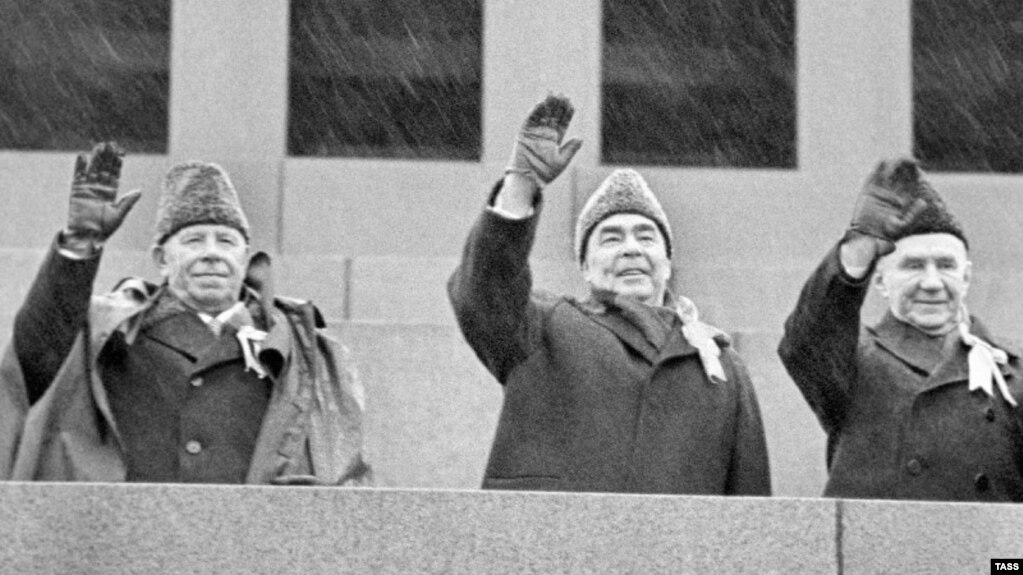
It is sometimes said that the United States has entered its equivalent of the Brezhnev era in the Soviet Union, a time of stagnation and decline under an intellectually moribund gerontocracy, when nobody believed the official lies anymore. In the Soviet case, this might have continued if not for the external pressure applied by Western economic expansion and a United States newly committed to an expensive arms race. Under such pressure, a new generation of Soviet leadership ventured an ideological loosening (glasnost) and economic liberalization (perestroika). It remains to be seen if competition from China will force the American party-state to likewise loosen its grip.
Our regime is subject to instability from within as well. The narratives legitimating Party rule are systematically out of joint with reality. This must have a corroding effect on the self-confidence of elites, and they need self-confidence. Recall that the role of the professional-managerial class is to tell other people what to do, and it rests its claim to authority on knowledge. The content of the knowledge that marks one as part of the PMC consists of the organized expertise through which money and power extend their dominion, via the channels established by the party-state. The shakiness of the various systems of organized expertise today, and the enforced character of the consensus that they are used to anchor, has grown more apparent as the system flails against populist challenge.
To take the most salient example, the party-state embarrassed itself in its response to Covid, suppressing the normal processes of scientific dispute and getting a lot wrong as a result, with enormous costs to the public. The pandemic revealed a basic mismatch between science as a mode of inquiry, with its strength deriving from its insistence on falsifiability, and “Science” as a univocal authority that is not to be questioned, which would seem to be the role it plays for our party-state. Further, the premise in our pandemic response was that we are one big “vulnerable population,” in defiance of the facts. Authorities did not engage in focused protection of the most vulnerable (per long-standing pandemic plans), but did inflict gratuitous harm on children who were at minuscule risk from the virus. The age-based risk gradient of the virus, which was learned early in the pandemic, had to be suppressed to sustain a general sense of emergency and to convince the majority of the benevolence of the party-state.
As failures accumulate, they can lead to nagging questions of a cui bono nature, which may reflect back on a PMC person’s identity as a “knowledge worker” (to use a term from a more innocent time when these ideological structures were more secure). If we may put this in the vernacular: a young man may begin to feel that his “bullshit job” is not only parasitical on the real economy, it is part of a system of social control that is basically anti-human. This could induce a little glasnost-adjacent political energy. In disillusioned or “red-pilled” pockets of the PMC, we may see the seeds of an emergent counter-elite.
To be “counter,” this counter-elite would have to display a devotion to basic competence while forgoing the easy moral valor that comes with presenting itself as protector of vulnerable innocents. Such a shift, if it were to occur, would likely trickle down to the non-elite spaces of local institutions in countless ways. For example, the managers of my local YMCA might devote less energy to crafting messages that the Y is inclusive and “safe” (from the Bay Area’s roving lynch mobs?) and more energy to making sure the pool doesn’t close down every week for lack of attention to the chlorine, or because the lifeguards don’t show up—the basic stuff. I would hazard a guess that queer people of color like to swim too, and may even prefer it to serving as oppression mascots to distract us from operational dysfunction.
For a counter-elite to build its claim to legitimacy on a basis other than the victimological one, it will have to be acquainted with a fuller anthropology than the schematic one that partitions the body politic along a scalar of oppression. The governing anthropology would have to include some positive, shared picture of human excellence that can inspire allegiance from the majority, because it is recognizable to them and answers to their own aspirations.
This doesn’t mean people need to study anthropology. All that is required, I think, is that our humanity not be interfered with by a top-down project of aggression against the normal. But such a modest request on behalf of common moral intuitions will likely be suspect as “populism.” It is incompatible with the moral scalar that secures state power and provides the principle of Party cohesion. A common good tied to vernacular morality, invoked as a standard of political judgment, would tend to restore a national, democratic consciousness. Such a secular or political “reformation” would be a threat to the tutelary role of our governing clerisies. The religious parallel is perhaps apt, as the Christian Reformation of Luther’s time likely contributed to the birth of the democratic consciousness and the emergence of the modern nation.
On the other hand, it is often said today, mostly on the right, that Christianity is the historical root of our victimological politics. This is an important question to investigate. It is the great theme of René Girard, and appears prominently in Nietzsche as well. It is anticipated in some of the ancient pagan critiques of Christianity, and is central to the “neopaganism” of the French New Right as represented by Alain de Benoist.
For my purposes here, I note only that, whatever its role in inaugurating the moral elevation of the victim, Christianity also offers resources for resisting an oligarchy that legitimates itself through victimology. Recovery of “the common good” as a regulative principle of politics, the force of which is actually felt, would be easier if elites felt subject to some higher authority—God, in other words. The reason to think so is that such an orientation facilitates awareness of a basic kinship among men. In The Gulag Archipelago, Aleksandr Solzhenitsyn wrote, “The line separating good and evil passes not through states, nor between classes, nor between political parties either—but right through every human heart. . . .” We are all fallen, and indeed actively falling from hour to hour. This intuition of unity in fallenness, if recovered, could have a moderating effect on projects of social control, which are so often rooted in a lack of self-awareness about this doubleness in our nature. They proceed by special pleading, attributing moral and intellectual incompetence to human beings in general while exempting the elect from these same premises.
But the Christian story offers not just a common humility in fallenness; it also offers a common dignity in the idea that man is created in the image of God. Indeed, God became man, as though to prove the point. Every political regime tends toward a tyranny that degrades man, and it falls to ordinary people to limit this tendency. Christopher Lasch noticed in his historical inquiries that “submission to God makes people less submissive in everyday life.” A renascent Christianity could work from the bottom up, calmly emboldening people to reclaim for themselves the status, not of victim, nor of oppressor, but of citizen.
This article originally appeared in American Affairs Volume VII, Number 3 (Fall 2023): 185–205.
Notes
1 The canonical text for interest group politics is Mancur Olson,
The Logic of Collective Action: Public Goods and the Theory of Groups (Cambridge: Harvard University Press, 1965).
2 In 1977, Barbara and John Ehrenreich identified the “professional-managerial class” as the class of the New Left. Alex Press, in her account of the Ehrenreichs’ work, writes that the PMC “relate to the working class with a mixture of ‘contempt and paternalism,’ while workers interact with them with ‘hostility and deference.’” The PMC is itself stratified and includes professions that are quite proletarian, such as social workers. “When the social worker confronts her client, or the manager his worker, they do so in an ‘objectively antagonistic’ relationship.” Alex Press, “The Origins of the Professional-Managerial Class: An Interview with Barbara Ehrenreich,” Dissent, October 22, 2019.
3 Milovan Djilas, The New Class: An Analysis of the Communist System (New York: Harcourt Brace Jovanovich, 1957).
4 Or rather, this would be the case in a naïvely majoritarian scheme in which political difference is not organized by party. In fact his constituents will have not a normal but a bimodal distribution of preferences on some binary proposition before the legislature, and he will have to cast his vote on it one way or the other. But still, in the crafting of legislation before such a vote, a pure delegate would aim to strike a balance that aims at the mean of the whole population of his constituents; at the common good as best it can be reflected through compromise.
5 There was no whipping, whether deliberate or otherwise, according to the 511-page report of a Customs and Border Protection investigation that was produced some months later. And in fact “there is no evidence that any migrants were forced to return to Mexico or denied entry to the United States.” But in a notable clash between the spirit of HR and the rough music of the Old West, there did emerge evidence that one horseman had used “denigrating and inappropriate language.” U.S. Customs and Border Protection, “CBP Releases Findings of Investigation of Horse Patrol Activity in Del Rio, Texas,” news release, July 8, 2022.
6 Pierre Manent, A World Beyond Politics?: A Defense of the Nation-State (Princeton: Princeton University Press, 2006), 39, emphasis added.
7 Manent, A World Beyond Politics?, 57.
8 See Robert D. Putnam, “E Pluribus Unum: Diversity and Community in the Twenty-First Century, the 2006 Johan Skytte Prize Lecture,” Scandinavian Political Studies 30, no. 2 (June 2007): 137–74. As Putnam summarizes his findings, “Diversity seems to trigger not in-group/out-group division, but anomie or social isolation. In colloquial language, people living in ethnically diverse settings appear to “hunker down”—that is, to pull in like a turtle.” They report (1) lower political efficacy—that is, confidence in their own influence and less expectation that others will cooperate to solve dilemmas of collective action (e.g., voluntary conservation to ease a water or energy shortage); (2) less likelihood of working on a community project; (3) lower likelihood of giving to charity or volunteering; (4) fewer close friends and confidants; (5) less happiness and lower perceived quality of life; (6) more time spent watching television and more agreement that “television is my most important form of entertainment.”
9 Gabriel Rossman, “The Dream of the 1990s is Alive, in Dystopia,” paper delivered at Zephyr–First Things Colloquium, Palo Alto, California, 2023.
10 “Corporations are institutions of delegated government. Their authorization is accompanied by a grant, sufficient to the work to be undertaken, of powers and privileges that governments normally deny natural persons and reserve to themselves. At the extreme, this has meant granting corporations nearly plenipotentiary powers, as with the British East India Company. More modestly, it might mean granting a canal or railroad company the power of eminent domain, as was often done in the early American republic, when corporations were chartered to build the nation’s infrastructure. . . . A history of state power without a history of corporations is thus radically incomplete. Indeed, the practice of chartering corporations can be thought of historically as state-building at one remove—the building of a ‘franchise state.’” David Ciepley, “Beyond Public and Private: Toward a Political Theory of the Corporation,” American Political Science Review 107, no. 1 (February 2013): 139–58.
11 In May of this year, the naacp rhetorically leaned in to its para-state status and issued a “travel advisory” for Florida, warning people of color and lbgtqia+ people that it is unsafe to visit the state after the legislature passed a lower-house bill defunding DEI bureaucracies and an upper-house bill prohibiting colleges and other institutions from requiring DEI loyalty oaths as a condition of hiring. Consistently, such measures are reported in the party-state press as the work of a rogue “authoritarian,” Ron DeSantis, not as democratically enacted legislation.
12 Julius Krein, “Why the Right Can’t Beat ESG,” Compact, January 3, 2023.
13 Ciepley, “Beyond Public and Private.”
14 Krein, “Why the Right Can’t Beat ESG.”
15 The earliest example of a capital strike may be the one organized against the New Deal, which FDR blamed for the recession of 1937. A politics of the common good was perceived as a threat by major corporations. Today, it is the initiatives of “common good conservatism” that are likely to prompt organized aggression by capital, acting in concert with the Humanitarian Party. The most prominent recent example of this was the campaign against the state of Florida after it enacted legislation that was labeled “don’t say gay” by the Party’s discourse-managers in journalism, late night comedy, and elsewhere. The point of the legislation was to push back against an activist gender agenda in schools. It was an assertion (by the most representative branch of government) of the autonomy of the family and its prerogatives against an education establishment that increasingly relies on secrecy to shield highly ideological curricula from interference by parents. Remote learning during the pandemic had the effect of giving parents a glimpse into what is being taught, as they peered over the shoulders of their Zooming children. This led to angry parents showing up at school board meetings, which prompted the attorney general to direct the FBI to regard protesting parents as potential domestic terrorists and issue a press release referring people to a “snitch line” (the National Threat Operations Center), leading to dozens of investigations by the FBI’s Counterterrorism Division. The capital strike by party-aligned corporations against Florida’s democratically enacted legislation thus dovetailed neatly with this action by the domestic security apparatus. U.S. House of Representatives Judiciary Committee, “US House Judiciary Republicans: DOJ Labeled Dozens of Parents as Terrorist Threats,” news release, May 20, 2022.