
Mayhem and Mania: The Political Psychology of the Pandemic
The Covid-19 pandemic, which took hold in the United States in the winter of 2020, seems to have contributed to a rash of mental problems. “During the pandemic,” the Kaiser Family Foundation recounted in February 2021, “about four in 10 adults in the United States have reported symptoms of anxiety or depressive disorder . . . up from one in ten adults who reported these symptoms from January to June 2019.” The Mental Health Association reported that anxiety and depression were particularly common among younger people. “Rates of suicidal ideation are highest among youth, especially lgbtq+ youth,” the association wrote in its survey.
The question I would pose is whether the pandemic also influenced political health. During the pandemic, American politics showed signs of unwonted turbulence. Ideas and actions that had existed on the political fringes assumed center stage. On the right, a political theory called “QAnon” gained acceptance among a sizable minority. It held that a ring of cannibalistic pedophiles were conspiring against Trump. “Patriots may have to resort to violence to save our country,” the anonymous author “Q” warned. The theory was first broached in 2017 on an obscure internet channel, but by 2021, a poll conducted by the Public Religion Research Institute found that 23 percent of Republicans and 15 percent of Independents believed that major American institutions were controlled by “Satan-worshipping pedophiles.” The armed Boogaloo movement, which called for a “second Civil War,” likewise gained adherents. Conspiracy theories about the Covid-19 vaccine were also rife. “Covid-19 vaccines are weapons of mass destruction—and could wipe out the human race,” one video declared.
Members of the political Right engaged in demonstrations that turned violent. In California, New York, Colorado, and Michigan, demonstrators including armed militias protested Covid lockdowns. In December, the Proud Boys (another group influenced by Boogaloo ideology) held a rally in Washington to back Trump’s charges of voter fraud; four churches were vandalized, and counterdemonstrators were beaten up and stabbed. On January 6, about ten thousand right-wing activists, many of them armed, including members of the Proud Boys and another white nationalist group, the Oath Keepers, came to Washington to force Congress to declare Trump the president; several thousand stormed the U.S. Capitol, causing members of Congress to barricade themselves in offices. In succeeding months, right-wing activists and public officials, undeterred by the courts and Joe Biden’s inauguration, continued to charge that the election had been stolen and that Trump was the real president. A year later, polls showed that only a fifth of Republicans believed that Biden had been legitimately elected.
Of course, there had been right-wing protests before 2020. During Barack Obama’s two terms in office, Tea Party groups held sway on the political right. But they advocated for typical, if extreme, conservative Republican views on taxes, spending, and immigration, and focused on a conventional lobbying and electoral strategy to achieve influence. One of the best known national groups, Americans for Prosperity, was financed by the conventionally conservative Koch brothers who would refuse to donate to Donald Trump in 2016. During Trump’s first three years in office, there were a handful of Far Right demonstrations, but like that of neo-Nazis in Charlottesville, they were seen as the expression of a small fringe and not of a substantial segment of the Republican Party. These demonstrations were also not insurrectionary. The Charlottesville demonstration was a protest against the removal of Confederate statuary.
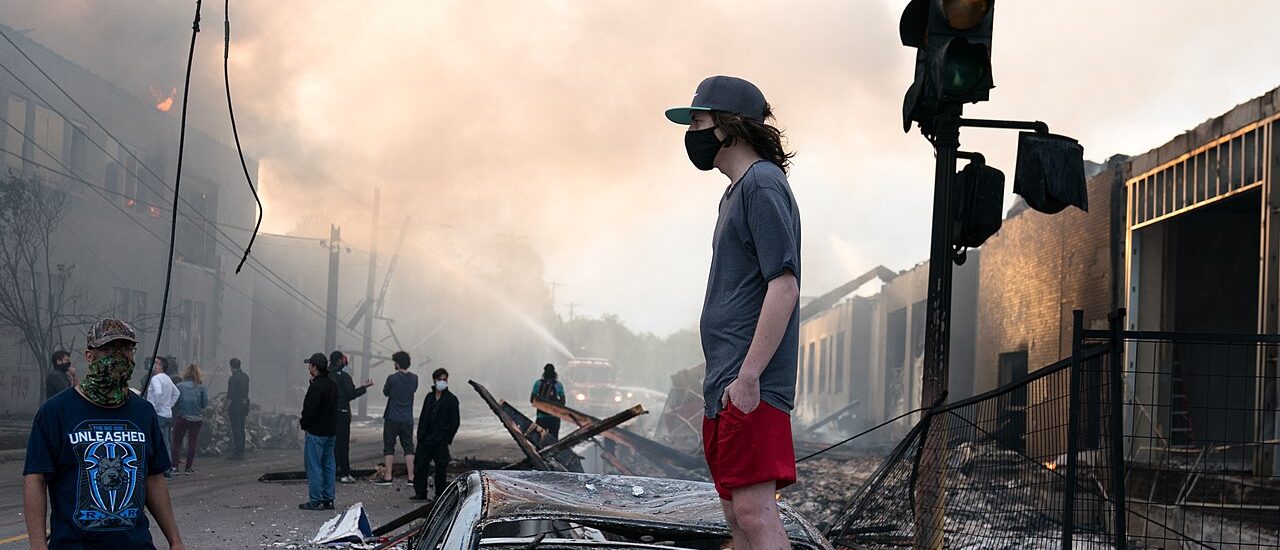
On the political left in 2020, conventional protest demonstrations against specific injustices turned into protracted riots and spread nationwide. In May 2020, demonstrators took to the streets to protest the brutal police killing of George Floyd, a black man accused in Minneapolis of passing counterfeit currency. Peaceful demonstrations quickly turned violent, and the violence lasted weeks. Around 1,500 buildings were damaged or destroyed, making the riots the second most destructive in American history. Stores, police precincts, and government buildings were set ablaze. New waves of protests were ignited by police brutality in Atlanta, Kenosha, and other cities. In Seattle and Portland, protestors occupied city downtowns for weeks and conducted pitched battles with the police.
The Minneapolis protestors demanded that the city police be dismantled. Nationally, “defund the police” became a common slogan. Some activists even advocated abolishing prisons. In Seattle, the Washington Post reported, “For 23 days in June, about six blocks in the city’s Capitol Hill neighborhood were claimed by left-wing demonstrators and declared police-free. Protesters hailed it as liberation—from police oppression, from white supremacy—and a catalyst for a national movement.” In Portland, many of the protestors were teenagers. A Portland group styling itself the Pacific Northwest Liberation Organization tweeted, “We are a bunch of teenagers armed with ADHD [attention deficit hyperactivity disorder] and yerba mate—we can take a 5 a.m. raid and be back on our feet a few hours later . . . we’ll be back again and again until every prison is reduced to ashes and every wall to rubble.”
Many of the protestors defended the arson and looting as part of an attack on white supremacy and “structural racism.” In Chicago, a representative of Black Lives Matter, which became the de facto leader of the nationwide protests, told a local radio station that the group supported the looters “100 percent. That’s reparations.” The Nation published an article “In Defense of Destroying Property.” “Theft and vandalism are not revolutionary acts in and of themselves, but they have the potential to become powerful forms of political expression in the context of an organized mass movement,” R. H. Lossin declared. National Public Radio interviewed Vicki Osterweil, the author of In Defense of Looting. “Looting,” she explained, “especially when it’s in the context of a Black uprising like the one we’re living through now, it also attacks the history of whiteness and white supremacy. The very basis of property in the U.S. is derived through whiteness and through Black oppression, through the history of slavery and settler domination of the country.”
The protestors, as evidenced by Osterweil’s statement, saw American history and society as riven by a division between whites, who explicitly or implicitly endorsed white supremacy, and blacks. The young exponents of these views called for cleansing American history of any hint of its racist past. They tumbled statues of Confederate generals, but also called for removing the names of Abraham Lincoln, Thomas Jefferson, and George Washington from public buildings. In media circles, younger staffers attempted to purge senior journalists and editors who had run afoul of their view of the protests. At the Philadelphia Inquirer, the editor was forced out for printing an editorial that condemned looting. At the New York Times, the editorial page editor and his deputy were forced to resign over the publication of an op-ed by a Republican senator calling for the National Guard to quell the protests.
To be sure, there were significant moral and political differences between the protests on the right and on the left. The basis of “stop the steal” and the January 6 protest was concocted offenses that never occurred. And QAnon’s pedophile ring was a malicious fantasy propagated on the internet that caught hold among the credulous. The protests against police brutality, however they descended into mayhem, were rooted in a protest against genuine injustice. There was also nothing imagined about the manner in which George Floyd was killed. It was recorded on a widely shown video. The defenses of looting might have been ideological claptrap, but they did not inspire homicidal rage at a pizza parlor. Still, there is no doubt that the protests on the right and on the left got wildly out of hand. The question is why they did, and whether the pandemic contributed to these prolonged outbursts of anger and indignation.
The Historical Precedent: The 1918–20 Pandemic
There is an historical precedent suggesting that the current pandemic may have contributed to the fervor of the protests. During the last deadly pandemic in the United States, the Spanish flu of 1918–20 (so named because it was first publicly acknowledged in Spain), 650,000 people died in the United States, out of a population of 106 million, and about 50 million died globally. Initially, Americans thought it was merely a bad pneumonia season. Wartime censorship also concealed the numbers of cases. But by 1919, Americans knew they were in the grips of a terrible pandemic. One Norwood, Massachusetts, resident commented, “It was horrifying. Not only were you frightened you might come down with it, but there was the eerie feeling of people passing away all around you.”
During this time, there were outbursts on the political right and left. The Ku Klux Klan revived, and it lynched eighty-three blacks in 1919. There were race riots in Chicago, Washington, D.C., and a dozen other cities. On the left, there was a massive strike wave—as many as four million workers went on strike—which was fueled in part by revolutionary fantasies. In Seattle, what began as a shipyard dispute became a general strike that collapsed in defeat after five days. Nationwide, 350,000 steelworkers struck in September and suffered a lasting defeat.
During the same year, as the pandemic raged, the Socialist Party of Eugene Debs split at the seams, as factions from the Far Left formed what became the American Communist Party. In its manifesto, the new Communist Party declared in August 1919 that the United States was in “a moment of struggles pregnant with revolution.” William F. Dunne, a founder of the party, predicted in 1919 that “unemployment will increase, there’ll be starvation, someday the banks will fail and the people will come pouring out on the streets, and the revolution will start.”
As recounted in John M. Barry’s The Great Influenza, armed citizens’ committees were formed in Arizona to fight the pandemic. They enforced anti-influenza ordinances, and they also doubled as anti-union forces, putting over a thousand striking miners on cattle cars and abandoning them in the desert without food or water. Nationally, in response to bombs from anarchists, striking trade unionists, and hyperbolic revolutionary agitation, Woodrow Wilson’s Attorney General A. Mitchell Palmer launched his infamous raids that led to the arrests of three thousand suspected Bolsheviks. The crazy summer of 1919 was dubbed the “Red Summer.”
There were specific provocations that helped explain what happened. The Chicago race riots began when whites murdered a seventeen-year-old black who was swimming in a part of Lake Michigan adjacent to white neighborhoods. The Klan’s revival came partly in response to the return of black servicemen from World War I, and the riots in response to the fears of white workers that black workers who had migrated north would take their jobs. The revolutionary fervor on the left was sparked in part by the Russian Revolution of 1917, and the strike wave by hopes of raising wages that had been held in check during the war. But just as during the Covid-19 pandemic, the political explosions on the right and left somehow exceeded the specific circumstances. While there was no moral equivalence between the racists of the KKK and the Seattle strikers, there was an edge of sheer craziness to the political activities and beliefs on both sides.
The Protestors’ Motives
If the pandemic did contribute to the political explosions that took place in 2020, how did it do so? One might argue that the economic hardship that the pandemic caused drove people to take to the streets. In April 2020, the unemployment rate was 14.7 percent. But many of the demonstrators were middle-class young people from the big cities and suburbs. A survey of the Portland protestors who were arrested found that “many appear to be college students.” Unemployment was concentrated initially among workers without college degrees who couldn’t work from home, and even for these, the blow of unemployment was cushioned by a massive government relief program.
A survey of the January 6 rioters found them, too, to be middle or even upper-middle class and less likely to be affected by an economic downturn. According to a study by University of Chicago sociologist Robert Pape, many of the protestors worked “as CEOs, shop owners, doctors, lawyers, IT specialists, and accountants.” Only 9 percent of the January 6 protestors were unemployed. Most didn’t appear to be driven, and driven to extremes, by economic concerns created by the pandemic.
Some of the right-wing protestors were objecting personally to lockdowns and masking requirements and later vaccination recommendations, but many of the January 6 demonstrators were motivated by politics and ideology. Likewise, while some of the left-wing protestors were African Americans whose neighborhoods suffered from police brutality, many of the protestors did not have to fear police brutality in the places they lived. The protests were not a “black uprising.” Only 17 percent of protestors were black. The greatest number of protestors and of those arrested were whites. They appeared driven most of all by moral indignation and by a Manichaean vision of politics riven by racial conflict. After demonstrators burned and looted small businesses in St. Paul’s Midway neighborhood, the city’s Pioneer Press wrote, “In St. Paul, the irony of self-proclaimed advocates—many of them white—arriving from outside the city to burn down large strips of ethnic neighborhoods in the name of racial justice hasn’t been lost on residents of the Midway.”
In other words, the protestors’ motives were diverse. Yet to a great extent, their actions didn’t stem from personal grievances and deprivation, economic or otherwise, but from political ideology and moral indignation.
Sociability and the Fear of Death
There are four factors, all of them particular to the pandemic and pertaining to social psychology, that may have led these protestors to go beyond peaceful protest and to embrace Manichaean justifications for their actions. The first is an inbred sociability that arises with infants’ dependence on their mothers and is intrinsic to work, play, and sexuality. Human beings obtain self-esteem through their relationships with others. When their links to others are severed, they grow frustrated and anxious, which is what occurred during the first year of the pandemic, and particularly during the lockdowns. That can lead to mental illness in some people. But it also fed the nationwide protests against the state lockdown policies that began in the spring of 2020. Michigan and Wisconsin had the biggest rallies. In Michigan, twenty thousand protestors surrounded the capitol in April as part of “Operation Gridlock.”
The protests on both left and right mixed violence with celebratory song and dance, and earnest indignation with a spirit of play. That mix reflected a need for social contact at a time of isolation. At a New York City demonstration, the New York Times reported, “Some came to the streets to dance. Others were moved to dance more spontaneously.” A story about the January 6 protests at the Capitol recounted, “They came in red, white and blue face paint and star-spangled superhero outfits, in flag capes (American, yes, but also Confederate and Trumpian) and flag jackets and Trump bobble hats. One man came as a patriotic duck; another as a bald eagle; another as a cross between a knight-errant and Captain America; another as Abraham Lincoln.”
The second factor, which gave urgency to the first, is the fear of disease and death aroused by the pandemic. In 2020 and early 2021, before vaccines were readily available, and even to some extent after that, the fear of death was palpable. More than 350,000 Americans died from Covid in 2020. Hospitalizations steadily rose. In early January 2021, at the time of the January 6 protests, 126,000 Americans were hospitalized. In October, a month before the election, the president himself caught Covid and nearly died. There is an indirect, sometimes unconscious, but highly significant connection between the attempt to evade the fear of death and the political outbursts that occurred during the pandemic.
Human beings have sublimated the fear of death through religious promises of immortality. But as anthropologist Ernest Becker argued in The Denial of Death, human beings also attempt to achieve symbolic immortality. They can do this through having children who perpetuate their name and memory, but also by identifying with a cause, a political group, an institution, a business, an ethnicity, and a nation (“dying for your country”) that is larger than themselves and that promises to outlive them. They create a worldview that attempts, in Becker’s words, “to shift the fear of death onto the higher level of cultural perpetuity.” They can also forge a lasting memory of themselves through good works and heroic acts, and through creating works of art, that outlive them. The individual “must stand out,” Becker writes, “be a hero, make the biggest possible contribution to world life, show that he counts more than anything or anyone else.”
Three psychologists, Sheldon Solomon, Jeff Greenberg, and Tom Pyszczynski, set out forty years ago to devise experiments that would show how the fear of death generated defenses of a subject’s worldview, on which his or her greater identity depended. (They summarized their findings in a 2015 book, The Worm at the Core.) Over the course of hundreds of experiments that measured people’s judgments after being reminded of their mortality, the three psychologists discovered an important distinction in the way people respond to the fear of their own death. When people immediately and consciously confront their own mortality, they are most likely to meet that fear directly. A patient told of a cancer diagnosis is likely to seek medical treatment; a homeowner warned of an imminent tornado is likely to head to the cellar. The psychologists call these “proximal defenses.”
But sometimes people will meet the fear of their death with denial—by insisting, for instance, that a clinical diagnosis or weather report is mistaken. Or more commonly, the fear itself, once confronted, will recede in everyday life from a person’s immediate attention. A person won’t dwell continually on a diagnosis. In these cases, the fear can be transformed into anxiety that persists unconsciously or at the edges of consciousness. This kind of anxiety about death will evoke what the psychologists call “distal defenses.” These will consist of the kind of literal and symbolic worldview defenses that Becker described.
The three psychologists found that when subjects were reminded of their own mortality, but then distracted by innocuous word games or stories, they were more likely than those in control groups to inflict harsher punishments on those who challenged their worldviews; give more positive evaluations to those who affirmed their views; and exhibit greater desire for fame, greater willingness to initiate social interactions, and greater desire for children. One can quarrel with the particulars of each of these experiments. Psychology is far from being an exact science. But what is important is the distinction the psychologists discovered between proximal and distal defenses.
One can apply this distinction to Americans’ reaction to the pandemic. Faced with the immediate fear of disease and possibly death, many Americans put on masks in crowded indoor settings. And when they got symptoms of disease, they went to doctors or emergency rooms. These were proximal defenses. Most people, however, were not constantly preoccupied with the fear of disease and death and were not sick with the virus. Instead, the pandemic hovered on the edge of their consciousness in the form of anxiety, and it aroused distal defenses used to ward off anxiety about death and disease. A final group of people, common on the political right, countered the fear of death and disease through denial. They claimed the virus was a hoax. This defense may have initially worked in areas where Covid had not spread, but by the summer of 2020, it functioned to ward off the immediate fear of death and to erect distal defenses.
In an article last year in the Journal of Humanistic Psychology, Pyszczynski, Greenberg, Solomon, and McKenzie Lockett contended that the pandemic contributed to the rise of mental illness. It did so, they wrote, by impeding the distal defenses that people use in order to ward off anxiety. “When people lose their jobs and cannot pursue their financial, education and career goals, they are losing important sources of self‑esteem,” the psychologists wrote. “Social relationships, which play such a major role in managing death fears, have also been hampered by the lockdown and social distancing measures.” Unable to ward off anxieties, people are likely to withdraw into depression.
But instead of withdrawing into depression, many people, with the fear of death hovering in the background, erected new distal defenses and intensified old ones. In line with the findings of the three psychologists and of numerous other psychologists who have tested their results, these defenses contributed to the extremes of belief and action on the left and right during the pandemic. They included polarized political views, an urge to assemble in mass rallies, meetings, and demonstrations that was sufficiently strong to overcome the fears of infection from the virus, the quest for heroism through moral action, the fervent embrace of a cause and a movement, the endorsement of simplistic and sometimes fantastic political theories, and the allegiance, sometimes blind, to charismatic leadership, whether to a group like Black Lives Matter or to President Trump. The quest for heroism through moral action helps to explain the actions of middle-class young whites who torched a police station to protest police brutality. It also helps explain the lonely quest by armed teenager Kyle Rittenhouse to defend Kenosha’s businesses against the protestors.
Group Psychology and the Pandemic
The third factor that helps explain the politics of the pandemic is group psychology—what happens internally when people join together to passionately support a cause or a movement. Gustave Le Bon wrote about this in The Psychology of Crowds and Sigmund Freud, using Le Bon’s analysis as a starting point, wrote about it in Group Psychology and the Analysis of the Ego. Le Bon and Freud took a reactionary view of mass political movements. They saw them, as the ancient Greeks did, as mobs, but their insight into what could be called mob psychology rather than group psychology sheds some light on the politics of the pandemic. Once people—impelled by the need for social contact and by the need to mount distal defenses against the anxieties created by the pandemic—joined mass demonstrations, a certain psychological dynamic took root.
In an impassioned crowd, the individual becomes subordinated to the will of the group. Individuals’ inhibitions fall away. That makes them capable of cruelty, but also valiant heroism on behalf of a cause, as they overcome their fear of death. Freud puts it this way:
When individuals come together in a group all their individual inhibitions fall away and all the cruel, brutal and destructive instincts . . . are stirred up to fine gratification. But under the influence of suggestion groups are also capable of high achievements in the shape of abnegation, unselfishness and devotion to an ideal. . . . It is possible to speak of an individual having his moral standards raised by a group.
Freud and Le Bon were primarily concerned with the “cruel, brutal and destructive instincts” that groups unleashed, but Becker, who was writing in the wake of the antiwar and civil rights protests of the 1960s, stressed the moral heroism that groups could inspire. Americans’ impassioned support for Ukraine and its president stems from the perception that the Ukrainians are risking their lives to defend their country. And that possibility of moral heroism applies to the protests during the pandemic as well. But the protestors also displayed indifference toward the havoc they were wreaking. In Kenosha, thirty-five small businesses, most of which were locally owned and under- or uninsured, were destroyed, and a working class, multiracial neighborhood was set ablaze; in Minneapolis, 1,500 businesses were badly damaged. The protestors took no account of who owned these stores. Many black-owned businesses were destroyed.
The January 6 protestors thought they were performing morally heroic acts. They were trying to overturn a stolen election. A few of them were hardened, armed militants, but most were not and were carried forward by the anger and enthusiasm of the crowd. Of those arrested for breaking into the Capitol and for violent acts against police, 70 percent had no prior criminal record, and of those having records, most were for misdemeanors like marijuana possession. One of those arrested for assaulting a police officer told a friend afterward that he had acted like an “idiot.” The demonstration had removed personal inhibitions and brought forward violent impulses that had previously been held in check.
In subordinating their will to the group and often toward a leader, individuals can set aside their critical faculties. “The intellectual capacity of a group is always far below that of an individual,” Freud wrote. Both Le Bon and Freud compared the mentality of a crowd to an individual under hypnosis who is subject to the power of suggestion. The result was an excessive “credulity” on the part of impassioned political groups. The Trump followers became convinced that the election had been stolen, and that by storming the Capitol, they had the power to reverse the results.
Political crowds also become taken with symbols and slogans which, Le Bon writes, “are uttered with solemnity in the presence of groups. Reason and argument are incapable of combatting certain words and formulas.” “Stop the steal” functioned that way for the January 6 protestors, and “black lives matter” for the protestors against police brutality. In an infamous scene in August 2020, protestors barged into a Washington, D.C., restaurant and demanded diners join them in chanting “black lives matter.” One woman was harassed for refusing to raise her fist in solidarity. “White silence is violence,” the protestors, most of whom were white, chanted.
Le Bon and Freud wrote a century or more before the reign of radio, television, and, finally, the internet and social media. It could be argued that the presence of these media, and especially social media, has extended the effects of group psychology well beyond physical participation in a group. The credulity created by the power of suggestion could help explain the massive support given to the wacky QAnon theories, or to proposals for the outright abolition of police and prisons at a time of rising crime numbers, or to the “cancellation” of people who had violated the protestors’ adopted taboos.
Trump and Biden
The fourth and final factor that contributed to the extreme politics during the pandemic was Donald J. Trump, whose presence and impact became magnified during the 2020 election. Trump became the charismatic leader of a large faction of the electorate and, at the same time, an object of hatred for an equally large segment. He was the most polarizing president in my lifetime, and I have lived through Ronald Reagan, Richard Nixon, and Lyndon Johnson. His hold over his followers, manifested in their willingness to believe anything he said, grew during the pandemic and election, as did his willingness to peddle utter falsehoods and to court a violent and insurrectionary opposition.
Freud and Le Bon both comment on the hold of charismatic leaders (Le Bon calls these leaders “prestigious”) upon their followers. The domination of a leader, Le Bon writes, “entirely paralyzes our critical faculty, and fills us with wonderment and respect. It would seem to arouse a feeling like that of ‘fascination’ in hypnosis.” In hypnosis, the hypnotist can use the power of suggestion to get patients to do or say things they might not otherwise have done or said. Freud describes the bond between leader and followers in terms that have a contemporary ring. “The members of the group stand in need of the illusion that they are equally and justly loved by their leaders, but the leader himself need love no one else. He may be of a masterful nature, absolutely narcissistic, self-confident and independent.”
With Trump, however, one must wonder to what extent the president himself was a symptom rather than a cause of the pandemic’s effect on the country’s politics. During his last year in office, he displayed his own credulity in evaluating cures for the virus. He alternated between outright denial and recommending bleach as an effective medication. He was clearly worried about catching the virus, and after he tested positive, feared he was going to die. After he lost to Biden, he nourished the illusion that he had actually won, and he devised a harebrained strategy to overturn the results, climaxing in the January 6 rally at the Capitol.
In his appearances the next year, he obsessively charged that the election had been stolen. Trump may have been cynically misleading his followers, but he may also have fallen prey to the illusions he created. During his 2016 campaign and the first years of his presidency, various medical experts pronounced him mentally ill, even though he was behaving exactly as he had done as a buccaneer real estate developer and television personality. But in his last year in office and in the aftermath of the election, he began behaving in ways that went beyond the often effective bravado, lies, and resentments of the sharp operator that Trump had been. He seemed unhinged, even deranged.
Biden, who succeeded Trump in January, was elected largely because he was not Trump. Biden’s election recalled that of Warren Harding in 1920. In the wake of World War I, the influenza pandemic, and the chaotic last year of the ailing Woodrow Wilson’s presidency, Harding promised a “return to normalcy.” Biden, too, promised normalcy. “Just imagine,” said Biden supporter Pete Buttigieg in October 2020, “turning on the TV, seeing your president, and feeling your blood pressure go down instead of up.” But as the pandemic continued into 2021, and as anxiety about death and disease lingered in the background, the candidate who won over 51.3 percent of voters found it difficult as president to win over his country.
Biden’s approval rating plummeted to below 40 percent in the winter of 2022. It rose slightly after the war in Ukraine began, as Biden identified himself and America with the Ukrainians’ heroic defense of their country, but it began sinking again. Biden’s trouble with voters was probably due to his failures to stem the pandemic (the administration was caught unprepared by the Delta and Omicron variants), the botched withdrawal from Afghanistan, an overambitious congressional agenda that invited defeat and disillusionment among his own followers, and soaring inflation from supply chain shortages. But Biden was also hampered, especially among Democrats, and Independents who leaned Democratic, by the very lack of charisma that had contributed to his November victory.
The continuing pandemic put a premium on precisely those qualities that Trump had possessed and that Biden lacked. Mark Cuban, the media mogul and owner of the Dallas Mavericks, when asked about Biden’s first year, said, “I think the glaring problem is that there is absolutely zero charisma in the Biden administration.” Just as the political psychology of the pandemic may have unhinged Trump, it may have helped to undermine his successor by underlining his flaws as a national leader in a country whose Constitution demands that a president act as both monarch and prime minister.
The 1920s and the 2020s
Covid-19 may continue to course through the population. New variants may arise. But due to the prevalence of vaccination and of prior infection, and the diminished severity of the disease, the spectral presence of the Grim Reaper may no longer hover as tellingly over America. As Barry’s history recounts, the Spanish flu infected Americans through 1921, but it ceased to be part of their daily life. So the psychological trajectory of the pandemic may soon subside, as it did in the early 1920s. But the resemblance between the post-pandemic early 1920s and America today seemingly ends there.
In the wake of World War I and the pandemic, the Republicans took power for the rest of the 1920s. The three Republican presidents, Harding, Calvin Coolidge, and Herbert Hoover, were not penalized by voters for their lack of charisma. After a sharp recession in 1920, Americans outside the farm states enjoyed a productivity-driven boom that lasted until 1929. In the war’s aftermath, victors and vanquished quarreled over reparations, but there was little sign of the Second World War that was to come.
By contrast, the war in Ukraine may presage a decade of sharp international conflict and lagging growth, as the globe splits into rival geopolitical and economic blocs. The 2020s may roar like the 1920s, but it will be the howl of a wounded animal rather than ebullient shout of a thriving nation. The Democrats are likely to get drubbed in the 2022 Congressional elections, but a Republican resurgence that year and even in 2024 is unlikely to endure. Instead, American politics will probably remain mired, as it has since 1994, in what political scientist W. D. Burnham has called an “unstable equilibrium” between the parties.
To be sure, the fear of the pandemic will fade—the frenzied protests of those years have already subsided—but the fanatical demands they brought forth will have a political afterlife. In 2022, voters are likely to punish the Democrats for the chaos the demonstrators sowed, for demands like “defund the police,” and for their Manichaean vision of a racist America. Even as the Democrats try to back away from their rhetoric of the protests, Republican Glenn Youngkin’s victory in Virginia’s gubernatorial race in November 2021 is likely to be replicated in 2022. But if Trump runs again in 2024, voters are likely to remember the threat that he and his supporters’ demand for “stop the steal” posed to America’s constitutional order. Republicans will suffer a backlash, and the dysfunctional deadlock in Washington will continue. The coming decade is likely to be anything but a return to normalcy.