
Back to Blair Mountain: Labor Unions’ Unsettled Future
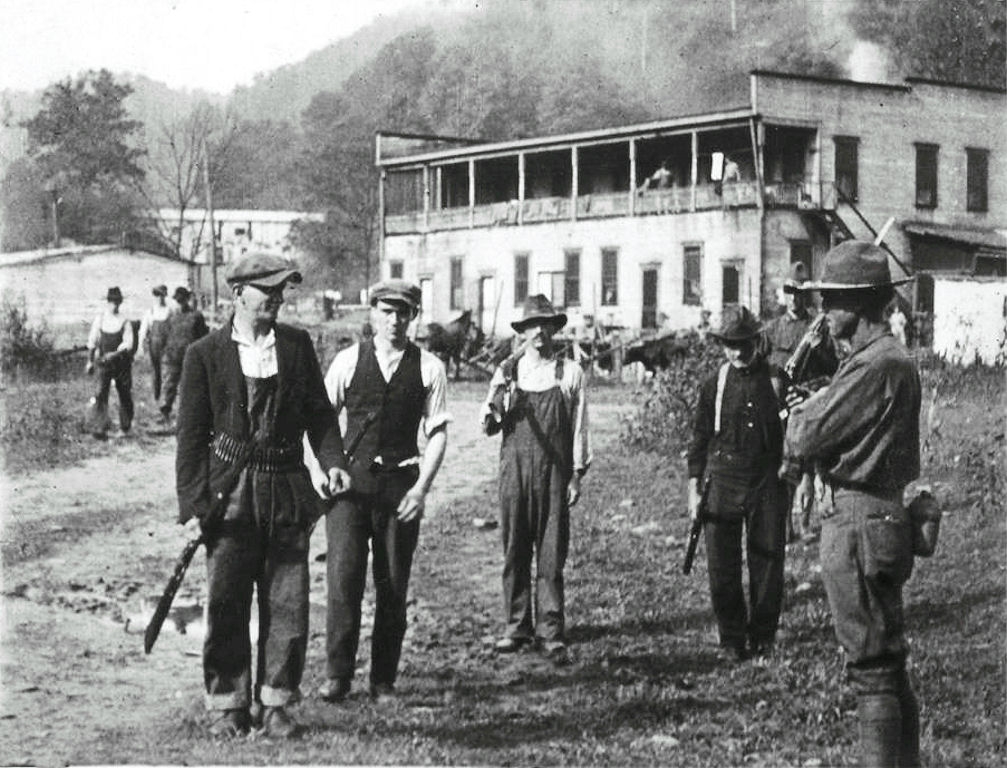
On a rainy August day in a United Mine Workers of America (UMWA) hall in Matewan, West Virginia, my fellow tourists and I got to meet an endangered species: real-life union miners. Most of them were retired. We were there to celebrate a hundred years since the largest armed labor uprising in American history.
The Battle of Blair Mountain stands as a seminal moment in U.S. labor relations. It wasn’t a small thing: the largest instance of civil violence since the Civil War, it also featured the only use of aerial bombing in anger on U.S. soil (though the bombs were dropped by private planes, not by U.S. military aircraft, as is sometimes claimed). Miners sought to unionize the coal fields of the southern three counties in West Virginia by force. The spark that set off mass mobilization was the death of Matewan police chief Sid Hatfield, an ally of the miners, killed by “gun thugs” hired by the coal operators. The miners stood down when the army was called in, and thereafter endured a period of hard times before the Roosevelt administration arrived with more favorable rules for collective bargaining.
Today, the once-mighty UMWA is close to defunct, declining along with the coal industry, and its pension fund is insolvent. Between 2011 and 2016, a total of forty thousand coal mining jobs were lost, and today the United States produces about half as much coal as it did a decade ago. About ten thousand more jobs were lost in 2019 alone, according to the U.S. Energy Information Agency, leaving the total number of employees at 42,159 as of 2020. A UMWA policy document from April 2021 more or less admits it’s over, and focuses on how the communities once sustained by coal might avoid being left behind amid the “global energy transition.” “[C]ommunities that have been hit hard by the drop in coal production and employment,” it reads, “have received little help from Washington, even though policies developed in the Nation’s Capital are to a large degree responsible for coal’s depression.”
In 2011, a Blair Mountain march was organized in an effort to preserve the area from mountaintop removal mining. Although strengthening organized labor was one of the march’s four stated purposes, the real driving force was environmental activists with a hostility to coal. In other words, the activists and labor historians in Charleston have been eagerly awaiting the end of mining for at least ten years. This summer, unless you noticed the union sponsors, you’d be forgiven for thinking the Blair Mountain cause had more to do with environmentalism or historic preservation than labor. Charles Keeney, a descendant of one of the leaders of the Blair Mountain miners and author of a book called The Road to Blair Mountain, told Teen Vogue, “It’s four generations of the powers that be [saying], ‘Coal is your identity’. . . . My contention is, coal has stolen our identity. We’re trying to reclaim it.”
During the tour through Matewan, featuring a Mother Jones impersonator, we stopped at the union hall and heard from some of the local’s officers. Most of the local’s members were retired—the UMWA has more retirees than active members—and while they continue to lobby for their members in Washington, it’s hard to see much of a future for the union if nobody’s going to the mines anymore. The response from larger union leadership and the Democratic Party seems to be “let them eat solar panels.”
What remains is the question of what all these West Virginians are going to do, other than fentanyl. And nobody seems to have a good answer. The labor movement contributes a frisson of working-class consciousness to the Democratic coalition, but coal miners are far down the intersectional totem pole.
This reflects a pretty steep decline in the clout of the UMWA specifically and labor in general. Richard Trumka, a man who once ran the UMWA and went on to lead the afl-cio, died this year. West Virginia’s idiosyncratic senator, Joe Manchin, an honorary UMWA member, may be enjoying a brief moment in the sun, but West Virginia’s union miners aren’t the force they once were. The UMWA itself may be counting on a post-coal future, but so far no help has come from Washington to manage it.
Concept and Reality
A lot has been said about the GOP’s possible transition into a “workers party.” “Just as Reagan converted the GOP into a conservative party, Trump has converted the GOP into a populist working-class party,” Stephen Moore told journalist Jonathan Swan in 2016. Trump promised the moon to America’s deindustrialized workers, but on the ground not much has changed for West Virginia’s former coal communities; they were going down before Trump, and they’re still declining. Six major coal companies declared bankruptcy by 2016, according to Evan Osnos in the Guardian. Many of them, as part of the bankruptcy process, have shed pension and health care commitments to union workers and retirees. This might be unfair, but with coal increasingly looking like a dead end, it does seem inevitable.
The fate of America’s coal miners is an exaggerated version of what’s happened to private sector unions as a whole. Their membership has been declining for decades, and today private sector union membership stands at about 6.2 percent.
In concept, however, unions are extremely popular. “Support for unions among Americans is the highest it’s been since 1965,” according to an article in Fortune this December. Even right-of-center politicians have begun to take notice and are speaking more about worker power, though concrete action remains elusive. Senator Marco Rubio earned himself a brief news cycle in March 2021 when he suggested conservatives might stand aside and allow Amazon workers to unionize. The point became moot when workers at the Bessemer, Alabama, Amazon warehouse voted down unionization, though the NLRB has ordered a new election. For its part, the union put out a statement saying they “welcome support from all quarters. . . . This should not be a partisan issue.”
The best work on the right about worker power has come from American Compass. “The failure of organized labor as an economic institution and a source of worker power is an inevitable consequence of America’s enterprise-level system,” wrote Oren Cass, “in which unionization is a fight waged workplace by workplace, bargaining only occurs after a successful vote, and employers who reach agreements with unions find themselves at a competitive disadvantage.”
American Compass commissioned a survey that strongly indicated a desire on the part of workers for unions to stick to workplace issues and stay out of national political debates. Of potential union members in the sample, sticking to workplace issues was favored by 74 percent to 26 percent. They also favored businesses themselves staying out of social justice causes by nearly two to one.
This is a striking indictment of currently existing private sector unions, joined at the hip to the Democratic Party, which contribute to the party’s piggy banks and lend the activism of their rank and file members. In particular, the SEIU’s Amalgamated Bank provides financial services for Democratic campaigns and the DNC. The Lincoln Project, interestingly enough, banked with Amalgamated from its inception. With the exception of a few builders’ unions, political donations tend to be one-sided as well.
And union members are right to question what they’re getting out of this deal, as some left-wingers do. “The question for America’s union members is whether anything tangible will flow back to us if Biden is elected, or if we will—as has happened in previous Democratic administrations—have to satisfy ourselves with pats on the head and White House photo-ops,” wrote Hamilton Nolan at In These Times. Nolan argues, in much the same way as American Compass’s contributors, that unions would be better off spending their money helping members and making more of them. But without any divorce between the unions and the Democratic Party on the horizon—and as long as the currently existing unions (as opposed to unionization in concept) are unpopular anyway—it probably doesn’t make sense for the Right to try to make serious overtures to, say, the afl-cio.
It’s also possible to take the injunction for labor to get out of politics too far, because the fights that seem most worth having are, necessarily, highly political. The jobs of tomorrow are inherently difficult to unionize in the normal way. Millions may be moving into gig work, with its flexibility offset by a lack of benefits and low pay, but traditional modes of unionization don’t work there. There’s no factory to lock owners out of, and there’s an army of scabs at the other end of the apps.
What this means is that any effort to put collective bargaining in place for these workers will have to come from legislatures. In other words, introducing some kind of collective bargaining scheme for gig workers is a highly political cause. It’s also one that, despite the solidaristic noises emanating from the smarter corners of the right-wing commentariat, the Republican Party is unlikely to take up anytime soon.
Any widespread effort to create worker cooperatives, even if they stuck to service provision, would probably be seen as—and would in fact be—political, too. As Wells King wrote for American Compass, “the organizations hoped for do not exist, in large part, because legally they cannot.” You need politics to change those rules. I’d love to be proved wrong, but this does not seem high on the priority list for conservative legislators, even if it should be.
Unions during the Pandemic
Despite the close relationship between America’s large unions and the Democratic Party, conservatives might be able to appreciate the way in which labor has exercised a restraining influence on vaccine mandates during the Covid-19 pandemic. Even the National Education Association (NEA) supported only a vaccine-and-test requirement, leaving the door open to testing for unvaccinated teachers, and in New York unions negotiated the vaccine exemption. “No worker should suffer any form of discipline or discrimination for refusing to be vaccinated,” read the afl-cio’s petition to the Labor Department in March 2020. The Teamsters oppose mandatory vaccination, as does New York State United Teachers.
Generally speaking, the closer the union is to the Democratic Party, the more open to mandates it is. The SEIU, for instance, whose activists fill progressive protests and whose Amalgamated Bank is closely integrated into the Democratic machine, is for vaccine mandates. By contrast, many police and firefighters’ unions oppose them. A Chicago Teamsters local lost a fight with their medical benefits fund over its mandatory vaccine policy.
Vaccines being necessary and good, I hope it isn’t perverse to say I find this resistance heartening. We shouldn’t be too comfortable with a world where employers increasingly assert the right to stick a needle in an employee’s arm, and it’s good to see workers pushing back. Conservatives should consider that vaccine mandates would be stricter without the presence of unions.
Regardless, pandemic measures have created challenges for unions, as they have for most social organizations: among the other casualties of Covid‑19 seems to be labor militancy. According to Bureau of Labor Statistics work stoppage data, 2018 and 2019 were the largest years for strikes since 1986, with twenty and twenty-five work stoppages, respectively, including large strikes by teachers in a number of states. But in 2020, there were only eight. There was a lot of hype about strikes in 2021, especially around “Striketober,” with NBC dubbing it the “year of the worker,” but as Doug Henwood admitted this January on his blog, the vaunted strike wave more or less failed to materialize.
Unionizing “Information Workers”
The one bright spot when it comes to unionization in America is in journalism, where, along with some old publications getting new unions, workers at vastly overvalued media companies are attempting to lay claim to a piece of the venture capital funding. Vox, Buzzfeed, Gawker, HuffPo, Salon, Slate, Pitchfork, New York Magazine, and the Onion have all unionized in the last six years. A total of 142 publications have unionized since 2015. The media organization Poynter called the trend “not just a wave, but a movement.” These digital media unions also get an outsized amount of attention because these are the workers that put out much of the content that gets consumed.
What remains to be seen is how much unionization really matters in an industry as unstable as this one. The model is about as different as one could imagine from the sort of grand concordat between labor and capital that characterized the heyday of mid-twentieth-century unionism. Many of these media unions feel like rearguard actions, reflective more of workers hanging on for dear life in a time of declining circulation and the imperatives of the attention economy than a stable equilibrium.
Take, for instance, the Roanoke Times, which unionized in the recent wave. It was one of a collection of Virginia papers owned for most of the 2010s by Berkshire Hathaway. The paper approved the union right after it was sold to Lee Enterprises in early 2020. In the sale, Berkshire became the sole creditor of the new owners, and retained all the newspapers’ real estate, which is now leased. (Warren Buffett hasn’t gotten out of the newspaper business; he just decided it was better to be its banker than own the papers directly.)
Several other formerly Berkshire-owned papers have unionized during the recent wave as well, like the Omaha World-Herald and Charlottesville’s Daily Progress, as have a few papers Lee owned prior to that purchase (in small markets like Missoula, Montana, and Casper, Wyoming). But Lee’s newly unionized newsrooms occur in the context of a heavily indebted company, which only barely fended off a bid from journalism’s grim reaper, Alden Global Capital, this November.
If the subsequent year or so is any indication, there may not be much of a Roanoke newspaper left, unionized or not. According to the local CBS affiliate, within the last twelve months, 25 percent of the staff was cut, and in April further cuts were announced, slashing nine more newsroom staff positions and leaving the total at thirty-seven. With circulation at about a third of where it was a decade ago, according to one person quoted in the story, its readership isn’t growing either. A union may help get workers a better deal, but it’s no substitute for a stable business model.
Meanwhile, at the higher end, Buzzfeed’s union, formed in 2019, has yet to successfully negotiate a pay raise for workers. In fact, the union agreed to a 20 percent pay cut in 2020, ostensibly to keep the company from having to lay anyone off. Vox’s union has been more successful.
Moreover, it’s hard not to notice that these media unions are often at the forefront of woke politics in newsrooms. At Gannett, the major fight NewsGuild picked was over newsroom diversity and pay disparities. One of the Slate union’s demands from management was a diversity task force. But the trend is most noticeable at the top of the industry, at the New York Times.
In response to the Times running an op-ed by Senator Tom Cotton, NewsGuild of New York put out a statement saying it “undermines the journalistic work of our members, puts our Black staff members in danger, promotes hate, and is likely to encourage further violence.” About two months later, the union put out a set of diversity demands that included diversity commissars being installed on the masthead and in the C-suite. In 2020, the Times’s union denounced their colleague Bret Stephens for daring to criticize the 1619 Project, and elsewhere made demands related to “sensitivity reads,” in which an article is vetted for potentially offensive content. This is much more common than you might think: diversity committees being granted the power to comb content for thoughtcrime is the great, and largely undiscussed, change to the editorial process in American newsrooms during the last few years. Times union members led the charge for longtime union comrade and colleague Donald McNeil’s head, and the union put out a statement saying he more or less had it coming.
The Times’s union is “seeing increased activity from younger members, some of whom are spearheading an effort to get more of their colleagues engaged in conversations about things like workplace diversity and inclusion,” is how Vanity Fair put it. What this means in practice is that at the New York Times, and one suspects at other media unions too, solidarity ends the moment you publish something the wokest union members find offensive, offer mild criticism of a colleague, or say anything perceived as racially insensitive.
While I personally think it would be great if the Washington Post’s demographic makeup were made to match the city it serves—I hope they start with the opinion section—the focus by these media unions on diversity quotas and pay gaps is in some ways a concession to the brutal competition of the industry. It’s the odd union movement that fights not for the currently employed workers, but for the ideal ones they’d like management to hire. Instead of fighting for a larger slice of the pie, they’re fighting for a smaller and smaller piece to go to different people. While it’s certainly true that traditional models of unionization are broken, the new focus of these media unions seems to have very little to do with getting a better deal for workers. When Americans endorse union membership by such large margins, could this really be what they have in mind?
During a Blair Mountain centennial lecture on museums and activism in Charleston, one of the curators invited to speak talked up her own union membership at a museum in Pennsylvania. Museums too have had an uptick in unionization in the last couple of years, and even a few graduate student unions have formed at universities. It’s easy to be cynical about a unionized knowledge-class worker going to West Virginia, which has lost tens of thousands of union jobs in recent years, to talk about how to bring social justice to museum exhibits. But this is, more or less, the trajectory of labor in the United States: unionization for museum workers and journalists, gig work for everyone else.
Searching for Solidarity
In West Virginia, as coal has receded and Blair Mountain has become a floating signifier, workers are caught between a Right not quite ready to prioritize their interests, still preferring shareholders to workers, and a Left that hates coal. Not for nothing were past reenactments of the Blair Mountain march “met with hostility and even assault by people along the route, many of them coal families, who were angered by the involvement of environmentalists,” according to the New York Times.
Then, on a deeper level, there’s the question of whether real solidarity is even possible on the left anymore. Certainly the concerns of poor whites with reactionary tendencies just don’t rate next to trendy identity politics and a green agenda that asks people to be satisfied with less instead of demanding more. For all we hear about the excesses of populism, here are some people who could use a good deal more. The teachers have a union, but virtually nobody else does. Those favored workers are committed, via the NEA, to bringing critical race theory to their children, and everyone else is left hoping less for union jobs than jobs simpliciter.